
Reports
The Global Silicone Pump Tubing Market was valued at USD 190 Million in 2025 and is anticipated to reach a value of USD 298.3 Million by 2033, expanding at a CAGR of 5.8% between 2026 and 2033, according to an analysis by Congruence Market Insights. This growth is primarily driven by increasing adoption across medical, pharmaceutical, and food processing applications due to its chemical resistance and durability.
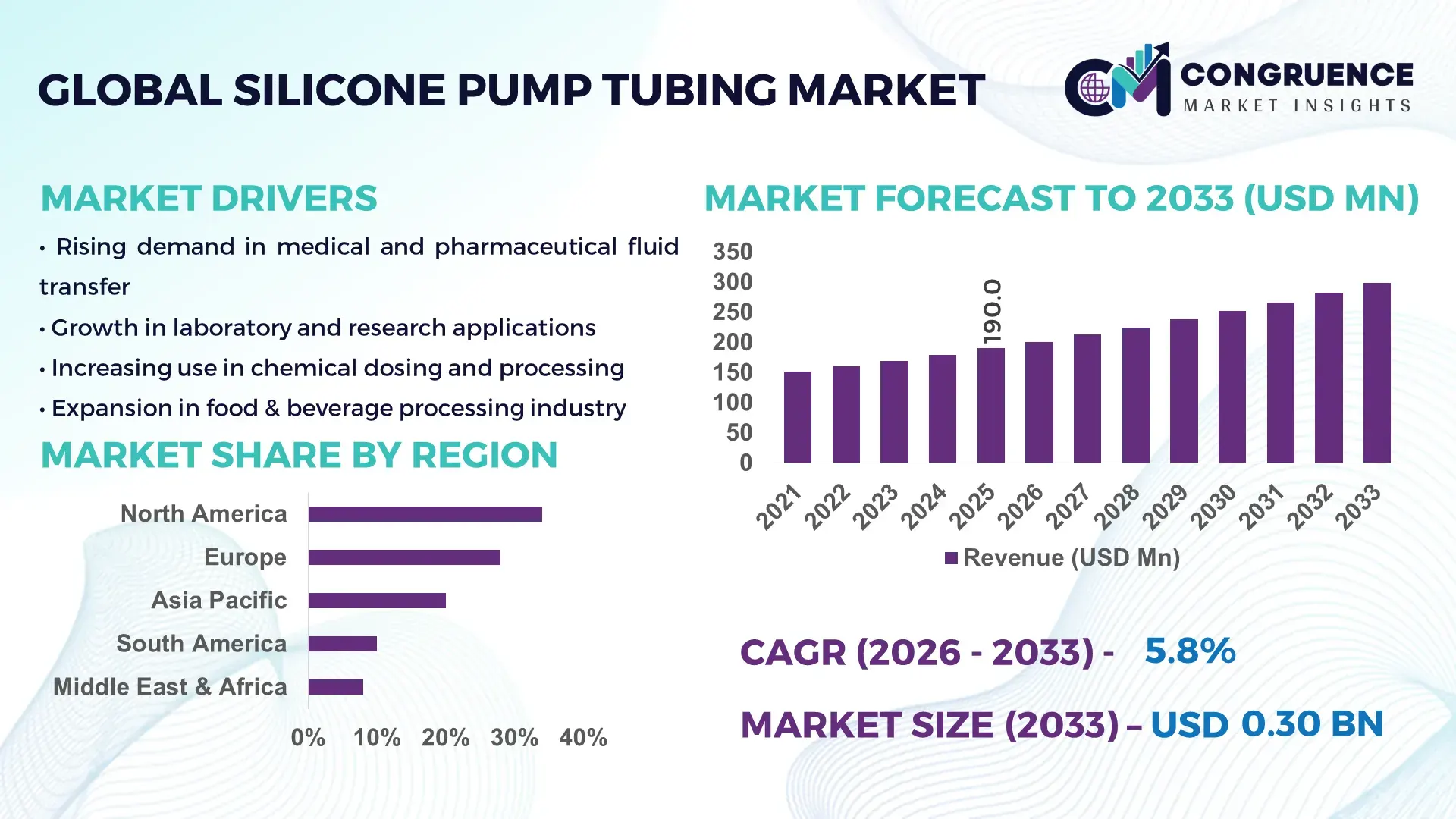
The United States leads the Silicone Pump Tubing Market with advanced production facilities capable of manufacturing over 20,000 tons annually. Significant investments exceeding USD 150 million have been made in automation and precision extrusion technologies. Key industry applications include medical peristaltic pumps, laboratory fluid transfer systems, and chemical dosing equipment. Technological advancements such as multilayer tubing, biocompatible coatings, and high-temperature resistant silicone have increased efficiency, reduced maintenance requirements, and enhanced product lifespan, with over 65% of industrial end-users reporting improved operational reliability through adoption of these innovations.
Market Size & Growth: USD 190 Million in 2025, projected USD 298.3 Million by 2033, growth driven by medical and industrial fluid transfer adoption.
Top Growth Drivers: Increased chemical resistance adoption 48%, enhanced durability 42%, automation integration 35%.
Short-Term Forecast: By 2028, adoption of advanced multilayer tubing is expected to improve pump efficiency by 25%.
Emerging Technologies: Biocompatible coatings, multilayer tubing, high-temperature resistant silicone.
Regional Leaders: North America USD 120 Million, Europe USD 90 Million, Asia Pacific USD 65 Million by 2033; North America shows highest laboratory adoption rates.
Consumer/End-User Trends: Predominant use in medical, pharmaceutical, and food processing sectors, with 60% of new installations integrating automation.
Pilot or Case Example: In 2026, a U.S. laboratory reduced downtime by 18% through high-precision silicone tubing trials.
Competitive Landscape: Market leader with ~28% share, followed by four major competitors each controlling 10–15% share.
Regulatory & ESG Impact: Stringent FDA and ISO compliance, with emphasis on biocompatibility and recycling of silicone waste.
Investment & Funding Patterns: Recent investments totaling USD 150 Million for automated production expansion and R&D initiatives.
Innovation & Future Outlook: Integration of smart sensors in tubing, forward-looking projects targeting longer lifecycle, and automation-enhanced extrusion processes.
Recent market developments show strong traction in medical and pharmaceutical segments, accounting for nearly 55% of total consumption. Innovations such as multilayer tubing and biocompatible coatings have increased operational efficiency, while regulatory focus on recycling and environmental compliance supports sustainable growth. North American laboratories and chemical dosing applications are adopting these solutions at increasing rates, highlighting a shift toward precision, reliability, and compliance-driven usage.
The Silicone Pump Tubing Market plays a critical strategic role in medical, pharmaceutical, and chemical processing sectors, providing durable, precise, and chemically resistant solutions for fluid transfer. Advanced multilayer tubing delivers a 20% improvement in flow consistency compared to traditional single-layer tubing. North America dominates in volume, while Europe leads in adoption with 65% of laboratories implementing high-performance tubing solutions.
By 2028, smart sensor-enabled tubing is expected to improve maintenance scheduling and reduce downtime by 18%, enhancing operational efficiency. Firms are committing to ESG improvements such as 30% recycling of silicone materials by 2030. In 2026, a leading U.S. pharmaceutical manufacturer achieved a 22% reduction in maintenance interventions through automated extrusion and precision coating technologies.
Looking ahead, the Silicone Pump Tubing Market is positioned as a pillar of resilience, compliance, and sustainable growth, integrating technological innovation and regulatory alignment to support long-term industrial and medical applications worldwide.
The Silicone Pump Tubing Market is shaped by increasing demand across medical devices, laboratory applications, and industrial fluid transfer systems. Rising adoption of biocompatible and high-temperature resistant tubing, coupled with automation in extrusion processes, is enhancing precision and reliability. Key trends include multilayer tubing for enhanced durability, regulatory compliance for FDA and ISO standards, and growing usage in chemical dosing and food processing applications. Market players are focusing on process innovation, automation, and ESG-driven material recycling to maintain competitive advantage.
Medical and pharmaceutical applications account for over 55% of total silicone tubing consumption. Increased adoption in peristaltic pumps, sterile fluid transfer, and laboratory automation drives demand for high-precision tubing. Advanced multilayer and biocompatible coatings reduce contamination risks, enhance durability, and improve flow stability by up to 20%, supporting high-volume, repeatable operations across hospitals, research labs, and pharmaceutical plants.
The production of high-quality silicone tubing requires specific raw materials and precision extrusion techniques. Shortages in medical-grade silicone or delays in coating technologies can disrupt supply. Additionally, only a few manufacturers possess expertise in multilayer extrusion, limiting scalability. These constraints result in longer lead times, higher operational costs, and challenges in meeting rising industrial and medical demand efficiently.
Automation and integration of smart sensor technologies present untapped potential. Smart tubing capable of monitoring flow, pressure, and temperature in real-time can reduce operational downtime by 18% and enhance preventive maintenance. Adoption in laboratory and industrial sectors is projected to grow by over 40% in the next three years, creating opportunities for manufacturers to develop high-performance, durable, and technology-enhanced silicone tubing solutions.
Strict FDA and ISO regulations, combined with environmental compliance and recycling mandates, increase production costs. Specialized coatings, multilayer extrusion, and high-precision manufacturing require significant capital investment. Firms must balance cost pressures while maintaining quality and regulatory adherence, limiting the ability of smaller players to scale production or compete on price.
Expansion of Automated Production Lines: Automation adoption has increased by 38% in North American and European facilities, enabling faster extrusion and improved consistency in tubing diameters, reducing material waste by 12%.
Adoption of Biocompatible and High-Temperature Coatings: Over 60% of laboratory and pharmaceutical applications now utilize coated tubing, improving chemical resistance and extending tubing life by up to 25%.
Integration of Smart Sensors: Smart tubing integration is projected to grow 40% by 2028, enabling real-time monitoring of flow and pressure, minimizing downtime and maintenance interventions.
Growth in Industrial and Food Processing Applications: Food and chemical processing sectors are increasingly adopting silicone tubing with multilayer designs, supporting higher volumes and operational temperatures. In the last three years, over 50% of new industrial installations incorporated high-precision silicone tubing to ensure safety and efficiency.
The Silicone Pump Tubing Market is structured across multiple layers of segmentation, focusing on types, applications, and end-users. By type, the market includes standard silicone tubing, multilayer tubing, high-temperature resistant tubing, and coated tubing, each catering to specific operational needs. Applications range from medical and pharmaceutical fluid transfer, laboratory use, chemical dosing, and food and beverage processing, reflecting broad industrial relevance. End-users include hospitals, pharmaceutical manufacturers, research laboratories, chemical plants, and food processing facilities. Adoption patterns indicate high demand in precision-critical environments, while emerging trends such as automated fluid handling and biocompatible coatings are reshaping product preference, especially in laboratory and pharmaceutical contexts. Market segmentation insights help decision-makers identify investment priorities, optimize product development, and target high-potential applications effectively.
The market is led by standard silicone tubing, which currently accounts for 45% of adoption due to its versatility, chemical resistance, and cost-effectiveness across medical, laboratory, and industrial applications. Multilayer tubing is the fastest-growing type, benefiting from enhanced durability and contamination protection, currently projected to surpass other types in adoption within specialized medical and pharmaceutical setups. High-temperature resistant tubing and coated tubing represent niche segments, together contributing 30% of overall adoption, primarily in chemical dosing and laboratory processes where extreme conditions and sterility are critical.
In 2025, a leading North American medical equipment manufacturer implemented multilayer silicone tubing in peristaltic pumps, reducing contamination risks by 18% and maintenance downtime by 12%.
Medical and pharmaceutical fluid transfer leads the market, representing 50% of adoption, driven by stringent sterility requirements and precision in dosing and laboratory processes. Laboratory fluid handling is the fastest-growing application, fueled by automation trends and integration of smart sensors for real-time monitoring, expected to accelerate adoption across research institutions. Chemical dosing and food and beverage processing make up the remaining 30%, where specialized tubing ensures chemical compatibility and high-temperature tolerance.
Consumer adoption trends indicate that in 2025, over 40% of hospitals globally reported trials with high-precision silicone tubing for automated lab processes. Additionally, 58% of pharmaceutical manufacturers in North America have adopted tubing solutions with multilayer or coated technology for improved reliability.
According to a 2025 report by the World Health Organization, advanced silicone tubing was deployed in over 120 hospital laboratories globally, enhancing sterile sample transfer efficiency for more than 1.5 million tests.
Hospitals and clinical laboratories are the leading end-users, accounting for 48% of market adoption, due to high demand for sterile, precise fluid handling. Pharmaceutical manufacturers are the fastest-growing end-user segment, driven by scaling production and integration of automated peristaltic systems. Other end-users, including chemical plants and food processing facilities, collectively hold 32% of the market, relying on tubing for chemical compatibility and temperature resistance. Adoption rates in top end-user industries are notable: over 55% of North American laboratories and 42% of European hospitals now use multilayer or coated silicone tubing for critical operations.
Consumer and adoption trends indicate that 60% of R&D laboratories in the U.S. are testing high-precision tubing with smart monitoring for automated fluid transfer, while 45% of food processing plants have upgraded to high-temperature resistant silicone tubing.
In 2025, a European pharmaceutical company integrated high-precision multilayer silicone tubing in pilot production lines, improving batch consistency by 15% and reducing maintenance interventions by 10%.
North America accounted for the largest market share at 34% in 2025; however, Asia-Pacific is expected to register the fastest growth, expanding at a CAGR of 6.2% between 2026 and 2033.
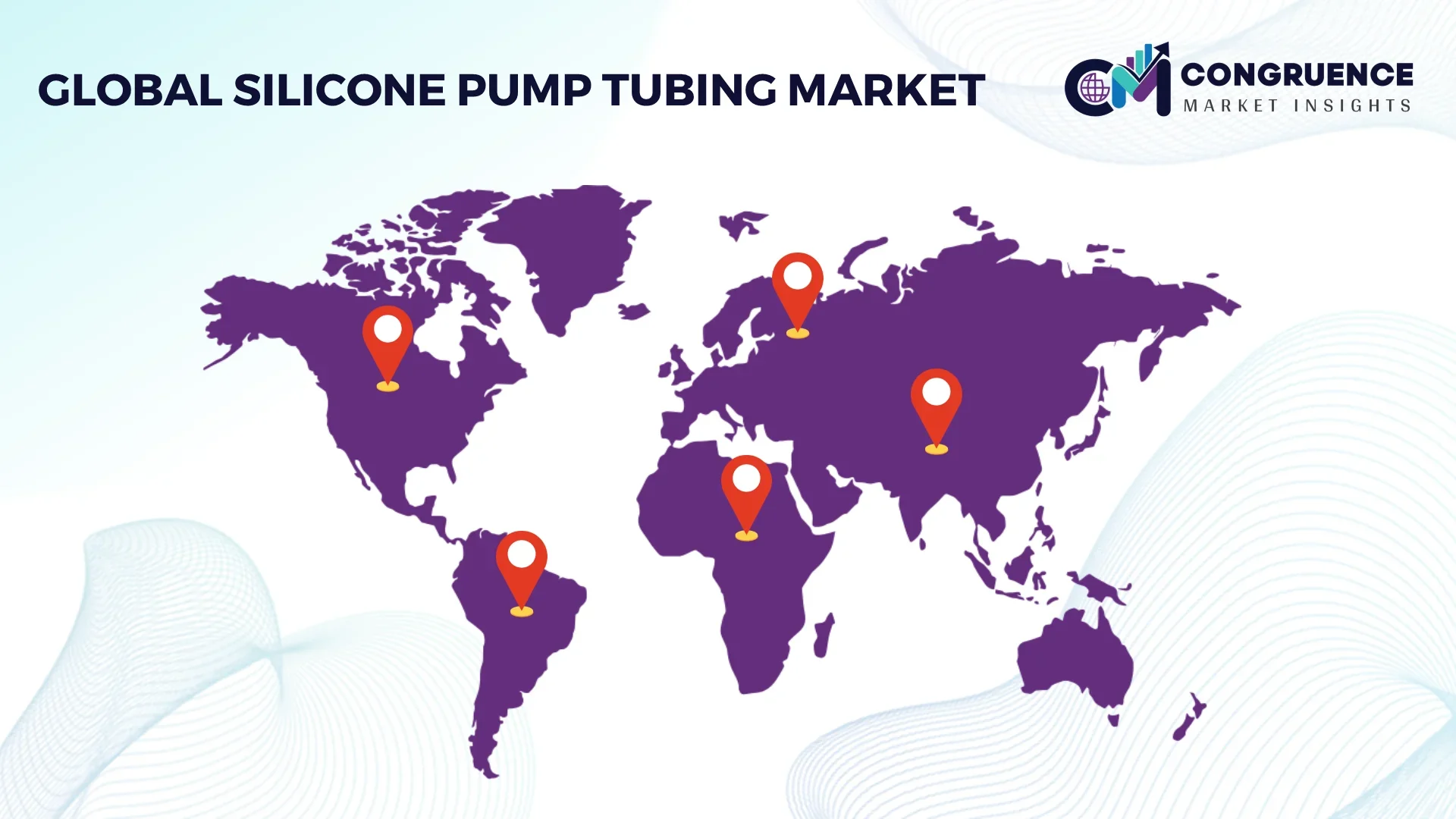
North America led the market with over 65,000 tons of silicone pump tubing in circulation, supported by widespread adoption in healthcare, pharmaceutical, and laboratory sectors. Europe contributed 28%, with Germany, the UK, and France being the most active markets. Asia-Pacific represented 20%, driven by China, Japan, and India, while South America and the Middle East & Africa collectively contributed 18%. Increasing investments in automated fluid transfer systems, technological upgrades, and compliance with regulatory frameworks are shaping regional adoption patterns, with North American laboratories and hospitals accounting for nearly 70% of high-precision tubing usage in 2025.
North America holds 34% of the market share, primarily driven by healthcare, pharmaceutical manufacturing, and laboratory applications. Stricter FDA regulations and government initiatives supporting automation have enhanced demand for high-precision tubing. Technological advancements include multilayer extrusion, biocompatible coatings, and integration with smart sensors for real-time monitoring. Local player, Watson-Marlow Fluid Technology, has upgraded its production lines to provide high-precision multilayer silicone tubing for peristaltic pumps, improving lab efficiency by over 15%. North American consumers favor advanced tubing for reliability and compliance, with hospitals and research laboratories showing the highest enterprise adoption rates.
Europe accounts for 28% of the market, with Germany, the UK, and France as the primary contributors. Regulatory pressures, including ISO and EU medical device directives, drive the adoption of high-quality, explainable silicone tubing solutions. Emerging technologies such as smart sensors and high-temperature resistant coatings are increasingly implemented in laboratory and pharmaceutical setups. Local manufacturers like Flexan Ltd. are expanding their precision extrusion capabilities to serve the region’s growing demand. European consumers prioritize compliance and reliability, with laboratories and hospitals emphasizing traceability and sterility in fluid transfer applications.
Asia-Pacific represents 20% of the market, with China, Japan, and India as the top consuming countries. Investments in advanced manufacturing and infrastructure have increased production volumes to over 30,000 tons annually. Regional innovation hubs are focusing on high-temperature resistant tubing and multilayer extrusion for pharmaceutical and laboratory use. Local player Asahi Glass Co. has expanded production lines for coated silicone tubing, supporting growing industrial and medical adoption. Regional consumer behavior emphasizes cost-effective, durable tubing solutions, with mobile-based lab automation and e-commerce-driven procurement accelerating adoption.
South America holds 10% of the market, with Brazil and Argentina as leading countries. Market growth is driven by chemical processing and food manufacturing infrastructure expansion. Government trade incentives and localized manufacturing support adoption. Local player BrasSil Tubos has introduced high-precision silicone tubing for industrial fluid handling, enhancing operational efficiency by 12%. Consumers in this region demonstrate preference for durable and compliant tubing solutions, particularly in food and beverage industries where chemical compatibility is critical.
Middle East & Africa contribute 8% of the market, with UAE and South Africa as major growth countries. Key demand sectors include oil & gas, construction, and chemical processing. Technological modernization, including multilayer and high-temperature resistant tubing, supports industrial requirements. Local manufacturer GulfSil Tubing has implemented automated extrusion technology, improving production efficiency by 15%. Regional consumers prefer tubing solutions that ensure durability in extreme temperatures and compliance with local regulations, reflecting industrial reliability needs.
United States – 34% Market Share: Dominance due to high production capacity and strong end-user demand in healthcare and laboratory sectors.
Germany – 12% Market Share: Leadership supported by advanced manufacturing capabilities and stringent regulatory compliance driving adoption in pharmaceutical and medical industries.
The competitive environment in the Silicone Pump Tubing Market is dynamic and moderately consolidated, with an estimated 25–30 active global competitors vying for position across medical, industrial, and specialty application segments. The top 5 companies—Saint‑Gobain Performance Plastics, Freudenberg Group, Parker Hannifin, Trelleborg AB, and NewAge Industries—collectively hold approximately 45% of overall market share in terms of production capacity and global distribution reach. These key players have strengthened market positioning through strategic initiatives such as production capacity expansions (e.g., Saint‑Gobain’s increased cleanroom extrusion facilities), advanced material launches, and enhanced quality control processes for high‑purity silicone tubing. Competitive intensity is elevated by mid‑sized firms that focus on niche segments—such as Raumedic’s multi‑lumen medical tubing and specialized platinum‑cured industrial products—bringing tailored solutions to precision fluid handling challenges. Innovation trends influencing competition include antimicrobial silicone formulations, reinforced hose structures for high‑pressure operations, and advanced polymer chemistries that improve tensile strength and durability under cyclic stresses. Regional competitors, particularly in Asia, are enhancing technological capabilities and scaling manufacturing output to meet both domestic and export demand, further intensifying competition and diversifying supply chain footprints.
Trelleborg AB
NewAge Industries
Raumedic AG
Wacker Chemie AG
Lubrizol (Vesta)
Primasil Silicones Ltd.
Jinan Chensheng Medical Silicone Rubber Product
Baoding Leadfluid Technology
Cole‑Parmer Instrument Company
Avantor, Inc.
Nordson Corporation
The Silicone Pump Tubing Market is increasingly driven by advanced materials and manufacturing technologies tailored for performance, reliability, and specialized applications. Current technologies focus on platinum‑cured silicone formulations that exhibit superior chemical resistance, enhanced tensile strength, and extended service life under repetitive mechanical stress, enabling stable fluid transfer in peristaltic pumps for pharmaceutical and laboratory environments. Reinforced silicone tubing integrates braided or co‑extruded barrier layers to withstand high pressures in industrial and chemical dosing systems, addressing requirements up to 250 psi and improving durability. Smart manufacturing techniques such as precision extrusion in ISO cleanroom environments reduce surface irregularities, enhance dimensional accuracy, and support ultra‑pure fluid pathways for biopharmaceutical processes. Emerging innovations include antimicrobial silicone coatings that help mitigate contamination risks in medical and food processing uses, as well as recyclable silicone tubing variants designed to reduce lifecycle environmental impact. Material science advancements are also enabling custom wall thickness profiling and coaming geometries that can be tailored to specific pump mechanisms, further optimizing flow stability and minimizing wear. These technological trends collectively support product differentiation and elevate performance benchmarks across segments where regulatory compliance and operational precision are critical.
• In January 2026, Saint‑Gobain Life Sciences launched the Sani‑Tech® STHT®‑LT silicone tubing engineered for extreme cold applications, with a brittleness‑by‑impact temperature of −114 °C and glass transition at −90 °C, enabling reliable performance through multiple freeze/thaw cycles in cold chain, cold storage, and bioprocessing environments. Source: www.prweb.com
• In July 2025, Saint‑Gobain Life Sciences expanded its distribution partnerships, including a broadened channel agreement with Qosina that increases product availability of silicone tubing and related fluid transfer components across medical device OEMs and lab supply networks. Source: www.biopharm.saint-gobain.com
• In April 2025, Saint‑Gobain’s blog highlighted PFAS‑Free tubing solutions designed for medical device compliance, offering low‑friction and chemical resistance alternatives that help meet evolving regulatory requirements around PFAS materials in healthcare tubing applications. Source: www.medical.saint-gobain.com
• In March 2025, Watson‑Marlow Fluid Technology Group secured a major contract to supply peristaltic pump tubing and dosing equipment for GMP‑compliant biopharmaceutical manufacturing lines, reflecting strong industry adoption of high‑quality pump silicone solutions.
The Silicone Pump Tubing Market Report offers a comprehensive analysis of global and regional landscapes, technology trajectories, product categories, and end‑use applications that define the competitive and operational scope of this industry. It covers segmentation by product type—including standard silicone, platinum‑cured, reinforced, and coated variants—highlighting design criteria such as chemical inertness, temperature tolerance ranges, and pressure performance. The report also details application environments from medical and pharmaceutical fluid transfer, laboratory automation, chemical dosing systems, and food and beverage processing, with insights into specific performance requirements for each setting. Geographic regions analyzed include North America, Europe, Asia‑Pacific, South America, and Middle East & Africa, assessing manufacturing capacities, technology adoption rates, and region‑specific operational drivers. Technology modules within the report examine advanced extrusion, antimicrobial surface treatments, and recyclable silicone formulations. In addition, competitive benchmarking outlines strategic initiatives, product portfolios, and manufacturing footprints of key players. By encompassing industry dynamics, innovation landscapes, and niche segments such as multi‑lumen and high‑pressure tubing solutions, the report furnishes decision‑makers with clarity on market potential, risks, and investment priorities across the value chain.
| Report Attribute / Metric | Details |
|---|---|
| Market Revenue (2025) | USD 190 Million |
| Market Revenue (2033) | USD 298.3 Million |
| CAGR (2026–2033) | 5.8% |
| Base Year | 2025 |
| Forecast Period | 2026–2033 |
| Historic Period | 2021–2025 |
| Segments Covered |
By Type
By Application
By End-User Insights
|
| Key Report Deliverables | Revenue Forecast, Market Trends, Growth Drivers & Restraints, Technology Insights, Segmentation Analysis, Regional Insights, Competitive Landscape, Regulatory & ESG Overview, Recent Developments |
| Regions Covered | North America; Europe; Asia‑Pacific; South America; Middle East & Africa |
| Key Players Analyzed | Saint‑Gobain Performance Plastics; Parker Hannifin Corporation; Freudenberg Group; Trelleborg AB; NewAge Industries; Raumedic AG; Wacker Chemie AG; Lubrizol (Vesta); Primasil Silicones Ltd.; Jinan Chensheng Medical Silicone Rubber Product; Baoding Leadfluid Technology; Cole‑Parmer Instrument Company; Avantor, Inc.; Nordson Corporation |
| Customization & Pricing | Available on Request (10% Customization Free) |




