
Reports
The Global Scleral Lens Market was valued at USD 347 Million in 2025 and is anticipated to reach a value of USD 1145.47 Million by 2033 expanding at a CAGR of 16.1% between 2026 and 2033. Market expansion is supported by rising adoption of specialty contact lenses for keratoconus, post-surgical corneal disorders, severe dry eye disease, and continuous improvements in high-oxygen-permeable materials combined with precision digital fitting technologies.
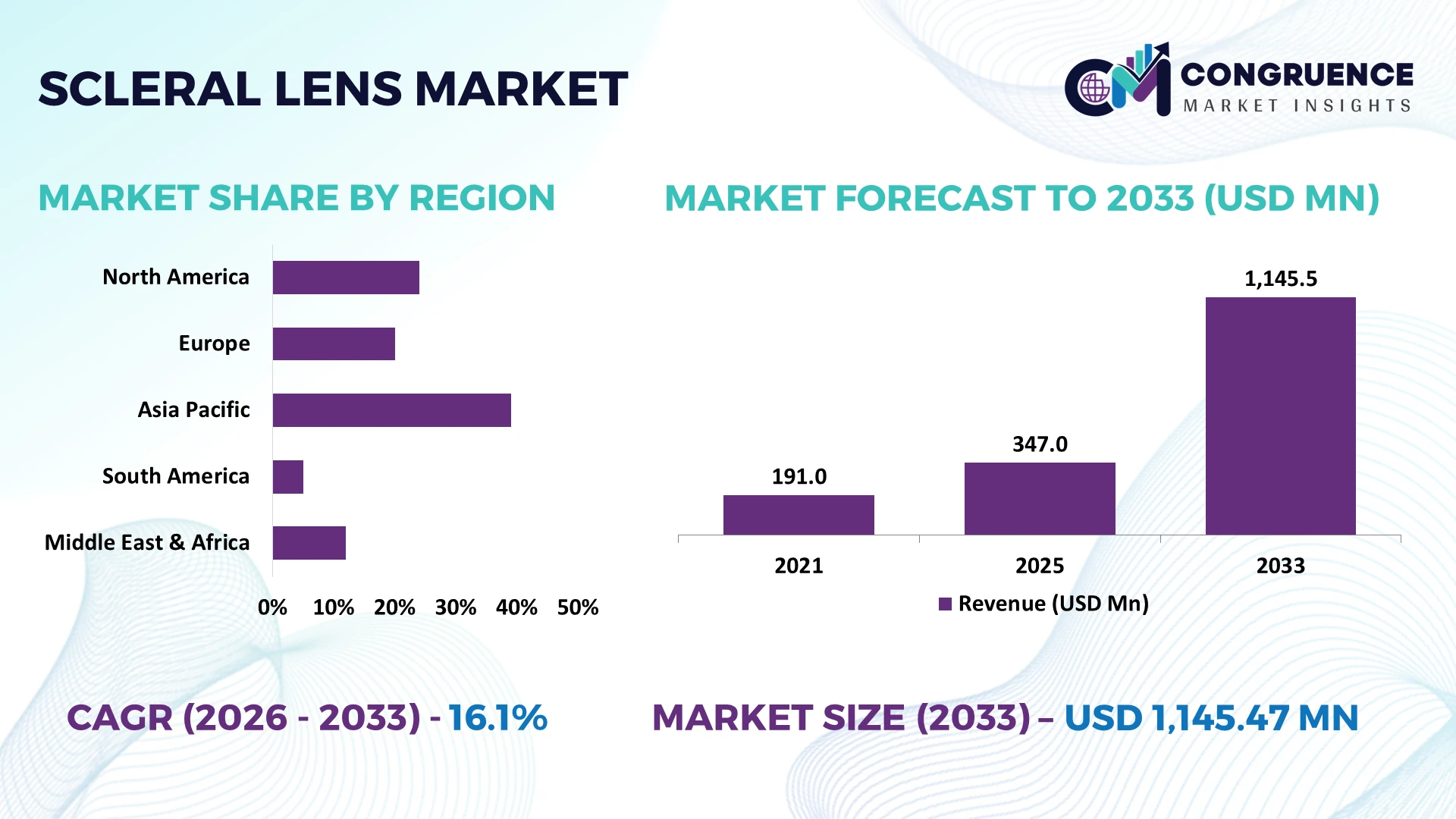
The United States accounts for nearly 39% of global specialty lens procedures, supported by a strong network of specialty eye clinics, advanced diagnostic infrastructure, and increasing investments in digital corneal topography systems. Japan continues strengthening premium lens manufacturing with over 85% adoption of advanced imaging during specialty lens fitting, while India is expanding clinical capacity through ophthalmology centers to address a rapidly growing patient base. Healthcare infrastructure modernization and resilient medical device supply chains further reinforce production and deployment across major markets.
Companies strengthening manufacturing capacity, practitioner training, and digital fitting capabilities are expected to secure stronger competitive positioning as specialty eye care continues shifting toward customized vision correction.
Market Size & Growth: USD 347 Million in 2025, reaching USD 1145.47 Million by 2033 at 16.1% CAGR, supported by advanced specialty lens materials and digital fitting technologies.
Top Growth Drivers: Keratoconus diagnosis (+18%), severe dry eye treatment adoption (+22%), specialty eye clinic expansion (+15%) continue accelerating market demand.
Short-Term Forecast: By 2028, digital fitting workflows reduce chair time by nearly 30% while improving first-fit success by approximately 20%.
Emerging Technologies: AI-assisted fitting, cloud-based corneal mapping, and next-generation high-Dk materials improve customization accuracy and practitioner productivity.
Regional Leaders: North America exceeds USD 420 Million, Europe approaches USD 290 Million, and Asia-Pacific surpasses USD 260 Million through expanding specialty eye care adoption.
Consumer & End-User Trends: More than 60% of complex corneal patients increasingly prefer customized scleral lenses for superior comfort and visual performance.
Pilot Example: A 2026 digital fitting implementation improved first-fit accuracy by 24% while reducing repeat clinical visits by 18%.
Competitive Landscape: Leading manufacturers collectively hold nearly 55% market share, supported by CooperVision, Bausch + Lomb, ABB Optical Group, Contamac, and Menicon.
Regulatory & ESG Impact: Digital documentation reduces administrative processing by about 20%, while sustainable packaging initiatives lower material waste by nearly 15%.
Investment & Funding: More than USD 450 Million supports manufacturing expansion, practitioner education, automation, and strategic partnerships across specialty ophthalmology.
Innovation & Future Outlook: Advanced biomaterials, AI-guided customization, and regional manufacturing expansion strengthen long-term competitiveness amid ongoing medical supply-chain optimization.
Specialty ophthalmology continues increasing demand for customized scleral lens solutions across corneal disease management, severe dry eye treatment, and post-operative vision rehabilitation. Digital corneal mapping, AI-assisted fitting platforms, and high-oxygen-permeable materials improve fitting precision by nearly 25%, while localized manufacturing initiatives and streamlined medical device regulations strengthen supply resilience and reduce delivery timelines, creating a stronger foundation for the strategic market transformation discussed below.
The scleral lens market has become strategically important as ophthalmology providers increasingly prioritize personalized vision correction, higher clinical efficiency, and long-term patient outcomes. Competition is shifting from conventional lens manufacturing toward integrated digital fitting ecosystems combining advanced imaging, cloud-enabled workflow management, and customized production. Healthcare infrastructure modernization and broader adoption of specialty eye care services are encouraging manufacturers to restructure supply networks while strengthening practitioner training and localized distribution.
Modern digital corneal mapping systems improve fitting precision by approximately 25% compared with traditional manual assessment, while reducing repeat clinical appointments by nearly 20%, lowering operational costs for specialty clinics. The United States leads large-scale deployment through established specialty practices, whereas India is rapidly expanding adoption by increasing ophthalmology infrastructure and practitioner certification programs, creating distinct competitive dynamics between mature and emerging healthcare systems.
A practical example includes specialty clinics integrating AI-supported fitting software with digital topography, enabling faster customization and improved patient management. Manufacturers are responding through manufacturing expansion, strategic clinical partnerships, and practitioner education programs. Over the next two to three years, digital workflow adoption is expected to exceed 65% across advanced specialty centers, reinforcing operational differentiation and strengthening long-term competitive positioning.
Growing integration of digital diagnostics and specialty ophthalmology services continues strengthening scleral lens adoption across advanced healthcare systems. Nearly 68% of specialty eye clinics now utilize digital corneal topography, while AI-assisted fitting improves first-fit success by approximately 22% and reduces patient follow-up visits by 18%. Japan continues expanding precision ophthalmic manufacturing, while the United States is investing in advanced specialty eye care infrastructure. These developments improve treatment efficiency, encourage faster clinical adoption, and support premium product positioning. Manufacturers are expanding practitioner education, investing in advanced materials, and forming partnerships with specialty clinics to strengthen market penetration while improving long-term patient outcomes.
Limited access to experienced specialty practitioners and relatively high fitting costs continue restricting broader market penetration. Initial scleral lens fitting expenses remain around 35–45% higher than conventional contact lenses, while approximately 30% of secondary healthcare facilities still lack advanced corneal imaging equipment. Rural healthcare access remains constrained in several developing countries, delaying diagnosis and customized treatment. These structural limitations reduce scalability and limit procedure volumes despite increasing clinical demand. Companies are mitigating operational risks by expanding regional fitting networks, localizing selected manufacturing processes, establishing long-term supplier agreements, and introducing practitioner certification programs that improve service availability and workflow consistency.
AI-assisted design platforms, automated production, and advanced polymer engineering are creating significant competitive opportunities within the scleral lens market. Automated digital workflows reduce manufacturing turnaround by nearly 28%, while precision customization improves fitting consistency by approximately 24% and decreases product remakes by 16%. India is strengthening ophthalmic manufacturing capabilities through expanding medical device production initiatives, creating attractive opportunities for localized supply ecosystems. Leading companies are increasing R&D investment, collaborating with digital ophthalmology software providers, and expanding regional production capacity. This combination of automation, customized manufacturing, and integrated clinical ecosystems creates durable operational advantages beyond conventional product competition.
Maintaining consistent clinical quality across expanding specialty care networks remains a significant execution challenge. More than 40% of new practitioners require advanced scleral fitting training, while digital workflow integration increases implementation complexity by nearly 18% during initial deployment. Interoperability between diagnostic imaging platforms and practice management software continues affecting workflow standardization, particularly across multi-site healthcare providers. These execution barriers influence service consistency, patient experience, and operational scalability. Companies must strengthen digital infrastructure, invest in practitioner development, standardize clinical protocols, and expand technology partnerships to ensure sustainable deployment quality while maintaining long-term competitiveness in precision ophthalmic care.
Digital Fitting Workflow Expansion: AI-assisted corneal mapping and cloud-based fitting platforms are becoming standard across specialty eye care, with digital fitting adoption exceeding 65% in advanced clinics and reducing fitting time by nearly 28%. Healthcare digitalization initiatives and workforce shortages are accelerating workflow automation. Manufacturers are scaling software integration, expanding practitioner training, and partnering with diagnostic equipment providers to improve clinical productivity and reduce repeat appointments by approximately 20%.
Localized Manufacturing Strategies: Companies are restructuring production networks to reduce dependence on long international supply chains, lowering average delivery lead times by nearly 18% while improving inventory availability by approximately 15%. Medical device resilience policies and logistics disruptions have accelerated regional manufacturing investments. Enterprises are expanding localized finishing facilities, strengthening supplier diversification, and increasing automation to improve operational continuity and customer responsiveness across specialty ophthalmic products.
Advanced Material Innovation: High oxygen-permeable polymers and precision surface treatments now account for over 55% of newly introduced premium scleral lens platforms, improving wearing comfort by approximately 22% and extending replacement performance by nearly 18%. Manufacturers are increasing investments in material science partnerships and automated quality inspection systems, enabling more consistent production while supporting increasingly customized lens designs for complex corneal conditions.
Clinical Ecosystem Integration: Specialty eye care providers are integrating electronic patient records, diagnostic imaging, and digital manufacturing into unified clinical workflows, reducing administrative processing by around 25% while increasing treatment capacity by nearly 17%. A less visible trend is the growing use of shared digital data platforms between clinics and laboratories. Companies are responding through software partnerships, interoperable platforms, and service-based business models that strengthen long-term practitioner relationships.
Full Scleral lenses remain the leading segment, accounting for approximately 44% of total market demand because they provide superior corneal protection, long wearing comfort, and reliable performance for patients with advanced corneal disorders. Their scalability across specialty ophthalmology practices and compatibility with digital fitting technologies strengthen clinical efficiency and treatment consistency. Semi-Scleral lenses continue serving established patient groups seeking balanced comfort and handling, while Mini Scleral lenses maintain relevance for moderate corneal irregularities and simplified fitting workflows.
Custom Scleral lenses represent the fastest-growing segment, with annual adoption increasing by nearly 21% as AI-assisted corneal mapping and precision manufacturing improve customization accuracy. More than 60% of premium specialty clinics now prioritize customized fitting solutions for complex ocular conditions. Manufacturers are expanding digital design capabilities, investing in automated production, and collaborating with specialty eye centers to shorten production cycles. Investment priorities are increasingly shifting toward personalized manufacturing platforms that improve clinical outcomes while strengthening competitive differentiation.
Keratoconus continues to dominate the application landscape with an estimated 42% market share, driven by increasing early diagnosis, broader specialty eye care access, and improved clinical awareness. Digital corneal topography enables earlier intervention, improving fitting precision by approximately 24%. Dry Eye Disease represents the fastest-growing application, supported by rising incidence of chronic ocular surface disorders and increasing adoption of therapeutic scleral lenses. Clinical demand is shifting toward long-term disease management rather than short-term vision correction.
Corneal Irregularities and Post-Surgical Vision Correction remain mature applications supported by expanding refractive surgery volumes and trauma management, while Ocular Surface Disease is gaining importance through multidisciplinary treatment pathways. Nearly 35% of specialty clinics have expanded therapeutic scleral lens programs during the past two years. Manufacturers are strengthening practitioner education, integrating digital diagnostic workflows, and expanding product portfolios tailored to specific clinical indications, creating stronger operational alignment between disease management and customized lens deployment.
Specialty Eye Centers hold approximately 41% of market demand because they combine advanced diagnostic infrastructure, experienced practitioners, and integrated specialty fitting services within a single clinical environment. Their operational capability supports management of complex corneal diseases requiring customized scleral lens solutions. Optometry Clinics represent the fastest-growing end-user segment, with patient volumes increasing by nearly 19% as digital diagnostic equipment becomes more accessible and practitioner certification expands across independent clinical networks.
Hospitals continue supporting complex referral cases and multidisciplinary ophthalmic treatment, while Ophthalmology Clinics maintain stable demand through specialized corneal disease management. Around 58% of advanced scleral lens fittings are now completed using digital corneal imaging integrated with clinical workflow systems. Companies are targeting these end users through customized training programs, flexible procurement models, technology partnerships, and integrated software solutions, enabling stronger customer retention while expanding deployment capacity across evolving specialty eye care ecosystems.
North America accounted for the largest market share at 39.8% in 2025 however, Asia-Pacific is expected to register the fastest growth, expanding at a 17.8% CAGR between 2026 and 2033.

Digital Specialty Eye Care Leadership
North America maintains the leading position through its extensive specialty eye care infrastructure, advanced diagnostic capabilities, and widespread adoption of customized scleral lens fitting. The region contributes nearly 40% of global deployment volume, supported by integrated ophthalmology networks and high utilization of digital corneal topography. More than 70% of specialty eye centers now employ AI-assisted fitting workflows, improving fitting precision and reducing repeat consultations. Ongoing investments in practitioner certification, electronic clinical workflow integration, and localized manufacturing continue strengthening operational efficiency. Strategic partnerships between lens manufacturers and specialty clinics are accelerating premium product adoption while improving patient access to advanced therapeutic lens solutions across established healthcare systems.
United States Market Outlook: The United States remains the operational center of the regional market through advanced specialty eye care infrastructure, strong practitioner density, and broad integration of digital diagnostic technologies. More than 75% of complex scleral lens fittings utilize advanced corneal imaging platforms, enabling highly customized treatment pathways. Manufacturers continue expanding clinician education programs, investing in domestic production capabilities, and collaborating with ophthalmology networks to accelerate innovation while improving nationwide access to specialty vision correction services.
Precision Manufacturing and Clinical Standardization
Europe continues strengthening its position through advanced medical device manufacturing, standardized clinical protocols, and growing adoption of digitally enabled specialty ophthalmology. The region represents approximately 28% of global demand, supported by established reimbursement systems and extensive practitioner expertise. More than 60% of specialty clinics have incorporated digital fitting platforms into routine practice, improving workflow consistency and reducing production adjustments. Regulatory harmonization and sustainability initiatives are encouraging manufacturers to optimize production efficiency while increasing investment in premium oxygen-permeable materials. Strategic collaborations between research institutions and specialty lens producers continue advancing product innovation and expanding clinical capabilities.
Germany Market Outlook: Germany leads the European market through its precision manufacturing ecosystem, strong ophthalmic research base, and advanced healthcare infrastructure. Over 65% of specialty ophthalmology centers utilize integrated digital fitting systems for complex corneal conditions. Domestic manufacturers continue investing in automated production technologies and research collaborations, strengthening supply reliability while supporting high-quality customized scleral lens development across both clinical and export markets.
Healthcare Infrastructure Expansion Accelerates Adoption
Asia-Pacific is emerging as the fastest-expanding regional market due to increasing ophthalmic infrastructure, growing practitioner certification, and rising investment in specialty eye care services. The region accounts for nearly 24% of global deployment while rapidly expanding manufacturing capacity for advanced ophthalmic devices. More than 30% of newly established specialty eye centers now incorporate digital corneal mapping systems into routine clinical workflows. Increasing localization of production and government-supported healthcare modernization programs are improving product accessibility and reducing delivery timelines. Companies are expanding regional manufacturing facilities and strengthening partnerships with specialty hospitals to address growing demand for customized therapeutic lenses.
India Market Outlook: India is rapidly strengthening its competitive position through expanding ophthalmology networks, increasing domestic medical device production, and rising investment in digital eye care technologies. More than 20% of tertiary eye hospitals have expanded specialty contact lens services over the past two years. Companies are establishing regional training centers, localized manufacturing operations, and clinical partnerships to improve practitioner capability while expanding access to advanced scleral lens treatment across major healthcare hubs.
Specialty Care Network Expansion
South America continues progressing through gradual expansion of specialty ophthalmology services and improved access to advanced diagnostic technologies. The region contributes around 5% of global demand, with deployment concentrated in urban healthcare networks. Nearly 18% more specialty eye clinics have incorporated digital corneal imaging into scleral lens evaluation compared with recent years. However, uneven healthcare infrastructure and dependence on imported specialty materials continue influencing operational consistency. Manufacturers are strengthening distributor partnerships, improving regional inventory management, and expanding practitioner education to improve treatment availability while supporting sustainable specialty eye care development.
Brazil Market Outlook: Brazil remains the region's largest market because of its established ophthalmology sector, growing private healthcare investment, and expanding specialty clinic network. Large metropolitan eye hospitals continue adopting advanced digital fitting technologies for complex corneal disorders. Companies are strengthening local distribution partnerships and increasing technical training initiatives, improving operational efficiency while expanding customized scleral lens accessibility across the country's leading healthcare centers.
Healthcare Modernization Supports Specialty Adoption
The Middle East & Africa market is advancing through healthcare modernization, investment in specialized ophthalmic facilities, and expanding access to advanced diagnostic technologies. The region represents approximately 3% of global demand, with deployment concentrated in well-developed healthcare systems. More than 25% of newly equipped specialty eye centers now include digital corneal topography as part of routine clinical practice. National healthcare diversification programs and increasing investment in medical technology infrastructure are supporting higher clinical capability. Manufacturers are expanding regional partnerships, strengthening technical support networks, and improving supply chain resilience to enhance specialty lens availability.
Saudi Arabia Market Outlook: Saudi Arabia leads regional development through sustained healthcare infrastructure investment, expanding specialty ophthalmology services, and rapid adoption of advanced diagnostic equipment. Major tertiary hospitals continue increasing deployment of digital eye care technologies while strengthening specialist training programs. International manufacturers are forming distribution partnerships and expanding technical service capabilities, supporting faster access to customized scleral lens solutions and improving operational consistency across the country's modern healthcare network.
The competitive landscape is led by CooperVision, Menicon, ABB Optical Group, Visionary Optics, and Bausch + Lomb, which primarily compete against regional specialty lens laboratories and independent custom manufacturers. The top five players collectively control approximately 58% of the market through extensive practitioner networks, advanced fitting technologies, and premium product portfolios. Competition increasingly centers on customization accuracy, digital workflow integration, and manufacturing speed rather than pricing alone. AI-assisted fitting platforms improve first-fit success by nearly 24%, while automated production reduces turnaround time by approximately 27% and digital ordering cuts processing delays by almost 20%. Global leaders are expanding practitioner education, forming technology partnerships, and strengthening localized manufacturing to improve delivery reliability. Regional manufacturers compete through flexible customization and shorter clinical response times. The competitive shift is moving toward integrated digital ecosystems and vertically connected production rather than standalone lens manufacturing. High clinical expertise requirements and advanced diagnostic infrastructure remain major entry barriers. Winning requires scalable digital fitting, rapid customization, resilient supply chains, and strong practitioner relationships.
CooperVision
Menicon Co., Ltd.
ABB Optical Group
Visionary Optics
Bausch + Lomb
Art Optical Contact Lens Inc.
Valley Contax Inc.
TruForm Optics Inc.
AccuLens
Contamac Ltd.
Precision Technology Services
SynergEyes Inc.
Digital ophthalmic technologies are redefining scleral lens development through AI-assisted corneal mapping, cloud-connected fitting software, and advanced high-oxygen-permeable materials. More than 68% of specialty eye centers now incorporate digital topography into fitting workflows, improving first-fit accuracy by approximately 24% while reducing clinical chair time by nearly 28%. Automated digital ordering platforms also minimize administrative errors and accelerate manufacturing coordination, enabling providers to deliver highly customized lenses with greater operational consistency and improved patient satisfaction.
Next-generation manufacturing combines three-dimensional surface modeling, precision CNC machining, and automated quality inspection to replace conventional manual design processes. Compared with legacy fitting workflows, digitally integrated production improves customization precision by nearly 30% while lowering remake rates by approximately 18%. Premium manufacturers and specialized ophthalmology networks benefit most because integrated digital ecosystems shorten production cycles and improve inventory planning. Growing interoperability between diagnostic software and manufacturing platforms further strengthens workflow continuity across specialty eye care providers.
Between 2026 and 2028, predictive fitting algorithms, digital patient monitoring, and smart clinical workflow platforms will become major competitive differentiators. Deployment of integrated digital fitting ecosystems is expected to exceed 75% among advanced specialty practices. Companies investing in automation, practitioner training, and connected manufacturing infrastructure will achieve faster product delivery, stronger customization capability, and superior clinical outcomes, creating durable competitive advantages in precision ophthalmic care.
May 2025 Menicon expanded its Global Rose K manufacturing network by adding X-Cel Specialty Contacts–Essilor Custom Contacts, strengthening specialty lens production capacity and practitioner access across multiple markets. Business impact: improved manufacturing scalability and customer reach.
January 2025 CooperVision expanded its specialty eye care education initiatives by strengthening practitioner training programs for advanced contact lens fitting, supporting broader adoption of customized scleral lenses. Business impact: accelerated clinical capability and specialist engagement. Source: https://coopervision.com
November 2024 Visionary Optics continued commercial deployment of its iContour scleral profilometry platform, with more than 40,000 scleral lenses designed using scleral shape data. Business impact: improved fitting precision while reducing remakes and chair time. Source: https://visionary-optics.com
June 2026 Menicon received approval in China for its Time XL scleral lens, expanding availability for patients with irregular corneas and strengthening its presence in a strategically important ophthalmic market. Business impact: accelerated international commercial expansion. Source: https://www.menicon.com
The report delivers comprehensive analysis of the global scleral lens market across Mini Scleral, Semi-Scleral, Full Scleral, and Custom Scleral product categories while evaluating applications including Keratoconus, Dry Eye Disease, Corneal Irregularities, Post-Surgical Vision Correction, and Ocular Surface Disease. It further examines adoption across Hospitals, Ophthalmology Clinics, Optometry Clinics, and Specialty Eye Centers, covering competitive participation, deployment trends, digital fitting adoption exceeding 65% in advanced practices, and evolving product positioning.
The assessment covers North America, Europe, Asia-Pacific, South America, and the Middle East & Africa, highlighting manufacturing capabilities, healthcare infrastructure, technology deployment, and regional operational strategies. It evaluates AI-assisted fitting, digital corneal mapping, advanced oxygen-permeable materials, automated production, and integrated clinical workflows while providing strategic insights for investment prioritization, expansion planning, competitive benchmarking, partnership development, and long-term market positioning between 2026 and 2033.
| Report Attribute/Metric | Report Details |
|---|---|
Market Revenue in 2025 | USD 347 Million |
Market Revenue in 2033 | USD 1145.47 Million |
CAGR (2026 - 2033) | 16.1% |
Base Year | 2025 |
Forecast Period | 2026 - 2033 |
Historic Period | 2021 - 2025 |
Segments Covered | By Type
By Application
By End-User
|
Key Report Deliverable | Revenue Forecast, Growth Trends, Market Dynamics, Segmental Overview, Regional and Country-wise Analysis, Competition Landscape |
Region Covered | North America, Europe, Asia-Pacific, South America, Middle East, Africa |
Key Players Analyzed | CooperVision, Menicon Co., Ltd., ABB Optical Group, Visionary Optics, Bausch + Lomb, Art Optical Contact Lens Inc., Valley Contax Inc., TruForm Optics Inc., AccuLens, Contamac Ltd., Precision Technology Services, SynergEyes Inc. |
Customization & Pricing | Available on Request (10% Customization is Free) |




