
Reports
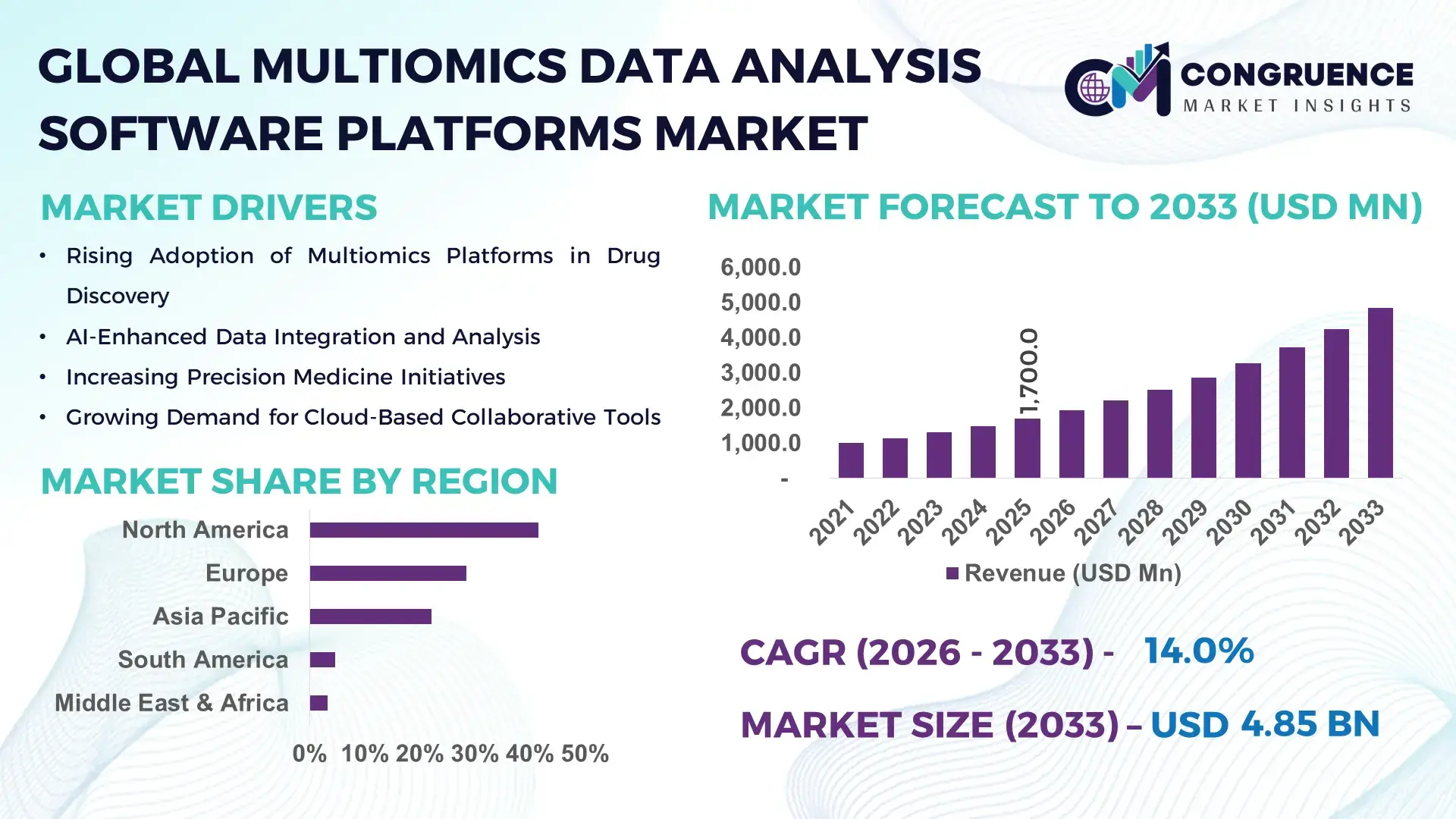
The Global Multiomics Data Analysis Software Platforms Market was valued at USD 1,700 Million in 2025 and is anticipated to reach a value of USD 4,849.4 Million by 2033 expanding at a CAGR of 14% between 2026 and 2033, according to an analysis by Congruence Market Insights. This growth is primarily driven by the accelerating adoption of integrated multiomics approaches across biomedical research, precision medicine, and advanced drug discovery workflows, where scalable data interpretation has become mission-critical.
The United States dominates the global Multiomics Data Analysis Software Platforms Market in terms of ecosystem depth and technology leadership. The country hosts over 40% of the world’s large-scale genomics and proteomics research centers, with more than 1,200 active multiomics research programs across academic, pharmaceutical, and biotech institutions. Annual public and private investments in bioinformatics and computational biology exceed USD 12 billion, supporting high-performance computing infrastructure and AI-enabled analytics platforms. Multiomics software platforms in the U.S. are widely deployed in oncology, rare disease research, and immunology, with over 65% of top-50 pharmaceutical companies integrating multiomics analytics into clinical trial design. Cloud-native architectures, federated data models, and FDA-aligned data governance frameworks are accelerating enterprise-scale deployment and cross-institutional data collaboration.
Market Size & Growth: Valued at USD 1,700 Million in 2025, projected to reach USD 4,849.4 Million by 2033, growing at a CAGR of 14%, supported by rising multiomics integration in drug development pipelines.
Top Growth Drivers: Precision medicine adoption (48%), AI-enabled analytics utilization (41%), and cloud-based bioinformatics deployment (36%).
Short-Term Forecast: By 2028, automated multiomics workflows are expected to reduce data processing time by 32% across enterprise research labs.
Emerging Technologies: AI-driven pathway modeling, cloud-native multiomics platforms, and graph-based biological network analysis.
Regional Leaders: North America projected at USD 1,980 Million by 2033 with enterprise adoption; Europe at USD 1,420 Million driven by academic consortia; Asia Pacific at USD 1,160 Million led by genomics-scale population studies.
Consumer/End-User Trends: Pharmaceutical and biotech firms account for over 52% of platform usage, followed by academic research institutes and CROs.
Pilot or Case Example: In 2024, a U.S.-based oncology research network improved biomarker discovery efficiency by 29% using AI-enabled multiomics platforms.
Competitive Landscape: Illumina (~18%) leads, followed by Thermo Fisher Scientific, QIAGEN, BGI Genomics, and Agilent Technologies.
Regulatory & ESG Impact: Compliance with FAIR data principles and genomic data privacy mandates is accelerating standardized platform adoption.
Investment & Funding Patterns: Over USD 6.5 billion invested globally in bioinformatics and multiomics software ventures during the past three years.
Innovation & Future Outlook: Integrated AI, real-time analytics, and interoperable data ecosystems are shaping next-generation platforms.
Multiomics Data Analysis Software Platforms Market adoption spans pharmaceuticals (~46%), academic research (~28%), clinical diagnostics (~16%), and agriculture and industrial biotechnology (~10%). Recent innovations include AI-driven biomarker discovery engines, cloud-scale federated analytics, and real-time visualization tools. Regulatory emphasis on data interoperability, coupled with rising healthcare R&D expenditure in Asia Pacific and Europe, is reshaping consumption patterns and strengthening long-term growth prospects.
The strategic relevance of the Multiomics Data Analysis Software Platforms Market lies in its ability to unify heterogeneous biological datasets into actionable insights, enabling faster, more precise decision-making across life sciences. Enterprises adopting integrated multiomics platforms report up to 35% improvement in target identification efficiency compared to siloed single-omics workflows. AI-driven multiomics analytics delivers nearly 42% higher predictive accuracy compared to traditional statistical bioinformatics models, making it a core technology in next-generation R&D strategies.
North America dominates in deployment volume, while Europe leads in adoption density, with approximately 58% of large academic research institutions actively using enterprise-grade multiomics platforms. By 2028, automated AI-based annotation and interpretation tools are expected to reduce manual bioinformatics workload by 30%, accelerating translational research timelines. Asia Pacific is emerging as a high-growth innovation hub, driven by national genomics initiatives and population-scale multiomics programs.
Compliance and ESG considerations are increasingly shaping platform selection, with organizations committing to data transparency, ethical AI usage, and energy-efficient cloud computing. Firms are targeting a 25% reduction in computational energy intensity by 2030 through optimized algorithms and green data centers. In 2024, a national genomics program in Japan achieved a 27% reduction in analysis turnaround time through cloud-integrated multiomics platforms. Looking forward, the Multiomics Data Analysis Software Platforms Market is positioned as a foundational pillar supporting resilience, regulatory compliance, and sustainable innovation across global life sciences ecosystems.
The Multiomics Data Analysis Software Platforms Market dynamics are shaped by the convergence of biological complexity and digital transformation. Increasing volumes of genomics, transcriptomics, proteomics, and metabolomics data are driving demand for scalable, interoperable analytics platforms. Pharmaceutical R&D pipelines are becoming more data-intensive, with multiomics datasets per clinical program growing by over 3× compared to five years ago. At the same time, advancements in cloud computing, AI, and high-performance analytics are lowering barriers to enterprise adoption. Regulatory focus on data integrity, reproducibility, and interoperability further influences platform architecture and deployment strategies. Competitive differentiation increasingly depends on automation, visualization capabilities, and integration with laboratory and clinical systems.
Precision medicine initiatives are fundamentally transforming research and clinical workflows, driving demand for multiomics data analysis software platforms. Over 60% of late-stage oncology trials now incorporate multiomics biomarkers, increasing reliance on integrated analytics solutions. Multiomics platforms enable patient stratification accuracy improvements of up to 34% compared to genomics-only approaches. National precision medicine programs across the U.S., Europe, and Asia are expanding datasets into millions of patient profiles, requiring scalable, AI-enabled software to interpret complex biological interactions. As personalized therapies advance, multiomics analytics is becoming indispensable for drug response prediction, companion diagnostics, and outcome optimization.
Despite strong demand, data heterogeneity remains a significant restraint in the Multiomics Data Analysis Software Platforms Market. Multiomics datasets vary widely in format, scale, and quality, with over 45% of research organizations reporting integration challenges across omics layers. Legacy laboratory information systems and proprietary data standards limit seamless interoperability. Additionally, skilled bioinformatics professionals capable of managing complex pipelines remain scarce, with talent gaps exceeding 20% in advanced analytics roles. These factors increase implementation timelines and operational complexity, slowing adoption among smaller institutions and emerging markets.
AI-driven automation presents substantial opportunities for the Multiomics Data Analysis Software Platforms Market. Automated feature extraction, pathway analysis, and predictive modeling can reduce manual intervention by up to 40%. Emerging platforms are embedding generative AI to assist hypothesis generation and experimental design, significantly enhancing researcher productivity. Growing adoption of cloud-native AI frameworks enables real-time collaboration across global research teams. As datasets expand beyond petabyte scale, demand for autonomous, self-optimizing analytics platforms is expected to accelerate, particularly among large pharmaceutical and population genomics programs.
Regulatory compliance and data privacy present ongoing challenges for the Multiomics Data Analysis Software Platforms Market. Genomic and multiomics data are classified as highly sensitive, with over 70 countries enforcing strict data protection regulations. Compliance with cross-border data transfer rules, consent management, and auditability requirements increases platform complexity and costs. Variations in regulatory frameworks across regions complicate global deployments. Ensuring explainable AI outputs and transparent analytical pipelines further adds to development burdens, requiring continuous investment in governance and compliance capabilities.
Expansion of AI-Driven Automated Analytics: AI-enabled multiomics platforms are reducing manual data interpretation workloads by approximately 38%, enabling faster biological insight generation. Over 46% of new platform deployments now include embedded machine learning models for pathway and network analysis.
Shift Toward Cloud-Native and Hybrid Deployments: Nearly 62% of enterprises prefer cloud or hybrid multiomics platforms, citing scalability improvements of over 40% compared to on-premise systems. Hybrid models support secure data localization while enabling cross-institutional collaboration.
Growing Integration with Clinical and Real-World Data: Integration of multiomics analytics with electronic health records has increased by 29%, supporting translational research and clinical decision support. Platforms combining omics and real-world evidence show 33% higher predictive reliability.
Standardization and Interoperability Advancements: Adoption of standardized data models and APIs has improved cross-platform interoperability by 27%. Industry-wide alignment with FAIR data principles is reducing data silos and accelerating collaborative research outcomes.
The Multiomics Data Analysis Software Platforms Market is segmented based on type, application, and end-user, reflecting the diversity of analytical needs across life sciences and healthcare ecosystems. By type, platforms range from integrated end-to-end multiomics suites to modular, single-omics analytics tools designed for flexible deployment. Application-wise, usage spans drug discovery, precision medicine, biomarker identification, and systems biology, with varying data complexity and regulatory requirements shaping adoption patterns. End-user segmentation highlights strong demand from pharmaceutical and biotechnology companies, followed by academic research institutions, clinical laboratories, and contract research organizations. Increasing data volumes, cross-omics integration requirements, and the need for faster insight generation are influencing buying decisions across all segments. Decision-makers increasingly prioritize scalability, interoperability, and AI-enabled automation when selecting platforms, making segmentation a critical lens for understanding competitive positioning and adoption behavior.
The market by type includes integrated multiomics platforms, single-omics analytics tools, AI-driven automated analysis platforms, and cloud-native collaborative platforms. Integrated multiomics platforms represent the leading type, accounting for approximately 44% of total adoption, as they enable unified analysis across genomics, transcriptomics, proteomics, and metabolomics within a single environment. Their leadership is supported by reduced data fragmentation, standardized workflows, and suitability for enterprise-scale research programs.
AI-driven automated analysis platforms are the fastest-growing type, expanding at an estimated 17% CAGR, driven by the need to manage exponentially growing datasets and reduce manual bioinformatics workloads. These platforms leverage machine learning for pattern recognition, pathway modeling, and predictive analytics, significantly improving turnaround times.
Single-omics analytics tools and cloud-native collaborative platforms collectively account for around 56% of the remaining share, serving niche requirements such as early-stage research, budget-constrained institutions, and geographically distributed collaborations. While modular tools remain relevant for focused studies, demand is gradually shifting toward integrated and AI-enabled solutions.
In 2025, a large national genomics initiative deployed an AI-enabled multiomics platform to automate variant interpretation, reducing analysis time by 31% across population-scale datasets.
By application, drug discovery and development is the leading segment, accounting for approximately 39% of platform utilization, as pharmaceutical pipelines increasingly rely on multiomics insights for target identification and toxicity prediction. Precision medicine applications follow closely, driven by the need for patient stratification and therapy optimization.
Clinical and translational research is the fastest-growing application, advancing at an estimated 16% CAGR, supported by the integration of multiomics data with clinical records and real-world evidence. Hospitals and research networks are adopting these platforms to improve diagnostic accuracy and treatment personalization.
Other applications—including systems biology, agricultural biotechnology, and industrial bioprocess optimization—collectively contribute around 61% of remaining usage, reflecting broadening adoption beyond traditional pharma research.
Consumer adoption trends indicate that over 41% of global pharmaceutical companies reported active multiomics platform deployment in R&D environments in 2025, while approximately 37% of large hospitals were piloting integrated omics analytics for advanced diagnostics.
In 2024, a multi-center healthcare research program applied multiomics analytics across oncology studies, improving biomarker validation accuracy by 28%.
Among end-users, pharmaceutical and biotechnology companies lead the market with an estimated 46% share, reflecting their high data intensity, regulatory rigor, and continuous demand for innovation in drug pipelines. These organizations prioritize scalable, validated platforms capable of supporting multi-phase research and global collaboration.
Academic and research institutions represent the fastest-growing end-user group, expanding at an estimated 15% CAGR, fueled by government-funded genomics programs, open-science initiatives, and expanding access to cloud-based analytics. Universities and public research centers are increasingly adopting enterprise-grade platforms previously limited to industry.
Other end-users—including clinical laboratories, contract research organizations, and biotechnology startups—collectively account for approximately 54% of adoption, with CROs reporting platform utilization rates exceeding 48% in complex multiomics trial support.
Adoption statistics show that over 40% of life sciences enterprises globally reported active pilots or deployments of multiomics analytics platforms in 2025, and around 35% of clinical labs indicated plans to expand multiomics capabilities within two years.
In 2025, a consortium of academic medical centers implemented a shared multiomics platform, increasing cross-institutional data reuse by 26% and accelerating collaborative research outcomes.
North America accounted for the largest market share at 41.6% in 2025; however, Asia-Pacific is expected to register the fastest growth, expanding at a CAGR of 16.8% between 2026 and 2033.
North America’s leadership is supported by high enterprise adoption, advanced bioinformatics infrastructure, and strong integration of AI-driven analytics across pharmaceutical and clinical research workflows. Europe followed with a 28.4% share in 2025, driven by large-scale genomics programs, regulatory alignment for data interoperability, and public-funded research initiatives. Asia-Pacific held approximately 22.1% of the global market in 2025, supported by expanding genomics infrastructure, national precision medicine initiatives, and increasing digital health investments. South America and the Middle East & Africa collectively accounted for the remaining 7.9%, reflecting early-stage adoption, improving research infrastructure, and growing public-private collaborations. Regional demand patterns are strongly influenced by healthcare R&D intensity, cloud adoption rates, regulatory maturity, and availability of skilled bioinformatics professionals.
North America accounted for approximately 41.6% of the global Multiomics Data Analysis Software Platforms Market in 2025, making it the leading regional market. Demand is primarily driven by pharmaceutical and biotechnology companies, academic research institutes, and large healthcare systems, which together represent over 70% of regional platform usage. Strong government support for genomics and precision medicine, along with favorable regulatory frameworks for digital health data management, has accelerated deployment. Technological advancements such as cloud-native analytics, federated data architectures, and AI-enabled interpretation tools are widely adopted, with more than 60% of large enterprises integrating multiomics platforms into R&D workflows. Local players are focusing on scalable AI-driven solutions that support clinical trial analytics and biomarker discovery. Consumer behavior reflects higher enterprise adoption in healthcare and life sciences, with institutions prioritizing automation, compliance readiness, and interoperability.
Europe held an estimated 28.4% share of the global market in 2025, supported by strong adoption across Germany, the UK, and France. The region benefits from pan-European genomics initiatives and harmonized data governance frameworks that emphasize transparency and interoperability. Regulatory bodies and sustainability-focused digital health policies have increased demand for explainable analytics and secure data-sharing platforms. Emerging technologies such as AI-driven pathway analysis and standardized omics data models are increasingly integrated into research workflows. Several regional software developers are expanding collaborative platforms designed for cross-border research projects. Consumer behavior in Europe shows a strong preference for compliant, auditable solutions, with over 55% of research institutions prioritizing explainability and data provenance in platform selection.
Asia-Pacific ranked third globally with around 22.1% market share in 2025, but it represents the fastest-expanding regional market by growth rate. China, Japan, and India are the top consuming countries, collectively accounting for over 65% of regional demand. Investments in genomics infrastructure, population-scale sequencing projects, and digital health ecosystems are driving adoption. Innovation hubs in China and Japan are advancing AI-enabled multiomics analytics, while India is emerging as a cost-efficient analytics and software development center. Regional players are focusing on scalable cloud-based platforms tailored for large datasets. Consumer behavior shows growing adoption among research institutes and biotech startups, supported by mobile-first digital health strategies and increasing enterprise digitization.
South America accounted for approximately 4.6% of the global market in 2025, with Brazil and Argentina serving as key markets. Adoption is supported by expanding biomedical research programs, improvements in digital infrastructure, and growing collaboration with global research networks. Government incentives for biotechnology research and favorable trade policies for software imports are supporting gradual market expansion. Local institutions are increasingly deploying multiomics platforms for infectious disease research and agricultural biotechnology. Consumer behavior in the region reflects demand linked to localization, language support, and cost-efficient analytics solutions, with public research institutions representing a significant portion of users.
The Middle East & Africa region represented roughly 3.3% of global market share in 2025, with the UAE and South Africa emerging as key growth countries. Regional demand is driven by healthcare modernization programs, national genomics initiatives, and investments in digital research infrastructure. Governments are supporting technology adoption through innovation hubs and international research partnerships. Local players are focusing on cloud-based platforms that address data security and scalability needs. Consumer behavior varies widely, with higher adoption in government-backed healthcare and academic research institutions, while private-sector usage remains at an early stage.
United States – 34.8% Market Share: Strong dominance driven by extensive bioinformatics infrastructure, high pharmaceutical R&D intensity, and early adoption of AI-enabled multiomics platforms.
Germany – 9.6% Market Share: Leadership supported by large-scale genomics research programs, strong regulatory alignment, and widespread adoption across academic and clinical research institutions.
The competitive environment in the Multiomics Data Analysis Software Platforms Market is dynamic and increasingly innovation-driven, marked by a substantial number of active competitors spanning large established corporations and specialized niche players. There are over 30 key competitors globally offering multiomics analytics software, cloud-native platforms, AI-enabled interpretation tools, and integrated workflow solutions. The nature of the market is moderately fragmented, with the combined share of the top 5 companies—Thermo Fisher Scientific, Illumina, QIAGEN, Agilent Technologies, and Bio-Rad Laboratories—estimated at around 52–58% of total market influence, while emerging vendors and startups collectively occupy the remainder.
Market leaders maintain competitive advantage through robust product portfolios that integrate genomics, proteomics, transcriptomics, metabolomics, and spatial data analysis, supported by high-performance computing infrastructure and AI/ML capabilities. Strategic initiatives such as partnerships, cloud-platform enhancements, and cross-sector alliances are frequent; for example, Illumina expanded its software ecosystem with its BioInsight business and Connected Multiomics platform, while collaborations like Illumina-NVIDIA target accelerated analytics performance. Innovation trends influencing competition include AI-driven data interpretation, federated learning for privacy-preserving analytics, GPU acceleration for high-throughput workloads, and enhanced visualization modules that support multi-modal insights. Smaller players such as DNAnexus and Seven Bridges capitalize on flexible cloud solutions, while specialist analytics frameworks and custom workflows attract research institutions and biotech firms seeking tailored functionality. Overall, competitive pressure is intensifying as companies invest in R&D, strategic partnerships, and adaptive pricing to meet evolving institutional requirements.
Agilent Technologies, Inc.
Bio-Rad Laboratories, Inc.
Danaher Corporation (Beckman Coulter)
Bruker Corporation
PerkinElmer, Inc.
BGI Genomics
Waters Corporation
Genedata
DNAnexus
Seven Bridges Genomics
SOPHiA GENETICS
Natera
Technology continues to be the cornerstone shaping the Multiomics Data Analysis Software Platforms Market, with several key innovations and architectural shifts driving platform capabilities and end‐user value. AI and machine learning integration are central, enabling automated pattern detection, feature extraction, and predictive modeling from large‐scale omics datasets. Advanced algorithms support complex tasks such as variant interpretation, pathway analysis, and multi-modal data fusion, improving analytical throughput and insight accuracy. GPU-accelerated computing architectures are also being adopted, enabling runtimes for computationally intensive multiomics workflows that previously took hours to be completed in significantly shorter time frames. For example, next-generation GPU-accelerated tools support single-cell and spatial omics analyses at scale, optimizing deep learning workflows and lowering computational overhead.
Cloud-native platforms and hybrid deployment models are expanding accessibility, providing scalable storage and processing that support cross-institutional collaboration, data sharing, and secure compliance with global data governance standards. These platforms often embed interactive visualization tools that allow researchers to explore multi-dimensional datasets and derive actionable biological insights without deep programming expertise. Federated learning techniques and data interoperability standards are gaining traction, enabling privacy-preserving analytical workflows across distributed datasets, which is particularly relevant in clinical research consortia. Emerging technologies such as quantum-inspired computation frameworks and graph-neural-network-based multiomics analysis tools are under development, signaling future shifts toward more powerful and flexible analytical models that can capture complex molecular interactions. Industry adoption of APIs, modular microservices, and standardized data formats further enhances platform extensibility, allowing seamless integration with laboratory instruments, electronic health records, and third-party bioinformatics tools. Collectively, these technological trends underscore a landscape where automation, scalability, and analytical depth define competitive differentiation and market growth.
• In January 2026, Illumina, Inc. launched Illumina Connected Multiomics, a cloud-based research software platform that integrates transcriptomic, genomic, proteomic, epigenetic, and spatial data into a unified analysis environment, enabling scalable multiomic workflows and interactive visualization across thousands of samples. Source: www.illumina.com
• In October 2025, Illumina announced the launch of its BioInsight AI informatics business focused on multi-omic drug discovery, designed to enhance software and AI offerings for pharmaceutical and biotech research. Source: www.fiercebiotech.com
• In 2025, Thermo Fisher Scientific expanded multiomics research capabilities by partnering with large-scale proteomics studies using its platforms, including collaborations involving over 200,000 patient samples to unlock biological insights in disease mechanisms. Source: www.thermofisher.com
• In 2024, NVIDIA released Parabricks v4.3, bringing generative AI and GPU acceleration to multiomic workloads including DNA, RNA, methylation, single-cell, and spatial omics analysis, significantly reducing computational times for complex pipelines. Source: developer.nvidia.com
The scope of the Multiomics Data Analysis Software Platforms Market Report comprehensively covers the technological, application, and regional dimensions of the competitive landscape. It analyzes platform types including integrated multiomics suites, AI-driven automated analytics, cloud-native and hybrid solutions, and specialty tools tailored for genomics, proteomics, transcriptomics, metabolomics, and other omics layers. The report assesses segmentation by application such as drug discovery and development, precision medicine, clinical research, systems biology, agricultural biotechnology, and industrial biosciences. It provides end-user insights across pharmaceutical and biotechnology enterprises, academic and government research institutions, clinical laboratories, and contract research organizations, highlighting adoption patterns, workflow integration preferences, and functional performance requirements.
Geographically, the report examines market behavior across major regions—North America, Europe, Asia-Pacific, South America, and the Middle East & Africa—emphasizing regional infrastructure trends, regulatory frameworks, and technology uptake. Evaluation of competitive technologies addresses AI and machine learning integration, GPU acceleration, cloud scalability, data interoperability standards, and federated analytics. It also characterizes innovation pipelines, strategic initiatives, and collaboration models shaping the market. By encompassing these dimensions, the report equips decision-makers with insights into market structure, growth drivers, technological evolution, and strategic positioning necessary for navigating a complex, evolving landscape in multiomics data analysis.
| Report Attribute / Metric | Details |
|---|---|
| Market Revenue (2025) | USD 1,700.0 Million |
| Market Revenue (2033) | USD 4,849.4 Million |
| CAGR (2026–2033) | 14% |
| Base Year | 2025 |
| Forecast Period | 2026–2033 |
| Historic Period | 2021–2025 |
| Segments Covered |
By Type
By Application
By End-User Insights
|
| Key Report Deliverables | Revenue Forecast, Market Trends, Growth Drivers & Restraints, Technology Insights, Segmentation Analysis, Regional Insights, Competitive Landscape, Regulatory & ESG Overview, Recent Developments |
| Regions Covered | North America, Europe, Asia-Pacific, South America, Middle East & Africa |
| Key Players Analyzed | Illumina, Inc., Thermo Fisher Scientific, QIAGEN N.V., Agilent Technologies, Bio-Rad Laboratories, Danaher Corporation (Beckman Coulter), Bruker Corporation, PerkinElmer, BGI Genomics, Waters Corporation, Genedata, DNAnexus, Seven Bridges Genomics, SOPHiA GENETICS, Natera |
| Customization & Pricing | Available on Request (10% Customization Free) |




