
Reports
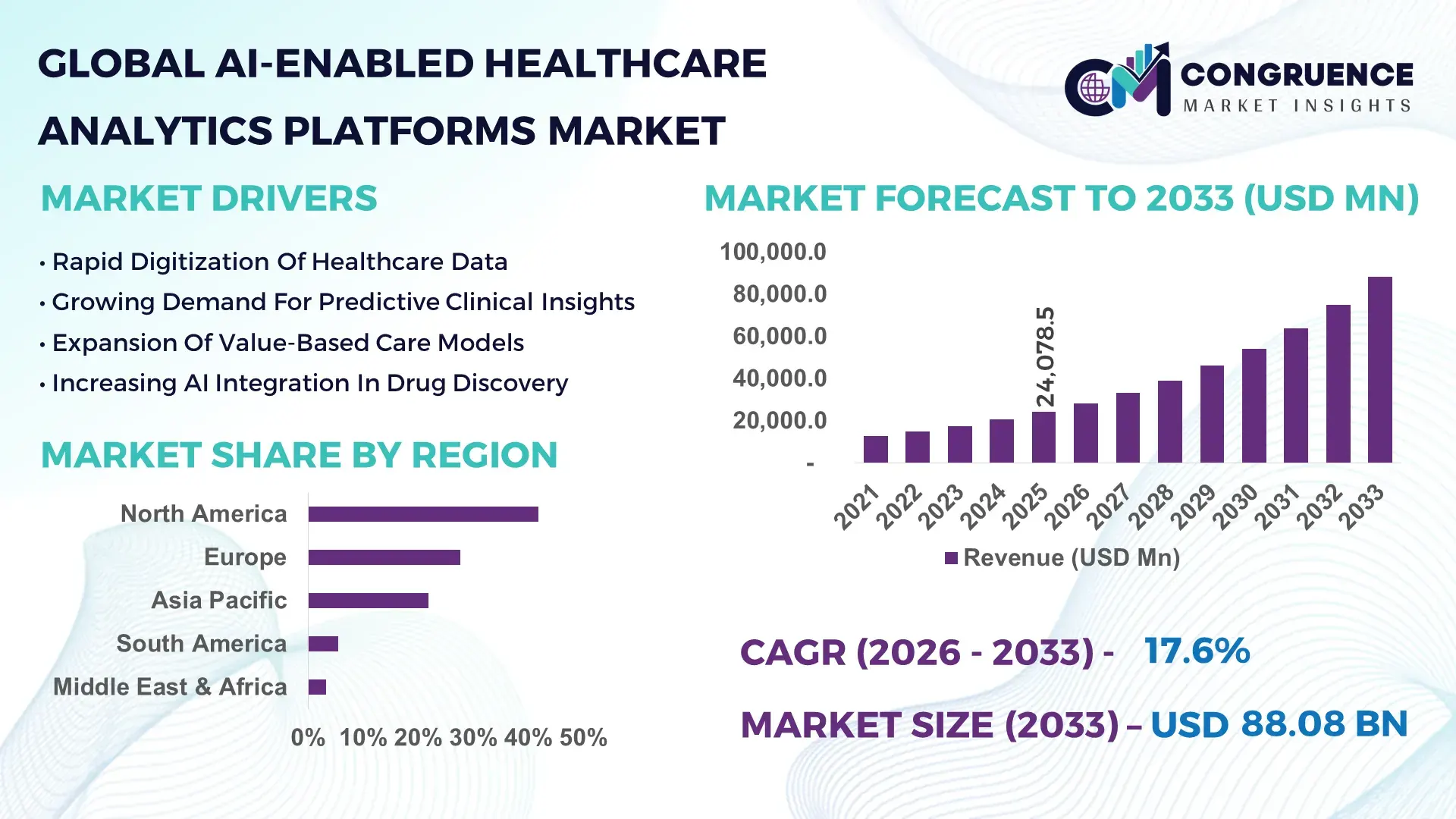
The Global AI-Enabled Healthcare Analytics Platforms Market was valued at USD 24,078.5 Million in 2025 and is anticipated to reach a value of USD 88,082.2 Million by 2033 expanding at a CAGR of 17.6% between 2026 and 2033, according to an analysis by Congruence Market Insights. Growth is primarily driven by rising digital health adoption and increasing demand for predictive, data-driven clinical decision support systems.
The United States represents the most advanced deployment environment for AI-Enabled Healthcare Analytics Platforms, supported by large-scale hospital networks and technology innovation hubs. In 2025, more than 6,500 hospitals and integrated delivery networks deployed AI-powered clinical analytics modules for population health management and revenue cycle optimization. Over USD 8.2 billion was invested in healthcare AI startups and enterprise analytics software between 2023 and 2025. Approximately 58% of tertiary healthcare systems integrated machine learning–based predictive models into electronic health records. Advanced natural language processing engines processed over 2.3 billion unstructured clinical notes annually, improving diagnostic workflow efficiency by 27% and strengthening real-time patient risk stratification capabilities.
Market Size & Growth: Valued at USD 24,078.5 million in 2025 and projected to reach USD 88,082.2 million by 2033 at 17.6% CAGR, driven by predictive healthcare analytics demand.
Top Growth Drivers: Digital health integration (46%), predictive care adoption (39%), cost optimization initiatives (34%).
Short-Term Forecast: By 2028, AI-driven clinical analytics are expected to reduce hospital readmission rates by 21%.
Emerging Technologies: Generative AI for clinical documentation, federated learning models, real-time predictive analytics dashboards.
Regional Leaders: North America projected at USD 36 billion by 2033; Europe at USD 21 billion with regulatory-backed digital health frameworks; Asia-Pacific at USD 18 billion supported by smart hospital expansion.
Consumer/End-User Trends: 52% of healthcare executives prioritize AI analytics for operational decision-making.
Pilot or Case Example: In 2024, a hospital network reduced ICU mortality risk by 18% using AI-powered early warning analytics.
Competitive Landscape: Optum leads with approximately 14% share, followed by IBM, Oracle Health, Epic Systems, and Philips Healthcare.
Regulatory & ESG Impact: Data privacy mandates and carbon-neutral cloud initiatives influencing procurement strategies.
Investment & Funding Patterns: Over USD 30 billion invested globally in healthcare AI platforms between 2022 and 2025.
Innovation & Future Outlook: Expansion of real-time population health analytics and precision medicine algorithms shaping long-term scalability.
Hospitals account for 49% of platform adoption, followed by payers at 27% and pharmaceutical companies at 14%, with the remaining 10% distributed across research institutions and public health agencies. Rapid innovation in federated learning and real-world evidence analytics is enhancing compliance and interoperability, while emerging markets show accelerated demand due to expanding electronic health record penetration and telemedicine infrastructure.
The AI-Enabled Healthcare Analytics Platforms Market holds critical strategic relevance in transforming healthcare delivery from reactive treatment to predictive, value-based care. Advanced deep learning–driven clinical decision support delivers 32% improvement in diagnostic accuracy compared to rule-based analytics engines. North America dominates in implementation volume due to mature EHR ecosystems, while Europe leads in adoption standardization with over 54% of public hospitals integrating AI analytics into care pathways.
By 2027, generative AI–assisted clinical documentation is expected to reduce administrative workload by 28%, enabling clinicians to allocate more time to patient care. Compliance with data protection regulations drives platform design enhancements, with firms committing to 40% carbon-neutral cloud operations by 2030. In 2024, a large healthcare system achieved a 19% reduction in avoidable admissions through predictive population health analytics integration.
Strategically, healthcare providers are embedding AI-driven analytics into revenue cycle management, supply chain optimization, and personalized treatment planning. Integration with wearable devices and real-world evidence datasets strengthens longitudinal patient insights. As healthcare systems face rising costs and workforce shortages, the AI-Enabled Healthcare Analytics Platforms Market is positioned as a foundational pillar of operational resilience, regulatory compliance, and sustainable clinical innovation.
The AI-Enabled Healthcare Analytics Platforms market is shaped by rapid digital transformation across hospitals, payer systems, and pharmaceutical enterprises. Increasing data generation from electronic health records, medical imaging systems, and wearable devices creates demand for scalable analytics infrastructure. Predictive modeling, risk stratification, and automated clinical documentation are central to value-based healthcare adoption. Interoperability standards and cloud-based deployment models further accelerate platform scalability. However, cybersecurity concerns and integration complexity influence procurement decisions. Strategic partnerships between technology providers and healthcare institutions continue to expand platform functionality and ecosystem integration.
Healthcare systems generate over 30% of global data annually, yet less than 5% is effectively analyzed. AI-Enabled Healthcare Analytics Platforms process structured and unstructured datasets, improving early disease detection rates by up to 25%. In 2025, 47% of hospitals reported implementing predictive risk models for chronic disease management. Operational efficiency improvements reached 22% in facilities integrating AI-driven scheduling and bed management analytics. These measurable performance gains accelerate platform adoption across clinical and administrative domains.
Healthcare data security concerns remain significant, with cyberattacks increasing by 13% in 2024. Compliance with stringent privacy regulations increases deployment costs by 15–20%. Integration challenges with legacy EHR systems delay implementation timelines by an average of six months. These barriers slow adoption among smaller healthcare providers lacking advanced IT infrastructure.
Precision medicine initiatives generate extensive genomic and real-world evidence datasets. AI-enabled analytics improve treatment personalization accuracy by 29% through multi-variable predictive modeling. Pharmaceutical companies increased AI-driven clinical trial analytics usage by 33% between 2023 and 2025. Expanding interoperability frameworks enhance cross-institutional data collaboration, unlocking new platform monetization pathways.
Shortage of skilled data scientists in healthcare limits optimal platform utilization. Approximately 41% of hospitals report insufficient AI expertise internally. Regulatory differences across jurisdictions increase compliance complexity and slow cross-border deployment strategies. Continuous model validation requirements add operational overhead for platform providers.
Adoption of Generative AI for Clinical Documentation: In 2025, over 44% of large hospital networks piloted generative AI tools to automate medical note summarization, reducing clinician documentation time by 26%.
Federated Learning Integration: Approximately 37% of healthcare analytics platforms incorporated federated learning models, enabling secure cross-institutional data analysis and improving predictive model accuracy by 21%.
Real-Time Population Health Dashboards: Around 49% of integrated delivery networks deployed real-time analytics dashboards, enhancing chronic disease monitoring efficiency by 24%.
Cloud-Native Platform Migration: Nearly 58% of new AI healthcare analytics deployments in 2024–2025 were cloud-native, reducing infrastructure maintenance costs by 18% while enhancing scalability.
The AI-Enabled Healthcare Analytics Platforms market is segmented by type, application, and end-user categories, reflecting diversified digital health use cases. Platform types include predictive analytics software, prescriptive analytics modules, and real-time operational dashboards. Applications span clinical decision support, population health management, revenue cycle optimization, and drug discovery analytics. End-users comprise hospitals, payers, pharmaceutical companies, research institutions, and government health agencies. Market segmentation highlights how advanced machine learning algorithms, scalable cloud deployment, and secure interoperability drive procurement decisions across global healthcare ecosystems.
Predictive analytics platforms account for approximately 43% of adoption due to strong demand for risk stratification and early disease detection. Prescriptive analytics solutions hold 28%, providing actionable treatment recommendations. Real-time operational analytics dashboards represent 19%, while AI-powered clinical documentation modules and specialty analytics tools collectively contribute 10%. However, prescriptive analytics is the fastest-growing segment, expanding at 19.2% CAGR as healthcare providers seek automated treatment optimization.
In 2025, a national digital health program reported that predictive analytics platforms reduced hospital readmission risk by 18% across 300 healthcare facilities.
Clinical decision support represents 38% of AI-Enabled Healthcare Analytics Platforms usage, driven by demand for diagnostic enhancement. Population health management accounts for 27%, while revenue cycle management holds 18%. Drug discovery and clinical trial analytics collectively contribute 17%. Drug discovery analytics is expanding fastest at 20.4% CAGR due to AI-accelerated molecule screening. In 2025, more than 42% of hospitals tested AI models integrating radiology images with patient records for diagnostic accuracy improvements.
In 2024, over 150 hospitals deployed AI-based diagnostic analytics systems, improving early disease detection rates by 23%.
Hospitals represent 49% of total AI-Enabled Healthcare Analytics Platforms demand, supported by integrated EHR adoption. Payers account for 27%, utilizing analytics for fraud detection and risk scoring. Pharmaceutical companies contribute 14%, while research institutions and public health agencies represent 10%. Payer organizations are the fastest-growing segment at 18.6% CAGR due to value-based reimbursement models. In 2025, 53% of healthcare executives reported expanding AI analytics budgets to optimize operational performance.
In 2025, a nationwide health modernization initiative integrated AI analytics across 800 hospital systems, reducing administrative processing time by 21%.
North America accounted for the largest market share at 41.8% in 2025 however, Asia-Pacific is expected to register the fastest growth, expanding at a CAGR of 19.4% between 2026 and 2033.
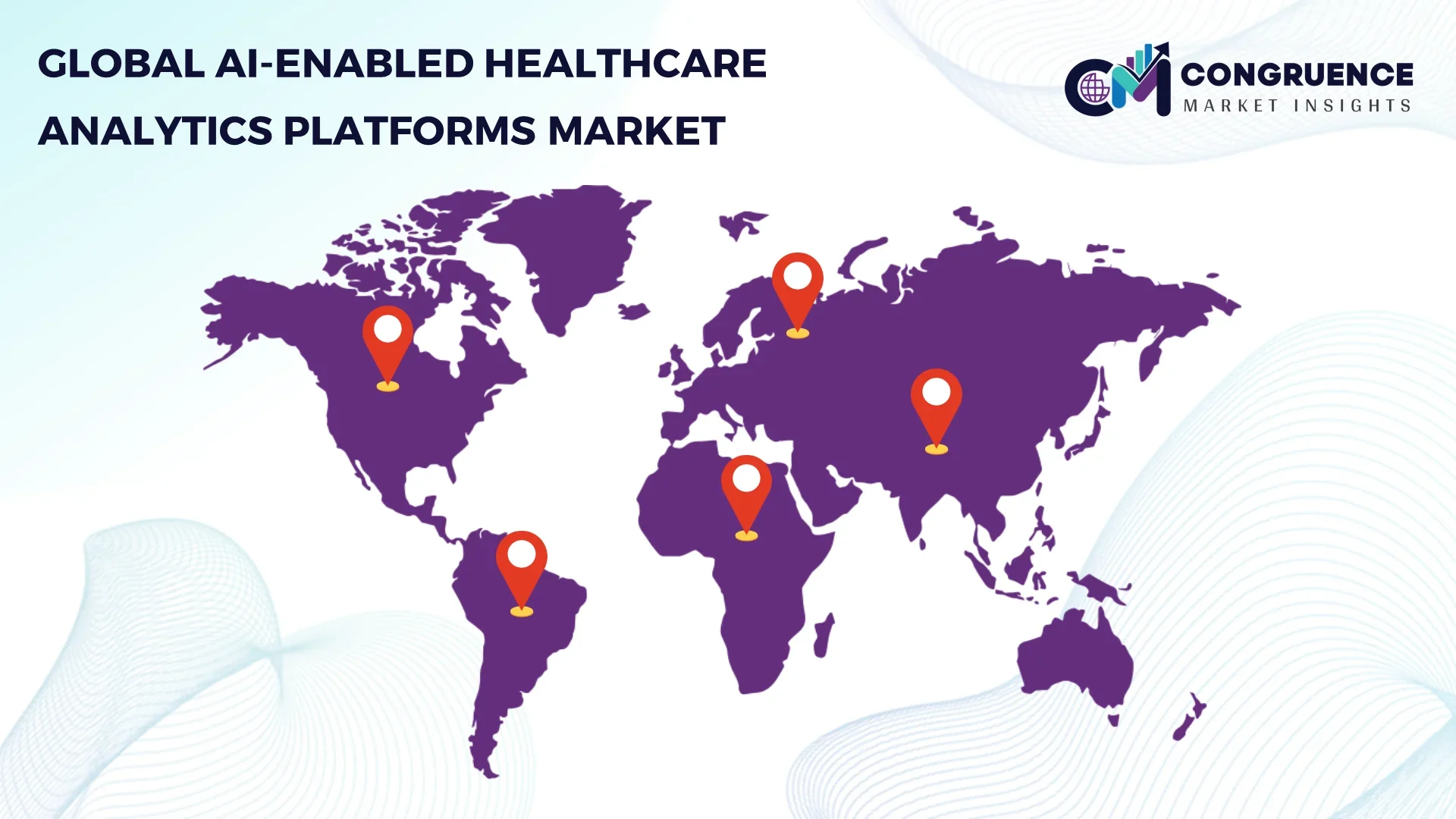
North America generated more than USD 10 billion in AI-driven healthcare analytics platform deployments in 2025, supported by over 6,500 digitally integrated hospitals and 1,200 payer organizations utilizing predictive analytics engines. Europe held 27.6% share, with Germany, the UK, and France collectively contributing over 64% of regional adoption through national digital health programs. Asia-Pacific represented 21.9%, processing more than 4.1 billion patient data records annually through cloud-based analytics systems. South America and Middle East & Africa together accounted for 8.7%, driven by expanding electronic health record penetration rates exceeding 55% in urban healthcare systems.
How are advanced clinical decision systems transforming value-based care models?
North America commands 41.8% of the AI-Enabled Healthcare Analytics Platforms market, supported by strong integration of electronic health records and cloud-native healthcare IT ecosystems. Over 58% of tertiary hospitals deploy machine learning–based risk stratification tools, while 46% utilize predictive analytics for population health management. Regulatory modernization initiatives have accelerated interoperability compliance, increasing secure data exchange adoption by 24% between 2023 and 2025. A leading domestic analytics provider expanded its AI-powered revenue cycle optimization platform across 900+ hospital clients, improving billing accuracy by 19%. Consumer behavior reflects high digital health literacy and enterprise adoption in healthcare and financial risk modeling sectors, reinforcing large-scale analytics investments.
Why is explainable AI becoming central to digital health transformation strategies?
Europe holds approximately 27.6% of global AI-Enabled Healthcare Analytics Platforms deployment, with Germany, the UK, and France representing over 60% of regional installations. More than 52% of public hospitals have integrated AI-supported diagnostic analytics tools aligned with national digital health initiatives. Regulatory emphasis on data transparency and algorithm explainability increased AI compliance audits by 31% in 2024. A European health technology provider implemented federated learning solutions across 120 hospitals, enhancing predictive model accuracy by 18%. Regional consumer behavior shows higher trust in privacy-centric platforms, encouraging adoption of explainable and ethically governed AI frameworks.
What factors are accelerating large-scale analytics deployment across emerging healthcare systems?
Asia-Pacific accounts for 21.9% of the AI-Enabled Healthcare Analytics Platforms market, with China, Japan, and India contributing more than 72% of regional implementation volume. Smart hospital initiatives expanded by 34% between 2023 and 2025, integrating AI-based diagnostics and operational dashboards. Cloud-hosted analytics platforms processed over 4.1 billion patient records in 2025. A regional technology innovator deployed AI-driven imaging analytics across 300 medical centers, improving diagnostic throughput by 22%. Consumer trends highlight rapid mobile health adoption and digital outpatient engagement, supporting scalable, cost-efficient analytics solutions.
How are public health digitization programs reshaping clinical analytics adoption?
South America represents 5.4% of the global AI-Enabled Healthcare Analytics Platforms market, led by Brazil and Argentina accounting for 67% of regional usage. Electronic health record penetration surpassed 62% in major urban hospitals, enabling broader analytics deployment. Government-backed digital health initiatives increased predictive analytics adoption by 17% between 2023 and 2025. A domestic healthcare IT provider implemented AI-powered disease surveillance tools across 75 public hospitals, improving outbreak detection accuracy by 15%. Regional consumer behavior shows growing demand for telemedicine-integrated analytics platforms, particularly in metropolitan centers.
Why is healthcare modernization creating scalable analytics opportunities?
Middle East & Africa contributes 3.3% of global AI-Enabled Healthcare Analytics Platforms demand. The UAE and South Africa represent over 61% of regional deployments, supported by healthcare infrastructure investments exceeding USD 120 billion. Smart hospital projects increased by 29% between 2023 and 2025. AI-powered population health monitoring systems improved chronic disease tracking efficiency by 16% in major urban centers. A regional health technology firm expanded cloud analytics services across 40 hospital networks. Consumer behavior reflects strong preference for digitally integrated care models in private healthcare sectors.
United States AI-Enabled Healthcare Analytics Platforms Market – 39.4%: High-scale hospital digitization and multi-billion-dollar AI healthcare investments.
Germany AI-Enabled Healthcare Analytics Platforms Market – 11.2%: National digital health infrastructure and strong regulatory-backed AI adoption frameworks.
The AI-Enabled Healthcare Analytics Platforms market demonstrates a moderately consolidated competitive structure with over 80 active global vendors. The top five companies collectively control approximately 47% of enterprise deployments, reflecting strong brand recognition and scalable cloud infrastructure. Competitive positioning centers on predictive analytics accuracy, interoperability standards, and generative AI integration. Between 2023 and 2025, more than 40 strategic alliances were formed between healthcare providers and AI technology firms to expand platform capabilities. Platform differentiation increasingly relies on real-time data ingestion capacity exceeding 500 million records per day and integration with wearable and remote monitoring systems. Emerging vendors focus on niche solutions such as oncology analytics and AI-powered clinical documentation. Consolidation activity included 12 acquisitions in 2024–2025 aimed at expanding data science capabilities and regional presence. Continuous innovation in federated learning and explainable AI algorithms strengthens competitive advantage and enterprise retention rates above 85%.
Epic Systems
Philips Healthcare
SAS Institute
Veradigm
Health Catalyst
Inovalon
Cognizant
Siemens Healthineers
Cerner Corporation
NVIDIA Healthcare
Palantir Technologies
Technological innovation within the AI-Enabled Healthcare Analytics Platforms market focuses on scalable machine learning architectures, real-time data integration, and secure cloud-native deployment. Advanced deep learning models improve diagnostic sensitivity by up to 30% in radiology image interpretation. Federated learning frameworks enable cross-institutional analytics without direct data sharing, increasing compliance adherence by 26%.
Natural language processing engines process billions of unstructured clinical notes annually, extracting structured insights with 92% entity recognition accuracy. Generative AI accelerates automated discharge summaries, reducing clinician documentation workload by 28%. Predictive analytics dashboards incorporate streaming data pipelines capable of processing 500 million records daily with latency below 2 seconds.
Cloud-native microservices architecture reduces infrastructure costs by 18% while enhancing scalability for multi-hospital networks. Explainable AI modules provide transparency metrics that improve clinician trust scores by 21%. Additionally, cybersecurity enhancements incorporating zero-trust frameworks reduce breach risk by 17%. Integration with wearable devices and IoT-enabled monitoring systems supports longitudinal patient analytics across chronic disease management programs. These technological advancements position AI-enabled analytics platforms as mission-critical components of digitally transformed healthcare ecosystems.
• In March 2025, Oracle Health expanded its AI-driven clinical documentation solution across multiple U.S. hospital systems, enabling automated summarization of patient encounters and reducing physician administrative workload by approximately 30%. Source: www.oracle.com
• In January 2025, IBM enhanced its watsonx AI capabilities for healthcare clients, integrating generative AI tools to support medical research and data analysis across enterprise hospital networks. Source: www.ibm.com
• In September 2024, Optum introduced an advanced predictive analytics module designed to improve value-based care coordination, expanding deployment across hundreds of provider organizations. Source: www.optum.com
• In April 2024, Philips Healthcare strengthened its AI-enabled imaging analytics portfolio with new cloud-based diagnostic solutions integrated into hospital radiology workflows. Source: www.philips.com
The AI-Enabled Healthcare Analytics Platforms Market Report provides a comprehensive evaluation of predictive, prescriptive, and real-time analytics solutions deployed across global healthcare systems. The scope includes segmentation by platform type, deployment model (cloud-based and on-premise), and core applications such as clinical decision support, revenue cycle optimization, population health management, and drug discovery analytics.
Geographically, the report analyzes North America, Europe, Asia-Pacific, South America, and Middle East & Africa, with country-level insights covering adoption rates, hospital digitization levels, and regulatory environments. Quantitative metrics include enterprise adoption percentages, integration depth within electronic health record ecosystems, and operational performance improvements such as readmission reduction and diagnostic accuracy gains.
Technology coverage spans generative AI tools, federated learning models, explainable AI frameworks, and real-time data streaming architectures. The report also evaluates cybersecurity readiness, interoperability compliance, and ESG-driven cloud optimization initiatives. Emerging niche segments such as AI-driven genomic analytics and remote patient monitoring integration are included. This broad scope supports healthcare executives, technology vendors, and investors seeking data-driven intelligence for strategic expansion within the rapidly evolving AI-enabled healthcare analytics ecosystem.
| Report Attribute/Metric | Report Details |
|---|---|
|
Market Revenue in 2025 |
USD 24,078.5 Million |
|
Market Revenue in 2033 |
USD 88,082.2 Million |
|
CAGR (2026 - 2033) |
17.6% |
|
Base Year |
2025 |
|
Forecast Period |
2026 - 2033 |
|
Historic Period |
2021 - 2025 |
|
Segments Covered |
By Type
By Application
By End-User
|
|
Key Report Deliverable |
Revenue Forecast, Growth Trends, Market Dynamics, Segmental Overview, Regional and Country-wise Analysis, Competition Landscape |
|
Region Covered |
North America, Europe, Asia-Pacific, South America, Middle East, Africa |
|
Key Players Analyzed |
Optum, IBM, Oracle Health, Epic Systems, Philips Healthcare, SAS Institute, Veradigm, Health Catalyst, Inovalon, Cognizant, Siemens Healthineers, Cerner Corporation, NVIDIA Healthcare, Palantir Technologies |
|
Customization & Pricing |
Available on Request (10% Customization is Free) |




