
Reports
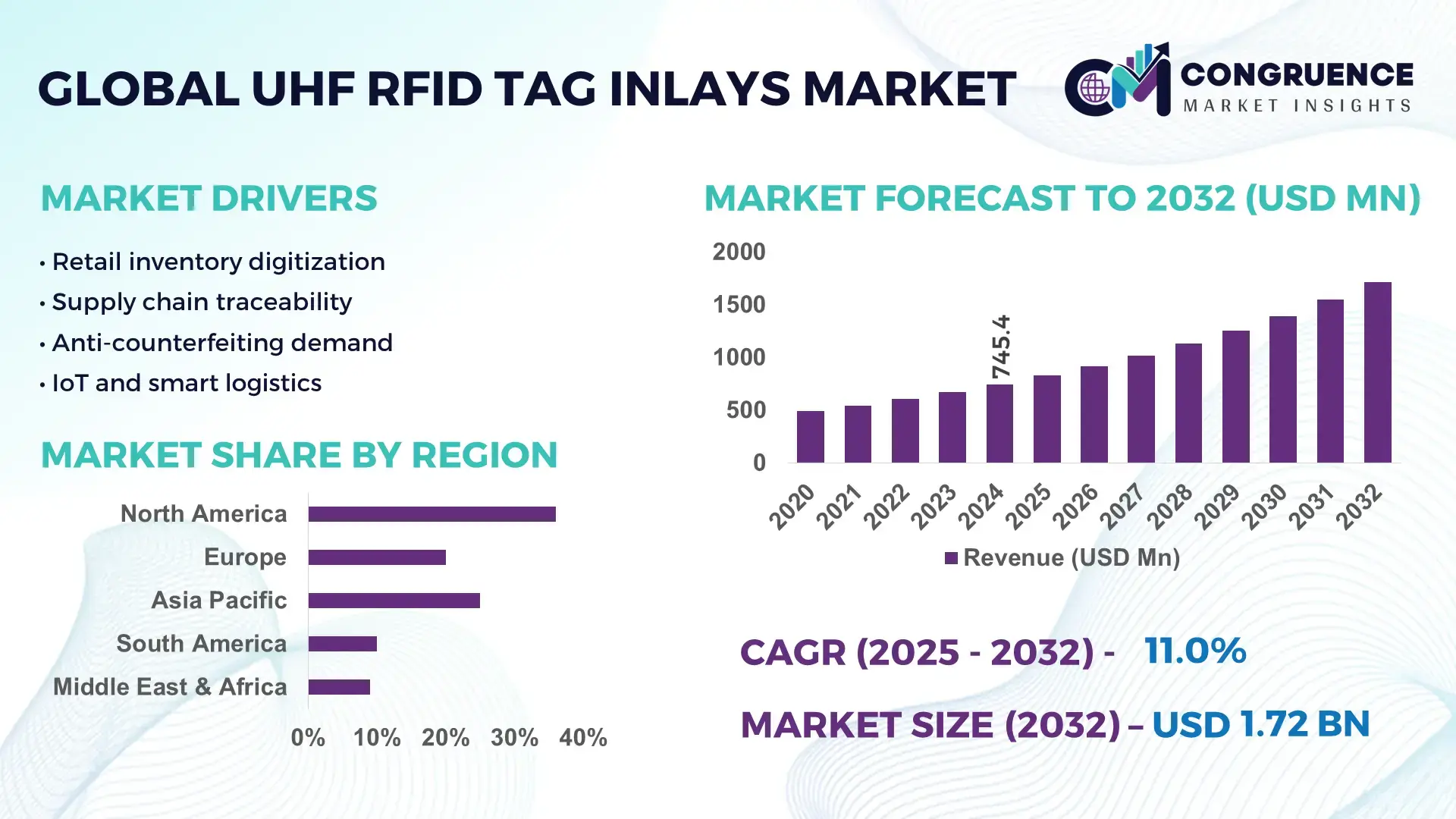
The Global UHF RFID Tag Inlays Market was valued at USD 745.42 Million in 2024 and is anticipated to reach a value of USD 1717.84 Million by 2032 expanding at a CAGR of 11% between 2025 and 2032. This growth is primarily supported by large-scale deployment of item-level tracking across retail, logistics, manufacturing, and healthcare supply chains.
The United States dominates the UHF RFID Tag Inlays marketplace through advanced domestic production capacity, sustained capital investment, and deep integration across multiple industries. The country hosts over 35 high-volume RFID manufacturing and conversion facilities, producing billions of inlays annually. Annual private and public investments in RFID and smart identification technologies exceed USD 2.5 billion, with logistics, retail, aerospace, and defense accounting for more than 70% of industrial usage. Over 80% of Tier-1 U.S. retailers deploy UHF RFID for inventory visibility, while adoption in warehousing and transportation management systems surpasses 65%. Technological advancements such as RAIN RFID standard optimization, chip miniaturization below 5 mm², and high-speed roll-to-roll encoding lines processing over 100,000 tags per hour further strengthen industrial scalability and deployment efficiency.
Market Size & Growth: Valued at USD 745.42 Million in 2024, projected to reach USD 1717.84 Million by 2032 at a CAGR of 11%, driven by automation-led supply chain digitization.
Top Growth Drivers: Retail RFID adoption at 78%, warehouse accuracy improvement at 35%, logistics handling time reduction at 28%.
Short-Term Forecast: By 2028, tag manufacturing costs are expected to decline by 18% through material optimization and higher wafer yields.
Emerging Technologies: RAIN RFID Gen2X, printable RFID antennas, ultra-thin flexible inlays for apparel and pharma packaging.
Regional Leaders: North America projected at USD 610 Million by 2032 with omnichannel retail adoption; Europe at USD 420 Million driven by traceability mandates; Asia-Pacific at USD 520 Million led by electronics and manufacturing scale.
Consumer/End-User Trends: Retailers account for over 45% of demand, followed by logistics and industrial asset tracking with rising item-level tagging.
Pilot or Case Example: A 2024 U.S. apparel retail pilot achieved 97% inventory accuracy and reduced stockouts by 22%.
Competitive Landscape: Avery Dennison leads with ~22% share, followed by Smartrac, Alien Technology, NXP Semiconductors, and Murata.
Regulatory & ESG Impact: Traceability regulations, waste reduction mandates, and recyclable antenna materials accelerate sustainable RFID adoption.
Investment & Funding Patterns: Over USD 3.1 Billion invested globally since 2022 in RFID capacity expansion, chip design, and automation.
Innovation & Future Outlook: Integration with IoT platforms, digital product passports, and AI-driven inventory analytics shaping long-term demand.
The UHF RFID Tag Inlays Market serves critical industry sectors including retail, which contributes approximately 45% of demand, logistics and warehousing at nearly 30%, manufacturing and industrial asset management at around 15%, and healthcare and pharmaceuticals accounting for the remainder. Recent innovations include eco-friendly aluminum and copper antenna designs, high-memory RFID chips supporting serialization, and ultra-thin inlays optimized for smart packaging. Regulatory emphasis on product traceability, anti-counterfeiting, and circular economy compliance continues to support adoption, while economic drivers such as labor optimization and shrinkage reduction enhance ROI justification. Regionally, North America and Europe exhibit high-value consumption linked to compliance and automation, whereas Asia-Pacific shows volume-driven growth supported by electronics manufacturing and export logistics. Emerging trends point toward RFID-enabled digital twins, battery-free sensor inlays, and convergence with blockchain-based traceability platforms, positioning the market for sustained long-term expansion.
The strategic relevance of the UHF RFID Tag Inlays Market lies in its role as a foundational enabler of real-time visibility, automation, and data-driven decision-making across global supply chains. Enterprises increasingly position UHF RFID tag inlays as core digital infrastructure rather than auxiliary tracking tools, integrating them into enterprise resource planning, warehouse management, and AI-driven analytics platforms. From a performance benchmark perspective, RAIN RFID Gen2X delivers nearly 35% faster read rates and 25% higher read accuracy compared to the older EPC Gen2 standard, enabling higher throughput in high-density item environments such as apparel distribution centers and automated warehouses. Regionally, Asia-Pacific dominates in volume manufacturing, producing billions of inlays annually due to large-scale electronics fabrication ecosystems, while North America leads in adoption with over 68% of large retailers and logistics operators actively deploying UHF RFID at item or pallet level. In the short term, by 2027, AI-driven RFID data analytics and edge-based filtering are expected to reduce inventory reconciliation time by approximately 30%, improving working capital efficiency and order fulfillment performance. From a compliance and ESG standpoint, firms are committing to material sustainability improvements such as 40% recyclable or aluminum-free antenna designs by 2030, supporting circular economy goals. A micro-scenario highlights that in 2024, a U.S.-based omnichannel retailer achieved a 22% reduction in stockouts and a 19% improvement in inventory accuracy through RFID-enabled AI demand forecasting initiatives. Collectively, these strategic, technological, and regulatory pathways position the UHF RFID Tag Inlays Market as a long-term pillar supporting operational resilience, regulatory compliance, and sustainable, scalable growth across industries.
The rapid expansion of automated retail, warehousing, and logistics ecosystems is a primary driver of the UHF RFID Tag Inlays Market. Over 75% of large-format retailers globally now operate omnichannel models that require near-real-time inventory visibility across stores and fulfillment centers. UHF RFID tag inlays enable inventory accuracy levels above 95%, compared to approximately 65–70% achieved through barcode-based systems. In logistics operations, RFID-enabled pallet and case tracking has reduced manual scanning labor by up to 30% and improved order picking accuracy by nearly 25%. Additionally, high-speed conveyor systems increasingly rely on UHF RFID portals capable of reading over 1,000 tags per second, directly boosting throughput efficiency. These operational gains continue to reinforce enterprise investment in scalable UHF RFID tag inlays across high-volume environments.
Material price volatility and system integration complexity present notable restraints for the UHF RFID Tag Inlays Market. Key raw materials such as aluminum, copper, and semiconductor wafers have experienced price fluctuations exceeding 20% over recent years, directly impacting tag inlay production costs. Additionally, integrating RFID infrastructure with legacy IT systems remains complex for small and mid-sized enterprises, often requiring specialized middleware, reader calibration, and data harmonization efforts. Deployment timelines can extend by several months when retrofitting existing warehouses or manufacturing lines, delaying return on investment. Environmental challenges, such as signal interference from liquids and metals, also necessitate customized inlay designs, increasing engineering and testing costs. These factors collectively slow adoption in cost-sensitive or technologically fragmented operating environments.
Sustainability-driven packaging and regulatory-backed digital traceability initiatives present significant opportunities for the UHF RFID Tag Inlays Market. Governments and industry bodies increasingly mandate product-level traceability for food, pharmaceuticals, and consumer goods, with compliance timelines accelerating toward the late 2020s. UHF RFID tag inlays embedded in recyclable or compostable packaging enable automated lifecycle tracking, supporting waste reduction and recall efficiency. Pilot programs in Europe demonstrate that RFID-enabled packaging can improve reverse logistics recovery rates by over 20%. Additionally, the emergence of digital product passports in apparel and electronics creates demand for ultra-thin, eco-designed RFID inlays capable of lasting the full product lifecycle. These developments unlock new application segments beyond traditional inventory management.
Regulatory fragmentation and performance variability remain persistent challenges for the UHF RFID Tag Inlays Market. Frequency allocations and power limits for UHF RFID differ across regions, requiring manufacturers to design region-specific inlays or multi-band solutions, increasing design complexity. Performance variability caused by environmental conditions—such as moisture absorption, electromagnetic interference, and dense item stacking—can reduce read reliability by 10–15% if not properly engineered. Additionally, certification and compliance testing across multiple jurisdictions add time and cost to product commercialization. For global enterprises operating cross-border supply chains, harmonizing RFID deployments under these constraints requires continuous optimization, making standardization and scalability ongoing challenges for the market.
Acceleration of Item-Level RFID Deployment Across Retail and Logistics: The shift toward item-level visibility is significantly increasing demand for UHF RFID tag inlays, particularly in retail and third-party logistics operations. More than 78% of large omnichannel retailers now deploy RFID tagging at SKU level, improving inventory accuracy to above 95% compared to sub-70% levels under barcode systems. In logistics hubs, UHF RFID portals capable of reading over 1,200 tags per second are enabling throughput improvements of nearly 30%. This trend is driving higher consumption of compact, high-sensitivity tag inlays optimized for dense read environments.
Rapid Adoption of Eco-Designed and Recyclable RFID Inlays: Sustainability requirements are reshaping product design priorities in the UHF RFID Tag Inlays market. Over 42% of newly launched inlays now use reduced-aluminum or aluminum-free antenna structures, cutting material usage by up to 35%. Retail and apparel brands are targeting packaging recyclability rates above 80% by 2030, accelerating demand for paper-based and polymer-light RFID inlays. These designs also reduce overall tag weight by approximately 20%, supporting logistics efficiency and ESG compliance simultaneously.
Integration of UHF RFID with AI and Real-Time Analytics Platforms: The convergence of UHF RFID tag inlays with AI-driven analytics is emerging as a key operational trend. Enterprises using RFID data integrated with machine learning models report up to 28% faster inventory reconciliation and a 22% reduction in stockouts. In manufacturing and warehousing, predictive analytics applied to RFID data streams have improved asset utilization rates by nearly 18%. This integration is increasing demand for high-memory, high-read-rate inlays capable of continuous, real-time data capture.
Expansion of High-Volume Manufacturing and Encoding Automation: Manufacturing scalability is advancing rapidly as suppliers deploy automated roll-to-roll production and encoding systems. Modern production lines now process over 100,000 UHF RFID tag inlays per hour, improving yield rates above 97%. Asia-Pacific accounts for more than 60% of global inlay manufacturing volume, while North America leads in automated encoding adoption with over 65% of large converters using inline verification systems. These advancements are lowering defect rates by nearly 25% and supporting mass deployment across cost-sensitive applications.
The UHF RFID Tag Inlays Market segmentation reflects varied adoption patterns based on technical specifications, operational use cases, and end-user maturity. By type, differentiation is driven by antenna design, substrate material, and form factor suitability for specific environments. Application-wise, demand is shaped by inventory visibility requirements, regulatory traceability mandates, and automation intensity across sectors. End-user insights reveal uneven adoption between early digital adopters and cost-sensitive industries, with measurable gaps in deployment scale and sophistication. Across all segments, decision-making is influenced by read performance, durability, integration ease, and compliance readiness rather than price alone. This segmentation structure highlights where volume demand concentrates today and where accelerated growth is emerging over the medium term.
UHF RFID tag inlays are segmented into dry inlays, wet inlays, and specialty inlays such as on-metal and high-memory variants. Dry inlays currently lead the segment, accounting for approximately 46% of total adoption, due to their flexibility in conversion, lower material complexity, and compatibility with high-speed label manufacturing. Wet inlays represent about 32% share, widely used in retail labeling where adhesive-backed solutions enable rapid deployment at scale. Specialty inlays are the fastest-growing type, expanding at an estimated 14.8% annually, driven by increased use in metal-rich environments, pharmaceuticals, and industrial asset tracking where signal reliability is critical. These specialty formats leverage tuned antennas and shielding layers to maintain read accuracy above 90% even on challenging surfaces. The remaining niche formats, including ultra-thin textile-embedded inlays and high-temperature-resistant designs, collectively account for nearly 22% of the market, supporting specialized industrial and healthcare use cases.
By application, retail inventory management leads with nearly 44% share, as item-level tagging has become integral to omnichannel fulfillment, shrinkage control, and real-time stock visibility. Logistics and supply chain tracking follows at around 29%, leveraging UHF RFID portals for pallet, carton, and container-level automation. Industrial asset tracking is the fastest-growing application, expanding at approximately 13.9% annually, fueled by smart factory initiatives and predictive maintenance programs where continuous asset visibility reduces downtime by over 20%. Healthcare and pharmaceutical traceability, including medical device tracking and cold-chain monitoring, together contribute about 17% of application demand, while niche uses such as event management and library systems form the remaining 10%.
From an end-user perspective, retailers represent the largest segment with approximately 41% share, reflecting high-volume deployment across apparel, grocery, and specialty retail formats. Logistics service providers account for nearly 26%, driven by automation in cross-docking and fulfillment operations. Manufacturing is the fastest-growing end-user segment, advancing at an estimated 12.6% annually, as Industry 4.0 adoption accelerates RFID-based work-in-progress tracking and asset utilization monitoring. Healthcare providers, pharmaceuticals, and government entities collectively contribute around 21%, supported by traceability mandates and operational efficiency goals, while other end-users such as education and event management account for the remaining 12%. Adoption rates among large manufacturers now exceed 60% for RFID-enabled asset tracking, compared to under 35% five years ago.
North America accounted for the largest market share at 38.6% in 2024 however, Asia-Pacific is expected to register the fastest growth, expanding at a CAGR of 13.4% between 2025 and 2032.

North America’s leadership is supported by large-scale enterprise RFID deployments, with over 68% of Tier-1 retailers and logistics operators using UHF RFID tag inlays for item- and pallet-level tracking. Europe followed with a 27.9% share, driven by regulatory-backed traceability requirements across retail, healthcare, and manufacturing. Asia-Pacific accounted for 24.1% of global demand in 2024, supported by high-volume manufacturing capacity and expanding e-commerce ecosystems, processing more than 60% of global RFID inlay production volume. South America and the Middle East & Africa collectively represented 9.4%, with adoption concentrated in logistics modernization, industrial asset tracking, and government-led digital infrastructure programs. Regional differences in regulatory maturity, automation intensity, and supply chain complexity continue to shape deployment depth and technology preferences across the UHF RFID Tag Inlays Market.
How is large-scale enterprise digitization accelerating advanced RFID adoption?
This region accounted for approximately 38.6% of the UHF RFID Tag Inlays Market in 2024, supported by deep penetration across retail, logistics, healthcare, and financial services. Retail and logistics together represent over 62% of regional demand, driven by omnichannel fulfillment and real-time inventory visibility. Government initiatives promoting supply chain transparency and healthcare traceability have accelerated institutional adoption, with over 55% of hospitals using RFID-enabled asset tracking. Technological advancements include AI-integrated RFID analytics and high-speed encoding systems capable of processing 100,000+ inlays per hour. Local players such as Avery Dennison continue expanding sustainable inlay designs and smart factory capabilities. Consumer behavior shows higher enterprise adoption in healthcare and finance, where accuracy rates above 95% are prioritized over cost.
Why are compliance-driven traceability requirements reshaping adoption patterns?
Europe held an estimated 27.9% share of the UHF RFID Tag Inlays Market in 2024, with Germany, the UK, and France accounting for more than 58% of regional demand. Regulatory frameworks emphasizing product traceability, recycling, and digital product passports are major adoption drivers. Sustainability initiatives have pushed over 45% of new RFID deployments toward recyclable or low-metal inlay designs. Emerging technologies such as ultra-thin textile-integrated inlays are gaining traction in apparel and luxury goods. Regional players like Smartrac have focused on eco-designed inlays and EU-compliant manufacturing processes. Consumer behavior reflects strong regulatory pressure, leading to demand for explainable, auditable UHF RFID Tag Inlays across retail and healthcare supply chains.
How are manufacturing scale and e-commerce expansion driving volume leadership?
Asia-Pacific ranks first globally by production volume, contributing over 60% of total UHF RFID tag inlay manufacturing output in 2024. China, Japan, and India are the top consuming countries, together representing nearly 72% of regional demand. The region benefits from dense electronics manufacturing clusters, automated roll-to-roll production lines, and expanding export logistics networks. Innovation hubs in China and Japan are advancing miniaturized antennas and high-sensitivity chips optimized for dense packaging. Local players such as Murata continue scaling high-performance inlay production for industrial and retail use. Consumer behavior is heavily influenced by e-commerce growth, with mobile-first retail platforms driving item-level tagging adoption.
What role does logistics modernization play in shaping regional demand?
South America accounted for approximately 5.6% of global market share in 2024, with Brazil and Argentina leading adoption. Logistics, agriculture exports, and industrial asset tracking represent over 64% of regional use cases, supported by infrastructure upgrades and port modernization projects. Government trade facilitation programs have increased RFID adoption in customs and cargo handling. Local integrators are deploying UHF RFID tag inlays to improve shipment visibility, achieving tracking accuracy improvements above 20%. Consumer behavior shows demand tied to logistics efficiency and multilingual labeling, supporting broader adoption across cross-border trade and distribution networks.
How is industrial diversification supporting gradual RFID penetration?
The Middle East & Africa represented around 3.8% of global demand in 2024, with growth centered in the UAE and South Africa. Oil & gas, construction, and government-led smart infrastructure projects drive adoption, accounting for nearly 57% of regional deployments. Technological modernization initiatives, including smart ports and automated warehouses, are increasing RFID usage for asset tracking and safety compliance. Trade partnerships and free-zone regulations have reduced import barriers for RFID components. Regional consumer behavior emphasizes operational reliability and durability, particularly in harsh environments where read accuracy above 90% is critical.
United States – 32.4% market share
Dominance driven by high enterprise adoption, advanced manufacturing capacity, and large-scale retail and logistics deployments of UHF RFID Tag Inlays.
China – 21.7% market share
Leadership supported by massive production volume, electronics manufacturing ecosystems, and strong demand from e-commerce and export logistics sectors using UHF RFID Tag Inlays.
The UHF RFID Tag Inlays market exhibits a moderately consolidated competitive structure, characterized by a mix of large multinational technology providers and specialized RFID-focused manufacturers. Globally, more than 35–40 active companies operate across inlay design, chip integration, antenna engineering, and large-scale conversion. The top five companies collectively account for approximately 55–60% of total market presence, reflecting strong control over high-volume production, patented antenna designs, and long-term contracts with retail, logistics, and industrial customers. Leading players compete on read performance, material efficiency, sustainability credentials, and production scalability rather than pricing alone.
Strategic initiatives increasingly shape competition. Over 65% of leading players have announced investments since 2023 in automated roll-to-roll manufacturing, increasing output capacity beyond 100,000 inlays per hour while reducing defect rates by nearly 25%. Partnerships between RFID chip suppliers and inlay converters have grown by more than 30%, aimed at improving chip sensitivity and enabling ultra-thin designs below 200 microns. Product innovation remains central, with over 40% of new launches focused on recyclable substrates, aluminum-free antennas, or specialty inlays for metal and liquid environments. Mergers and technology alliances are selectively used to expand geographic reach, particularly in Asia-Pacific manufacturing hubs and North American enterprise markets. Overall, competition is driven by scale, technological differentiation, ESG alignment, and the ability to support global, multi-region deployments.
Avery Dennison Corporation
Smartrac (an independent RFID-focused brand)
Alien Technology
NXP Semiconductors
Murata Manufacturing
HID Global
Confidex
Tageos
Checkpoint Systems
Identiv
The UHF RFID Tag Inlays Market is being reshaped by both incremental and disruptive technologies that enhance performance, reduce costs, and unlock new applications across industries. One of the most impactful areas is advanced antenna design, where optimized near-field and far-field patterns have increased read reliability by up to 30% in dense tag environments such as retail stockrooms and automated sorting hubs. Recent inlay designs now routinely achieve read sensitivity thresholds below -18 dBm, enabling accurate detection at greater distances and through challenging packaging materials like multilayer plastics and metallic enclosures. Another key advancement is the integration of high-memory RFID chips, which support up to 8 kbits of on-tag data storage. This expanded memory capacity allows inlays to store serialized identifiers, batch histories, and conditional instructions that can be processed by edge readers, reducing backend database queries by approximately 22% during peak operations. These enhanced inlays are finding traction in cold-chain logistics, healthcare tracking, and serialized inventory programs.
The move toward eco-designed and recyclable inlays represents a significant shift in material technology. Over 40% of newly introduced inlay formats use aluminum-free or reduced-metal antenna structures, cutting raw material consumption by nearly 35% and aligning with corporate ESG commitments to circular economy principles. These formats are also lighter, contributing to lower transport costs in high-volume deployments. Automation in manufacturing is accelerating with roll-to-roll encoding and inline verification systems that process upwards of 100,000 tags per hour with defect detection rates above 97%. Digital transformation initiatives further leverage cloud-connected RFID platforms and AI-driven analytics to provide real-time inventory dashboards, predictive demand signals, and anomaly detection that can reduce shrinkage and stockouts by more than 20%.
Emerging technologies such as chipless RFID variants, multi-protocol readers, and blockchain integration for immutable traceability records are gaining experimentation momentum. Chipless formats aim to lower unit costs for very high-volume consumer goods tagging, while blockchain linkage enables verified supply chain histories for regulatory compliance and anti-counterfeiting. Collectively, these technological developments are enhancing the strategic value of UHF RFID tag inlays as foundational components of resilient, intelligent, and sustainable supply chain ecosystems.
• In January 2024, Avery Dennison introduced the AD Burst and AD 2Metal Rock M781 inlay families, optimized for apparel and logistics applications with enhanced performance and read reliability in challenging environments, supporting high-speed inventory accuracy and robust tracking across global supply chains. (rfid.averydennison.com)
• In September 2023, Avery Dennison launched the AD Pure™ range of plastic-free UHF RFID inlays and tags, reducing label weight by up to 44% and delivering between 70–90% lower carbon footprint compared to traditional plastic-based alternatives, accelerating sustainability in retail and supply chain tagging. (Ink World magazine)
• In October 2024, Avery Dennison unveiled AD Dura 2.0, a reinforced RFID inlay solution designed for harsh environments with resistance to water, heat, vibration, and shock, extending product lifecycle and waste reduction capabilities for industrial, automotive, and logistics applications. (rfid.averydennison.com)
• In July 2025, Avery Dennison launched an RFID-enabled In-Mold Label (IML) portfolio, embedding UHF RFID functionality into molded plastics to support circular reuse systems and real-time tracking for high-volume industrial and consumer reuse scenarios. (rfid.averydennison.com)
The UHF RFID Tag Inlays Market Report provides an extensive analysis of the technology, product types, applications, end-user segments, and geographical landscapes shaping the deployment of ultra-high frequency RFID identification solutions. It covers segmentation across tag form factors, including dry inlays, wet inlays, and specialty inlays designed for unique environments such as on-metal and industrial use. Detailed technology insights include RAIN RFID, dual-frequency and hybrid configurations, memory capacity variations, and performance enhancements tailored for diverse operational conditions.
Geographically, the report examines regional adoption patterns spanning North America, Europe, Asia-Pacific, South America, and the Middle East & Africa, highlighting volume trends, manufacturing hubs, supply chain integration, and regulatory drivers influencing RFID inlay uptake. Application analyses encompass key use cases such as retail inventory management, logistics and warehousing, industrial asset tracking, healthcare traceability, and emerging niches like smart containers and reusable asset tracking.
Scope further includes technological enablers such as advanced antenna designs, high-performance chips with expanded memory, integration with IoT and AI analytics platforms, and eco-designed inlays aligned with sustainability goals. End-user insights focus on behavior patterns, sectoral demands, and adoption rates among retailers, manufacturers, healthcare providers, and logistics operators. The report also examines innovation trends, production capacity expansions, material science advancements, and the influence of digital transformation strategies on market dynamics, aiming to equip decision-makers with actionable intelligence on both established and emerging segments within the UHF RFID Tag Inlays ecosystem.
| Report Attribute/Metric | Report Details |
|---|---|
Market Revenue in 2024 | USD 745.42 Million |
Market Revenue in 2032 | USD 1717.84 Million |
CAGR (2025 - 2032) | 11% |
Base Year | 2024 |
Forecast Period | 2025 - 2032 |
Historic Period | 2020 - 2024 |
Segments Covered | By Types
By Application
By End-User
|
Key Report Deliverable | Revenue Forecast, Growth Trends, Market Dynamics, Segmental Overview, Regional and Country-wise Analysis, Competition Landscape |
Region Covered | North America, Europe, Asia-Pacific, South America, Middle East, Africa |
Key Players Analyzed | Avery Dennison Corporation, Smartrac (an independent RFID-focused brand), Alien Technology, NXP Semiconductors, Murata Manufacturing, HID Global, Confidex, Tageos, Checkpoint Systems, Identiv |
Customization & Pricing | Available on Request (10% Customization is Free) |




