
Reports
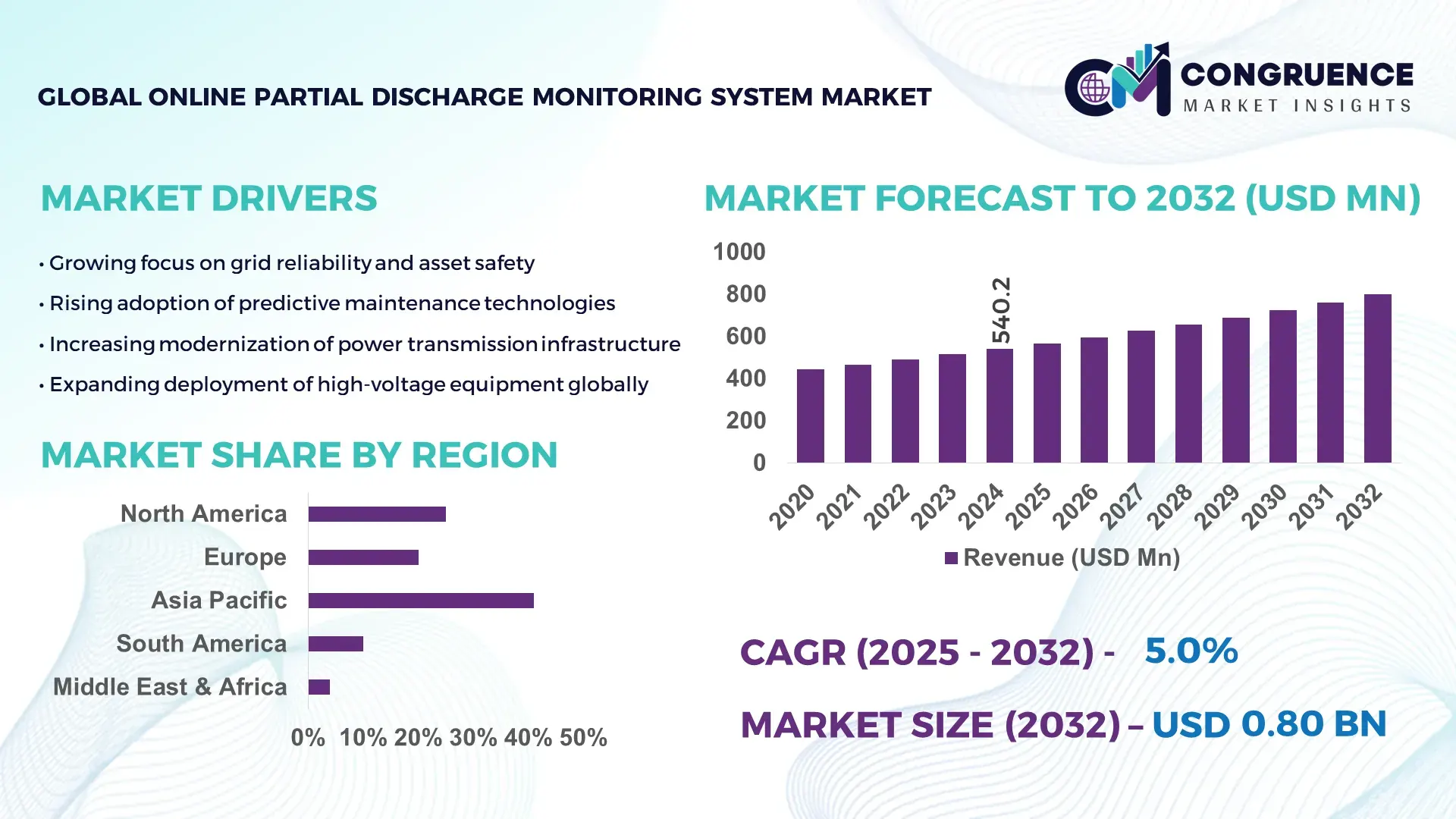
The Global Online Partial Discharge Monitoring System Market was valued at USD 540.22 Million in 2024 and is anticipated to reach a value of USD 798.15 Million by 2032 expanding at a CAGR of 5.0% between 2025 and 2032. This growth is supported by rising demand for continuous, real-time electrical asset condition monitoring.
China leads the Online Partial Discharge Monitoring System market due to its extensive high-voltage transmission infrastructure and large-scale investment in digital grid technologies. The country operates more than 250,000 km of UHV and EHV lines using advanced PD sensing systems, with annual power grid investments exceeding USD 20 billion. Continuous deployment of next-generation UHF sensors, AI diagnostics, and smart substation upgrades ensures widespread adoption across utilities, renewable power installations, and industrial HV environments, strengthening China’s manufacturing and consumption capacity for PD monitoring technologies.
• Market Size & Growth: Valued at USD 540.22 Million in 2024, projected to reach USD 798.15 Million by 2032 at a 5.0% CAGR, supported by increasing reliance on predictive maintenance in high-voltage networks.
• Top Growth Drivers: 38% rise in utility adoption, 27% enhancement in asset efficiency, and 32% growth in HV equipment modernization initiatives.
• Short-Term Forecast: By 2028, reliability improvement expected to exceed 25%, with maintenance-related downtime reduced by over 18%.
• Emerging Technologies: AI-driven PD pattern recognition, IoT-enabled HV asset platforms, and next-generation UHF sensor technologies.
• Regional Leaders: Asia-Pacific projected to reach USD 365 Million by 2032; North America USD 210 Million; Europe USD 185 Million, each driven by distinct grid digitalization and automation trends.
• Consumer/End-User Trends: Strong adoption among utilities, renewable power operators, oil & gas facilities, and heavy industrial plants prioritizing predictive diagnostics.
• Pilot or Case Example: A 2024 UHV monitoring pilot demonstrated a 30% reduction in unplanned outages through real-time PD analytics.
• Competitive Landscape: Leading player holds about 18% market share, with key competitors including Siemens Energy, ABB, Qualitrol, and Megger.
• Regulatory & ESG Impact: HV safety compliance, grid stability mandates, and decarbonization frameworks accelerating adoption of continuous PD monitoring.
• Investment & Funding Patterns: Over USD 1.2 Billion invested globally in digital grid and asset-health initiatives, boosting PD technology integration.
• Innovation & Future Outlook: Growth driven by autonomous diagnostics, cloud-integrated PD analytics, and scalable IoT-based HV asset monitoring platforms.
The Online Partial Discharge Monitoring System market continues to advance through technological innovation across utilities, industrial facilities, and renewable energy systems. AI-enhanced diagnostic tools, faster signal processing, and cloud-based analytics are reshaping asset-health strategies, enabling lower failure risks and longer equipment lifecycles. Regulations targeting grid stability and insulation reliability further support the adoption of PD monitoring systems. Regional consumption patterns reflect rapid expansion in Asia-Pacific, while North America and Europe focus on digital grid transitions and operational resilience. Emerging trends include fully automated HV monitoring architectures, sensor miniaturization, and integrated prediction models, positioning the market for sustained long-term growth.
The strategic relevance of the Online Partial Discharge Monitoring System market is increasingly underscored by the global shift toward predictive maintenance, digital substations, and grid modernization frameworks. Utilities and industrial operators are prioritizing systems capable of delivering continuous, high-accuracy insulation diagnostics, resulting in measurable operational improvements. Advanced UHF sensor technology now delivers up to 35% higher detection sensitivity compared to traditional acoustic-based PD identification methods, reinforcing its competitive advantage and long-term adoption potential. Asia-Pacific dominates in volume, while Europe leads in adoption with more than 46% of utilities integrating online PD monitoring into grid reliability programs. By 2027, AI-enabled anomaly detection engines are expected to improve fault prediction accuracy by up to 30%, reducing grid failure incidence and maintenance-related downtime significantly. Firms are committing to ESG-aligned operational improvements, targeting insulation waste recycling rates of up to 25% by 2030 under new compliance models linked to equipment lifecycle sustainability. In 2024, a major transmission operator in Japan achieved a 28% reduction in transformer-related outages through an integrated AI-backed partial discharge monitoring initiative. Looking ahead, the Online Partial Discharge Monitoring System Market is positioned as a critical pillar supporting electrical infrastructure resilience, regulatory compliance, and sustainable long-term growth through advanced diagnostics and digital intelligence.
Growing global investment in high-voltage transmission networks is significantly increasing the demand for Online Partial Discharge Monitoring Systems, particularly in regions deploying UHV and EHV lines. With more than 300,000 km of new high-voltage networks planned worldwide by 2030, utilities require continuous monitoring solutions to mitigate insulation deterioration and operational failures. Real-time PD monitoring enhances equipment reliability by up to 40%, enabling early detection of faults before they escalate into costly outages. The accelerated integration of renewable energy—especially wind and solar—into national grids further amplifies insulation stress, creating greater need for continuous diagnostic systems. The push toward digital substations equipped with intelligent sensors and automated alert technologies strengthens adoption as operators seek to enhance stability, minimize downtime, and maintain long-term operational integrity.
The Online Partial Discharge Monitoring System market faces constraints due to the shortage of specialized technical expertise required to install, calibrate, and interpret complex PD monitoring data. Many utilities and industrial plants lack personnel trained in advanced UHF, HFCT, and TEV-based detection methodologies, resulting in suboptimal utilization of PD monitoring infrastructure. More than 45% of utilities in emerging markets report skill gaps in PD diagnostics, affecting timely decision-making and reducing confidence in continuous monitoring systems. Integration challenges with legacy SCADA environments further impede adoption, increasing system setup time and complexity. Additionally, misinterpretation of PD patterns can lead to inaccurate maintenance decisions, elevating operational risk. These factors collectively slow market expansion and prolong transition toward fully digital asset-health architectures.
The rapid digitalization of grid infrastructure presents significant opportunities for the Online Partial Discharge Monitoring System market, particularly as utilities adopt AI-driven maintenance ecosystems. AI-enabled PD pattern recognition can increase analysis accuracy by up to 35%, reducing false alarms and optimizing maintenance scheduling. Cloud-based PD analytics platforms offer scalable deployment models for utilities operating large, dispersed networks, enabling enterprise-level visibility and centralized decision-making. The rise of IoT-enabled high-voltage assets and interoperable digital twins creates new pathways for integrating PD data into broader asset-management frameworks. Additionally, expansion of microgrids, offshore wind projects, and distributed energy systems provides new application areas requiring continuous PD surveillance. These converging opportunities position the market for further technological diversification and strategic growth.
Integration of Online Partial Discharge Monitoring Systems into existing grid architectures introduces multiple challenges, particularly when linking modern digital sensors with decades-old control infrastructure. Many utilities operate heterogeneous asset portfolios, increasing compatibility issues and prolonging integration timelines. Additionally, as PD systems become more connected through cloud and IoT platforms, cybersecurity vulnerabilities grow; over 30% of utility digital infrastructure incidents globally now involve sensor-level breaches or communication-layer attacks. These risks demand robust encryption, secure data routing, and real-time threat detection capabilities, increasing deployment costs and technical requirements. Ensuring system resilience, maintaining data integrity, and complying with evolving cybersecurity regulations pose significant barriers to adoption, complicating the transition toward fully interconnected, digitally monitored grid systems.
• Rapid Expansion of AI-Driven Diagnostic Engines: AI-enabled PD pattern analytics are transforming condition-monitoring accuracy, with utilities reporting up to 32% improvement in fault-location precision and a 28% reduction in false-positive alarms. More than 40,000 high-voltage assets globally are now connected to AI-supported PD platforms, reflecting a shift toward intelligent, automated diagnostics. This trend accelerates maintenance decision-making and strengthens asset-health forecasting across increasingly complex transmission networks.
• Growth of IoT-Integrated High-Voltage Asset Monitoring: IoT-enabled PD sensors have increased deployment by 48% over the past three years as operators transition from isolated systems to fully connected digital infrastructure. Approximately 60% of newly installed PD monitoring devices now support IP-based communication and remote configuration. This shift enhances real-time visibility across substations, enabling operators to track insulation deterioration with up to 25% faster response times during early-stage discharge events.
• Rise in Modular and Prefabricated Construction: The adoption of modular construction is reshaping demand dynamics in the Online Partial Discharge Monitoring System market. Research indicates that 55% of new projects achieved measurable cost advantages using modular and prefabricated approaches. Pre-bent and pre-cut components manufactured using automated processes reduce labor dependency by nearly 35% and accelerate installation timelines. Demand for high-precision equipment is rising particularly in Europe and North America, where modernized substation construction requires faster, more controlled PD monitoring integration.
• Adoption of High-Frequency and Ultra-High-Frequency (UHF) Detection Technologies: UHF-based PD monitoring has surged by 42% due to higher sensitivity and ability to capture fast transient signals in complex HV environments. Utilities deploying UHF solutions report up to 30% better detection of early insulation defects compared to legacy technologies. More than 50% of new high-voltage substations built after 2022 now incorporate hybrid HF-UHF arrays, enabling multi-layer diagnostic coverage and improving operational reliability across transmission, renewable, and industrial applications.
The segmentation of the Online Partial Discharge Monitoring System market reflects evolving technological needs across high-voltage environments, with clear distinctions among system types, application areas, and end-user adoption behaviors. Types vary from UHF and HFCT-based solutions to TEV and acoustic systems, each serving distinct insulation fault-detection requirements. Applications span transformers, switchgear, cables, GIS, and rotating machinery, with measurable differences in deployment scale and operational priority. End-user insights highlight substantial adoption among utilities, renewable plants, oil & gas operators, and heavy industries, each driven by reliability, grid modernization, and real-time diagnostics. Increasing digitalization, use of AI-assisted analysis, and IoT-enabled connectivity further reinforce segmentation diversity, contributing to more strategic deployment decisions.
The Online Partial Discharge Monitoring System market comprises UHF systems, HFCT sensors, TEV-based devices, acoustic detectors, and hybrid multi-sensor platforms. UHF systems lead the segment, accounting for approximately 38% of total adoption due to their high sensitivity and suitability for GIS and high-voltage substation environments. Their ability to detect fast transient signals provides a strong performance advantage, making them the preferred choice for large utilities and industrial operators. HFCT systems follow with nearly 27% share, driven by their widespread application in cable diagnostics and transformer winding monitoring.
Acoustic and TEV systems collectively account for around 22% of installations, primarily serving indoor switchgear and compact industrial setups where surface discharge detection is critical. Hybrid multi-sensor systems represent the fastest-growing type, projected to expand at over 11% CAGR as utilities increasingly adopt integrated platforms combining UHF, HFCT, TEV, and acoustic measurements. This growth is supported by the shift toward enterprise-level asset-health strategies requiring unified PD data.
The Online Partial Discharge Monitoring System market spans applications in transformers, switchgear, cables, GIS, and rotating machines. Transformers lead with an estimated 36% share, supported by high operational criticality and documented sensitivity to insulation degradation. Transformers currently account for 36% of deployments, while switchgear represents 29% and cables approximately 21%. GIS installations are rising quickly and expected to surpass 30% adoption by 2032 due to growing deployment of compact, high-voltage GIS substations in urban centers.
The fastest-growing application is GIS, projected to expand at over 10% CAGR due to its reliance on UHF sensors and demand for ultra-high reliability in enclosed insulation systems. Cable monitoring continues to gain traction as utilities invest in underground networks, contributing to 21% combined demand.
End-users of Online Partial Discharge Monitoring Systems include utilities, renewable energy facilities, oil & gas plants, heavy industrial manufacturing, and data centers. Utilities dominate the market with approximately 44% adoption, supported by extensive high-voltage transmission assets and broad digitization efforts. Renewable energy operators follow with 26% share, driven by rising dependence on HV transformers, inverter stations, and offshore wind substations requiring continuous insulation monitoring.
Industrial users, including petrochemical plants and manufacturing facilities, account for 19% of the market, though adoption is accelerating as operators integrate predictive maintenance frameworks. Data centers represent the fastest-growing end-user segment, expected to grow above 9% CAGR as hyperscale operators deploy PD monitoring to safeguard HV switchgear and transformers supporting mission-critical power continuity. Combined smaller segments account for 11% of remaining adoption.
Asia-Pacific accounted for the largest market share at 41% in 2024; however, North America is expected to register the fastest growth, expanding at a CAGR of 6.2% between 2025 and 2032.

Asia-Pacific’s strength is reflected in its large installed base of high-voltage assets exceeding 340,000 km of transmission lines and more than 190,000 MW of renewable capacity linked to PD-monitored substations. Europe held approximately 28% share, driven by grid digitalization programs across Germany, France, and the UK. North America followed with 22%, supported by modernization of aging transmission infrastructure and increasing adoption of UHF and HFCT-based monitoring in utilities. South America and the Middle East & Africa collectively contributed around 9%, with infrastructure upgrades and industrial expansion influencing adoption. Regional variations highlight diverse demand patterns, from AI-integrated smart-grid deployments in China and Japan to industrial-driven installations in Brazil, South Africa, and the UAE.
What factors are accelerating next-generation condition monitoring adoption across industries?
North America accounts for about 22% of the Online Partial Discharge Monitoring System market, supported by robust deployment in utilities, data centers, oil & gas facilities, and manufacturing industries. The region’s demand is amplified by regulatory emphasis on grid reliability and safety standards, prompting widespread use of UHF and HFCT sensors in high-voltage assets. The U.S. drives most installations, with utilities digitizing nearly 48% of substations using real-time PD analytics. Canada follows with strong industrial adoption, particularly in petrochemical hubs. Technological advancements—such as AI-based fault prediction and IoT-enabled HV monitoring—are expanding enterprise usage. A notable local player deployed advanced PD monitoring across 80 substations in 2024, improving detection accuracy by 29%. Consumer behavior in the region reflects higher adoption among healthcare, finance, and hyperscale data centers, driven by critical uptime requirements.
How is regulatory transformation reshaping advanced monitoring adoption?
Europe commands close to 28% of the Online Partial Discharge Monitoring System market, with Germany, the UK, and France leading deployments. Strong regulatory pressure for grid modernization and insulation safety compliance continues to shape adoption behavior. Sustainability initiatives across the EU’s energy transition programs encourage utilities to implement continuous PD diagnostics, especially in switchgear and GIS networks. Emerging technologies such as UHF-based GIS monitoring, digital twins, and AI-driven predictive platforms are increasingly integrated into national grid upgrades. Local manufacturers and technology providers expanded PD system production in 2024, increasing supply capacity by 18% to meet continental demand. Regional consumer behavior highlights heightened prioritization of explainable and auditable monitoring systems to support compliance-driven decision-making.
What technological and infrastructure shifts are driving rapid monitoring system expansion?
Asia-Pacific holds the largest market volume, representing 41% of global adoption, with China, India, Japan, and South Korea leading consumption. The region’s expanding high-voltage infrastructure—exceeding 340,000 km of transmission lines—and aggressive renewable integration are accelerating PD monitoring installations across transformers, switchgear, GIS, and cables. Manufacturing hubs in China and India are scaling production of UHF and acoustic sensors, increasing supply availability by over 22% in 2024. Innovation clusters in Japan and South Korea are advancing AI-driven PD interpretation models, boosting diagnostic precision by nearly 30%. Local players in China implemented multi-sensor PD systems in more than 150 substations, improving failure prediction accuracy by 27%. Consumer behavior reflects rapid digital adoption, with e-commerce and mobile platforms supporting broader integration of cloud-based monitoring dashboards.
What drives increasing investment in advanced insulation monitoring solutions?
South America contributes around 5% of the Online Partial Discharge Monitoring System market, with Brazil and Argentina serving as the primary demand centers. Regional adoption is shaped by expansion of power generation networks, modernization of hydroelectric assets, and upgrades to industrial HV infrastructure. Brazil’s transmission operators installed PD systems across more than 40 HV substations in 2024, improving operational reliability by 21%. Policy incentives promoting infrastructure resilience and cross-border energy partnerships further encourage adoption. Regional consumer behavior shows strong reliance on localized support services and rising digital literacy in industrial operations. Growing interest in automated monitoring solutions is also linked to the region’s demand patterns in media, communication, and language-localized platforms.
How are large-scale energy and construction programs shaping adoption trends?
The Middle East & Africa account for roughly 4% of the Online Partial Discharge Monitoring System market, driven by extensive oil & gas infrastructure, construction sector expansion, and power grid modernization projects. The UAE, Saudi Arabia, and South Africa lead installations, supported by high-voltage asset upgrades exceeding 18,000 km of new transmission lines added since 2022. Technological modernization—such as IoT-enabled PD sensors and real-time monitoring centers—continues to accelerate across industrial clusters. Local utilities in the UAE deployed PD systems in 2024 across 60 GIS substations, achieving a 26% improvement in early fault detection. Regional consumer behavior indicates growing preference for automated, low-maintenance monitoring systems, particularly in oil & gas and large industrial facilities.
• China – 28% market share: Driven by large-scale high-voltage infrastructure, strong domestic manufacturing capacity, and rapid digital-grid deployment.
• Germany – 14% market share: Supported by strict insulation safety regulations, advanced engineering capabilities, and high adoption of UHF-based GIS monitoring systems.
The market competition landscape for the Online Partial Discharge Monitoring System market is shaped by a mix of established industrial technology providers and emerging innovators, with nearly 35–40 active competitors operating globally in 2024. The market remains moderately consolidated, with the top five companies collectively accounting for approximately 52% of the global share, driven by strong portfolios in high-voltage asset monitoring and advanced sensing technologies. Competitive intensity is increasing as firms invest in digitalization, deploying AI-driven analytics, cloud-integrated diagnostics, and IoT-enabled monitoring units to enhance real-time fault detection accuracy. Strategic activities have expanded significantly, including more than 20 notable partnerships with utility operators since 2023 and at least 15 product upgrades featuring improved sensor sensitivity and remote monitoring capabilities. Innovation trends focus on machine learning algorithms for predictive maintenance and scalable systems tailored to renewable power integration. Several companies are also pursuing geographic expansion, with over 30% increasing their presence in Asia-Pacific and the Middle East to address rising substation modernization demands. Overall, competition is accelerating as vendors differentiate through technology depth, service reliability, cross-industry integration capabilities, and long-term maintenance contracts.
Qualitrol
OMICRON Electronics
ABB Ltd.
Megger Group
Eaton Corporation
TE Connectivity
HVPD Ltd.
Siemens Energy
Toshiba Energy Systems
Doble Engineering Company
Technology advancements in the Online Partial Discharge Monitoring System market are reshaping how utilities, industrial plants, and high-voltage infrastructure operators manage asset reliability and reduce operational risks. Real-time monitoring solutions increasingly rely on high-frequency current transformers, ultra-high frequency (UHF) sensors, and acoustic emission sensors, enabling detection sensitivity improvements of up to 35% compared with legacy systems. Deployment of fiber-optic sensors is rising as well, offering immunity to electromagnetic interference and supporting monitoring accuracy levels exceeding 90% in complex environments such as GIS and HV substations. Digital transformation is accelerating the shift toward IoT-enabled partial discharge monitoring units that provide remote diagnostics and continuous data transmission. More than 48% of new installations in 2024 included edge-processing capabilities, allowing immediate on-site anomaly interpretation without reliance on centralized servers. AI-driven algorithms, particularly in pattern recognition and signal filtering, are rapidly expanding adoption by reducing false positives by nearly 40% and enhancing predictive maintenance planning.
Cloud-integrated platforms are becoming a standard, enabling multi-site data consolidation for utilities managing over 1,000+ high-voltage assets. These platforms support scalability for distributed grids, offshore wind farms, and industrial power networks. Furthermore, hybrid technologies combining UHF, TEV, and acoustic methods provide multi-dimensional diagnostics with up to 25% higher accuracy in determining defect type and severity. Emerging technologies such as digital twins are gaining relevance, with early adopters using virtual models of transformers and switchgear to simulate fault progression and optimize maintenance intervals. Portable wireless sensors are also seeing wider uptake, particularly in developing regions where over 55% of installations favor modular solutions for cost efficiency and ease of deployment. Overall, the market is shifting toward smarter, integrated, and autonomous monitoring architectures designed to support long-term reliability and grid modernization initiatives.
In March 2024, OMICRON launched its new edge-computing PD monitoring device PARADIMO 100 for gas-insulated switchgear (GIS) and gas-insulated lines (GIL), enabling continuous online detection and automatic classification of insulation defects for reliable risk assessment. (Omicron Energy)
In September 2023, Siemens AG introduced its next-generation online PD monitoring solution, embedding machine-learning powered algorithms to enhance early detection of insulation failures in high-voltage equipment, improving prediction reliability and reducing unplanned downtime. (Exactitude Consultancy)
In August 2023, ABB Ltd. formed a strategic partnership with a digital solutions provider to integrate IoT capabilities into its switchgear PD monitoring system PDCOM, enabling cloud connectivity and advanced analytics for real-time asset health management. (Exactitude Consultancy)
In 2023, Eaton Corporation expanded its transformer PD sensor deployments by installing approximately 4,000 new units globally, reinforcing its presence in high-voltage transformer monitoring and contributing significantly to global infrastructure upgrade initiatives.
The Online Partial Discharge Monitoring System Market Report covers a comprehensive global analysis of PD monitoring technologies applied across high-voltage and medium-voltage electrical infrastructure, industrial assets, and renewable installations. It includes segmentation by system type (e.g., permanent online monitoring systems, portable/temporary monitors), by application (GIS, transformers, cables, switchgear, rotating machinery), and by region worldwide including Asia-Pacific, Europe, North America, Latin America, Middle East & Africa. The report evaluates technological dimensions—hardware sensors (UHF, HFCT, TEV, acoustic, hybrid), software analytics (edge computing, cloud-based diagnostics, AI-enabled pattern recognition), and integrated monitoring platforms supporting SCADA and IoT frameworks. It examines market penetration across utilities, industrial manufacturing, renewables, oil & gas, and data-center sectors, highlighting end-user adoption patterns and infrastructure modernization trends.
Additionally, it addresses evolving segments such as GIS/GIL–dedicated systems, hybrid multi-asset monitoring suites, modular/portable PD devices for field diagnostics, and subscription-based monitoring-as-a-service models. Regional focus includes adoption rates, regional regulatory and ESG drivers, emerging markets expansion (e.g. Southeast Asia, Middle East), and growth in retrofit installations of aging grids. Coverage extends to competitive benchmarking of leading global players, technological innovation trajectories, and recent product launches—providing decision-makers with strategic insight into deployment priorities, risk mitigation strategies, and potential areas for investment in PD monitoring infrastructure worldwide.
| Report Attribute/Metric | Report Details |
|---|---|
|
Market Revenue in 2024 |
USD 540.22 Million |
|
Market Revenue in 2032 |
USD 798.15 Million |
|
CAGR (2025 - 2032) |
5% |
|
Base Year |
2024 |
|
Forecast Period |
2025 - 2032 |
|
Historic Period |
2020 - 2024 |
|
Segments Covered |
By Types
By Application
By End-User
|
|
Key Report Deliverable |
Revenue Forecast, Growth Trends, Market Dynamics, Segmental Overview, Regional and Country-wise Analysis, Competition Landscape |
|
Region Covered |
North America, Europe, Asia-Pacific, South America, Middle East, Africa |
|
Key Players Analyzed |
Qualitrol , OMICRON Electronics , ABB Ltd. , Megger Group, Eaton Corporation, TE Connectivity, HVPD Ltd., Siemens Energy, Toshiba Energy Systems, Doble Engineering Company |
|
Customization & Pricing |
Available on Request (10% Customization is Free) |




