
Reports
The Global Sentiment Analytics Market was valued at USD 571.0 Million in 2025 and is anticipated to reach a value of USD 1,496.6 Million by 2033 expanding at a CAGR of 12.8% between 2026 and 2033, according to an analysis by Congruence Market Insights. This growth is primarily supported by the accelerating integration of AI-driven text and speech analytics across enterprise decision-making workflows.
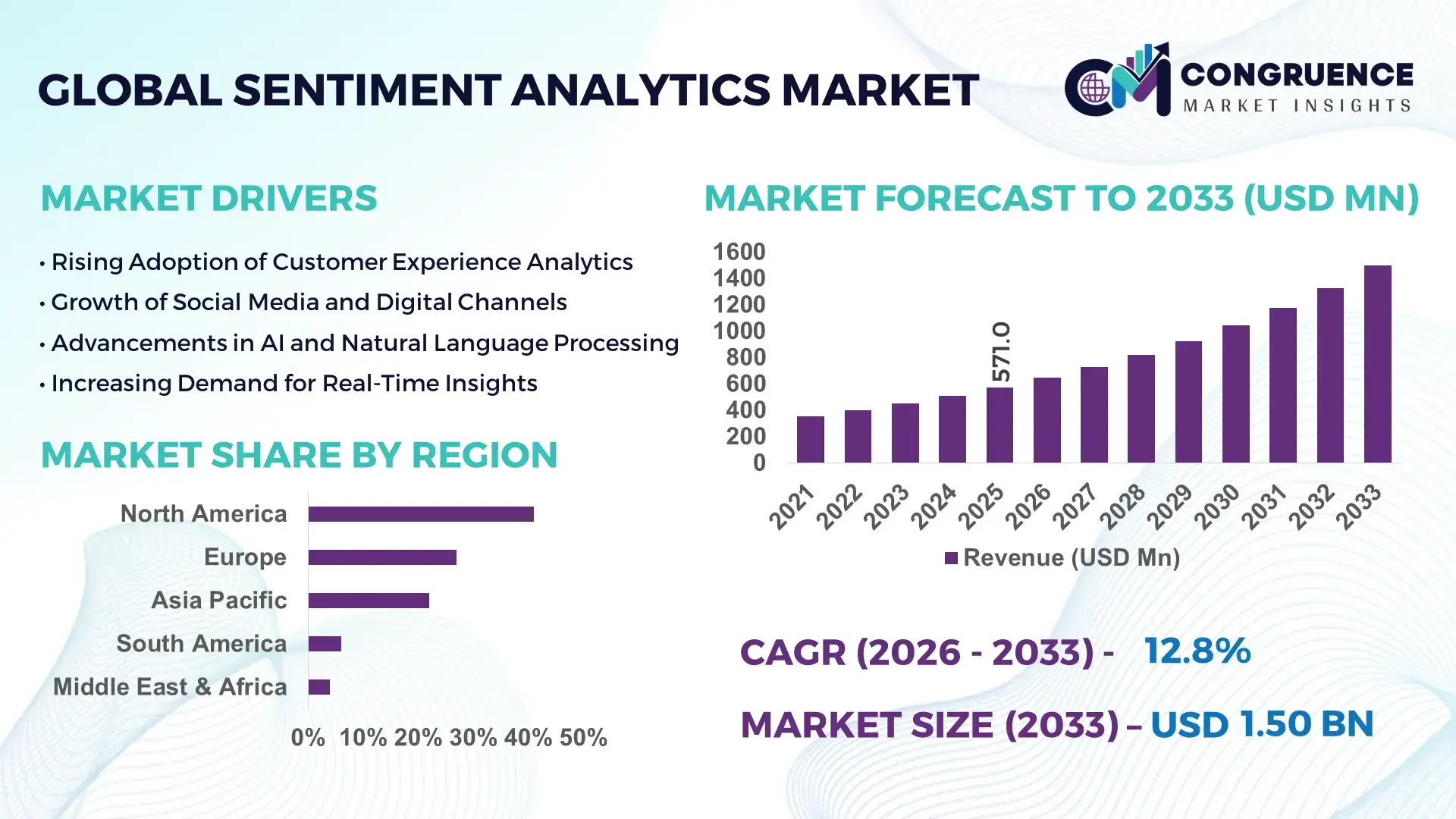
The United States represents the dominant national marketplace for sentiment analytics, supported by large-scale cloud infrastructure, advanced AI research funding, and enterprise-scale deployment across banking, retail, and healthcare. In 2025, over 68% of Fortune 500 companies in the U.S. deployed sentiment analytics within customer experience platforms. Annual corporate AI investment exceeded USD 120 billion, with natural language processing accounting for nearly 18% of enterprise AI budgets. The U.S. processes more than 45 billion customer interaction records annually through sentiment engines, with BFSI and e-commerce contributing over 52% of enterprise workloads. Consumer adoption of AI-enabled feedback analysis surpassed 62% across digital service platforms.
Market Size & Growth: USD 571.0 Million in 2025, projected to reach USD 1,496.6 Million by 2033, CAGR 12.8%, driven by enterprise AI adoption and CX automation.
Top Growth Drivers: Digital customer engagement 48%, contact center automation 41%, social media analytics adoption 37%.
Short-Term Forecast: By 2028, automated sentiment scoring is expected to improve customer resolution efficiency by 32%.
Emerging Technologies: Transformer-based NLP, multimodal sentiment fusion, real-time speech emotion detection.
Regional Leaders: North America USD 610 Million by 2033, Europe USD 410 Million by 2033, Asia Pacific USD 350 Million by 2033, each driven by cloud-native analytics adoption.
Consumer/End-User Trends: BFSI, retail, and telecom account for 58% of enterprise usage, with omnichannel analytics adoption exceeding 64%.
Pilot or Case Example: In 2024, a U.S. telecom pilot reduced churn by 19% using real-time sentiment routing.
Competitive Landscape: Market leader holds ~22% share, followed by IBM, Microsoft, Google, NICE, and Salesforce.
Regulatory & ESG Impact: AI transparency rules and data privacy compliance influencing 46% of enterprise deployments.
Investment & Funding Patterns: Recent funding exceeded USD 3.2 Billion across enterprise AI and CX analytics.
Innovation & Future Outlook: Integration with generative AI and decision automation shaping next-generation platforms.
The sentiment analytics market spans BFSI with 31% contribution, retail and e-commerce with 27%, telecom with 14%, healthcare with 11%, and media with 9%, driven by conversational AI, speech-to-text analytics, and regulatory-grade auditability, while Asia Pacific consumption growth exceeds 21% annually.
The sentiment analytics market has become a strategic pillar for enterprise intelligence, enabling organizations to convert unstructured customer data into measurable business actions. Transformer-based natural language models deliver 42% improvement in classification accuracy compared to legacy rule-based text mining standards. North America dominates in volume, while Asia Pacific leads in adoption with 59% of large enterprises integrating sentiment analytics into CRM and ERP platforms.
By 2028, generative AI-driven sentiment orchestration is expected to cut customer complaint resolution time by 35%, while automated voice sentiment engines are projected to improve agent productivity by 28%. Firms are committing to ESG-aligned data governance improvements such as 30% reduction in biased model outputs by 2030 through explainable AI frameworks.
In 2024, a leading European bank achieved 24% reduction in fraud investigation time through multimodal sentiment risk scoring. Strategic pathways increasingly focus on cross-channel sentiment fusion, regulatory-grade explainability, and integration with decision intelligence layers. The Sentiment Analytics Market is positioned as a foundation of resilience, compliance, and sustainable digital growth across customer-centric industries.
The Sentiment Analytics Market is shaped by rapid digital transformation, expansion of omnichannel customer engagement, and rising enterprise demand for real-time decision intelligence. Over 80% of enterprise data remains unstructured, creating sustained demand for scalable NLP and speech analytics platforms. Cloud-native deployments now represent 67% of new installations, while API-based integration adoption exceeds 54% across large enterprises. Regulatory frameworks around AI governance, data localization, and explainability increasingly influence vendor architecture and procurement cycles.
Enterprises analyze more than 3.5 trillion customer messages annually, with real-time sentiment scoring now embedded in 61% of contact centers. Automated routing based on emotional tone improves first-contact resolution by 29%, while predictive sentiment models reduce churn risk by 21%. BFSI alone processes over 14 billion sentiment-tagged interactions per year, accelerating platform adoption.
Over 46% of enterprises delay deployments due to AI governance risks. Compliance costs linked to GDPR, HIPAA, and AI audit requirements increased enterprise deployment budgets by 18%. Bias detection and model retraining now consume 23% of operational AI spend, slowing rollout timelines.
Generative AI-enabled sentiment summarization reduces analyst workload by 41% and improves insight extraction speed by 36%. Multilingual sentiment engines now support over 120 languages, expanding adoption across emerging markets where digital interactions are growing at 27% annually.
High-volume social and voice data streams grow by 38% annually, stressing model performance. Concept drift reduces model accuracy by 17% within 12 months, forcing frequent retraining cycles and increasing infrastructure utilization by 22%.
Expansion of Real-Time Speech Sentiment Engines: Over 64% of contact centers now deploy live voice emotion detection, reducing average handling time by 26% and increasing agent productivity by 31%.
Adoption of Multimodal Sentiment Fusion: Platforms combining text, voice, and facial cues improve classification accuracy by 34%, with enterprise pilot adoption exceeding 47% across BFSI and telecom.
Integration with Generative AI Assistants: More than 52% of enterprises embed sentiment signals into AI copilots, improving decision recommendation precision by 29% and reducing manual analysis hours by 38%.
Rise in Modular and Prefabricated Construction: The adoption of modular construction is reshaping demand dynamics in the Sentiment Analytics Market. Research suggests that 55% of the new projects witnessed cost benefits while using modular and prefabricated practices. Automated off-site fabrication reduced labor requirements by 33% and shortened project timelines by 28%, increasing demand for precision-enabled analytics systems across infrastructure projects.
The Sentiment Analytics Market is segmented by type, application, and end-user, reflecting the expanding scope of AI-driven emotional and opinion intelligence across enterprise environments. By type, platforms are evolving from traditional text-based engines to multimodal systems integrating voice, video, and contextual signals. Application-wise, customer experience management remains the dominant use case, followed by brand monitoring, market intelligence, and workforce analytics. End-user adoption is concentrated across BFSI, retail, telecom, healthcare, and media, where large volumes of unstructured interaction data create sustained demand for real-time sentiment insights. More than 64% of large enterprises now deploy sentiment analytics within at least one core business workflow, while over 52% use it across multiple departments. The segmentation landscape is increasingly shaped by cloud deployment, API-based integration, multilingual processing, and regulatory-grade explainability requirements.
Text-based sentiment analytics currently account for 46% of overall adoption, driven by mature NLP pipelines, low computational cost, and seamless integration with CRM and social listening platforms. Voice-based sentiment analytics holds 28% of adoption, fueled by rapid deployment across contact centers and IVR systems for emotion-aware routing and compliance monitoring. However, multimodal sentiment analytics—integrating text, audio, and visual cues—is rising fastest, expected to expand at a 15.6% CAGR, supported by advances in transformer architectures and edge AI inference.
Video-based sentiment analytics represents 14% of current adoption, with strong traction in security, advertising effectiveness, and telemedicine. Contextual and behavioral sentiment engines contribute a combined 12%, serving niche use cases such as employee engagement analytics and fraud detection.
Customer experience management leads with a 39% application share, supported by omnichannel feedback analytics, churn prediction, and real-time complaint routing. Brand monitoring and reputation intelligence follow at 21%, while market research and consumer insights platforms account for 17%. However, workforce analytics and HR sentiment tracking are growing fastest at a 14.9% CAGR, driven by remote work monitoring, burnout detection, and organizational pulse surveys.
Risk and compliance monitoring, along with product feedback optimization, contribute a combined 23%, supporting regulated industries and agile product teams. In 2025, more than 38% of enterprises globally reported piloting sentiment analytics for customer experience platforms, while 61% of Gen Z consumers indicated higher trust in brands using AI-driven chat and feedback systems.
BFSI is the leading end-user segment with a 31% share, driven by fraud risk detection, compliance voice monitoring, and customer churn analytics across high-volume service channels. Retail and e-commerce follow at 26%, supported by real-time review analysis, pricing sentiment tracking, and personalized marketing optimization. Telecom accounts for 17%, leveraging sentiment engines for network service quality analytics and automated complaint resolution.
Healthcare, media, and government collectively contribute 26%, with strong adoption in patient experience monitoring, political opinion tracking, and public service optimization. The fastest-growing end-user segment is healthcare, expanding at a 15.2% CAGR, fueled by telemedicine growth, patient engagement digitization, and regulatory emphasis on experience quality.
In 2025, over 42% of hospitals in the U.S. tested AI models combining clinical text with patient feedback, while 44% of SMEs reported deploying sentiment tools for digital marketing optimization.
North America accounted for the largest market share at 41% in 2025 however, Asia Pacific is expected to register the fastest growth, expanding at a CAGR of 14.6% between 2026 and 2033.
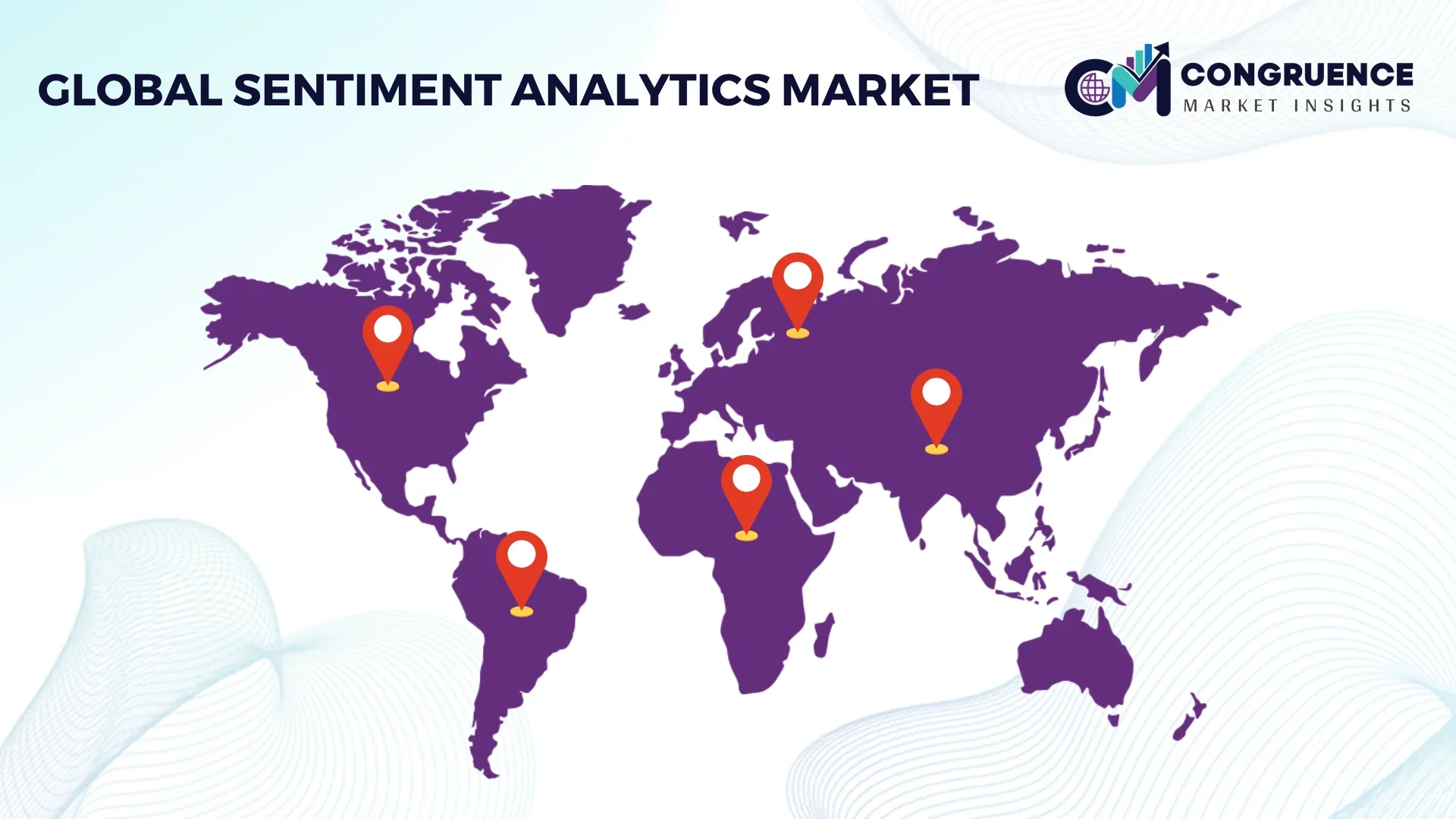
North America processed over 38 billion sentiment-tagged interactions in 2025 across BFSI, retail, and telecom. Europe followed with a 27% share, driven by regulatory-grade analytics and multilingual deployments across 24 official languages. Asia Pacific contributed 22% of global deployments, with more than 1.4 billion mobile users interacting with AI-driven feedback systems annually. South America and Middle East & Africa together represented 10%, but enterprise pilot density increased by 31% year-on-year. Cloud-native deployments exceeded 67% globally, while real-time speech analytics adoption crossed 59% across high-volume service regions, reshaping regional competitive dynamics.
North America commands approximately 41% of the global sentiment analytics deployment base, supported by high enterprise digital maturity and advanced cloud infrastructure. BFSI, healthcare, retail, and telecom collectively generate over 62% of regional demand. Regulatory frameworks around AI transparency and data protection now influence more than 48% of enterprise procurement decisions. Over 72% of large enterprises deploy sentiment analytics in at least two business functions. Local players continue to integrate real-time emotion detection into contact center platforms, processing more than 120 million voice minutes per day. Consumer behavior shows higher enterprise adoption in healthcare and finance, with 58% of hospitals using patient feedback analytics and 64% of banks deploying compliance-grade voice sentiment monitoring.
Europe accounts for nearly 27% of global adoption, led by Germany, the UK, and France, which together represent over 61% of regional installations. Regulatory pressure from data protection and AI governance frameworks drives demand for explainable sentiment models, now used in 53% of regulated enterprise deployments. Financial services, public administration, and manufacturing analytics dominate usage. More than 46% of European platforms support full model auditability and bias reporting. Local providers focus on multilingual sentiment engines supporting 20+ languages. Consumer behavior reflects regulatory-driven adoption, with 44% of enterprises prioritizing explainable AI over black-box models.
Asia Pacific ranks as the fastest-expanding region, representing 22% of current deployments. China, India, and Japan account for over 68% of regional consumption. Mobile-first analytics dominate, with more than 1.1 billion app-based interactions processed monthly. E-commerce, fintech, and super-app ecosystems drive adoption. Regional innovation hubs in Bengaluru, Shenzhen, and Tokyo host over 2,400 AI startups working on NLP and speech analytics. Local platforms deploy low-latency inference across 5G-enabled data centers. Consumer behavior shows growth driven by e-commerce and mobile AI apps, with 63% of users engaging via mobile channels.
South America contributes approximately 6% of global deployments, led by Brazil and Argentina, which together account for 72% of regional usage. Media monitoring, public services, and telecom dominate applications. Government digital inclusion programs increased enterprise AI pilots by 29% in 2025. Portuguese and Spanish language model optimization remains a core focus. Local providers process over 4.6 billion social media messages annually. Consumer behavior shows demand tied to media and language localization, with 57% of deployments focused on brand and political opinion analytics.
Middle East & Africa represents nearly 4% of global adoption, led by UAE and South Africa, contributing over 65% of regional deployments. Government digital transformation, oil & gas safety analytics, and smart city platforms drive demand. Over 38 national e-government programs integrate sentiment monitoring into citizen service portals. Arabic and African language model development expanded by 41% over two years. Consumer behavior varies by sector, with 49% of public-sector deployments focused on service quality monitoring and grievance redressal.
United States – 32% Market Share: Dominance driven by high enterprise AI penetration and large-scale cloud-native contact center deployments.
China – 18% Market Share: Leadership supported by massive digital consumer base and extensive mobile AI ecosystem integration.
The Sentiment Analytics Market exhibits a moderately fragmented competitive environment with more than 70 active providers offering a wide spectrum of text, voice, and multimodal emotional intelligence solutions. Despite this fragmentation, the top 5 companies collectively account for an estimated ~38–42% of enterprise deployments, reflecting a blend of established tech giants and specialized analytics vendors. Major players have differentiated through strategic partnerships, enhanced product launches, and aggressive AI integration strategies to maintain competitive positioning. In 2025 alone, Microsoft strengthened its ecosystem through collaboration with social listening platforms, while Google expanded multilingual sentiment capabilities within its AI developer tools, and IBM enhanced real-time sentiment analytics in core CX platforms. These moves illustrate how incumbents are embedding sentiment functions deeper into broader enterprise suites to capture cross-selling synergies and higher usage density. Innovation trends influencing competition include multimodal analytics converging text, voice, and visual cues, real-time sentiment inference, and agentic AI assistants that automate insight generation across feedback channels. Smaller and mid-sized players often focus on niche differentiators like cultural intelligence, sarcasm detection, or localized language modeling to compete with broad-based offerings. Overall, the competitive landscape reflects rising demand for scalable, explainable, and real-time emotional intelligence tools that fit varied enterprise needs and deployment models.
Salesforce
Qualtrics
Clarabridge
Brandwatch
Lexalytics
SAS
Medallia
Rasa
MonkeyLearn
Hootsuite
NLP Cloud
Enterpret
Uniphore
Dig
The Sentiment Analytics Market is being reshaped by a range of current and emerging technologies that are driving deeper insights, improved accuracy, and broader use-case adoption across industries. A key trend is the integration of Generative AI capabilities into sentiment engines, enabling automated theme extraction, contextual understanding, and narrative summarization across large volumes of unstructured data. In 2024–2025, platforms began incorporating generative models to enhance multi-language sentiment interpretation and accelerate response automation in customer support suites. Another significant technological driver is the proliferation of multimodal sentiment analytics, which fuses text, audio, and visual signals to capture emotional nuance more effectively than text-only models. In practical terms, this means enterprise systems can now detect voice-based emotion cues or subtle visual expressions from video feeds in addition to traditional textual sentiment classification. Real-time inference engines, powered by edge AI and low-latency cloud services, allow businesses to process high-frequency interaction data—such as call center voice streams or social media posts—with minimal delay. Additionally, cultural intelligence modules are improving sentiment interpretation by accounting for regional language idioms, emojis, and contextual nuances, enhancing global applicability. Explainability frameworks are also being embedded into analytics pipelines to address compliance and governance requirements, enabling enterprises to audit and justify sentiment-driven decisions. Together, these technologies are enabling sentiment analytics to evolve from descriptive reporting tools into predictive and prescriptive intelligence systems integral to strategic decision-making across customer experience, risk management, and brand health monitoring.
• In October 2025, Pulsar Group launched Insight Agents, AI-powered autonomous analytics tools embedded within its social and narrative intelligence platform to automate anomaly detection, forecasting, and routine sentiment tasks at enterprise scale. Source: en.wikipedia.org
• In March 2025, Uniphore launched its Business AI Cloud, enhancing sentiment and conversational intelligence capabilities across voice and workflow automation — expanding the company’s footprint in enterprise customer experience and contact center AI. Source: en.wikipedia.org
• In March 2025, Microsoft announced a strategic collaboration with a leading social listening platform to embed advanced sentiment analytics capabilities into its Azure AI ecosystem, expanding real-time brand perception insights across social networks for enterprise customers.
• In June 2025, Google expanded its Vertex AI platform to include enhanced multilingual sentiment extraction tools, enabling developers to deploy comprehensive sentiment models across customer feedback, news, and social data streams at scale.
The Sentiment Analytics Market Report provides a comprehensive examination of the market’s breadth, covering segmentation by product type (text analytics, voice analytics, multimodal analytics), deployment mode (cloud, on-premise), and diverse application areas such as customer experience management, brand reputation tracking, workforce sentiment analysis, and risk compliance monitoring. The report encompasses geographic analyses across North America, Europe, Asia Pacific, South America, and Middle East & Africa, offering insights into regional adoption drivers, local infrastructure trends, and unique consumer behavior patterns. Technology focus areas include traditional NLP, generative AI integration, real-time inference engines, multimodal fusion frameworks, explainability and governance layers, and cultural intelligence enhancements for global applicability. Industry verticals such as BFSI, retail and e-commerce, telecom, healthcare, media, and public sector use cases are examined to reveal how sentiment analytics supports operational excellence, customer loyalty programs, and product innovation. The scope also addresses emerging niches like employee engagement sentiment, predictive risk monitoring, and political/public opinion analytics, highlighting quantitative penetration rates and qualitative strategic impacts. By encompassing both foundational and cutting-edge aspects of sentiment analytics, the report serves as a strategic tool for decision-makers to benchmark competitive positions, identify technology priorities, and plan investments aligned with evolving enterprise intelligence needs.
| Report Attribute / Metric | Details |
|---|---|
| Market Revenue (2025) | USD 571.0 Million |
| Market Revenue (2033) | USD 1,496.6 Million |
| CAGR (2026–2033) | 12.8% |
| Base Year | 2025 |
| Forecast Period | 2026–2033 |
| Historic Period | 2021–2025 |
| Segments Covered |
By Type
By Application
By End-User Insights
|
| Key Report Deliverables | Revenue Forecast, Market Trends, Growth Drivers & Restraints, Technology Insights, Segmentation Analysis, Regional Insights, Competitive Landscape, Regulatory & ESG Overview, Recent Developments |
| Regions Covered | North America, Europe, Asia-Pacific, South America, Middle East & Africa |
| Key Players Analyzed | Microsoft, Google, IBM, Salesforce, Qualtrics, Clarabridge, Brandwatch, Lexalytics, SAS, Medallia, Rasa, MonkeyLearn, Hootsuite, NLP Cloud, Enterpret, Uniphore, Dig |
| Customization & Pricing | Available on Request (10% Customization Free) |




