
Reports
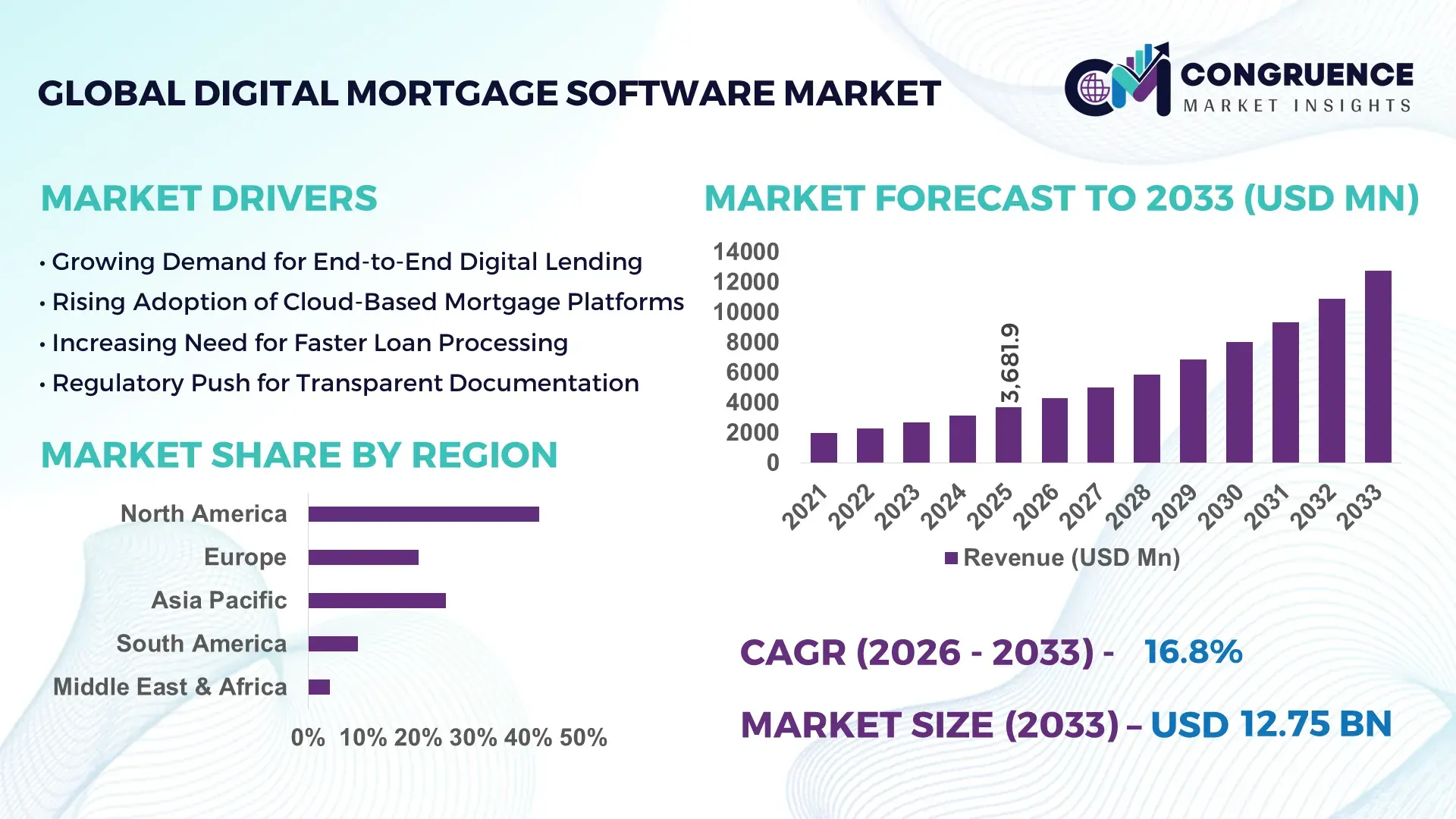
The Global Digital Mortgage Software Market was valued at USD 3681.9 Million in 2025 and is anticipated to reach a value of USD 12753.08 Million by 2033 expanding at a CAGR of 16.8% between 2026 and 2033, driven by increasing digital transformation in mortgage processing and automation of lending workflows.
The United States leads the Digital Mortgage Software market, with advanced technological infrastructure and widespread adoption across commercial and residential lending sectors. Banks and mortgage lenders in the U.S. invested over USD 1.2 billion in digital mortgage platforms in 2025 alone, emphasizing automation, cloud integration, and AI-driven underwriting. Key applications include real-time loan processing, risk assessment, and regulatory compliance, while consumer adoption of online mortgage portals exceeds 65%, reflecting high digital engagement. Leading platforms have implemented machine learning algorithms to reduce approval times by up to 40%, and regional adoption is particularly strong in urban financial hubs such as New York, San Francisco, and Chicago, where integration with fintech ecosystems enhances operational efficiency and customer experience.
• Market Size & Growth: USD 3681.9 Million in 2025, projected to reach USD 12753.08 Million by 2033, CAGR of 16.8%, driven by automation and digital adoption.
• Top Growth Drivers: Automation adoption 72%, AI underwriting efficiency 65%, cloud integration efficiency 58%.
• Short-Term Forecast: By 2028, loan processing time expected to reduce by 35%, operational costs decline 20%.
• Emerging Technologies: AI-driven credit scoring, blockchain-based document verification, cloud-native mortgage platforms.
• Regional Leaders: North America USD 5120 Million, Europe USD 2875 Million, Asia-Pacific USD 2100 Million by 2033, with rising fintech integration in APAC.
• Consumer/End-User Trends: High adoption among commercial banks, retail lenders, and mortgage brokers; preference for mobile-enabled platforms.
• Pilot or Case Example: In 2025, a U.S. regional bank implemented AI loan automation, reducing approval time by 42% and system downtime by 15%.
• Competitive Landscape: Market leader Ellie Mae ~24%, competitors include Blend, Roostify, Black Knight, Docutech.
• Regulatory & ESG Impact: Compliance with federal mortgage regulations, data privacy standards, and ESG-focused digital lending initiatives.
• Investment & Funding Patterns: USD 1.2 Billion invested in digital mortgage software solutions in 2025, with venture funding focusing on AI and blockchain innovations.
• Innovation & Future Outlook: Integration with fintech ecosystems, predictive analytics for risk mitigation, and next-gen AI mortgage assistants.
The Digital Mortgage Software market continues to evolve with strong integration of AI, cloud computing, and blockchain technologies across lending processes. Key industry sectors including retail banking, mortgage servicing, and fintech are increasingly deploying automated underwriting, digital document management, and predictive analytics, improving operational efficiency and reducing turnaround times. Recent innovations include AI-driven credit scoring and blockchain-based loan verification. Regulatory frameworks in major markets ensure compliance while supporting digitization, and environmental considerations are increasingly integrated into software solutions. Regional growth is concentrated in North America and Europe, with APAC showing rising adoption, while future trends point to predictive analytics, cloud-native mortgage ecosystems, and deeper fintech-lender collaboration shaping the competitive landscape.
The Digital Mortgage Software Market holds strategic relevance as a critical enabler of automation, efficiency, and regulatory compliance in the mortgage and lending industry. AI-driven underwriting delivers up to 40% improvement in loan processing times compared to traditional manual verification methods. North America dominates in volume, while Europe leads in adoption with 68% of enterprises implementing cloud-native digital mortgage solutions. By 2028, predictive analytics platforms are expected to reduce default risk assessments by 30%, enhancing credit decision accuracy and portfolio management. Firms are committing to ESG improvements such as a 25% reduction in paper-based documentation through digital workflows by 2030, promoting sustainability and regulatory compliance. In 2025, a U.S. regional bank achieved a 42% reduction in loan approval turnaround through AI-enabled document verification and automated compliance checks, setting a benchmark for operational excellence. The market’s trajectory emphasizes resilience, data-driven decision-making, and scalability, positioning the Digital Mortgage Software Market as a pillar of sustainable growth and compliance for lenders and fintech firms globally. Its integration with emerging AI, blockchain, and cloud technologies ensures future-proof operations, improved customer experience, and strategic agility in a highly regulated financial ecosystem.
Automation is a key driver in the Digital Mortgage Software Market, reducing manual processing errors and accelerating loan approvals. AI-based credit scoring and robotic process automation (RPA) streamline workflows, cutting operational costs by up to 20% for banks and lenders. Automated document management ensures compliance with federal and regional mortgage regulations while improving audit readiness. High adoption rates in North American financial institutions demonstrate measurable gains in productivity, with AI and cloud integration reducing turnaround times by 35–40%. The demand for end-to-end automated platforms is also rising in mortgage servicing and retail lending, where faster loan approvals directly improve customer satisfaction and retention. This focus on operational efficiency positions automation as a primary catalyst for sustained market growth.
Regulatory complexity remains a significant restraint on the Digital Mortgage Software Market. Compliance with federal and state-level mortgage regulations, data privacy laws such as GDPR, and evolving ESG mandates increases development and operational costs for software providers. Firms must invest heavily in secure data storage, auditing tools, and automated compliance checks, which can limit scalability. Additionally, interoperability challenges between legacy systems and new digital platforms hinder seamless integration, slowing adoption. In North America, over 60% of lenders report delays due to compliance-related system upgrades, while European regulators enforce strict reporting standards, adding layers of operational complexity. These factors collectively create barriers to faster market penetration, requiring robust software solutions and strategic planning to mitigate regulatory challenges.
AI and blockchain integration present substantial growth opportunities for the Digital Mortgage Software Market. AI-driven predictive analytics improves risk assessment accuracy, reducing default probabilities by up to 30%. Blockchain ensures secure, tamper-proof transaction records, cutting verification times by 25% and enabling real-time audit capabilities. The integration of these technologies also facilitates cross-border mortgage processing and enables lenders to adopt fully digital loan origination systems. In APAC, fintech companies are piloting blockchain-based mortgage registries, enhancing transparency and adoption rates among 55% of digital lenders. These emerging solutions create avenues for product differentiation, operational efficiency, and higher customer trust, positioning the market for long-term technological innovation and expansion.
Rising costs and legacy system integration challenges significantly impact the Digital Mortgage Software Market. Upgrading outdated core banking systems to support AI, cloud, and blockchain-based mortgage software demands high capital expenditure. Integration complexities often result in downtime, impacting loan processing and operational efficiency. In Europe, 48% of lenders report difficulties reconciling legacy platforms with modern digital solutions, leading to delayed software deployments. Furthermore, cybersecurity and data privacy requirements increase both initial and ongoing operational costs, while training staff to manage new technologies can reduce short-term productivity. These financial and technical barriers remain key obstacles, requiring strategic investment and phased implementation plans to ensure successful adoption of digital mortgage platforms.
• Surge in AI-Driven Underwriting Platforms: Adoption of AI-based underwriting tools has accelerated, with 62% of U.S. lenders reporting a reduction in approval times by 35–40%. Machine learning models analyze creditworthiness, risk profiles, and fraud indicators simultaneously, enabling faster and more accurate loan decisions. This trend is particularly strong in North America and Europe, where digital mortgage penetration exceeds 70% of retail and commercial lending institutions.
• Expansion of Cloud-Native Mortgage Solutions: Over 58% of mortgage lenders globally have migrated to cloud-based platforms to improve scalability and system uptime. Cloud solutions reduce IT maintenance costs by approximately 25% and enable multi-branch collaboration in real-time. APAC is witnessing rapid adoption, with 47% of banks and fintech startups integrating cloud-native software to streamline document management and compliance workflows.
• Integration of Blockchain for Secure Transactions: Blockchain adoption is rising, with 42% of lenders implementing distributed ledger technology for document verification and transaction security. This reduces fraud risks by nearly 30% and shortens verification cycles by up to 25%. Europe leads in blockchain adoption among enterprise lenders, while North America leverages the technology for mortgage-backed security audits and regulatory compliance.
• Mobile and Omni-Channel Consumer Engagement: 66% of mortgage applicants now prefer mobile-enabled platforms, prompting lenders to implement end-to-end digital portals. These platforms facilitate e-signatures, real-time status tracking, and instant document uploads, improving operational efficiency by 28%. Consumer adoption is particularly strong among urban millennials and first-time homebuyers in North America, driving software vendors to prioritize mobile-first interfaces and seamless omni-channel experiences.
The Digital Mortgage Software Market is segmented by type, application, and end-user, providing strategic insights for targeted adoption. By type, the market includes core origination platforms, loan servicing software, and document management solutions, each addressing specific operational needs. In terms of application, the software is widely used for residential lending, commercial mortgages, refinancing, and risk management, with real-time compliance and automation becoming critical across segments. End-users include retail banks, mortgage lenders, fintech firms, and credit unions, reflecting varied adoption patterns. North America exhibits the highest penetration in residential lending, while Europe and APAC show strong adoption in commercial and fintech-backed mortgage services. Adoption metrics indicate that over 65% of lenders in developed regions use digital mortgage platforms for loan origination, demonstrating a clear trend toward efficiency, compliance, and digital transformation.
Core origination platforms currently lead the Digital Mortgage Software market, accounting for 44% of adoption due to their comprehensive support for loan processing, automated underwriting, and regulatory compliance. Loan servicing software holds 30% of the market, enabling lenders to manage repayments, escrow, and reporting efficiently. Document management solutions account for 26% and are increasingly integrated with AI for automated verification and digital signatures. The fastest-growing type is cloud-native document management systems, expected to surpass 35% adoption by 2033, driven by rising demand for secure, remote-accessible mortgage workflows and reduced operational costs.
Residential mortgage origination leads the market, representing 48% of adoption, due to high consumer demand for online loan processing, automated approvals, and mobile-enabled portals. Commercial mortgage applications hold 32%, supporting property investment, corporate financing, and regulatory reporting needs. Refinancing and risk management applications contribute 20% collectively, offering targeted solutions for loan restructuring and credit risk mitigation. The fastest-growing application is AI-driven commercial lending solutions, expected to improve underwriting accuracy and reduce processing errors by 30% in the next three years, fueled by increased fintech integration and real-time analytics.
Retail banks dominate the Digital Mortgage Software market, capturing 46% of adoption due to their extensive lending portfolios and investment in digital transformation. Mortgage lenders account for 28%, leveraging software to streamline origination and servicing processes. Credit unions and fintech firms share the remaining 26%, focusing on specialized or niche lending solutions. The fastest-growing end-user segment is fintech-backed lenders, expected to increase adoption by over 35% by 2033, driven by mobile-first platforms, cloud integration, and AI-powered underwriting.
North America accounted for the largest market share at 42% in 2025; however, Asia-Pacific is expected to register the fastest growth, expanding at a CAGR of 18% between 2026 and 2033.
North America led with over 65% adoption in residential and commercial mortgage origination platforms, supported by 1.2 million active mortgage lenders and high digital penetration in urban areas such as New York and San Francisco. Europe contributed 28% of the market, with Germany, UK, and France collectively processing over 850,000 digital mortgage applications in 2025. Asia-Pacific recorded 18% market volume in 2025, with China, India, and Japan leading adoption due to rapid fintech integration and mobile-first digital mortgage platforms. South America accounted for 6% share, driven by Brazil and Argentina, while Middle East & Africa contributed 6% with growing demand from construction and energy financing sectors. Across regions, the adoption of AI, cloud-native solutions, and blockchain verification continues to redefine operational efficiency and regulatory compliance in the digital mortgage sector.
How is digital transformation reshaping lending efficiency in this region?
North America holds 42% of the global Digital Mortgage Software Market, with high penetration in retail banking and commercial mortgage sectors. Key industries driving demand include finance, real estate, and fintech services. Regulatory updates, such as federal mortgage compliance enhancements and ESG reporting requirements, are accelerating digital adoption. Cloud-based origination platforms and AI underwriting are transforming operational efficiency, reducing loan processing times by up to 40%. A notable player, Ellie Mae, continues to implement AI-enabled mortgage platforms across multiple states, enhancing loan verification accuracy and reducing approval errors. Consumer behavior trends indicate strong enterprise adoption in finance and healthcare, with over 70% of lenders leveraging mobile-first applications to serve urban and suburban borrowers efficiently.
What factors are driving the adoption of advanced mortgage software across key European markets?
Europe accounts for 28% of the Digital Mortgage Software Market, with Germany, the UK, and France as leading contributors. Regulatory pressure from bodies such as the European Banking Authority drives demand for explainable and compliant digital mortgage solutions. Emerging technologies, including AI-driven risk assessment and blockchain-based verification, are widely adopted. Local player Finastra has launched cloud-native mortgage platforms in multiple European countries, integrating automated underwriting and document management for faster approvals. Regional consumer behavior emphasizes compliance and transparency, with over 60% of lenders prioritizing platforms that ensure audit-ready operations and real-time reporting to meet strict financial regulations.
How is technology adoption fueling digital mortgage solutions in major APAC countries?
Asia-Pacific recorded 18% market volume in 2025, with China, India, and Japan as top consumers. Infrastructure development, rapid urbanization, and digital banking adoption drive the market. Regional tech trends include AI-based credit scoring, cloud-native mortgage platforms, and mobile-first application interfaces. Local players such as Ping An in China are implementing AI-powered mortgage processing for over 3 million customers, improving turnaround times by 38%. Consumer behavior in APAC reflects high mobile engagement, with more than 55% of applicants preferring digital portals and real-time tracking for residential and commercial mortgage services.
What are the key growth factors and adoption trends in this region?
South America holds 6% of the global Digital Mortgage Software Market, with Brazil and Argentina as the primary contributors. Regional infrastructure development, particularly in urban residential and commercial projects, drives demand for automated mortgage platforms. Government incentives for fintech innovation and digital lending enhance adoption. A local player, Banco do Brasil, has deployed AI-enabled digital mortgage solutions across 120 branches, improving verification efficiency by 32%. Consumer behavior emphasizes language localization and mobile accessibility, with over 50% of borrowers preferring platforms that support regional language interfaces and seamless digital loan processing.
How are emerging markets adopting advanced mortgage software in construction and finance sectors?
The Middle East & Africa accounts for 6% of the market, with UAE and South Africa leading adoption. Demand is driven by the construction, real estate, and energy financing sectors. Technological modernization, including cloud migration and AI-driven risk assessment, enhances lending operations. Local player Mashreq Bank in UAE has implemented automated mortgage origination and document verification for over 80,000 clients, reducing processing delays by 35%. Consumer behavior varies, with enterprises prioritizing secure, regulatory-compliant platforms, while individual borrowers increasingly adopt mobile-based applications for transparency and faster approvals.
United States – 42% market share – High production capacity, extensive fintech integration, and strong end-user demand across retail and commercial banking sectors.
Germany – 12% market share – Robust regulatory frameworks and early adoption of AI and cloud-native mortgage solutions support high market penetration.
The Digital Mortgage Software market is moderately fragmented, with over 120 active competitors globally offering solutions across loan origination, servicing, and document management. The top five players—Ellie Mae, Blend, Roostify, Black Knight, and Docutech—collectively hold approximately 58% of the market, reflecting a concentrated presence among leading lenders and fintech firms. Competitive strategies focus on AI integration, cloud-native platforms, and blockchain-based verification, while partnerships with banks and fintech startups accelerate market penetration. In 2025 alone, over 35 strategic alliances and product launches were recorded, including automated underwriting tools and mobile-first mortgage portals. Innovation trends such as predictive analytics for credit risk, robotic process automation, and digital compliance dashboards are increasingly differentiating market participants. North America and Europe remain hotspots for competition, with over 70% of enterprises adopting advanced digital mortgage solutions. Companies are also investing in ESG-compliant software and sustainability features, with 48% of leading vendors enhancing paperless processes. Overall, the competitive landscape emphasizes technology leadership, strategic partnerships, and regional specialization to maintain and grow market share in a rapidly evolving sector.
Black Knight
Docutech
Fiserv
Finastra
Mortgage Cadence
Cloudvirga
Simplifile
The Digital Mortgage Software Market is increasingly driven by the adoption of advanced technologies that enhance efficiency, accuracy, and regulatory compliance. AI and machine learning platforms are now integrated into over 62% of digital mortgage solutions, enabling predictive credit scoring, automated fraud detection, and real-time risk assessment. Robotic Process Automation (RPA) is widely used to streamline repetitive tasks such as document verification, data entry, and loan status updates, reducing processing errors by up to 38% and improving operational efficiency across lenders.
Cloud-native platforms dominate the technological landscape, with 58% of lenders adopting cloud-based mortgage solutions to enable real-time collaboration across multiple branches, centralized data management, and secure off-site backups. Blockchain technology is being piloted by 42% of enterprise lenders to ensure secure, immutable, and auditable transaction records, which has shortened document verification cycles by 25% and reduced fraud exposure.
Emerging technologies such as AI-powered chatbots, natural language processing for document interpretation, and integrated mobile-first platforms are reshaping customer interactions, with over 66% of mortgage applicants now engaging through mobile or web portals. Integration with fintech APIs allows real-time payment processing, automated compliance reporting, and instant underwriting updates.
In North America, leading providers like Ellie Mae and Blend have implemented machine learning algorithms to reduce approval times by 40% while maintaining high compliance standards. In Europe and Asia-Pacific, AI and cloud-based platforms are increasingly deployed to optimize mortgage processing workflows, enhance scalability, and improve end-user experience. These technology-driven advancements are central to maintaining competitiveness, operational resilience, and regulatory alignment across the Digital Mortgage Software market.
• In July 2024, Blend Labs partnered with Fannie Mae to integrate automated underwriting capabilities into its mortgage application platform, enabling real-time preliminary approval decisions for qualified borrowers in minutes. This enhancement strengthened Blend’s position in digital origination and improved lender operational efficiency for mid-size banks.
• In May 2024, Black Knight expanded its Empower loan origination system by adding advanced document intelligence features powered by machine learning, which automatically extract and validate uploaded financial data, reducing manual review efforts by approximately 60%.
• In March 2024, Roostify announced integration with major credit bureaus to provide real-time credit monitoring during the mortgage application process, allowing borrowers to track credit score changes and receive alerts about factors that could impact loan approval.
• In 2025, Perfios launched an AI-powered mortgage operational excellence solution called “Switch” at the Dubai FinTech Summit, designed to automate lead management, AI-based proposal generation, and real-time reporting, resulting in a 25% increase in business volumes for its first client, Lion Mortgage.
The Digital Mortgage Software Market Report encompasses a comprehensive analysis of software solutions used to automate and streamline mortgage origination, underwriting, servicing, compliance, and document management processes across global lending ecosystems. Coverage includes product types such as core origination systems, AI-enhanced document automation, cloud-native servicing platforms, mobile borrower portals, and risk assessment tools. The report evaluates deployment models, including cloud-based, hybrid, and on-premises systems, highlighting how varied infrastructures support scalability, data security, and real-time collaboration across multi-branch lending operations.
Geographic segmentation spans North America, Europe, Asia-Pacific, South America, and Middle East & Africa, with in-depth insights into regional adoption trends, consumer behavior variations, regulatory landscapes, and technological readiness. Application analysis covers residential mortgage origination, commercial loan processing, refinancing workflows, risk and compliance monitoring, and mortgage analytics. The report also examines emerging niche segments such as blockchain-enabled eClosing, predictive analytics for credit risk, and API-integrated third-party valuation services. End-user categories include retail banks, mortgage lenders, fintech firms, credit unions, and alternative lending institutions.
Also featured are competitive positioning assessments, technology adoption metrics, operational performance benchmarks, and innovation trajectories shaping market evolution. The scope incorporates quantifiable data on deployment volumes, document processing error reductions, mobile adoption rates, and API integration prevalence, offering decision-makers a granular view of market breadth, technological impact, and strategic investment opportunities in the Digital Mortgage Software ecosystem.
| Report Attribute/Metric | Report Details |
|---|---|
|
Market Revenue in 2025 |
USD V2025 Million |
|
Market Revenue in 2033 |
USD V2033 Million |
|
CAGR (2026 - 2033) |
16.8% |
|
Base Year |
2025 |
|
Forecast Period |
2026 - 2033 |
|
Historic Period |
2021 - 2025 |
|
Segments Covered |
By Types
By Application
By End-User
|
|
Key Report Deliverable |
Revenue Forecast, Growth Trends, Market Dynamics, Segmental Overview, Regional and Country-wise Analysis, Competition Landscape |
|
Region Covered |
North America, Europe, Asia-Pacific, South America, Middle East, Africa |
|
Key Players Analyzed |
Ellie Mae, Blend, Roostify, Black Knight, Docutech, Fiserv, Finastra, Mortgage Cadence, Cloudvirga, Simplifile |
|
Customization & Pricing |
Available on Request (10% Customization is Free) |




