
Reports
The Global Regenerative Agriculture Market was valued at USD 13090.1 Million in 2025 and is anticipated to reach a value of USD 31271 Million by 2033 expanding at a CAGR of 11.5% between 2026 and 2033. Growth is driven by corporate regenerative sourcing, soil-carbon measurement, no-till adoption, bio-based inputs, and policy-linked incentives that are shifting farms from input-intensive production toward measurable soil, water, and biodiversity outcomes.
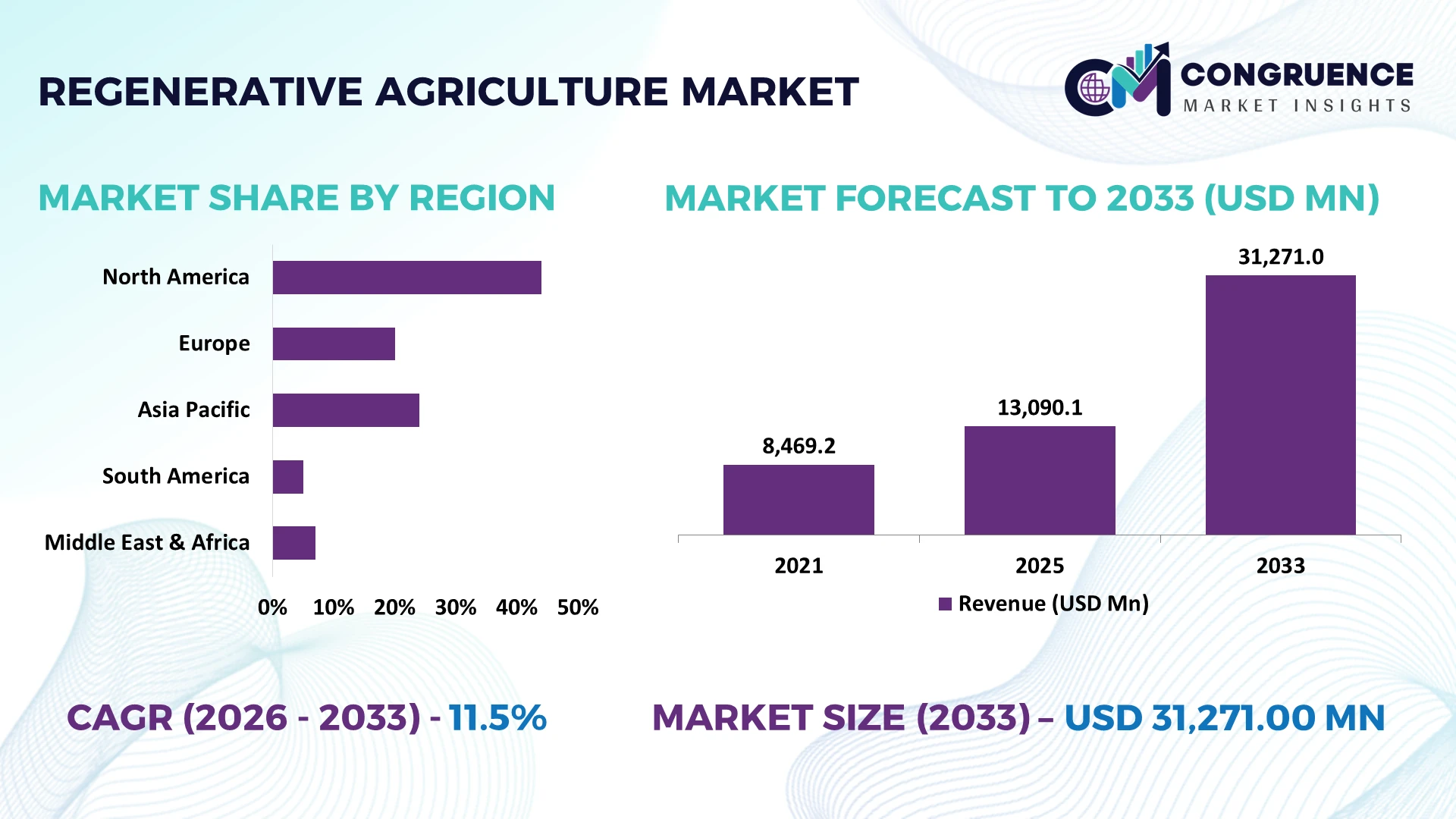
The United States holds the dominant position, with North America representing 35.7% of the global market in 2025, while U.S. regenerative agriculture programs covered more than 1 million Cargill RegenConnect acres for the 2025 planting season. Europe reached USD 4,030.6 million in 2025, while Asia Pacific represented 20.9%, highlighting a widening adoption gap and faster technology-led expansion across India and other Asian farming systems.
Strategic decisions should prioritize scalable soil-monitoring platforms, verified carbon outcomes, farmer-financing models, and supply-chain partnerships in North America while accelerating technology deployment across high-growth Asian markets.
Market Size & Growth: USD 13,090.1 million in 2025 to USD 31,271 million by 2033 at 11.5% CAGR, propelled by measurable soil-carbon and regenerative sourcing programs.
Top Growth Drivers: Corporate sourcing 35%, soil-health technology 30%, policy incentives 25%.
Short-Term Forecast: By 2028, digital soil monitoring is positioned to cut field-assessment costs by 15% and improve data efficiency by 20%.
Emerging Technologies: AI agronomy, satellite soil analytics, and autonomous no-till equipment are accelerating precision regenerative management.
Regional Leaders: North America leads at 35.7%; Europe reaches USD 16,558.2 million and Asia Pacific USD 13,404.0 million by 2033.
Consumer/End-User Trends: Nestlé sourced 27.6% of key ingredients from regenerative-practice farmers in 2025, up from 6.8% in 2022.
Pilot/Case Example: 2024 Lakhipara Tea Estate reduced pesticide toxicity by 52–77% while increasing soil organic carbon 6.72%.
Competitive Landscape: Cargill leads large-scale deployment, competing with Nestlé, General Mills, Indigo Ag, and Danone across regenerative supply chains.
Regulatory & ESG Impact: Regenerative programs align with restoration targets requiring finance to rise from USD 64 billion to USD 296 billion by 2030.
Investment & Funding: Regenerative landscape commitments reached USD 6 billion across 280 million hectares by end-2024, strengthening blended-finance pipelines.
Innovation & Future Outlook: AI verification, carbon MRV, biochar, agroforestry, and traceability are shifting competition toward outcome-based farming and resilient supply-chain models.
Regenerative Agriculture is gaining traction across soil and crop management, agroforestry, livestock integration, biochar, carbon measurement, and low-tillage systems. Technology-led adoption is strengthening, with North America accounting for 35.7% of the market in 2025 while Asia Pacific reached 20.9%. Corporate food and beverage supply chains are increasingly embedding regenerative sourcing, supported by satellite monitoring, farm-level data platforms, biological inputs, and outcome-based incentives. The shift is creating stronger demand for measurable soil-health performance and traceable agricultural supply, setting the foundation for strategic expansion.
Regenerative agriculture is becoming strategically important because food producers, processors, and retailers increasingly compete on supply resilience, verified environmental performance, and access to differentiated agricultural inputs. Corporate sourcing programs are restructuring procurement around soil health, biodiversity, water efficiency, and traceable production, turning regenerative practices into a commercial capability rather than a niche sustainability initiative.
Digital soil mapping, satellite monitoring, AI-based agronomy, and farm-management platforms are strengthening deployment. Compared with manual field assessment, digitally integrated monitoring can reduce assessment time by roughly 20% while improving data consistency. The United States leads large-scale commercialization, while India is developing smaller, fragmented deployments where low-cost advisory platforms, biological inputs, and localized farmer networks are more important than highly automated machinery.
Over the next 2–3 years, adoption will increasingly depend on measurable soil-carbon improvements, farm-level traceability, and contracted procurement rather than voluntary participation alone. Companies are directing investment toward MRV platforms, farmer-financing models, biological inputs, and partnerships with food processors. Practical deployments combining cover crops, reduced tillage, precision nutrient management, and digital verification demonstrate how operational improvements can support ESG reporting and procurement security. Competitive advantage will increasingly belong to companies that integrate regenerative production with measurable data, resilient sourcing, and scalable commercial partnerships.
Corporate procurement is the strongest structural driver, as approximately 35% of regenerative-market activity is linked to supply-chain programs, while soil-health technologies are expanding adoption by about 30% across digitally enabled farms. In the United States, food companies are contracting growers around cover crops, reduced tillage, biodiversity, and verified soil outcomes. This shift converts regenerative agriculture from farm-level experimentation into procurement infrastructure. Companies are responding through multi-year farmer contracts, agronomic partnerships, digital MRV platforms, and biological-input investments. The non-obvious advantage is supply-risk reduction: healthier soils can improve input efficiency and production resilience, giving processors greater visibility over future raw-material availability while strengthening sustainability credentials.
Fragmented farm structures constrain deployment, particularly where smallholders dominate agricultural production. Digital monitoring can require 15–20% higher initial implementation expenditure than conventional advisory systems, while limited connectivity affects approximately 20% of digitally targeted rural operations in developing markets. India illustrates the challenge: fragmented holdings, uneven mechanization, and inconsistent soil-data availability complicate standardized regenerative protocols. Input-price volatility also makes farmers cautious about transitioning away from established production systems. Companies are reducing exposure through localized agronomy partnerships, cooperative purchasing, bundled technology services, and outcome-based contracts. The key operational constraint is not practice availability but verification and coordination at scale, making interoperable farm-data infrastructure essential for profitable commercialization.
AI-driven soil analytics, remote sensing, and automated farm recommendations create a high-value opportunity for precision regenerative agriculture. Digital decision systems can target 10–15% reductions in unnecessary field operations, while precision nutrient management can improve input-use efficiency by around 10%. Australia, the United States, and India offer distinct expansion opportunities through large farms, advanced agritech ecosystems, and extensive smallholder networks. Companies are increasing R&D around satellite-derived soil indicators, carbon MRV, biological inputs, and farm-level digital twins. A particularly attractive opportunity is linking regenerative verification directly with procurement contracts and financing, allowing verified soil outcomes to become commercial data assets rather than standalone ESG metrics.
Scaling regenerative systems requires consistent measurement across diverse soils, climates, crops, and farm-management practices. Variability in measurement methodologies can create 10–15% differences in reported field outcomes, while fragmented data systems can increase verification workloads by approximately 20%. In the United States, large commercial farms can deploy sensors and machinery rapidly; Indian deployments often require mobile-first tools, local agronomists, and cooperative structures. Companies must therefore invest in interoperable MRV infrastructure, standardized protocols, workforce training, and independent verification partnerships. The critical challenge is maintaining comparable performance data across thousands of farms. Competitive sustainability claims will increasingly depend on verified outcomes, making data integrity as important as the agricultural practice itself.
Digital Soil Intelligence Expands: AI soil mapping, satellite monitoring, and farm analytics are moving from pilots into routine workflows, with digital tools targeting 10–15% lower field-assessment costs and roughly 20% faster data processing. U.S. agribusinesses are integrating these systems with procurement and verification platforms, improving operational visibility and accelerating regenerative compliance.
Verified Supply Chains Strengthen: Food companies are restructuring sourcing around measurable soil, carbon, and biodiversity outcomes, with regenerative procurement programs increasingly covering 10–20% of selected ingredient supply. Traceability requirements and retailer ESG commitments are pushing suppliers toward standardized MRV, multi-year contracts, and farmer partnerships, creating a less visible shift from sustainability claims toward auditable procurement performance.
Mechanization Gets More Precise: No-till equipment, variable-rate application, autonomous guidance, and biological-input systems are becoming more integrated, reducing unnecessary field passes by about 10% and improving input-use efficiency by 8–12%. U.S. producers are combining cover crops with conservation tillage, while equipment manufacturers are adapting machinery portfolios around lower-disturbance workflows and labor-efficient operations.
Outcome-Based Farming Gains Ground: Carbon measurement, soil-health scoring, and performance-linked incentives are reshaping farm economics, with outcome-based programs targeting 10–15% improvements in resource efficiency. Supply-chain pressure and emerging verification standards are encouraging companies to fund farmer training, digital MRV, and localized agronomy rather than relying solely on input subsidies, strengthening long-term operational accountability.
Cover Cropping is estimated to hold the leading position at approximately 29% of regenerative agriculture activity, supported by relatively low equipment requirements, compatibility with existing rotations, and direct soil-erosion and moisture benefits. No-Till Farming follows at around 24%, with adoption strongest in large-scale mechanized systems where reduced field passes support fuel and labor efficiency. Crop Rotation accounts for roughly 21%, while Managed Grazing and Agroforestry represent about 15% and 11%, respectively. Companies are expanding seed portfolios, agronomic advisory services, and equipment partnerships around cover-crop and low-disturbance systems.
No-Till Farming is the fastest-growing type, driven by precision guidance, residue-management technology, and rising interest in lower fuel consumption. USDA data show no-till represented 35.6% of U.S. field-corn acres and 44.8% of soybean acres in the latest surveyed years, demonstrating that mature conservation practices are increasingly being integrated into broader regenerative systems. Agroforestry remains more specialized, while Managed Grazing is gaining relevance for integrated livestock systems. Investment is shifting toward interoperable equipment, biological inputs, and farm-data platforms rather than standalone practices.
Soil Health Management is estimated to lead applications with approximately 31% share, reflecting its direct connection to yield stability, nutrient efficiency, erosion control, and farm-level decision-making. Sustainable Crop Production follows at around 25%, while Carbon Sequestration represents nearly 20%. Water Conservation and Biodiversity Management account for approximately 14% and 10%, respectively. Soil-health applications are more mature because farmers can connect them directly to field performance, whereas carbon programs require stronger measurement, verification, and contracting infrastructure. Companies are therefore integrating soil diagnostics, biological inputs, and digital agronomy into broader farm-management packages.
Carbon Sequestration is the fastest-growing application, with adoption expanding as corporate buyers seek measurable Scope 3 and land-use outcomes. Digital MRV can improve verification workflows by roughly 15–20%, making carbon-linked programs more scalable. Water Conservation is becoming increasingly operational in drought-exposed agricultural systems, while Biodiversity Management is gaining importance within food-company sourcing frameworks. The strategic shift is toward combining applications rather than selling isolated outcomes, enabling companies to bundle soil, water, carbon, and production metrics into a single commercial platform.
Crop Farms are estimated to represent approximately 38% of market activity, reflecting their direct control over tillage, crop rotation, soil amendments, and input-management decisions. Agribusinesses account for about 23%, followed by Food Companies at 18%, Cooperatives at 13%, and Livestock Farms at 8%. Crop farms remain the largest deployment base because regenerative practices are embedded directly into field operations. However, Food Companies are becoming the fastest-growing buyer group as procurement teams connect regenerative sourcing with traceability, ESG reporting, and long-term raw-material security. Companies are responding through customized agronomy packages, contract farming, digital verification, and incentive-linked purchasing.
Food Companies are shifting from short-term sustainability pilots toward multi-year supplier ecosystems, while Agribusinesses increasingly bundle seeds, biological inputs, equipment, and advisory services. Cooperatives provide an important scaling mechanism for fragmented farms, particularly in India, where shared services reduce technology and training barriers. Livestock Farms remain smaller but strategically relevant through Managed Grazing and integrated crop-livestock models. The non-obvious competitive advantage is procurement intelligence: companies that capture farm-level regenerative data can improve supplier selection, traceability, and input planning simultaneously.
North America accounted for the largest market share at 35.7% in 2025 however, Asia-Pacific is expected to register the fastest growth, expanding at a CAGR of 13.1% between 2026 and 2033.
Corporate sourcing is accelerating large-scale regenerative deployment
North America leads the market through large-scale row-crop production, advanced precision-agriculture infrastructure, established agribusiness networks, and corporate sourcing programs. The region accounted for approximately 35.7% of global activity in 2025. U.S. deployment is concentrated across corn, soybean, wheat, and livestock supply chains, where cover crops, reduced tillage, soil monitoring, and carbon verification are becoming integrated into procurement workflows. Cargill’s RegenConnect program surpassed 1 million enrolled acres for the 2025 planting season, demonstrating commercial-scale adoption. Major food and agribusiness companies are also expanding farmer partnerships and regenerative sourcing commitments. Companies are prioritizing digital MRV, biological inputs, agronomic services, and outcome-based contracts to strengthen supply resilience while improving sustainability performance.
United States Market Outlook: The United States remains the primary operational hub because of its mechanized farming base, precision-agriculture infrastructure, advanced commodity logistics, and strong agribusiness ecosystem. Cargill’s regenerative program has engaged more than 1 million acres, while its long-term ambition targets 10 million acres. This scale supports rapid integration of soil monitoring, conservation equipment, and verified regenerative practices.
Policy alignment is reshaping regenerative farm economics
Europe is developing a policy-led regenerative agriculture structure where soil protection, biodiversity, climate targets, and sustainable procurement increasingly influence agricultural investment. Approximately 11% of EU agricultural land is managed organically, creating an established foundation for regenerative-adjacent practices. Smaller farm structures compared with the United States increase the importance of cooperatives, advisory platforms, and shared digital infrastructure. Companies are increasingly deploying soil diagnostics, farm-data platforms, traceability systems, and biological inputs to meet sustainability requirements while improving operational efficiency. Regulatory developments are also encouraging food companies to strengthen supply-chain documentation and environmental reporting. The competitive opportunity is shifting from standalone regenerative products toward integrated farm-management solutions that combine production performance with measurable environmental outcomes.
United Kingdom Market Outlook: The United Kingdom has strong farmer awareness, established agricultural research capabilities, and increasing commercial interest in soil-health management. Its market structure supports advisory platforms, field-level monitoring, and outcome-based supply agreements. Companies are positioning through partnerships with farmers, food processors, and technology providers, creating stronger commercialization pathways for measurable regenerative practices.
Fragmented agriculture is driving mobile-first regenerative solutions
Asia-Pacific is emerging as a major deployment market because of its extensive agricultural production base, fragmented farms, growing digital-advisory infrastructure, and increasing focus on soil and water resilience. The region represented approximately 20.9% of global activity in 2025. Regenagri programs covered nearly 2 million hectares globally by the end of 2024, with India recording approximately 50% growth in covered area. Adoption increasingly relies on mobile agronomy, farmer cooperatives, biological inputs, water-efficient cultivation, and simplified MRV rather than expensive automation. Companies are responding through localized partnerships, shared-service models, farmer financing, and low-cost verification technologies. The non-obvious advantage is that digital platforms can scale regenerative guidance across fragmented farms without requiring equivalent investment in machinery.
India Market Outlook: India combines extensive agricultural production with fragmented holdings, expanding digital advisory networks, and increasing emphasis on soil-health restoration. Regenerative deployment is increasingly supported through cooperatives, localized agronomy, biological inputs, and mobile-based monitoring. Companies with low-cost MRV, farmer-network partnerships, and scalable advisory platforms are well positioned to address the country’s highly distributed agricultural structure.
Brazil is linking regenerative production with export competitiveness
South America is increasingly shaped by Brazil’s large-scale soybean, corn, cattle, and sugarcane industries, creating substantial scope for integrated regenerative systems. Brazil benefits from extensive agricultural land, established low-carbon farming initiatives, sophisticated commodity logistics, and export-oriented supply chains. The country is strengthening land-restoration initiatives and sustainable agricultural financing, while international buyers increasingly demand traceability and stronger environmental credentials. Regenerative practices are therefore becoming connected with soil restoration, deforestation controls, carbon measurement, and supply-chain transparency. Companies are expanding farmer-financing programs, agronomic partnerships, digital monitoring, and verified sourcing models. However, regulatory uncertainty around sustainability frameworks remains an important investment consideration. The strongest competitive advantage comes from combining regenerative production with export compliance, traceability, and reliable commodity procurement.
Brazil Market Outlook: Brazil offers exceptional scalability because of its large commercial farms, advanced agricultural machinery base, established logistics networks, and export-oriented commodity production. The country’s low-carbon agricultural financing ecosystem is supporting adoption of conservation practices and resource-efficient technologies. Companies are increasingly integrating regenerative programs with traceability, carbon measurement, and sustainable commodity sourcing.
Water resilience is driving regenerative investment priorities
Middle East and Africa deployment is increasingly concentrated around water-stressed agriculture, degraded soils, livestock production, food security, and climate-resilient farming. Regenerative systems are being combined with irrigation modernization, drought-tolerant crops, agroforestry, managed grazing, and digital farm monitoring. Africa represents a significant expansion opportunity because farmer networks, cooperatives, development programs, and commercial supply chains can accelerate distributed deployment. Companies are prioritizing localized financing, mobile advisory platforms, climate-adaptive inputs, and soil-water management technologies. The strongest operational opportunity lies in combining regenerative practices with water-efficiency infrastructure rather than treating sustainability as a standalone agricultural objective. This approach improves resource productivity while strengthening resilience across food-production systems exposed to climate variability and infrastructure constraints.
South Africa Market Outlook: South Africa provides a comparatively advanced commercial farming ecosystem, established agribusiness infrastructure, and growing adoption of precision agriculture and conservation farming. Its combination of livestock production, crop cultivation, water-management requirements, and digital farm technologies creates strong potential for integrated regenerative systems. Companies are targeting partnerships that connect farm analytics with soil, water, and productivity outcomes.
Global leaders including Cargill, Nestlé, PepsiCo, General Mills, and Danone compete with specialist technology providers such as Indigo Ag and regional agribusiness networks. The top five players are estimated to control approximately 30% of organized commercial activity, reflecting a moderately concentrated structure built around farmer access and procurement scale. Competition increasingly centers on verified outcomes, with digital MRV targeting 15–20% higher verification efficiency and regenerative programs improving input efficiency by approximately 8–12%. Cargill is expanding farmer enrollment, while PepsiCo and food companies are strengthening regenerative sourcing partnerships. Vertical integration across agronomy, biological inputs, farm data, carbon measurement, and commodity procurement is reinforcing incumbent positions. Technology specialists compete through analytics, traceability, and scalable verification. The principal entry barrier is access to reliable farmer networks and trusted measurement systems. Winning requires procurement scale, farmer economics, interoperable technology, and credible outcome verification.
Cargill
Nestlé
PepsiCo
General Mills
Danone
Unilever
Archer Daniels Midland Company (ADM)
Bunge
Indigo Ag
McCain Foods
Olam Agri
Nutrien
Bayer
Syngenta
Current regenerative agriculture technology centers on precision soil sensing, satellite imagery, variable-rate application, no-till equipment, and digital farm records. Sensor-guided nutrient management can improve input efficiency by 1–2%, while precision application can reduce field operating costs by about 1%. Adoption is moving from pilot farms toward commercial supply-chain programs.
Emerging tools combine AI, machine learning, remote sensing, and automated irrigation to translate field data into regenerative decisions. AI-supported crop monitoring can improve decision accuracy and operational performance by 1–2%, while automated subsurface drip systems can raise water-use efficiency by 1–2%. Integrated digital MRV platforms are gaining deployment among larger growers and food companies because measurable outcomes strengthen procurement and compliance.
Disruptive potential lies in AI-enabled digital twins, robotics, biological inputs, and continuously verified carbon-and-soil measurement. Compared with manual scouting and blanket input application, integrated precision systems can deliver roughly 2% better operational efficiency. Adoption will accelerate through 2026–2028 as platforms connect machinery, sensors, farm records, and buyer incentives. Technology providers, large growers, input suppliers, and food brands benefit competitively through lower resource waste, stronger traceability, and more resilient sourcing. Acting now matters because interoperable data infrastructure and field-level automation increasingly determine scalability and faster response to weather and input volatility.
April 2024 ADM expanded its regenerative agriculture program beyond 2.8 million acres in 2023, targeting 3.5 million acres in 2024 and 5 million in 2025. The expansion broadened farmer participation, strengthening sustainable sourcing and supply-chain resilience globally across. Source: adm.com
November 2024 Cargill RegenConnect surpassed 1 million enrolled acres for 2025, with more than 40% of returning farmers adding acreage. The milestone signals accelerating farmer adoption of low-till, no-till, and cover-cropping practices, strengthening Cargill’s regenerative supply network commercially. Source: cargill.com
September 2025 ICAR-IARI and the S M Sehgal Foundation launched a collaborative project applying advanced technologies, including automation-enabled subsurface-drip fertigation, to regenerative production. The initiative targets improved productivity and resource-use efficiency, accelerating technology integration across Indian farming systems. Source: icar.org.in
May 2026 TechnoServe and ADM partnered to support 15,000 soybean farmers across four Maharashtra districts through an $500,000, 18-month program. Digital advisory tools, training, and market access are designed to strengthen climate resilience, soil health, and farmer livelihoods. Source: technoserve.org
The Regenerative Agriculture Market Report covers practice types including cover cropping, crop rotation, reduced tillage, no-till farming, agroforestry, integrated livestock, and soil restoration, with analysis by application across cereals, oilseeds, fruits, vegetables, and specialty crops. End-user coverage includes farmers, agribusinesses, food processors, retailers, and institutional buyers. Regional analysis spans North America, Europe, Asia-Pacific, South America, and Middle East & Africa, highlighting leading markets and emerging adoption pockets.
The report evaluates precision agriculture, AI-enabled farm management, remote sensing, digital MRV, biological inputs, smart irrigation, and carbon-measurement technologies. It assesses adoption patterns, supply-chain participation, practice deployment, and competitive positioning, including niche opportunities in regenerative sourcing, soil-carbon programs, and climate-resilient production. These insights support investment planning, geographic expansion, partnership strategy, technology prioritization, and competitive positioning while clarifying market direction between 2026 and 2033.
| Report Attribute/Metric | Report Details |
|---|---|
Market Revenue in 2025 | USD 13090.1 Million |
Market Revenue in 2033 | USD 31271 Million |
CAGR (2026 - 2033) | 11.5% |
Base Year | 2025 |
Forecast Period | 2026 - 2033 |
Historic Period | 2021 - 2025 |
Segments Covered | By Type
By Application
By End-User
|
Key Report Deliverable | Revenue Forecast, Growth Trends, Market Dynamics, Segmental Overview, Regional and Country-wise Analysis, Competition Landscape |
Region Covered | North America, Europe, Asia-Pacific, South America, Middle East, Africa |
Key Players Analyzed | Cargill, Nestlé, PepsiCo, General Mills, Danone, Unilever, Archer Daniels Midland Company (ADM), Bunge, Indigo Ag, McCain Foods, Olam Agri, Nutrien, Bayer, Syngenta |
Customization & Pricing | Available on Request (10% Customization is Free) |




