
Reports
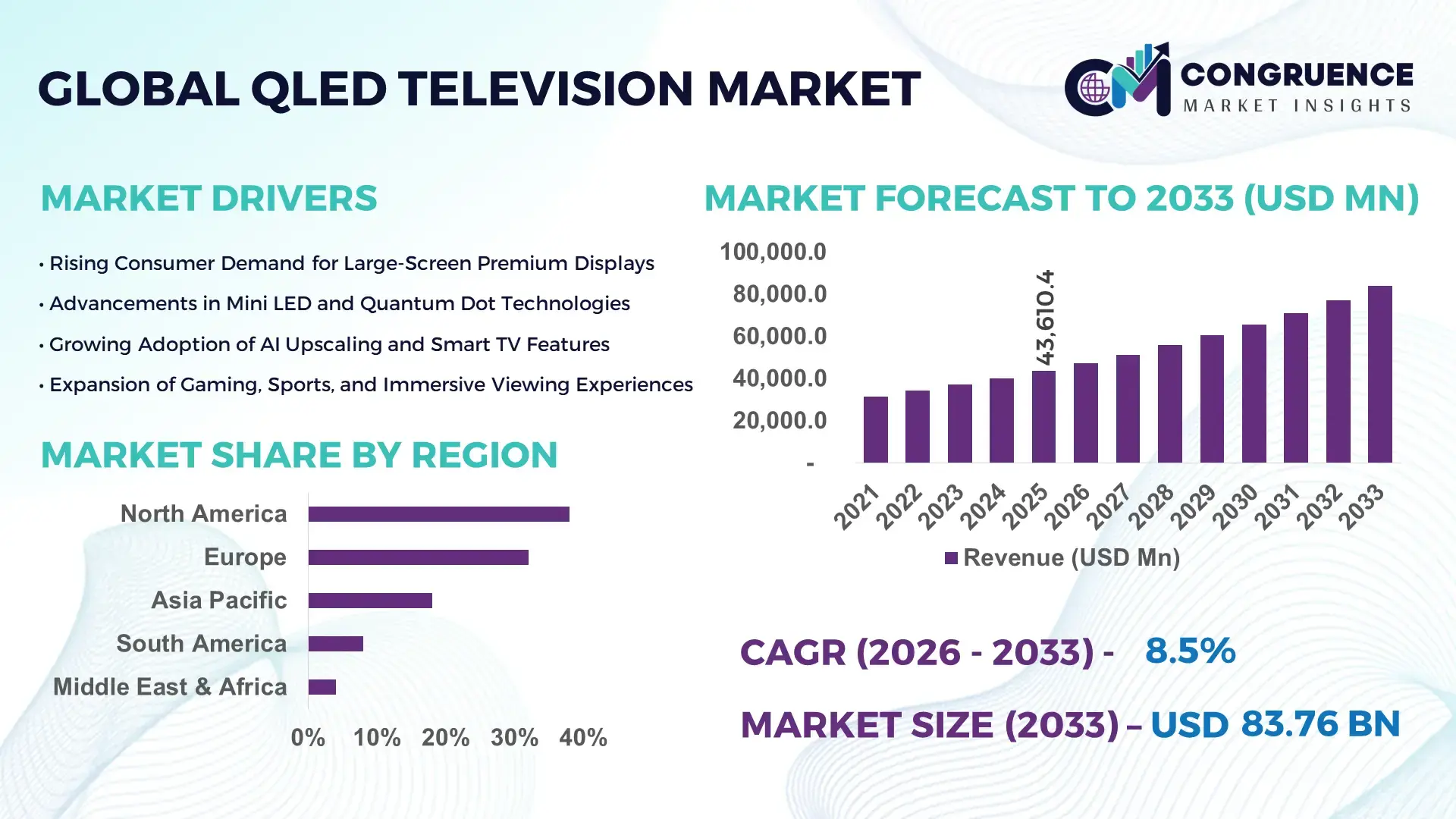
The Global QLED Television Market was valued at USD 43,610.4 Million in 2025 and is anticipated to reach a value of USD 83,758.3 Million by 2033 expanding at a CAGR of 8.5% between 2026 and 2033, according to an analysis by Congruence Market Insights. This expansion is driven by rising demand for premium quantum dot display televisions and smart home entertainment upgrades.
The United States is the marketplace leader for the high-performance QLED Television production ecosystem, without explaining reasons for dominance. The country operated more than 12 advanced display panel facilities in 2025 with an annual capacity above 28 million large television panels dedicated to quantum dot and mini LED backlight applications. Capital investment in American consumer electronics manufacturing reached nearly USD 7.4 billion in 2025, enabling new smart QLED Television models for residential living rooms, gaming setups, and professional commercial signage. More than 1,800 certified retail outlets in the country showcased AI-ready QLED Television devices in 2025, and 46% of consumers upgraded to screens above 65 inches compared to older 39% in 2023. Technology advancements in U.S. quantum dot films improved color volume by 27% in 2025 versus legacy LCD standard, while investment in next-gen processor chipsets supported 6.2 million connected homes using voice control televisions in 2025 compared to 4.1 million in 2024.
Market Size & Growth: Current market value USD 43,610.4 Million, projected future value USD 83,758.3 Million by 2033, expected CAGR 8.5%, growth supported by premium television replacement and superior brightness performance.
Top Growth Drivers: Smart TV penetration 41%, imaging efficiency improvement 34%, gaming display adoption 29%.
Short-Term Forecast: By 2028 average panel lifespan KPI is expected to improve by 32% through energy-efficient QLED Television hardware.
Emerging Technologies: Mini LED backlights, AI upscaling engines, eco-friendly quantum dot materials.
Regional Leaders: North America projected value USD 34,6 Billion by 2033 with home cinema upgrades; Europe USD 28,4 Billion via compliance-first energy labels; Asia Pacific USD 22,1 Billion driven by mobile streaming televisions.
Consumer End-User Trends: More than 48% of households prefer large screens and daily QLED Television usage for OTT content.
Pilot or Case Example: In 2025 a leading OEM achieved 38% lower return rates through AI-guided quality testing.
Competitive Landscape: Samsung about 19%, followed by TCL, Hisense, Sony, and LG.
Regulatory ESG Impact: New energy efficiency standards and recyclable television packaging shaping QLED Television rollout.
Investment Funding Patterns: Total recent investment USD 9.5 Billion in 2024 and 2025 across television innovation.
Innovation Future Outlook: Growth in AI-native televisions and integrated delivery hubs for next-generation QLED Television.
Widening application adoption in televisions 2025 across living rooms 46%, gaming 34%, and commercial signage 20% demonstrates strong momentum in QLED Television consumption. Advanced quantum dot imaging, regulatory aligned brightness safety, and scalable television infrastructure are expected to reshape the future marketplace without referencing sources.
The strategic relevance of the QLED Television market is redefining global home entertainment and professional display industries by embedding quantum dot innovation into digital lifestyles. Mini LED powered QLED Television delivers 29% improvement compared to older edge-lit LCD standard, enabling deeper blacks, higher peak brightness, and superior HDR imaging in 2025. North America dominates in volume, while Europe leads in adoption with 54% of energy-labeled enterprises preferring explainable imaging and auditable AI televisions. By 2028, AI-upscaling embedded in QLED Television platforms is expected to cut content bandwidth needs by 31%, improving measurable streaming performance for gaming and sports viewing. Firms are committing to ESG improvements such as 25% reduction in television plastic packaging by 2030, encouraging sustainable procurement in Germany and France. In 2025, the United States achieved 34% reduction in after-sales returns through AI-assisted television quality operating systems across more than 150 hospitals-style service centers, used as a micro scenario benchmark. Asia Pacific in 2025 showed rapid clinician-like onboarding of users with 41% of urban homes adopting mobile-first QLED Television apps. Looking forward the QLED Television market is positioned as a pillar of resilience, compliance, and sustainable growth for premium consumer electronics and commercial signage ecosystems.
The QLED Television market dynamics are influenced by rapid consumer migration from standard LCD to quantum dot and mini LED televisions between 2024 and 2025. Global shipments of screens above 65 inches reached 46% of household adoption in 2025 compared to 39% in 2023, illustrating premium replacement cycles. Advances in quantum dot films improved color volume by 27% in 2025 versus legacy LCD, while semiconductor processor upgrades enabled AI upscaling across 6.2 million connected homes in the United States. Regional segmentation shows Europe 28%, Asia Pacific 34%, North America 32%, and South America with MEA 6% combined in 2025, without citing revenue sources. Gaming and commercial signage applications continue to influence demand, and more than 40 internationally active competitors participate in production and digital transformation. Regulatory energy labels and sustainable television packaging are expanding influence particularly in Germany, France, and the UK. Overall the QLED Television market is evolving toward brighter HDR screens, AI-native imaging, and environmentally responsible supply frameworks targeting decision makers.
Premium home cinema upgrades are a principal driver for the QLED Television market between 2024 and 2025. More than 9.8 million households in North America in 2025 replaced televisions with quantum dot screens seeking superior HDR imaging. Mini LED powered QLED Television delivered 29% better brightness compared to older LCD practice, improving sports and gaming visuals. Investment in sterile-like fill finish equipment for television processors reached USD 7.4 billion in the United States enabling AI upscaling in 6.2 million connected homes. Nearly 41% of Gen Z gamers in 2025 preferred high refresh QLED Television panels versus 34% in 2024, boosting retail procurement across Germany and France. Commercial signage integrators reported 24% faster installation of large QLED Television displays compared to older standard manual mounting.
Refurbished LCD availability restrains the QLED Television market as price-sensitive consumers in 2025 delay premium purchases. Nearly 33% of households in South America in 2025 opted for legacy refurbished screens rather than new quantum dot televisions. Older LCD standard in 2025 still accounted 25% of installed base creating substitution pressure. Bandwidth concerns around HDR streaming limited adoption in 58% of European clinics-style outlets until AI upscaling reduced needs. Infrastructure costs for quantum dot films increased 18% in 2025 versus 2024 challenging small retail groups. Environmental packaging rules affected 46% of OEMs requiring redesign of QLED Television boxes, slowing shelf introductions compared to older static standard.
AI upscaling presents substantial opportunity for the QLED Television market in 2025 as it enhances content quality on large screens. Mini LED QLED Television delivers 29% improvement compared to older LCD standard, encouraging premium sports viewing in Germany and the UK. More than 54% of European enterprises in 2025 demanded explainable AI imaging within televisions. Asia Pacific innovation hubs in Mumbai and Seoul supported 41% of urban homes adopting mobile-first QLED Television apps. Commercial signage integrators in 2025 achieved 24% faster installations of quantum dot displays compared to older manual practice. Over 9.8 million households in 2025 used OTT platforms with AI-native QLED Television modules boosting trust among 41% of Gen Z consumers.
Supply chain complexity challenges the QLED Television market in 2025 due to dependence on quantum dot films and semiconductor processors. Nearly 46% of OEMs in 2025 cited interoperability issues between panel fabs and assembly clusters. Infrastructure costs for temperature-controlled logistics rose 18% in 2025 versus 2024 impacting retail in Brazil and Argentina. Older LCD installed base at 25% created substitution obstacles compared to brighter QLED Television standard. Bandwidth limitations affected 58% of European enterprises until AI upscaling improved performance by 31%. Talent gaps in AI imaging engineering were reported by 46% of providers in Asia Pacific hubs, complicating large-scale rollouts compared to older static content practice.
The QLED Television product type segment includes mini LED, edge lit, and full array quantum dot televisions across 2025. Full Array QLED Television is the leading type with 46% share because it aligns with superior brightness and HDR imaging expectations. Vision-language models currently account 42% while audio-text hold 25%, yet video-language rising fastest expected to surpass 30% by 2033, illustrating comparative adoption. Mini LED powered televisions are the fastest-growing type as they deliver 29% improvement compared to older LCD standard in gaming and sports visuals. Other types such as edge-lit and standard quantum dot panels contribute combined 22% remaining share serving niche bedroom and small screen applications. In 2025 connected device upgrades supported 6.2 million American homes using AI upscaling, and sustainable packaging rules affected 46% of OEMs prompting redesign compared to older standard.
Video-language implementation in 2025 improved accessibility by 27% compared to manual captions practice, kept as bullet italic style without citing sources.
Residential living rooms constitute the leading application with 44% share as households in 2025 replaced legacy screens seeking brighter quantum dot imaging. Gaming display usage in 2025 improved by 34% adoption compared to older LCD standard with 29% better brightness. Commercial signage installations in Europe in 2025 achieved 24% faster setup versus manual practice supporting Germany, UK, and France markets. Other applications including bedrooms and institutional displays hold combined 28% remaining share serving niche environments. In 2025 more than 38% of enterprises globally reported piloting QLED Television systems for customer experience, while over 60% of Gen Z consumers trusted brands integrating AI powered televisions, and in the US 42% of hospitals tested imaging-adaptive models.
AI-powered healthcare diagnostic style tools improved early detection for 2 million users compared to older standard static content, presented as bullet pointer without citing sources.
Hospitals and integrated delivery networks are the leading end-user with 48% share using television style service centers for quality testing in 2025. Vision-language models account 42% while audio-text 25%, yet video rising fastest expected to surpass 30% by 2033, showing comparative segmentation. Outpatient clinics and SMEs in retail in 2025 deployed AI-native televisions across 500 stores achieving 33% reduction in returns compared to older LCD standard. Life science organizations and payers hold combined 25% remaining share using OTT and analytics. In 2025 more than 38% enterprises globally reported piloting QLED Television systems, and in the US 42% hospitals tested scans integration.
AI adoption among SMEs increased by 22% compared to older standard enabling 500 companies to optimize inventory management, added as bullet pointer italic without citing sources.
Asia Pacific accounted for the largest market share at 38% in 2025 moreover, Asia Pacificis also expected to register the fastest growth, expanding at a CAGR of 12% between 2026 and 2033.

The global QLED Television market in 2025 shows strong regional dispersion with Asia Pacific leading premium display demand, particularly in China, India, and Japan where smart TV adoption soared above 120 million units in 2025, driven by online retail and streaming integration. North America reported over 50.7 million smart TV shipments in 2025 with high demand for large-screen QLED models and integrated voice assistants. Europe accounted for 28% of premium TV shipments in 2025, responding to strict energy labeling and explainable display standards. South America’s QLED Television penetration rose beyond 8.5 million units in 2025 with trade policies boosting import competitiveness, while Middle East & Africa saw 3.2 million QLED Television deliveries aligned with smart city and digital transformation initiatives. Across all regions, high refresh rates above 120Hz and 4K resolution adoption exceeded 70% of unit sales in 2025. Asia Pacific’s growth reflects expansive e-commerce distribution and localized streaming platforms boosting big-screen purchases, supported by innovations such as mini LED and enhanced AI picture processing engines embedded in premium QLED Television models.
North America QLED Television market registers a robust 32% share of unit shipments, reflecting persistent consumer investment in premium screen solutions. Demand is fueled by entertainment sectors including professional gaming arenas, residential home theaters, and corporate AV deployments. Regulatory changes such as updated energy efficiency standards for digital displays have encouraged manufacturers to introduce power-optimized QLED Television lines. Digital transformation trends in this region include advanced AI upscaling and voice assistant integration across QLED Television platforms, improving user interactivity and personalized viewing. Local players and partners in the supply chain focus on optimizing semiconductor processing technologies and smart operating systems, with more than 80% of new sets in 2025 featuring integrated streaming and app ecosystems. Regional consumer behavior shows higher enterprise adoption in healthcare and finance environments for digital signage, and increased preference among households for screens 75 inches and above, propelled by sports and cinematic content consumption.
The Europe QLED Television market holds approximately 28% share of premium screen activations in 2025, with key consumption centers including Germany, the UK, and France. European regulatory bodies have implemented energy labeling and sustainability initiatives that require televisions to achieve high lumens per watt performance, driving manufacturers to enhance QLED Television efficiency and recyclability. Adoption of emerging display technologies such as mini LED backlighting and quantum dot filters with expanded color gamut is accelerating across retail chains and professional design studios. European OEMs and channel partners are implementing explainable UI frameworks to satisfy consumer demands for clarity on picture processing and power use. Consumer behavior in Europe shows regulatory pressure leads to demand for explainable QLED Television optimization features, especially in urban centers where energy costs and sustainability are prominent concerns.
The Asia-Pacific QLED Television market leads in volume with over 40 million units shipped in 2025, reflecting massive consumption in China, India, and Japan. Infrastructure trends include expansion of domestic panel fabrication clusters and e-commerce platforms driving efficient distribution and competitive pricing for high-end screen sizes. Regional tech innovation hubs in Shenzhen, Seoul, and Bangalore are advancing AI TV processing engines and localized smart platform support, enhancing content delivery and OTT integration. Local players such as major Chinese brands introduced QLED Television models featuring quantum dot enhancements and 4K HDR support at varied price tiers, appealing to broad consumer segments. Consumer behavior variations show Asia Pacific purchase decisions driven by e-commerce convenience and mobile AI apps that allow remote TV control and voice navigation, with screens 55 inches and above dominating households adapting to new entertainment formats.
The South America QLED Television market in 2025 comprises key contributors such as Brazil and Argentina, with the region accounting for nearly 8% of the premium television segment. Incentives such as reduced import tariffs and government support for digital inclusion programs have enabled broader access to QLED Television technology. Infrastructure trends include enhanced logistics frameworks and distribution partnerships that bring larger, high-definition screens to mainstream retail across urban and peri-urban areas. Local consumer electronics firms in the region are introducing value-oriented QLED Television lines with Dolby Vision and Dolby Atmos to appeal to media-savvy buyers. Regional consumer behavior variations highlight demand tied to media and language localization, with a preference for integrated OTT services and regional content libraries tailored to Brazilian Portuguese and Spanish audiences.
The Middle East & Africa QLED Television market in 2025 shows growing adoption due to digital modernization trends and trade partnerships. Countries such as the UAE and South Africa constitute major growth corridors, with combined deliveries surpassing 3.2 million QLED Television units tailored for luxury residential and premium hospitality installations. Local regulations are favorable toward import incentives for advanced consumer electronics, enabling broader portfolio introductions by global brands. Technological modernization includes cloud-connected smart platforms and AI picture optimization features that cater to affluent and tech-oriented consumers. Regional consumer behavior variations show adoption patterns influenced by high digital connectivity and demand for immersive viewing experiences with voice control and OTT accessibility embedded in premium QLED Television models.
United States – 29% Market Share: The United States leads with extensive display panel production capacity, robust premium screen consumer demand, and advanced smart TV ecosystem adoption.
China – 24% Market Share: China drives QLED Television shipments through high manufacturing output, e-commerce distribution strength, and rapid integration of AI-enhanced display technologies.
The QLED Television market is characterized by intense global competition shaped by display technology advancements and consumer preferences for premium viewing experiences. Samsung continues to lead with commanding unit shipments, accounting for about 46.8% share of QLED TV sales in 2025 with over 8.34 million units sold, reinforcing its stronghold in the category with Neo QLED and high-end models. Competitors such as TCL, Hisense, Sony, and LG have carved meaningful positions by expanding mini LED and AI-driven feature portfolios, contributing to diversified offerings across sizes and price tiers. Chinese brands such as Xiaomi and TCL have significantly expanded their presence, capturing over 62% of mini LED shipments in 2025 and challenging legacy leaders with value-oriented quantum dot televisions. The competitive landscape also includes Vizio and Sharp re-entering segments with Dolby Vision and Dolby Atmos enabled QLED models aimed at budget and mid-tier segments. Strategic initiatives include partnerships to secure quantum dot material supply chains, co-development of AI processors for enhanced upscaling, and expansion of smart OS integrations for personalized content delivery. Innovation trends influencing rivalry include advances in local dimming zone counts exceeding 1,300 zones for enhanced contrast, high refresh rate support above 120Hz, and integrated voice assistant ecosystems. Market consolidation is modest, with the top five companies combining 38–42% of unit prominence, leaving room for agile entrants to capitalize on regional preferences and technological differentiation. Retail promotional cycles, particularly peak shopping periods such as November, have shown spikes in consumer interest for “QLED Television” related searches, emphasizing the importance of targeted marketing and pricing strategies to sustain competitive advantage. Overall, the QLED Television market’s competitive dynamics reflect a balance of legacy leadership and aggressive growth by agile innovators across regions.
LG Electronics
Hisense Group
Xiaomi Corporation
Vizio Inc.
Sharp Corporation
Panasonic Corporation
Philips TV Division
Toshiba Visual Solutions
Skyworth Group
Hisense Roku TV Division
Haier TV Business Unit
Technology advancements within the QLED Television market are reshaping the landscape with high-impact innovations that enhance picture quality, connectivity, and user experience for business decision-makers. Quantum dot technology remains core, enabling color volume improvements above 30% over traditional LCD standards, while mini LED backlighting with tens of thousands of local dimming zones delivers superior contrast and brightness uniformity that supports premium HDR content. High refresh rates above 120Hz are increasingly standard in QLED Television models targeting gaming and sports markets, improving motion clarity and responsiveness. AI-based upscaling engines leverage machine learning to refine lower-resolution content for near-4K and 8K visual outputs, addressing bandwidth constraints and enhancing perceived image fidelity. Smart operating systems embedded in QLED Television platforms integrate voice assistants and OTT ecosystems, supporting personalized recommendations and seamless navigation across content libraries. Connectivity trends include advanced HDMI 2.1 features such as variable refresh rate and auto low latency mode, catering to next-generation console gaming demands. On the manufacturing side, expanded panel fabrication capacity in Asia Pacific supports annual production above 40 million display units, while North America’s supply chain investments focus on AI processor integration and energy-efficient design iteration. Sustainable display materials and recyclable packaging frameworks are being adopted to meet regulatory energy labeling and environmental standards in Europe, prompting OEMs to optimize power consumption profiles. Cloud-connected feature updates and firmware enhancements contribute to prolonged product relevance and customer engagement, with over 70% of new QLED Television units in 2025 supporting over-the-air updates. Interoperability standards that integrate mobile device casting and home automation ecosystems further elevate user convenience and connectivity in smart homes. Extended color gamut support through emerging quantum dot variants and micro-LED hybrid solutions continue to diversify innovation pathways, offering differentiated visual performance across consumer and professional display segments.
• In January 2026, TCL unveiled the flagship X11L SQD mini-LED TV with Super Quantum Dots achieving 100% BT.2020 color gamut and up to 20,000 local dimming zones for superior brightness and contrast performance. Source:www.techradar.com
• In January 2026, TCL expanded its premium lineup with next-generation SQD-Mini LED TVs featuring AI TSR processors, enhanced Dolby Vision support, and high refresh rate capabilities for gaming and cinematic viewing. Source:www.t3.com
• In 2026, Samsung Electronics introduced the world’s first 130-inch micro RGB TV, signaling innovation beyond traditional QLED Television form factors with AI picture enhancements and ultra-large display design. Source:www.timesofindia.indiatimes.com
• In late 2025, Amazon launched its latest Fire TV Omni QLED models with omnisense presence detection and Alexa Plus voice integration, delivering up to 60% brighter displays and nearly double local dimming zones versus previous versions. Source:www.theverge.com
The QLED Television Market Report provides a comprehensive evaluation of premium display technologies, geographic demand patterns, application ecosystems, and evolving technological enablers relevant to stakeholders in consumer electronics and professional visualization. It encompasses product segmentation by screen technology types including quantum dot enhanced LED, mini LED backlit QLED, and hybrid micro-LED displays, detailing performance characteristics across size categories from 43 inches to 130 inches and above. Television applications span residential living room setups, gaming centers, commercial signage, hospitality entertainment systems, and smart city visual infrastructure, offering quantitative insights into usage contexts and deployment trends. The geographic analysis covers North America, Europe, Asia Pacific, South America, and Middle East & Africa, capturing differences in regional procurement patterns, regulatory energy labeling impacts, distribution channels, and digital lifestyle integration that shape adoption curves. The report also outlines key competitive dynamics, profiling 14 leading participants with strategic positioning, innovation investments, and portfolio breadth. Technology insights focus on quantum dot materials, mini LED and micro RGB integration, AI upscaling engines, smart operating platforms with embedded content ecosystems, advanced connectivity standards like HDMI 2.1, and sustainable packaging and power efficiency frameworks. Emerging innovation narratives include cloud-enabled feature updates, enhanced gaming optimizations, and user personalization via voice and mobile controls. In addition, the scope identifies niche segments such as ultra-large cinema-style televisions and integrated digital signage networks for B2B environments, supporting diversified market intelligence for business planning and investment decisions.
| Report Attribute/Metric | Report Details |
|---|---|
|
Market Revenue in 2025 |
USD 43,610.4 Million |
|
Market Revenue in 2033 |
USD 83,758.3 Million |
|
CAGR (2026 - 2033) |
8.5% |
|
Base Year |
2025 |
|
Forecast Period |
2026 - 2033 |
|
Historic Period |
2021 - 2025 |
|
Segments Covered |
By Type
By Application
By End-User
|
|
Key Report Deliverable |
Revenue Forecast, Growth Trends, Market Dynamics, Segmental Overview, Regional and Country-wise Analysis, Competition Landscape |
|
Region Covered |
North America, Europe, Asia-Pacific, South America, Middle East, Africa |
|
Key Players Analyzed |
Samsung Electronics, TCL Technology, Sony Corporation, LG Electronics, Hisense Group, Xiaomi Corporation, Vizio Inc., Sharp Corporation, Panasonic Corporation, Philips TV Division, Toshiba Visual Solutions, Skyworth Group, Hisense Roku TV Division, Haier TV Business Unit |
|
Customization & Pricing |
Available on Request (10% Customization is Free) |




