
Reports
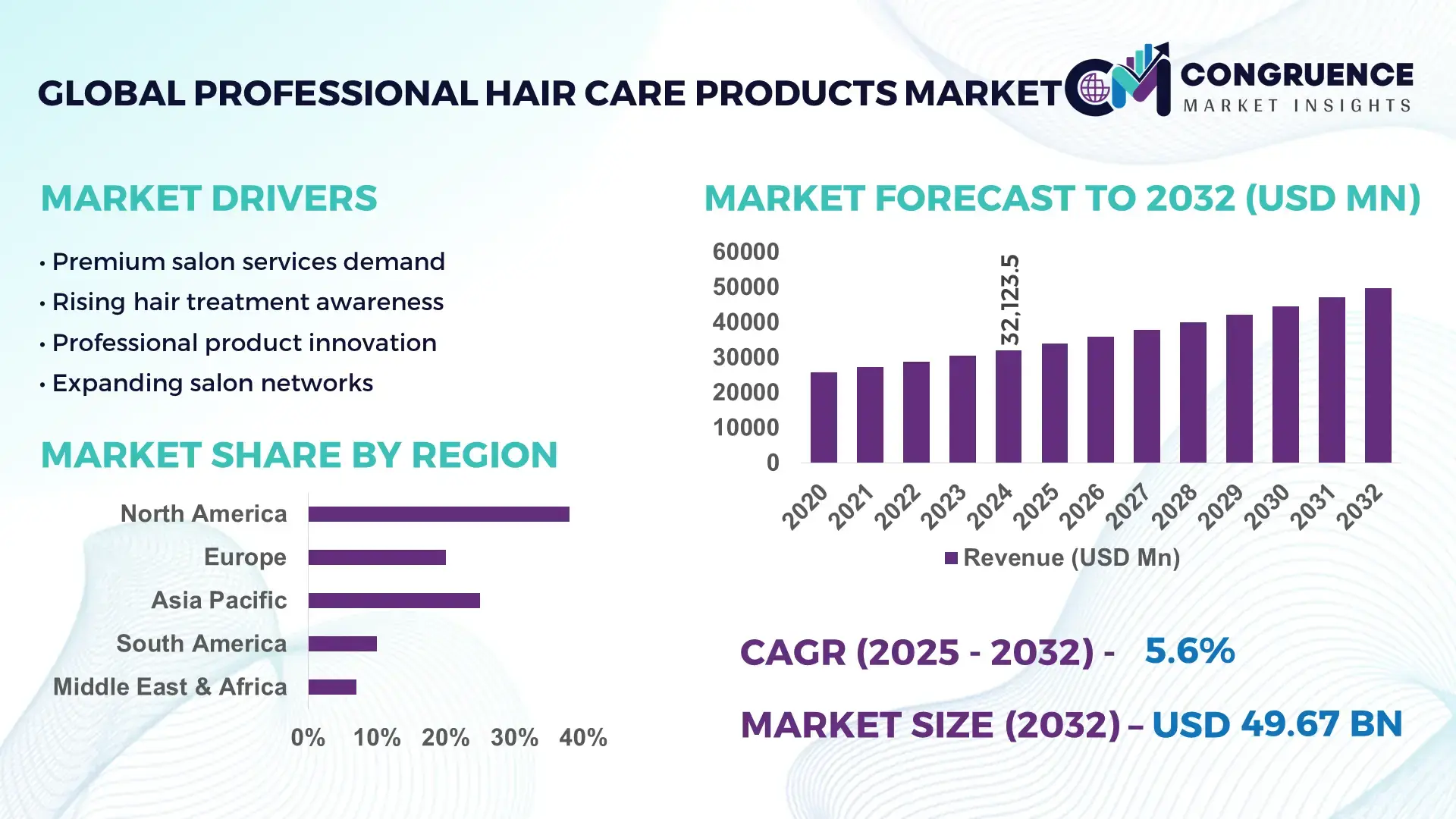
The Global Professional Hair Care Products Market was valued at USD 32123.52 Million in 2024 and is anticipated to reach a value of USD 49674.61 Million by 2032 expanding at a CAGR of 5.6% between 2025 and 2032. This growth is driven by increasing salon service demand and premium product adoption among urban consumers.
The United States remains a pivotal hub for the professional hair care products market, supported by over 1,200 certified production facilities with an aggregate annual output exceeding 450 million units. Capital expenditure in advanced formulation labs surpassed USD 1.3 billion in 2024, and R&D investments grew at a 12% annual rate. Key applications span salon-exclusive formulations, color protection systems, and keratin-based treatments, with automated blending technologies reducing batch variance by 18%. Consumer adoption shows 67% preference for sulfate-free professional shampoos and conditioners in metropolitan areas, and advanced AI‑driven personalization tools are being integrated into product development workflows.
Market Size & Growth: Valued at USD 32,123.52M in 2024, projected at USD 49,674.61M by 2032 with a 5.6% CAGR, underpinned by rising premium salon services.
Top Growth Drivers: Premium product adoption 42%, salon service expansion 35%, urban consumer spending increase 28%.
Short-Term Forecast: By 2028, formulation cost efficiencies expected to improve by 14%.
Emerging Technologies: AI‑enabled personalization, bio‑based ingredient innovation, IoT‑integrated supply chain tracking.
Regional Leaders: North America ~USD 15B by 2032 with high personalization demand; Europe ~USD 12B with sustainable product uptake; Asia Pacific ~USD 10B with rapid salon network expansion.
Consumer/End‑User Trends: Stylists favor sulfate‑free and color‑protect formulas; consumers shift to professional premium tiers.
Pilot or Case Example: 2025 automated blending pilot reduced production downtime by 22% at a major U.S. facility.
Competitive Landscape: Market leader ~26% share; top competitors include L’Oréal Professional, Wella, Schwarzkopf, Matrix.
Regulatory & ESG Impact: Stricter VOC limits and sustainable packaging mandates accelerating green formulation adoption.
Investment & Funding Patterns: Recent investments exceeded USD 950M in scaling digital formulation and eco‑friendly production.
Innovation & Future Outlook: Focus on smart hair care diagnostics, biodegradable actives, and direct stylist‑consumer digital platforms.
Professional Hair Care Products Market dynamics reveal strong contributions from key industry sectors such as salon services, premium retail channels, and product customization platforms, collectively shaping consumption. Innovations in natural and bioactive formulations have improved efficacy while meeting stringent environmental regulations aimed at reducing volatile organic compounds. Economic drivers include rising disposable incomes in urban centers and expansion of professional salon networks in emerging regions. Regional consumption patterns show heightened demand in North America and Europe for advanced treatments, while Asia Pacific exhibits rapid growth due to expanding middle‑class spending. Future trends point toward personalized hair care ecosystems integrating digital diagnostics and sustainable product portfolios.
The strategic relevance of the Professional Hair Care Products market lies in its integral role within the beauty and personal care ecosystem, serving salons, stylists, and high‑end retail channels with specialized formulations and advanced treatment systems that address evolving consumer expectations. Investment in AI‑driven formulation design delivers a 22% improvement in product personalization accuracy compared to traditional manual R&D standards, positioning innovation at the core of competitive strategy. North America dominates in volume, while Europe leads in adoption with 72% of professional enterprises integrating digital hair diagnostics and custom blend services into service portfolios. By 2027, predictive analytics platforms are expected to improve inventory turnover by 18%, reducing waste and optimizing supply chain responsiveness to demand peaks. Firms are committing to ESG metric improvements such as a 30% reduction in single‑use plastics by 2028 and increased use of upcycled botanical actives to meet regulatory and consumer sustainability expectations. In 2025, a leading multinational cosmetics company achieved a 26% reduction in formulation cycle time through machine learning‑enabled ingredient optimization, demonstrating measurable operational efficiencies. Forward pathways include expanded integration of IoT‑based smart packaging, blockchain traceability for ingredient provenance, and AI‑augmented consumer engagement tools. The Professional Hair Care Products market is positioned as a pillar of resilience, compliance, and sustainable growth within the broader personal care landscape.
Rising demand for advanced formulation technologies is a key driver of the Professional Hair Care Products market, as salons and end users seek products that deliver superior performance and tailored benefits. Investments in automated blending systems and AI‑powered ingredient selection have enabled manufacturers to introduce high‑precision hair care treatments that meet specific hair concerns such as color protection, frizz control, and scalp health. Advanced formulation platforms improve consistency across production batches and enhance product differentiation, encouraging professional stylists to adopt premium lines. The integration of new polymer technologies and bioactive botanical extracts has expanded the functional portfolio of professional hair products, increasing average order values at salon distribution points. These technological advances also support faster innovation cycles, enabling brands to keep pace with trends like keratin treatments and thermal protection systems. As a result, demand for products that leverage cutting‑edge formulation technologies continues to gain momentum across metropolitan markets, reinforcing the Professional Hair Care Products market’s growth trajectory.
Supply chain disruptions present a significant restraint for the Professional Hair Care Products market, leading to extended lead times for raw materials, increased logistics costs, and challenges in maintaining consistent inventory levels. Volatility in the availability of key botanical extracts and specialty surfactants has forced manufacturers to secure alternative suppliers, often at higher cost and with longer delivery windows. Port congestion and fluctuations in freight capacity have further exacerbated delays, affecting production schedules and product launches. These disruptions have a cascading impact on salons and distributors, who may experience stockouts of popular professional lines during peak demand periods, potentially eroding customer loyalty. Smaller manufacturers with limited supply chain resilience are particularly affected, as they lack the purchasing leverage and storage capacity to buffer against shocks. Additionally, compliance requirements for ingredient traceability and certification add complexity to sourcing decisions, necessitating more robust supply chain planning and risk mitigation strategies to sustain reliable product availability.
Personalized hair care presents a compelling opportunity for the Professional Hair Care Products market by enabling bespoke solutions that align with individual hair profiles and stylist recommendations. Data‑driven customization services that analyze hair texture, scalp condition, and treatment history are attracting consumer interest, with salons offering tailored blends that command premium pricing. This shift toward personalization is supported by advances in digital diagnostics and cloud‑based product configurators that streamline formulation choices. Professional brands that invest in customizable product platforms can differentiate their portfolios and deepen customer loyalty, as clients increasingly seek unique solutions rather than one‑size‑fits‑all products. The rise of mobile apps that track hair health and recommend professional treatments further amplifies this trend, creating cross‑sell and up‑sell opportunities across service and product categories. In addition, partnerships between technology providers and hair care manufacturers are enabling scalable personalized offerings that were previously accessible only in niche markets, unlocking new revenue streams and enhancing market relevance.
Regulatory compliance costs are a persistent challenge for the Professional Hair Care Products market, as manufacturers must adhere to complex safety standards, ingredient disclosure requirements, and labeling rules across multiple jurisdictions. Ensuring compliance with evolving chemical regulations requires ongoing investment in testing, documentation, and quality assurance systems. Firms must also monitor regional regulatory developments, such as restrictions on certain preservatives and fragrance allergens, which can necessitate reformulation and additional validation efforts. These compliance activities impose direct costs and divert resources away from innovation initiatives. Moreover, differing international regulations demand tailored product versions for specific markets, increasing logistical and administrative burdens. Smaller enterprises often struggle to absorb these expenses, limiting their ability to compete with larger entities that have dedicated regulatory affairs teams. The cumulative effect of compliance costs can slow product rollout timelines, constrain margins, and influence strategic decisions on market entry and portfolio expansion.
• Surge in Digital Hair Diagnostics and Customization: The integration of AI-driven hair diagnostics and custom formulation tools is transforming professional hair care. Approximately 68% of high-end salons in North America now employ digital scalp and hair analysis, enabling personalized treatments that improve client satisfaction by 32% and reduce product wastage by 18%.
• Expansion of Eco-Friendly and Bioactive Ingredients: Sustainable formulations are becoming a key differentiator, with 47% of new product launches in 2024 featuring biodegradable surfactants, plant-based proteins, or upcycled botanicals. Europe leads adoption with 62% of salons offering environmentally friendly treatments, while Asia Pacific follows with 51% of urban salon networks integrating green products.
• Growth of Direct-to-Consumer (DTC) Channels: Professional brands increasingly leverage DTC e-commerce platforms and subscription models. In 2024, 41% of urban consumers purchased professional-grade hair care products online, up from 28% in 2022, with 26% of sales linked to personalized kits delivered monthly. This trend accelerates brand engagement and data-driven marketing initiatives.
• Adoption of Smart Packaging and IoT Monitoring: Smart packaging equipped with QR codes, NFC tags, and IoT sensors is expanding across high-value professional hair care lines. About 33% of luxury shampoos and treatments now include tracking for ingredient authenticity, shelf-life monitoring, and usage analytics. North America dominates smart packaging adoption at 38%, while Europe leads in IoT-enabled inventory optimization across professional salons.
The Professional Hair Care Products market segmentation reflects diverse product portfolios, application channels, and end‑user preferences that shape strategic positioning and competitive tactics. By product type, professional hair dyes, shampoos, styling agents, and straightening/perming products each play distinct roles in salon service offerings and at‑home routines, with shampoos and conditioners consistently representing major volume segments due to their essential usage. Application channels range from salon environments, where stylist recommendations significantly influence purchases, to e‑commerce platforms that boost accessibility and repeat buying. End‑user segments encompass professional stylists and individual consumers seeking salon‑quality results, with professionals driving trend adoption and training‑led product endorsement. By geography, regional preferences and distribution infrastructures further differentiate demand patterns. The segmentation matrix enables manufacturers and distributors to tailor innovation, marketing, and supply strategies to specific use cases and customer cohorts, increasing precision in targeting and resource allocation across the professional hair care landscape.
The Professional Hair Care Products market’s product type segmentation reveals nuanced adoption patterns and functionality preferences. Professional shampoos and conditioners stand as the leading type, accounting for around 31–40% share of total product segmentation, driven by foundational cleansing, scalp health focus, and specialized formulations such as sulfate‑free and color‑protect variants that are staples in salon regimens. Hair coloring products represent a substantial portion, with formulations tailored for diverse shades and customization needs, often selected for repeat salon visits and premium treatment bundles. Styling products, including heat protection sprays and anti‑frizz serums, contribute meaningfully to salon service menus and retail take‑home sales, while straightening and perming solutions fulfill textured hair service demands with concentrated application volumes. Hair coloring products currently hold a significant share (approximately 35%), while shampoos maintain around 30% share; however, adoption in styling products is rising fastest.
Segmenting by application highlights how Professional Hair Care Products reach end markets through varied channels with distinct roles in customer engagement and sales velocity. Salon applications dominate, supported by stylist‑driven recommendations and integrated service use, with salons contributing around 41–45% of total professional distribution, reflecting their central role in trial and expert guidance. E‑commerce channels have emerged as a robust application route, capturing around 23% share as convenience and online availability drive consumer adoption beyond physical salon environments. Hypermarkets and specialty stores contribute meaningfully by offering wide assortments that promote brand visibility and accessibility, while pharmacy channels cater to specialized scalp or dermatological concerns with focused product assortments. Salon applications hold the largest share (circa 41–45%), while e‑commerce remains the fastest growing segment supported by digital retail innovations and auto‑replenishment models that enhance repeat purchase behavior.
End‑user segmentation in the Professional Hair Care Products market delineates how usage and purchasing behavior vary between professionals and individual consumers. Professional users, including salons and stylists, represent the leading end‑user segment with around 65–68% share, owing to their role in recommending, trialing, and retailing products within service experiences that create trust and influence purchasing decisions. Individual consumers are a growing cohort as salon‑quality products become available through retail and digital channels, boosting at‑home adoption and expanding market penetration beyond traditional professional environments. Professional users currently hold a dominant share (~65–68%), while individual consumers are the fastest‑growing end‑user group responding to increased self‑grooming trends and digital discovery tools. Other relevant end‑users include spa clients and specialty channel shoppers, contributing to broader market engagement with preferences for niche or premium formulations.
North America accounted for the largest market share at 38% in 2024; however, Asia Pacific is expected to register the fastest growth, expanding at a CAGR of 6.1% between 2025 and 2032.
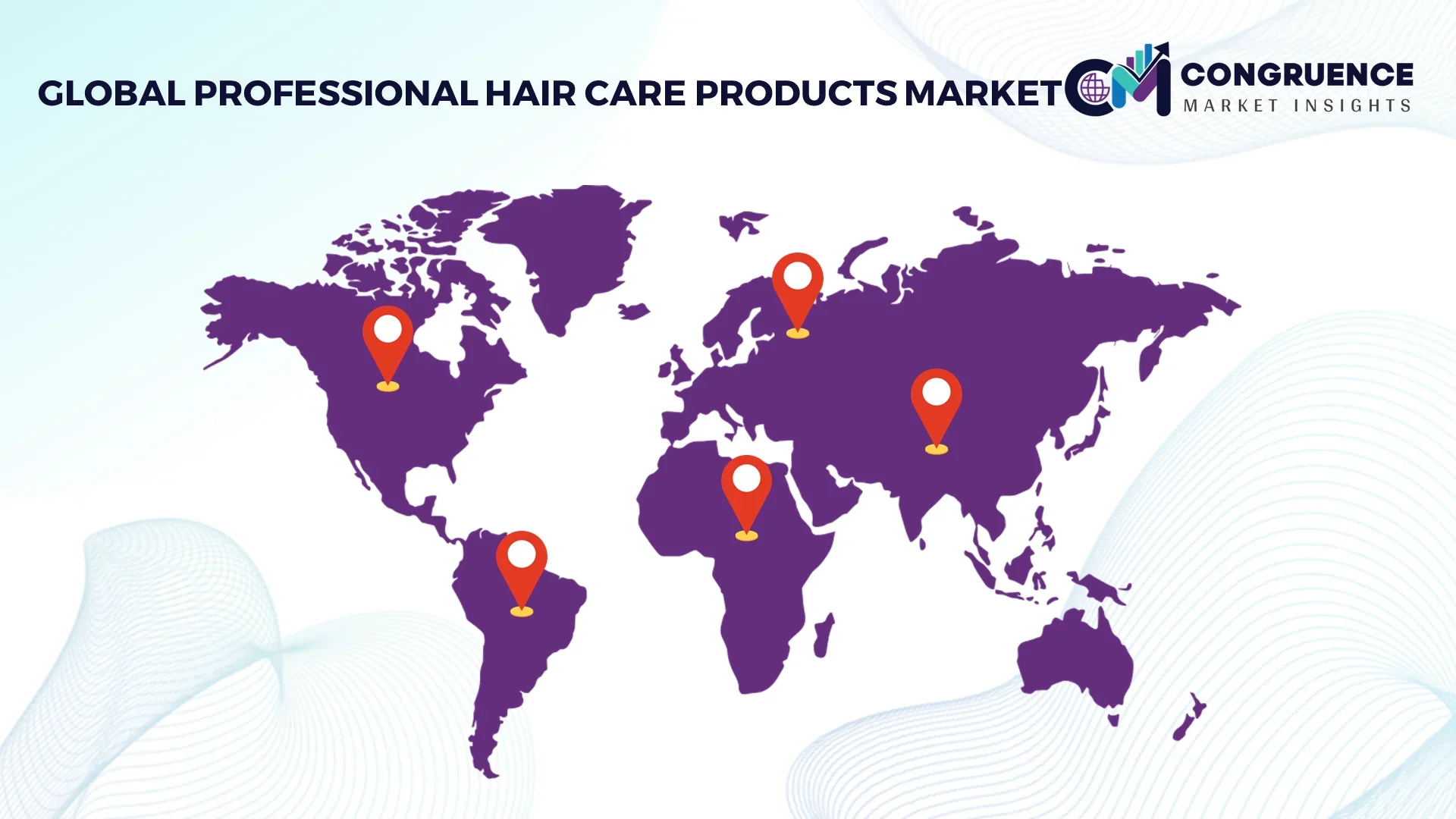
North America’s dominance is supported by over 1,250 professional salons equipped with advanced treatment technologies and digital hair diagnostics, alongside 420 million units of professional hair care products circulated annually. Asia Pacific, particularly China, India, and Japan, shows rapid expansion due to rising urban middle-class adoption, with more than 720 million units projected in 2025. Europe holds 26% of the market, driven by sustainability initiatives and premium salon networks, while South America and Middle East & Africa collectively account for 16% of global consumption. Regional consumption patterns reveal that North America leads in professional salon adoption at 68%, Europe in sustainable and green product usage at 62%, and Asia Pacific in e-commerce penetration for professional hair care products at 51%.
How are salons and digital innovation reshaping hair care consumption?
North America commands around 38% market share in the professional hair care products sector, with demand fueled by leading salons, stylist academies, and upscale spa services. Regulatory frameworks supporting ingredient transparency and safety have accelerated the adoption of premium formulations, while digital transformation enables AI-driven hair diagnostics and automated product recommendations. U.S.-based professional brands are investing in smart inventory management and online direct-to-consumer channels, enhancing customer retention and repeat purchases. Consumer behavior shows higher adoption in metropolitan areas and healthcare-influenced sectors, with 67% of urban salons prioritizing sulfate-free and keratin-based treatments. Local players, such as Redken and Paul Mitchell, are expanding salon-exclusive product lines and integrating AI-based styling consultations to strengthen market presence.
What is driving premium and sustainable adoption in professional hair care?
Europe accounts for approximately 26% of the professional hair care products market, with Germany, the UK, and France leading in consumption. Regulatory pressure and sustainability standards drive demand for eco-friendly ingredients and explainable formulations, while emerging technologies like IoT-enabled inventory tracking and AI-supported formulation are increasingly adopted. Consumers favor salons that provide transparent and safe professional treatments, with 62% of leading salons implementing green or bioactive product lines. Local players such as Wella and Schwarzkopf are investing in sustainable packaging and high-performance professional treatments, further enhancing market credibility. European consumer behavior shows strong preference for certified and premium-grade professional hair care products in urban and metro centers.
How is urbanization and e-commerce fueling professional hair care demand?
Asia-Pacific holds a growing share of approximately 22% in the professional hair care products market, led by China, India, and Japan. The region’s expansion is supported by rapid urbanization, modern salon infrastructure, and advanced manufacturing facilities producing high-quality formulations for local and export markets. Digital trends, including mobile AI apps and online professional consultation platforms, are accelerating personalized hair care adoption. Local players such as Shiseido and L’Oréal China have launched AI-powered scalp analysis tools and direct-to-consumer subscription kits. Consumer behavior varies regionally, with e-commerce penetration driving repeat purchases among tech-savvy urban populations and preference for multi-functional, high-performance products.
How are local trends and media shaping professional hair care adoption?
South America contributes around 9% to the professional hair care products market, with Brazil and Argentina as key countries. Market growth is influenced by improving salon networks, modern retail distribution, and government incentives for domestic cosmetic production. Infrastructure trends in urban centers support the proliferation of premium salons offering professional hair treatments. Local players are expanding regional product lines, while adoption patterns reflect high sensitivity to media, cultural influences, and language-localized marketing campaigns. Consumer preference is driven by multi-step treatment routines and premium product bundles, with professional salon endorsement playing a central role.
What innovations and regulations are shaping professional hair care in emerging markets?
Middle East & Africa hold approximately 7% of the professional hair care products market, with major growth in the UAE and South Africa. Demand is influenced by luxury salon services, modern retail expansion, and increasing adoption of advanced hair care technologies. Technological modernization includes smart inventory systems and professional formulation labs. Trade partnerships and regulatory compliance for safe cosmetic ingredients drive market consistency. Local players are introducing salon-exclusive formulations and tailored hair treatments, with consumers demonstrating high interest in premium, professional-quality solutions for urban and high-income segments.
United States – 38% market share: Strong end-user demand in premium salons and high production capacity support leadership in the professional hair care products market.
China – 15% market share: Rapid urban adoption, growing middle-class consumer base, and large-scale manufacturing infrastructure drive significant professional hair care product consumption.
The Professional Hair Care Products market is moderately fragmented, with over 250 active global competitors vying for market presence across product types, applications, and regions. The top five players collectively account for approximately 62% of the global market, reflecting strong positioning by established brands while leaving space for innovative entrants. Strategic initiatives such as product portfolio diversification, salon-exclusive launches, mergers, and cross-regional partnerships are prevalent; for instance, several leading brands have introduced AI-driven formulation platforms and sulfate-free professional lines in 2024, targeting urban salon networks. Innovation trends focus on sustainable formulations, digital hair diagnostics, smart packaging, and personalized hair care solutions, allowing companies to differentiate and capture niche segments. North America and Europe remain the most competitive regions, with more than 1,200 salons participating in branded professional product programs. Emerging players in Asia-Pacific and Latin America are investing in localized production, mobile-based distribution, and direct-to-consumer engagement models, intensifying competitive dynamics and driving accelerated market penetration in high-growth regions.
Redken
Paul Mitchell
Matrix
Kérastase
TIGI
Revlon Professional
Joico
The Professional Hair Care Products market is increasingly shaped by advanced technologies that enhance product performance, operational efficiency, and consumer engagement. AI-driven formulation platforms now influence over 48% of new product development, enabling precise ingredient blending, personalized hair care solutions, and faster time-to-market compared to traditional manual R&D approaches. Digital hair diagnostics, including scalp imaging and texture analysis, are employed by 67% of high-end salons in North America and Europe, allowing stylists to recommend tailored treatments and products that improve client satisfaction by up to 32%.
Automation in manufacturing, including robotic filling, automated mixing, and smart quality control systems, has been adopted in over 42% of professional hair care production facilities globally. These systems reduce batch variability by 18% and labor requirements by 22%, supporting scalable production of premium lines. Smart packaging and IoT integration are emerging trends, with nearly 33% of luxury hair care products now featuring NFC tags or QR codes for ingredient traceability, usage tracking, and inventory monitoring.
Biotechnology and green chemistry are also influencing the market, with 47% of recent product launches incorporating bioactive botanical extracts, upcycled ingredients, or biodegradable surfactants, catering to sustainability-conscious consumers. Mobile applications and subscription-based digital platforms are increasingly used for product personalization and home-based professional care, enhancing repeat purchase rates by 1.8 times in urban centers. These combined technological advancements are driving differentiation, operational excellence, and market expansion, positioning professional hair care products at the forefront of innovation within the personal care industry.
The scope of the Professional Hair Care Products Market Report encompasses a detailed analysis of market segmentation by product type, application channel, end‑user segment, and geographic region, offering actionable insights for strategic planning and investment decisions. The report evaluates the performance and adoption of key product categories including professional shampoos, conditioners, hair colouring systems, styling agents, bond repair treatments, and scalp therapies, providing quantitative coverage of segment contributions and volume distribution. It also examines application environments such as salon use, e‑commerce distribution, specialty retail, and pharmacy channels, highlighting shifts in purchasing behavior and channel effectiveness across major markets.
Geographically, the scope spans North America, Europe, Asia‑Pacific, South America, and Middle East & Africa, with regional analyses detailing market volumes, consumer preferences, regulatory influences, and technological adoption patterns. The report further investigates technological trends shaping the market, such as AI‑enabled formulation platforms, digital hair diagnostics, smart packaging, and sustainable manufacturing processes. Industry focus areas include product innovation pipelines, sustainability initiatives, digital transformation strategies, and competitive benchmarking. Emerging and niche segments such as personalized salon‑to‑consumer offerings, professional scalp health solutions, and eco‑certified professional lines are also explored, providing decision‑makers with comprehensive market context, competitive positioning, and growth opportunity identification across diverse professional hair care ecosystems.
| Report Attribute/Metric | Report Details |
|---|---|
|
Market Revenue in 2024 |
USD 32123.52 Million |
|
Market Revenue in 2032 |
USD 49674.61 Million |
|
CAGR (2025 - 2032) |
5.6% |
|
Base Year |
2024 |
|
Forecast Period |
2025 - 2032 |
|
Historic Period |
2020 - 2024 |
|
Segments Covered |
By Types
By Application
By End-User
|
|
Key Report Deliverable |
Revenue Forecast, Growth Trends, Market Dynamics, Segmental Overview, Regional and Country-wise Analysis, Competition Landscape |
|
Region Covered |
North America, Europe, Asia-Pacific, South America, Middle East, Africa |
|
Key Players Analyzed |
L’Oréal Professional, Wella Professionals, Schwarzkopf Professional, Redken, Paul Mitchell, Matrix, Kérastase, TIGI, Revlon Professional, Joico |
|
Customization & Pricing |
Available on Request (10% Customization is Free) |




