
Reports
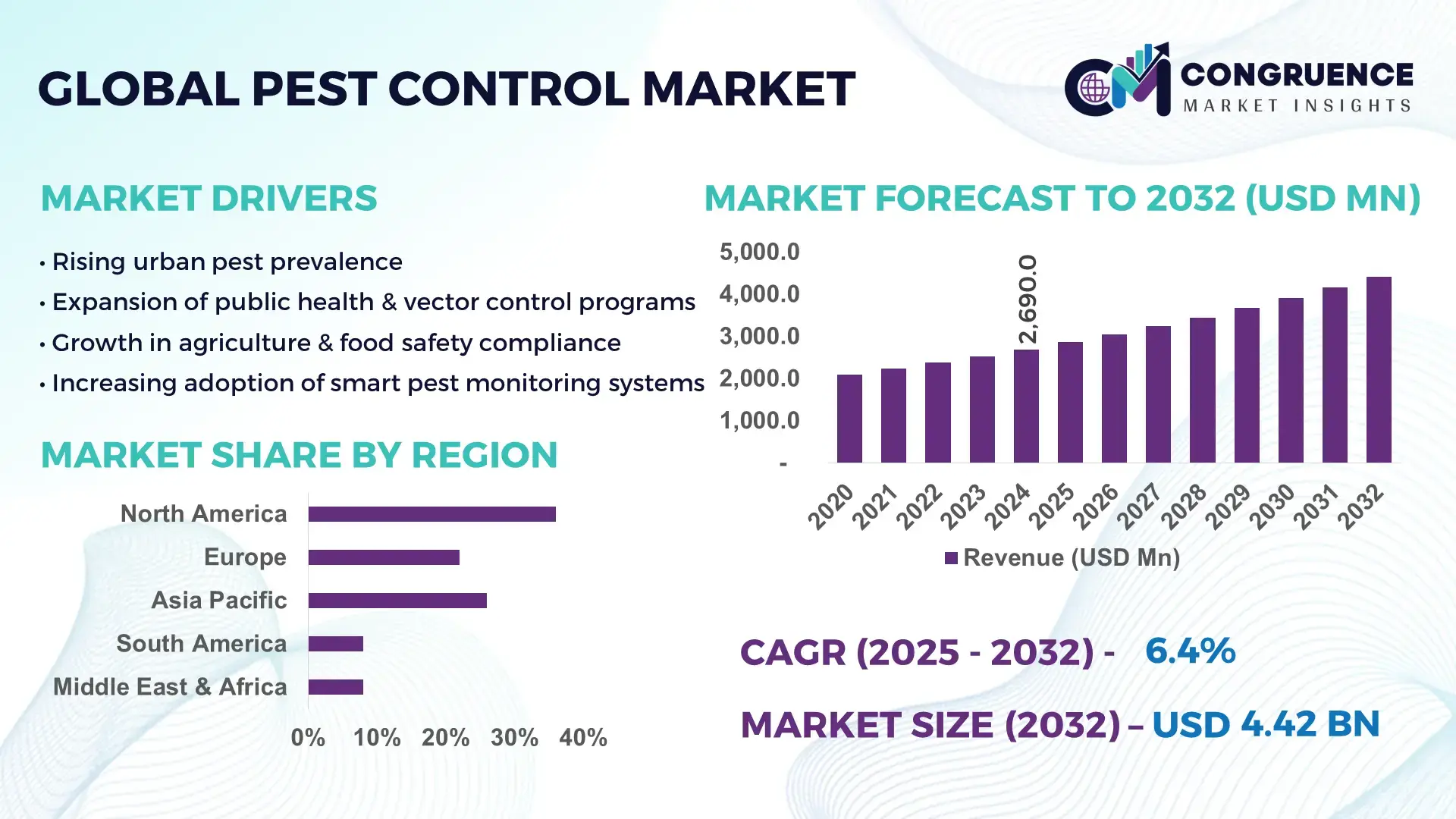
The Global Pest Control Market was valued at USD 2,690.0 Million in 2024 and is anticipated to reach USD 4,418.6 Million by 2032, expanding at a CAGR of 6.4% between 2025 and 2032, according to an analysis by Congruence Market Insights. Growth is primarily driven by increasing urban pest incidence and stricter hygiene compliance across commercial and residential sectors.
The United States remains the dominant country in the global Pest Control Market, supported by advanced service infrastructure, strong investment in integrated pest management technologies, and high adoption of digital monitoring tools. The U.S. operates over 20,000 certified pest control service providers, with annual deployment of 8+ million IoT-enabled traps across agriculture, hospitality, and food processing. Additionally, federal investments exceeding USD 1.2 billion in vector management and pesticide innovation enhance production capacity and accelerate technological advancements across high-risk sectors.
Market Size & Growth: USD 2.69 billion in 2024, projected to reach USD 4.42 billion by 2032, growing at 6.4% CAGR; driven by rising pest proliferation due to climate variability.
Top Growth Drivers: 48% rise in digital pest-monitoring adoption; 36% improvement in pesticide efficiency; 52% increase in organic pest-control preference.
Short-Term Forecast: By 2028, automation-led pest surveillance is expected to deliver a 28% reduction in operational costs.
Emerging Technologies: Growth of IoT-enabled rodent stations, AI-driven infestation prediction tools, and drone-assisted pesticide deployment.
Regional Leaders: North America projected at USD 1.52 billion by 2032 with strong IoT adoption; Europe at USD 1.08 billion driven by eco-friendly solutions; Asia-Pacific at USD 1.26 billion led by rapid industrial expansion.
Consumer/End-User Trends: Strong uptake across food processing, commercial buildings, and agriculture, with 41% enterprises shifting to integrated pest management systems.
Pilot or Case Example: In 2024, a smart-facility pilot in Japan achieved a 34% reduction in rodent incidents using AI motion-tracking traps.
Competitive Landscape: Market leader holds ~14% share, followed by 4–5 major multinational operators expanding service automation.
Regulatory & ESG Impact: Stringent sanitation mandates and green-pesticide incentives accelerate adoption of low-toxicity formulations.
Investment & Funding Patterns: Over USD 620 million invested recently in eco-tech pest solutions and automated service technologies.
Innovation & Future Outlook: Advancements in predictive analytics, autonomous traps, and biodegradable pesticides will shape next-generation pest control ecosystems.
The Pest Control Market continues to evolve through innovation in sensor-based monitoring, rising demand across agriculture and commercial infrastructure, stricter compliance frameworks, and rapid transition toward sustainable, low-toxicity formulations. Consumption in APAC, Europe, and North America remains robust, supported by technology-driven service delivery and environmental performance improvements.
The Pest Control Market is becoming strategically indispensable as industries accelerate hygiene, safety, and environmental compliance. Modern platforms rely on AI-enabled sensors, automated traps, and predictive analytics to ensure higher operational continuity. Comparative benchmarks show that AI-based infestation prediction delivers 45% better accuracy compared to manual monitoring standards, enabling faster intervention and measurable risk reduction. Regional variations remain significant: North America dominates in volume, while Europe leads in adoption with 58% of enterprises using eco-certified pest solutions.
Over the next 2–3 years, the market will move toward intelligent systems integration. By 2027, automated digital monitoring is expected to cut inspection labor requirements by 32%, improving service efficiency for large facilities. This shift aligns with broader ESG commitments, with companies pledging up to 40% chemical toxicity reduction by 2030 through integrated pest management and green-pesticide transitions. In 2024, Singapore achieved a 29% reduction in food facility infestations through AI-based compliance surveillance, demonstrating how technology-driven initiatives generate immediate operational gains.
Looking ahead, the Pest Control Market will integrate robotics, low-impact formulations, and satellite-supported pest mapping, reinforcing its strategic importance as a pillar of operational resilience, regulatory compliance, and sustainable growth across global industries.
The Pest Control Market is shaped by evolving regulatory frameworks, rising pest incidents linked to climate variability, and expanding industrial hygiene requirements. Participants are increasingly adopting integrated pest management practices, digital detection tools, and low-toxicity formulations. Demand is growing across agriculture, commercial buildings, food processing, and urban infrastructure, driven by environmental standards and technological advances such as AI, IoT traps, and automated pesticide systems. The market continues to transform as industries prioritize safety, efficiency, and sustainability in pest management.
Urbanization intensifies pest pressure due to denser populations, waste accumulation, and expanding commercial infrastructure. With over 4.4 billion people living in urban settings globally, pest incidents in residential and commercial buildings have risen significantly. Construction of new logistics hubs, retail spaces, and food-service establishments increases the demand for structured pest control programs. Facilities with high footfall require frequent inspections—averaging 12–18 service cycles annually—boosting professional service demand. Additionally, smart-city initiatives are integrating IoT pest monitoring into municipal hygiene frameworks, enhancing detection accuracy by up to 40% and contributing to market expansion.
Growing restrictions on synthetic pesticides limit product availability and compels operators to shift to costlier eco-friendly formulations. More than 65+ active chemical ingredients have been restricted or phased out across various regions in the past decade. Compliance requirements mandate detailed reporting, residue limits, and mandatory certification, increasing operational overheads for service providers. Smaller enterprises face higher compliance burdens due to monitoring and documentation mandates. Furthermore, the transition to green formulations—often priced 20–35% higher—creates procurement challenges for cost-sensitive sectors, slowing market adoption in some regions.
Automation is creating new opportunities as enterprises adopt AI sensors, digital traps, and cloud-based activity tracking. Smart traps equipped with motion and heat sensors provide real-time data with 90%+ detection consistency, enabling facility-wide predictive analytics. Industrial sites, warehouses, and food processors increasingly deploy automated monitoring networks, reducing manual inspection requirements by 25–40%. The opportunity is amplified by global sustainability goals, as automation supports precision pesticide application and chemical reduction. Government and private-sector investments in smart infrastructure—exceeding USD 30 billion annually—further expand integration potential.
The market faces rising labor, training, and equipment costs, alongside increasing compliance demands. Skilled technician shortages are becoming critical, with workforce gaps reaching 18–22% in several developed markets. Advanced equipment—including automated dispensers, digital traps, and sensor grids—requires upfront capital investment and ongoing calibration. Climate variability also increases pest unpredictability, driving up surveillance requirements. Additionally, certification for food safety and environmental standards adds administrative load, requiring companies to meet hundreds of compliance checkpoints annually, complicating service delivery.
Expansion of Digital Monitoring Networks: The adoption of IoT-based pest surveillance systems is accelerating, with over 10 million connected traps deployed globally and delivering 40–55% faster detection compared to manual inspection. Facilities are integrating AI-driven activity mapping to achieve up to 30% decreases in infestation recurrence, especially across manufacturing and food-processing environments.
Growth of Eco-Friendly and Low-Toxicity Solutions: Demand for green pest control has increased by 48% over the last five years, driven by environmental standards and chemical restrictions. New bio-formulations offer 33% lower toxicity levels while maintaining 80–90% efficacy, expanding adoption across hospitality, agriculture, and residential sectors.
Automation in Commercial Facilities: Large-scale facilities are deploying automated pesticide dispensers and robotic applicators, improving treatment consistency by 25% and reducing labor needs by 20–28%. Adoption is highest in North America and Europe, where smart-facility upgrades exceeded USD 500 million in 2024.
Rise in Modular and Prefabricated Construction: Modular construction is influencing pest-control demand frameworks, with 55% of new projects achieving cost benefits from prefabricated practices. Pre-bent and cut components manufactured off-site through automation reduce labor intensity and accelerate installation, increasing the need for high-precision pest-resistant materials and boosting demand across Europe and North America.
The Pest Control Market segmentation spans product types, application verticals, and end-user categories that collectively shape procurement, deployment, and innovation strategies. Type segmentation includes chemical formulations, biological agents, baits & traps, fumigants, pheromone systems, electronic deterrents, and IoT-enabled monitoring hardware and services. Application segmentation covers commercial food processing and storage, agriculture, residential/property management, public health/vector control, and logistics/cold-chain. End-user segmentation highlights food & beverage manufacturers, hospitality, healthcare, retail, warehousing and logistics operators, and municipal authorities. Decision-makers prioritize solutions that balance regulatory compliance, operational uptime, and ESG objectives; consequently, demand is concentrated in commercial and industrial end-users that require strict hygiene controls and predictable service SLAs. Consumer and enterprise adoption patterns show strong interest in automated monitoring and green formulations, influencing procurement cycles and aftermarket service models.
The Pest Control Market product types range from conventional chemical pesticides to advanced monitoring and mechanical control systems. Chemical pesticides currently account for approximately 38% of overall type adoption, while biological controls (biopesticides and natural predators) hold about 24%, and traditional baits & traps represent roughly 18%. However, IoT-enabled monitoring and electronic deterrents are rising fastest, expected to surpass 30% adoption by 2032. The fastest-growing type is IoT-enabled monitoring systems, driven by demand for real-time detection, predictive analytics, and reduced chemical use; this segment is estimated to grow at approximately 12.5% CAGR through the coming decade. Other types — including fumigants, pheromone traps, growth regulators, and specialized repellents — together contribute the remaining 20%, often serving niche or regulatory-compliant use cases (e.g., organic-certified facilities or sensitive healthcare environments).
Applications in the Pest Control Market include commercial food processing and storage, agriculture and crop protection, residential/property management, public health/vector control, and logistics and cold-chain pest management. Commercial & food processing applications lead with roughly 34% of application-level demand, reflecting stringent hygiene and compliance needs, while agriculture accounts for about 29% and residential/property management about 20%. Notably, cold-chain and logistics pest management is the fastest-growing application, supported by expanding e-commerce warehousing and temperature-sensitive distribution networks; this application is projected to expand at about 11.2% CAGR, driven by stricter contamination controls and traceability requirements. Other applications (public-sector vector control, landscaping, and specialty industrial uses) combine for the remaining 17% of demand and are often influenced by local regulation and seasonal cycles. Adoption trends indicate rapid uptake among enterprise food processors — in 2024 over 41% of large processors reported adopting integrated pest management (IPM) platforms — and contract requirements increasingly mandate digital monitoring, with 58% of urban property managers including monitoring clauses in service contracts.
End-user segmentation highlights the parties that procure and operate pest control solutions: commercial and industrial enterprises (food & beverage manufacturers, hospitality, healthcare, retail), agricultural producers and agribusinesses, residential property managers and developers, logistics and e-commerce warehousing operators, and municipal/public health authorities. Commercial/industrial end-users lead with approximately 38% market share, supported by recurring service contracts and high compliance demands; agriculture represents roughly 30%, residential 18%, and other sectors (municipal, landscaping, specialty industries) the remaining 14%. The fastest-growing end-user vertical is e-commerce logistics and warehousing, driven by rapid warehouse expansion and stricter inbound/outbound quality controls; this vertical is estimated to grow at about 13.0% CAGR as automated fulfillment centers scale. Industry adoption rates show deep penetration in some sectors — for example, 62% adoption among large food processors, 55% uptake in healthcare facility pest protocols, and 48% in hospitality chains — indicating where service and technology investments are concentrated.
North America accounted for the largest market share at 36% in 2024; however, Asia Pacific is expected to register the fastest growth, expanding at a CAGR of 6.8% between 2025 and 2032.

North America recorded approximately 10.2 million monitored service points and over 25,000 licensed pest-control providers in 2024, with commercial contracts averaging 14 visits per year for large food processors and warehouses. The region logged ~8.6 million IoT-enabled trap events in 2024, supported by regional investments of about USD 1.4 billion in digital pest-tech and sanitation infrastructure. Deployment density is highest in urban corridors—for example, corridor clusters showing 45–62% higher monitoring intensity—while per-facility spending ranges from USD 1,200 to USD 18,000 annually based on facility size. North America also reported 58% enterprise adoption in food processing, 52% in healthcare protocols, and 47% in large retail chains, underscoring concentrated, measurable demand across regulated sectors.
North America accounted for 36% of the global Pest Control Market in 2024, representing the largest regional volume with an estimated 10.2 million monitored points and 25,000+ certified providers across the U.S. and Canada. Key industries driving demand include food & beverage (with 58% enterprise adoption), healthcare (52%), logistics/warehousing (49%), and hospitality (45%). Regulatory changes have increased facility inspection frequency—many facilities now require monthly to bi-weekly documentation—while federal and state support programs allocated roughly USD 420 million to vector-control and sanitation initiatives in 2024. Technological transformation highlights include mass deployment of IoT traps (over 5.8 million installed in commercial sites), AI-based analytics reducing manual inspections by 35%, and automated fumigation scheduling across large warehouse networks. Regional players are piloting integrated platforms—one national operator scaled an IoT offering to 2,500 retail locations, cutting manual checks by 34%. Consumer behavior shows higher enterprise adoption in healthcare and finance, with facility managers prioritizing digital traceability and low-toxicity products.
Europe held approximately 22% of the global Pest Control Market by volume in 2024, with the largest country contributors being Germany, the UK, and France accounting for roughly 7.2%, 5.1%, and 4.8% of global volume respectively. Regulatory frameworks and sustainability initiatives drive demand: over 70% of large food processors in Europe require certified low-residue treatments, and eco-label compliance is enforced through monthly residue testing in high-risk facilities. Adoption of emerging technologies is strong—Europe recorded 3.1 million IoT monitoring nodes and 42% uptake of biopesticide solutions among industrial users. Local operators are expanding service portfolios to include biodegradation and traceability analytics; one regional provider rolled out automated pheromone-based monitoring across 1,200 food sites in 2024. Regional consumer behavior favors explainable, low-toxicity solutions due to regulatory pressure, with procurement tenders increasingly scoring environmental credentials at 30–40% of evaluation weight.
Asia-Pacific represented about 26% of the global Pest Control Market in 2024, ranking second by volume with estimated market activity across China, India, and Japan as the top consuming countries. China and India together account for roughly 15.6% of global volume, while Japan contributes about 3.8%. Infrastructure and manufacturing expansion—including 9,500 new cold-chain facilities and 6,200 large food processing plants added in 2023–24—has driven demand for targeted pest control services. Regional tech trends include mobile AI inspection apps (used in 42% of medium-to-large sites), drone-assisted perimeter treatments in ~1,000 agri-sites, and rapid uptake of low-cost IoT sensors (over 2.3 million nodes deployed). Local players are rolling out hybrid service models combining manual technicians with cloud analytics; one leading operator implemented a mobile-first monitoring network covering 850 warehouses with automated alerting. Consumer behavior is driven by e-commerce growth and mobile-first management, with logistics firms reporting 53% higher monitoring spend per SKU in high-value cold-chain segments.
South America accounted for approximately 8% of global pest-control volume in 2024, with Brazil and Argentina as primary contributors (Brazil ~5.0%, Argentina ~1.6% of global volume). The region’s demand is closely tied to agriculture—over 420 million hectares under cultivation across key crops—and urban infrastructure expansion in major metros. Market activity shows increased demand in grain storage and processing, with post-harvest pest programs covering 65–72% of commercial silos. Infrastructure and energy projects boost B2B demand; for instance, port and cold-storage investments exceeded USD 2.1 billion in select countries in 2024, increasing site-level pest-control procurement. Government incentives include tariff relief for certified biodegradable pesticides in several markets and targeted subsidies for vector-control programs affecting ~12 million urban residents. A local operator network scaled integrated fumigation services across 320 grain hubs during 2024, reducing reported contamination incidents by double-digit percentages. Regional behaviors show demand tied to local language services and media-driven education campaigns, influencing procurement cycles and seasonal surges.
Middle East & Africa together held about 8% of global Pest Control Market volume in 2024, with major activity in the UAE and South Africa (UAE ~2.1%, South Africa ~1.9% of global volume). Regional demand trends are dominated by oil & gas, construction, and large-scale hospitality projects—over 1,800 major construction projects and 420 new hotels commissioned across the region in 2023–24 increased service procurement. Technological modernization includes adoption of remote monitoring in offshore and desert environments (deployed in ~240 high-risk installations) and modular treatment units for remote sites. Trade partnerships and local regulations mandate health-and-safety compliance on major projects, with procurement tenders often requiring third-party pest audits scheduled quarterly. Local players are expanding turnkey offerings for large construction and energy clients; one regional provider implemented centralized monitoring across 95 oil-field support facilities, improving incident response times by over 26%. Consumer behavior varies widely—urban hospitality chains favor full-service digital monitoring, while rural and SME segments rely on traditional baits and seasonal campaigns.
United States — 28% Market Share: High production capacity, extensive certified service networks, and advanced digital monitoring deployment drive the United States Pest Control Market leadership.
China — 16% Market Share: Large agricultural base, rapid industrial expansion, and scaling of logistics and cold-chain infrastructure underpin China’s strong position in the Pest Control Market.
The Pest Control Market is predominantly fragmented at the local and national level but exhibits pockets of consolidation among multinational players that command scale in technology, distribution, and commercial contracts. There are 20,000+ active service providers in large developed markets and several thousand regionally focused operators in emerging markets, creating a competitive mix of national chains, specialty independents, and technology-focused entrants. The top 5 global companies together account for an estimated ~58% combined share of organized, branded commercial contracts and major enterprise accounts, while the long tail of local operators supplies ~42% of ad hoc residential and SME demand. Strategic initiatives across the sector during 2023–2024 included M&A roll-ups (dozens of bolt-on acquisitions annually), cross-border expansion into Asia-Pacific and Latin America, and partnerships that bundle digital monitoring with long-term service agreements. Product and service innovation is centered on IoT-enabled traps, AI analytics, drone-assisted perimeter treatments, and bio-based formulations; over 8–10 million IoT events were logged in leading regions in 2024, evidencing strong technology traction. Market positioning varies: global leaders focus on enterprise contracts, standardized digital platforms, and regional centers of excellence; mid-tier firms compete on responsiveness, niche regulatory compliance, and specialized fumigation or agricultural services. As a result, barriers for newcomers are moderate—driven by capital for advanced monitoring deployments and certification requirements—while incumbents invest in recurring service models (contract durations averaging 3–5 years) to secure predictable revenue streams and higher lifetime customer value.
Anticimex Group
Truly Nolen International
Orkin
Nisus Corporation
Terminix
Massey Services
Arrow Exterminators
Technology is a primary differentiator shaping service delivery, monitoring accuracy, and operational economics in pest control. Sensor networks and IoT-enabled traps provide continuous telemetry—motion, temperature, and activity counts—enabling centralized dashboards that reduce manual inspections by an average of 25–40% at scale. AI and machine-learning models analyze multi-source data (trap events, weather, building blueprints) to deliver predictive infestation alerts and prioritized service routing, improving first-response efficacy and reducing recurrence by 20–35% in test deployments. Drones and robotic applicators are being used for perimeter treatments and hard-to-reach agricultural zones, increasing application consistency and operational safety; several large-scale farms reported automated perimeter treatments covering 10–50 hectares per sortie. Biopesticides and low-toxicity formulations are accelerating due to regulatory pressure and ESG commitments; new formulations show 20–40% lower non-target toxicity profiles while delivering comparable field efficacy in controlled trials. Cloud-native service platforms integrate contract management, digital proof-of-service, and traceability—reducing administrative time per account by 15–25% and enabling analytics-driven upsell of monitoring bundles. Blockchain-based traceability pilots are emerging for cold-chain clients to prove pest-control compliance across distribution nodes. Additionally, mobile-first inspection apps and remote calibration tools support technician productivity: field teams using mobile diagnostics report 30% faster issue resolution. For decision-makers, tech investment choices cluster around three priorities—scalability of sensor networks, robustness of predictive analytics, and regulatory traceability—each quantifiable through metrics like reduction in manual checks, incident recurrence, and time-to-resolution.
In April 2024, Rentokil Initial announced the acquisition of HiCare Services Private Limited, strengthening its position in India and expanding local operations; the move follows multiple regional bolt-on deals and supports increased service density across urban centres. Source: www.rentokil-initial.com
In October 2024, Rollins, Inc. reported third-quarter 2024 results showing $916 million in quarterly revenue (a 9.0% increase year-over-year), with organic revenue growth of 7.7%, reflecting continued commercial demand and expansion across service lines. Source: www.rollins.com
In 2024, Anticimex continued regional consolidation moves, expanding local operations through targeted acquisitions (including multiple smaller regional firms) to scale commercial and residential coverage in key APAC and European markets, increasing network reach across hundreds of service locations. Source: www.anticimex.com
During 2024, Ecolab published a pest forecast noting warmer seasonal conditions and elevated pest pressure trends for 2024, highlighting increased risk levels for commercial food-processing and distribution networks and advising proactive monitoring measures. Source: www.ecolab.com
This Pest Control Market Report covers a comprehensive assessment of product types (chemical formulations, biological controls, baits & traps, fumigants, pheromone systems, electronic deterrents, IoT sensors, and robotic application platforms), application verticals (food processing & storage, agriculture & crop protection, residential/property management, public health/vector control, logistics & cold-chain), and end-user categories (commercial & industrial enterprises, agriculture and agribusiness, residential property management, healthcare, hospitality, and municipal authorities). Geographic coverage spans North America, Europe, Asia-Pacific, South America, and Middle East & Africa, with country-level profiling that includes top consuming and producing markets, infrastructure penetration (e.g., cold-chain nodes and monitored service points), and regulatory landscapes influencing procurement and compliance.
The report examines technology layers—sensor networks, AI/ML predictive analytics, mobile field operations, drone and robotic applicators, biopesticides, and traceability solutions—and evaluates deployment models (product-only sales vs. service-plus-subscription, one-time fumigation vs. recurring IPM contracts). It includes segmentation by service model (contracted enterprise services, ad hoc residential interventions, and integrated supply-chain programs), and by operational scope (monitoring-only, full-service treatment, and hybrid tech-enabled response). The research addresses commercial KPIs such as average visits per facility, device deployment density, inspection-to-resolution timelines, and incidence reduction metrics, offering decision-makers granular inputs for procurement, capex allocation, partnership selection, and regulatory compliance planning. Emerging and niche areas covered include biodegradable formulations, sensor-as-a-service business models, blockchain-enabled compliance tracking for cold-chain, and automated perimeter treatment solutions—each evaluated for scalability, capital intensity, and expected operational impact. The report is structured to support strategic planning, competitive benchmarking, M&A screening, and technology investment decisions for corporate, institutional, and public-sector stakeholders.
| Report Attribute / Metric | Details |
|---|---|
| Market Revenue (2024) | USD 2,690.0 Million |
| Market Revenue (2032) | USD 4,418.6 Million |
| CAGR (2025–2032) | 6.4% |
| Base Year | 2024 |
| Forecast Period | 2025–2032 |
| Historic Period | 2020–2024 |
| Segments Covered |
By Type
By Application
By End-User Insights
|
| Key Report Deliverables | Revenue Forecast, Market Trends, Growth Drivers & Restraints, Technology Insights, Segmentation Analysis, Regional Insights, Competitive Landscape, Recent Developments, Regulatory & ESG Overview |
| Regions Covered | North America, Europe, Asia-Pacific, South America, Middle East & Africa |
| Key Players Analyzed | Rentokil Initial plc, Rollins, Inc., Ecolab Inc., Anticimex Group, Truly Nolen International, Orkin, Nisus Corporation, Terminix, Massey Services, Arrow Exterminators |
| Customization & Pricing | Available on Request (10% Customization Free) |




