
Reports
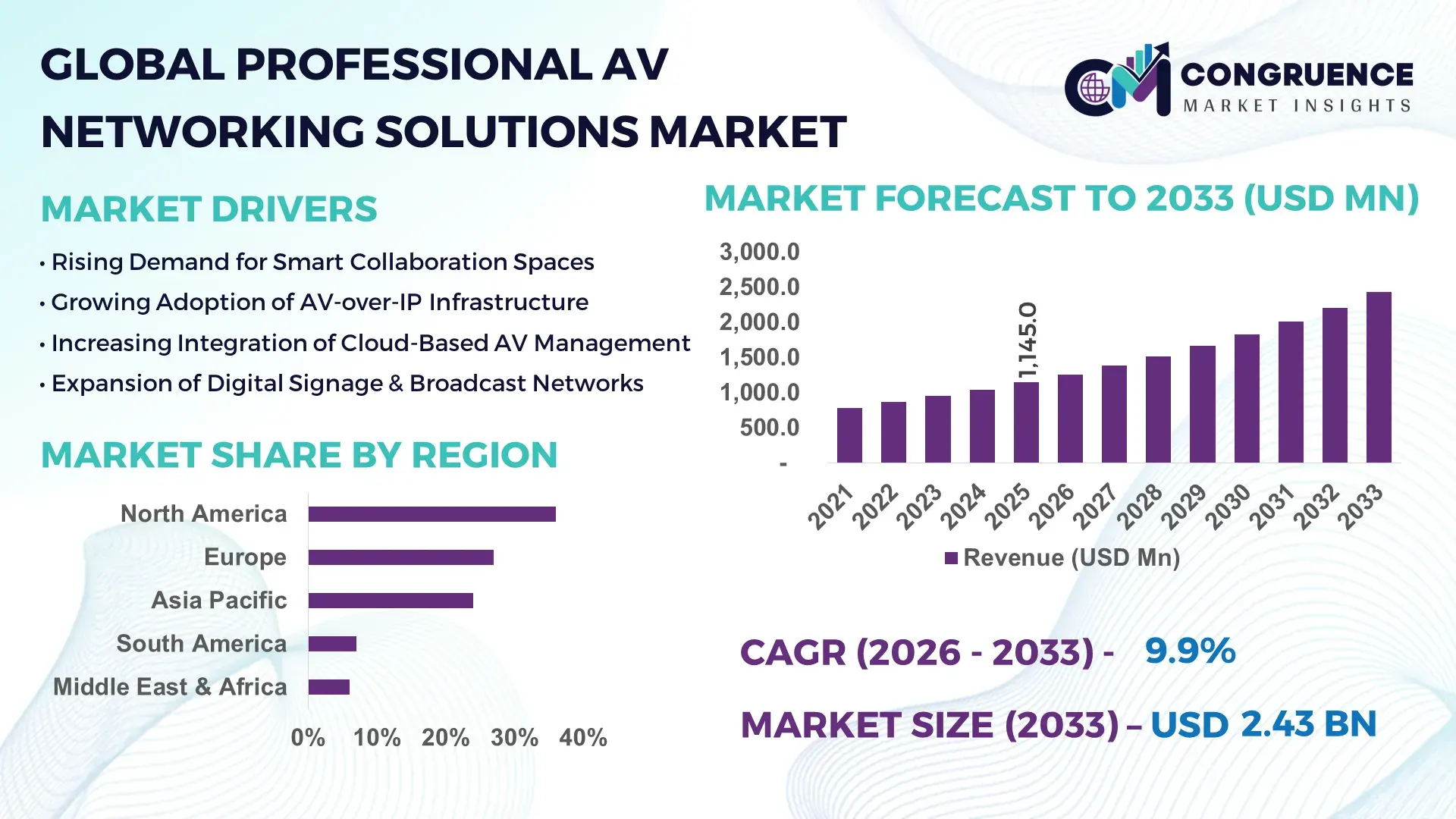
The Global Professional AV Networking Solutions Market was valued at USD 1,145.0 Million in 2025 and is anticipated to reach a value of USD 2,427.8 Million by 2033 expanding at a CAGR of 9.85% between 2026 and 2033, according to an analysis by Congruence Market Insights. The market expansion is primarily driven by accelerated adoption of AV-over-IP infrastructure across enterprise, education, healthcare, and smart commercial facilities seeking scalable, low-latency, and software-defined media distribution systems.
The United States dominates the Professional AV Networking Solutions Market in terms of deployment scale, innovation intensity, and enterprise adoption. The country accounts for over 35% of global AV-over-IP installations across corporate campuses, higher education institutions, and digital broadcasting facilities. More than 70% of Fortune 500 companies have integrated IP-based AV management platforms across multi-site operations. U.S.-based manufacturers and solution integrators collectively invest over USD 500 million annually in R&D for networked audio, 4K/8K video routing, and software-defined AV control systems. Additionally, smart classroom penetration exceeds 60% in public universities, and over 45% of large healthcare networks deploy centralized AV-over-IP monitoring systems to streamline telemedicine and surgical visualization workflows.
Market Size & Growth: Valued at USD 1,145.0 Million in 2025, projected to reach USD 2,427.8 Million by 2033 at 9.85% CAGR, driven by enterprise-wide IP convergence and hybrid collaboration expansion.
Top Growth Drivers: 68% enterprise AV-over-IP migration rate; 42% reduction in cabling infrastructure costs; 35% improvement in remote content management efficiency.
Short-Term Forecast: By 2028, centralized AV network management platforms are expected to reduce operational downtime by 30% across multi-site deployments.
Emerging Technologies: AI-driven signal optimization, 8K-ready IP video distribution, Software-Defined AV (SDAV), and Time-Sensitive Networking (TSN) integration.
Regional Leaders: North America projected USD 980 Million by 2033 with strong corporate adoption; Europe USD 620 Million with smart building retrofits; Asia-Pacific USD 540 Million driven by education digitization.
Consumer/End-User Trends: Corporate enterprises represent over 40% of installations, followed by education at 28% and healthcare at 18%, with rising preference for scalable IP-based matrices.
Pilot or Case Example: In 2024, a U.S. university campus achieved 38% reduction in maintenance response time after deploying centralized AV-over-IP monitoring.
Competitive Landscape: Market leader holds approximately 18% share, followed by 3–5 major global AV networking providers competing through protocol interoperability and cloud integration.
Regulatory & ESG Impact: Energy-efficient AV systems reduce power consumption by up to 25%, aligning with green building certifications and ESG reporting mandates.
Investment & Funding Patterns: Over USD 1.2 Billion invested globally in smart infrastructure upgrades and enterprise collaboration networks during 2023–2025.
Innovation & Future Outlook: Increasing convergence of IT and AV departments, edge processing integration, and scalable cloud-managed AV ecosystems shaping long-term deployment strategies.
Enterprise (40%), education (28%), healthcare (18%), and broadcast sectors drive demand for scalable AV-over-IP matrices and software-defined control systems. Adoption of 8K-capable switches and AI-based network diagnostics is reshaping performance benchmarks. Energy efficiency mandates and smart building regulations accelerate upgrades, particularly in North America and Western Europe. Asia-Pacific exhibits strong institutional deployment growth. Future outlook centers on cloud-native AV orchestration and cybersecurity-enhanced media transport.
The Professional AV Networking Solutions Market holds strategic importance as enterprises transition from hardware-bound matrix systems to scalable, IP-centric architectures that unify audio, video, and control networks. Organizations are prioritizing infrastructure that supports hybrid collaboration, real-time analytics, and centralized monitoring across distributed campuses. Software-Defined AV delivers 40% greater scalability compared to traditional HDMI-based matrix switching, enabling seamless device expansion without major rewiring costs.
North America dominates in deployment volume, while Asia-Pacific leads in adoption momentum with over 52% of new higher-education institutions implementing IP-based AV control ecosystems. By 2028, AI-powered AV traffic optimization is expected to improve bandwidth utilization efficiency by 35% across enterprise networks.
From an ESG standpoint, firms are committing to 30% energy-efficiency improvements in smart commercial buildings by 2030 through low-power AV switches and automated shutdown systems. In 2024, a leading U.S. technology integrator achieved 33% latency reduction and 25% energy savings after deploying Time-Sensitive Networking-enabled AV infrastructure across a multi-building corporate campus.
Strategically, companies are investing in cybersecurity-hardened AV endpoints and encrypted media transport protocols to mitigate IP-based vulnerabilities. As IT and AV convergence accelerates, the Professional AV Networking Solutions Market is emerging as a pillar of operational resilience, digital compliance, and sustainable enterprise infrastructure modernization.
The Professional AV Networking Solutions Market is shaped by rapid IT-AV convergence, growing hybrid workplace models, and demand for centralized, software-managed media infrastructure. Enterprises are replacing legacy analog and hardware matrix systems with scalable AV-over-IP frameworks capable of supporting 4K/8K streaming, remote diagnostics, and cloud orchestration. Education and healthcare sectors increasingly require low-latency video distribution for distance learning and telemedicine. Network standardization, interoperability protocols, and cybersecurity requirements significantly influence procurement decisions. Furthermore, smart building integration and green infrastructure investments are reshaping installation patterns, with IP-enabled AV switches integrated into broader building management systems. Competitive intensity remains high as vendors focus on interoperability, reduced latency, and improved network security architecture.
Enterprise digital transformation initiatives are pushing AV systems onto unified IP backbones, eliminating up to 45% of legacy cabling complexity. Over 60% of new commercial office developments now integrate AV-over-IP frameworks at the construction stage. Centralized AV monitoring reduces troubleshooting time by nearly 35%, improving operational efficiency across multi-site enterprises. The shift toward hybrid collaboration tools has increased demand for multi-room streaming and distributed signal routing, particularly in corporate headquarters and technology campuses. As IT departments assume responsibility for AV management, network-based scalability and software-defined upgrades are becoming procurement priorities.
IP-based AV systems expand network endpoints, increasing potential attack surfaces. Approximately 48% of enterprise IT leaders identify unsecured AV devices as moderate cybersecurity risks. Encryption upgrades and firmware patching increase operational costs and deployment complexity. Smaller institutions often delay upgrades due to integration compatibility issues with legacy systems. Additionally, bandwidth congestion in older network infrastructures can reduce streaming stability by up to 20%, limiting seamless deployment in cost-sensitive environments.
Global smart building initiatives are expanding at over 12% annually, with more than 50% of new commercial projects integrating centralized AV control. Government-backed digital classroom programs aim to equip 65% of public institutions with IP-enabled display systems by 2030. Healthcare networks increasingly deploy real-time surgical visualization and telemedicine platforms, increasing demand for ultra-low latency AV distribution. Integration with AI-driven analytics platforms enables predictive maintenance, reducing equipment failure incidents by 28%.
Interoperability across proprietary protocols creates configuration inconsistencies, affecting up to 30% of multi-vendor installations. Migration from analog to IP requires skilled networking professionals, yet nearly 40% of AV integrators report talent shortages in advanced network configuration. Upgrading to 10GbE or higher switching infrastructure adds capital expenditure pressure, particularly in educational institutions. Additionally, legacy HDMI-based systems cannot easily integrate with cloud-managed AV ecosystems, delaying modernization cycles.
72% Shift Toward AV-over-IP Deployment: Approximately 72% of new enterprise AV installations now utilize IP-based signal distribution rather than traditional matrix switching. Organizations report 35% faster scalability when adding endpoints and a 30% reduction in long-term maintenance interventions.
8K and High-Bandwidth Network Adoption Rising by 48%: Deployment of 10GbE-enabled switches and 8K-capable encoders increased by 48% across corporate and broadcast environments. These systems deliver 4x resolution improvement compared to 1080p infrastructure and reduce latency by nearly 25%.
AI-Driven AV Monitoring Improves Efficiency by 33%: AI-enabled diagnostic platforms identify network congestion and device malfunctions in real time, lowering downtime by 33%. Predictive alerts reduce reactive service visits by nearly 28%, improving operational continuity.
Energy-Efficient AV Systems Reduce Power Usage by 26%: Smart power management integration in networked AV devices reduces idle energy consumption by 26%. Over 58% of newly constructed smart commercial buildings incorporate automated AV shutdown features to meet green certification targets.
The Professional AV Networking Solutions Market is segmented by type, application, and end-user, reflecting the increasing convergence of IT infrastructure with audio-visual distribution systems. By type, the market spans AV-over-IP hardware, network switches, encoders/decoders, control software platforms, and cloud-managed AV systems. Hardware-based AV-over-IP encoders and decoders remain foundational for signal transport, while software-defined AV platforms are rapidly transforming system scalability and centralized management. By application, corporate enterprise environments represent the most mature deployment landscape, followed by education, healthcare, live events, and broadcast studios. The shift toward hybrid collaboration and distributed content delivery is influencing demand patterns across multi-campus and multi-site facilities. From an end-user perspective, large enterprises and institutional buyers dominate procurement due to high bandwidth requirements and multi-room installations. However, mid-sized enterprises and smart commercial infrastructure developers are demonstrating strong adoption momentum, supported by digital modernization programs and smart building mandates.
The Professional AV Networking Solutions Market by type includes AV-over-IP encoders/decoders, network switches (1GbE/10GbE), control and management software platforms, signal extenders, and cloud-based orchestration systems. AV-over-IP encoders and decoders currently account for approximately 38% of total product adoption, as they form the backbone of digital signal transmission across enterprise campuses. Network switches optimized for media traffic hold nearly 27%, driven by demand for low-latency and high-bandwidth switching environments. However, cloud-managed AV control platforms are expanding fastest, projected to grow at a CAGR of 12.4% through 2033, supported by centralized device monitoring and firmware automation capabilities.
Software-defined AV solutions are gaining preference as organizations seek to reduce physical matrix dependency by up to 40%. Meanwhile, signal extenders and specialty converters contribute a combined 35% share, serving niche environments such as broadcast studios and medical imaging centers requiring deterministic latency performance.
• In 2024, a leading U.S. public university upgraded over 450 classrooms with AV-over-IP encoders integrated into a centralized 10GbE backbone, improving signal routing flexibility by 37% and reducing maintenance response time by 32%.
Corporate enterprise environments lead the Professional AV Networking Solutions Market, accounting for approximately 40% of total deployments due to high demand for distributed conferencing, digital signage, and multi-site control systems. Education follows with 28%, as smart classrooms and lecture capture systems increasingly rely on IP-based routing. Healthcare applications hold nearly 18%, supporting telemedicine, surgical imaging, and centralized monitoring. However, live events and hybrid broadcasting applications are growing fastest, with an estimated CAGR of 11.8%, driven by increased demand for real-time streaming and remote production workflows.
Corporate AV networking adoption enables up to 35% improvement in cross-site communication efficiency. In 2025, more than 41% of multinational enterprises reported upgrading legacy matrix systems to IP-based infrastructure. Additionally, 39% of universities globally are piloting centralized AV management dashboards to reduce IT overhead. The remaining 14% includes hospitality, government, and transportation control centers, where control-room grade reliability is critical.
• In 2025, a European national healthcare authority reported that over 120 hospitals integrated IP-based surgical video distribution systems, reducing procedural latency by 29% and improving remote specialist consultation access.
Large enterprises remain the leading end-user segment, representing approximately 45% of overall installations due to multi-building campus infrastructure and standardized IT governance models. Educational institutions account for 25%, reflecting large-scale classroom digitization initiatives. Healthcare networks contribute nearly 15%, particularly for imaging-intensive departments. However, small and medium-sized enterprises (SMEs) represent the fastest-growing end-user segment, expanding at a CAGR of 12.1%, supported by cost-efficient cloud-managed AV platforms and subscription-based deployment models.
In 2025, 38% of mid-sized enterprises reported piloting centralized AV-over-IP monitoring tools to enhance collaboration environments. Additionally, 42% of U.S. hospitals are actively testing integrated AV-network systems for remote diagnostics and patient data visualization. Government and transportation sectors collectively represent the remaining 15%, primarily for command-and-control and surveillance-integrated AV deployments.
• In 2024, a U.S. state-level education board confirmed deployment of IP-based AV networking systems across more than 600 public school facilities, increasing digital lesson delivery capacity by 44% while lowering onsite technical intervention rates by 31%.
North America accounted for the largest market share at 36% in 2025 however, Asia-Pacific is expected to register the fastest growth, expanding at a CAGR of 11.2% between 2026 and 2033.

North America’s dominance is supported by over 70% enterprise penetration of AV-over-IP systems in Fortune 1000 companies and more than 65% smart classroom integration across higher education institutions. Europe holds approximately 27% market share, driven by large-scale digital workplace modernization and sustainability-focused building retrofits across Germany, the UK, and France. Asia-Pacific represents nearly 24% of global installations, with China, Japan, and India accounting for over 60% of regional deployments, particularly in smart campuses and commercial real estate. South America contributes 7%, largely centered in Brazil and Argentina, where broadcast and live event infrastructure modernization is rising. The Middle East & Africa account for 6%, fueled by mega infrastructure projects and smart city initiatives in the UAE and Saudi Arabia. Across regions, over 55% of new commercial construction projects integrate IP-based AV frameworks at the design stage.
North America holds approximately 36% of the Professional AV Networking Solutions Market share, supported by strong enterprise IT-AV convergence and smart infrastructure investments. The corporate sector accounts for nearly 48% of regional deployments, followed by education at 26% and healthcare at 17%. More than 72% of large enterprises utilize centralized AV management dashboards for multi-site conferencing environments. Federal and state-level smart building incentives promoting energy-efficient infrastructure upgrades have accelerated replacement of legacy matrix systems. The region has witnessed over 40% migration toward 10GbE-enabled AV switching environments in commercial offices. Local technology integrators are actively expanding managed AV services portfolios, with one leading U.S.-based AV networking provider deploying AI-driven monitoring tools across 300+ corporate campuses in 2024, reducing downtime by 34%. Consumer behavior reflects higher enterprise adoption in healthcare and finance, where compliance-driven digital transformation budgets remain strong.
Europe represents approximately 27% of the Professional AV Networking Solutions Market share, with Germany, the UK, and France collectively accounting for over 58% of regional installations. Corporate retrofits and public-sector modernization projects are key drivers, particularly under green building mandates targeting 30% energy reduction in commercial facilities by 2030. Around 44% of new office developments in Western Europe integrate AV-over-IP systems during initial construction. Emerging technologies such as Time-Sensitive Networking (TSN) and AI-based AV diagnostics are increasingly adopted, especially in Germany’s industrial campuses and the UK’s financial institutions. A European AV manufacturer expanded its 8K-enabled encoder production capacity by 25% in 2024 to support broadcast and live-event clients. Consumer behavior trends show regulatory pressure leading to greater demand for energy-efficient, interoperable AV solutions aligned with sustainability compliance standards.
Asia-Pacific ranks second globally in total installations, contributing approximately 24% of the Professional AV Networking Solutions Market volume. China, Japan, and India collectively account for over 60% of regional demand, driven by large-scale smart campus projects and commercial infrastructure expansion. More than 50% of newly constructed IT parks in major metropolitan cities integrate IP-based AV frameworks as part of building automation systems. Regional innovation hubs in Tokyo, Shenzhen, and Bengaluru are promoting AI-integrated AV control platforms. A Japanese electronics manufacturer increased its networked AV switch production by 30% in 2024 to meet enterprise demand. Consumer behavior indicates growth driven by digital education programs and corporate digitalization, with over 46% of large institutions piloting centralized AV monitoring dashboards.
South America accounts for approximately 7% of the Professional AV Networking Solutions Market share, with Brazil representing nearly 55% of regional installations and Argentina contributing around 18%. Broadcast modernization and live-event streaming upgrades are major growth contributors, particularly as over 40% of media studios transition to IP-based routing systems. Infrastructure investments linked to telecommunications expansion are supporting improved network backbone capacity. Government-backed digital transformation initiatives in Brazil aim to upgrade over 35% of public universities with smart AV classrooms by 2028. A regional AV integrator deployed centralized IP-based control systems across 120 conference venues in 2024, improving signal reliability by 28%. Consumer demand remains closely tied to media localization and multi-language broadcasting capabilities.
The Middle East & Africa region holds roughly 6% of the Professional AV Networking Solutions Market share, led by the UAE and Saudi Arabia, which collectively account for over 50% of regional deployments. Oil & gas facilities, large-scale construction projects, and smart city initiatives are key demand drivers. Approximately 38% of newly constructed commercial complexes in the UAE integrate centralized AV-over-IP systems. Technological modernization in transport hubs and luxury hospitality developments has accelerated adoption of 4K/8K-ready AV networks. A UAE-based system integrator implemented AI-based AV monitoring across 45 high-rise commercial buildings in 2024, improving maintenance efficiency by 31%. Consumer behavior reflects growing demand for high-performance digital signage and multilingual conferencing environments aligned with global business standards.
United States – 32% Market Share: Strong enterprise IT integration, large-scale smart campus deployments, and high R&D investment in AV-over-IP technologies support leadership in the Professional AV Networking Solutions Market.
Germany – 11% Market Share: Advanced industrial campuses, sustainability-driven retrofits, and high adoption of energy-efficient AV networking infrastructure position Germany as a key European leader in the Professional AV Networking Solutions Market.
The Professional AV Networking Solutions Market exhibits a moderately fragmented competitive structure, with more than 60 active global and regional vendors offering AV-over-IP hardware, switching infrastructure, control software, and integrated system solutions. The top five companies collectively account for approximately 52% of total market share, indicating moderate consolidation at the leadership level while maintaining strong competitive intensity across mid-tier providers.
Market leaders differentiate through proprietary AV-over-IP protocols, 8K-ready encoders, AI-based network monitoring, and cybersecurity-enhanced endpoints. Over 40% of leading vendors have expanded cloud-managed AV orchestration capabilities since 2023 to support distributed enterprise campuses. Strategic partnerships between AV manufacturers and enterprise networking providers have increased by 28% between 2023 and 2025, reflecting the convergence of IT and AV ecosystems.
Product innovation cycles average 12–18 months, particularly for 10GbE-enabled switches and low-latency encoders. Mergers and acquisitions activity remains active, with at least 8 notable integration-focused acquisitions recorded globally in 2024–2025 to enhance interoperability and managed services portfolios. Competitive positioning increasingly emphasizes scalability, interoperability compliance, and ESG-aligned energy-efficient hardware, with energy consumption reductions of up to 25% highlighted as a differentiating metric. The market’s evolution is driven by R&D intensity, protocol standardization initiatives, and global channel expansion strategies.
Crestron Electronics
Q-SYS (QSC)
Atlona
Black Box Corporation
Kramer Electronics
ClearOne
Barco
Bosch Security and Safety Systems
Sony Professional Solutions
Panasonic Connect
NETGEAR AV
Shure Incorporated
Technological advancement in the Professional AV Networking Solutions Market is centered on IP convergence, ultra-low latency transmission, and AI-driven network optimization. Over 70% of new enterprise AV deployments now rely on AV-over-IP architecture rather than traditional circuit-based matrices. The transition toward 10GbE and 25GbE switching environments enables 4K and 8K signal transport with latency levels below 1 millisecond in optimized networks.
Time-Sensitive Networking (TSN) integration is gaining momentum, allowing deterministic media delivery across shared enterprise networks. Approximately 35% of large-scale broadcast and command-center deployments now specify TSN-enabled switches to ensure synchronized audio-video performance.
Cloud-managed AV orchestration platforms are expanding, enabling centralized firmware updates and device monitoring across 500+ endpoints within a single enterprise network. AI-based diagnostics reduce fault detection time by nearly 30%, while predictive analytics tools lower service interventions by up to 28%.
Cybersecurity enhancements, including AES-256 encryption and network segmentation, are becoming standard features in over 60% of enterprise-grade AV endpoints. Additionally, energy-efficient PoE++ (Power over Ethernet) switches reduce infrastructure cabling complexity by 40% and lower idle power consumption by up to 22%. Interoperability initiatives and standardized IPMX protocol development are further enabling vendor-neutral ecosystems, enhancing scalability and cross-platform compatibility for mission-critical installations.
• In February 2025, Crestron Electronics expanded its DM NVX AV-over-IP lineup with the advanced DM NVX® 384 encoder/decoder featuring USB-C connectivity, multi-input switching, multiview capability, and support for multiple resolutions — enhancing unified communications and large-format display applications across enterprise, education, and control-room environments. Source: www.crestron.com
• In January 2026, QSC announced a strategic expansion of its Q-SYS Full Stack AV Platform with the introduction of standardized collaboration solutions, including Q-SYS RoomSuite Modular Systems, Q-SYS Connect for Zoom, MPA-Q series network amplifiers, and X Class Server Core X50r — designed to facilitate scalable, cloud-managed AV distribution and hospitality/entertainment space deployments. Source: www.qsys.com
• In 2025, NETGEAR AV closed the year with major industry recognition and expanded education initiatives, earning multiple awards (e.g., TVBEurope Best of Show for M4350 switches and SVC Innovative Product Awards) while transforming its NETGEAR Academy into a comprehensive AV-over-IP training platform with over 30,000 enrolled professionals, broadening accessibility for integrators and IT/AV specialists. Source: www.netgear.com
• In October 2025, Q-SYS expanded its Full Stack AV Platform with new hardware and software innovations, adding the NC-90 and NC-Pro15x network cameras, high-density QIO Series audio models, space utilization insights via Q-SYS Reflect, and enhanced NS Series Gen 2 network switches — enabling improved hybrid collaboration and intelligent space management for enterprise and mission-critical environments. Source: www.qsys.com
The Professional AV Networking Solutions Market Report provides comprehensive coverage across product types, applications, end-user industries, and geographic regions. The study encompasses AV-over-IP encoders and decoders, network switches (1GbE, 10GbE, and above), control and management software platforms, signal extenders, and cloud-based orchestration solutions. It evaluates deployment patterns across corporate enterprises, education institutions, healthcare facilities, broadcast studios, hospitality environments, government command centers, and transportation hubs.
Geographically, the report analyzes North America, Europe, Asia-Pacific, South America, and the Middle East & Africa, including country-level insights for major economies such as the United States, Germany, China, Japan, Brazil, and the UAE. The scope includes infrastructure modernization trends, IT-AV convergence strategies, smart building integration, and sustainability-driven procurement models.
Technological focus areas cover Time-Sensitive Networking (TSN), IPMX interoperability standards, 8K-ready transmission systems, AI-driven diagnostics, cybersecurity-enhanced AV endpoints, and PoE++ network optimization. The report further examines adoption behavior across enterprise sizes, integration complexity factors, regulatory influences, energy-efficiency initiatives, and digital transformation roadmaps. It delivers actionable intelligence tailored to system integrators, manufacturers, infrastructure planners, IT decision-makers, and institutional buyers evaluating scalable, secure, and future-ready AV networking ecosystems.
| Report Attribute / Metric | Details |
|---|---|
| Market Revenue (2025) | USD 1,145.0 Million |
| Market Revenue (2033) | USD 2,427.8 Million |
| CAGR (2026–2033) | 9.85% |
| Base Year | 2025 |
| Forecast Period | 2026–2033 |
| Historic Period | 2021–2025 |
| Segments Covered |
By Type
By Application
By End-User Insights
|
| Key Report Deliverables | Revenue Forecast; Market Trends; Growth Drivers & Restraints; Technology Insights; Segmentation Analysis; Regional Insights; Competitive Landscape; Regulatory & ESG Overview; Recent Developments |
| Regions Covered | North America; Europe; Asia-Pacific; South America; Middle East & Africa |
| Key Players Analyzed | Extron Electronics; AMX; Harman Professional Solutions; Crestron Electronics; Q-SYS (QSC); Atlona; Black Box Corporation; Kramer Electronics; ClearOne; Barco; Bosch Security and Safety Systems; Sony Professional Solutions; Panasonic Connect; NETGEAR AV; Shure Incorporated |
| Customization & Pricing | Available on Request (10% Customization Free) |




