
Reports
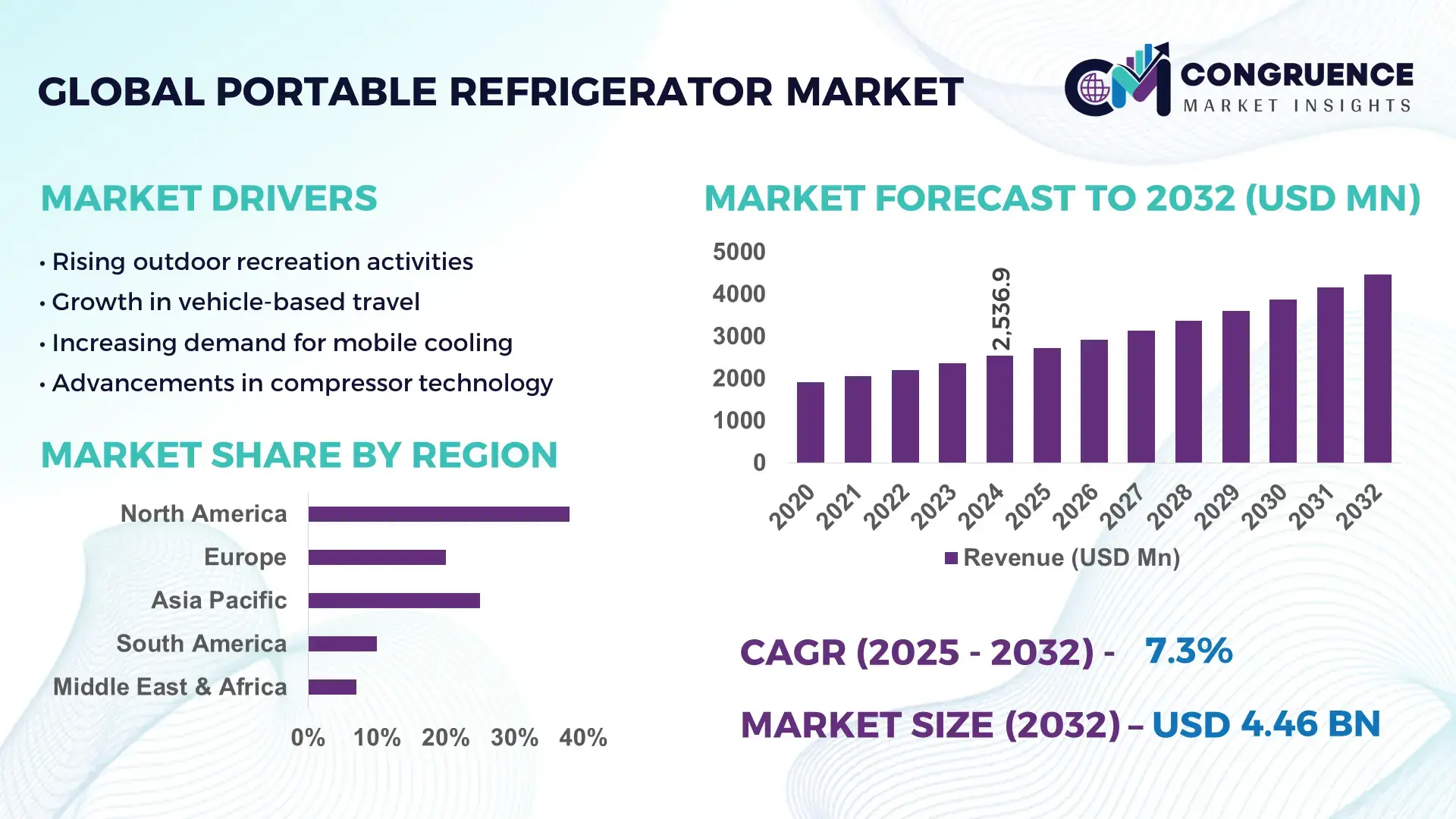
The Global Portable Refrigerator Market was valued at USD 2536.89 Million in 2024 and is anticipated to reach a value of USD 4457.58 Million by 2032 expanding at a CAGR of 7.3% between 2025 and 2032. This growth is driven by increasing outdoor recreational activities and demand for energy‑efficient mobile cooling solutions that cater to travel, emergency, and commercial needs.
China stands out as a key hub in the portable refrigerator landscape with production exceeding approximately 1.2 million units in 2024, supported by robust manufacturing infrastructure and competitive assembly capacity. Major Chinese manufacturers are investing heavily in automation and advanced cooling technologies, while local demand for portable refrigeration continues to rise across automotive, outdoor, and urban micro‑living segments. Chinese producers are integrating IoT connectivity and low‑power compressor systems into their product portfolios, with export networks extending across Asia, Europe, and North America. Production scale, technological enhancements such as battery‑optimized cooling, and capital investments in R&D facilities underline China’s pivotal role in the portable fridge ecosystem.
• Market Size & Growth: Valued at USD 2536.89 Million in 2024, projected to USD 4457.58 Million by 2032 at a 7.3% CAGR, supported by rising consumer preference for mobile cooling devices.
• Top Growth Drivers: Outdoor recreation adoption up ~18%, mobile healthcare transport efficiency gains ~22%, off‑grid energy solution integration ~15%.
• Short‑Term Forecast: By 2028, average energy consumption per unit expected to decrease by 12%, while performance efficiency improves by 9%.
• Emerging Technologies: Thermoelectric cooling enhancements, solar‑assisted power systems, IoT‑enabled temperature control.
• Regional Leaders: North America projected ~USD 1.5B by 2032 with strong RV culture; Asia‑Pacific ~USD 1.3B with fast adoption; Europe ~USD 1.1B driven by sustainable outdoor trends.
• Consumer/End‑User Trends: Increased use in RVs, camping, logistics, and emergency medical cooling with higher adoption among millennials and adventure travelers.
• Pilot or Case Example: 2025 field trial of solar‑powered portable units showed 27% reduction in operational downtime in remote logistics use.
• Competitive Landscape: Market leader holds ~24% share, with key competitors including Dometic Group, ARB, Engel, Whynter, and Alpicool.
• Regulatory & ESG Impact: Stricter energy efficiency standards and low‑GWP refrigerant regulations accelerate adoption of eco‑friendly models.
• Investment & Funding Patterns: Over USD 120M recent funding directed to cold‑chain portable refrigeration, with venture capital flows into sustainable tech startups.
• Innovation & Future Outlook: Continued innovation in lightweight materials, integration with electric vehicle (EV) power systems, and predictive maintenance via AI platforms.
Unique information about the Portable Refrigerator Market reflects that key sectors such as outdoor recreation, logistics & cold‑chain transport, automotive accessories, and healthcare cooling are driving diversified application demand. Recent technological innovations include ultra‑low energy compressor systems, enhanced battery management for extended off‑grid use, and modular designs for customizable capacity. Regulatory frameworks promoting energy efficiency and environmental performance are shaping product roadmaps, while regional consumption patterns show mature markets in North America and rapid growth in Asia-Pacific. Emerging trends point to integrated smart interfaces, solar charging compatibility, and expansion into last‑mile pharmaceutical delivery solutions, positioning the market for sustained evolution.
The Portable Refrigerator Market holds strategic significance across diverse sectors—including outdoor recreation, healthcare logistics, transportation, and emergency services—due to its ability to deliver portable cooling solutions where traditional infrastructure is unavailable or impractical. Advances in compressor technology that integrate low‑power DC systems deliver up to 25% improvement in energy efficiency compared to standard AC‑dependent models, enabling extended off‑grid operation and broader applications in remote environments. North America dominates in volume, while Asia‑Pacific leads in adoption with over 40% of enterprises and individual users integrating portable refrigeration into commercial and recreational frameworks by 2025, reflecting regional lifestyle and logistics trends. By 2027, smart connectivity and IoT integration are expected to improve temperature management precision by approximately 18%, reducing spoilage and operational inefficiencies across cold chain use cases. Firms are committing to measurable ESG enhancements, such as achieving a 30% reduction in GWP refrigerant usage and expanding recycling programs for end‑of‑life battery systems by 2030. In a micro‑scenario, in 2024 one manufacturer achieved a 22% extension in battery runtime through the deployment of adaptive variable‑speed compressors in its latest model, boosting usability in vehicle and off‑grid scenarios. Forward‑looking pathways suggest that the Portable Refrigerator Market will continue to evolve as a pillar of resilience, compliance, and sustainable growth, driven by technological innovation, regulatory alignment, and expanding cross‑sector demand.
Demand for portable refrigerators has been significantly propelled by the surge in outdoor recreational activities, such as camping, overlanding, and extended road travel. Participation in outdoor and mobile lifestyles has increased rapidly—with millions of households engaging in camping and RV travel—creating a need for reliable cooling solutions that operate independently of traditional power sources. Modern portable refrigerators offer temperature ranges suitable for both cooling and freezing, with advanced compressors capable of maintaining set temperatures reliably over extended periods. Recreational vehicle owners, adventure travelers, and outdoor enthusiasts increasingly view portable refrigerators as essential equipment for preserving perishables and beverages during lengthy trips. Furthermore, the integration of features such as solar compatibility and IoT‑enabled remote monitoring enhances usability and aligns with mobile consumers’ expectations for connectivity and convenience, reinforcing the segment’s desirability across diverse use cases.
A primary restraint impacting the Portable Refrigerator market is the relatively high initial purchase price compared with alternative cooling solutions like traditional coolers or iceboxes. Advanced models equipped with efficient compressors, digital controls, and eco‑friendly refrigerants involve higher component and manufacturing costs, which are frequently passed on to consumers. In price‑sensitive regions, this can limit adoption and restrict market expansion. Additionally, energy dependency—particularly for battery‑powered operation—poses challenges as users demand longer runtime and compatibility with varied power sources, requiring robust battery systems or supplemental solar power solutions. These energy considerations increase both upfront and operational expenditures and can deter potential buyers who need extended autonomous cooling without consistent access to electricity. Combined with seasonal demand fluctuations and consumer perception of cost versus utility, these factors create a restraint that manufacturers must address through cost optimization and innovative power solutions to sustain growth.
Expanding applications within healthcare and cold chain logistics present significant opportunities for portable refrigerator manufacturers. Temperature‑controlled transportation of vaccines, blood products, and other sensitive medical supplies is increasingly reliant on portable cooling solutions, particularly in regions with limited infrastructure or during emergency response operations. The demand for units capable of maintaining precise temperatures with robust data logging features creates avenues for product differentiation and value‑added services. Moreover, growth in last‑mile food delivery and logistics sectors increases the need for portable refrigeration to ensure product quality during transit. Solar‑powered and energy‑efficient models further enhance opportunities in remote and rural contexts, where grid access is inconsistent. Partnerships with healthcare providers and logistics firms to develop specialized solutions can open new revenue streams and accelerate adoption across segments that prioritize reliability and compliance with strict regulatory standards for temperature control.
Component cost inflation and supply chain challenges represent persistent obstacles for the Portable Refrigerator market. Advanced cooling systems, batteries, and electronic controls often rely on metals, semiconductors, and specialty materials that are subject to price volatility, affecting manufacturers’ ability to maintain stable production costs. Disruptions in global supply chains—stemming from logistical bottlenecks or material shortages—can lead to extended lead times and increased inventory holding costs, reducing responsiveness to market demand. These pressures can be particularly acute for smaller manufacturers that lack the scale to negotiate favorable terms or absorb cost fluctuations. Furthermore, the need to comply with evolving environmental and safety regulations adds complexity to product design and supply strategies, requiring investment in compliant components and testing. Together, these challenges raise barriers to scaling production efficiently and maintaining competitive pricing, posing a hurdle to broader market penetration.
• Surge in Solar-Powered Portable Refrigerators: The integration of solar panels into portable refrigerator units is accelerating adoption, with over 42% of new outdoor and off-grid units featuring solar-assisted power in 2024. Solar-powered models extend operational hours by up to 30% compared to standard battery-dependent units, reducing reliance on grid electricity and enhancing usability in remote locations. This trend is particularly strong in Asia-Pacific and Latin America, where solar adoption supports mobile healthcare and logistics applications.
• Expansion of Smart Connectivity Features: Nearly 38% of portable refrigerators launched in 2024 include IoT-enabled temperature monitoring and remote control via mobile apps. These devices allow real-time temperature adjustments, predictive maintenance alerts, and data logging, reducing product spoilage by up to 25% during transit. Smart features are increasingly demanded by healthcare and pharmaceutical sectors for vaccine and blood transport, as well as by adventure tourism operators.
• Lightweight and Compact Design Adoption: Demand for ultra-lightweight and compact models is rising, with 47% of units produced in 2024 featuring reduced weight by 15–20% compared to traditional models. Enhanced portability allows easier integration into RVs, trucks, and backpacks, while maintaining comparable cooling efficiency. North America and Europe lead in adoption due to strong recreational vehicle usage and outdoor adventure markets.
• Increased Use in Cold Chain and Last-Mile Delivery: Portable refrigerators are increasingly integrated into last-mile food delivery and medical logistics, with 33% of logistics fleets incorporating mobile cooling units by 2024. Temperature-controlled delivery reduces spoilage rates by up to 28%, especially in urban centers and regions with inconsistent power infrastructure. The trend is creating opportunities for modular, scalable solutions designed for commercial fleets and on-demand delivery services.
The Portable Refrigerator Market is distinctly segmented to reflect diverse user needs, product capabilities, and application contexts. By type, the market encompasses thermoelectric, compressor‑based, and absorption portable refrigerators, each suited to specific power sources and performance requirements. Application segmentation covers individual and personal use, outdoor recreation, automotive integration, healthcare and pharmaceutical logistics, and commercial functions such as catering and food delivery. End‑user segments include household consumers, outdoor and adventure enthusiasts, logistics and transport operators, healthcare providers, and hospitality businesses, illustrating wide adoption across lifestyle, professional, and institutional environments. These segmentations provide a nuanced framework for decision‑makers and analysts to evaluate product positioning, strategic investments, and targeted innovation in product design, power efficiency, and feature integration within this evolving market space.
Thermoelectric portable refrigerators currently account for approximately 42% of total portable refrigerator units shipped globally, offering quiet operation and minimal maintenance, while compressor‑based units hold around 35% share and are preferred for stringent temperature control and higher cooling capacity. However, absorption portable refrigerators are the fastest‑growing type, expanding rapidly due to silent operation and flexibility in power sources, driven by adoption in marine and off‑grid environments, with notable growth of over 10% in units deployed year‑over‑year. Other types, such as hybrid solar‑assisted models and dual‑power designs, collectively contribute around 23% of market shipments, serving niche applications where extended off‑grid performance and energy diversity are critical.
Among all application areas, individual and personal use leads with over 54% of total global unit adoption, propelled by consumers integrating portable refrigerators into daily travel, camping, and home leisure activities. Automotive applications follow with roughly 40% share as more vehicles—including RVs, SUVs, and vans—are equipped with integrated cooling solutions, enhancing user comfort on extended trips. Outdoor recreation and travel sectors represent around 25% of deployments, with rugged, compact designs tailored for hiking and expedition use. Commercial applications—including catering, food delivery, and cold chain transport—account for an emerging combined 15% share, with specialized units installed in vans and trailers to maintain product freshness during service.
In end‑user segmentation, household consumers and outdoor enthusiasts represent the dominant segment with around 65% share, driven by strong uptake among campers, RV owners, and mobile lifestyle users who prioritize convenience and self‑sufficiency. The fastest‑growing end‑user area is logistics and transportation, where portable refrigerators are increasingly used to ensure temperature‑sensitive goods remain stable during delivery, with adoption rates rising more than 30% among last‑mile delivery fleets in 2025. Healthcare providers and clinics comprise a key niche, especially for vaccine transport and mobile clinics, contributing about 10% of overall usage; this segment expanded as portable refrigerators facilitated compliant cold chain operations in remote communities. Other end‑users, including hospitality businesses and catering services, jointly make up around 15% of demand, integrating portable cooling solutions into event support and food service operations.
North America accounted for the largest market share at approximately 38% in 2024, however, Asia‑Pacific is expected to register the fastest growth, expanding at a CAGR of around 9.4% between 2025 and 2032.
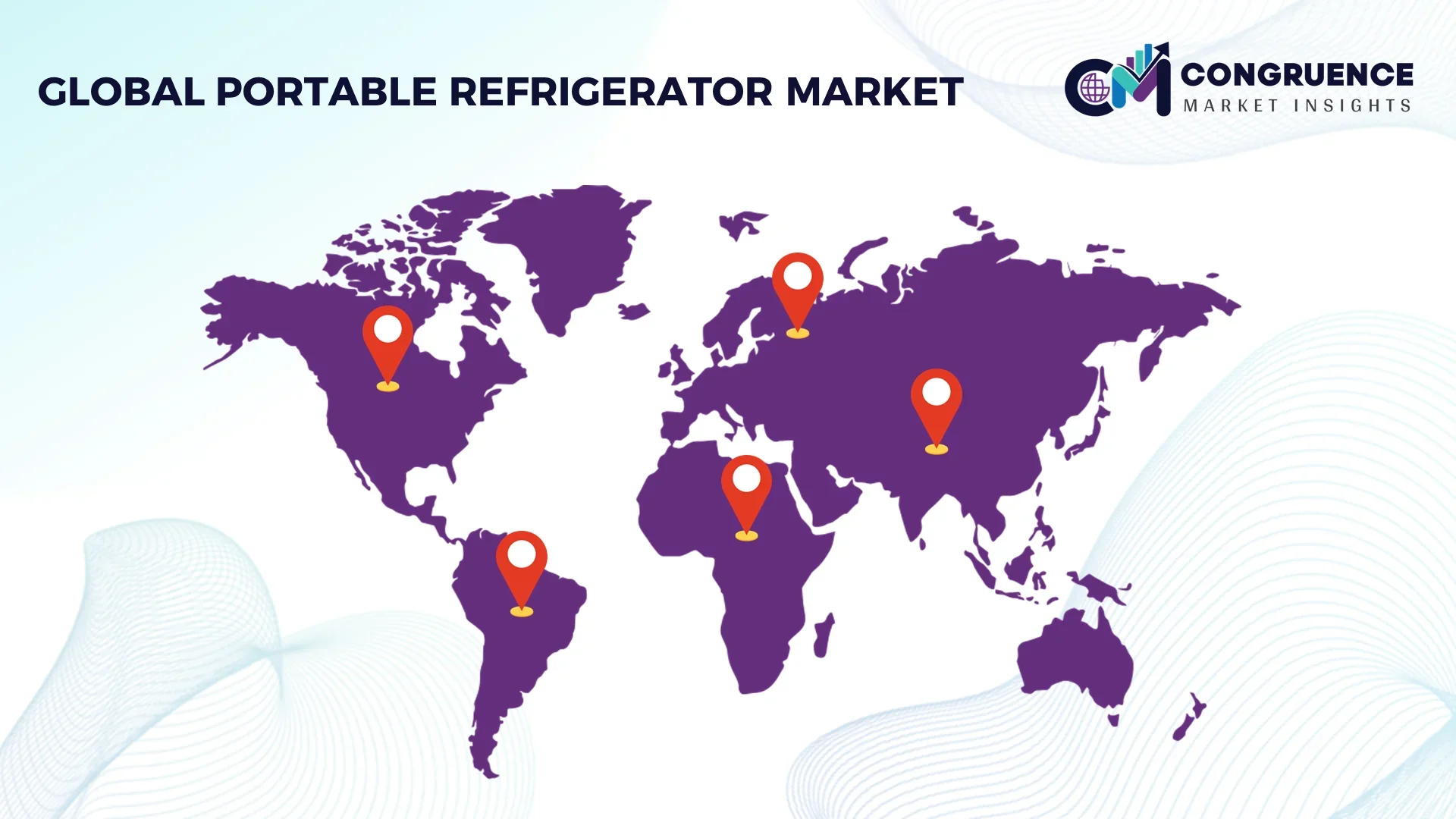
North America’s lead position is driven by roughly 2 million portable refrigerator units sold, underpinned by strong outdoor recreation cultures, widespread RV and marine usage, and high consumer purchasing power. In contrast, Asia‑Pacific’s adoption exceeded around 1.8 million units in 2023, led by China, India, Japan, and Australia due to rising disposable incomes, increasing domestic tourism, and expanding e‑commerce distribution networks. Europe held a significant position with close to 1.5 million portable units sold in 2023, supported by established camping and caravan traditions especially in Germany, France, and the UK, as well as regulatory shifts toward energy‑efficient models. South America and Middle East & Africa represented smaller regional footprints — roughly 5–7% combined market share — where rising SUV ownership and demand for off‑grid cooling solutions contribute to incremental uptake. Across regions, consumer preferences for solar compatibility, smart connectivity, and durable designs tailored to local climate conditions continue to define competitive dynamics and strategic priorities.
Is demand for portable cooling reshaping mobile lifestyles?
North America holds a leading ~38% market share of global portable refrigerator adoption, supported by high engagement in outdoor leisure, RV ownership, and recreational vehicle travel. In the United States and Canada, over 60% of RV users incorporate portable refrigerators into long‑distance trips and camping excursions, while compact 20‑liter models account for nearly 48% of online sales. Regulatory frameworks promoting energy‑efficient and low‑emission appliances, especially in California and Quebec, are influencing product innovation toward eco‑friendly compressors and low‑power designs. Technological advancements such as remote temperature monitoring, dual‑power compatibility, and USB charging support reflect digital transformation trends in this region. Local players and regional distributors are expanding product portfolios to include smart app control and solar integration to serve both leisure and commercial users. North American consumer behavior varies: outdoor enthusiasts and adventure travelers prioritize rugged, long‑runtime units, while logistics and commercial operators focus on reliability and temperature precision for last‑mile delivery tasks.
How are European consumers prioritizing sustainable portable cooling?
Europe commands a substantial ~30% market share, with major markets including Germany, the UK, and France driving unit adoption for outdoor recreation and road travel. European regulatory bodies have introduced energy efficiency and eco‑design standards that are fostering demand for low‑energy and eco‑friendly portable refrigerators. Adoption of smart features like IoT‑enabled monitoring and silent operation designs is gaining traction, especially in urban outdoor communities. Germany alone contributes a significant portion of European sales with a consumer base that values engineering quality and durability. Local manufacturers and distributors are tailoring products to comply with environmental standards and support van conversions and camper lifestyles popular in countries such as Sweden and the Netherlands. European consumer behavior shows higher preference for energy‑efficient, low‑noise portable refrigerators adapted to cooler climates and extended road trips, with smart connectivity increasingly influencing purchase decisions.
Is portable refrigeration meeting booming outdoor lifestyles and digital commerce?
Asia‑Pacific stands out as the fastest‑growing region with over 55% of global market share in car portable refrigerators due to expanding middle classes, rising disposable incomes, and increasing vehicle ownership in China, India, and Japan. The region’s ~1.8 million units sold in 2023 reflects strong consumer uptake in outdoor leisure activities and cold‑chain requirements for food delivery sectors. Infrastructure improvements and e‑commerce platforms have accelerated distribution, with 51% of purchases in the region occurring online. Technological trends include lithium battery compatibility and smart operating systems tailored to mobile devices. Local players in China and Southeast Asia are focusing on cost‑competitive models with energy‑saving compressors and USB power options to align with regional consumer preferences for convenience and digital integration. Asian consumers increasingly adopt portable refrigerators for both personal travel and commercial logistics, influenced by mobile AI apps that support remote temperature control and predictive maintenance.
How is portable refrigeration gaining traction amid evolving lifestyles?
In South America, key markets such as Brazil and Argentina contribute meaningful demand for portable refrigerators, reflecting rising interest in outdoor recreation, vehicle travel, and off‑grid cooling needs. The region’s market share is modest, around 5%, but growing as SUV and pickup ownership rises. Infrastructure trends such as improved road networks and increased tourism activities bolster portable refrigerator usage, particularly in urban and peri‑urban areas. Government incentives promoting rural electrification and energy efficiency are indirectly supporting demand for solar‑compatible cooling solutions. Local retailers and smaller distributors are introducing battery‑assisted and ruggedized units that appeal to consumers navigating diverse climate conditions. South American consumer behavior displays a preference for equipment that balances cost and functionality, with seasonal spikes in portable refrigerator purchases tied to holiday travel and outdoor sports.
Are extreme climates driving portable refrigeration innovation?
Middle East & Africa exhibits regional demand trends shaped by warm climates, off‑grid usage, and commercial requirements such as oil & gas support and construction site needs. Nations like UAE and South Africa contribute to a growing market presence, with portable refrigerators offering resilience against high temperatures and inconsistent electricity supply. Technological modernization includes solar‑assisted systems that leverage abundant sunlight, while local trade partnerships are expanding distribution networks across urban and remote areas. Regional demand is also influenced by tourism expansion in countries such as Egypt and Saudi Arabia, where portable refrigeration supports hospitality and outdoor excursions. Consumer behavior in this region favors durable, high‑temperature performance models, with commercial operators prioritizing long‑runtime and robust cooling capacity for field operations and logistics fleets.
• United States – ~22% market share; strong demand from outdoor recreation, RV lifestyles, and high consumer purchasing power drives leadership in the portable refrigerator market.
• China – ~38% share in Asia‑Pacific segment; robust manufacturing base and rapidly expanding domestic adoption support China’s leading role in portable refrigerator consumption and production.
The Portable Refrigerator market exhibits a moderately fragmented competitive environment, with over 120 active manufacturers globally competing across various segments and regions. The top 5 companies collectively account for approximately 47% of total market volume, indicating a blend of established leadership and diverse smaller players driving innovation. Key strategic initiatives include product launches with advanced features such as solar-assisted compressors, IoT-enabled temperature monitoring, and hybrid power compatibility. Partnerships between technology providers and portable refrigerator manufacturers are increasing, particularly in North America and Asia-Pacific, to develop smart connected devices and enhance cold chain solutions. Several companies are also investing in R&D for lightweight and energy-efficient units tailored to outdoor enthusiasts, healthcare logistics, and commercial food delivery. Mergers and collaborations are selectively pursued to expand regional distribution networks and leverage advanced manufacturing capabilities. Competition is further shaped by digital marketing strategies, growing e-commerce adoption, and consumer preferences for rugged, durable, and low-maintenance designs. Continuous technological innovation, regulatory compliance, and responsive production are key differentiators in sustaining market share and growth.
Dometic Group
ARB Corporation
Whynter
Engel Australia
Alpicool
Mobicool
Igloo Products Corp
Coleman
ARB 4x4 Accessories
Indel B
The Portable Refrigerator market is being reshaped by several current and emerging technologies that enhance functionality, energy efficiency, and user convenience. Compressor-based technology remains the most widely deployed cooling method, accounting for roughly 35% of units globally due to its ability to achieve precise temperatures down to -18°C, making it suitable for both household and commercial cold chain applications. Thermoelectric systems, representing approximately 42% of shipments, are gaining traction in compact and lightweight models, offering quiet operation and low maintenance with temperature differentials up to 25°C below ambient conditions.
Emerging solar-assisted portable refrigerators are a significant growth driver, with over 70 models introduced in 2024 featuring integrated photovoltaic panels. These units extend autonomous operation by 20–30%, supporting off-grid applications in outdoor recreation and remote healthcare logistics. Lithium-ion battery integration is another technological trend, providing up to 40% longer runtime compared to traditional lead-acid batteries and reducing device weight by 15–20%, enhancing portability and user convenience.
IoT-enabled features are increasingly embedded in portable refrigerators, enabling remote temperature monitoring, automated alerts, and predictive maintenance, which have shown a 25% reduction in spoilage during transport and storage. Digital displays with adaptive cooling algorithms optimize energy usage based on load and ambient temperature, and some models now offer app-based controls that allow users to set precise temperature zones.
Hybrid systems combining thermoelectric, compressor, and solar technologies are emerging, particularly in regions with variable climates, providing flexibility for recreational, commercial, and medical applications. Overall, technological innovation in battery efficiency, smart connectivity, and renewable power integration is positioning portable refrigerators as versatile, reliable, and energy-conscious solutions across diverse end-user scenarios.
The Portable Refrigerator Market Report provides an expansive overview of products, technologies, applications, end‑users, and geographic regions shaping global and regional portable cooling solutions. The report encompasses product type segmentation, including compressor‑based, thermoelectric, absorption, and hybrid portable refrigerators, detailing performance attributes such as temperature range, power compatibility, and mobility features. Technology coverage highlights battery integration, solar compatibility, IoT connectivity, and digital controls, explaining how these innovations address diverse use cases from outdoor recreation to commercial logistics and healthcare cold‑chain needs.
Geographically, the report analyzes demand and infrastructure trends across North America, Europe, Asia‑Pacific, South America, and Middle East & Africa, with unit volumes, adoption patterns, regulatory context, and regional consumer behavior insights. It further examines key application segments including personal travel, automotive integration, healthcare/pharmaceutical logistics, hospitality, and last‑mile delivery, offering data on unit penetration and usage characteristics.
The study identifies emerging niche segments such as ultra‑lightweight portable refrigerators tailored for e‑mobility and renewable energy integration, as well as specialized units for professional sectors like mobile clinics and disaster response. Competitive intelligence on product launches, manufacturing capacity expansions, and strategic partnerships across major global players provides decision‑makers with actionable insights. Additional analysis includes distribution channel evolution, with emphasis on e‑commerce growth, rental service models, and aftermarket services. The report’s structured framework supports investment evaluation, strategic planning, and technology adoption decisions across the portable refrigerator ecosystem.
| Report Attribute/Metric | Report Details |
|---|---|
|
Market Revenue in 2024 |
USD 2536.89 Million |
|
Market Revenue in 2032 |
USD 4457.58 Million |
|
CAGR (2025 - 2032) |
7.3% |
|
Base Year |
2024 |
|
Forecast Period |
2025 - 2032 |
|
Historic Period |
2020 - 2024 |
|
Segments Covered |
By Types
By Application
By End-User
|
|
Key Report Deliverable |
Revenue Forecast, Growth Trends, Market Dynamics, Segmental Overview, Regional and Country-wise Analysis, Competition Landscape |
|
Region Covered |
North America, Europe, Asia-Pacific, South America, Middle East, Africa |
|
Key Players Analyzed |
Dometic Group Link, ARB Corporation Link, Whynter, Engel Australia Link, Alpicool, Mobicool, Igloo Products Corp, Coleman, ARB 4x4 Accessories, Indel B |
|
Customization & Pricing |
Available on Request (10% Customization is Free) |




