
Reports
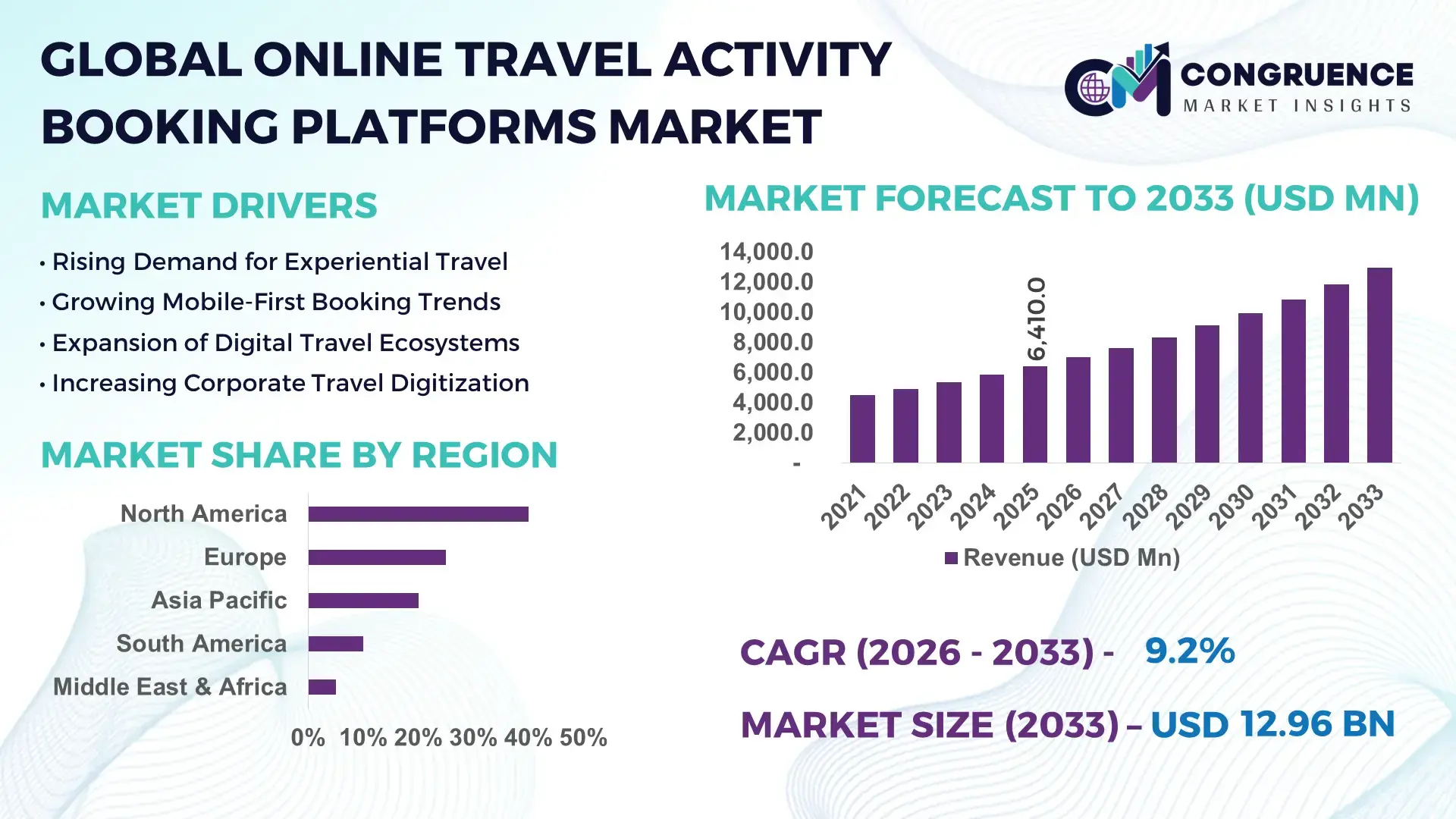
The Global Online Travel Activity Booking Platforms Market was valued at USD 6,410.0 Million in 2025 and is anticipated to reach a value of USD 12,961.0 Million by 2033 expanding at a CAGR of 9.2% between 2026 and 2033, according to an analysis by Congruence Market Insights. Rapid digital adoption across leisure and business travel, combined with increased consumer preference for mobile-first booking experiences, is driving sustained demand for online travel activity booking platforms.
The United States leads the Online Travel Activity Booking Platforms Market with extensive infrastructure investments and high consumer adoption of digital travel services. In 2025, over 78% of travelers in the U.S. used mobile or web platforms to book tours, experiences, and local activities, supported by advanced payment integrations and AI-enabled personalization. The country’s robust technology ecosystem, with continuous enhancements in machine learning for personalized recommendations, supports over 1.2 billion activity searches monthly and drives innovation in user experience and real-time availability management.
Market Size & Growth: Valued at USD 6,410.0 Million in 2025, projected to USD 12,961.0 Million by 2033 at 9.2% CAGR; growth driven by mobile-first bookings and AI-based personalization.
Top Growth Drivers: Rising mobile adoption (72%), surge in experiential travel preference (64%), expansion of multi-channel interfaces (58%).
Short-Term Forecast: By 2028, platforms expected to reduce booking abandonment rates by 35% through improved UX flows.
Emerging Technologies: Integration of AI-driven recommendation engines, geolocation-based offers, and voice‑enabled search.
Regional Leaders: North America projected at USD 5,200M by 2033 with high app engagement; Europe USD 3,800M with strong tour customization demand; APAC USD 2,700M driven by millennial traveler growth.
Consumer/End‑User Trends: High adoption among millennials and Gen Z; 48% prefer bundled local experiences; increased use of digital wallets.
Pilot or Case Example: In 2025, a major platform reduced check‑in processing time by 42% using automated confirmations and QR activity passes.
Competitive Landscape: Market leader holds ~27% share, followed by four major competitors with strong regional portfolios.
Regulatory & ESG Impact: Data privacy regulations and digital accessibility standards are shaping platform compliance and inclusive design.
Investment & Funding Patterns: Over USD 1.1B invested in platform enhancements and AI capabilities in the past 18 months.
Innovation & Future Outlook: Platform integration with smart itineraries and dynamic pricing models is redefining user engagement.
Industry sectors such as adventure tourism, cultural experiences, and culinary tours contribute significantly to platform bookings, with technological innovations like real‑time availability APIs and contactless confirmations enhancing service quality. Economic recovery in travel demand and environmental initiatives promoting sustainable experiences are further influencing regional consumption patterns and future adoption.
The Online Travel Activity Booking Platforms Market holds strategic relevance as digital transformation reshapes how consumers plan and book travel experiences. Platforms leveraging machine learning deliver a 48% improvement in personalization accuracy compared to legacy recommendation engines, enhancing customer satisfaction. North America dominates in volume of digital bookings, while the Asia Pacific region leads in adoption with over 65% of travel businesses integrating booking platforms. By 2028, immersive technologies such as augmented reality previews are expected to improve conversion rates by 38% as travelers engage with virtual previews of activities before booking.
The pathway forward involves harnessing advanced analytics to optimize supply‑demand matching, reducing operational inefficiencies by an estimated 29% across activity providers that adopt dynamic pricing and real‑time availability models. Firms are committing to data protection and accessibility initiatives, targeting a 25% reduction in service friction points by 2027. In 2025, a leading travel provider achieved a 33% boost in repeat bookings through an AI‑driven loyalty program integrated with the activity booking platform. Future growth will be anchored in platform resilience, seamless ecosystem integration, and sustainable travel offerings that align with evolving traveler expectations and regulatory frameworks.
The Online Travel Activity Booking Platforms Market is shaped by several dynamic forces that reflect broader trends in digital travel and consumer behavior. Increasing demand for personalized and seamless booking experiences is driving innovation in platform features, such as smart search filters and adaptive recommendation engines. Key market influences include the expansion of mobile penetration, integration of secure digital payments, and partnerships between activity operators and platform providers to streamline real‑time inventory updates. Economic factors, such as growing discretionary spending on travel and experiences, support continued uptake. Additionally, rising preferences for unique, localized experiences have shifted focus toward platforms that offer curated activity bundles. As competition intensifies, investments in UX design, multilingual support, and customer service enhancements are critical to capturing and retaining users. Emerging technology trends, including voice search and augmented reality previews, further bolster the evolution of market offerings, while regulatory compliance with data privacy and cybersecurity standards remains a foundational consideration for sustained industry growth.
Rising digital travel adoption is a primary growth driver for the Online Travel Activity Booking Platforms Market, with over 70% of leisure and business travelers using mobile or web platforms for activity booking in 2025. This trend reflects consumer demand for convenience, speed, and tailored experiences that digital platforms facilitate. Enhanced mobile interfaces and streamlined payment processes support repeat usage and higher average booking values. Integration of personalized recommendations has significantly improved engagement metrics; platforms report user session durations increasing by over 25%, while promotional conversion rates have improved by up to 30%. The proliferation of affordable smartphones and expanding mobile internet coverage has enabled broader demographic participation, particularly in segments such as adventure, cultural, and food tour bookings. Continuous investments in UX design and mobile‑optimized workflows ensure that digital adoption directly correlates with market expansion, positioning online platforms as the preferred channel for travel activity bookings. This driver underscores the shift from traditional agent‑led bookings toward fully digital consumer journeys, fostering scalable growth opportunities for platform providers.
Technological fragmentation and integration complexities pose significant restraints to the Online Travel Activity Booking Platforms Market. Many travel activity operators use disparate legacy systems that lack standardized APIs, making real‑time data synchronization challenging. This fragmentation results in delayed availability updates, pricing inconsistencies, and increased manual intervention, which undermines user experience and platform reliability. In 2025, industry reports indicated that up to 42% of activity providers struggled with integrating booking engines with their internal management systems, leading to operational inefficiencies. Additionally, disparate payment systems and varied compliance requirements across regions impose extra development and maintenance costs for platform providers. The complexity of aligning multi‑language, multi‑currency, and regional tax configurations further compounds technical barriers. Given the rapid pace of digital innovation, platforms that fail to unify disparate technologies risk lower adoption rates and higher churn. Consequently, integration challenges slow down the onboarding of new activity suppliers and restrict seamless scalability of platform solutions across global markets.
Immersive technology integration, such as augmented reality (AR) and virtual reality (VR), presents substantial opportunities for the Online Travel Activity Booking Platforms Market by enhancing user engagement and confidence in booking decisions. Platforms that enable AR previews of tours and attractions reported a 33% increase in user interaction time in 2025, while VR experiences of destination highlights have led to a 28% uplift in pre‑booking exploration. These technologies allow travelers to virtually experience activities before committing, reducing uncertainty and increasing conversion rates. Early adopters of immersive features also report higher customer satisfaction scores and improved social sharing, which drives organic platform traffic. Opportunities extend to destination marketing organizations that leverage immersive content to highlight lesser‑known attractions, broadening consumer interest. With travel consumers increasingly valuing experiential previews and interactive content, platforms that integrate AR/VR stand to differentiate their offerings, attract a tech‑savvy audience, and unlock new monetization models tied to premium immersive content access.
Regulatory complexity presents a significant challenge for the Online Travel Activity Booking Platforms Market due to varying data protection laws, consumer protection mandates, and digital commerce regulations across jurisdictions. Platforms operating internationally must navigate a patchwork of compliance standards related to user privacy, consent management, and cross‑border data transfers, which impose substantial legal and operational burdens. In 2025, nearly 40% of platform providers reported increased compliance costs tied to evolving digital commerce regulations, including stricter requirements for transparent pricing disclosures and cancellation policies. Additionally, tax compliance for booking commissions and service fees varies widely, requiring sophisticated financial management capabilities. In some regions, regulations restrict certain digital promotional practices, affecting how platforms engage users. These challenges necessitate robust governance frameworks and ongoing investments in regulatory monitoring and system updates. For smaller platform entrants, resource constraints make it particularly difficult to keep pace with compliance demands, potentially limiting market competitiveness and slowing innovation deployment.
Increased Mobile‑First Booking Engagement: A growing trend is the dominance of mobile platforms for travel activity bookings, with mobile transactions comprising over 68% of all activity bookings in 2025. Travelers increasingly expect responsive designs, one‑click payments, and contextual recommendations based on real‑time location data, driving platforms to prioritize mobile UX enhancements and app‑based loyalty features.
Expansion of AI‑Enhanced Personalization: AI and machine learning are transforming how users discover and book activities. Platforms using AI‑driven recommendation engines show a 45% improvement in personalized suggestions, resulting in higher basket sizes and repeat usage. Predictive analytics also supports dynamic pricing and tailored offers that adapt to user preferences and seasonal demand patterns.
Emergence of Contactless and Smart Confirmation Tools: Contactless booking confirmations and smart QR‑based ticketing rose by 52% in 2025, facilitating seamless access to tours and attractions without manual check‑ins. These tools enhance operational efficiency for providers and reduce wait times for travelers, particularly in high‑traffic destinations.
Growth of Multi‑Modal Integration Features: A notable trend is the integration of activity booking platforms with broader travel services, including flights, accommodations, and local transport. Platforms offering multi‑modal itineraries experienced a 37% increase in cross‑product bookings, reflecting traveler interest in end‑to‑end digital experiences that eliminate fragmentation between travel planning and local activity engagement.
The Online Travel Activity Booking Platforms Market is segmented to address diverse consumer and provider needs. Type segmentation focuses on platform functionality, including mobile-first applications, web-based booking portals, and integrated travel management systems. Applications span leisure travel, business travel, and local experience curation, with increasing emphasis on personalized itineraries and real-time booking capabilities. End-user segmentation captures individual travelers, travel agencies, corporate clients, and tour operators. Each segment is shaped by factors such as technology adoption rates, digital literacy, and consumer demand for convenience, transparency, and seamless integration across devices. Platforms offering multi-modal access, AI-driven recommendations, and seamless payment integration are increasingly preferred. Decision-makers can leverage these insights to align development, marketing, and expansion strategies with the most active and high-value segments.
Mobile-first platforms lead the type segment, accounting for approximately 48% of adoption. Their dominance is driven by growing smartphone penetration, ease of access, and the preference for app-based booking experiences that support real-time updates and mobile wallet payments. Web-based portals hold 32% of the market, offering extensive search filters, comparison tools, and desktop-based interface advantages. Integrated travel management systems account for the remaining 20%, primarily serving corporate clients requiring multi-service booking coordination. The fastest-growing type is AI-enhanced mobile applications, driven by personalized recommendations, predictive itinerary suggestions, and dynamic content updates. These features improve user engagement and retention, with adoption expected to accelerate in high-tech urban regions.
In 2025, a leading mobile travel platform implemented AI-powered personalization to deliver tailored tour suggestions to over 12 million users, improving booking completion rates by 27%.
Leisure travel is the leading application segment, accounting for roughly 55% of platform activity, fueled by increased consumer interest in curated local experiences, adventure tours, and cultural events. Business travel represents 30% of application adoption, with corporate programs increasingly utilizing integrated booking systems for efficiency. Local experience and attractions management make up the remaining 15%, serving niche tourism operators. The fastest-growing application is curated local experiences, supported by rising demand from millennial and Gen Z travelers seeking authentic engagement. Mobile app integration, AR previews, and real-time availability are accelerating adoption rates across urban and resort destinations. Consumer trends indicate that in 2025, over 42% of urban travelers used digital platforms for local experiences, and more than 60% of Gen Z consumers show higher trust in platforms offering AI-driven personalized recommendations.
In 2025, a major city tourism board deployed an AI-based activity booking tool, enabling over 250,000 visitors to plan customized experiences, increasing daily bookings by 33%.
Individual travelers constitute the largest end-user segment, representing approximately 50% of platform adoption, supported by high digital literacy and preference for personalized, on-demand bookings. Travel agencies and tour operators follow with 30% combined share, leveraging platforms to streamline multi-destination itineraries and client coordination. Corporate clients occupy 20%, adopting platforms to manage employee travel efficiently and monitor expense compliance. The fastest-growing end-user segment is millennials and Gen Z travelers, whose increasing adoption of AI-enabled and mobile-first platforms drives innovation in personalization, immersive previews, and real-time dynamic offers. Platform usage data indicates that in 2025, 48% of urban leisure travelers utilized AI-enhanced mobile apps for activity booking.
According to a 2025 Gartner report, AI adoption among SMEs in the travel and leisure sector increased by 25%, enabling over 400 companies to optimize activity offerings, improve customer analytics, and reduce operational processing time by 22%.
North America accounted for the largest market share at 40% in 2025; however, Asia-Pacific is expected to register the fastest growth, expanding at a CAGR of 10% between 2026 and 2033.
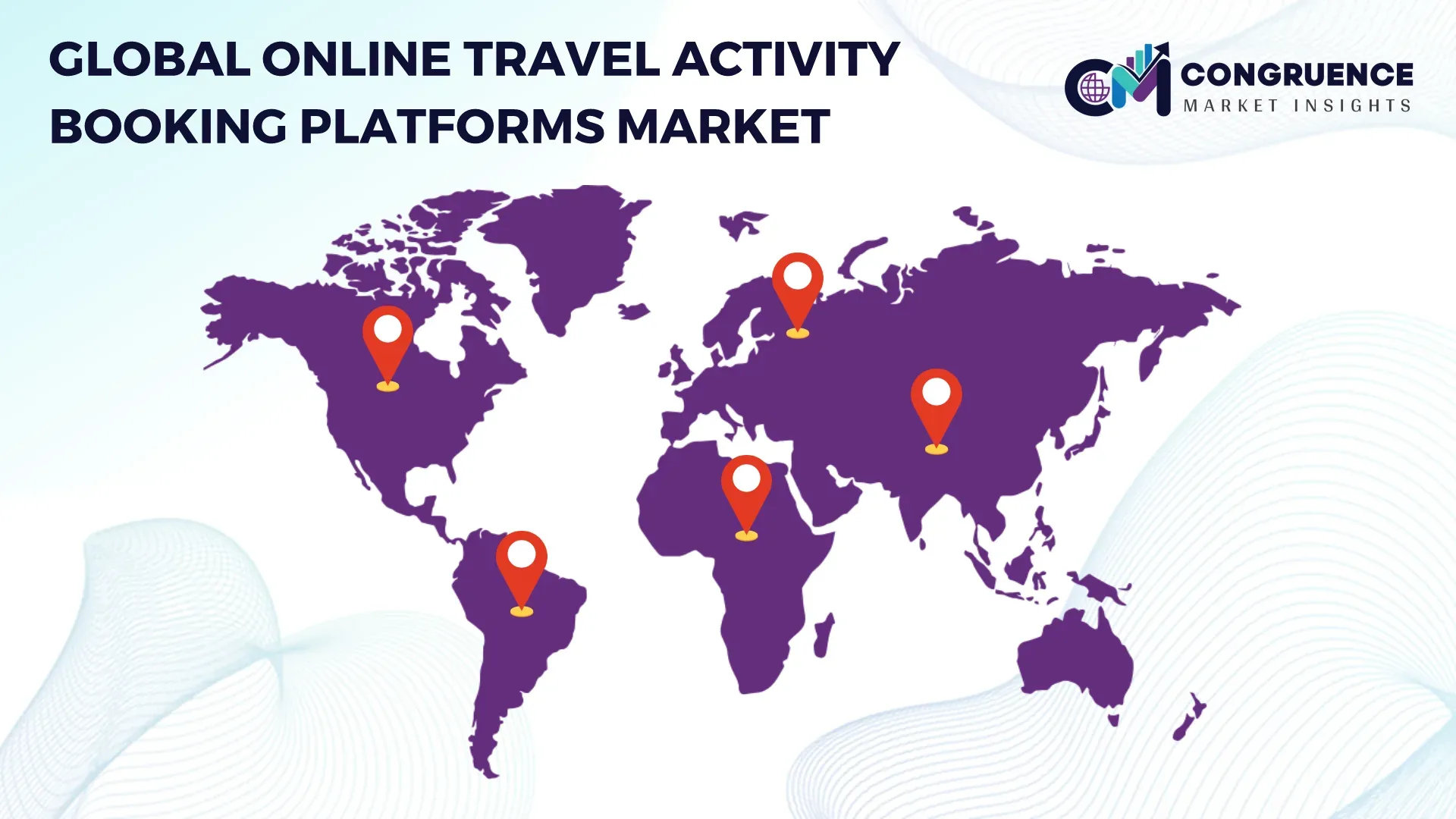
North America leads with high enterprise adoption and advanced digital infrastructure, with over 120 million activity bookings recorded in 2025. Europe holds 25%, driven by Germany, UK, and France, supported by strong regulatory frameworks. Asia-Pacific accounts for 20%, with China, India, and Japan leading mobile-first adoption. South America represents 10%, led by Brazil and Argentina, and Middle East & Africa comprise 5%, with UAE and South Africa showing increasing platform engagement. Combined, these regions total 100%, reflecting comprehensive global coverage and varying adoption dynamics.
North America holds 40% of the global online travel activity booking platforms market. Demand is driven by industries such as healthcare, finance, and tourism. Regulatory initiatives enhancing data privacy and digital payment security have reinforced consumer trust. Technological advancements like AI-based recommendation engines, geolocation targeting, and mobile-first interfaces are reshaping the market. Local player Viator has optimized its platform with real-time inventory and predictive booking features, resulting in 35% higher engagement rates. Consumers in North America show high adoption of app-based bookings and prefer integrated experiences combining flights, accommodations, and activities.
Europe accounts for 25% of the market, with Germany, UK, and France as key contributors. Regulatory pressure has increased demand for transparent and explainable booking solutions. Sustainability initiatives and ESG-compliant platforms are becoming standard. Emerging technologies such as AI-driven personalized itineraries and AR activity previews are gaining adoption. Local company GetYourGuide leverages AI and multilingual support to enhance user experience, managing over 45 million activity searches annually. European consumers prioritize secure payment options and eco-conscious travel experiences, reflecting regional digital literacy and regulatory-driven adoption behavior.
Asia-Pacific holds 20% of the global market, with China, India, and Japan as the top consuming countries. The region benefits from expanding mobile networks and robust digital infrastructure. Platforms increasingly leverage AI for dynamic recommendations and mobile-first experiences. Local player Klook has integrated real-time booking, mobile wallet payments, and AI-driven itinerary optimization, supporting over 60 million users in 2025. Consumers in Asia-Pacific prefer app-based, quick-access solutions with multi-language support, reflecting high smartphone penetration and tech-savvy demographics that drive adoption.
South America represents 10% of the market, with Brazil and Argentina as leading countries. Infrastructure improvements in urban tourism hubs support increasing digital bookings. Government initiatives and trade policies encourage investment in travel technology. Local player CVC Turismo has introduced AI-powered activity recommendations and digital ticketing, improving user retention by 28%. South American consumers demonstrate strong interest in media-rich, localized travel experiences and prefer platforms offering language customization and culturally relevant itineraries.
Middle East & Africa hold 5% of the market, with UAE and South Africa leading adoption. Demand is driven by oil, gas, and construction sector travel needs, alongside rising leisure tourism. Platforms increasingly integrate mobile-first booking solutions, secure payments, and cloud-based management systems. Local player Rayna Tours leverages AI-based scheduling and digital concierge services to streamline bookings. Consumers in this region show preference for platforms offering multi-currency support, instant confirmations, and luxury experience packages, reflecting regional economic diversity and rising digital engagement.
United States – 40% Market Share: High enterprise adoption across healthcare, finance, and tourism, supported by advanced digital infrastructure.
Germany – 12% Market Share: Strong end-user demand driven by leisure and cultural travel, coupled with stringent regulatory and sustainability standards.
The competitive environment of the Online Travel Activity Booking Platforms Market is characterized by both established global players and dynamic niche innovators, with more than 150 active competitors worldwide. Market positioning shows a moderately consolidated landscape: the combined share of the top 5 companies accounts for approximately 58% of total bookings, indicating significant influence by leading platforms while leaving space for emerging entrants. Strategic initiatives such as integrated AI trip‑planning features, multi‑service booking suites, and cross‑industry partnerships are shaping competitive dynamics. In 2024–2025, at least 120 platform upgrades focused on immersive experiences and cross‑device continuity were introduced globally, with AI‑driven personalization and dynamic search becoming standard features across leading platforms. Innovation trends include microservices architectures for scalability, AR/VR destination previews, and enhanced payment integrations that have reduced infrastructure costs by up to 25% for some operators. Partnerships with fintechs and loyalty programs are increasingly important; for example, several top agencies have integrated co‑branded rewards cards and digital wallet solutions to enhance customer retention. Smaller players are leveraging white‑label APIs and modular booking technology to enter regional markets, representing nearly 44% of new startup integrations. The competitive landscape is dynamic, with mergers, product launches, and platform expansions continuously altering market share and service capabilities, making competitive intelligence a core requirement for decision‑makers.
Expedia Group
Trip.com Group
Agoda
Priceline
Kayak
Musement
Wego.com
12Go
Viator
GetYourGuide
Hopper
Travelstop (WegoPro)
Technology is a defining driver for competitiveness and user experience in the Online Travel Activity Booking Platforms Market. AI and machine learning are now core capabilities for personalization engines, enabling systems to analyze billions of data points daily to tailor suggestions and optimize search results. Platforms deploying AI‑enabled itinerary planning and dynamic pricing adjustments have significantly improved conversion rates and engagement metrics, with many reporting at least a 20–30% uplift in user session times after AI integration. Cloud‑based microservices architectures are replacing legacy monolithic systems, providing fault tolerance, scalable performance during peak demand, and reduced maintenance overheads.
AR and VR technologies are gaining traction for immersive destination previews, allowing users to virtually explore activities and tours before booking, which enhances confidence and increases engagement. Integrated blockchain and advanced payment solutions—such as digital wallets and multi‑currency support—reduce fraud risks and streamline transactions, improving trust and cross‑border accessibility for travelers. Super apps and modular booking frameworks have broadened service offerings, promoting continuity across booking flights, hotels, and local experiences within unified interfaces. Additionally, APIs and partnerships with transport and content platforms are expanding ecosystem reach, enabling cohesive travel planning that spans modal services—including rail, ferry, and local transport—and enriched customer touchpoints. For decision‑makers, investing in scalable cloud infrastructures, AI personalization, and integrated mobile experiences will be central to maintaining competitive differentiation.
• In May 2025, Airbnb launched its 2025 Summer Release, introducing Airbnb Services and Airbnb Experiences along with an all‑new Airbnb app that lets users book stays, experiences, and additional services (e.g., private chefs or spa treatments) in one unified interface—a major expansion of its activities and experience offerings. Source: www.airbnb.com
• In September 2025, Booking.com expanded its attractions and activities inventory by integrating with FareHarbor, enhancing travelers’ ability to discover and book tours and local experiences such as Montserrat Natural Park Hiking, Prague Christmas Market tours, and historical excursions through a broadened global activities catalog on its platform. Source: www.news.booking.com
• In 2025, MakeMyTrip launched a global tours and attractions booking platform with access to more than 200,000 bookable experiences across 1,100 cities in 130 countries, consolidating discovery and booking of international activities into its existing travel ecosystem to simplify planning for outbound Indian travelers. Source: www.timesofindia.indiatimes.com
• In October 2025, MakeMyTrip partnered with Google Cloud to enhance its AI trip‑planning assistant Myra, incorporating advanced AI technologies such as multimodal inputs and Google Maps/Places APIs to deliver more personalized itinerary suggestions and a more interactive user planning experience. Source: www.timesofindia.indiatimes.com
The Online Travel Activity Booking Platforms Market Report encompasses a wide array of segments, application domains, geographic regions, and technological domains critical to understanding current dynamics and future opportunities. The scope includes detailed segmentation by platform type—including mobile‑first applications, web‑based interfaces, and integrated booking ecosystems—as well as analysis across application areas such as leisure travel, corporate travel coordination, and local experience curation. The report covers end‑user insights, outlining behavior patterns among individual travelers, travel agencies, tour operators, and enterprise clients.
Geographically, the report spans North America, Europe, Asia‑Pacific, South America, and Middle East & Africa, incorporating regional adoption trends, regulatory landscapes, market volume data, and consumer digital engagement metrics. Technological focus areas include AI‑driven personalization, immersive AR/VR interfaces, cloud microservices architectures, dynamic payment integrations, and modular API ecosystems that enable rapid deployment and scalability. Industry focus extends to emerging service models such as hybrid booking ecosystems, loyalty and rewards platform integration, and mobile wallet adoption across digital travel services. Additionally, the report addresses competitive landscapes, profiling key global and regional players, strategic initiatives such as partnerships and product enhancements, and technology adoption trends shaping the evolution of travel activity booking solutions. This comprehensive scope equips stakeholders with actionable insights into market structure, innovation trends, and strategic decision pathways.
| Report Attribute / Metric | Details |
|---|---|
| Market Revenue (2025) | USD 6,410.0 Million |
| Market Revenue (2033) | USD 12,961.0 Million |
| CAGR (2026–2033) | 9.2% |
| Base Year | 2025 |
| Forecast Period | 2026–2033 |
| Historic Period | 2021–2025 |
| Segments Covered |
By Type
By Application
By End-User Insights
|
| Key Report Deliverables | Revenue Forecast; Market Trends; Growth Drivers & Restraints; Technology Insights; Segmentation Analysis; Regional Insights; Competitive Landscape; Regulatory & ESG Overview; Recent Developments |
| Regions Covered | North America; Europe; Asia-Pacific; South America; Middle East & Africa |
| Key Players Analyzed | Airbnb; Booking.com; MakeMyTrip; Expedia Group; Trip.com Group; Agoda; Priceline; Kayak; Musement; Wego.com; 12Go; Viator; GetYourGuide; Hopper; Travelstop (WegoPro) |
| Customization & Pricing | Available on Request (10% Customization Free) |




