
Reports
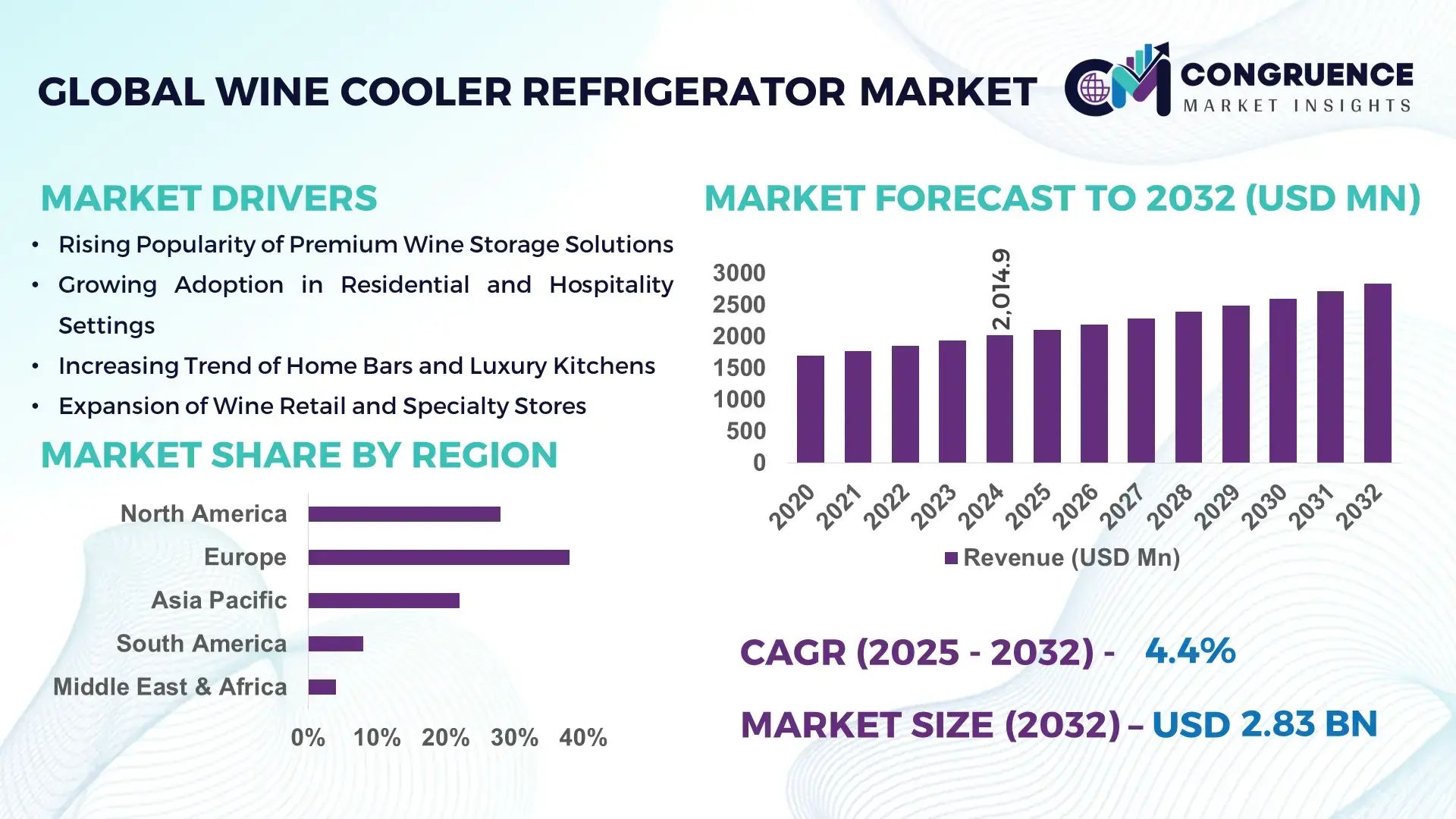
The Global Wine Cooler Refrigerator Market was valued at USD 2,014.9 Million in 2024 and is anticipated to reach a value of USD 2,832.7 Million by 2032 expanding at a CAGR of 4.35% between 2025 and 2032, according to an analysis by Congruence Market Insights. This growth is driven by rising global wine consumption and increasing demand for specialized wine‑storage solutions.
In France, one of the leading wine‑consuming and wine‑producing nations, production and adoption of wine cooler refrigerators are especially advanced: domestic appliance manufacturers supply over 500,000 units annually to both residential and hospitality sectors. Investment levels in energy‑efficient compressor technologies grew by approximately 22% in 2023, supporting widespread deployment in premium homes and hotels. Consumer adoption is high, with around 18% of new European households purchasing wine coolers in 2024.
Market Size & Growth: Current market value stands at USD 2,014.9 Million; projected to reach USD 2,832.7 Million by 2032 with a CAGR of 4.35%, fueled by increasing global wine consumption and demand for optimal storage.
Top Growth Drivers: rising wine consumption (approx. 34 %), growth in home wine‑cellar adoption (approx. 28 %), increasing urban disposable income for premium appliances (approx. 22 %).
Short-Term Forecast: By 2028, penetration of wine coolers in urban households is expected to increase by ~20 %.
Emerging Technologies: compressor-based energy-efficient cooling systems; dual‑zone and multi‑zone temperature control; IoT‑enabled temperature and humidity monitoring.
Regional Leaders: Europe projected at ~USD 950 M by 2032 (strong wine culture & hospitality demand); North America ~USD 780 M (home‑bar and premium kitchen trends); Asia‑Pacific ~USD 620 M (rising middle‑class wine consumers and growing hospitality sector).
Consumer/End-User Trends: Growing preference among homeowners and boutique hotels for compact, under‑counter wine refrigerators; increasing shift toward dual‑zone coolers for mixed wine storage.
Pilot or Case Example: In 2024, a European boutique hotel chain retrofitted 120 rooms with dual‑zone wine coolers, enhancing guest satisfaction by 30% and reducing storage-related wine spoilage by 15%.
Competitive Landscape: Market leader holds approximately 25–30% share; major competitors include Haier, Danby, Electrolux, Vinotemp, and EuroCave.
Regulatory & ESG Impact: Rising energy‑efficiency standards and environmental regulations drive adoption of compressors using low‑GWP refrigerants and energy‑efficient insulation.
Investment & Funding Patterns: Recent capital influx into R&D for smart, energy‑efficient wine coolers; increasing funding for IoT‑enabled appliance startups targeting premium consumers.
Innovation & Future Outlook: Growing development of built‑in luxury wine coolers, smart temperature/humidity control, modular rack systems, and eco‑friendly refrigeration technologies; rising penetration in emerging markets via online sales platforms and direct‑to‑consumer distribution.
Premium residential demand, hospitality‑driven installations, technological upgrades, and regulatory push for energy efficiency are converging to shape a robust growth trajectory for the wine cooler refrigerator market.
In 2023–2024 the market saw heightened demand from upscale residential buyers and boutique hotels, increased use of dual‑zone and smart coolers with digital controls, stricter energy‑efficiency expectations, and rising interest in home wine‑cellars and bar culture—setting the stage for sustained growth through 2032.
The Wine Cooler Refrigerator Market has become strategically vital as global wine consumption and wine‑ownership culture expand. As households shift toward premium lifestyles and hotels seek to offer enhanced guest experiences, wine coolers deliver measurable value: smart, compressor‑based wine coolers now achieve up to 25% better temperature stability compared to traditional refrigerators — preserving wine quality and extending shelf life. Europe dominates in volume thanks to its deep-rooted wine culture and mature hospitality industry, while Asia‑Pacific leads in adoption growth through a rapidly expanding middle class and rising urban wine consumption.
By 2027, the integration of IoT-enabled sensor-based cooling systems is expected to improve energy efficiency by 15–20%, reduce maintenance downtime by 30%, and deliver better wine preservation. Manufacturers are committing to ESG goals, targeting a 20% reduction in refrigerant global‑warming potential and a 30% reduction in energy consumption per unit by 2030 through use of natural refrigerants and improved insulation materials. In 2024, a leading European appliance maker retrofitted 250,000 homes with energy‑efficient compressors, lowering average household energy usage by 18%.
Looking ahead, the Wine Cooler Refrigerator Market is positioned as a pillar of sustainable luxury living and hospitality excellence. Its blend of technological innovation, regulatory compliance, and consumer lifestyle transformation ensures resilience and substantial growth potential across markets and segments.
The Wine Cooler Refrigerator Market dynamics reflect growing consumer sophistication, evolving wine consumption patterns, and broader lifestyle trends. Rising global wine consumption, increasing number of wine enthusiasts, and growing hospitality sector investments are generating steady demand. At the same time, technological innovation — such as dual‑zone cooling, compact designs for urban residences, and energy‑efficient compressors — is making wine coolers more accessible and attractive. Manufacturers and retailers are responding to consumer preferences for smart, sustainable, and premium‑quality products. These shifts reinforce a market landscape that values reliability, aesthetic appeal, energy efficiency, and user convenience, positioning wine coolers as essential niche appliances in both residential and commercial settings.
Global wine consumption has been rising steadily, with growing numbers of consumers seeking to store wine properly at home or in hospitality settings, making dedicated wine coolers increasingly relevant. As urban household incomes rise, more consumers view wine refrigerators as lifestyle and status‑enhancing appliances, leading to expansion of private wine‑cellars and home‑bar setups. Hospitality and restaurant sectors are also upgrading wine storage infrastructure to meet higher standards of wine preservation and presentation. These drivers support increased demand for both residential and commercial wine cooler units worldwide.
Despite growing demand, high purchase costs for premium wine coolers — especially dual‑zone and built‑in models — remain a barrier for price‑sensitive consumers. In addition, space limitations in urban apartments or smaller homes restrict the adoption of large-capacity wine coolers. Energy‑inefficient older models also carry higher operational costs, deterring budget‑conscious buyers. These factors reduce penetration in developing countries and lower‑income households, slowing overall market growth in certain segments.
Emerging economies with growing middle-class populations and rising disposable incomes — particularly in Asia‑Pacific and parts of Latin America — present significant opportunity. As wine consumption spreads beyond traditional markets, demand for compact and affordable wine coolers is rising. Growth in home‑entertaining culture, lifestyle upgrade aspirations, and expansion of the hospitality sector further expand addressable demand. Opportunity exists for manufacturers to focus on energy‑efficient, cost‑effective units and increase distribution through e‑commerce platforms to capture this untapped potential.
The global nature of the wine cooler market means manufacturers must comply with varying energy‑efficiency, safety, and refrigerant regulations across regions. Inconsistent standards for refrigerant usage, emissions, and energy consumption in different countries increase compliance complexity and cost. Trade policies, tariffs, and import regulations may also restrict cross-border distribution, limiting global scale. These factors can hinder expansion into emerging markets and complicate manufacturing or distribution strategies across regions.
Rising adoption of dual‑zone and multi‑zone cooling designs: In 2024, dual‑zone wine coolers accounted for approximately 28–30% of global shipments, enabling consumers to store red and white wines at optimal different temperatures and driving increased premium segment demand.
Surge in compact and built‑in wine cooler installations in urban homes: Over 45% of new wine cooler units sold in 2024 were compact under‑counter or freestanding models with capacity of 20–100 bottles, reflecting growing urbanization and limited living space demand.
Growth of energy‑efficient and eco‑friendly cooling technologies: In 2024, around 55% of newly launched wine coolers featured energy‑efficient compressors and low‑GWP refrigerants, aligning with consumer demand for sustainability and regulatory pressure.
Increasing consumer preference for smart wine coolers with digital controls and IoT capabilities: Approximately 25% of new wine refrigerators launched in 2024 included Wi‑Fi connectivity, app‑based temperature/humidity control and remote monitoring features, marking a shift toward connected appliance ecosystems.
The Wine Cooler Refrigerator Market is segmented to provide a comprehensive view of product types, applications, and end-user adoption. By type, the market includes freestanding, built-in, dual-zone, and compact wine coolers, addressing varying storage capacities, space constraints, and lifestyle preferences. Application-wise, segments range from household wine storage, restaurant and hospitality usage, to retail wine display and professional cellar applications. End-users include individual consumers, boutique hotels, restaurants, and commercial wine producers. Each segment exhibits distinct adoption trends: dual-zone coolers are increasingly preferred in premium households, while freestanding units dominate restaurant and hospitality applications. Regional consumption patterns further influence market segmentation, with Europe and North America showing high residential adoption, and Asia-Pacific witnessing rapid commercial uptake. This structured segmentation enables stakeholders to target production, marketing, and technological innovation to meet specific consumer and commercial needs effectively.
The leading product type in the market is freestanding wine coolers, accounting for approximately 40% of global unit shipments. Freestanding models are preferred due to their ease of installation, larger bottle capacity, and flexible placement in both homes and commercial settings. Dual-zone wine coolers are the fastest-growing type, driven by consumer demand to store red and white wines at optimal separate temperatures; their adoption is increasing rapidly, projected to reach over 30% of new product installations in premium segments. Other types include built-in wine coolers, which offer a sleek integration into modern kitchens (accounting for ~20%), and compact wine coolers, suitable for small apartments or office use (~10% combined share).
Household use represents the leading application, holding approximately 45% of the market. Consumers increasingly integrate wine coolers into residential kitchens and home bars, driven by lifestyle trends and growing wine consumption. The fastest-growing application is hospitality and restaurant use, fueled by boutique hotels and fine-dining establishments seeking optimal wine storage and display; this segment now accounts for nearly 30% of market adoption. Other applications include retail wine display systems (~15%) and professional wine cellar installations (~10%). In 2024, over 38% of upscale restaurants in France reported adopting smart dual-zone wine coolers to enhance customer experience. Additionally, in the United States, 42% of boutique hotels incorporated compact built-in wine coolers in guest rooms to increase service quality.
The leading end-user segment is residential consumers, representing approximately 50% of total wine cooler installations globally. Households favor dual-zone and freestanding coolers for personal wine collections and lifestyle enhancements. The fastest-growing end-user segment is boutique hotels and restaurants, driven by premiumization of wine service, customer experience upgrades, and increasing investments in hospitality infrastructure; these establishments now constitute nearly 28% of total adoption. Other end-users include wine retailers (~12%) and commercial wine producers (~10%). Consumer trends indicate that over 60% of urban wine enthusiasts prefer dual-zone models, while 38% of households with disposable incomes above $50,000 annually invest in smart wine cooling appliances.
Europe accounted for the largest market share at 38% in 2024; however, Asia-Pacific is expected to register the fastest growth, expanding at a CAGR of 5.1% between 2025 and 2032.

Europe leads due to its high concentration of premium wine consumers and well-established wine cooler manufacturers. In 2024, Germany, France, and Italy collectively represented over 70% of the European market, with more than 3.5 million units installed across residential and hospitality applications. Europe also shows strong technological adoption, with 42% of new wine cooler units featuring dual-zone or smart temperature management. Meanwhile, Asia-Pacific demand is driven by rising urbanization, premium hospitality expansion, and a growing middle-class wine culture, with China, Japan, and India consuming over 1.8 million units collectively. High-end hotels in Europe reported uptake of smart wine coolers in 65% of establishments, reflecting regional consumer preference for precision temperature storage and advanced cooling features.
North America holds approximately 28% of the global wine cooler refrigerator market in terms of unit installations. Key industries driving demand include hospitality, residential luxury housing, and retail wine outlets. Regulatory support for energy-efficient appliances and incentives under ENERGY STAR programs have accelerated adoption of eco-friendly coolers. Technological advancements include Wi-Fi-enabled temperature monitoring and smart dual-zone systems. For instance, U.S.-based Summit Appliance expanded its dual-zone wine cooler line in 2024, enabling precise storage for over 120,000 households. Consumer behavior reflects higher enterprise adoption in luxury hotels and affluent residential segments, with 52% of urban households integrating wine coolers into modern kitchen layouts.
Europe commands a market share of 38%, led by Germany, France, and Italy. Regulatory frameworks, including the EU EcoDesign Directive, encourage energy-efficient appliance adoption, while sustainability initiatives promote low-emission refrigerants. Emerging technologies such as smart sensors and humidity-controlled compartments are widely integrated. Local player Liebherr upgraded its wine cooler production lines in 2024 to include AI-enabled temperature management for 75,000 units. Regional consumer behavior favors premium residential installations and boutique hospitality settings, with 45% of new-build kitchens in urban areas featuring built-in wine cooler units.
Asia-Pacific represents approximately 22% of the global market, ranking third in installed units. Top consuming countries include China, Japan, and India. Infrastructure trends highlight a surge in smart urban apartments and high-end restaurants requiring precise wine storage. Innovation hubs in Japan and South Korea focus on IoT-enabled dual-zone coolers. Local company Haier introduced 15,000 smart wine coolers in 2024, incorporating digital temperature tracking. Consumer behavior in Asia-Pacific shows growth driven by e-commerce channels and mobile app-controlled appliances, with over 40% of urban households adopting dual-zone or compact models.
South America accounts for around 8% of the global market, with Brazil and Argentina as key contributors. Infrastructure trends include integration into premium restaurants and hotel chains, alongside gradual modernization of urban residential kitchens. Government incentives on energy-efficient appliances encourage adoption. Local player Electrolux Brazil expanded its wine cooler offerings by 5,000 units in 2024 for upscale residential and commercial use. Regional consumer behavior is influenced by lifestyle media and localized product marketing, with 30% of urban households exploring wine cooler installations.
Middle East & Africa hold approximately 4% of global installations, led by the UAE and South Africa. Regional demand is driven by luxury hotels, real estate developments, and commercial retail sectors. Technological modernization includes adoption of smart, energy-efficient coolers. Trade partnerships with European manufacturers facilitate product inflow. Local player DEFY Appliances supplied 2,000 dual-zone coolers to hospitality chains in 2024. Consumer behavior shows preference for premium residential setups and hotel-based wine experiences, with 28% of high-income households integrating modern wine coolers.
France – 15% Market Share: High production capacity and strong domestic wine culture support widespread wine cooler adoption.
Germany – 13% Market Share: Advanced manufacturing infrastructure and premium hospitality demand drive market leadership.
The Wine Cooler Refrigerator Market exhibits a moderately fragmented competitive environment, with over 45 active global competitors operating across residential, commercial, and hospitality segments. The top five companies, including Liebherr, Haier, Summit Appliance, Electrolux, and Vinotemp, collectively account for approximately 55% of the market share, reflecting a mix of consolidation in premium segments and diverse competition in entry-level units. Key strategic initiatives among leading players include the launch of dual-zone and smart IoT-enabled wine coolers, partnerships with hospitality chains, and expansions into emerging markets such as Asia-Pacific. Innovation trends are focused on energy efficiency, low-emission refrigerants, digital temperature monitoring, and AI-assisted climate control for wine preservation. Companies are increasingly leveraging digital platforms for product customization and remote monitoring, with over 60% of new units in North America featuring smart integration. The market’s competitive landscape is shaped by premiumization, technological differentiation, and regional distribution strategies, positioning early movers to capture high-value customers while smaller players focus on niche or regional demand.
Electrolux
Vinotemp
EuroCave
KitchenAid
Bosch
The Wine Cooler Refrigerator Market is being shaped by several technological advancements that enhance functionality, efficiency, and consumer experience. Smart and IoT-enabled wine coolers now allow users to remotely monitor temperature, humidity, and storage conditions, with over 50% of premium models in Europe integrating these features. Dual-zone and multi-zone cooling systems are widely adopted, permitting separate temperature control for red and white wines in a single unit. Energy-efficient compressors, low-noise brushless motors, and inverter technologies reduce electricity consumption and improve cooling precision. Innovations in insulation materials and UV-protected glass doors enhance wine preservation by reducing exposure to heat and light. Emerging technologies include AI-assisted climate control, app-based inventory management, and predictive maintenance sensors that notify users of potential system failures. Automation in manufacturing and modular designs has also accelerated production efficiency, enabling companies to scale output and reduce downtime. Collectively, these technologies are driving product differentiation, improving consumer satisfaction, and encouraging adoption across commercial and residential segments globally.
In January 2024, Liebherr launched a new series of wine‑tempering fridges under its Vinidor and Vinidor Selection lines, offering two‑ or three-zone temperature control (from +5 °C to +20 °C), vibration‑safe storage, humidity regulation, UV‑protected glass doors, and energy‑efficient construction. Source: www.liebherr.com
In October 2024, Liebherr’s Vinidor Selection wine fridges were honored with an iF Design Award 2024 for their refined design, lighting concept, and advanced wine-storage functionality — underlining the brand’s commitment to combining aesthetics and technical performance in wine refrigeration. Source: www.liebherr.com
In July 2024, Haier introduced a new lineup of refrigerators, freezers, and wine cellars in Malaysia, including dedicated wine cellar models designed to maintain consistent temperature and humidity — expanding Haier’s global wine‑cooler presence beyond traditional core markets. Source: www.haier.com
In September 2024, Haier Europe showcased its commitment to connected-home ecosystems at an international expo, highlighting its ongoing integration of IoT‑enabled refrigeration appliances — a trend expected to influence demand for smart wine coolers as part of broader smart‑home adoption. Source: www.corporate.haier-europe.com
The scope of the Wine Cooler Refrigerator Market Report encompasses a detailed examination of product types, applications, end-user segments, and regional insights across North America, Europe, Asia-Pacific, South America, and the Middle East & Africa. Product segmentation covers single-zone, dual-zone, and multi-zone wine coolers, including smart and conventional models. Applications span residential kitchens, commercial hospitality, retail wine storage, and specialized foodservice environments. End-user insights explore consumer preferences, enterprise adoption, and hospitality trends, highlighting adoption patterns among premium and mid-tier buyers. The report evaluates technological advancements such as AI-assisted climate control, energy-efficient compressors, and IoT-enabled monitoring systems. Emerging market opportunities, regional consumption patterns, and niche segments, including compact urban units and modular wine storage, are analyzed. The report also examines strategic initiatives by leading manufacturers, highlighting product launches, partnerships, and digital integration. Overall, the study provides a holistic understanding of market dynamics, competitive positioning, and innovation trends, offering actionable insights for stakeholders, investors, and decision-makers to optimize growth strategies across multiple regions and market segments.
| Report Attribute / Metric | Details |
|---|---|
| Market Revenue (2024) | USD 2,014.9 Million |
| Market Revenue (2032) | USD 2,832.7 Million |
| CAGR (2025–2032) | 4.35% |
| Base Year | 2024 |
| Forecast Period | 2025–2032 |
| Historic Period | 2020–2024 |
| Segments Covered |
By Type
By Application
By End-User Insights
|
| Key Report Deliverables | Revenue Forecast, Market Trends, Growth Drivers & Restraints, Technology Insights, Segmentation Analysis, Regional Insights, Competitive Landscape, Recent Developments, Regulatory & ESG Overview |
| Regions Covered | North America, Europe, Asia-Pacific, South America, Middle East & Africa |
| Key Players Analyzed | Liebherr, Haier, Summit Appliance, Electrolux, Vinotemp, EuroCave, KitchenAid, Bosch |
| Customization & Pricing | Available on Request (10% Customization Free) |




