
Reports
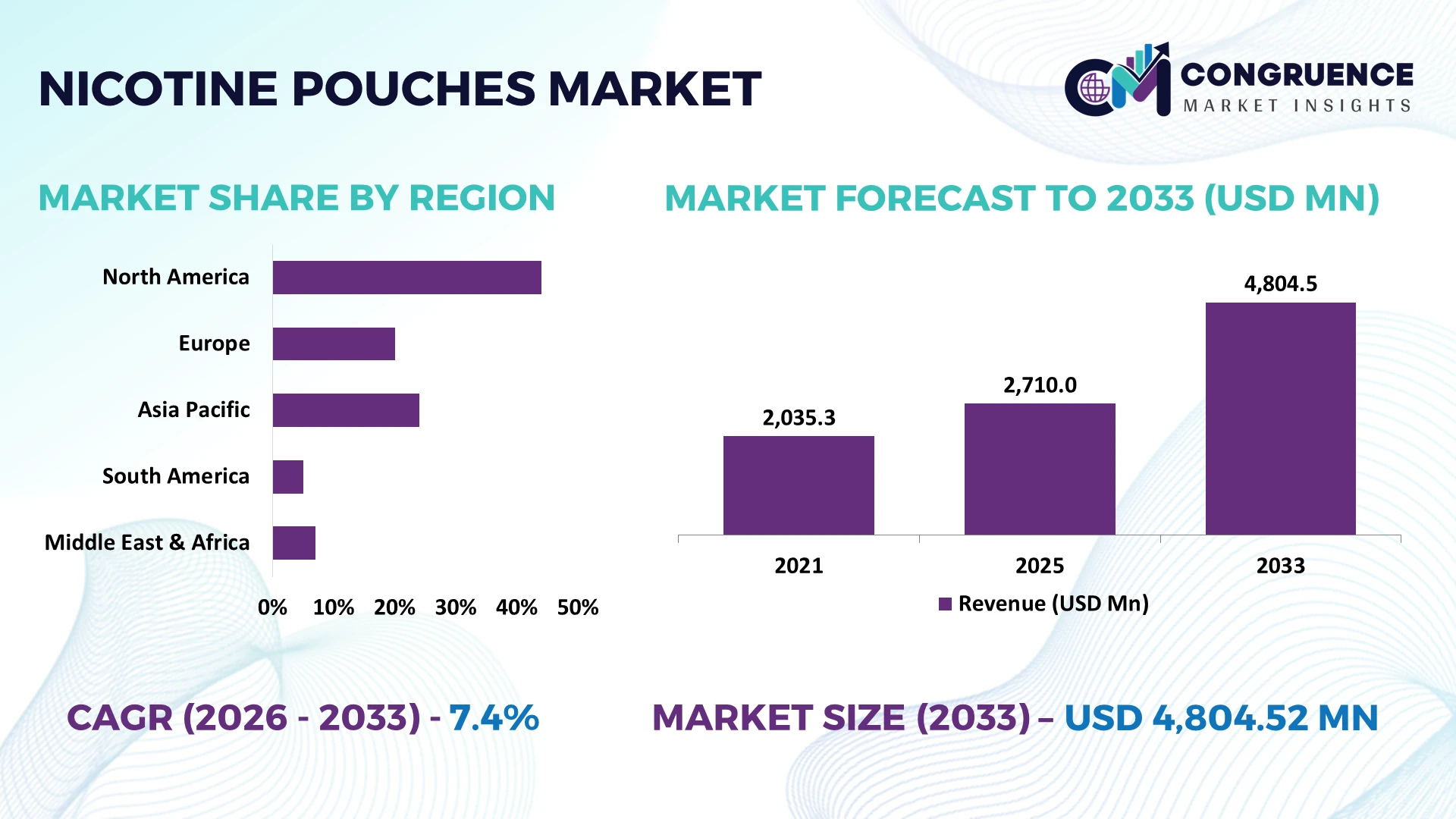
The Global Nicotine Pouches Market was valued at USD 2710 Million in 2025 and is anticipated to reach a value of USD 4804.52 Million by 2033 expanding at a CAGR of 7.42% between 2026 and 2033. Growth is driven by adult nicotine users shifting toward smoke-free oral formats, expanding retail distribution, broader nicotine-strength portfolios, and regulatory authorization of specific pouch products.
The United States represents the dominant commercial market, supported by rapid convenience-store penetration, domestic manufacturing investment, and strong adoption among adult oral-nicotine consumers. ZYN held approximately 61.5% of U.S. nicotine-pouch can volume, while Philip Morris International committed USD 1.2 billion to a Colorado manufacturing facility designed to expand domestic capacity. Sweden remains more mature by population penetration, with approximately 5% of people reporting daily nicotine-pouch use in 2024. The U.S. FDA’s January 2025 authorization of 20 ZYN products further differentiated regulated products from unauthorized alternatives.
Strategically, manufacturers combining regulatory clearance, domestic capacity, retail execution, and differentiated strengths are best positioned to capture sustained global nicotine pouch demand.
Market Size & Growth: USD 2.71 billion in 2025 reaches USD 4.80 billion by 2033 at 7.42%, supported by adult migration toward smoke-free oral nicotine.
Top Growth Drivers: U.S. ZYN shipments increased 37%, international nicotine-pouch volumes advanced above 35%, and U.S. ZYN consumer offtake increased approximately 25%.
Short-Term Forecast: By 2027, major U.S. capacity additions should materially reduce product shortages and support more consistent retail replenishment across high-volume channels.
Emerging Technologies: Automated pouch filling, moisture optimization and precision nicotine dosing increasingly support portfolios spanning approximately 1.5–11 mg strengths.
Regional Leaders: North America leads commercial scale, Europe retains established oral-nicotine adoption, while Asia-Pacific represents an emerging regulated expansion opportunity across selected markets.
Consumer/End-User Trends: Daily nicotine-pouch use reached approximately 5% of Sweden’s population and 15% among women aged 16–29, demonstrating significant demographic penetration.
Pilot/Case Example: During 2025, U.S. ZYN consumer offtake increased approximately 25%, demonstrating strong sell-through despite earlier supply limitations and capacity constraints.
Competitive Landscape: ZYN controlled approximately 61.5% of U.S. can volume, competing primarily with on!, VELO, Rogue and emerging authorized nicotine-pouch portfolios.
Regulatory & ESG Impact: The FDA authorized 20 ZYN products in January 2025, making regulatory evidence and youth-access controls increasingly important competitive requirements.
Investment & Funding: Philip Morris International committed USD 1.2 billion to a Colorado facility, strengthening U.S. localization and reducing dependence on imported finished-product capacity.
Innovation & Future Outlook: ZYN reached 55 international markets during 2025, while next-generation formats increasingly emphasize controlled release, smaller pouches and differentiated nicotine strengths.
The Nicotine Pouches Market is increasingly concentrated around adult smoke-free nicotine substitution, convenience-store distribution, differentiated flavors and strengths, and regulated product portfolios. Recent innovation centers on smaller pouch formats, moisture management, precision dosing and automated high-volume manufacturing. Sweden provides a mature adoption benchmark, with daily pouch use reaching approximately 5% of the population, while the United States is rapidly expanding domestic capacity. Tighter FDA oversight of authorized versus unauthorized products is simultaneously raising compliance barriers, making regulatory execution, manufacturing scale and channel access central to the market’s strategic direction.
Nicotine pouches are becoming strategically important as tobacco companies redirect portfolios toward smoke-free products and regulators establish clearer boundaries between authorized and unauthorized oral nicotine. The U.S. FDA authorization of 20 ZYN products in January 2025 strengthened regulatory differentiation, while ZYN reached 55 international markets during 2025. This shift makes scientific substantiation, manufacturing scale, adult-focused distribution, and compliance capability increasingly decisive competitive assets.
Manufacturing technology is also changing economics. Automated pouch forming, filling, dosing, and inspection can deliver more than 30% higher throughput than labor-intensive legacy lines while improving dose consistency and reducing material losses. Sweden remains more mature, with daily nicotine-pouch use near 5% of the population, whereas the United States combines lower population penetration with substantially greater expansion capacity. Domestic production investment is therefore accelerating to shorten replenishment cycles and reduce import dependency.
Through 2026–2028, competition will concentrate on regulatory authorization, localized capacity, controlled-release formulations, and retail execution. A practical example is PMI’s new Colorado production facility, designed to expand U.S. ZYN supply after periods of constrained availability. Manufacturers are increasing capacity and regulatory investment simultaneously. Long-term leadership will belong to companies that combine compliant innovation with dependable supply and disciplined adult-consumer acquisition.
Adult migration from combustible and traditional oral tobacco toward smoke-free formats is restructuring nicotine consumption. U.S. ZYN shipments increased approximately 37% during 2025, while consumer offtake advanced about 25%, demonstrating that retail movement remained strong despite earlier supply constraints. International nicotine-pouch volumes expanded by more than 35%, confirming that adoption is extending beyond established Nordic markets. The January 2025 U.S. authorization of 20 ZYN products further strengthened regulated pouch availability and provided retailers with clearer product differentiation. Manufacturers are responding through domestic capacity expansion, broader strength portfolios, and increased regulatory investment. A strategically important consequence is that shelf availability now directly influences brand conversion: companies capable of maintaining uninterrupted convenience-store inventories can capture adult users precisely when they transition from cigarettes, snus, or other oral nicotine formats.
Regulatory inconsistency remains the strongest structural restraint because nicotine-pouch rules differ sharply between established and emerging markets. The United States authorized 20 ZYN products in 2025, yet authorization remains product-specific, limiting rapid portfolio proliferation. Sweden reports daily pouch use near 5% of its population, while certain European governments have tightened nicotine limits, flavor rules, packaging requirements, or proposed stronger controls. These differences prevent manufacturers from deploying identical formulations and packaging across markets, increasing compliance, testing, and inventory complexity. Restrictions become particularly costly when flavor or strength portfolios require country-specific reformulation. Companies are mitigating exposure through dedicated regulatory teams, market-specific SKUs, localized manufacturing, and tighter distributor controls. The non-obvious commercial constraint is portfolio fragmentation: even large production networks lose scale efficiency when regulatory divergence forces multiple formulations for comparatively small national markets.
Next-generation pouch engineering creates opportunities beyond simply adding flavors. Manufacturers are developing smaller formats, optimized moisture systems, controlled nicotine release, plant-derived fillers, and increasingly precise dosing across approximately 1.5–11 mg product ranges. Sweden demonstrates the segmentation potential: daily pouch use reaches roughly 5% nationally and approximately 15% among women aged 16–29, showing how format preferences can differ substantially by demographic group. Meanwhile, ZYN’s presence expanded to 55 international markets during 2025, creating infrastructure for more targeted portfolio deployment. Through 2026–2028, formulation R&D will increasingly focus on sensory consistency, release profiles, pouch comfort, and manufacturing repeatability. Companies are expanding pilot lines and consumer-testing capabilities accordingly. A less obvious opportunity lies in SKU architecture: fewer, precisely differentiated strength-format combinations can improve manufacturing utilization while giving retailers clearer adult-consumer segmentation.
Scaling nicotine pouches internationally creates an execution challenge spanning age verification, marketing governance, product consistency, traceability, and unauthorized-channel control. ZYN reached 55 markets during 2025, while U.S. shipment growth of approximately 37% increased manufacturing and distribution intensity. At the same time, FDA authorization covered 20 specific ZYN products, illustrating how regulatory status attaches to defined products rather than an unrestricted brand portfolio. Rapid expansion therefore increases the number of manufacturing batches, distributors, retailers, and digital touchpoints requiring consistent compliance oversight. Companies must invest in automated quality inspection, serialization, distributor auditing, age-gated commerce, and regulatory intelligence. The long-term competitive risk is execution inconsistency: a manufacturer can achieve high production efficiency yet lose market access if labeling, formulation, youth-marketing controls, or channel practices diverge from local requirements. Scalable compliance infrastructure must therefore expand alongside physical manufacturing capacity.
Regulatory Authorization Reshapes Portfolios: U.S. nicotine-pouch authorization expanded from 20 products in early 2025 to 43 by August 2026, including 9 mg and 11 mg variants. Manufacturers are concentrating launches around scientifically reviewed formulations, strengthening compliance teams and rationalizing SKUs. The shift raises development costs but gives authorized portfolios stronger retail defensibility against products lacking marketing authorization.
Higher-Strength Formats Gain Ground: Product architecture is expanding beyond established 3 mg and 6 mg strengths, with U.S.-authorized portfolios reaching 9 mg and 11 mg in 2026. Companies are using formulation control and differentiated pouch construction to segment adult nicotine users more precisely. This broadening increases manufacturing complexity but enables brands to serve distinct usage profiles without relying primarily on flavor proliferation.
Youth Controls Tighten Commercial Execution: U.S. youth nicotine-pouch use remained 1.7% in 2025, while 17.6% of current youth users reported daily consumption and 90.8% used flavored products. Regulatory scrutiny is consequently influencing packaging, advertising and retail execution. Manufacturers are strengthening age controls, responsible-marketing practices and child-resistant packaging as compliance performance becomes increasingly important to maintaining market access.
Nordic Usage Broadens Demographically: Sweden’s daily nicotine-pouch penetration reached 5% in 2024; among women aged 16–29, usage increased from 10% in 2022 to 15%, while comparable male usage rose from 5% to 11%. Producers are refining pouch size, strength and sensory profiles around differentiated adult segments, making demographic portfolio design increasingly important to shelf productivity.
Tobacco-Free Pouches lead the market with an estimated 42% share, reflecting their central positioning as nicotine products without tobacco leaf. Their scalability benefits from standardized fiber substrates, controlled nicotine dosing and broad compatibility with flavor and moisture formulations. Slim Pouches account for approximately 24%, benefiting from discreet placement and established Nordic consumption patterns. Mini Pouches address users prioritizing smaller oral formats, while Moist Pouches emphasize faster sensory release. Dry Pouches retain relevance where longer storage stability and slower release characteristics influence purchasing.
Slim Pouches represent the fastest-growing type as manufacturers optimize comfort, discretion and nicotine delivery without materially increasing pouch dimensions. The emerging 9–11 mg authorized U.S. portfolio demonstrates how strength differentiation can occur alongside compact format engineering. Manufacturers are investing in automated filling, moisture control and substrate development while balancing format expansion against production-line complexity. The strategic priority is shifting from maximum SKU proliferation toward scalable combinations of pouch geometry, moisture profile and precisely controlled nicotine delivery.
Smoking Alternative represents the leading application with an estimated 44% share, supported primarily by adult smokers seeking non-combustible nicotine formats without smoke, ash or inhalation. Oral Nicotine Delivery follows at approximately 24%, reflecting the fundamental delivery mechanism underpinning repeat pouch consumption. Tobacco Harm Reduction is becoming strategically more significant as regulatory evaluation increasingly differentiates product risk profiles relative to cigarettes. Nicotine Replacement and Smoking Cessation remain distinct, smaller applications because nicotine pouches are not approved smoking-cessation medicines in the United States.
Tobacco Harm Reduction represents the fastest-developing application positioning following the U.S. regulatory shift in 2026 permitting specific modified-risk claims for 20 ZYN products. Manufacturers are therefore investing more heavily in toxicological evidence, consumer-understanding studies and controlled product communication. The business implication is significant: scientifically substantiated differentiation can strengthen conversion among existing adult tobacco users, whereas unsupported cessation positioning creates regulatory exposure. Companies are consequently separating commercial tobacco-pouch strategies from medically established cessation pathways.
Adult Nicotine Users represent the largest end-user group with an estimated 38% share because nicotine pouches compete across existing cigarette, smokeless-tobacco and other nicotine consumption occasions. Adult Smokers account for approximately 31%, forming a strategically important conversion pool where smoke-free oral delivery removes combustion and inhalation from product use. Alternative Tobacco Users remain an established segment familiar with oral consumption, while Tobacco Harm-Reduction Users increasingly evaluate authorized products according to relative-risk information. Smoking Cessation Users remain smaller because pouches should not be positioned as approved cessation medication.
Tobacco Harm-Reduction Users represent the fastest-growing strategic end-user segment as product-specific regulatory evidence becomes commercially actionable. In Sweden, daily nicotine-pouch use reached 5% of people aged 16–84, demonstrating considerably deeper penetration than earlier U.S. adult adoption indicators. Manufacturers are targeting existing adult nicotine consumers through differentiated strengths, compact formats, retail segmentation and compliant communications rather than broad population acquisition. Competitive advantage increasingly depends on converting established nicotine demand without expanding inappropriate non-user uptake.
North America accounted for the largest market share at 46% in 2025 however, Asia-Pacific is expected to register the fastest growth, expanding at a CAGR of 9.2% between 2026 and 2033.

Regulated Products Reshape Retail Competition
North America accounts for approximately 46% of global nicotine pouch demand, with the United States providing the overwhelming commercial concentration through convenience stores, tobacco outlets, and expanding digital retail. Regulatory authorization increasingly determines shelf access: the FDA authorized 20 ZYN products in January 2025 and subsequently broadened the authorized pouch portfolio. Manufacturing localization is advancing alongside regulatory scrutiny, reducing dependence on imported finished products and improving replenishment reliability. Philip Morris International’s planned Colorado facility represents a USD 1.2 billion manufacturing commitment designed to strengthen domestic ZYN capacity. Competition is consequently moving beyond flavor and price toward regulatory evidence, production availability, adult-consumer conversion, and retailer execution. Canada remains structurally different because nicotine pouch distribution faces tighter regulatory controls, concentrating legal access within a narrower framework.
United States Market Outlook: The United States combines the region’s largest adult nicotine consumer base with extensive convenience-store infrastructure and rapidly scaling domestic production. ZYN held approximately 61.5% of U.S. nicotine-pouch can volume, demonstrating significant brand concentration. FDA product authorization, enforcement against unauthorized products, and new manufacturing capacity are raising entry requirements while strengthening companies capable of supporting compliant nationwide distribution.
Regulatory Fragmentation Redefines Market Access
Europe represents approximately 35% of global nicotine pouch demand, supported by mature Nordic oral-nicotine consumption and expanding adoption across several continental markets. Sweden provides the strongest usage benchmark, where approximately 5% of people aged 16–84 reported daily nicotine-pouch use in 2024. However, country-level differences in nicotine limits, flavors, taxation, packaging, and sales restrictions prevent uniform portfolio deployment. Belgium prohibits nicotine pouches, while other markets apply differing product rules, forcing manufacturers to maintain country-specific compliance strategies. Nordic production expertise gives established suppliers advantages in formulation, pouch substrates, moisture control, and high-volume manufacturing. Companies are responding through localized SKUs, regulatory affairs investment, controlled strength portfolios, and selective geographic expansion. The critical European competitive factor is therefore regulatory adaptability rather than simple distribution scale, particularly as governments reassess novel nicotine-product frameworks.
Sweden Market Outlook: Sweden remains Europe’s most strategically developed nicotine pouch ecosystem because oral nicotine consumption is deeply established and product innovation is concentrated around pouch size, strength, moisture, and sensory characteristics. Daily pouch use reaches approximately 15% among women aged 16–29, providing manufacturers with a mature environment for testing differentiated formats before considering broader international deployment.
Selective Regulation Shapes Market Entry
Asia-Pacific represents approximately 9% of global nicotine pouch demand, but commercial development varies sharply because nicotine regulation ranges from restrictive frameworks to controlled tobacco-market access. Japan presents an important strategic market through its established reduced-risk nicotine ecosystem, although heated tobacco currently dominates non-combustible substitution. Pakistan has emerged as a notable manufacturing and commercialization base for modern oral nicotine, supported by multinational tobacco operations and growing familiarity with smoke-free products. Australia maintains substantially tighter nicotine controls, limiting conventional retail scalability. Manufacturers therefore cannot apply a single regional distribution model; market entry requires country-specific regulatory assessment, adult-user targeting, and compliant channel development. Global suppliers are prioritizing selected markets through controlled launches, distributor partnerships, localized consumer research, and manufacturing optimization rather than indiscriminate geographic expansion. This regulatory selectivity makes market-access capability more valuable than rapid SKU proliferation.
Pakistan Market Outlook: Pakistan offers a distinctive operating environment because multinational tobacco companies already possess manufacturing, distribution, and adult-consumer engagement infrastructure. With a population exceeding 240 million and substantial combustible-tobacco consumption, the addressable switching pool is large. Local manufacturing capability can also shorten supply chains, although affordability, regulation, and responsible adult-only commercialization remain decisive execution requirements.
Urban Distribution Drives Selective Adoption
South America represents approximately 5% of global nicotine pouch demand, with commercial activity concentrated in major urban consumer markets rather than evenly distributed national networks. Brazil provides the largest potential adult nicotine base, but stringent tobacco and nicotine-product regulation materially shapes commercialization pathways. Chile, Argentina, and other markets similarly require country-specific assessment of product classification, importation, labeling, and retail eligibility. Consequently, multinational manufacturers emphasize regulatory preparation and controlled distribution instead of large-scale portfolio deployment. The region’s established convenience, supermarket, and specialist retail infrastructure could support rapid physical availability where regulations permit, while compact pouch formats lower logistics requirements compared with combustible products. However, unauthorized cross-border and digital commerce can complicate category governance. Companies are strengthening importer oversight, compliance monitoring, and market-specific portfolio decisions before committing substantial manufacturing or distribution resources.
Brazil Market Outlook: Brazil is strategically important because its population exceeds 200 million and it possesses extensive tobacco retail infrastructure, yet regulatory constraints significantly restrict commercialization of newer nicotine formats. For manufacturers, the opportunity therefore depends less on immediate physical distribution capability and more on regulatory positioning, product authorization pathways, and disciplined preparation for any future change in permissible nicotine categories.
Smoke-Free Portfolios Enter New Channels
Middle East & Africa represents approximately 5% of global nicotine pouch demand, with adoption concentrated in selected Gulf and African markets where multinational tobacco groups already operate established distribution networks. South Africa provides one of the more developed modern nicotine retail environments, while Gulf markets offer purchasing power and strong convenience-retail infrastructure. Regulatory frameworks nevertheless differ substantially by country, requiring manufacturers to manage product classification, nicotine strength, labeling, and import procedures independently. Compared with cigarettes, lightweight pouch formats require less transportation volume and no combustion-related merchandising infrastructure, creating a non-obvious distribution advantage in geographically dispersed markets. Suppliers are using existing tobacco wholesaler relationships, controlled retail launches, adult-user education, and market-specific portfolios to establish presence. Regulatory compliance and affordability remain more decisive than manufacturing scale across many African markets.
South Africa Market Outlook: South Africa combines established tobacco distribution with growing availability of alternative nicotine formats, making it a strategically relevant entry point for multinational pouch brands. Its population exceeds 60 million and formal retail networks provide scalable consumer access. Companies can leverage existing distribution relationships, but evolving nicotine-product regulation requires careful control of marketing, labeling, strength positioning, and adult-only sales practices.
Philip Morris International’s ZYN competes directly with British American Tobacco’s VELO, Altria’s on!, Imperial Brands’ Zone, and Turning Point Brands’ FRE for adult oral-nicotine users. The top five players account for approximately 80% of organized global demand, making regulatory capability and distribution scale decisive. ZYN commands roughly 61.5% of U.S. can volume, while challengers compete through differentiated strengths, pouch formats, flavor portfolios, and retailer incentives. Leading brands increasingly target 20–30% production-capacity gains through automated filling and localized manufacturing while expanding authorized portfolios and convenience-store availability. Competition is shifting from rapid SKU proliferation toward scientifically substantiated products, manufacturing reliability, and regulatory authorization. Vertical integration in formulation, pouch production, and distribution strengthens supply control, while country-specific nicotine rules increase compliance costs for entrants. Unauthorized-product enforcement creates additional pressure on smaller brands. Winning requires regulatory evidence, dependable high-volume supply, differentiated adult-user propositions, disciplined marketing, and retail execution capable of challenging deeply established incumbents across priority markets consistently.
Philip Morris International
British American Tobacco
Altria Group
Imperial Brands
Japan Tobacco International
Turning Point Brands
Swisher
GN Tobacco
Another Snus Factory
Ministry of Snus
Habit Factory
Dholakia Tobacco
Scandinavian Tobacco Group
Current nicotine-pouch technology centers on precision dosing, automated pouch forming, moisture control and nonwoven substrates improving dose consistency and manufacturing. Mesh systems such as NICOSILK target softer mouthfeel, while inspection integrates machine vision for fill-weight, seal and dimensional control. Automated inspection can cut manual quality-check workload by roughly 20–30% on high-volume lines, strengthening throughput and consistency as manufacturers scale portfolios.
Emerging development focuses on controlled-release matrices, differentiated moisture profiles, compact geometries and lower-impact packaging. BAT’s Velo Shift introduced a redesigned comfort shape requiring new manufacturing machinery, alongside a can made with 90% bio-based material. Compared with conventional fixed-format pouch lines, digitally controlled forming and dosing can improve changeover efficiency by approximately 15–25% where multiple strengths and formats share equipment. Adoption is widening as authorized U.S. portfolios now span 3–11 mg strengths, increasing demand for flexible production technology.
Through 2026–2028, disruptive advantage will come from closed-loop process control, AI-assisted visual inspection, serialization and formulation analytics linking product quality with regulatory traceability. These systems can reduce quality-related rejects by approximately 10–20% versus manual sampling-led processes. Large manufacturers benefit most because high utilization spreads automation investment across greater volumes. Acting now protects manufacturing flexibility as strength differentiation, compliance requirements and format innovation accelerate.
July 2024 Philip Morris International announced a $600 million Colorado ZYN manufacturing plant expected to create 500 jobs, expanding domestic capacity after first-quarter U.S. ZYN shipments increased nearly 80% year over year and reducing supply constraints materially. Source: Reuters
September 2025 Altria and KT&G signed a global collaboration memorandum covering international modern oral nicotine opportunities, including potential on! portfolio expansion and Altria participation in Another Snus Factory, owner of LOOP, strengthening cross-border manufacturing and distribution capabilities. Source: Altria
June 2026 FDA granted modified-risk orders for 20 Swedish Match ZYN products in 3 mg and 6 mg strengths, permitting a specific lower-risk claim versus cigarettes and creating stronger regulatory differentiation for authorized nicotine pouch portfolios nationwide. Source: FDA
August 2026 Altria expanded on! PLUS to approximately 120,000 U.S. retail locations after six products gained authorization; on! retail share reached 8.6% in the second quarter, strengthening nationwide availability as pouch competition intensified across regulated channels. Source: C-Store Dive
The Nicotine Pouches Market Report evaluates Tobacco-Free Pouches, Mini Pouches, Slim Pouches, Moist Pouches and Dry Pouches across Smoking Alternative, Nicotine Replacement, Tobacco Harm Reduction, Oral Nicotine Delivery and Smoking Cessation applications. End-user analysis covers Adult Smokers, Adult Nicotine Users, Smoking Cessation Users, Alternative Tobacco Users and Tobacco Harm-Reduction Users across North America, Europe, Asia-Pacific, South America and Middle East & Africa.
Technology coverage examines precision nicotine dosing, automated pouch forming, moisture optimization, nonwoven substrates, controlled-release formulations, machine-vision inspection and bio-based packaging. Regulatory positioning receives particular attention as authorized U.S. portfolios now span 3–11 mg strengths, while Sweden provides a mature adoption benchmark with approximately 5% daily population usage. The report supports 2026–2033 investment planning through competitive benchmarking, regulatory assessment, manufacturing strategy, geographic expansion analysis and evaluation of emerging strength, format and distribution opportunities.
| Report Attribute/Metric | Report Details |
|---|---|
Market Revenue in 2025 | USD 2710 Million |
Market Revenue in 2033 | USD 4804.52 Million |
CAGR (2026 - 2033) | 7.42% |
Base Year | 2025 |
Forecast Period | 2026 - 2033 |
Historic Period | 2021 - 2025 |
Segments Covered | By Type
By Application
By End-User
|
Key Report Deliverable | Revenue Forecast, Growth Trends, Market Dynamics, Segmental Overview, Regional and Country-wise Analysis, Competition Landscape |
Region Covered | North America, Europe, Asia-Pacific, South America, Middle East, Africa |
Key Players Analyzed | Philip Morris International, British American Tobacco, Altria Group, Imperial Brands, Japan Tobacco International, Turning Point Brands, Swisher, GN Tobacco, Another Snus Factory, Ministry of Snus, Habit Factory, Dholakia Tobacco, Scandinavian Tobacco Group |
Customization & Pricing | Available on Request (10% Customization is Free) |




