
Reports
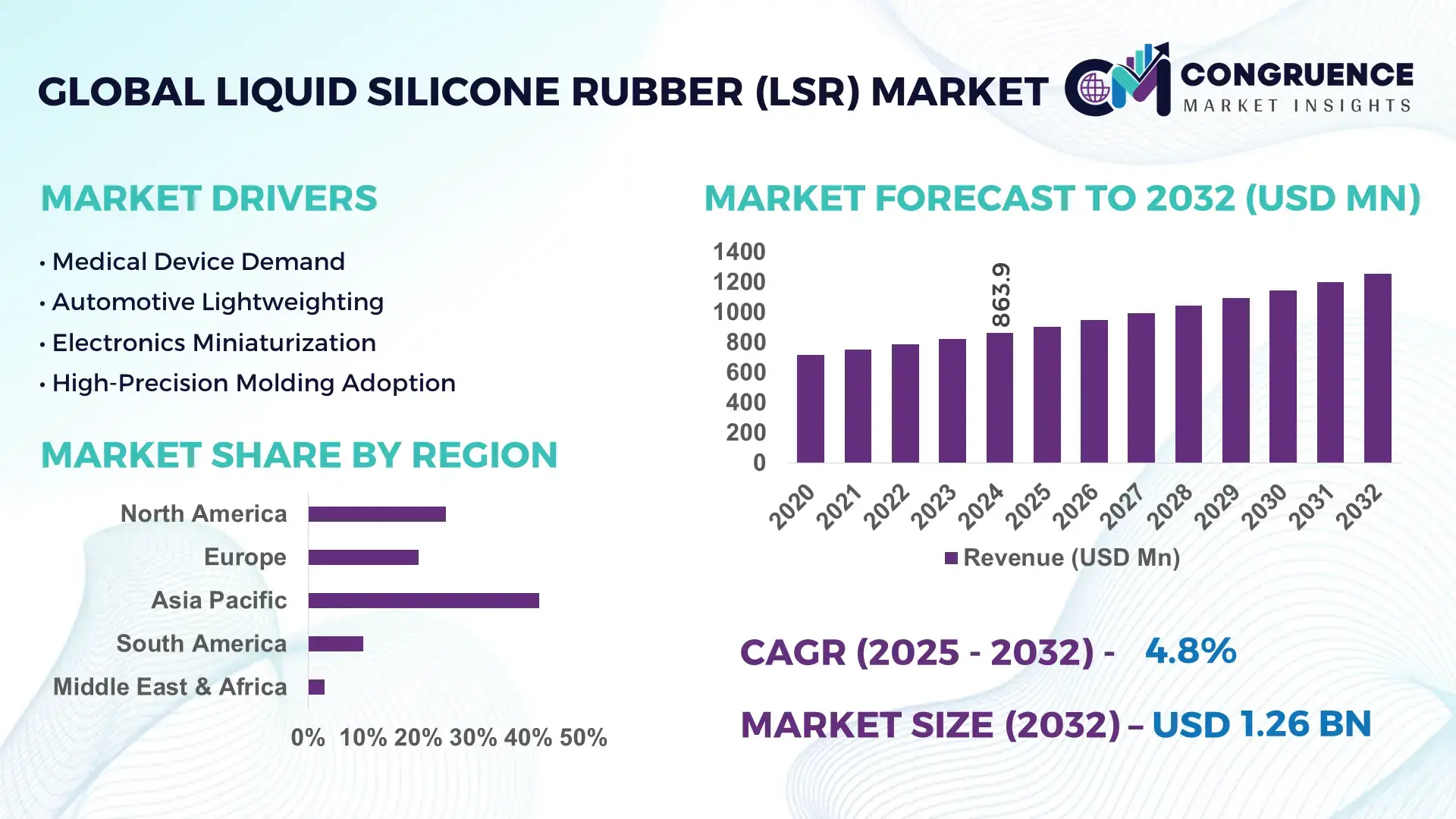
The Global Liquid Silicone Rubber (LSR) Market was valued at USD 863.86 Million in 2024 and is anticipated to reach a value of USD 1257 Million by 2032 expanding at a CAGR of 4.8% between 2025 and 2032. Growth is primarily driven by rising adoption of high-performance elastomers in medical devices, automotive electrification, and precision electronics manufacturing.
China represents the most influential country in the global Liquid Silicone Rubber (LSR) marketplace in terms of industrial scale and downstream utilization. The country hosts more than 40 large-scale silicone processing facilities, with annual silicone material production capacity exceeding 1.5 million metric tons. In 2024, fixed-asset investments in China’s silicone and specialty polymer sector surpassed USD 6.2 billion, supporting expanded LSR use in automotive connectors, consumer electronics seals, and medical tubing. Over 55% of domestic LSR consumption is linked to electronics and electrical components, while medical-grade LSR demand is growing at over 7% annually due to increased local manufacturing of healthcare devices. Automation-driven liquid injection molding systems are widely deployed, improving material efficiency by approximately 18% across major production clusters.
Market Size & Growth: Valued at USD 863.86 Million in 2024, projected to reach USD 1257 Million by 2032, growing at a CAGR of 4.8%, supported by increased use of durable, heat-resistant elastomers in regulated and high-precision applications.
Top Growth Drivers: Medical-grade LSR adoption +34%, lightweight automotive component integration +27%, electronics miniaturization demand +22%.
Short-Term Forecast: By 2028, advanced liquid injection molding is expected to reduce material wastage by approximately 15% across large-scale processors.
Emerging Technologies: Multi-shot LSR molding, platinum-catalyzed curing systems, and AI-enabled process monitoring for defect reduction.
Regional Leaders: Asia Pacific projected at USD 485 Million by 2032 with electronics-driven adoption; Europe at USD 365 Million with medical-grade compliance focus; North America at USD 298 Million led by automotive electrification applications.
Consumer/End-User Trends: Medical device manufacturers account for over one-third of high-purity LSR demand, while EV component suppliers show the fastest adoption growth.
Pilot or Case Example: In 2023, an automated LSR molding pilot in Germany achieved a 21% cycle-time reduction and 12% energy efficiency improvement.
Competitive Landscape: Wacker Chemie AG leads with an estimated 18% share, followed by Dow, Momentive, Shin-Etsu Chemical, Elkem ASA, and KCC Corporation.
Regulatory & ESG Impact: Stricter biocompatibility standards and low-VOC material regulations are accelerating the shift toward platinum-cured LSR grades.
Investment & Funding Patterns: Over USD 2.1 Billion invested globally since 2022 in capacity expansion, automation upgrades, and specialty-grade development.
Innovation & Future Outlook: Integration of recyclable silicone systems and smart manufacturing platforms is expected to reshape cost structures and application versatility.
The Liquid Silicone Rubber (LSR) market is structurally supported by strong demand from medical devices, automotive components, consumer electronics, and industrial sealing applications, with medical and healthcare sectors contributing approximately 38% of total consumption. Recent innovations include high-flow LSR formulations for micro-molding, self-adhesive grades eliminating secondary bonding, and enhanced tear-strength variants for dynamic automotive environments. Regulatory emphasis on biocompatibility, thermal stability, and environmental safety continues to favor LSR over conventional elastomers. Regionally, Asia Pacific leads consumption growth due to electronics manufacturing density, while Europe shows steady expansion driven by healthcare compliance requirements. Looking ahead, increased use of automation, sustainable silicone chemistries, and integration with advanced molding technologies is expected to enhance productivity and broaden end-use adoption across high-value manufacturing sectors.
The Liquid Silicone Rubber (LSR) Market holds strategic relevance across regulated, precision-driven industries due to its combination of thermal stability, biocompatibility, chemical resistance, and automation compatibility. LSR increasingly underpins long-term manufacturing strategies in medical devices, electric vehicles, consumer electronics, and industrial sealing, where component reliability and compliance are non-negotiable. Platinum-cured LSR processing delivers approximately 25% faster cycle times compared to peroxide-cured elastomer standards, while also reducing post-curing requirements and defect rates. Asia Pacific dominates in volume-driven production output, while Europe leads in adoption intensity, with over 62% of medical device manufacturers integrating LSR-based components into critical assemblies. By 2028, AI-enabled liquid injection molding systems are expected to improve yield efficiency by nearly 20% through real-time viscosity control and predictive defect detection. From a compliance and ESG perspective, manufacturers are committing to carbon intensity improvements, including up to 30% reduction in processing-related emissions and increased recycling of silicone by-products by 2030. In 2023, Germany-based automotive suppliers achieved a 17% scrap reduction through digitally monitored LSR molding lines optimized for electric powertrain insulation components. Looking ahead, the Liquid Silicone Rubber (LSR) Market is positioned as a pillar of industrial resilience, regulatory alignment, and sustainable growth, supporting high-value manufacturing ecosystems through advanced material science and intelligent production pathways.
Rising demand for medical-grade and precision-engineered components is a primary driver of the Liquid Silicone Rubber (LSR) Market. LSR is widely used in medical tubing, implantable device seals, respiratory masks, and wearable healthcare products due to its non-reactive nature and stability under repeated sterilization. In 2024, medical applications accounted for nearly 38% of total LSR consumption globally. Over 70% of newly approved Class II medical devices incorporate silicone-based components, with LSR preferred for its dimensional accuracy and low extractables. In parallel, electronics manufacturers are adopting LSR for micro-molded components, achieving up to 15% improvement in assembly reliability. The material’s compatibility with automated molding systems further enhances throughput and consistency, making it indispensable for high-volume, high-precision production environments.
Raw material price volatility and specialized processing requirements present notable restraints for the Liquid Silicone Rubber (LSR) Market. Silicone feedstocks are sensitive to fluctuations in energy costs and upstream chemical supply chains, leading to price variability exceeding 12% annually in certain regions. Additionally, LSR processing requires dedicated liquid injection molding equipment, precise temperature control, and skilled technical oversight, increasing capital and operational expenditures. Small and mid-sized manufacturers often face barriers to entry due to equipment costs that are 25–30% higher than conventional rubber molding systems. Quality deviations resulting from improper mixing or curing can also elevate rejection rates, discouraging adoption among cost-sensitive end-users. These factors collectively slow penetration in price-driven industrial segments.
The rapid expansion of electric vehicles and smart manufacturing ecosystems presents significant opportunities for the Liquid Silicone Rubber (LSR) Market. LSR is increasingly deployed in EV battery seals, thermal management components, and high-voltage connectors, where resistance to heat, vibration, and chemical exposure is essential. EV-related applications now account for over 18% of automotive LSR usage, with demand expected to rise as global EV production scales. Additionally, Industry 4.0 initiatives are driving adoption of digitally optimized LSR molding systems, enabling predictive maintenance and reducing downtime by up to 20%. These advancements open pathways for higher-margin specialty grades and long-term supplier partnerships within advanced manufacturing networks.
Regulatory compliance and sustainability expectations pose ongoing challenges for the Liquid Silicone Rubber (LSR) Market. Medical, food-contact, and automotive applications require adherence to stringent standards related to purity, traceability, and material performance, increasing validation timelines and compliance costs. Achieving consistent compliance across multiple regional frameworks can extend product qualification cycles by 6–12 months. From a sustainability standpoint, while silicone offers long service life, recycling infrastructure remains limited, with less than 15% of silicone waste currently recycled globally. Manufacturers must invest in cleaner production technologies and closed-loop material initiatives, increasing short-term costs while navigating evolving environmental regulations and customer-driven ESG benchmarks.
• Accelerated Adoption of Liquid Silicone Rubber in Modular and Prefabricated Construction Components
The rise of modular and prefabricated construction is reshaping demand patterns in the Liquid Silicone Rubber (LSR) market, particularly for seals, gaskets, membranes, and vibration-damping elements. Around 55% of newly executed modular construction projects reported measurable cost benefits through off-site fabrication and standardized assemblies. LSR-based components are increasingly specified due to their dimensional stability and long service life, supporting up to 30% faster installation timelines. In Europe and North America, over 40% of prefabricated building envelopes now integrate silicone-based sealing systems to improve weather resistance, thermal insulation, and joint durability, reinforcing steady industrial-grade LSR demand.
• Expansion of Medical-Grade LSR Use Driven by Device Miniaturization and Automation
Medical device manufacturing continues to elevate LSR demand as product designs trend toward miniaturization and automated assembly. More than 65% of disposable medical components introduced since 2023 rely on liquid injection molding, where LSR enables tolerance accuracy below ±0.05 mm. Adoption of platinum-cured LSR has improved production yield by nearly 18% while supporting repeated sterilization cycles exceeding 1,000 exposures. Hospitals and device manufacturers are increasing use of single-use LSR components, contributing to over 28% growth in cleanroom-compatible LSR molding lines globally.
• Increased Integration of LSR in Electric Vehicle and Advanced Mobility Systems
The transition toward electric mobility is accelerating LSR usage in high-voltage insulation, battery sealing, and thermal management systems. Electric vehicle platforms now incorporate up to 20 kg of silicone-based elastomers per unit, with LSR accounting for nearly 45% of that volume. Compared to conventional rubber, LSR improves thermal endurance by over 35% and reduces component failure rates by approximately 22%. Automotive suppliers are scaling automated LSR molding cells, achieving cycle-time reductions of 15% while supporting higher component consistency for electrified drivetrains.
• Growing Emphasis on Sustainable and Digitally Optimized LSR Manufacturing
Sustainability and digitalization are reshaping LSR production strategies, with manufacturers adopting closed-loop processing and smart manufacturing tools. Over 32% of large-scale LSR processors have implemented real-time viscosity monitoring, reducing material waste by up to 14%. Additionally, energy-efficient curing systems are lowering electricity consumption per molded unit by nearly 18%. Environmental compliance programs now target 25–30% reductions in processing-related emissions by 2030, positioning LSR as a preferred elastomer for industries prioritizing long-term durability, regulatory alignment, and operational efficiency.
The Liquid Silicone Rubber (LSR) market segmentation highlights clear differentiation across types, applications, and end-user industries, reflecting the material’s adaptability to high-precision, regulated, and performance-critical environments. By type, formulation-specific properties such as viscosity, curing mechanism, and purity levels determine suitability for medical, automotive, or industrial uses. Application-wise, demand is concentrated in sectors requiring thermal stability, chemical resistance, and long lifecycle performance, while emerging uses are driven by electrification and automation trends. End-user insights reveal a strong skew toward industries with stringent compliance standards and large-scale automated production systems. Across all segments, adoption patterns show increasing preference for advanced, high-consistency LSR grades that support miniaturization, complex geometries, and sustainable manufacturing objectives.
Liquid Silicone Rubber (LSR) types are primarily segmented into medical-grade LSR, industrial-grade LSR, and specialty or high-performance LSR formulations. Medical-grade LSR currently accounts for approximately 46% of total adoption, reflecting its extensive use in implants, tubing, respiratory masks, and wearable healthcare devices. Its dominance is supported by low extractables, biocompatibility, and the ability to withstand more than 1,000 sterilization cycles without material degradation. Industrial-grade LSR holds around 32% of usage, mainly in automotive seals, electrical insulation, and consumer goods where durability and thermal resistance up to 200°C are critical. Specialty and high-performance LSR types, including self-adhesive and ultra-low viscosity grades, collectively represent about 22% of the market but are the fastest-growing segment, expanding at an estimated CAGR of 6.9%, driven by demand for micro-molding and multi-material bonding.
By application, medical devices represent the leading segment, accounting for roughly 38% of total Liquid Silicone Rubber (LSR) usage. This leadership is anchored in the material’s stability under repeated sterilization and its ability to achieve dimensional tolerances below ±0.05 mm, which is critical for precision components. Automotive applications follow with approximately 29% adoption, supported by rising use of LSR in electric vehicle battery seals, connectors, and thermal management systems. However, electronics and electrical applications are emerging as the fastest-growing segment, with adoption expanding at a CAGR of about 7.4%, driven by miniaturization and increased demand for moisture-resistant insulation in smart devices. Other applications, including consumer goods, industrial machinery, and construction-related sealing systems, collectively contribute around 33% of total usage.
From an end-user perspective, medical and healthcare manufacturers constitute the largest segment, accounting for nearly 41% of Liquid Silicone Rubber (LSR) consumption. This segment benefits from stringent regulatory requirements that favor high-purity, platinum-cured LSR grades and automated cleanroom production. Automotive OEMs and tier-one suppliers represent about 34% of end-user demand, with increasing emphasis on electrification and lightweight materials. Electronics manufacturers, while currently holding around 15% adoption, are the fastest-growing end-user group, expanding at a CAGR of approximately 7.8% as demand rises for compact, high-reliability components. Remaining end-users, including industrial equipment producers and consumer goods manufacturers, together contribute roughly 10% of the market, with adoption rates ranging between 12% and 18% depending on application complexity.
Asia-Pacific accounted for the largest market share at 42.6% in 2024 however, Europe is expected to register the fastest growth, expanding at a CAGR of 5.3% between 2025 and 2032.
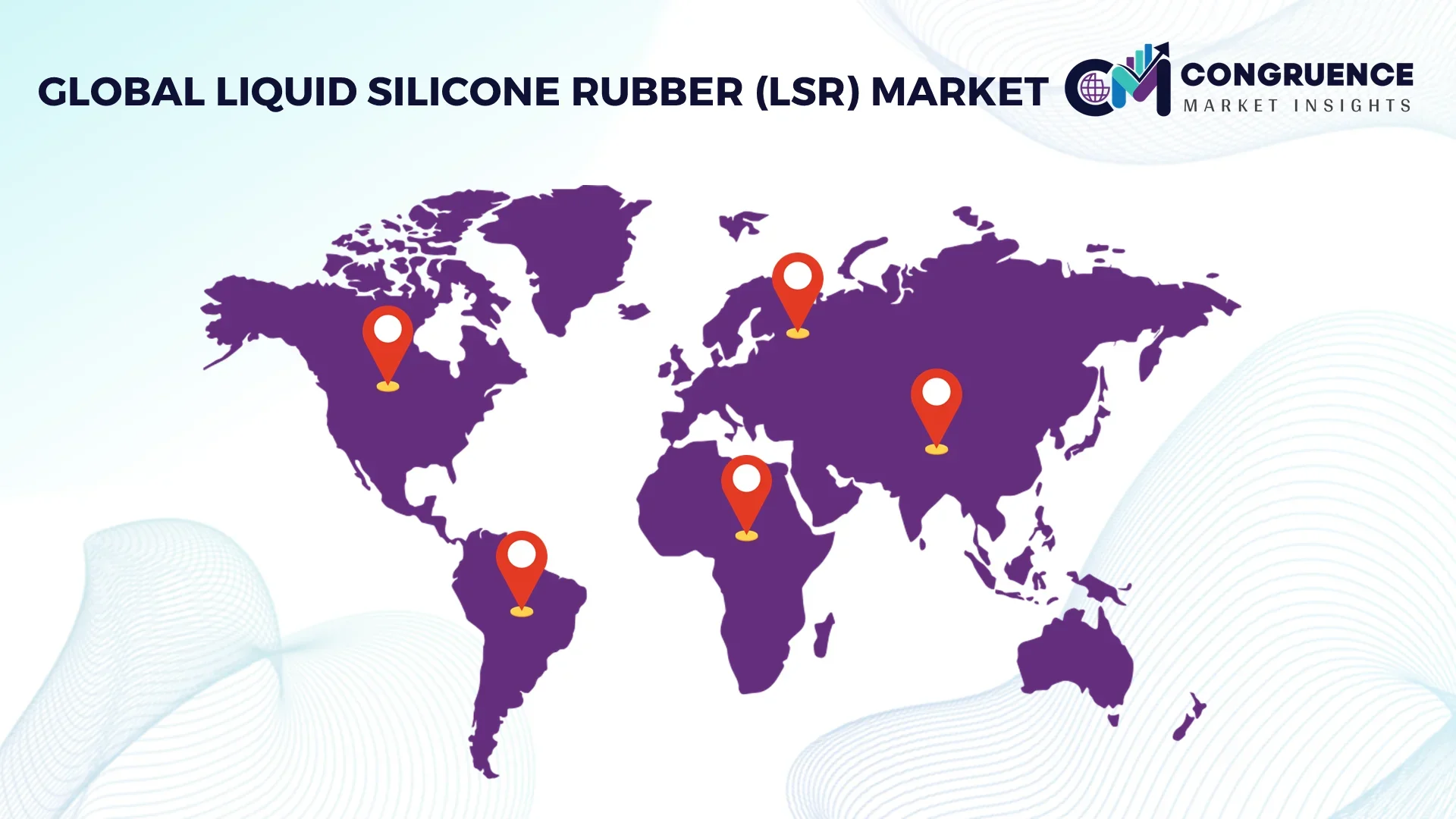
Asia-Pacific’s leadership is supported by high-volume manufacturing, with over 55% of global LSR production capacity concentrated across China, Japan, and South Korea. Europe’s growth trajectory reflects accelerated adoption of medical-grade and sustainable silicone materials, with more than 60% of regulated medical device producers incorporating LSR components. North America follows with a 28.4% share in 2024, driven by advanced healthcare infrastructure and EV manufacturing, while South America and the Middle East & Africa together account for approximately 11.2%, supported by infrastructure, energy, and consumer goods expansion. Regional disparities in automation, regulatory frameworks, and end-user sophistication continue to shape localized demand intensity and application focus.
How is advanced manufacturing reshaping demand patterns across high-compliance industries?
North America accounted for approximately 28.4% of the Liquid Silicone Rubber (LSR) market in 2024, supported by strong demand from healthcare, automotive electrification, and electronics manufacturing. Medical devices represent nearly 40% of regional LSR consumption, with hospitals and OEMs favoring platinum-cured grades for compliance and durability. Automotive demand is rising, with EV-related LSR components growing by over 22% in unit adoption. Regulatory frameworks focused on biocompatibility and food-contact safety continue to reinforce premium material usage. Digital transformation is evident, with more than 45% of LSR processors using automated liquid injection molding systems. Local players such as Dow are expanding specialty silicone portfolios for medical and EV insulation applications. Consumer behavior shows higher enterprise adoption in healthcare and life sciences, prioritizing reliability and long-term performance.
Why is regulation-driven innovation accelerating material adoption across advanced industries?
Europe represented around 24.1% of the global Liquid Silicone Rubber (LSR) market in 2024, with Germany, France, and the UK contributing more than 65% of regional demand. Medical technology and automotive engineering remain the primary demand drivers, together accounting for nearly 58% of usage. Sustainability initiatives and strict material compliance standards are accelerating adoption of low-emission and recyclable silicone solutions. Over 50% of European LSR processors have implemented energy-efficient curing and closed-loop manufacturing systems. Companies such as Wacker Chemie AG are investing in high-purity LSR grades tailored for healthcare and e-mobility. Regional consumer behavior reflects strong regulatory pressure, driving preference for traceable, compliant, and explainable Liquid Silicone Rubber (LSR) formulations.
How does scale-driven manufacturing influence material consumption across diverse industries?
Asia-Pacific is the largest and most production-intensive region, accounting for approximately 42.6% of global Liquid Silicone Rubber (LSR) consumption in 2024. China alone contributes over 50% of regional volume, followed by Japan and South Korea. The region hosts more than 60% of global silicone processing facilities, supporting large-scale supply to electronics, automotive, and consumer goods sectors. Electronics applications represent nearly 35% of regional demand, driven by smartphones, wearables, and EV components. Manufacturing automation is expanding rapidly, with over 48% of new LSR molding lines deployed in this region since 2022. Players such as Shin-Etsu Chemical continue to expand specialty LSR capacity. Consumer behavior is shaped by cost efficiency, high-volume output, and rapid product cycles.
What role do infrastructure and industrial diversification play in material adoption?
South America accounted for approximately 6.8% of the Liquid Silicone Rubber (LSR) market in 2024, with Brazil and Argentina representing over 70% of regional consumption. Demand is concentrated in automotive components, industrial seals, and consumer goods manufacturing. Infrastructure modernization and energy sector investments are increasing the use of durable elastomers capable of withstanding extreme operating conditions. Trade incentives and regional manufacturing programs have improved access to advanced molding technologies, with LSR usage in industrial equipment rising by nearly 18% since 2022. Local processors are upgrading injection molding capabilities to reduce imports. Consumer behavior reflects growing preference for long-lasting materials in household and automotive products.
How are industrial diversification and modernization shaping material demand?
The Middle East & Africa region contributed roughly 4.4% of global Liquid Silicone Rubber (LSR) demand in 2024, led by the UAE, Saudi Arabia, and South Africa. Oil & gas, construction, and healthcare infrastructure projects are key demand drivers, collectively accounting for over 60% of regional usage. Technological modernization initiatives have increased adoption of heat- and chemical-resistant LSR components in energy and industrial applications. Trade partnerships and industrial localization policies are supporting material availability. Regional processors are gradually adopting automated molding, improving output efficiency by approximately 12%. Consumer behavior varies widely, with industrial buyers prioritizing durability and regulatory compliance.
China – 31.8% share: Dominates the Liquid Silicone Rubber (LSR) market due to large-scale production capacity, integrated electronics manufacturing, and extensive industrial applications.
United States – 19.6% share: Holds a leading position in the Liquid Silicone Rubber (LSR) market supported by advanced medical device manufacturing, strong regulatory frameworks, and high adoption of automated molding technologies.
The Liquid Silicone Rubber (LSR) market exhibits a moderately consolidated competitive structure, characterized by a mix of global chemical majors and specialized silicone material producers. Approximately 25–30 active manufacturers operate globally at commercial scale, with the top five companies collectively accounting for nearly 62% of total global supply, indicating strong concentration at the upper end of the value chain. Market leaders maintain competitive positioning through vertically integrated production, proprietary platinum-cure technologies, and long-term supply agreements with medical, automotive, and electronics OEMs.
Strategic initiatives increasingly focus on capacity expansions, specialty-grade launches, and regional manufacturing localization. Over 40% of leading players have announced investments in automated liquid injection molding-compatible formulations since 2023, aiming to improve processing efficiency by 15–20% for end users. Partnerships with medical device manufacturers and EV component suppliers are rising, with collaborative development projects shortening product qualification timelines by up to 25%. Innovation trends center on ultra-low volatility LSR, self-adhesive grades eliminating secondary bonding, and sustainable silicone systems designed to reduce processing emissions by 20–30%. Overall, competition is shifting from volume-based pricing toward performance differentiation, regulatory readiness, and application-specific customization.
Wacker Chemie AG
Dow
Shin-Etsu Chemical Co., Ltd.
Momentive Performance Materials
Elkem ASA
KCC Corporation
Avantor Performance Materials
Shin-Etsu Silicones of America
Reiss Manufacturing
Liquid injection molding (LIM) remains the foundational production technology for Liquid Silicone Rubber (LSR), representing the dominant processing method across large-scale facilities and accounting for roughly 65% of high-volume LSR production lines globally. Advances in LIM hardware low-pressure injection units, precision metering pumps, and automated degassing systems have reduced cycle-time variability by 15–25% and lowered reject rates by 12–18%, directly improving throughput and yield for decision-makers focused on OEE improvements.
Multi-shot and overmolding technologies are enabling integrated component assemblies by combining LSR with rigid plastics and elastomers in a single cycle; such systems have cut secondary assembly steps by approximately 30% in pilot implementations and are central to packaging EV connectors, medical housings, and consumer-electronics seals. Micro-molding capabilities now routinely achieve dimensional tolerances of ±0.02–0.05 mm, enabling LSR use in microfluidic medical components and high-density electronic interconnects where traditional elastomers cannot meet precision demands.
Catalysis and cure-system innovation notably platinum-cured, addition-type systems have shortened post-processing and eliminated extended thermal post-cure in many grades, improving line throughput and reducing energy per part by an estimated 12–18% when combined with infrared or forced-air curing ovens. High-flow, low-viscosity LSR formulations facilitate faster fill rates and reduced flash, with automated dispensing accuracy improving to within ±0.01–0.05 g per shot on modern metering equipment.
Digitalization and Industry 4.0 adoption are material: ~20–30% of tier-one processors have implemented real-time viscosity monitoring, predictive maintenance, and digital-twin simulations to optimize process windows and reduce downtime. Machine-vision inspection systems are lowering defect escapes by an estimated 20%, while closed-loop controls and recipe management have accelerated qualification cycles by up to 25% for regulated applications.
• In February 2024, WACKER Chemie AG introduced a new non-postcuring liquid silicone rubber grade under the ELASTOSIL® LR 5003 series tailored for large-scale food contact and sensitive product manufacturing, enabling compliance with stringent tear resistance and processing requirements in high-volume applications. (wacker.com)
• In May 2024, Elmet Elastomere Produktions- und Dienstleistungs GmbH launched the TOP 700 dosing system for injection molding Liquid Silicone Rubber (LSR), delivering a high precision dosing rate exceeding 5 litres per minute at unique pump pressures up to 210 bar, thereby enhancing part consistency and throughput. (Claight Corp.)
• In February 2024, Trelleborg Group agreed to acquire Baron Group, an Australian-Chinese precision silicone components manufacturer, strengthening its advanced application capabilities and precision manufacturing footprint for medical and industrial LSR applications.
• In October 2024, Shenzhen Tenchy Silicone and Rubber Co., Ltd. launched a new medical-grade silicone tubing series for critical healthcare applications, featuring 100% medical-grade composition and sterilization compatibility across autoclave, CIP, and radiation methods to support hygiene and durability standards.
The Liquid Silicone Rubber (LSR) Market Report encompasses a broad and detailed examination of material segments, processing technologies, application landscapes, and geographic insights relevant to decision-makers, product engineers, and strategic planners. The report analyzes types of LSR formulations — including medical-grade, industrial-grade, food-grade, and specialty high-performance variants — with clear delineation of properties, tolerance thresholds, and processing requirements that suit various applications. It also covers processing technologies such as liquid injection molding, multi-shot systems, and emerging additive manufacturing integration, presenting comparative capabilities and operational performance metrics like precision tolerances and production yield improvements.
In examining applications, the report highlights medical device components, automotive seals and insulation, electrical and electronics packaging, consumer product elastomers, industrial machinery gaskets, and construction sealing systems. Each application segment is described with usage profiles, material requirements, and key performance indicators, such as operational temperature ranges and mechanical resilience metrics. The geographic dimension includes regional demand patterns across Asia-Pacific, North America, Europe, South America, and Middle East & Africa, with volume benchmarks and regional technology adoption trends.
The scope also addresses industry focus areas, such as regulatory compliance for biocompatibility, food safety, and sustainability mandates, which influence material selection and qualification protocols. Emerging niche segments like self-adhesive LSR grades, recyclable LSR formulations, and micro-precision molding for wearable devices are discussed, offering insight into innovation pathways and potential strategic investments. Overall, the report provides a comprehensive framework for understanding competitive positioning, technological evolution, and adoption dynamics within the global Liquid Silicone Rubber (LSR) landscape.
| Report Attribute/Metric | Report Details |
|---|---|
|
Market Revenue in 2024 |
USD 863.86 Million |
|
Market Revenue in 2032 |
USD 1257 Million |
|
CAGR (2025 - 2032) |
4.8% |
|
Base Year |
2024 |
|
Forecast Period |
2025 - 2032 |
|
Historic Period |
2020 - 2024 |
|
Segments Covered |
By Types
By Application
By End-User
|
|
Key Report Deliverable |
Revenue Forecast, Growth Trends, Market Dynamics, Segmental Overview, Regional and Country-wise Analysis, Competition Landscape |
|
Region Covered |
North America, Europe, Asia-Pacific, South America, Middle East, Africa |
|
Key Players Analyzed |
Wacker Chemie AG, Dow, Shin-Etsu Chemical Co., Ltd., Momentive Performance Materials, Elkem ASA, KCC Corporation, Avantor Performance Materials, Shin-Etsu Silicones of America, Reiss Manufacturing |
|
Customization & Pricing |
Available on Request (10% Customization is Free) |




