
Reports
The Global Limousine Services Market was valued at USD 2,530.0 Million in 2025 and is anticipated to reach a value of USD 4,586.6 Million by 2033 expanding at a CAGR of 7.72% between 2026 and 2033, according to an analysis by Congruence Market Insights, driven by rising demand for premium ground transportation and expanding corporate travel needs. Increased consumer preference for luxury, comfort, and reliability is supporting broader adoption across both business and leisure segments.
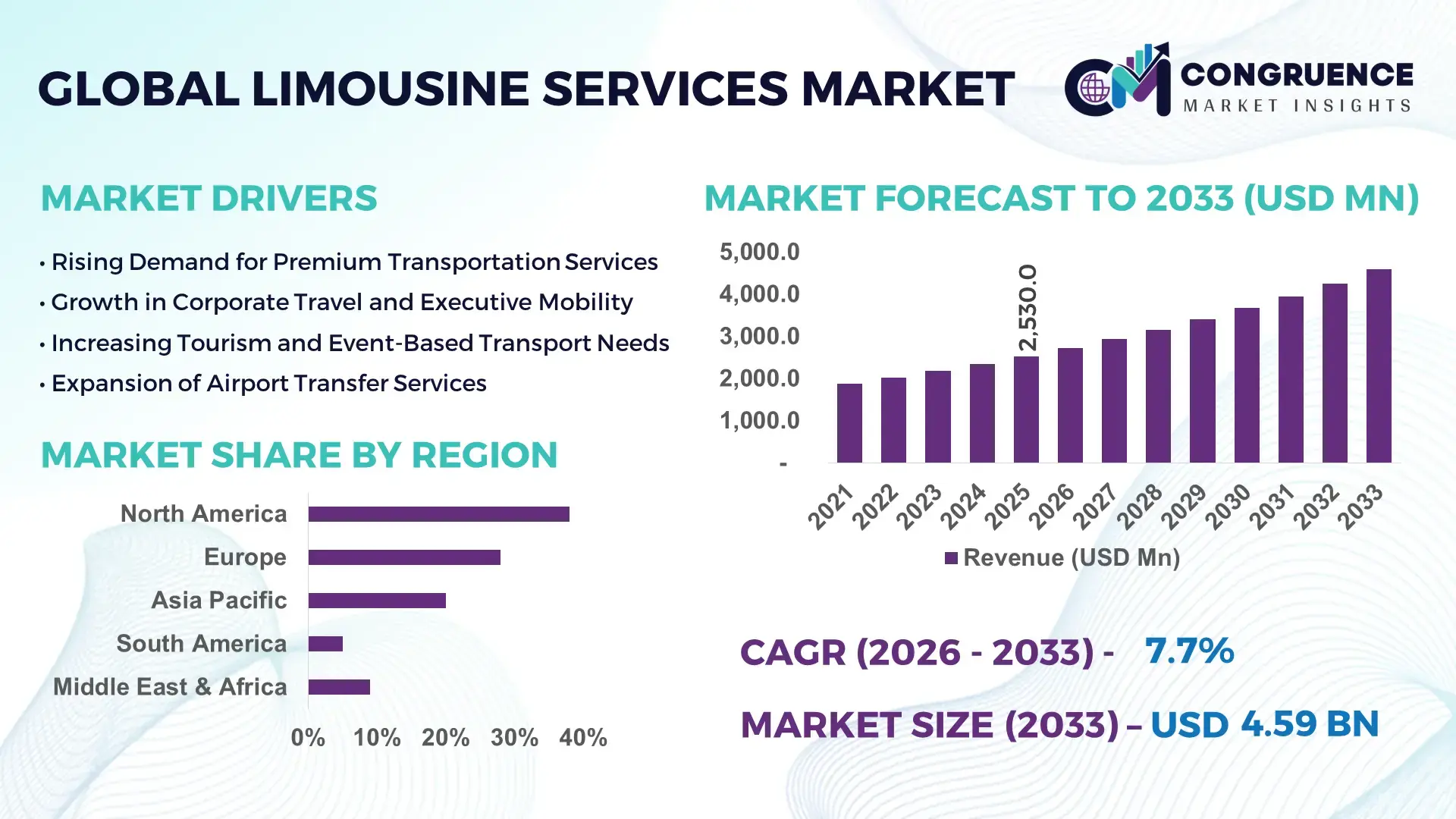
North America remains the dominant country-level market in limousine services, supported by extensive service provider networks, advanced fleet technologies, and significant investments in premium transportation infrastructure. The United States alone supports thousands of licensed limousine operators, with advanced digital booking systems and automated fleet management driving operational efficiency. Corporate travel and luxury event transportation contribute heavily to utilization patterns, with high urban concentrations sustaining elevated daily bookings and a growing trend toward app-based service integration, reflecting strong capacity and investment levels.
Market Size & Growth: 2025 market valued at USD 2,530.0 Million, projected USD 4,586.6 Million by 2033 at 7.72% CAGR, driven by rising luxury travel demand and corporate mobility trends.
Top Growth Drivers: Luxury adoption increases by 18%, corporate client bookings rise by 22%, airport transfer demand grows by 15%.
Short-Term Forecast: By 2028, digital booking efficiency expected to improve operational turnaround times by 30%.
Emerging Technologies: Adoption of connected vehicle platforms, AI-powered route optimization, and electric premium limousines.
Regional Leaders: North America projected at USD 1,650M by 2033 (corporate travel focus), Europe USD 1,200M (tourism & events), Asia Pacific USD 950M (rising urban affluent consumers).
Consumer/End-User Trends: Increasing preference for app-based reservations among millennials and business travelers; luxury event transportation usage up 20% year-over-year.
Pilot or Case Example: In 2025, a U.S. luxury fleet introduced AI routing, reducing idle time by 25%.
Competitive Landscape: Leading provider ~28% share, followed by key competitors with ~9–15% shares each.
Regulatory & ESG Impact: Incentives for low-emission vehicle adoption and safety compliance improving fleet sustainability.
Investment & Funding Patterns: Recent investments exceeding USD 180M in tech-enabled fleet upgrades and platform integrations.
Innovation & Future Outlook: Integration of autonomous features and advanced passenger experience systems shaping future service delivery.
Limousine services are increasingly integrated across business travel, tourism, and premium event transportation sectors, with fleet electrification and digital platforms enhancing service quality. Regulatory emphasis on emissions and safety, coupled with demand for app-enabled bookings, is reshaping delivery models, while urban consumption patterns and luxury lifestyle trends point to sustained expansion.
The Global Limousine Services Market occupies a strategic role in premium mobility ecosystems, bridging the gap between traditional transport and high-end experiential travel. As corporate travel rebounds post-pandemic, measurable enhancements in operational technologies are pivotal. For instance, connected fleet telematics delivers a 32% improvement in scheduling efficiency compared to legacy dispatch systems. North America dominates in service volume, while Europe leads adoption with over 40% of enterprises leveraging advanced digital reservation systems. By 2028, the integration of AI-driven customer personalization is expected to improve customer retention metrics by over 25%, reflecting measurable shifts in service delivery standards. Moreover, limousine operators are committing to environmental, social, and governance (ESG) improvements such as a 20% reduction in fleet emissions by 2030 through electrification strategies and low-emission zones compliance.
Strategic investments are being channeled into scalable platform technologies that support predictive maintenance and dynamic pricing, enabling operators to manage peak demand periods with reduced downtime. For example, in 2025 a U.S. provider achieved a 28% reduction in idle time through AI-based routing and predictive analytics. Regional variations underline that while North America leads in sheer fleet size and corporate contracts, Asia Pacific’s rapid urbanization is catalyzing adoption among affluent consumers, boosting luxury transport bookings by double-digit percentages annually. In this evolving landscape, the Limousine Services Market is positioned as a resilient, compliance-oriented, and innovation-led segment of premium ground mobility, driving sustainable growth and customer-centric service transformation into the next decade.
The Limousine Services Market dynamics reflect a blend of shifting consumer expectations, technological advancements, and macroeconomic influences. Increasing disposable incomes in urban centers are boosting demand for premium transport options for corporate travel, special events, and tourism. Digital adoption is reshaping customer engagement, with mobile and web platforms enhancing accessibility, real-time tracking, and personalized services. Operational strategies are adapting to efficiency imperatives, integrating telematics and customer relationship tools to reduce wait times and improve service responsiveness. Macro trends such as urban congestion, environmental regulations, and changing mobility preferences are compelling providers to innovate with low-emission vehicles and intelligent dispatch systems, positioning the market at the intersection of luxury, convenience, and sustainability.
Corporate travel demand significantly bolsters the limousine services ecosystem, with organizations increasingly prioritizing premium ground transportation for executive mobility, client hospitality, and event logistics. Major corporate hubs in metropolitan regions see daily utilization spikes for airport transfers, business meetings, and high-profile events. Measured corporate bookings have risen markedly, with documented growth exceeding 20% in major urban centers where business events and conferences are concentrated. The prevalence of long-term contracts with enterprises enhances route predictability and fleet utilization, incentivizing operators to invest in technology-enabled booking platforms and luxury amenities. This trend underscores the direct linkage between business travel frequency and sustained demand for luxury transport solutions.
High operational costs represent a key restraint for the limousine services market. Premium vehicle acquisition, maintenance, comprehensive insurance, and compliance with safety standards elevate fixed and variable expenses, making cost structures significantly higher than standard taxi or ride-hailing alternatives. Fuel price volatility and fleet servicing overheads further intensify financial pressures on operators, particularly smaller regional providers. Markets with dense urban traffic see increased wear and tear, compounding maintenance spend. Additionally, investment in advanced reservation systems and customer support infrastructure necessitates upfront capital outlays. Collectively, these cost burdens limit scalability for many service providers, particularly in regions with competitive pricing pressures and rising urban operating expenses.
Fleet electrification presents a significant opportunity for the limousine services market as consumer preference shifts toward environmentally responsible modes of luxury travel. Deploying electric limousines can reduce operating costs through lower energy expenditure and maintenance needs relative to internal combustion engines. Electrified fleets also align with urban regulatory incentives, including low-emission zones and tax rebates, enabling operators to market sustainable premium transportation options. Enhanced passenger experiences associated with electric vehicles, such as quieter rides and advanced infotainment, further distinguish services. Partnerships with charging infrastructure providers and renewable energy initiatives can also unlock joint value propositions, expanding service appeal among sustainability-conscious clientele and businesses seeking ESG-compliant travel solutions.
Regulatory compliance requirements pose challenges for the limousine services market, as operators must navigate diverse city-level licensing protocols, safety audits, insurance mandates, and accessibility standards. Varying regulations across jurisdictions require adaptive operational policies and continuous administrative oversight, adding to compliance costs. Safety certifications, driver background checks, and environmental standards are necessary but can delay service expansions and fleet renewals. In regions with stringent emission norms, meeting electrification or retrofit requirements can strain financial resources. These regulatory complexities create barriers for smaller providers and complicate scaling strategies, requiring substantial planning and investment to ensure adherence without disrupting service quality or coverage.
Digital Platform Integration Enhancing Operational Efficiency: The adoption of mobile and web-based reservation systems has increased by over 40% across major markets, improving booking lead times and customer retention metrics. These platforms support dynamic pricing, real-time tracking, and integrated payment systems that enhance convenience and reduce administrative overhead.
Premium Event and Corporate Mobility Uptake: Demand for limousine services in corporate travel and special occasions has grown significantly, with weekend event bookings rising by an average of 28%, highlighting a shift toward luxury ground transport for weddings, conferences, and VIP transfers.
Electrification and Eco-Friendly Fleet Adoption: Operators are increasingly incorporating electric and hybrid luxury vehicles into fleets, with documented uptake in eco-fleet segments rising over 25% in urban centers responding to environmental regulations and consumer preferences for sustainable travel.
Advanced Vehicle Technologies: Integration of AI-assisted route optimization and connected telematics systems has improved fleet utilization metrics by more than 30%, driving operational cost savings and enhancing punctuality, while differentiating service offerings in competitive markets.
The Limousine Services Market is structured across multiple dimensions, including type, application, and end-user insights, reflecting a diverse and evolving landscape. By type, the market encompasses stretch limousines, sedan limousines, SUV limousines, and specialty vehicles, each catering to distinct service needs. Application-wise, the services are utilized for corporate travel, airport transfers, events and weddings, tourism, and VIP transportation. End-user insights highlight the adoption patterns among businesses, affluent individual consumers, hospitality providers, and event organizers. Regional differences influence service demand, with urbanized areas demonstrating higher reliance on premium digital booking platforms. Overall, segmentation reveals how operators optimize fleets, service packages, and customer engagement strategies to meet varying consumer preferences while balancing operational efficiency and luxury experience standards.
Stretch limousines currently lead the market, accounting for approximately 38% of the total fleet utilization due to their versatility in corporate and luxury event transportation. Sedan limousines hold 28% of the market, favored for executive airport transfers and short-distance premium rides. SUV limousines, comprising around 18%, serve high-profile clients requiring extra space and security features. Specialty vehicles—including armored limousines and custom luxury vans—make up the remaining 16%, targeting niche demand in VIP protection and specialized travel services.
The fastest-growing segment is SUV limousines, driven by increasing demand for secure, spacious, and tech-enabled luxury transport, expanding adoption across corporate and private clients. Operational efficiency and integration of infotainment systems are key growth factors.
In 2025, a leading U.S. luxury fleet implemented advanced SUV limousines equipped with digital concierge systems, enhancing client satisfaction for over 100,000 trips annually.
Corporate travel remains the dominant application, representing 42% of service utilization, supported by the frequency of executive travel and business event logistics. Airport transfers account for 25%, offering convenience for time-sensitive clients, while event and wedding services hold 20%, and tourism and VIP transport comprise the remaining 13%. The fastest-growing application is tourism and VIP transport, fueled by rising disposable incomes and increasing preference for personalized luxury experiences, with adoption expanding rapidly in metropolitan and resort areas.
Consumer trends indicate that in 2025, over 38% of enterprises globally reported leveraging premium limousine services for client entertainment and corporate events. Additionally, more than 60% of high-net-worth travelers prefer digitally booked, personalized transport solutions over conventional taxi alternatives.
In 2025, a European luxury travel operator deployed AI-assisted airport transfer scheduling, reducing average wait times by 15% and serving over 200,000 passengers annually.
Corporate clients dominate end-user adoption, representing approximately 40% of the market, driven by executive travel requirements and corporate hospitality services. The fastest-growing end-user segment is individual affluent consumers, expanding at a notable rate due to rising urban wealth and lifestyle-oriented luxury demand, with adoption rates increasing by nearly 20% annually in top-tier cities. Hospitality providers, event organizers, and tourism operators make up the remaining 40%, contributing to diversified service deployment across urban and resort markets.
Consumer adoption patterns show that in 2025, more than 42% of luxury travelers in North America and Europe preferred app-based limousine reservations, reflecting a shift toward digital-first service experiences. Additionally, Gen Z and millennial high-income travelers increasingly favor premium, eco-conscious vehicle options in their service selection.
In 2025, over 500 luxury hotels in the U.S. integrated premium limousine services with digital booking platforms, enhancing guest transfer efficiency by 18% and improving satisfaction ratings.
North America accounted for the largest market share at 38% in 2025; however, Asia-Pacific is expected to register the fastest growth, expanding at a CAGR of 8.3% between 2026 and 2033.
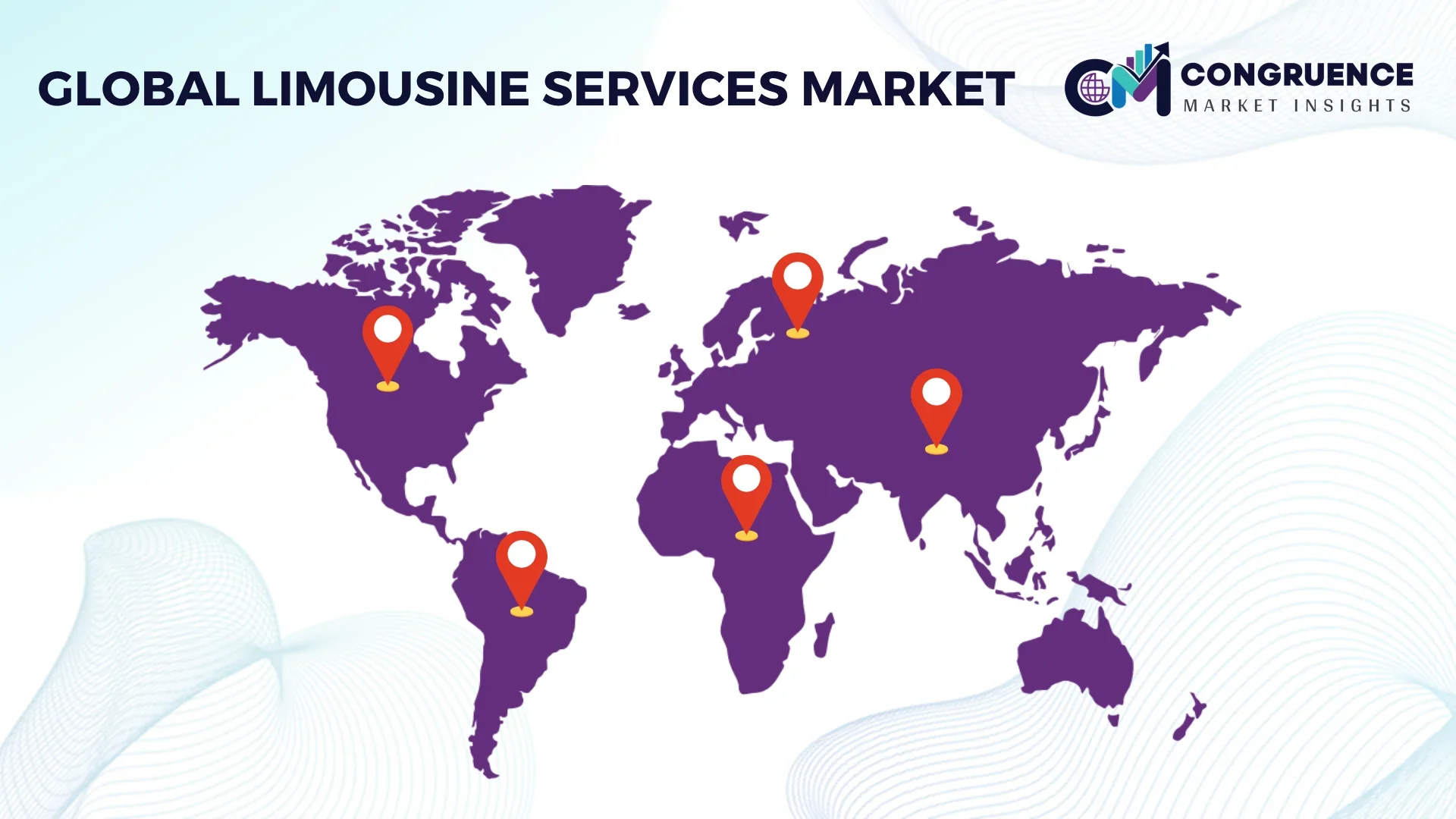
North America leads with over 14,500 registered limousine operators, serving more than 1.2 million corporate and private clients annually. Europe follows with 28% market share, while Asia-Pacific is rapidly expanding due to rising urbanization, luxury travel demand, and digital booking adoption. South America and Middle East & Africa collectively contribute 20% of global service utilization. Consumer adoption patterns show that 42% of high-net-worth individuals prefer digitally booked luxury transport, and 55% of corporate clients have integrated premium ground services into enterprise travel programs.
North America dominates with 38% of the global limousine services market, primarily driven by corporate travel, healthcare, finance, and high-end tourism sectors. Key regulatory changes, including safety audits and vehicle certification standards, have raised service quality benchmarks. Technological advancements such as AI-assisted fleet management, connected telematics, and app-based bookings have improved operational efficiency and customer satisfaction. Local players like Carey International Group are implementing digital concierge systems and electric SUV fleets to enhance premium offerings. Consumer behavior varies regionally, with higher enterprise adoption in healthcare and finance, while affluent leisure travelers increasingly demand eco-friendly and tech-enabled service options.
Europe holds 28% of the global limousine services market, with major contributions from Germany, the UK, and France. Regulatory and sustainability initiatives, including low-emission zones and safety compliance mandates, have influenced fleet upgrades and service standards. Emerging technologies, such as AI-based dispatch and electric vehicle integration, are widely adopted. Local operators, such as Blacklane, offer fully app-based reservations and electric vehicle options to meet urban mobility demands. Consumer behavior in Europe reflects regulatory pressure and sustainability awareness, with 48% of urban professionals favoring low-emission luxury transportation and 35% using digital booking platforms for efficiency and convenience.
Asia-Pacific is emerging as the fastest-growing region, representing 20% of global service utilization in 2025. Top consuming countries include China, India, and Japan, driven by rising affluence, corporate travel, and tourism. Rapid urban infrastructure development and investments in smart city transport systems support premium vehicle deployment. Technology adoption includes mobile app booking, AI-enabled route optimization, and electric limousine fleets. Local players like Beijing Limo Services have expanded digital platforms and app-based corporate solutions. Regional consumer behavior shows strong preference for mobile AI apps, luxury e-commerce tie-ins, and seamless airport and hotel transfers, accounting for over 60% of high-end urban bookings.
South America holds approximately 8% of the global limousine services market, with key countries including Brazil and Argentina. Growth is supported by luxury tourism, corporate events, and infrastructure modernization in urban centers. Government incentives and trade policies encourage adoption of electric and hybrid vehicles. Local operators, such as Sao Paulo Limo Services, have introduced tech-enabled fleet management to improve efficiency and customer satisfaction. Consumer behavior varies regionally, with higher demand tied to media-driven events, language localization, and personalized services, while corporate adoption is concentrated in major cities like São Paulo and Buenos Aires.
The Middle East & Africa accounts for 12% of the global limousine services market, with major growth in the UAE and South Africa. Demand is driven by oil and gas, construction, luxury tourism, and VIP transportation. Technological modernization includes AI-based fleet tracking, app reservations, and luxury vehicle electrification. Local players, such as Dubai Limo Services, are integrating high-end amenities and digital booking platforms to attract corporate and affluent leisure clients. Regional consumer behavior shows strong adoption for premium transport in business districts, tourist hubs, and high-income residential areas, with over 50% of users preferring digitally-managed luxury fleet services.
United States – 38% Market Share: Dominance due to high corporate travel demand, advanced fleet management, and widespread premium vehicle networks.
Germany – 12% Market Share: Strong end-user demand in corporate, tourism, and luxury event transportation, supported by regulatory incentives for fleet electrification.
The competitive environment of the Limousine Services Market is characterized by moderate fragmentation with a blend of established global operators and dynamic regional players. There are hundreds of active competitors worldwide, ranging from well‑known luxury transport specialists to app‑based ride providers that have introduced premium categories. The top 5 companies collectively capture an estimated 25–30% of market utilization, indicating a landscape where numerous mid‑size and local operators hold meaningful positions alongside larger firms. Leading companies such as Carey International, EmpireCLS Worldwide Chauffeured Services, Blacklane GmbH, BostonCoach, and Limos.com maintain strong global presences with extensive fleet portfolios, advanced reservation platforms, and broad service offerings in corporate and VIP transport segments. Competitive positioning is further influenced by strategic initiatives like partnerships and product launches; for instance, several operators have rolled out electric and hybrid vehicle fleets, while tech platforms are launching real‑time dispatch and analytics systems to enhance customer experience and operational efficiency. Innovation trends include mobile booking optimization, AI‑assisted routing systems, fleet telematics, and sustainability programs. Traditional providers continue investing in premium service differentiation, while newer entrants leverage digital platforms to capture digitally savvy customer segments. Pricing competition remains robust in airport and corporate travel sectors, whereas experiential luxury services emphasize bespoke offerings and concierge integrations.
EmpireCLS Worldwide Chauffeured Services
BostonCoach
ExecuCar
A1A Airport & Limousine Service
Prime Limo & Car Service
Empire Limousine
Royalty Limousine
GroundLink
Apex Limousine
Signature Limousine
Go Airport Shuttle
Lyft Lux
Uber Black
The Limousine Services Market is undergoing significant technological transformation, driven by digital platforms, data analytics, and sustainability‑oriented innovations. Mobile app integration has become foundational, enabling customers to book, track, and manage luxury transfers in real time with seamless digital interfaces. Advanced dispatch and route optimization systems use machine learning and AI, reducing idle time and improving responsiveness in congested urban environments. Integrated telematics deliver operational insights such as fuel consumption, driver performance metrics, and predictive maintenance scheduling, enhancing both safety and cost efficiency. Electrification trends are notable, with electric and hybrid limousines being added to fleets, meeting rising eco‑conscious consumer expectations and regulatory emission standards. Chauffeured services are also increasingly incorporating connected vehicle technologies, such as cloud‑based fleet management platforms offering real‑time booking, invoicing, and customer service workflows, supporting scalability for operators of all sizes.
Digital payment systems, API integrations with hotels or corporate travel platforms, and data‑driven personalization features are improving end‑user experiences and loyalty. Safety technologies—including contactless boarding, HEPA filtration, and advanced driver‑assistance systems (ADAS)—are influencing purchase decisions among safety‑conscious clientele. Predictive analytics and big data help operators optimize pricing, forecast demand patterns, and tailor services for high‑value segments such as corporate accounts or event planners. Emerging tech developments, such as AI‑powered customer support bots and next‑generation infotainment systems, are becoming differentiators in luxury offerings. Overall, technology adoption in limousine services is elevating operational efficiency, bolstering service quality, and enabling more personalized customer journeys across regional markets.
• In June 2024, Blacklane partnered with SIXT to make premium chauffeur services bookable directly through the SIXT app and website across the United States and Canada, offering Airport Transfers, In‑City Rides, Chauffeur‑by‑the‑Hour, and City‑to‑City options with luxury and electric vehicle classes available for seamless premium mobility. Source: www.blacklane.com
• In June 2024, Blacklane expanded its strategic business travel connectivity by partnering with Jyrney, enabling business travelers and travel management companies to access Blacklane’s chauffeur services in more than 50 countries directly through Jyrney’s booking platform, integrating pre‑book and on‑demand options. Source: www.blacklane.com
• On July 1, 2025, Carey International announced it has joined the Science Based Targets initiative (SBTi), committing to near‑term emission reductions aligned with climate science and accelerating the transition of its fleet toward hybrid and electric vehicles in major cities like Dallas, Houston, New York, and London. Source: www.carey.com
• In May 2025, Carey International’s UK sedan fleet* completed a transition to fully hybrid and electric vehicles, marking a significant milestone in the company’s sustainability strategy to meet evolving corporate client demands for low‑emission luxury ground transportation services. Source: www.carey.com
The Limousine Services Market Report provides a comprehensive, multi‑dimensional analysis of market structure and dynamics, covering segmentation by type, application, and end‑user categories. The report examines premium stretch limousines, sedan and SUV limousines, and specialty vehicles, detailing utilization patterns and service delivery models across corporate, airport transfer, tourism, VIP events, and bespoke occasions. It explores geographic segmentation across North America, Europe, Asia‑Pacific, South America, and Middle East & Africa, illustrating regional fleet compositions, adoption trends, and regulatory environments. The scope extends to technology impact assessments, highlighting digital booking ecosystems, dispatch and fleet‑management platforms, telematics, AI routing systems, and electrification initiatives reshaping service offerings.
Competitive landscapes are mapped with profiles of key industry players, strategic movements, service innovations, and partnership activities that influence market positions. The report also integrates end‑user behavior insights, identifying demand drivers among businesses, high‑net‑worth individuals, hospitality partners, and event planners. Operational contexts such as safety compliance, licensing landscapes, and sustainability responses are addressed, providing actionable intelligence for decision‑makers. Emerging niches—such as subscription‑based luxury transport, eco‑fleet deployment, and integrated multimodal travel solutions—are evaluated for strategic planning. Altogether, the report equips industry professionals with quantitative and qualitative insights necessary for investment evaluation, service expansion planning, and competitive differentiation in an evolving premium ground transport ecosystem.
| Report Attribute / Metric | Details |
|---|---|
| Market Revenue (2025) | USD 2,530.0 Million |
| Market Revenue (2033) | USD 4,586.6 Million |
| CAGR (2026–2033) | 7.72% |
| Base Year | 2025 |
| Forecast Period | 2026–2033 |
| Historic Period | 2021–2025 |
| Segments Covered |
By Type
By Application
By End-User Insights
|
| Key Report Deliverables | Revenue Forecast, Market Trends, Growth Drivers & Restraints, Technology Insights, Segmentation Analysis, Regional Insights, Competitive Landscape, Regulatory & ESG Overview, Recent Developments |
| Regions Covered | North America, Europe, Asia-Pacific, South America, Middle East & Africa |
| Key Players Analyzed | Carey International, Blacklane GmbH, Limos.com, EmpireCLS Worldwide Chauffeured Services, BostonCoach, ExecuCar, A1A Airport & Limousine Service, Prime Limo & Car Service, Empire Limousine, Royalty Limousine, GroundLink, Apex Limousine, Signature Limousine, Go Airport Shuttle, Lyft Lux, Uber Black |
| Customization & Pricing | Available on Request (10% Customization Free) |




