
Reports
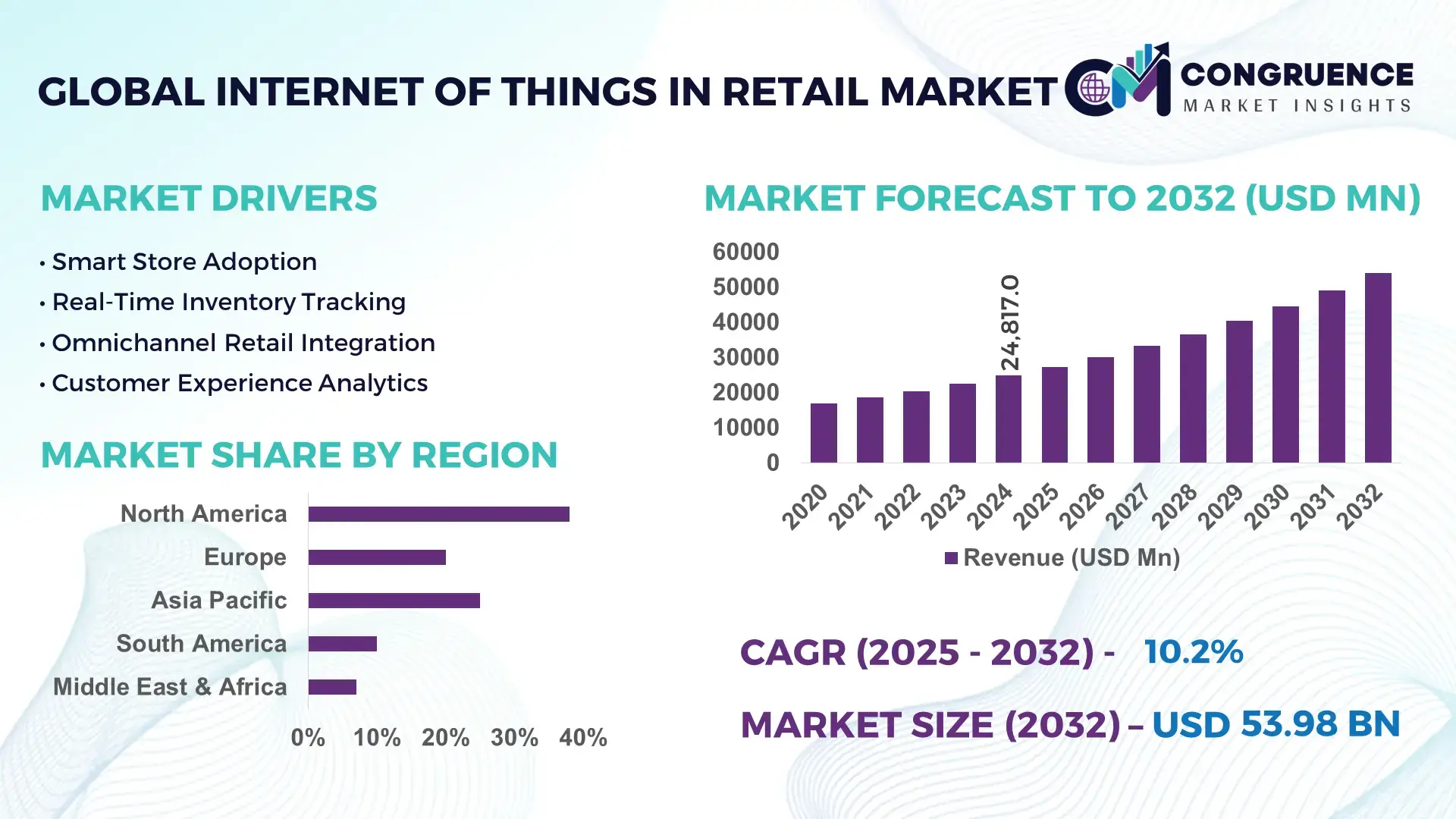
The Global Internet of Things in Retail Market was valued at USD 24817.04 Million in 2024 and is anticipated to reach a value of USD 53976.25 Million by 2032 expanding at a CAGR of 10.2% between 2025 and 2032. This growth is primarily driven by large-scale deployment of smart shelves, RFID-enabled inventory systems, and real-time consumer analytics to improve operational efficiency and in-store personalization.
The United States dominates the Internet of Things in Retail market through advanced deployment scale, capital investment, and technology integration across large-format and omnichannel retailers. In 2024, over 65% of Tier-1 U.S. retailers had active IoT-based inventory or customer analytics deployments, with RFID tagging penetration exceeding 70% in apparel and grocery segments. Annual retail IoT investment in the U.S. surpassed USD 6.5 billion, focused on smart shelves, computer vision checkout, and predictive demand systems. More than 45 million connected retail devices are operational nationwide, supporting applications such as loss prevention, dynamic pricing, energy optimization, and omnichannel fulfillment. AI-integrated IoT platforms enable real-time decision-making across supply chains, while 5G-enabled stores accelerate data transmission for edge analytics and automated store operations.
Market Size & Growth: Valued at USD 24817.04 Million in 2024 and projected to reach USD 53976.25 Million by 2032, growing at a CAGR of 10.2% due to rising demand for real-time inventory visibility and personalized shopping experiences.
Top Growth Drivers: Smart inventory adoption (+38%), shrinkage reduction through IoT security systems (−25%), and store energy efficiency improvements (+22%).
Short-Term Forecast: By 2028, IoT-enabled retailers are expected to achieve up to 30% reduction in stock-out incidents and 18% improvement in supply chain responsiveness.
Emerging Technologies: RFID 2.0, AI-driven computer vision analytics, edge computing, and 5G-connected retail infrastructure.
Regional Leaders: North America projected at USD 18200 Million by 2032 with high AI-IoT convergence; Europe at USD 14350 Million driven by energy-efficient smart stores; Asia Pacific at USD 16500 Million led by cashier-less store expansion.
Consumer/End-User Trends: Rapid adoption among omnichannel retailers, supermarkets, and specialty apparel brands focused on frictionless checkout and hyper-personalization.
Pilot or Case Example: In 2023, a large U.S. grocery chain deployed smart shelves and achieved a 28% reduction in out-of-stock events within 12 months.
Competitive Landscape: Cisco (~18% share) leads, followed by IBM, Microsoft, Oracle, SAP, and Intel.
Regulatory & ESG Impact: Data privacy regulations and energy efficiency mandates are accelerating adoption of secure, low-power IoT platforms.
Investment & Funding Patterns: Over USD 14 billion invested globally between 2022–2024, with strong growth in venture funding for AI-enabled retail IoT startups.
Innovation & Future Outlook: Increased integration of IoT with digital twins, autonomous stores, and predictive analytics platforms is shaping next-generation retail ecosystems.
The Internet of Things in Retail Market spans key sectors including grocery, apparel, electronics, and specialty retail, with inventory management and asset tracking accounting for approximately 35% of solution deployments, followed by customer experience analytics at nearly 28%. Recent innovations include AI-powered smart shelves, computer vision-based loss prevention systems, and IoT-driven dynamic pricing engines. Regulatory focus on data security, energy efficiency, and sustainability is influencing system architecture and vendor selection. Regionally, North America leads in high-value deployments, while Asia Pacific records faster unit adoption due to dense urban retail formats. Future outlook highlights increased edge intelligence, autonomous store models, and deeper integration with cloud-based retail analytics platforms.
The Internet of Things in Retail Market has become strategically critical as retailers shift from reactive operations to predictive, data-driven business models. IoT-enabled retail ecosystems integrate sensors, RFID, cameras, and edge devices to generate continuous operational intelligence across supply chains, stores, and customer touchpoints. AI-powered computer vision delivers up to 35% improvement in inventory accuracy compared to manual barcode scanning, while RFID-based stock management reduces stock discrepancies by nearly 30% compared to legacy ERP-only systems. Asia Pacific dominates in deployment volume due to high-density retail networks, while North America leads in adoption, with over 68% of large retail enterprises actively using IoT-driven analytics platforms.
In the short term, by 2027, AI-integrated edge IoT is expected to improve demand forecasting accuracy by approximately 25%, directly reducing excess inventory and markdown dependency. Compliance and ESG priorities are also shaping adoption strategies, with firms committing to energy optimization and waste reduction through smart building systems, targeting up to 20% reduction in store-level energy consumption by 2028. In 2024, a major U.S. omnichannel retailer achieved a 22% reduction in shrinkage through AI-enabled shelf monitoring and real-time alerting systems deployed across more than 1,000 stores. As retailers face margin pressure, regulatory scrutiny, and sustainability mandates, the Internet of Things in Retail Market is increasingly positioned as a core pillar supporting operational resilience, regulatory compliance, and long-term sustainable growth.
Real-time inventory accuracy has become a decisive operational requirement as omnichannel fulfillment volumes continue to rise. IoT-enabled RFID, smart shelves, and connected backroom systems reduce manual inventory checks by over 40% and lower out-of-stock incidents by approximately 25%. In large grocery and apparel chains, automated inventory tracking has enabled same-day replenishment cycles and improved order fulfillment rates beyond 95%. These systems also support dynamic pricing and localized assortment optimization, allowing retailers to respond faster to demand fluctuations. As store networks expand and SKU complexity increases, IoT-driven visibility directly supports operational efficiency, customer satisfaction, and working capital optimization within the Internet of Things in Retail Market.
Despite strong adoption momentum, data security concerns and integration complexity remain key restraints in the Internet of Things in Retail Market. Retail IoT environments often involve thousands of endpoints generating sensitive consumer and transaction data, increasing exposure to cyber threats. Studies indicate that over 60% of retailers cite security architecture costs and compliance readiness as barriers to scaling IoT deployments. Integration challenges with legacy POS, ERP, and warehouse systems further slow implementation, particularly for mid-sized retailers. These technical and organizational constraints raise deployment timelines and total ownership costs, limiting faster and broader adoption across fragmented retail ecosystems.
AI-enabled IoT personalization represents a significant growth opportunity within the Internet of Things in Retail Market. Connected sensors and computer vision systems analyze in-store behavior, dwell time, and product interaction patterns, enabling personalized promotions and layout optimization. Retailers using IoT-driven personalization report up to 20% improvement in conversion rates and measurable increases in average basket value. Integration with loyalty platforms and mobile applications further enhances customer engagement through real-time offers. As privacy-compliant analytics frameworks mature, personalization powered by IoT and AI is expected to expand across physical stores, unlocking new value from existing infrastructure investments.
Scalability remains a challenge in the Internet of Things in Retail Market due to the cumulative cost of hardware deployment, network upgrades, and ongoing device management. Large retailers may operate tens of thousands of sensors per region, requiring continuous maintenance, firmware updates, and data management. Infrastructure investments such as edge servers, secure connectivity, and cloud analytics platforms can increase IT operating expenses by more than 15% annually. Additionally, skills shortages in IoT security and analytics complicate long-term system optimization. These factors create financial and operational hurdles, particularly for retailers pursuing rapid multi-region expansion of IoT-enabled store models.
Expansion of AI-Enabled Computer Vision Across Physical Stores: Retailers are rapidly deploying IoT-integrated computer vision systems to monitor shelf availability, shopper movement, and loss prevention. By 2024, more than 48% of large-format retailers had implemented camera-based IoT analytics in at least part of their store networks. These systems have demonstrated up to 32% reduction in inventory blind spots and nearly 27% improvement in planogram compliance. Adoption is particularly strong in grocery and mass merchandise formats, where real-time visual data supports faster replenishment cycles and automated alerts without manual intervention.
Acceleration of RFID and Smart Shelf Penetration: RFID-enabled IoT infrastructure continues to gain traction as retailers seek near-perfect inventory accuracy. Over 70% of apparel retailers now use item-level RFID tagging, achieving inventory accuracy rates above 95% compared to below 70% with traditional scanning methods. Smart shelves embedded with weight sensors and RFID readers have reduced out-of-stock events by approximately 25% and improved on-shelf availability by nearly 20%. Deployment density has increased, with an average of 1 sensor per 1.5 square meters in high-throughput retail environments.
Growth of Edge Computing and In-Store Data Processing: Edge-based IoT architectures are becoming a core trend as retailers aim to process data locally and reduce latency. By 2025, nearly 42% of retail IoT workloads are expected to be handled at the edge rather than centralized cloud platforms. This shift has delivered up to 40% faster response times for pricing updates and security alerts, while lowering bandwidth usage by around 30%. Edge IoT adoption is especially prominent in high-traffic urban stores and cashier-less retail formats.
Integration of IoT with Energy and Sustainability Management Systems: Retailers are increasingly using IoT to optimize energy consumption and meet ESG targets. Smart lighting, HVAC sensors, and occupancy-based energy controls have enabled average store-level energy savings of 18% to 22%. In 2024, more than 50% of newly built smart stores integrated IoT-based energy management from day one. These systems also support predictive maintenance, reducing equipment downtime by approximately 15% and extending asset life cycles across large retail portfolios.
The Internet of Things in Retail Market is segmented by type, application, and end-user, each reflecting distinct adoption patterns and operational priorities. By type, hardware-driven solutions remain foundational, while software platforms and services are gaining prominence as retailers prioritize analytics and system integration. Application-wise, inventory management and asset tracking dominate deployments due to their direct impact on availability and fulfillment efficiency, while customer experience and energy management applications are expanding rapidly. From an end-user perspective, large organized retailers lead adoption due to scale advantages and digital maturity, although specialty and mid-sized retailers are accelerating uptake through cloud-based and modular IoT solutions. Segmentation insights highlight a shift from isolated device deployment toward integrated, data-centric retail ecosystems that support omnichannel strategies, operational automation, and sustainability goals across global retail formats.
The Internet of Things in Retail Market by type includes hardware, software platforms, and services. Hardware solutions—such as RFID tags, sensors, cameras, and gateways—currently account for approximately 46% of adoption, as physical devices form the backbone of data capture across stores and supply chains. Software platforms hold around 34% share, driven by demand for real-time analytics, AI-driven insights, and centralized device management. Services, including integration, maintenance, and managed IoT offerings, collectively represent about 20%, supporting deployment scalability and lifecycle management.
While hardware leads in installed base, software platforms are the fastest-growing type, expanding at an estimated CAGR of 14.8%, supported by rising adoption of cloud-native analytics, edge intelligence, and AI-enabled dashboards. Growth is fueled by retailers seeking actionable insights rather than raw data. Services continue to gain relevance in complex, multi-store deployments where internal IT capabilities are limited.
By application, inventory management and asset tracking lead the Internet of Things in Retail Market, accounting for nearly 38% of total adoption due to their direct influence on stock availability, fulfillment accuracy, and shrinkage control. Customer experience optimization follows with around 27%, supported by smart shelves, digital signage, and in-store behavior analytics. Loss prevention and security applications contribute approximately 18%, while energy and facility management, along with other applications, collectively account for the remaining 17%.
Among these, customer experience applications are the fastest-growing, with adoption expanding at an estimated CAGR of 15.6%, driven by demand for personalization, frictionless checkout, and omnichannel engagement. Retailers are leveraging IoT data to tailor promotions and optimize store layouts based on real-time shopper behavior. Energy management applications are also gaining traction as retailers pursue measurable sustainability outcomes.
Large organized retailers represent the leading end-user segment in the Internet of Things in Retail Market, accounting for approximately 52% of total adoption due to their extensive store networks, higher capital availability, and advanced digital strategies. Specialty retailers contribute around 24%, particularly in apparel and electronics, where real-time inventory visibility is critical. Small and mid-sized retailers collectively account for nearly 24%, increasingly adopting cloud-based and subscription IoT models.
Small and mid-sized retailers are the fastest-growing end-user group, with adoption increasing at an estimated CAGR of 16.2%, supported by lower-cost sensors, scalable platforms, and managed services that reduce upfront complexity. Grocery and convenience retail segments report IoT adoption rates exceeding 60% in developed markets, while fashion and electronics retail show adoption rates near 55%.
North America accounted for the largest market share at 38% in 2024 however, Asia-Pacific is expected to register the fastest growth, expanding at a CAGR of 12.8% between 2025 and 2032.
North America’s leadership is supported by early enterprise-scale deployments, with over 65% of Tier-1 retailers using IoT-enabled inventory or analytics systems and more than 45 million connected retail devices installed across stores and warehouses. Europe follows with approximately 27% share, driven by regulatory-led digitalization and sustainability mandates, while Asia-Pacific holds around 25% share, supported by high retail outlet density and mobile-first consumer ecosystems. South America and the Middle East & Africa together account for the remaining 10%, with adoption concentrated in urban retail hubs. Region-wise variation reflects differences in infrastructure readiness, regulatory maturity, consumer digital behavior, and capital investment levels, shaping differentiated adoption pathways for the Internet of Things in Retail Market globally.
This region holds approximately 38% of the global Internet of Things in Retail Market, underpinned by strong demand from grocery, mass merchandise, and specialty retail chains. Retailers here prioritize inventory automation, loss prevention, and omnichannel fulfillment, with IoT adoption rates exceeding 70% among large enterprises. Government-backed digital infrastructure programs and data security regulations have encouraged secure IoT deployments. Technological advancements include widespread use of AI-driven computer vision, edge computing, and RFID 2.0. A major U.S.-based retailer has deployed smart shelves and computer vision across more than 1,000 stores, achieving measurable reductions in stock-outs. Consumer behavior shows high acceptance of cashier-less stores, smart checkout, and personalized promotions, reinforcing continuous IoT investment across retail formats.
Europe accounts for nearly 27% of the Internet of Things in Retail Market, with Germany, the UK, and France representing the largest adopters. Regulatory frameworks related to data protection, energy efficiency, and sustainability significantly influence purchasing decisions. More than 60% of new smart retail projects integrate IoT-based energy and facility management systems. Adoption of emerging technologies such as digital twins, explainable AI analytics, and low-power IoT sensors is accelerating. A leading European grocery cooperative has implemented RFID-based inventory systems across 800+ locations, improving shelf availability metrics. Consumer behavior reflects higher sensitivity to transparency and sustainability, driving demand for traceable supply chains and compliant IoT architectures.
Asia-Pacific ranks second in volume and is the fastest-expanding region, holding about 25% of the global market. China, India, and Japan are the top consuming countries, collectively accounting for over 70% of regional IoT retail deployments. Dense urban retail formats and large e-commerce penetration support high sensor density, often exceeding 1 device per square meter in smart stores. Regional innovation hubs focus on AI-driven checkout, facial recognition, and mobile-integrated IoT platforms. A major East Asian retailer has rolled out cashier-less stores in 300+ urban locations. Consumer behavior is strongly influenced by mobile apps and digital payments, accelerating real-time IoT adoption.
South America represents approximately 6% of the Internet of Things in Retail Market, with Brazil and Argentina as key contributors. Adoption is concentrated in metropolitan areas, where organized retail chains invest in IoT for inventory visibility and theft reduction. Infrastructure upgrades and regional trade policies supporting digital imports have improved device accessibility. Smart energy management is a growing application due to high utility costs, delivering up to 15% store-level energy savings. A regional supermarket chain in Brazil has deployed IoT-based cold-chain monitoring across 400 stores. Consumers show strong preference for localized content and pricing, influencing IoT-enabled personalization strategies.
The Middle East & Africa account for roughly 4% of global adoption, with growth centered in the UAE and South Africa. Retail IoT demand is linked to smart city programs, mall modernization, and tourism-driven retail infrastructure. Governments support digital transformation through incentives for smart buildings and connected infrastructure. Retailers are adopting IoT for energy optimization, footfall analytics, and premium customer experiences. A UAE-based retail group has integrated IoT-driven energy and occupancy monitoring across 50+ flagship stores. Consumer behavior reflects preference for high-tech, experience-driven retail environments, particularly in premium urban centers.
United States – 32% share: Dominates the Internet of Things in Retail Market due to large-scale retail networks, high enterprise IoT adoption, and advanced AI-enabled store infrastructure.
China – 21% share: Leads through dense retail ecosystems, rapid deployment of cashier-less stores, and strong integration of IoT with mobile payment and e-commerce platforms.
The Internet of Things in Retail Market is characterized by a moderately fragmented yet increasingly competitive landscape, with more than 120 active technology providers operating across hardware, software platforms, analytics, and managed services. Competition is shaped by the ability to deliver scalable, secure, and interoperable IoT ecosystems rather than standalone devices. The top five companies collectively account for approximately 46% of total deployments, indicating partial consolidation at the enterprise level while leaving room for niche and regional specialists. Leading players are strengthening market positioning through strategic partnerships with cloud providers, retail system integrators, and AI software firms. Product innovation is accelerating, with over 60% of major vendors launching edge-enabled analytics platforms or AI-integrated retail solutions between 2023 and 2024. Mergers and acquisitions activity is focused on expanding computer vision, cybersecurity, and RFID capabilities, while ecosystem-based go-to-market strategies are becoming common. Competitive differentiation increasingly depends on data security certifications, energy-efficient device design, and the ability to support omnichannel retail models. As retailers prioritize measurable outcomes such as inventory accuracy above 95% and shrinkage reduction beyond 20%, vendors capable of delivering integrated, outcome-driven solutions are gaining competitive advantage.
Cisco Systems
IBM Corporation
Microsoft Corporation
Oracle Corporation
SAP SE
Intel Corporation
Siemens AG
Zebra Technologies
Honeywell International
Huawei Technologies
Technology innovation is the primary force shaping the evolution of the Internet of Things in Retail Market, with retailers deploying interconnected hardware and software architectures to achieve real-time operational visibility and automation. RFID technology remains foundational, with item-level tagging adoption exceeding 70% in apparel retail and delivering inventory accuracy above 95%, compared to below 70% using manual scanning methods. Computer vision systems integrated with IoT cameras are increasingly used for shelf monitoring, shopper behavior analysis, and loss prevention, enabling shrinkage reduction of up to 25% and planogram compliance improvements of nearly 30% across large store networks.
Edge computing has emerged as a critical enabler, with approximately 42% of retail IoT workloads now processed locally to reduce latency and bandwidth dependency. This shift supports rapid decision-making for dynamic pricing, real-time alerts, and cashier-less checkout systems, achieving response time improvements of up to 40% compared to centralized processing. Connectivity advancements, including 5G and low-power wide-area networks, support dense sensor deployments, with smart stores averaging 1–2 connected devices per square meter in high-traffic environments.
AI and machine learning are increasingly embedded into IoT platforms, transforming raw sensor data into predictive insights. AI-driven demand forecasting models improve forecast accuracy by around 25%, while predictive maintenance algorithms reduce equipment downtime by approximately 15%. Cybersecurity technologies such as zero-trust architectures and device-level encryption are gaining prominence, particularly as retailers manage fleets exceeding tens of thousands of endpoints. Sustainability-focused technologies, including smart energy management and occupancy-based controls, deliver 18–22% reductions in energy consumption, aligning digital transformation with ESG objectives. Together, these technologies are redefining efficiency, resilience, and scalability across the Internet of Things in Retail Market.
• In January 2024, Wiliot showcased its ambient IoT Visibility Platform at the NRF 2024 event, demonstrating real‑time, end‑to‑end tracking of retail products’ location, temperature, and supply chain status using battery‑free IoT Pixels attached to items and packaging, enabling improved inventory visibility and operational efficiency. (Wiliot)
• In October 2025, Walmart expanded its collaboration with Wiliot by deploying millions of ambient IoT sensors across its U.S. supply chain, covering over 500 sites initially and planning a national rollout to all 4,600 stores and 40+ distribution centers by 2026 to enhance inventory tracking and cold chain compliance. (Supply Chain Dive)
• In October 2025, Walmart’s ambient IoT rollout was described as retail’s largest sensor deployment, with plans for up to 90 million IoT sensors attached to pallets to deliver continuous real‑time data into AI systems for improved supply chain precision and reduced manual inventory tasks. (SCW Magazine)
• In Q1 2025, Verizon and Walgreens began a 5G‑enabled IoT pilot program in select pharmacy locations to automate inventory tracking and enhance customer service through connected devices and advanced analytics integration.
The Internet of Things in Retail Market Report provides a comprehensive view of technological integration across retail operations, supply chain, customer engagement, and store infrastructure. It covers segmentation by component—including hardware such as sensors, RFID tags, beacons, and wearables; software platforms for connectivity, device management, and analytics; and services encompassing professional and managed services supporting deployment and lifecycle optimization. Deployment models from cloud-centric to on-premise architectures are analyzed to understand retail preferences driven by data security, scalability, and performance requirements.
The report also explores technology categories such as Bluetooth Low Energy, Near Field Communication, Zigbee, and emerging connectivity protocols that influence device interoperability and energy efficiency. Application segments include inventory management, automated checkout, customer engagement, asset tracking, predictive maintenance, and digital signage, each reflecting operational priorities across retail formats. Geographic insights span North America, Europe, Asia-Pacific, South America, and Middle East & Africa, highlighting regional infrastructure readiness, regulatory landscapes, and adoption profiles.
Industry focus encompasses supermarket chains, specialty retailers, e-commerce fulfillment centers, and convenience formats, with attention to how IoT supports omnichannel strategies and consumer behavior analytics. Emerging niche segments include AI-augmented IoT for personalized promotions, edge computing for real-time decisioning, and sustainability-focused solutions for energy management. The report underscores integration challenges, security considerations, and future readiness strategies for decision-makers aiming to leverage IoT for operational excellence and competitive differentiation.
| Report Attribute/Metric | Report Details |
|---|---|
Market Revenue in 2024 | USD 24817.04 Million |
Market Revenue in 2032 | USD 53976.25 Million |
CAGR (2025 - 2032) | 10.2% |
Base Year | 2024 |
Forecast Period | 2025 - 2032 |
Historic Period | 2020 - 2024 |
Segments Covered | By Types
By Application
By End-User
|
Key Report Deliverable | Revenue Forecast, Growth Trends, Market Dynamics, Segmental Overview, Regional and Country-wise Analysis, Competition Landscape |
Region Covered | North America, Europe, Asia-Pacific, South America, Middle East, Africa |
Key Players Analyzed | Cisco Systems, IBM Corporation, Microsoft Corporation, Oracle Corporation, SAP SE, Intel Corporation, Siemens AG, Zebra Technologies, Honeywell International, Huawei Technologies |
Customization & Pricing | Available on Request (10% Customization is Free) |




