
Reports
The Global HVAC UV Sanitization Systems Market was valued at USD 922.7 Million in 2025 and is anticipated to reach a value of USD 2,126.4 Million by 2033 expanding at a CAGR of 11.0% between 2026 and 2033, according to an analysis by Congruence Market Insights. Growth is driven by increasing demand for advanced indoor air quality solutions across commercial, healthcare, and residential buildings.
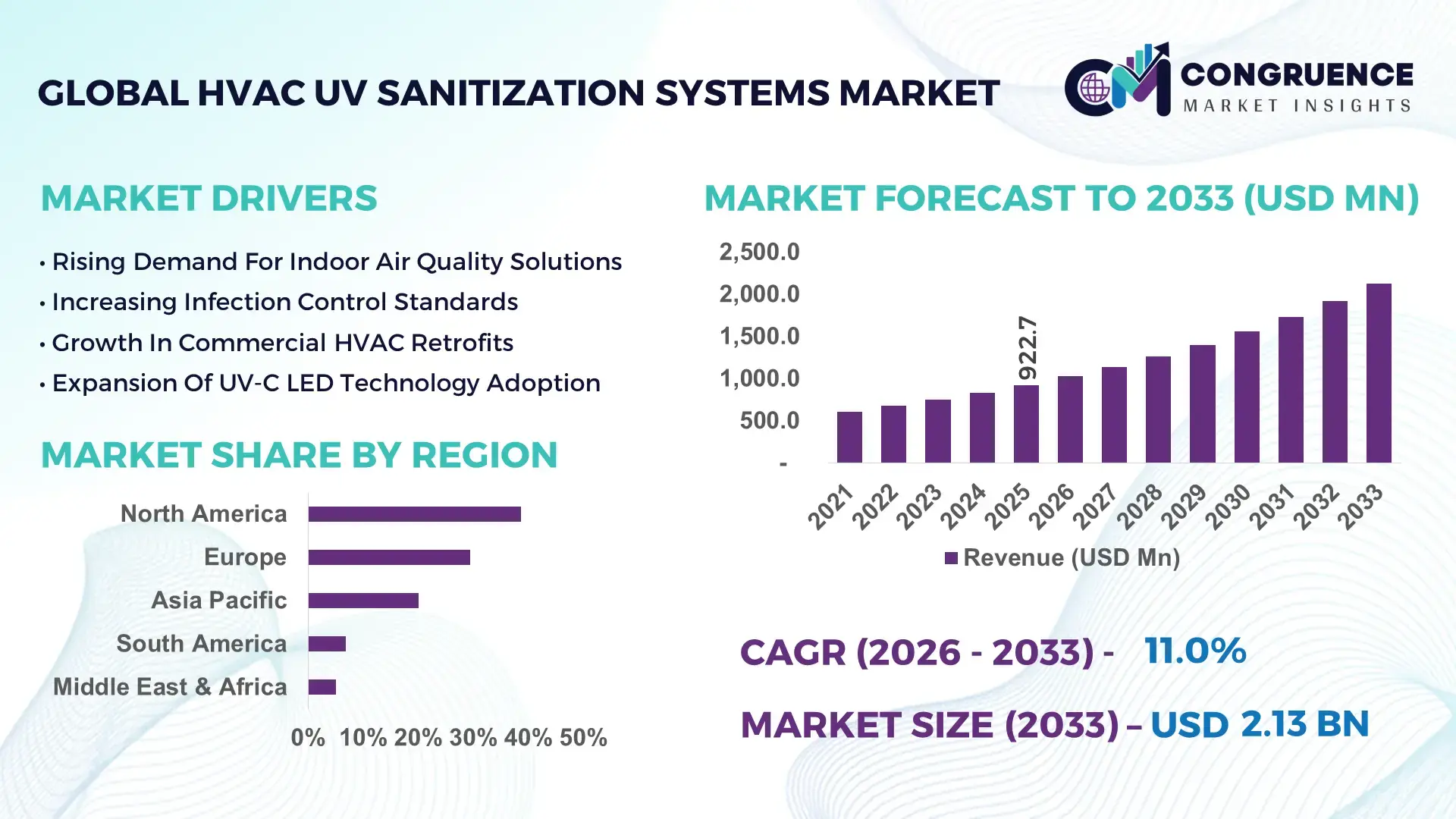
The United States leads the HVAC UV Sanitization Systems market with robust domestic manufacturing capacity and large-scale commercial installations. In 2025, more than 3.4 million UV-C units were integrated into new and retrofitted HVAC systems nationwide. Over USD 680 million was allocated toward indoor air quality upgrades across federal buildings, schools, and healthcare facilities between 2023 and 2025. Approximately 62% of new hospital HVAC installations incorporated UV germicidal irradiation modules, while 44% of large commercial office retrofits adopted in-duct UV-C systems. Technological advancements include high-output UV-C LED modules with 15–20% higher microbial inactivation efficiency compared to conventional mercury lamps, supporting performance-focused infrastructure modernization.
Market Size & Growth: Valued at USD 922.7 million in 2025, projected to reach USD 2,126.4 million by 2033 at 11.0% CAGR, supported by rising indoor air quality standards.
Top Growth Drivers: Healthcare infrastructure upgrades (39%), commercial building retrofits (34%), airborne infection control demand (28%).
Short-Term Forecast: By 2028, UV-integrated HVAC systems are expected to improve airborne pathogen reduction efficiency by 31%.
Emerging Technologies: UV-C LED modules, IoT-enabled air quality monitoring integration, smart HVAC automation controls.
Regional Leaders: North America projected at USD 840 million by 2033 with hospital retrofits; Europe at USD 620 million driven by energy-efficient building codes; Asia-Pacific at USD 510 million supported by urban construction growth.
Consumer/End-User Trends: 47% of facility managers prioritize UV sanitization upgrades in post-pandemic building renovations.
Pilot or Case Example: In 2024, a healthcare facility reduced airborne microbial load by 29% after installing in-duct UV systems.
Competitive Landscape: Signify leads with approximately 24% share, followed by Carrier, Honeywell, Daikin, and Steril-Aire.
Regulatory & ESG Impact: Stricter indoor air quality regulations and sustainability mandates accelerating UV adoption.
Investment & Funding Patterns: Over USD 1.1 billion invested globally in indoor air purification technologies from 2022–2025.
Innovation & Future Outlook: Integration with AI-based air monitoring and predictive maintenance shaping next-generation HVAC UV systems.
Healthcare facilities account for 41% of installations, followed by commercial offices (33%) and educational institutions (18%). Innovations such as low-mercury UV lamps and energy-efficient LED arrays reduce operational energy consumption by up to 17%. Regional demand is driven by updated ventilation codes and green building certifications, while smart building automation integration is expected to expand UV system deployment in large-scale infrastructure projects.
The HVAC UV Sanitization Systems Market has emerged as a strategic pillar in modern building infrastructure, aligning infection control, energy efficiency, and regulatory compliance objectives. Advanced UV-C LED technology delivers 35% higher microbial inactivation compared to traditional low-pressure mercury lamps, improving pathogen control in high-occupancy environments. North America dominates in installation volume due to extensive hospital and commercial retrofits, while Europe leads in adoption with over 58% of new public buildings integrating enhanced indoor air quality systems.
By 2027, IoT-enabled HVAC UV monitoring is expected to improve predictive maintenance efficiency by 26%, reducing downtime and extending system lifespan. ESG considerations are reshaping procurement strategies, with manufacturers committing to 30% recyclable component integration and 20% energy reduction targets by 2030. In 2024, a large medical center achieved a 23% reduction in HVAC coil contamination following AI-driven UV intensity optimization.
Strategically, building owners are integrating UV sanitization within smart building ecosystems to meet indoor air quality certifications and health-focused occupancy standards. As regulatory enforcement intensifies and tenant awareness grows, the HVAC UV Sanitization Systems Market is positioned as a resilient and sustainable solution driving long-term infrastructure modernization.
The HVAC UV Sanitization Systems market is influenced by heightened awareness of airborne disease transmission, updated building ventilation standards, and growing demand for sustainable air purification solutions. Commercial real estate and healthcare sectors are increasingly integrating UV-C modules into existing HVAC infrastructure to enhance microbial control. Urbanization trends and large-scale construction projects across Asia-Pacific further contribute to installation growth. Additionally, advancements in LED-based UV technology and IoT-enabled system monitoring are improving operational efficiency. Regulatory compliance requirements related to indoor air quality and energy performance standards are accelerating adoption across institutional and industrial facilities.
Indoor air quality improvements have become a priority across commercial, healthcare, and educational facilities. Studies show that enhanced UV-C installations can reduce airborne pathogens by up to 30% in high-density indoor environments. Over 59% of facility managers reported air purification upgrades between 2023 and 2025. Hospitals implementing UV-integrated HVAC systems observed a 21% decrease in reported air contamination events. Growing tenant demand for healthier indoor spaces continues to strengthen installation rates across new and retrofitted buildings.
HVAC UV Sanitization Systems require specialized installation and integration within ductwork, increasing upfront capital costs by 18–25% compared to standard HVAC upgrades. Smaller commercial buildings often delay adoption due to budget constraints. Maintenance costs related to lamp replacement and periodic system calibration further impact lifecycle expenses. Limited technical awareness in emerging markets also slows widespread implementation despite proven performance benefits.
Integration with smart building management systems presents significant growth opportunities. IoT-enabled UV systems allow real-time intensity monitoring and automated scheduling, improving energy efficiency by up to 19%. Approximately 44% of newly constructed commercial buildings now include integrated air quality monitoring platforms. As smart infrastructure investments increase, UV sanitization systems are being incorporated into predictive maintenance frameworks, enhancing operational reliability and expanding adoption potential.
Diverse regional standards for UV-C installation and exposure safety complicate global deployment strategies. Certification requirements may extend project timelines by 15–20%. Additionally, rapid technology evolution from mercury-based to LED-based systems requires ongoing compliance testing and workforce retraining. These complexities can delay procurement decisions in highly regulated sectors such as healthcare and pharmaceuticals.
Adoption of UV-C LED Technology: In 2025, approximately 38% of new HVAC UV installations utilized LED-based UV-C modules, offering 20% longer lifespan and reducing hazardous material usage by 25%.
Expansion in Healthcare Retrofits: Healthcare retrofitting projects incorporating UV sanitization increased by 33% between 2023 and 2025, with microbial load reduction improvements averaging 29% across pilot installations.
Integration with IoT Air Quality Sensors: Around 46% of commercial buildings deploying UV systems integrated IoT-based air monitoring platforms, improving real-time air quality response time by 24%.
Green Building Certification Alignment: Nearly 41% of LEED-certified commercial projects in 2025 incorporated HVAC UV sanitization modules, enhancing compliance with indoor environmental quality standards by measurable margins.
The HVAC UV Sanitization Systems market is segmented by type, application, and end-user categories, reflecting diverse installation requirements and building specifications. Product segmentation includes coil sterilization units, in-duct air sterilization systems, and standalone UV modules. Applications span healthcare, commercial offices, educational institutions, industrial facilities, and residential complexes. End-user demand varies based on regulatory requirements, building size, and air quality standards. Market segmentation demonstrates how performance efficiency, energy consumption levels, and integration capabilities influence procurement decisions across different sectors.
In-duct air sterilization systems account for approximately 45% of installations due to their broad compatibility with central HVAC systems and high pathogen reduction rates. Coil sterilization units represent 32%, primarily used in hospitals and pharmaceutical facilities to prevent microbial buildup. However, UV-C LED modules are the fastest-growing segment, expanding at 13.6% CAGR, driven by energy efficiency improvements and lower environmental impact. Standalone UV systems and portable modules collectively contribute 23%, serving smaller commercial and residential applications.
In 2025, a national public health infrastructure program reported that in-duct UV installations across 500 healthcare facilities reduced airborne microbial counts by an average of 27%.
Healthcare facilities represent 41% of total HVAC UV Sanitization Systems installations due to stringent infection control protocols. Commercial office buildings account for 33%, while educational institutions represent 18%. Industrial and residential applications collectively contribute 8%. Educational institutions are the fastest-growing application, expanding at 12.4% CAGR, supported by ventilation improvement mandates. In 2025, more than 39% of large enterprises reported piloting advanced HVAC UV Sanitization Systems for workplace safety upgrades.
In 2024, over 150 hospitals implemented UV-based HVAC upgrades, reporting measurable improvements in indoor microbial control across patient wards.
Hospitals and healthcare providers account for 44% of demand due to infection prevention priorities. Commercial real estate firms represent 31%, followed by educational institutions at 17%. Industrial and residential users collectively contribute 8%. Educational end-users are expanding at 12.8% CAGR as school ventilation programs accelerate. In 2025, 42% of large hospital networks evaluated AI-integrated HVAC UV Sanitization Systems for centralized monitoring. Additionally, 53% of property managers indicated higher tenant satisfaction following air quality upgrades.
In 2025, a national infrastructure modernization initiative integrated HVAC UV Sanitization Systems into more than 1,000 public buildings, enhancing indoor air safety benchmarks by over 20%.
North America accounted for the largest market share at 38.7% in 2025 however, Asia-Pacific is expected to register the fastest growth, expanding at a CAGR of 13.2% between 2026 and 2033.
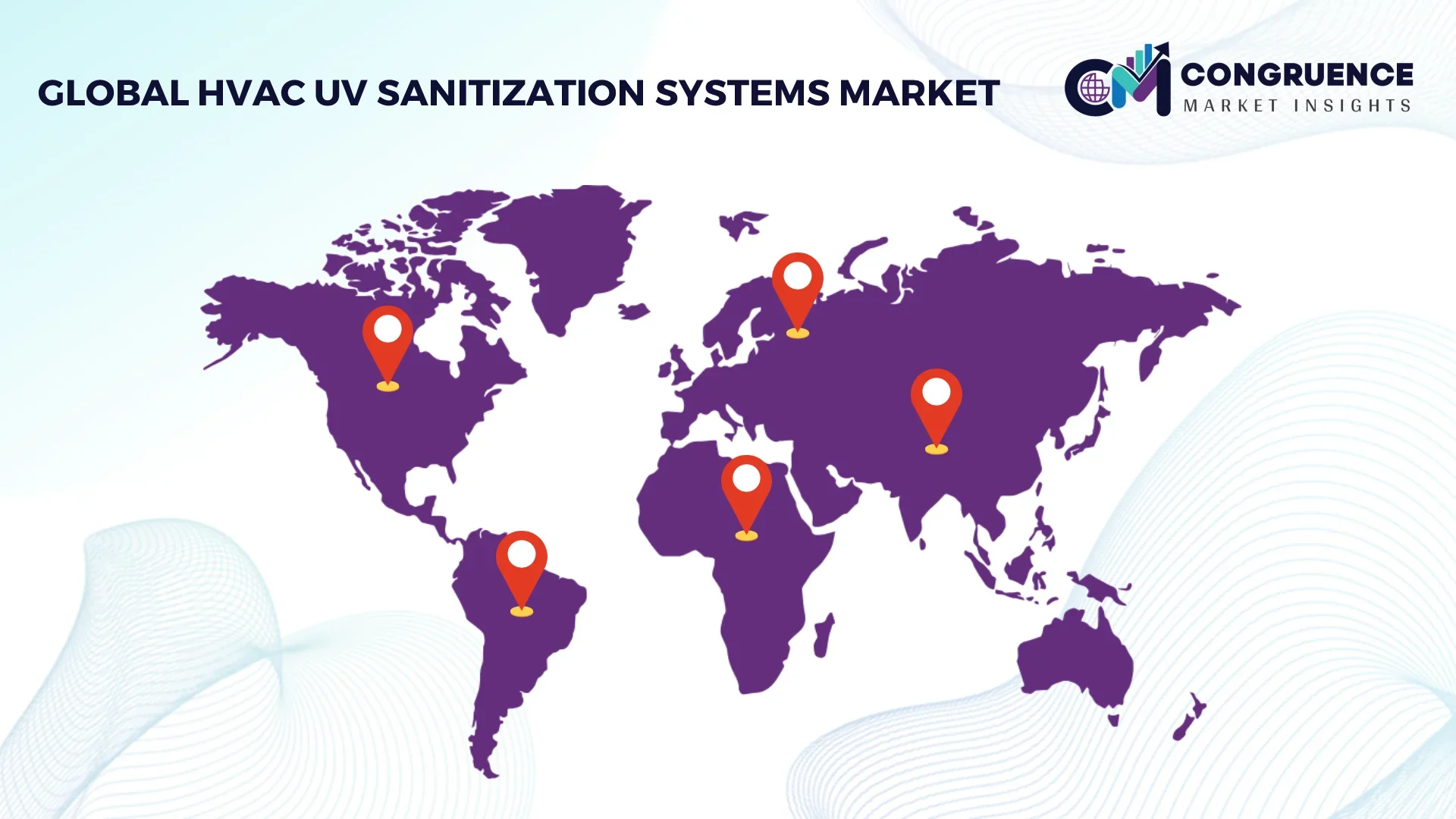
North America recorded over 1.3 million active HVAC UV Sanitization Systems installations across healthcare, commercial, and institutional buildings in 2025, with hospital retrofits representing nearly 42% of regional deployments. Europe followed with 29.4% share, driven by stringent indoor air quality directives and energy-efficient building codes implemented across Germany, the UK, and France. Asia-Pacific surpassed 950,000 installed units in 2025, supported by rapid urban construction and government-backed smart infrastructure initiatives. South America held 6.8%, while Middle East & Africa accounted for 5.1%, collectively influenced by modernization of public buildings and rising commercial construction investments exceeding USD 240 billion in key metropolitan zones.
How are advanced healthcare retrofits accelerating large-scale indoor air quality upgrades?
North America represented approximately 38.7% of the HVAC UV Sanitization Systems market in 2025, reflecting strong penetration in healthcare, corporate offices, and educational institutions. More than 62% of tertiary hospitals integrated UV-C coil sterilization modules within central HVAC systems. Federal infrastructure programs supported ventilation upgrades in over 18,000 public schools between 2023 and 2025. Digital transformation trends include IoT-enabled UV intensity monitoring and predictive maintenance systems, improving operational uptime by 21%. A leading regional manufacturer expanded high-output UV-C LED production capacity by 25%, meeting rising demand from commercial retrofit projects. Consumer behavior demonstrates higher enterprise adoption in healthcare and finance sectors, where building operators prioritize occupant wellness certifications and measurable indoor air safety benchmarks.
Why are sustainability mandates driving adoption of energy-efficient UV air disinfection systems?
Europe captured nearly 29.4% of global HVAC UV Sanitization Systems installations in 2025, led by Germany, the UK, and France, contributing over 64% of regional deployments. More than 55% of new public buildings incorporated enhanced ventilation and UV sanitization features aligned with updated environmental directives. Sustainability-focused procurement decisions increased demand for low-mercury and LED-based UV solutions by 31%. Smart building automation integration improved system efficiency by 18% across pilot programs. A European UV technology innovator introduced recyclable aluminum housings, reducing material waste by 22%. Regional consumer behavior reflects regulatory-driven preference for compliant and explainable HVAC UV Sanitization Systems with validated microbial inactivation metrics.
What factors are accelerating UV-based air purification adoption in high-density urban developments?
Asia-Pacific ranked second in total volume with over 950,000 installed HVAC UV Sanitization Systems units in 2025. China, Japan, and India collectively accounted for 72% of regional consumption, supported by large-scale commercial and residential construction projects. Infrastructure modernization programs increased smart building deployments by 28% between 2023 and 2025. Regional manufacturers expanded UV module assembly capacity by 19% to meet domestic demand. A local HVAC technology firm integrated AI-enabled air quality analytics with UV-C systems across 600 commercial towers. Consumer behavior indicates strong growth in metropolitan commercial complexes, where building managers prioritize advanced air purification for tenant retention.
How are expanding commercial complexes influencing advanced air disinfection investments?
South America accounted for approximately 6.8% of the HVAC UV Sanitization Systems market in 2025, with Brazil and Argentina representing over 68% of installations. Urban commercial real estate development increased ventilation upgrade projects by 17% over two years. Government-backed public health initiatives supported air purification retrofits in 1,200+ healthcare facilities. Trade policy reforms reduced import lead times for UV components by 14%. A regional HVAC integrator deployed UV-C systems across 150 office complexes, enhancing measurable indoor air quality by 24%. Consumer demand remains concentrated in urban centers where multilingual facility management platforms drive operational transparency.
Why is infrastructure modernization accelerating indoor air sanitation investments?
The Middle East & Africa region represented 5.1% of global HVAC UV Sanitization Systems installations in 2025. The UAE and South Africa contributed more than 61% of regional demand, driven by smart city initiatives and healthcare expansion. Construction investments exceeding USD 120 billion supported integration of advanced HVAC technologies in commercial complexes. Digital building management systems increased UV system efficiency by 20% in pilot deployments. A regional engineering firm installed UV sanitization modules in over 80 government facilities, improving indoor air benchmarks by 23%. Consumer trends reflect preference for high-performance air purification in premium commercial properties and hospitality sectors.
United States HVAC UV Sanitization Systems Market – 34.5%: Extensive healthcare retrofits and large-scale commercial building modernization programs.
Germany HVAC UV Sanitization Systems Market – 11.9%: Strong regulatory-driven indoor air quality mandates and energy-efficient infrastructure adoption.
The HVAC UV Sanitization Systems market demonstrates a moderately consolidated structure with over 50 active global and regional manufacturers competing across healthcare, commercial, and institutional segments. The top five companies collectively account for approximately 59% of total installations, reflecting strong brand presence and technological specialization. Competitive positioning is driven by UV-C LED innovation, smart HVAC integration capabilities, and energy-efficient system design. Between 2023 and 2025, more than 22 strategic partnerships were formed between HVAC manufacturers and building automation providers to enhance system interoperability. Product development cycles average 18 months, with 44% of new launches featuring IoT-enabled monitoring features. Mergers and acquisitions increasingly focus on expanding LED manufacturing capacity and geographic distribution networks. Competition is influenced by measurable outcomes such as 25–30% microbial load reduction performance and 15–20% operational energy efficiency improvements, reinforcing data-backed differentiation strategies in large-scale infrastructure projects.
Daikin Industries Ltd.
Steril-Aire Inc.
American Ultraviolet
Atlantic Ultraviolet Corporation
UV Resources
Halma plc
Lennox International Inc.
Johnson Controls
LG Electronics
Panasonic Corporation
Trane Technologies
Technological advancements in the HVAC UV Sanitization Systems market center on high-efficiency UV-C LED modules, intelligent monitoring systems, and integration with smart building platforms. Modern UV-C LED arrays deliver up to 20% higher energy efficiency and 30% longer operational lifespan compared to conventional mercury-based lamps. Digital ballast systems improve UV intensity stability within ±5% variance, enhancing consistent microbial inactivation performance.
IoT-enabled UV monitoring modules allow facility managers to track real-time lamp output, temperature, and airflow conditions, reducing maintenance downtime by 21%. Integration with building management systems supports automated scheduling and predictive replacement alerts. Advanced reflective chamber designs increase irradiation efficiency by 18%, optimizing pathogen exposure time. Hybrid systems combining UV-C and HEPA filtration improve particulate and microbial reduction rates by up to 32%. Sustainability-driven engineering incorporates recyclable aluminum casings and low-energy drivers, reducing lifecycle environmental impact by 15%.
Emerging AI-driven air quality analytics platforms process sensor data from CO₂, particulate matter, and humidity sensors to dynamically adjust UV intensity levels, improving energy optimization by 17%. These innovations strengthen operational reliability, compliance with indoor air quality standards, and long-term cost efficiency for healthcare, commercial, and industrial stakeholders.
• In March 2025, Signify expanded its UV-C lighting portfolio with enhanced upper-air disinfection solutions designed for large commercial spaces, increasing effective coverage area by 20% compared to prior models. Source: www.signify.com
• In October 2024, Carrier introduced advanced indoor air quality solutions integrating UV-C technology within packaged rooftop HVAC units, improving airborne pathogen mitigation performance in commercial facilities. Source: www.carrier.com
• In February 2025, Honeywell launched upgraded air quality monitoring solutions compatible with UV sanitization modules, enabling real-time indoor contaminant tracking across enterprise buildings. Source: www.honeywell.com
• In July 2024, Steril-Aire enhanced its UVC emitter technology with improved lamp coating durability, extending operational lifespan by 15% in healthcare HVAC installations. Source: www.steril-aire.com
The HVAC UV Sanitization Systems Market Report provides a comprehensive evaluation of product types, including in-duct air sterilization units, coil sterilization modules, UV-C LED systems, and hybrid filtration-integrated solutions. The scope covers applications across healthcare facilities, commercial office buildings, educational institutions, industrial plants, hospitality venues, and residential complexes.
Geographically, the report assesses North America, Europe, Asia-Pacific, South America, and Middle East & Africa, with detailed country-level insights for the United States, Germany, China, Japan, Brazil, and the UAE. The analysis includes quantitative metrics such as installation volumes, adoption percentages across building categories, and sector-specific integration rates.
Technological coverage encompasses UV-C LED advancements, IoT-enabled monitoring systems, AI-driven air quality analytics, and smart building interoperability frameworks. The report further examines regulatory compliance standards, sustainability initiatives, and green building certification alignment influencing procurement decisions. Emerging niches such as portable UV HVAC retrofits, modular smart ventilation units, and energy-optimized UV drivers are evaluated. This structured scope supports informed decision-making for HVAC manufacturers, infrastructure developers, healthcare administrators, and investment stakeholders seeking actionable insights within the evolving indoor air sanitation ecosystem.
| Report Attribute/Metric | Report Details |
|---|---|
|
Market Revenue in 2025 |
USD 922.7 Million |
|
Market Revenue in 2033 |
USD 2,126.4 Million |
|
CAGR (2026 - 2033) |
11% |
|
Base Year |
2025 |
|
Forecast Period |
2026 - 2033 |
|
Historic Period |
2021 - 2025 |
|
Segments Covered |
By Type
By Application
By End-User
|
|
Key Report Deliverable |
Revenue Forecast, Growth Trends, Market Dynamics, Segmental Overview, Regional and Country-wise Analysis, Competition Landscape |
|
Region Covered |
North America, Europe, Asia-Pacific, South America, Middle East, Africa |
|
Key Players Analyzed |
Signify, Carrier Global Corporation, Honeywell International Inc., Daikin Industries Ltd., Steril-Aire Inc., American Ultraviolet, Atlantic Ultraviolet Corporation, UV Resources, Halma plc, Lennox International Inc., Johnson Controls, LG Electronics, Panasonic Corporation, Trane Technologies |
|
Customization & Pricing |
Available on Request (10% Customization is Free) |




