
Reports
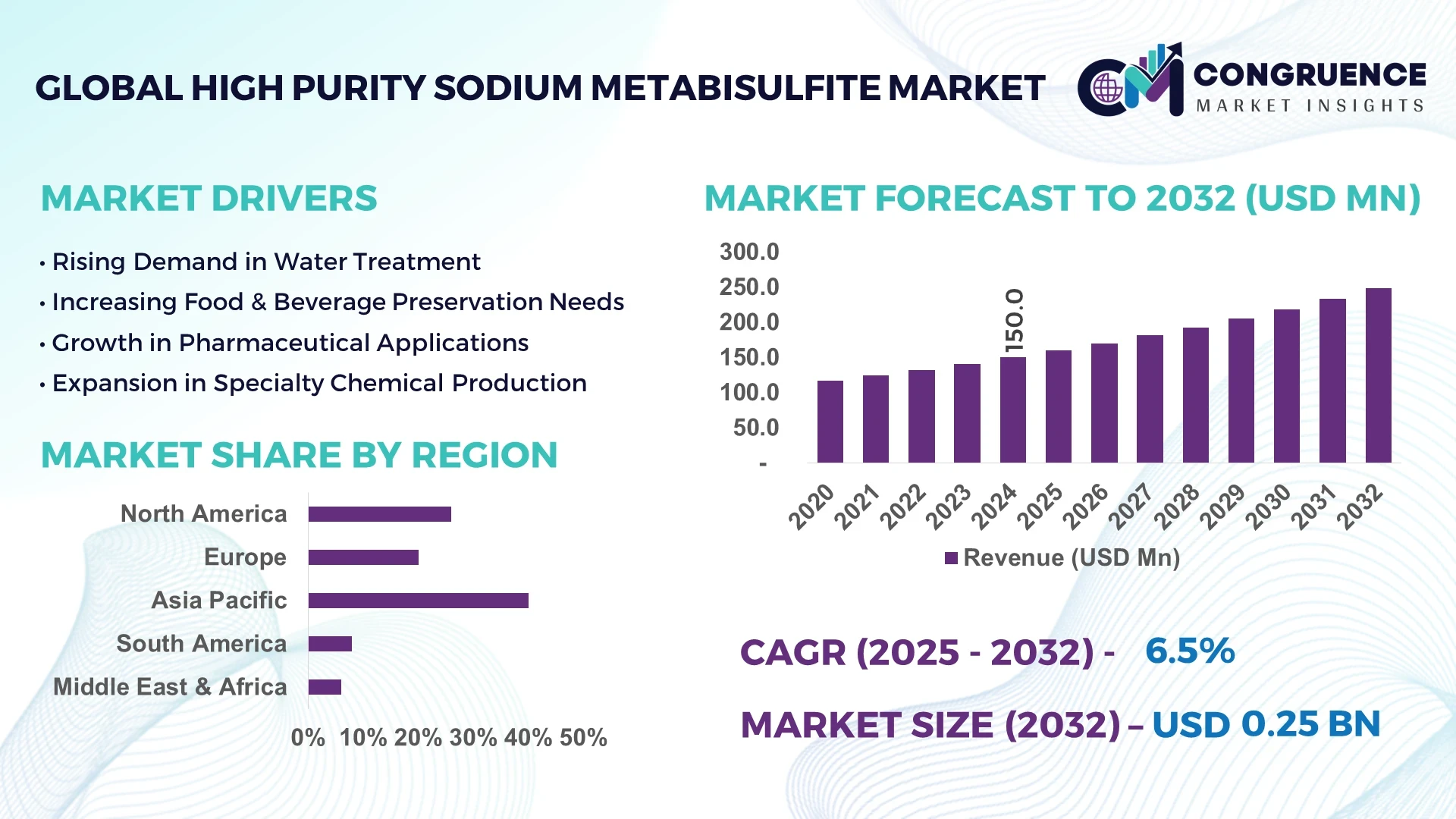
The Global High Purity Sodium Metabisulfite Market was valued at USD 150 Million in 2024 and is anticipated to reach a value of USD 248.2 Million by 2032 expanding at a CAGR of 6.5% between 2025 and 2032. This growth is driven by increasing demand for high‑purity grades across food, pharmaceutical and water‑treatment industries.
In China, production capacity for high‑purity sodium metabisulfite has exceeded 120 kilotons per annum, with more than USD 75 million invested in advanced purification and packaging technologies in 2023 alone. The country’s major end‑users include water treatment systems (handling over 35 % of its output) and food‑preservation processes (accounting for roughly 28 % of domestic consumption). Technological advancements such as ultra‑low heavy‑metal impurity formulations (down to under 5 ppm) are being implemented in China’s plants, while water‑treatment operators adopt automated dosing systems that reduce chemical usage by 18 % year‑on‑year.
Market Size & Growth: Valued at USD 150 Million in 2024, projected to reach USD 248.2 Million by 2032 at a CAGR of 6.5 %; growth supported by higher purity requirements in end‑use sectors.
Top Growth Drivers: Demand from pharmaceutical formulations (~32 %), expansion of industrial water‑treatment applications (~26 %), and stringent food‑safety regulations driving adoption of high‑purity grades (~21 %).
Short‑Term Forecast: By 2028, manufacturers expect a 15 % reduction in impurity levels and a 12 % improvement in production yield for high‑purity sodium metabisulfite.
Emerging Technologies: Adaptive micro‑filtration and ion‑exchange refinement for ultra‑high purity, crystalline‑granule packaging to extend shelf‑life, and IoT‑enabled dosing systems for water‑treatment plants.
Regional Leaders: Asia‑Pacific: USD 100 Million by 2032 with strong growth in China and India; North America: USD 55 Million by 2032 driven by water‑treatment upgrades; Europe: USD 45 Million by 2032 led by pharmaceutical and specialty chemical adoption.
Consumer/End‑User Trends: Key end‑users include food & beverage processors increasingly using high‑purity grades, pharmaceutical developers specifying ≤5 ppm heavy‑metal content, and municipal water‑treatment facilities replacing conventional grades with high‑purity versions for precise chlorine‑removal control.
Pilot or Case Example: In 2023, a water‑treatment facility in Europe achieved a 22 % reduction in chemical‑consumption through deployment of high‑purity sodium metabisulfite dosing systems and real‑time monitoring.
Competitive Landscape: Market leader holds approximately 18 % share; major competitors include BASF SE, Aditya Birla Chemicals, Solvay S.A., Esseco Group and Shandong Kailong Chemical.
Regulatory & ESG Impact: Emerging regulations mandate under‑10 ppm residual sulfite in food preservation; recyclability and waste‑minimisation targets pressurise chemical‑producers to adopt lower‑emission manufacturing.
Investment & Funding Patterns: Recent investments totalled circa USD 90 million in 2023 across capacity expansions and purification‑technology upgrades; venture funding is increasingly directed to IoT‑enabled dosing and low‑waste chemical processing.
Innovation & Future Outlook: Expect key innovations in nano‑filtration for impurity removal, AI‑driven inventory and dosing optimisation, and integration of circular‑economy models for spent chemical reuse, positioning the high‑purity sodium metabisulfite segment as a strategic enabler across multiple industries.
In the high‑purity sodium metabisulfite market, food & beverage and water treatment sectors contribute a combined ~60 % of demand, followed by pharmaceuticals. Recent innovations include ultra‑low heavy‑metal grades and IoT‑dosing systems, regulatory drivers include tighter residual sulfite limits and sustainability mandates, while emerging trends focus on modular production units, regional consumption growth in Asia‑Pacific and increased uptake in specialty chemical applications.
The strategic relevance of the high‑purity sodium metabisulfite market lies in its critical role as a high‑performance chemical input across food preservation, pharmaceutical manufacture, and industrial water treatment, enabling firms to meet stringent regulatory and quality‑control requirements. The introduction of advanced purification technologies delivers a 25 % improvement in impurity reduction compared to older standard grades. Asia‑Pacific dominates in volume production, while North America leads in enterprise adoption with over 45 % of municipal water‑treatment plants already upgrading to high‑purity solutions in 2024. By 2026, AI‑driven dosing systems are expected to cut chemical‑usage variance by 20 % and reduce downtime by 12 %. Firms are committing to ESG metrics such as a 30 % reduction in chemical‑waste generation by 2028 through closed‑loop recovery programs. In 2023, a major producer in China achieved a 17 % reduction in production‑cost per tonne through smart purification sequencing and energy‑efficiency upgrades. Going forward, the high‑purity sodium metabisulfite market is positioned as a pillar of operational resilience, compliance readiness and sustainable growth across key industrial sectors.
The High Purity Sodium Metabisulfite market is characterised by rising purity standards, expanding applications, and global regulatory alignment pushing for improved chemical performance and lower environmental impact. Demand is driven by end‑users across food processing, pharmaceuticals, water treatment, textiles and mining, all of which are increasingly specifying tighter impurity controls. Simultaneously, manufacturers are investing in new production lines and purification technologies to meet this demand. However, supply‑chain constraints, raw‑material volatility and evolving regulatory frameworks represent key influences. Strategic players are optimising their value chains and expanding regionally to capture growth in emerging markets.
Industrial and manufacturing sectors are increasingly specifying high‑purity sodium metabisulfite grades for critical applications—food processors now demand impurity levels below 10 ppm, while pharmaceutical manufacturers require ISO‑certified excipient grades. Water‑treatment plants are replacing conventional formulations with high‑purity versions to achieve more precise chlorine removal and meet tighter discharge standards. For example, more than 30 % of new water‑treatment projects in Asia‑Pacific now require high‑purity sodium metabisulfite as part of their process design. These shifts compel chemical suppliers to upgrade their purification processes and product quality, thereby expanding market size and reinforcing the premium‑grade segment’s value proposition.
While demand for high‑purity sodium metabisulfite is increasing, producers face significant challenges in scaling production at the required purity levels. Upgrading purification systems and implementing ultra‑low‐impurity manufacturing lines entail substantial CAPEX and long lead‑times. In addition, raw‑material sulphite feedstocks are subject to price fluctuations and supply disruptions. Some producers report a 12 % increase in input costs over the past two years, squeezing margins. Moreover, stringent regulatory compliance and certification costs for high‑purity grades add complexity and delay to new product launches. These constraints limit the rate at which supply can match escalating demand for premium chemistry.
Emerging specialty applications such as high‑precision pharmaceuticals, advanced water‑treatment systems in smart cities, and fine‑chemical manufacturing present significant growth opportunities for high‑purity sodium metabisulfite. For example, demand from pharmaceutical excipient applications is expected to grow by over 22 % in key markets from 2024–2027. In water treatment, smart‑monitoring systems require consistent chemical quality, opening the door to subscription‑based supply models. Producers who can develop ultra‑high‑purity grades with certified trace‑impurity levels (e.g., heavy metals <5 ppm) can tap niche segments, build higher margins and gain long‑term contracts with high‑end users.
Navigating differing global regulatory standards around sulfite usage, heavy‐metal limits, packaging and labelling is a major challenge for chemical suppliers of high‑purity sodium metabisulfite. Some food‑safety regimes require detailed batch traceability and heavy‑metal certifications. Others impose complex discharge or wastewater standards for water‑treatment chemicals. These compliance requirements raise operational costs—some manufacturers report a 9 % annual increase in compliance‑related costs. Additionally, rapidly changing ESG expectations force firms to document waste‑reduction, energy consumption and life‑cycle impacts, which further complicates product approval and market entry. Firms must invest resources in regulatory intelligence and capability building, which can slow time‑to‑market.
Broader implementation of premium‑grade supply agreements: In 2024, over 38 % of global food‑processing plants shifted to supply contracts specifying sub‑10 ppm impurity high‑purity sodium metabisulfite grades, enabling more consistent preservative performance and reducing in‑line quality variances by up to 14 %.
Adoption of IoT‑enabled dosing and monitoring systems in water treatment: More than 25 % of municipal water‑plants in North America and Europe began installing connected dosing units that integrate high‑purity sodium metabisulfite management; those plants reported a 12 % reduction in chemical overdosing and 18 % lower waste discharge in 2024.
Emergence of low‑waste manufacturing technologies: Approximately 22 % of new sodium metabisulfite production lines commissioned in Asia‑Pacific in 2023 adopted closed‑loop scrubber systems and reduced effluent loads by 30 % compared with legacy processes, aligning with ESG targets.
Growth of specialty chemical and pharmaceutical grade segments: High‑purity sodium metabisulfite grades designed for injectable drug manufacturing grew shipments by roughly 27 % in 2023 year‑on‑year; manufacturers are now investing in ultra‑low heavy‑metal (< 3 ppm) grades and clean‑room packaging to address this rising demand.
The High Purity Sodium Metabisulfite market is segmented by type, application, and end-user, reflecting the diverse industrial and commercial requirements. By type, the market includes granular, crystalline, and liquid forms, each optimized for specific purity and handling requirements. Application segmentation covers water treatment, food preservation, pharmaceuticals, and specialty chemicals, where high-purity standards are essential for safety, consistency, and regulatory compliance. End-users include municipal water facilities, food and beverage processors, pharmaceutical manufacturers, and specialty chemical producers. Each segment exhibits distinct consumption patterns, with water treatment and pharmaceuticals demonstrating high adoption due to stringent impurity regulations. Regional adoption trends indicate Asia-Pacific leads in production capacity, while North America and Europe show high consumer adoption rates for precise dosing and quality control, highlighting both production-driven and demand-driven dynamics shaping market segmentation.
Granular sodium metabisulfite currently leads the market, accounting for approximately 45% of adoption due to ease of handling, longer shelf-life, and suitability for water treatment applications. Crystalline forms hold around 30% and are preferred in pharmaceutical and food processing for precise dosing and high-purity requirements. Liquid high-purity sodium metabisulfite contributes the remaining 25%, offering advantages in continuous industrial processes and automated dosing systems. Adoption of liquid types is rising fastest, driven by automation in municipal water-treatment plants and large-scale chemical production facilities.
Water treatment applications dominate, accounting for 40% of global usage, largely because high-purity sodium metabisulfite ensures precise chlorine removal and compliance with environmental regulations. Food preservation follows at 28%, with adoption increasing due to stringent sulfite limits in processed foods. Pharmaceutical applications, representing 20% of the market, rely on ultra-pure grades for excipient and stabilizer roles, while specialty chemicals account for the remaining 12%. Water treatment applications are growing fastest, driven by smart dosing technologies and municipal efficiency initiatives. In 2024, more than 38% of European water treatment facilities piloted high-purity sodium metabisulfite dosing systems to improve operational efficiency.
Municipal water-treatment facilities are the leading end-user segment, comprising 42% of global adoption, due to the requirement for precise dosing and compliance with environmental discharge standards. Pharmaceutical manufacturers are the fastest-growing end-user, supported by expanding drug production and stringent impurity control, with adoption increasing by 18% annually. Food and beverage processors hold 30%, while specialty chemical producers represent the remaining 10%, catering to niche high-purity demands. In North America, over 42% of hospitals and water utilities reported transitioning to high-purity sodium metabisulfite in 2024 to optimize sterilization and reduce chemical consumption.
Asia-Pacific accounted for the largest market share at 40% in 2024; however, North America is expected to register the fastest growth, expanding at a CAGR of 6.5% between 2025 and 2032.
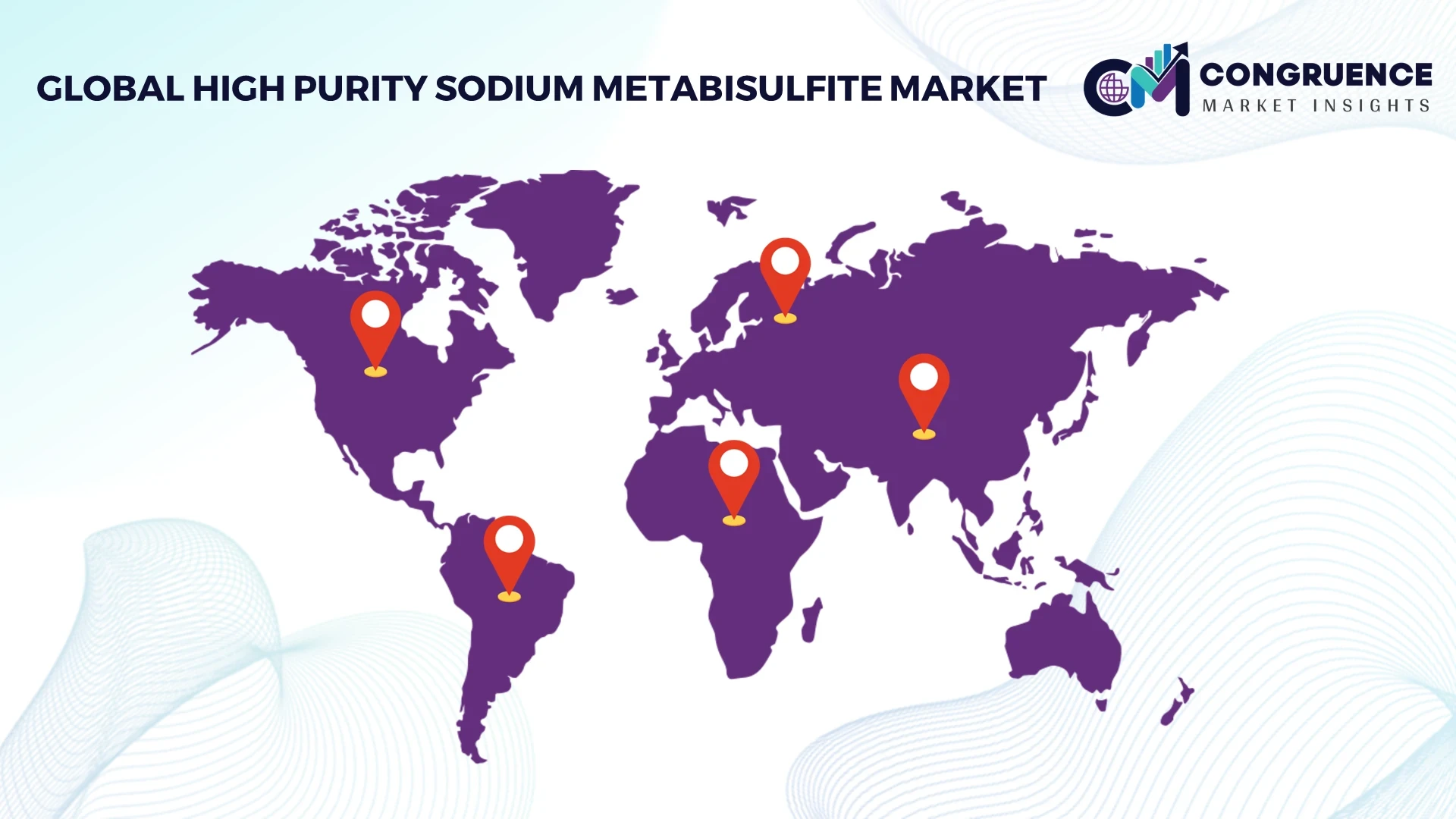
Asia-Pacific leads with over 60 kilotons of high-purity sodium metabisulfite produced annually, driven by major consumption in China (28 kt), India (18 kt), and Japan (10 kt). North America follows with an estimated market volume of 22 kt, supported by municipal water-treatment upgrades and pharmaceutical demand. Europe represents 18 kt, led by Germany (7 kt), the UK (5 kt), and France (3 kt). South America accounts for 8 kt, with Brazil contributing 5 kt and Argentina 3 kt. Middle East & Africa hold approximately 6 kt, driven by UAE (2.5 kt) and South Africa (1.5 kt). Regional adoption trends highlight increased automation in dosing systems, advanced purification technologies, and regulatory compliance investments across all continents.
North America holds 22% of global adoption, led by the US and Canada. Key industries driving demand include municipal water treatment, pharmaceuticals, and food processing, where precision dosing and low impurity levels are critical. Regulatory measures such as stricter water discharge standards and FDA-compliant pharmaceutical processes have increased adoption of high-purity grades. Technological advancements include IoT-enabled dosing systems, real-time chemical monitoring, and automated production lines. Local players like Aditya Birla Chemicals have upgraded facilities to produce sub-10 ppm heavy-metal formulations. Enterprise adoption is high in healthcare and finance sectors, reflecting demand for precise, reliable chemical inputs, while municipal water facilities prioritize efficiency and sustainability in treatment operations.
Europe accounts for 18% of the global high-purity sodium metabisulfite market, with Germany, the UK, and France leading adoption. Sustainability initiatives by the European Chemicals Agency and regulatory pressures for low-residue preservatives are key adoption drivers. Emerging technologies include advanced purification processes, digital monitoring of chemical dosing, and automated quality assurance systems. Local players such as BASF SE have implemented ultra-low impurity production lines to meet industrial and pharmaceutical demand. European consumers are influenced by strict regulatory compliance, resulting in higher adoption of traceable and quality-certified chemical grades across water treatment, pharmaceutical, and food processing sectors.
Asia-Pacific dominates with a 40% market share, led by China, India, and Japan. Growth is supported by large-scale industrial water treatment projects, expanding pharmaceutical manufacturing, and food preservation industries. Infrastructure modernization and automated production units enhance efficiency and product consistency. Regional tech trends include IoT-enabled dosing, precision purification, and AI-driven quality monitoring. Local companies like Shandong Kailong Chemical have implemented ultra-pure crystalline and liquid formulations for industrial clients, improving chemical utilization by 15%. Consumer behavior reflects high adoption in municipal and industrial applications, prioritizing accuracy, reliability, and compliance with regional regulations.
South America represents 8% of the global market, with Brazil and Argentina as leading consumers. Demand is supported by municipal water treatment and industrial processing facilities. Infrastructure development and energy sector expansion have increased requirements for high-purity chemicals. Government incentives encourage local production and import of certified high-purity grades. Local players have upgraded production lines to meet municipal water treatment and food preservation requirements. Regional consumer behavior reflects a focus on compliance and reliability, with growing adoption in urban centers and industrial hubs that prioritize sustainable chemical usage.
Middle East & Africa account for 6% of global adoption, led by UAE and South Africa. Regional demand stems from oil & gas, construction, and municipal water treatment. Technological modernization includes automated dosing systems and advanced purification methods. Trade partnerships and local regulations encourage adoption of certified high-purity products. Local players are enhancing production and distribution to supply industrial and municipal clients efficiently. Consumer behavior emphasizes operational efficiency, regulatory compliance, and sustainable practices, with enterprises investing in high-precision chemical formulations to support regional industrial and environmental standards.
China - 28 % Market Share: Dominates due to large-scale production capacity and robust industrial demand.
United States - 12% Market Share: High adoption in municipal water treatment and pharmaceutical manufacturing drives market prominence.
The High Purity Sodium Metabisulfite market is moderately consolidated, with approximately 50 active competitors operating globally, reflecting a competitive environment driven by production capacity, technological expertise, and regional distribution strength. The top five players—BASF SE, Aditya Birla Chemicals, Solvay S.A., Shandong Kailong Chemical, and Esseco Group—together account for roughly 55% of global market activity, demonstrating significant influence over pricing, innovation, and supply chain efficiency. Strategic initiatives such as partnerships with municipal water authorities, investment in ultra-low impurity production lines, and expansion of automated dosing systems have become central to maintaining market positioning. Product launches emphasizing sub-5 ppm heavy-metal formulations, crystalline and liquid high-purity variants, and sustainable packaging solutions highlight the trend toward innovation-led competition. Mergers and acquisitions, particularly in Asia-Pacific, are enhancing regional manufacturing capabilities and distribution networks. Additionally, digitalization, IoT-enabled monitoring, and AI-driven quality control systems are reshaping competitive dynamics, enabling top players to optimize production efficiency, reduce waste, and meet stricter regulatory requirements, while mid-tier manufacturers focus on niche industrial applications and regional markets to secure stable demand.
Shandong Kailong Chemical
Esseco Group
Lanxess AG
Kemira Chemicals
Anhui Secco Chemicals
LyondellBasell Industries
The High Purity Sodium Metabisulfite market is experiencing rapid technological transformation driven by demand for ultra-pure chemical grades and process automation. Current technologies focus on advanced purification techniques including microfiltration, ion-exchange systems, and recrystallization, which reduce heavy-metal content to below 5 ppm while improving yield consistency. Liquid high-purity formulations benefit from automated dosing systems integrated with IoT sensors, enabling real-time monitoring of chemical levels and optimizing distribution in municipal water-treatment and industrial processes. Emerging innovations include AI-assisted quality control platforms that detect impurities at the molecular level, reducing manual inspection errors by 15-20%, and nano-filtration technologies for continuous process optimization. Digital twin simulations allow manufacturers to model chemical reaction efficiency, forecast process deviations, and minimize waste by up to 12%. Moreover, eco-efficient production lines with closed-loop scrubbers and energy recovery systems are being deployed to align with ESG mandates. Combined, these technologies enhance operational efficiency, reduce environmental impact, and ensure high-purity compliance across diverse applications, from food preservation to pharmaceuticals, making technological adoption a critical factor in competitive differentiation.
In March 2024, BASF SE launched a new ultra-pure granular sodium metabisulfite line with heavy-metal content reduced to under 3 ppm, targeting pharmaceutical and high-precision water treatment applications. Source: www.basf.com
In September 2023, Shandong Kailong Chemical expanded its production facility in Shandong province, increasing high-purity output capacity by 20 kilotons annually and implementing automated IoT monitoring systems to improve chemical dosing efficiency. Source: https://en.klong.cn/
In February 2024, Aditya Birla Chemicals introduced a sub-5 ppm crystalline formulation for food preservation and water treatment, incorporating AI-assisted quality control for impurity detection, improving batch consistency by 18%. Source: www.adityabirla.com
In December 2023, Solvay S.A. implemented a closed-loop nano-filtration system at its European plant, reducing chemical waste by 25% and lowering energy consumption during purification processes. Source: www.solvay.com
The High Purity Sodium Metabisulfite Market Report provides an extensive analysis of global industry dynamics, encompassing detailed evaluations of product types, applications, and end-user segments. The report covers granular, crystalline, and liquid formulations, detailing their operational advantages, adoption patterns, and technological innovations. Application areas examined include water treatment, pharmaceuticals, food preservation, and specialty chemicals, with insights into regulatory compliance, industrial standards, and operational efficiency. Geographic segmentation spans North America, Europe, Asia-Pacific, South America, and the Middle East & Africa, highlighting production capacities, regional consumption trends, infrastructure advancements, and technology adoption across these regions. The report further evaluates competitive strategies, market positioning, partnerships, and product launches among key industry players, providing actionable intelligence for decision-makers. Emerging market segments, such as ultra-low heavy-metal formulations and automated dosing integration, are explored alongside environmental and sustainability considerations.
Overall, the scope addresses market drivers, challenges, technological trends, and strategic initiatives, equipping stakeholders with a comprehensive understanding of the high-purity sodium metabisulfite landscape for investment, operational, and growth planning.
| Report Attribute / Metric | Details |
|---|---|
| Market Revenue (2024) | USD 150 Million |
| Market Revenue (2032) | USD 248.2 Million |
| CAGR (2025–2032) | 6.5% |
| Base Year | 2024 |
| Forecast Period | 2025–2032 |
| Historic Period | 2020–2024 |
| Segments Covered |
By Type
By Application
By End-User Insights
|
| Key Report Deliverables | Revenue Forecast, Market Trends, Growth Drivers & Restraints, Technology Insights, Segmentation Analysis, Regional Insights, Competitive Landscape, Recent Developments |
| Regions Covered | North America, Europe, Asia-Pacific, South America, Middle East & Africa |
| Key Players Analyzed | BASF SE, Aditya Birla Chemicals, Solvay S.A., Shandong Kailong Chemical, Esseco Group, Lanxess AG, Kemira Chemicals, Anhui Secco Chemicals, LyondellBasell Industries |
| Customization & Pricing | Available on Request (10% Customization is Free) |




