
Reports
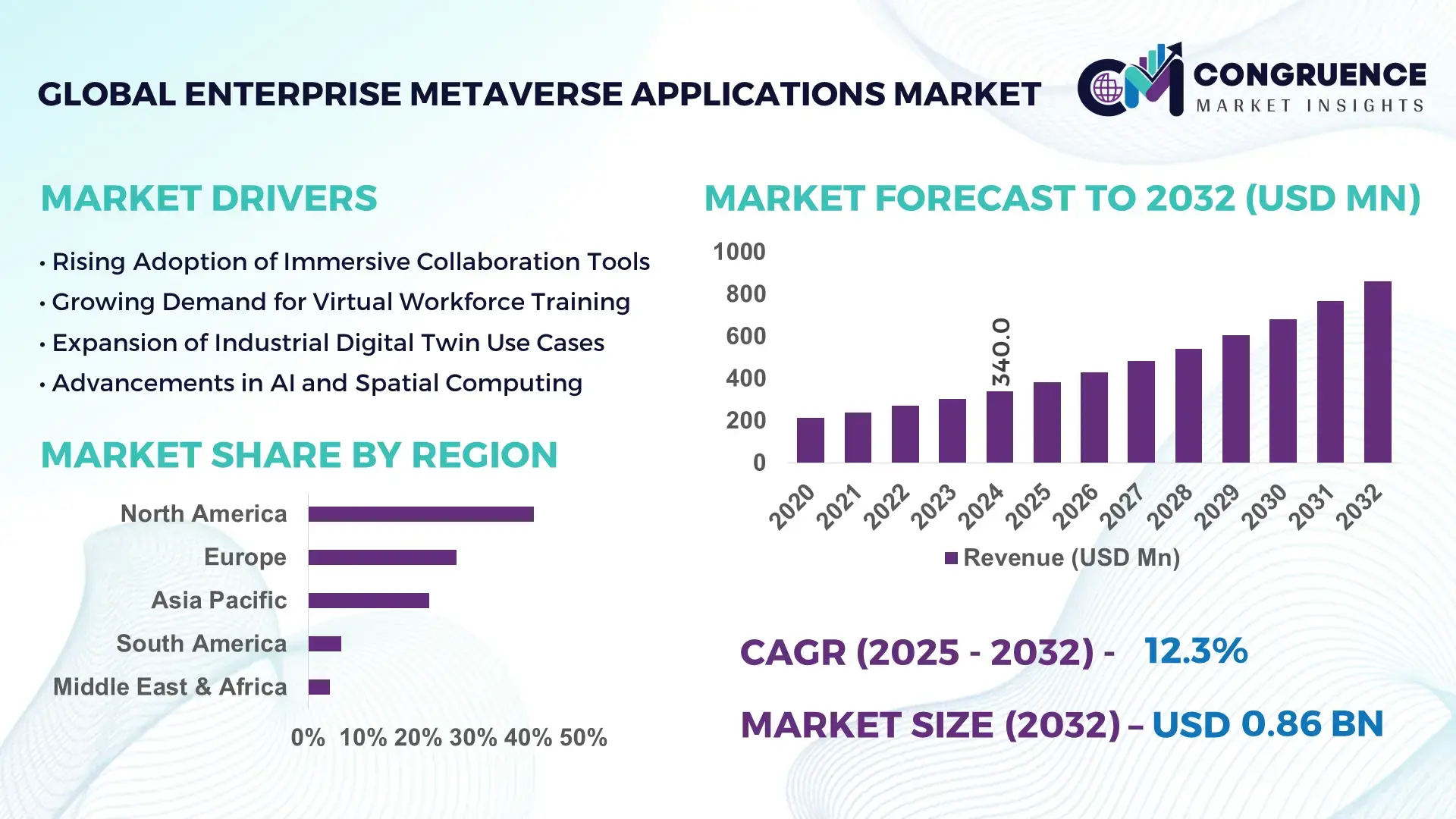
The Global Enterprise Metaverse Applications Market was valued at USD 340.0 Million in 2024 and is anticipated to reach a value of USD 860.0 Million by 2032 expanding at a CAGR of 12.30% between 2025 and 2032, according to an analysis by Congruence Market Insights. This growth is driven by accelerating enterprise demand for immersive collaboration platforms, digital twins, and AI-enabled virtual work environments that enhance operational efficiency and workforce productivity.
The United States represents the most influential country in the Enterprise Metaverse Applications Market, supported by advanced digital infrastructure and sustained enterprise technology investments. In 2024, U.S.-based enterprises accounted for over 48% of global enterprise XR software deployments, with more than USD 18 billion invested in immersive technologies across manufacturing, healthcare, defense, and BFSI sectors. Over 62% of Fortune 500 companies have initiated metaverse-enabled pilots for virtual training, simulation, or digital twin operations. The country hosts more than 55% of global enterprise-grade AR/VR platform developers, and over 70% of large U.S. enterprises report active use of cloud-integrated immersive collaboration tools, reflecting strong adoption depth across end-user industries.
Market Size & Growth: Valued at USD 340.0 Million in 2024, projected to reach USD 860.0 Million by 2032, expanding at a CAGR of 12.30%, driven by enterprise digital transformation and immersive collaboration demand.
Top Growth Drivers: Remote workforce adoption (42%), digital twin utilization (36%), immersive training efficiency gains (29%).
Short-Term Forecast: By 2028, enterprise metaverse deployments are expected to improve operational efficiency by approximately 25%.
Emerging Technologies: AI-driven digital twins, spatial computing platforms, blockchain-based identity management.
Regional Leaders: North America (USD 320 Million by 2032) with industrial simulations; Europe (USD 240 Million) with compliance-driven adoption; Asia Pacific (USD 210 Million) with manufacturing-focused virtualization.
Consumer/End-User Trends: Manufacturing, BFSI, and healthcare enterprises account for over 60% of enterprise metaverse usage.
Pilot or Case Example: In 2023, a U.S. aerospace firm reduced training downtime by 38% using immersive simulation platforms.
Competitive Landscape: Meta Platforms leads with ~18% share, followed by Microsoft, NVIDIA, Unity Technologies, and Siemens.
Regulatory & ESG Impact: Digital workplace and data governance frameworks are accelerating compliant virtual collaboration adoption.
Investment & Funding Patterns: Over USD 6.5 Billion invested globally in enterprise metaverse platforms during 2022–2024.
Innovation & Future Outlook: Integration of generative AI with immersive platforms is shaping next-generation enterprise workflows.
Enterprise metaverse applications are increasingly deployed across manufacturing (31%), BFSI (18%), healthcare (15%), and energy sectors. Advances in spatial AI, real-time rendering, and cloud-native XR platforms are accelerating deployment scalability. Regulatory focus on data security and carbon-efficient digital operations is influencing adoption, while Asia Pacific is emerging as a high-growth consumption region driven by industrial digitalization and smart factory initiatives.
The Enterprise Metaverse Applications Market is becoming strategically vital as organizations seek resilient, scalable, and data-driven operating models. Enterprises are leveraging immersive platforms to unify remote collaboration, simulation, and real-time decision-making across distributed environments. Spatial computing combined with AI-powered digital twins delivers up to 32% improvement in asset utilization compared to traditional 2D monitoring dashboards. While North America dominates in deployment volume, Europe leads in structured adoption, with over 54% of large enterprises integrating metaverse tools into regulated workflows.
By 2027, AI-enabled immersive analytics are expected to cut enterprise training costs by nearly 30% while improving skill retention rates by over 40%. Firms are also aligning enterprise metaverse deployments with ESG commitments, targeting reductions such as 25% lower travel-related emissions by 2030 through virtual collaboration. In 2024, a German automotive manufacturer achieved a 28% reduction in production errors using real-time digital twin simulations within a metaverse environment. Looking ahead, the Enterprise Metaverse Applications Market is positioned as a foundational pillar for operational resilience, regulatory compliance, and sustainable digital growth across global enterprises.
The Enterprise Metaverse Applications Market is shaped by rapid digitalization, evolving workforce models, and increasing reliance on immersive data visualization. Enterprises are integrating metaverse platforms with cloud, IoT, and AI systems to enhance operational transparency and decision accuracy. Demand is influenced by the need for secure virtual collaboration, advanced training simulations, and predictive maintenance environments. Industry adoption is further supported by declining XR hardware costs and expanding 5G connectivity, enabling scalable enterprise-grade deployments across multiple sectors.
Enterprises are increasingly adopting immersive training environments to address skill gaps and improve workforce efficiency. Studies indicate that VR-based training improves knowledge retention by up to 75% compared to traditional classroom methods. In high-risk industries such as manufacturing and energy, immersive simulations reduce workplace incidents by nearly 30%, driving sustained demand for enterprise metaverse applications.
Despite growing adoption, enterprises face challenges integrating metaverse platforms with legacy IT systems. Over 46% of enterprises report concerns related to data privacy, identity management, and interoperability across platforms. Compliance requirements in regulated industries further slow deployment timelines, limiting near-term scalability.
The expansion of industrial digital twins presents significant opportunities for enterprise metaverse platforms. Digital twin-enabled enterprises report up to 35% improvement in predictive maintenance accuracy and 20% reduction in unplanned downtime. As smart factories expand globally, demand for immersive simulation environments is expected to accelerate.
Enterprise-grade metaverse deployment requires substantial upfront investment in XR hardware, software integration, and cybersecurity. Approximately 41% of mid-sized enterprises cite capital expenditure constraints as a primary challenge, particularly in emerging markets where IT budgets remain limited.
Expansion of Digital Twin-Driven Operations: Over 58% of large manufacturing enterprises now use metaverse-enabled digital twins, achieving 27% improvement in asset monitoring accuracy and 22% faster decision cycles.
Growth in Immersive Remote Collaboration: More than 64% of global enterprises report using immersive virtual workspaces, reducing cross-border travel by 35% and accelerating project timelines by 18%.
AI Integration in Spatial Analytics: AI-powered metaverse platforms deliver up to 33% faster anomaly detection in industrial environments, with adoption rising across energy and utilities sectors.
Enterprise Training Virtualization: Immersive training adoption has increased by 46%, with enterprises reporting 40% lower onboarding time and 28% higher employee performance metrics.
The Enterprise Metaverse Applications Market is segmented based on type, application, and end-user, reflecting the diverse ways immersive technologies are being deployed across enterprise environments. By type, the market spans virtual reality–centric platforms, augmented reality solutions, mixed reality environments, and digital twin–enabled metaverse systems, each supporting different enterprise objectives. Application-wise, adoption ranges from immersive training and virtual collaboration to industrial simulation, customer engagement, and real-time operational monitoring. End-user segmentation highlights strong uptake among large enterprises, manufacturing organizations, BFSI institutions, healthcare providers, and technology-intensive SMEs. Segmentation trends indicate that enterprises increasingly favor integrated, AI-enabled platforms capable of supporting multiple use cases rather than standalone immersive tools. Adoption intensity varies by industry maturity, regulatory environment, and digital infrastructure readiness, with higher penetration in sectors requiring complex visualization, safety-critical training, and distributed workforce coordination.
The Enterprise Metaverse Applications Market by type includes Virtual Reality (VR) platforms, Augmented Reality (AR) applications, Mixed Reality (MR) solutions, Digital Twin–based metaverse platforms, and AI-integrated immersive environments. VR-based enterprise platforms currently account for approximately 38% of total adoption, driven by their widespread use in immersive training, safety simulations, and virtual collaboration environments. Enterprises report up to 45% improvement in training retention through VR-enabled learning modules, reinforcing its leading position. AR solutions represent nearly 27% of adoption, particularly in field service, maintenance, and remote assistance use cases, where overlaying real-time data improves task accuracy by over 30%. However, digital twin–enabled metaverse platforms are the fastest-growing type, expanding at an estimated 15.8% CAGR, fueled by demand for real-time asset visualization, predictive maintenance, and scenario modeling in manufacturing and energy sectors. These platforms enable up to 25% reduction in unplanned downtime. Mixed reality and AI-integrated immersive platforms collectively account for the remaining 35% share, serving niche but expanding roles in advanced design collaboration, autonomous operations testing, and complex systems integration.
By application, the market encompasses immersive training and workforce enablement, virtual collaboration and remote workspaces, industrial simulation and digital twins, customer experience and virtual engagement, and enterprise data visualization. Immersive training is the leading application, accounting for approximately 34% of enterprise adoption, as organizations increasingly replace physical training setups with virtual environments that reduce safety risks and lower training time by nearly 40%. Virtual collaboration platforms hold around 26% share, supporting distributed teams with persistent virtual workspaces and 3D data interaction. Industrial simulation and digital twin applications are the fastest-growing, expanding at an estimated 16.2% CAGR, driven by Industry 4.0 initiatives and smart factory deployments. These applications enable predictive modeling that improves production efficiency by 20–28%. Customer experience and virtual engagement, along with advanced enterprise visualization tools, together represent about 40% of adoption, particularly in BFSI, retail, and technology services. In 2024, over 41% of global enterprises reported piloting metaverse-based collaboration or simulation tools for internal operations.
End-user segmentation shows large enterprises as the dominant adopters, accounting for approximately 46% of total usage, supported by higher IT budgets, complex operational needs, and existing digital infrastructure. Manufacturing enterprises alone contribute nearly 28% of end-user adoption, leveraging metaverse platforms for production simulation, workforce training, and digital twin integration. BFSI and healthcare together represent around 24%, using immersive environments for compliance training, customer onboarding, and clinical simulation. SMEs are the fastest-growing end-user segment, expanding at an estimated 14.6% CAGR, driven by increasing availability of cloud-based, subscription-driven metaverse platforms that lower entry barriers. Technology and professional services SMEs report productivity gains of 18–25% from immersive collaboration tools. Public sector, education, and energy utilities collectively account for the remaining 30% share, with adoption focused on infrastructure planning, safety training, and operational resilience. In 2024, more than 39% of enterprises globally reported active or pilot use of enterprise metaverse applications for internal collaboration.
North America accounted for the largest market share at 41% in 2024; however, Asia-Pacific is expected to register the fastest growth, expanding at a CAGR of 15.5% between 2025 and 2032.
North America’s leadership is supported by high enterprise digital maturity, with over 62% of large organizations deploying immersive collaboration or simulation platforms. Europe followed with approximately 27% share, driven by regulated industry adoption and sustainability-linked digital investments. Asia-Pacific held close to 22% share in 2024, but enterprise deployment volumes are accelerating rapidly, supported by large-scale manufacturing digitization and smart city programs. South America and the Middle East & Africa collectively accounted for the remaining 10%, with adoption concentrated in media, energy, construction, and public-sector modernization. Across regions, enterprise use cases increasingly emphasize immersive training, digital twins, and AI-enabled virtual collaboration, with deployment intensity closely linked to cloud penetration, 5G availability, and government-backed digital transformation initiatives.
North America represents the most established regional market, accounting for approximately 41% of global enterprise metaverse application adoption in 2024. Demand is led by manufacturing, healthcare, BFSI, aerospace, and technology services, which together contribute over 65% of regional deployments. Government-backed digital workforce initiatives and defense simulation programs continue to support adoption, while evolving data governance frameworks encourage secure enterprise-grade platforms. Technological advancement is evident in the widespread integration of AI-driven digital twins and cloud-native XR platforms, with more than 58% of large enterprises using immersive tools for training or simulation. Regional players such as Microsoft are expanding enterprise metaverse ecosystems by embedding immersive collaboration and spatial computing into productivity platforms. Enterprise behavior shows higher adoption in healthcare and finance, where virtual training and secure collaboration environments are prioritized.
Europe accounts for roughly 27% of the Enterprise Metaverse Applications Market, with Germany, the UK, and France representing over 60% of regional demand. Adoption is driven by automotive manufacturing, industrial engineering, healthcare, and public infrastructure planning. Regulatory bodies emphasize data protection, interoperability, and digital sovereignty, shaping demand for compliant and explainable immersive platforms. Sustainability initiatives linked to carbon reduction are accelerating virtual collaboration, with enterprises reporting 30% lower business travel volumes through immersive workspaces. European technology firms and industrial solution providers are integrating digital twin–based metaverse environments into smart factory and energy transition projects. Consumer behavior reflects strong regulatory influence, with enterprises prioritizing transparent, auditable immersive systems over experimental deployments.
Asia-Pacific ranks third by current share at approximately 22%, but leads global expansion momentum by deployment volume growth. China, Japan, and India collectively account for over 70% of regional enterprise metaverse usage, driven by manufacturing, electronics, logistics, and smart infrastructure programs. High-capacity 5G networks and dense manufacturing ecosystems support large-scale immersive simulations and digital twin rollouts. Innovation hubs in Shenzhen, Tokyo, Bengaluru, and Seoul are advancing AI-integrated XR platforms for enterprise use. Regional technology firms are developing cost-efficient, cloud-based immersive solutions tailored for SMEs. Enterprise behavior shows growth driven by e-commerce integration, mobile-first platforms, and workforce upskilling initiatives across industrial clusters.
South America holds close to 6% of the global market, with Brazil and Argentina representing the majority of regional enterprise adoption. Key drivers include media production, corporate training, energy, and infrastructure planning. Governments are supporting digital skills development and innovation hubs to improve enterprise competitiveness. Adoption remains selective, but immersive training platforms are increasingly used to address workforce shortages, improving training efficiency by over 20% in pilot programs. Regional technology firms and telecom providers are partnering to deliver localized immersive content. Enterprise behavior highlights demand tied to media applications, language localization, and virtual engagement tools tailored to regional audiences.
The Middle East & Africa region accounts for approximately 4% of global adoption, with the UAE and South Africa leading enterprise deployments. Demand is concentrated in oil & gas, construction, infrastructure planning, and public-sector modernization. National digital transformation agendas and smart city programs are driving immersive platform pilots for simulation and workforce training. Technological modernization includes increased adoption of cloud-based XR and digital twin solutions for large-scale projects. Regional enterprises show growing interest in virtual collaboration to reduce project delays and travel costs. Consumer behavior varies, with higher uptake in capital-intensive industries and government-backed initiatives.
United States – 34% Market Share: Strong enterprise technology investment, advanced digital infrastructure, and high adoption across manufacturing, healthcare, and BFSI sectors.
China – 18% Market Share: Large-scale industrial digitization, smart manufacturing initiatives, and rapid deployment of immersive enterprise platforms across production ecosystems.
The competitive environment of the Enterprise Metaverse Applications Market is both dynamic and moderately consolidated, with a broad mix of established technology heavyweights and specialized immersive-tech innovators competing to shape enterprise adoption. There are 30+ active competitors globally, ranging from platform providers and XR hardware makers to digital twin specialists and enterprise software integrators. The market’s structure is moderately consolidated at the top, with the combined share of the top 5 companies around 42–48%, leaving significant room for mid-tier and niche firms to influence innovation and vertical specialization.
Leading players deploy distinct competitive strategies including strategic partnerships, mergers & acquisitions, and product expansions to strengthen their enterprise metaverse portfolios. For example, Microsoft has embedded mixed-reality and immersive collaboration tools into mainstream enterprise productivity platforms such as Teams, enhancing remote work and simulation use cases. Meta Platforms, through its Reality Labs division, consistently iterates on VR hardware (e.g., Quest headsets) and collaboration software, despite recent strategic shifts refocusing resources toward AI-infused hardware and wearables. Unity Technologies and Epic Games lead in developer tools, powering over 50% of creator projects and enabling interoperable content across enterprise simulations and virtual collaboration environments. NVIDIA’s Omniverse platform anchors industrial digital twin and real-time simulation offerings for engineering and manufacturing contexts, while Roblox extends into enterprise training and virtual commerce with dedicated enterprise features.
The competitive landscape is further marked by rapid product launch cycles, cross-sector partnerships, and innovation trends such as AI-augmented digital twins, cloud roll-outs of metaverse platforms, and interoperability frameworks that enhance enterprise utility and deployment flexibility. This robust competitive activity underscores the market’s strategic importance and rapid technological evolution.
Unity Technologies
Epic Games
Roblox Corporation
Apple Inc.
Siemens AG
Verofax
Tech Mahindra Ltd
Infosys
Wipro Ltd
The Enterprise Metaverse Applications Market is driven by a constellation of current and emerging technologies that collectively enhance immersive experiences, operational efficiency, and cross-enterprise collaboration. A core pillar of technology impact is extended reality (XR) — encompassing virtual reality (VR), augmented reality (AR), and mixed reality (MR) — which enables fully immersive training environments, remote collaboration spaces, and interactive simulation workflows tailored for enterprise use. XR penetration has risen with improved headset comfort, greater resolution, and lower latency, facilitating enterprise workflows that mimic real-world interactions on a digital plane.
Digital twin technology plays a transformative role by creating virtual replicas of physical assets, processes, or environments. These twin models support real-time monitoring, predictive modeling, scenario testing, and cross-functional decision support, particularly in manufacturing, logistics, and energy sectors. By integrating IoT sensor data with 3D simulation layers, enterprises can visualize performance metrics and anticipate operational risks before they occur.
Artificial intelligence (AI) adds another dimension by empowering automation and intelligent insights within metaverse platforms. AI drives spatial contextualization, facilitates natural language interactions within virtual environments, and delivers adaptive learning pathways in simulation modules. AI also supports procedural content generation, enabling immersive world construction and personalized training modules without heavy manual design overheads.
The cloud and edge computing convergence underpins scalable deployment of metaverse solutions. Cloud infrastructure delivers persistent virtual worlds with global access, while edge computing reduces latency for real-time interaction, crucial for industrial simulations and geographically distributed teams. The advent of standards like OpenUSD enhances interoperability across platforms and drives integration of diverse metaverse ecosystems.
Human-computer interface innovations — including gesture tracking, haptic feedback, and eye-tracking — are enhancing user experience and task precision in enterprise contexts. These interfaces improve collaboration effectiveness, reduce cognitive load, and allow intuitive interaction with complex data visualizations.
Overall, these technologies are not siloed; they converge to form composite enterprise metaverse platforms that enable dynamic workflows, intelligence-driven insights, and scalable digital environments that mirror and augment real-world operations. Decision-makers are increasingly prioritizing solutions that integrate these technological vectors to enhance productivity, workforce engagement, and strategic digital transformation.
In January 2024, Microsoft Mesh for Teams became generally available in Microsoft Teams, enabling organizations to conduct 3D immersive meetings with avatar-based virtual environments within Teams. Enterprises such as Accenture, BP, Takeda, and Mercy Ships were highlighted as early adopters leveraging this capability for hybrid collaboration, onboarding, and immersive engagement. Source: www.microsoft.com
In 2025, Microsoft retired the standalone Microsoft Mesh platform and shifted its immersive 3D meeting capabilities directly into Teams using a new “Immersive events” feature. As of December 1, 2025, the standalone Mesh applications and web portal were decommissioned and replaced by Teams’ native immersive experiences including 3D avatar interaction and customizable 3D event environments. Source: www.microsoft.com
In March 2024, NVIDIA announced the availability of Omniverse Cloud APIs, expanding the Omniverse platform’s reach into enterprise workflows for industrial digital twins and simulation. The new Omniverse Cloud APIs enable developers and enterprise software makers to integrate Omniverse real-time collaboration and 3D simulation capabilities directly into design, automation, and digital twin applications. Source: www.nvidia.com
In 2025, Roblox expanded its global accessibility by launching on two new native platforms, including the Samsung Galaxy Store and the Xbox Ally handheld devices. This expansion broadens enterprise and consumer access to Roblox-based immersive experiences, enabling enterprises and creators to deliver 3D environments across a wider range of devices. Source: www.corp.roblox.com
The Enterprise Metaverse Applications Market Report provides a comprehensive assessment of immersive digital technologies enabling enterprise transformation across industries. It encompasses segmentation by type (e.g., VR platforms, AR solutions, mixed reality environments, digital twins, and AI-augmented metaverse ecosystems), mapping product capabilities and deployment patterns for enterprise use. The report covers a broad range of applications including immersive training and workforce enablement, virtual collaboration and remote workspaces, industrial simulation, customer experience and engagement tools, and enterprise data visualization systems.
Geographically, the report spans key regions — North America, Europe, Asia-Pacific, South America, and Middle East & Africa — detailing regional adoption behaviors, infrastructure readiness, regulatory influences, and consumer patterns that shape deployment strategies. Each region’s analysis includes market share distribution, technology uptake rates, enterprise priorities, and infrastructure conditions such as cloud/5G penetration and workforce digital skill profiles.
Industry focus areas include manufacturing, healthcare, BFSI, technology services, energy, and public services, emphasizing how immersive environments address sector-specific needs like safety training, simulation, complex operational planning, and virtual customer engagement. The report also highlights niche segments such as mobile-first metaverse adoption, scalability frameworks for SMEs, and cross-industry interoperability ecosystems.
Technology insights emphasize the convergence of XR, AI, cloud/edge computing, digital twins, and advanced interfaces that elevate enterprise workflows. The scope captures innovation trends, interoperability initiatives (e.g., OpenUSD frameworks), and evolving enterprise architectures that support persistent virtual work environments. Additionally, the report examines the competitive landscape, strategic partnerships, and technology adoption roadmaps, assisting decision-makers in aligning investment, operational, and innovation priorities within the enterprise metaverse ecosystem.
| Report Attribute / Metric | Details |
|---|---|
| Market Revenue (2024) | USD 340.0 Million |
| Market Revenue (2032) | USD 860.0 Million |
| CAGR (2025–2032) | 12.30% |
| Base Year | 2024 |
| Forecast Period | 2025–2032 |
| Historic Period | 2020–2024 |
| Segments Covered |
By Type
By Application
By End-User Insights
|
| Key Report Deliverables | Revenue Forecast, Market Trends, Growth Drivers & Restraints, Technology Insights, Segmentation Analysis, Regional Insights, Competitive Landscape, Regulatory Overview, Recent Developments |
| Regions Covered | North America, Europe, Asia-Pacific, South America, Middle East & Africa |
| Key Players Analyzed | Microsoft Corporation; Meta Platforms, Inc.; NVIDIA Corporation; Unity Technologies; Epic Games; Roblox Corporation; Apple Inc.; Siemens AG; Verofax; Tech Mahindra Ltd.; Infosys Limited; Wipro Limited |
| Customization & Pricing | Available on Request (10% Customization Free) |




