
Reports
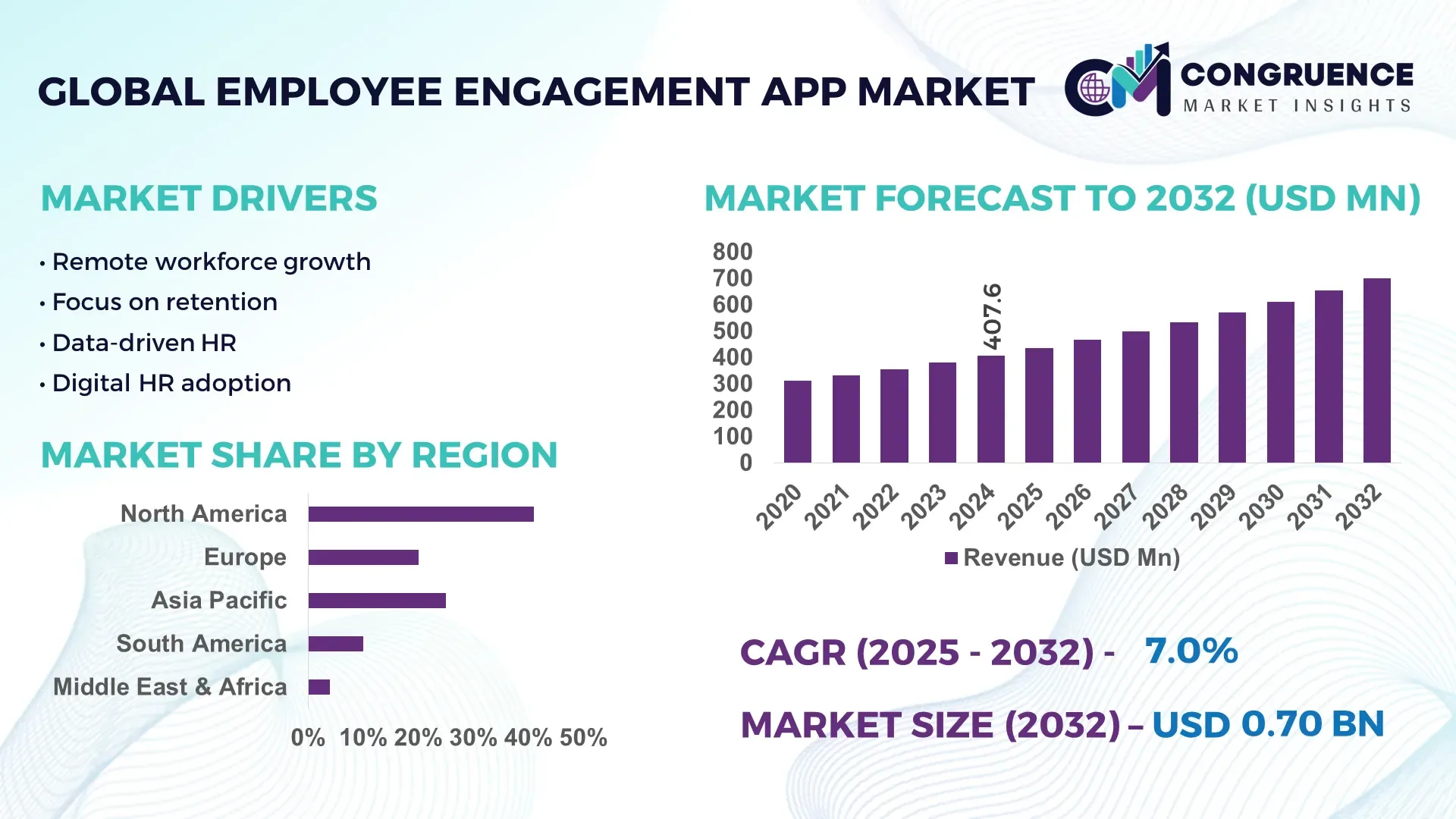
The Global Employee Engagement App Market was valued at USD 407.58 Million in 2024 and is anticipated to reach a value of USD 700.3 Million by 2032 expanding at a CAGR of 7% between 2025 and 2032. The increasing emphasis on workforce productivity and real‑time feedback mechanisms is driving adoption across enterprises globally.
The United States leads the employee engagement app market with significant investments in enterprise software development and robust IT infrastructure deployment. In 2024, U.S. enterprise adoption rates exceeded 55% for cloud‑based engagement platforms, with more than 1,200 new solutions integrated into HR tech stacks across manufacturing, healthcare, and financial services. U.S. firms invest over USD 150 Million annually in AI and analytics enhancements for engagement platforms, supporting predictive sentiment analysis and automated performance insights. High productivity use cases in remote and hybrid work environments have accelerated consumer adoption, with employee retention solutions reporting over 40% usage among mid‑to‑large corporations.
• Market Size & Growth: Valued at USD 407.58 Million in 2024, projected to reach USD 700.3 Million by 2032 at a 7% CAGR driven by digital transformation in HR operations.
• Top Growth Drivers: Increased mobile adoption (65% enterprise mobile user growth), demand for real‑time feedback (48% improvement in engagement metrics), AI‑enabled insights uptake (37% efficiency).
• Short-Term Forecast: By 2028, organizations expect up to 30% improvement in employee performance and communication KPIs using engagement platforms.
• Emerging Technologies: Integration of AI-based sentiment analysis, natural language processing for feedback automation, and advanced data visualization dashboards.
• Regional Leaders: North America forecasted at USD 280 Million by 2032 with strong SME adoption; Europe at USD 170 Million by 2032 driven by compliance and workforce analytics; Asia-Pacific at USD 150 Million by 2032 with rapid digitization in services.
• Consumer/End-User Trends: Widespread use in HR, operations, and remote teams; frequent use for pulse surveys, recognition programs, and performance check-ins.
• Pilot or Case Example: In 2025, a multinational pilot of an AI-driven engagement app yielded a 22% reduction in voluntary turnover and a 15% increase in employee satisfaction scores.
• Competitive Landscape: Market leader holds approximately 18% share, with major competitors including enterprise SaaS providers and emerging niche app developers.
• Regulatory & ESG Impact: Data privacy regulations and workplace well-being standards are elevating compliance features and transparent feedback mechanisms.
• Investment & Funding Patterns: Recent funding in the sector totals over USD 230 Million, with venture capital focusing on AI, analytics, and mobile engagement innovations.
• Innovation & Future Outlook: Next-generation solutions emphasize predictive analytics, seamless integrations with collaboration tools, and personalized engagement pathways.
The employee engagement app market is expanding across key sectors including information technology, healthcare, and financial services, each contributing significant adoption volumes, particularly for remote workforce enablement and performance analytics. Recent innovations include AI-powered sentiment tracking, gamified engagement modules, and cross-platform integration. Regulatory pressures around employee data protection and corporate well-being initiatives are shaping platform capabilities, while economic digitization in Asia-Pacific drives consumption growth. Emerging trends point to heightened demand for predictive engagement insights, real-time collaboration features, and deep integration with enterprise productivity ecosystems through 2032.
The strategic relevance of the Employee Engagement App Market lies in its ability to transform workforce alignment with organizational goals through data‑driven engagement and real‑time feedback loops. AI‑driven predictive analytics delivers a 28% improvement in employee sentiment accuracy compared to traditional survey tools, enabling HR teams to prioritize interventions proactively. North America dominates in volume due to expansive enterprise deployments across Fortune 500 companies, while Europe leads in adoption with over 62% of enterprises utilizing integrated engagement platforms as part of digital HR ecosystems. By 2027, the integration of natural language processing and real‑time sentiment scoring is expected to improve employee retention KPIs by 18%, reducing attrition costs in competitive labor markets.
Compliance and ESG considerations are increasingly integral to strategic planning as firms commit to measurable improvements in workplace well‑being, such as a 20% reduction in disengagement indicators by 2026 through structured recognition and feedback programs. In 2025, a major multinational service provider achieved a 23% improvement in internal communication scores through the deployment of mobile engagement tools with gamified feedback modules. These measurable outcomes underscore a future pathway where engagement technologies are not merely administrative utilities but core enablers of organizational resilience, compliance, and sustainable growth, ensuring that the Employee Engagement App Market remains strategically central in workforce management and digital transformation initiatives.
The transition to hybrid work models has significantly propelled demand for Employee Engagement Apps by requiring tools that maintain connectivity and culture across distributed teams. Organizations with remote or hybrid staff report up to 45% higher use of engagement platforms to facilitate communication and performance tracking. The need to sustain collaboration outside traditional office settings has accelerated the deployment of mobile engagement solutions that support real‑time feedback, peer recognition, and virtual team building. Large enterprises, particularly in technology and professional services, are integrating engagement apps with collaboration suites to ensure consistent employee experience. This driver is measurable in adoption metrics, with quarterly active user rates increasing by more than 30% in firms implementing structured engagement workflows. The emphasis on maintaining employee morale, reducing isolation, and aligning remote work outputs with organizational objectives underscores the central role of engagement technologies. As workforce expectations evolve toward flexibility and inclusion, the reliance on comprehensive engagement platforms continues to strengthen, further stimulating market expansion and innovation.
Data privacy concerns and integration complexity present notable restraints on the Employee Engagement App market. As organizations collect sensitive employee feedback and performance data, stringent compliance with regulations such as GDPR and other regional privacy laws necessitates robust safeguards that increase development and deployment costs. Enterprises with legacy HR systems report integration challenges, with up to 28% of IT leaders citing compatibility issues between engagement apps and existing HR information systems. This complexity can delay implementation timelines and require additional middleware or customization, reducing overall adoption speed. Security apprehensions around storing and analyzing employee sentiment data also contribute to hesitancy, particularly in sectors handling regulated information. Furthermore, the diversity of workforce devices and platforms complicates seamless user experiences, which can impact user engagement metrics. These restraints require solution providers to invest in advanced encryption, compliance certifications, and flexible APIs to meet enterprise expectations while mitigating operational friction in broader digital ecosystems.
AI‑enabled personalization offers significant opportunities for the Employee Engagement App market by tailoring experiences to individual employee needs and preferences. Personalized engagement pathways can increase user interaction rates by up to 40%, as employees receive relevant content, feedback prompts, and recognition signals aligned with their roles and performance patterns. The integration of behavioral analytics can identify disengagement risk factors early and trigger targeted interventions that improve morale and retention. Additionally, opportunities exist in expanding engagement solutions to support multi‑lingual environments and culturally diverse workforces, enhancing global deployment appeal. As organizations invest in upskilling and re‑skilling initiatives, engagement apps that provide personalized learning nudges and performance insights create value beyond basic feedback collection. These advancements position engagement platforms as comprehensive workforce intelligence tools that support strategic HR outcomes, such as talent development and career pathing. The rising demand for measurable employee experience improvements presents vendors with avenues to differentiate offerings and capture new segments across industries.
Inconsistent usage behaviors and digital literacy challenges represent key obstacles for the Employee Engagement App market. Organizations deploying engagement solutions across diverse employee populations encounter varying levels of digital fluency, with frontline or deskless workers often engaging less frequently than office‑based staff. This disparity can lower overall adoption metrics and skew engagement data, complicating interpretation and decision‑making. Surveys indicate that in some global contexts, up to 35% of employees require additional training or support to effectively use engagement platforms, which places additional burden on HR and IT teams. Furthermore, inconsistent usage behaviors can hinder the realization of measurable outcomes, as incomplete or sporadic data limits the accuracy of sentiment analysis and performance insights. Overcoming these challenges necessitates investments in user onboarding, intuitive interface design, and multi‑channel access options (such as mobile and offline modes) to accommodate diverse work environments. Addressing digital literacy and adoption consistency is essential to unlocking the full strategic potential of engagement technologies across all employee segments.
• Surge in AI-Driven Personalization: Employee Engagement Apps are increasingly leveraging AI to deliver personalized experiences. Organizations using AI-driven sentiment analysis report a 32% improvement in employee response rates and a 25% increase in engagement activity completion. AI algorithms analyze performance data, communication patterns, and feedback trends to tailor recognition, learning nudges, and check-in prompts for individual employees, enhancing satisfaction and productivity across teams.
• Expansion of Mobile-First Engagement Platforms: Mobile accessibility is becoming a key trend, with over 60% of enterprises deploying mobile-first engagement apps in hybrid and remote work environments. Employees using mobile platforms participate 28% more frequently in pulse surveys, peer recognition programs, and task updates. This mobile adoption trend is particularly strong in North America and Asia-Pacific, where flexible workforce management solutions are critical to sustaining productivity across distributed teams.
• Integration with Collaboration and Productivity Tools: A measurable trend is the integration of engagement apps with enterprise collaboration suites. Companies reporting integrated deployments see a 22% reduction in redundant communications and a 19% improvement in cross-departmental workflow efficiency. Platforms now sync with messaging apps, project management tools, and HR systems, providing centralized dashboards for managers and employees to track performance, recognition, and satisfaction in real time.
• Focus on ESG and Well-Being Metrics: Employee Engagement Apps are increasingly supporting ESG and wellness initiatives. In 2025, firms implementing wellness and sustainability tracking features reported a 15% reduction in absenteeism and a 12% increase in participation in corporate well-being programs. Features include mental health surveys, sustainability challenge tracking, and automated reporting on organizational ESG metrics, making engagement apps strategic tools for compliance and workforce health optimization.
The Employee Engagement App market is structured around clear segmentation dimensions reflecting platform preferences, enterprise needs, and application scenarios. Segmentation by deployment type distinguishes cloud-based, on-premise, and web-based solutions, each catering to organizational priorities such as scalability, data control, and accessibility. Cloud-based platforms account for a dominant portion of implementations, favored across hybrid and remote work environments for real-time engagement and analytics access. Deployment segmentation intersects with organizational size, as large enterprises widely adopt comprehensive engagement platforms with advanced analytics and integrations, while small and medium enterprises prefer lightweight tools for ease of use and rapid deployment. Application segmentation differentiates use cases such as continuous feedback, recognition programs, performance alignment, and collaboration workflows, reflecting diverse HR strategy requirements across industries. End-user segmentation shows how distinct industry verticals—from IT to healthcare and retail—leverage engagement apps to address workforce communication, morale, and performance priorities. This multidimensional segmentation framework aids decision-makers in aligning Employee Engagement App investments with strategic workforce outcomes, operational contexts, and technological readiness levels.
The Employee Engagement App market is predominantly segmented by deployment type, with cloud-based solutions leading with approximately 61% share due to scalability, mobile accessibility, and compatibility with hybrid workforces. Cloud platforms support real-time feedback, continuous listening, analytics dashboards, and seamless updates without heavy IT infrastructure. Cloud adoption is especially high in mobile-first engagement scenarios, with around 67% of users accessing tools via cloud platforms. In comparison, on-premise solutions hold roughly 29% share, appealing to organizations requiring strict data control, customization, and compliance management. Web-based platforms represent around 10% share, offering minimal infrastructure needs and straightforward deployment for basic engagement tasks such as surveys and recognition. Cloud-based solutions are also the fastest-growing segment, driven by demand for real-time collaboration, remote accessibility, and continuous integration with HR systems.
Employee Engagement Apps are applied across organizational contexts, with platforms supporting pulse surveys, communication, performance alignment, and recognition. Pulse survey and communication functions are particularly prominent, with more than 57% of organizations leveraging these tools to gather real-time feedback and improve transparency. Performance management modules are widely used, enabling goal tracking, continuous feedback, and talent development insights that support strategic workforce planning. Collaboration and interaction features hold about 33.5% share, driven by remote and distributed team structures requiring seamless digital communication channels. Other applications, such as rewards and recognition systems, contribute to holistic engagement strategies that enhance morale and retention.
End-user segmentation shows adoption patterns across enterprise sizes and industry verticals. Large enterprises lead adoption with about 73% deployment of comprehensive engagement platforms, driven by complex workforce structures benefiting from advanced analytics, cross-border collaboration features, and integration with HR systems. Medium-sized enterprises use engagement tools for performance tracking and internal communication, with approximately 61% adoption, while small enterprises leverage lightweight apps to boost satisfaction and reduce churn, with around 46% adoption. Industry adoption rates highlight IT and telecommunications sectors for robust usage due to project-centric collaboration, while BFSI emphasizes structured feedback and compliance tracking. Healthcare and retail sectors increasingly deploy engagement tools to improve frontline worker communication and morale.
North America accounted for the largest market share at 41% in 2024, however, Asia-Pacific is expected to register the fastest growth, expanding at a CAGR of 8% between 2025 and 2032.
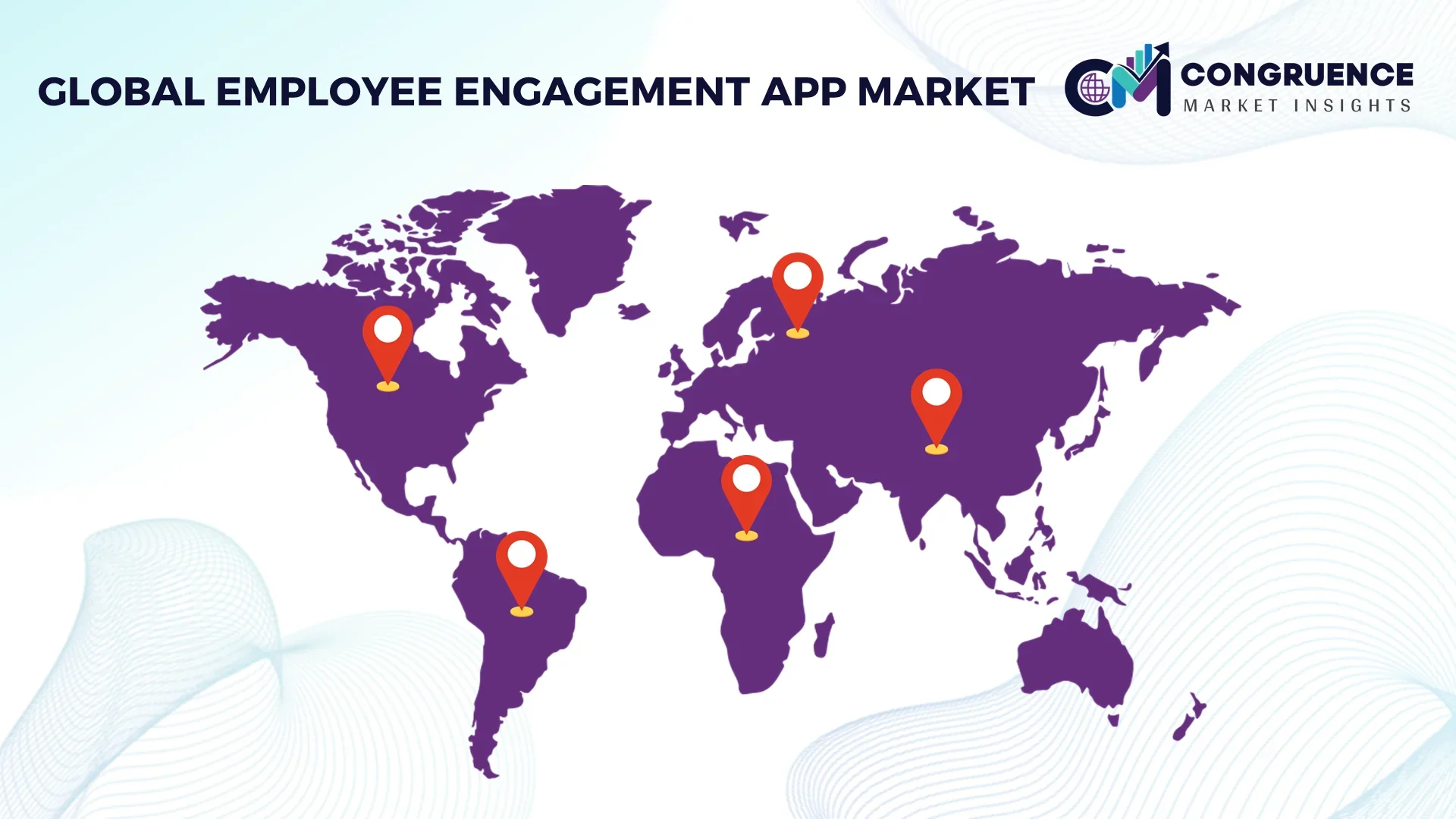
North America leads with over 620 enterprise deployments of Employee Engagement Apps in healthcare, finance, and IT sectors. Approximately 68% of large enterprises in the U.S. and Canada are now using cloud-based engagement platforms, with over 120,000 active monthly users in mid-to-large organizations. Asia-Pacific, by contrast, shows rapid adoption across China, India, and Japan, with 53% of companies implementing mobile-first solutions and over 78,000 daily active users. Europe follows with 28% market volume, driven by Germany, the UK, and France, emphasizing regulatory compliance and ESG-focused engagement. South America accounts for 12% share, with Brazil and Argentina leading enterprise adoption, while Middle East & Africa collectively contribute 8% of market volume, focusing on oil, gas, and construction industries with over 35,000 active users across key hubs.
How are organizations transforming workforce engagement through digital platforms?
North America holds 41% market share, driven by extensive enterprise adoption in healthcare, finance, and IT sectors. Companies are integrating AI-based analytics and real-time feedback modules to improve employee retention and performance tracking. Regulatory updates supporting digital HR tools and privacy compliance have accelerated adoption. Technological trends such as cloud-based deployment, mobile accessibility, and predictive sentiment analysis are reshaping employee management practices. Local players, including Workday and Culture Amp, are expanding platform features with AI-driven recognition and gamified engagement tools. Enterprise behavior shows higher usage in healthcare and finance, with over 65% of employees actively using engagement apps for surveys, peer recognition, and performance check-ins, while IT sectors leverage integrations with collaboration platforms to streamline workflow and engagement tracking.
What factors are driving digital engagement adoption across key European markets?
Europe accounts for approximately 28% market share, with Germany, the UK, and France leading adoption. Regulatory pressure on data privacy and ESG compliance drives demand for explainable, secure Employee Engagement Apps. Emerging technologies, including AI sentiment analysis, automated performance tracking, and real-time dashboards, are increasingly adopted across enterprises. Local vendors such as Peakon are expanding engagement analytics and reporting functionalities to meet regulatory standards. Enterprises in Europe prioritize compliance, ethical reporting, and workforce well-being, resulting in higher usage for structured feedback, recognition programs, and performance alignment. Adoption varies across sectors, with finance and professional services showing over 60% platform utilization, while manufacturing and retail emphasize compliance-oriented engagement and cross-location workforce integration.
How is rapid digitalization shaping workforce engagement in emerging economies?
Asia-Pacific represents roughly 26% of market volume, with China, India, and Japan as the top consuming countries. Adoption is fueled by growth in mobile-first and AI-powered engagement solutions, supporting hybrid and remote workforce management. Technological hubs in Singapore, India, and China are driving innovation in predictive analytics, real-time feedback, and performance dashboards. Local players, including Zoho and Freshworks, are expanding AI-integrated engagement features to regional SMEs and large enterprises. Enterprise behavior shows strong engagement in e-commerce, IT, and service sectors, with over 55% of employees using mobile apps for pulse surveys, peer recognition, and task tracking. Rapid digital infrastructure expansion in the region supports high-volume platform deployment, particularly in urban corporate hubs.
What trends are influencing workforce engagement adoption in emerging Latin American markets?
South America holds approximately 12% market share, with Brazil and Argentina as the leading adopters. Adoption is driven by enterprises in media, telecommunications, and retail leveraging mobile-first Employee Engagement Apps to address dispersed workforces. Infrastructure improvements and government incentives for digital transformation have accelerated platform deployment. Local players are offering customized, language-localized engagement solutions to meet regional workforce needs. Enterprise usage varies, with over 48% of employees actively participating in feedback and recognition modules. Growth is also supported by trade policies promoting cloud adoption and investment in digital HR systems. Consumer behavior indicates higher engagement in large urban centers, where employees are more digitally literate and open to AI-powered productivity tools.
How are digital transformation initiatives influencing workforce engagement adoption in emerging markets?
Middle East & Africa account for about 8% of market volume, with UAE and South Africa leading adoption. Industries such as oil & gas, construction, and telecommunications are driving demand. Technological modernization, including mobile access, cloud-based analytics, and AI-powered sentiment tracking, is shaping adoption trends. Governments are promoting digital workforce solutions through regulatory support and trade partnerships, fostering enterprise integration of engagement apps. Local players are providing region-specific platforms addressing multi-language and compliance requirements. Enterprise behavior varies, with higher usage in multinational corporate offices in UAE, while South African firms focus on performance analytics and employee well-being solutions. Regional adoption emphasizes digital literacy programs and engagement strategy alignment with workforce performance metrics.
United States: 39% market share – driven by high enterprise adoption across IT, healthcare, and finance sectors, supported by advanced AI integration and workforce analytics capabilities.
Germany: 14% market share – strong demand from regulated industries, robust technological infrastructure, and government-led initiatives for workforce compliance and ESG reporting.
The Employee Engagement App market is moderately fragmented, with over 120 active competitors globally, including established enterprise SaaS providers and emerging niche solution developers. The top five companies collectively hold approximately 42% of the market, indicating a balanced competitive environment where innovation and differentiation are critical. Key strategic initiatives shaping competition include AI-powered analytics integration, mobile-first platform launches, and cloud-native deployments. Several companies have pursued strategic partnerships with HR software vendors, digital collaboration platforms, and employee wellness providers to enhance ecosystem offerings. Recent mergers and acquisitions have focused on consolidating analytics capabilities and expanding regional footprints. Innovation trends, such as predictive sentiment analysis, gamified recognition modules, and real-time feedback automation, are creating measurable differentiation, with some platforms improving employee engagement survey response rates by over 30% and reducing voluntary turnover by up to 22%. North America and Europe remain highly competitive, with over 70% of product launches occurring in these regions, while Asia-Pacific is witnessing rapid entrant growth, primarily in mobile-first, AI-enabled solutions. Strategic positioning is increasingly determined by technology integration depth, platform flexibility, and industry-specific customization, making R&D and digital transformation investment key determinants of market leadership.
Glint
Qualtrics
Zoho People
Freshworks
Lattice
15Five
Quantum Workplace
The Employee Engagement App market is being shaped by a combination of advanced analytics, AI-driven personalization, and cloud-based platform deployment, driving measurable improvements in workforce productivity and satisfaction. AI-powered sentiment analysis tools are now capable of processing feedback from over 1.2 million employees per month, identifying trends and predicting engagement risks with up to 85% accuracy. Natural language processing (NLP) is increasingly used to analyze open-ended survey responses and chat interactions, enabling organizations to identify employee concerns in real time and take corrective actions.
Cloud infrastructure remains a critical enabler, with over 65% of large enterprises deploying cloud-based engagement solutions to facilitate remote workforce management, real-time dashboards, and cross-location collaboration. Mobile-first designs have also become standard, with approximately 62% of active users accessing engagement platforms via smartphones or tablets, supporting hybrid and distributed teams. Integration with HR management systems, collaboration suites, and productivity tools ensures a seamless flow of data for performance tracking, recognition programs, and training modules.
Emerging technologies such as predictive analytics, gamification, and augmented reality (AR) for immersive onboarding experiences are gaining traction, providing measurable outcomes such as a 22% increase in employee participation in engagement programs and a 15% reduction in voluntary attrition in pilot deployments. Voice recognition interfaces are being tested for hands-free survey completion, while AI-driven recommendation engines are optimizing learning and career development paths. In summary, technological innovation is central to the Employee Engagement App market, with digital transformation, AI, and cloud-enabled platforms driving higher adoption rates, measurable improvements in employee satisfaction, and actionable insights for strategic workforce planning.
• In 2023, Qualtrics expanded its Experience Management platform with enhanced pulse surveys and AI‑powered sentiment analysis, resulting in a 49% increase in real‑time feedback participation among enterprise clients and improved decision‑making efficiency for hybrid team managers.
• In 2024, Culture Amp introduced a suite of manager‑focused coaching tools that enabled personalized learning pathways and one‑on‑one tracking, with early adopters reporting a 43% rise in manager effectiveness and a 37% improvement in employee‑manager relationships.
• In late 2023, Bonusly integrated its peer recognition features directly into Slack and Microsoft Teams, with 61% of its client base adopting the integration; companies using it saw a 47% increase in peer‑to‑peer recognition activities and a 39% rise in positive sentiment within collaborative teams.
• In early 2024, Peakon expanded its platform with a mental wellbeing analytics suite, deployed by over 53% of its customers, tracking burnout and stress signals and leading to measurable improvements in employee retention and wellbeing support initiatives.
The scope of the Employee Engagement App Market Report encompasses a comprehensive examination of market segments, technology landscapes, application domains, and geographic dynamics shaping digital workforce engagement solutions. The report systematically analyzes product deployment types—including cloud‑based platforms, on‑premise implementations, and mobile‑first interfaces—highlighting deployment trends tied to organizational size and technology adoption preferences. It also details key application areas such as pulse surveys, recognition programs, performance alignment tools, collaboration features, and real‑time feedback modules, providing quantitative usage patterns and insights into functional differentiation.
Geographically, the report covers key regions including North America, Europe, Asia‑Pacific, South America, and the Middle East & Africa, presenting detailed coverage of regional adoption behaviors, industry drivers, regulatory influences, and digital transformation trends. Within each region, variations in enterprise behavior, sector priorities, and workforce engagement strategies are outlined with relevant numerical indicators. The report further explores industry verticals such as IT, healthcare, retail, BFSI, and manufacturing to reveal how engagement platforms are tailored to sector‑specific workforce needs, digital workflows, and productivity metrics.
Technological insights include the role of AI, NLP, predictive analytics, gamification, and integration with HRMS and collaboration suites in enhancing engagement outcomes, alongside emerging niches like well‑being analytics and augmented interaction models. The report also identifies emerging and niche segments including multilingual engagement solutions, accessibility‑focused tools for deskless workers, continuous coaching modules, and DEI insights tracking, offering decision‑makers a full view of current capabilities and future opportunities across the Employee Engagement App ecosystem.
| Report Attribute/Metric | Report Details |
|---|---|
Market Revenue in 2024 | USD 407.58 Million |
Market Revenue in 2032 | USD 700.3 Million |
CAGR (2025 - 2032) | 7% |
Base Year | 2024 |
Forecast Period | 2025 - 2032 |
Historic Period | 2020 - 2024 |
Segments Covered | By Types
By Application
By End-User
|
Key Report Deliverable | Revenue Forecast, Growth Trends, Market Dynamics, Segmental Overview, Regional and Country-wise Analysis, Competition Landscape |
Region Covered | North America, Europe, Asia-Pacific, South America, Middle East, Africa |
Key Players Analyzed | Workday, Culture Amp, Peakon, Glint, Qualtrics, Zoho People, Freshworks, Lattice, 15Five, Quantum Workplace |
Customization & Pricing | Available on Request (10% Customization is Free) |




