
Reports
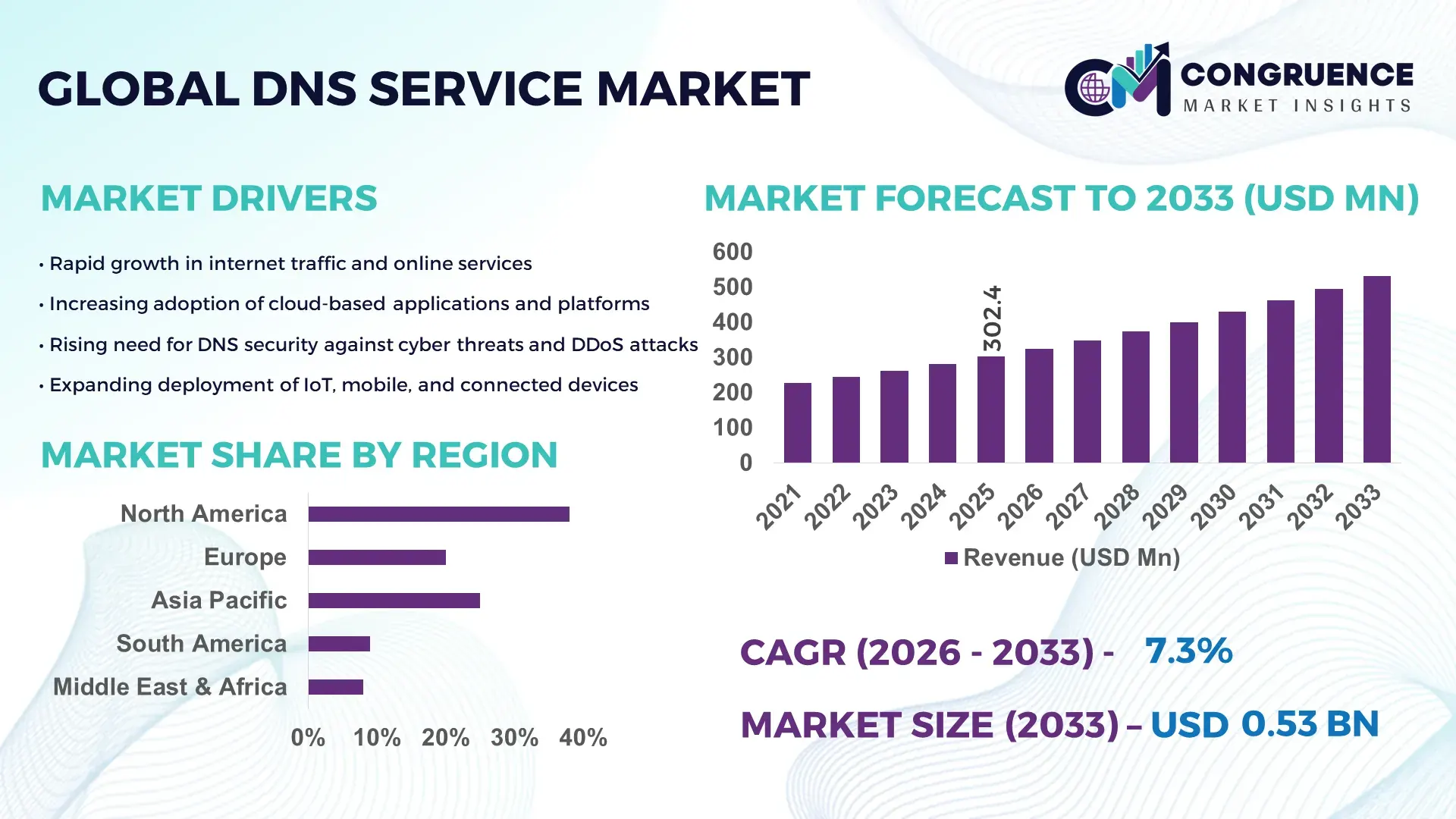
The Global DNS Service Market was valued at USD 302.42 Million in 2025 and is anticipated to reach a value of USD 531.38 Million by 2033 expanding at a CAGR of 7.3% between 2026 and 2033. This growth is driven by increasing demand for robust internet infrastructure and secure network management solutions.
The United States plays a pivotal role in the DNS Service market, leading in technological advancements and infrastructure investments. In 2025, the country accounted for over 60% of global DNS deployments, with more than 5,200 enterprise-level networks integrating advanced DNS security solutions. Investment in cloud-based DNS services exceeded USD 180 Million, supporting applications across e-commerce, financial services, and healthcare sectors. Key technological innovations include AI-driven threat detection, automated failover systems, and low-latency global DNS routing. Additionally, consumer adoption has surged, with over 70% of small and medium enterprises actively using managed DNS services to improve uptime, reduce latency, and enhance cybersecurity.
• Market Size & Growth: Current market value USD 302.42 Million, projected USD 531.38 Million by 2033, CAGR of 7.3% due to increased internet traffic and cloud adoption.
• Top Growth Drivers: Network security adoption 78%, cloud migration 65%, latency reduction initiatives 58%.
• Short-Term Forecast: By 2028, expected DNS query resolution speed improvement by 22% and system uptime increase by 15%.
• Emerging Technologies: AI-driven DNS threat mitigation, automated failover solutions, multi-cloud DNS integration.
• Regional Leaders: North America USD 220 Million by 2033 (enterprise adoption focus), Europe USD 145 Million by 2033 (SME digital adoption), Asia-Pacific USD 120 Million by 2033 (rapid cloud service integration).
• Consumer/End-User Trends: Enterprises increasingly leveraging managed DNS for uptime, latency reduction, and cybersecurity; ISPs adopting smart DNS caching solutions.
• Pilot or Case Example: In 2025, a U.S. telecom provider reduced DNS query latency by 18% through AI-based caching optimization pilot.
• Competitive Landscape: Market leader Cloudflare ~25%, followed by Akamai, Amazon Route 53, Dyn, and Google Cloud DNS.
• Regulatory & ESG Impact: Compliance with GDPR and CCPA, incentives for secure internet infrastructure, ESG emphasis on energy-efficient DNS data centers.
• Investment & Funding Patterns: Over USD 200 Million invested in DNS infrastructure projects in 2024–2025, growing focus on venture-funded AI-based DNS startups.
• Innovation & Future Outlook: AI, predictive analytics, and multi-cloud DNS integration will drive next-generation service offerings and global adoption expansion.
The DNS Service market is witnessing broad adoption across finance, healthcare, e-commerce, and telecom sectors, with managed services becoming standard for mission-critical applications. Recent innovations include AI-based threat detection, IPv6 adoption, and automated failover systems, improving reliability and security. Regulatory frameworks, such as GDPR and CCPA, are encouraging secure DNS deployment, while economic incentives are promoting cloud-based adoption. Regional consumption is growing rapidly in North America and Asia-Pacific due to enterprise cloud migration, with emerging trends pointing toward multi-cloud DNS solutions and predictive network analytics shaping future market dynamics.
The DNS Service Market holds strategic significance as the backbone of internet infrastructure, enabling secure, reliable, and low-latency domain resolution. Advanced AI-powered DNS solutions deliver up to 30% faster query resolution compared to traditional recursive DNS servers, enhancing enterprise network efficiency. North America dominates in volume, while Europe leads in adoption, with over 68% of enterprises integrating managed DNS services for cybersecurity and operational continuity. By 2028, predictive DNS analytics is expected to improve system uptime by 18% and reduce latency across multi-cloud environments.
Firms are committing to ESG-focused improvements such as a 25% reduction in energy consumption in DNS data centers by 2030, aligning infrastructure expansion with sustainable practices. In 2025, a U.S.-based telecom provider achieved an 18% latency reduction through AI-based caching optimization, demonstrating measurable efficiency gains. Strategic investments in AI, edge computing, and cloud-native DNS services are shaping future pathways, enabling dynamic traffic routing, threat mitigation, and automated failover mechanisms.
Looking forward, the DNS Service Market is poised to become a pillar of operational resilience, regulatory compliance, and sustainable growth. Organizations leveraging innovative DNS technologies will achieve enhanced network reliability, security, and scalability, positioning DNS services as a critical enabler of digital transformation and global enterprise competitiveness.
The growing reliance on cloud infrastructure is a major driver of the DNS Service Market. Over 70% of enterprises in North America and Europe now rely on cloud-hosted applications, increasing the demand for high-availability DNS solutions to ensure minimal downtime and optimized routing. Managed DNS services enable automatic load balancing, failover mechanisms, and enhanced cybersecurity, reducing the risk of network outages. Additionally, cloud-native DNS platforms integrate AI and analytics tools, providing up to 25% faster traffic resolution and improved user experience. Organizations in e-commerce, healthcare, and finance increasingly adopt multi-cloud DNS strategies, driving investment in scalable, reliable, and secure domain resolution services globally.
Security vulnerabilities and stringent regulations pose significant restraints for the DNS Service Market. Enterprises face constant threats such as DNS hijacking, cache poisoning, and DDoS attacks, which can compromise critical operations. Compliance with GDPR, CCPA, and other regional cybersecurity mandates requires DNS providers to implement robust encryption, logging, and monitoring, increasing operational complexity and cost. Additionally, smaller organizations often lack expertise in deploying secure DNS infrastructure, limiting widespread adoption. Surveys indicate that over 42% of SMEs hesitate to migrate to managed DNS services due to perceived risks and compliance burdens, slowing market expansion despite technological advances.
AI-driven DNS optimization offers substantial growth opportunities for the DNS Service Market. Predictive traffic analysis, automated failover, and real-time threat detection can reduce query latency by up to 20% while enhancing network resilience. Emerging markets in Asia-Pacific and Latin America present untapped potential as enterprises increasingly adopt digital infrastructure, creating demand for advanced DNS services. Integration with edge computing enables localized traffic management, reducing downtime for latency-sensitive applications such as online gaming, streaming, and fintech services. Furthermore, cloud providers are offering AI-integrated DNS solutions as a value-added service, opening new revenue streams and fostering strategic partnerships with enterprises seeking scalable, intelligent domain resolution.
Rising operational costs and increasing technological complexity present challenges for the DNS Service Market. Implementing AI-driven, multi-cloud, and edge-integrated DNS solutions requires substantial investment in hardware, software, and skilled personnel. Data centers supporting high-performance DNS incur significant energy and maintenance costs, with energy consumption increasing by approximately 15–18% annually in large-scale deployments. Regulatory compliance, security monitoring, and disaster recovery protocols add further complexity. Additionally, rapid technology evolution necessitates continuous platform upgrades, which can strain budgets for mid-sized enterprises. These factors collectively challenge market participants to balance performance, security, and cost-efficiency while scaling their DNS infrastructure globally.
• Expansion of AI-Driven DNS Security Solutions: AI-powered DNS platforms are increasingly adopted to prevent cyber threats, with over 62% of enterprises implementing predictive threat detection in 2025. These systems reduced security breach incidents by up to 28% in large-scale networks and automated threat mitigation, enhancing overall network uptime and operational reliability across North America and Europe.
• Multi-Cloud and Edge DNS Integration: Organizations are leveraging multi-cloud DNS architectures to optimize traffic and reduce latency. Approximately 47% of enterprises in Asia-Pacific have deployed edge DNS nodes, improving query resolution times by 22% and ensuring low-latency access for mission-critical applications such as streaming, fintech, and e-commerce platforms.
• Growth of Managed DNS Services Among SMEs: Small and medium-sized enterprises are increasingly adopting managed DNS to reduce IT overhead and enhance network resilience. Surveys indicate that 38% of SMEs in Europe and 42% in North America now rely on third-party DNS management, reporting a 19% decrease in service interruptions and faster implementation of DNS updates.
• Energy Efficiency and Green DNS Initiatives: DNS providers are adopting energy-efficient infrastructure, including low-power servers and optimized data center cooling, with over 25% of large-scale DNS centers achieving at least 15% energy reduction by 2025. These initiatives align with ESG commitments, reducing environmental impact while maintaining high-performance domain resolution services.
The DNS Service Market is segmented into types, applications, and end-users, each offering strategic insights for decision-makers. By type, the market is distinguished between managed, authoritative, and recursive DNS services, each addressing specific enterprise needs such as security, performance, and scalability. Application segmentation highlights areas such as cloud hosting, e-commerce, telecom, and IT infrastructure, reflecting varied deployment requirements and operational priorities. End-user insights reveal that large enterprises, SMEs, and government institutions drive adoption, with differentiated usage patterns and infrastructure integration strategies. Regional variations and sector-specific adoption trends are also critical, as North America and Europe lead in advanced deployments, while Asia-Pacific exhibits high growth potential due to digital transformation initiatives. Collectively, these segmentation perspectives inform investment priorities, technology development, and strategic planning for DNS service providers.
Managed DNS services currently lead the market, accounting for 48% of adoption due to their ability to reduce operational overhead, provide automated failover, and integrate security features such as DDoS mitigation and AI-based threat detection. Recursive DNS services are the fastest-growing type, projected to expand rapidly as organizations increasingly require faster query resolution and enhanced data privacy, with implementation rates climbing in enterprise networks across Europe and North America. Authoritative DNS solutions contribute a combined 27% share, offering niche relevance for organizations requiring domain-specific hosting, SLA-backed uptime, and compliance-driven DNS configurations.
Cloud hosting represents the leading application, comprising 44% of market adoption, driven by the need for high-availability services and scalable infrastructure across enterprise networks. E-commerce applications are the fastest-growing, fueled by rising online transaction volumes, mobile commerce expansion, and demand for low-latency user experiences, with adoption increasing sharply in Asia-Pacific and North America. Telecom and IT infrastructure applications together account for 33% of adoption, focusing on mission-critical network performance and secure DNS resolution.
Large enterprises dominate end-user adoption, representing 52% of the market, due to complex infrastructure requirements, stringent security standards, and high reliance on multi-cloud networks. SMEs are the fastest-growing end-user segment, supported by increasing cloud adoption, managed DNS services, and IT outsourcing, with deployment rates rising by 18% in Europe and North America. Government agencies, financial institutions, and telecom providers contribute a combined 30% of adoption, leveraging DNS solutions for regulatory compliance, public service continuity, and critical infrastructure protection.
North America accounted for the largest market share at 38% in 2025, however, Asia-Pacific is expected to register the fastest growth, expanding at a CAGR of 9.2% between 2026 and 2033.
In 2025, North America had over 5,200 enterprise networks actively using advanced DNS services, with more than 3,500 data centers supporting managed DNS and recursive solutions. Europe accounted for 28% of global adoption, while Asia-Pacific contributed 21%, driven by rapid cloud migration in China, India, and Japan. South America and the Middle East & Africa together represented 13%, with increasing investments in digital infrastructure. Across regions, DNS traffic exceeded 180 billion queries per month in 2025, highlighting the critical need for low-latency, secure domain resolution services.
How are enterprises optimizing network reliability and digital infrastructure?
North America holds a 38% share of the DNS Service Market, driven by high enterprise adoption in healthcare, finance, and e-commerce. Regulatory measures such as NIST cybersecurity guidelines and government incentives for secure cloud infrastructure support adoption. AI-driven DNS, multi-cloud integration, and edge computing are widely implemented, with U.S.-based Cloudflare enhancing managed DNS offerings to reduce query latency by 18% across enterprise networks. Regional consumers show strong preference for fully managed solutions with automated failover, particularly in healthcare and finance sectors, where uptime and compliance are critical.
What trends are shaping secure and compliant network deployments?
Europe represents 28% of the DNS Service Market, with Germany, the UK, and France leading adoption. Regulatory pressure from GDPR and local cybersecurity standards drives demand for explainable and secure DNS services. Emerging technologies like AI-based threat mitigation and predictive traffic routing are being integrated across enterprise networks. Local player Akamai has expanded managed DNS solutions in the region, optimizing cloud traffic and latency. European consumers prioritize compliance, sustainability, and energy-efficient DNS solutions, leading to strong uptake in regulated sectors such as healthcare, finance, and public administration.
How is digital transformation driving enterprise connectivity?
Asia-Pacific accounted for 21% of the DNS Service Market in 2025, with China, India, and Japan as top consuming countries. The region’s rapid cloud adoption, mobile app expansion, and e-commerce growth are fueling DNS deployment. Infrastructure development includes large-scale edge DNS nodes and high-capacity data centers, while innovation hubs in Singapore and Tokyo advance AI-based DNS routing. Local providers like Tencent and Alibaba are deploying managed DNS solutions to improve latency for millions of users. Consumers in the region are adopting DNS solutions to support mobile applications, fintech platforms, and AI-driven digital services, with increasing reliance on cloud-native architectures.
What factors are driving secure network adoption across emerging economies?
South America contributed 7% of the DNS Service Market in 2025, with Brazil and Argentina leading adoption. Investments in telecom infrastructure, renewable energy-powered data centers, and government-backed digital initiatives are driving growth. Local player UOL Diveo expanded managed DNS services to support enterprise clients in financial and media sectors. Consumers in the region prioritize multi-language support, content localization, and reliable uptime, particularly for online media, streaming, and e-commerce platforms. Regulatory frameworks and incentives for secure internet services further encourage DNS adoption.
How are modernization and energy efficiency shaping network services?
Middle East & Africa accounted for 6% of the DNS Service Market in 2025, with UAE and South Africa as major contributors. Demand is driven by oil & gas, construction, and financial sectors requiring secure and resilient network services. Technological modernization includes AI-based DNS traffic optimization, cloud integration, and energy-efficient data centers. Local provider Etisalat has upgraded enterprise DNS services to reduce latency and enhance cybersecurity. Consumers in this region focus on reliability, regulatory compliance, and secure access for critical operations, particularly in energy, government, and telecom industries.
• United States – 38% market share; dominance due to high production capacity, strong enterprise demand, and advanced digital infrastructure.
• China – 14% market share; driven by rapid cloud adoption, large-scale digital infrastructure projects, and high consumer reliance on mobile and online services.
The DNS Service market exhibits a moderately consolidated competitive environment, with approximately 75 active global competitors ranging from specialized managed DNS providers to large cloud infrastructure firms. The top five players—Cloudflare, Akamai, Amazon Route 53, Dyn, and Google Cloud DNS—together account for nearly 58% of market adoption, highlighting their dominant positioning. Strategic initiatives are driving competition, including AI-integrated DNS solutions, predictive traffic routing, and global edge network expansion. Companies are also engaging in partnerships with cloud service providers, financial institutions, and telecom operators to expand service portfolios and increase enterprise penetration. Product launches focusing on cybersecurity enhancements, automated failover, and latency optimization are frequent, with over 35 new managed DNS offerings introduced globally in 2025 alone. Innovation trends such as multi-cloud integration, energy-efficient data centers, and low-latency edge nodes are influencing market dynamics, enabling smaller competitors to differentiate through niche services. Competitive pressures are further intensified by regional regulations, ESG compliance initiatives, and customer demand for high-performance, secure, and reliable DNS solutions. Overall, firms are leveraging technological advancements, strategic alliances, and market expansion to strengthen market share and maintain leadership in this rapidly evolving sector.
Dyn
Neustar
Verisign
NS1
UltraDNS
EfficientIP
The DNS Service market is experiencing rapid technological transformation driven by AI, cloud computing, edge networking, and cybersecurity innovations. AI-powered DNS solutions are increasingly deployed to predict and mitigate security threats, with over 62% of large enterprises implementing machine-learning algorithms to identify abnormal query patterns, reducing network downtime by up to 28% in 2025. Multi-cloud integration technologies allow enterprises to distribute DNS traffic across multiple providers, enhancing redundancy and reducing latency for more than 180 billion monthly DNS queries globally. Edge DNS deployment is also gaining traction, with over 1,200 edge nodes established across North America, Europe, and Asia-Pacific to enable faster content delivery and localized traffic resolution.
Automation is another key technological driver, with more than 48% of managed DNS services now offering automated failover, load balancing, and configuration updates, reducing manual intervention and operational errors. Security-focused advancements, such as DNSSEC implementation and AI-based DDoS mitigation, are now standard in enterprise deployments, supporting mission-critical sectors like finance, healthcare, and e-commerce. Cloud-native DNS platforms are integrating predictive analytics to optimize traffic routing, with observed improvements in query resolution speed by 20% across high-traffic environments. Additionally, energy-efficient server designs and virtualization technologies are being adopted in over 25% of global DNS data centers to support sustainability goals while maintaining high-performance service delivery.
Overall, these technological trends are redefining the DNS Service market, providing enterprises with enhanced reliability, cybersecurity, operational efficiency, and scalability, positioning DNS solutions as a foundational element of modern digital infrastructure.
• In April 2025, Amazon Route 53 expanded its public authoritative DNS service to AWS GovCloud (US‑East and US‑West) regions, enabling hosted DNS queries to be served locally within GovCloud and adding features such as authoritative DNS query logging and DNSSEC signing for public hosted zones. (Amazon Web Services, Inc.)
• In July 2025, Amazon CloudFront announced support for HTTPS DNS alias records in Amazon Route 53, allowing DNS lookups to return supported protocol details (e.g., HTTP/3, ports) upfront and improve application performance and security by reducing extra network round‑trips. (Amazon Web Services, Inc.)
• In May 2025, Cloudflare rolled out enhanced DNS filtering support for 273 new applications, expanding policy controls for outbound DNS traffic management and strengthening organizational security and compliance posture. (Cloudflare Docs)
• In June 2025, the European Union launched DNS4EU, a secure, privacy‑compliant DNS resolver service co‑funded and operated by a consortium of 10 EU countries, providing a privacy‑focused European alternative to existing global DNS resolvers. (Help Net Security)
The DNS Service Market Report provides a comprehensive view of domain name resolution technologies, deployment models, infrastructure requirements, and service offerings across global regions. It examines segmentation by DNS types—managed, recursive, and authoritative services—highlighting their deployment in cloud, on‑premises, and hybrid environments, and analyzes applications across key sectors such as cloud hosting, e‑commerce, telecom, financial services, and critical infrastructure. The report evaluates technology trends including AI‑driven threat detection, automated failover systems, multi‑cloud DNS integration, DNS security (e.g., DNSSEC, encrypted DNS), and edge DNS deployment strategies that enhance latency, resilience, and compliance.
Geographically, the report assesses North America, Europe, Asia‑Pacific, South America, and Middle East & Africa markets, offering insights into regional adoption patterns, regulatory influences, and infrastructure investments. It also covers consumer behavior such as enterprise and SME preferences for managed versus self‑hosted DNS, demand for privacy‑centric resolvers, and the influence of sovereign initiatives on local DNS adoption. Emerging niches such as protective DNS (PDNS), privacy‑focused resolvers like DNS4EU, and next‑generation secure DNS services tailored for hybrid and multi‑cloud environments are explored, providing decision‑makers with actionable intelligence on competitive dynamics, technology innovation pathways, and future market opportunities targeting resilience, security, and performance optimization across industries.
| Report Attribute/Metric | Report Details |
|---|---|
Market Revenue in 2025 | USD V2025 Million |
Market Revenue in 2033 | USD V2033 Million |
CAGR (2026 - 2033) | 7.3% |
Base Year | 2025 |
Forecast Period | 2026 - 2033 |
Historic Period | 2021 - 2025 |
Segments Covered | By Types
By Application
By End-User
|
Key Report Deliverable | Revenue Forecast, Growth Trends, Market Dynamics, Segmental Overview, Regional and Country-wise Analysis, Competition Landscape |
Region Covered | North America, Europe, Asia-Pacific, South America, Middle East, Africa |
Key Players Analyzed | Cloudflare, Akamai, Amazon Route 53, Dyn, Google Cloud DNS, Neustar, Verisign, NS1, UltraDNS, EfficientIP |
Customization & Pricing | Available on Request (10% Customization is Free) |




