
Reports
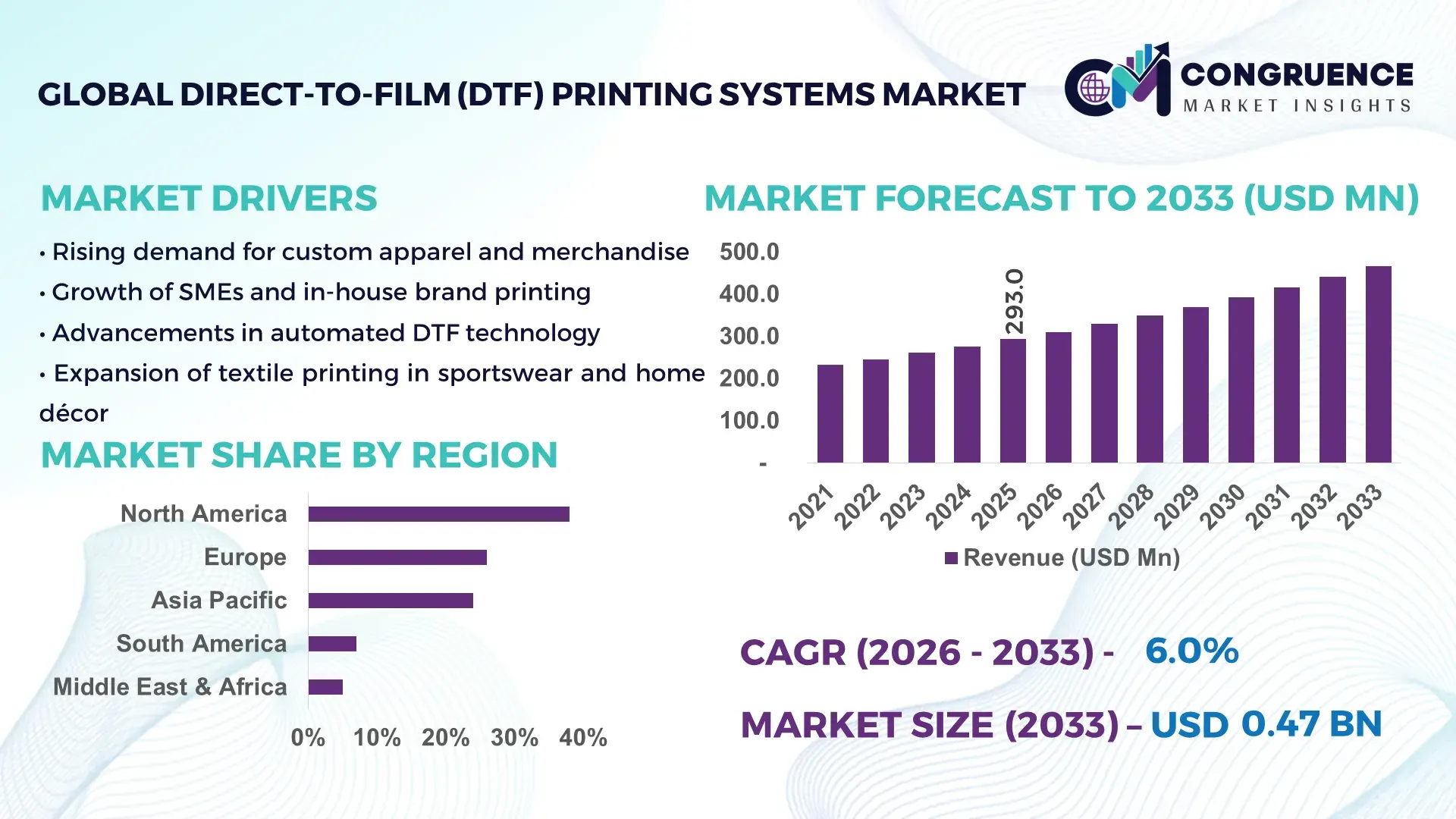
The Global Direct-to-Film (DTF) Printing Systems Market was valued at USD 293.0 Million in 2025 and is anticipated to reach a value of USD 467.0 Million by 2033, expanding at a CAGR of 6% between 2026 and 2033, according to an analysis by Congruence Market Insights. This growth is driven by the accelerating shift toward short-run, customized textile printing and rising adoption of digitally enabled apparel decoration technologies across commercial and industrial users.
The United States represents the most influential national market for Direct-to-Film (DTF) Printing Systems, supported by advanced production infrastructure, high capital investment, and rapid technology deployment. Over 38,000 commercial print service providers operate across apparel, promotional products, and industrial labeling segments, with DTF systems increasingly integrated into mid-scale production lines. Annual investments exceeding USD 1.2 billion in digital textile printing equipment highlight strong capital inflows. The U.S. also leads in hybrid DTF–DTG installations, with nearly 42% of new textile printers adopting multi-process compatibility. Key applications include fashion apparel, sportswear, and customized merchandise, while automation, AI-based color profiling, and water-based ink innovations continue to enhance throughput and print consistency.
Market Size & Growth: Valued at USD 293.0 Million in 2025, projected to reach USD 467.0 Million by 2033, expanding at 6% CAGR, supported by rising demand for on-demand textile customization.
Top Growth Drivers: Custom apparel adoption (48%), reduction in setup time versus screen printing (35%), multi-fabric compatibility efficiency gains (27%).
Short-Term Forecast: By 2028, average per-unit printing costs are expected to decline by 18% due to automation and ink optimization.
Emerging Technologies: AI-driven RIP software, water-based eco-inks, and automated powder curing systems.
Regional Leaders: North America (USD 162 Million by 2033) with SME adoption; Asia Pacific (USD 148 Million by 2033) driven by volume manufacturing; Europe (USD 96 Million by 2033) led by sustainable printing mandates.
Consumer/End-User Trends: Over 52% of demand originates from apparel decorators and promotional merchandise producers favoring short-run flexibility.
Pilot or Case Example: In 2024, a U.S.-based apparel printer achieved 22% throughput improvement using AI-enabled DTF workflow optimization.
Competitive Landscape: Market leader holds ~19% share, followed by Epson, Roland DG, Brother Industries, Mimaki, and Kornit Digital.
Regulatory & ESG Impact: Adoption accelerated by VOC reduction standards and water-based ink compliance requirements.
Investment & Funding Patterns: More than USD 680 Million invested globally in DTF-related equipment upgrades and digital print startups (2023–2025).
Innovation & Future Outlook: Integration of DTF with smart factories and cloud-based production management is reshaping scalable print operations.
The Direct-to-Film (DTF) Printing Systems Market serves apparel (58%), promotional products (21%), industrial textiles (13%), and home décor (8%). Recent innovations include low-temperature adhesive powders and extended-gamut pigment inks, improving wash durability by over 30%. Environmental regulations promoting water-based inks, combined with Asia Pacific’s cost-driven consumption growth and Europe’s sustainability focus, are shaping future adoption patterns and long-term market evolution.
The Direct-to-Film (DTF) Printing Systems Market holds growing strategic relevance as manufacturers, apparel brands, and print service providers seek operational flexibility, rapid customization, and compliance-ready production technologies. DTF printing enables decentralized manufacturing models by eliminating the need for pre-treated garments and reducing setup complexity. Compared to traditional screen printing, automated DTF workflows deliver up to 32% faster turnaround times, while AI-enabled RIP software delivers 25% color accuracy improvement compared to manual profiling standards.
From a regional standpoint, Asia Pacific dominates in volume manufacturing, particularly in India, China, and Vietnam, while North America leads in adoption intensity, with over 46% of small and mid-sized print enterprises deploying DTF systems. Europe remains a technology refinement hub, focusing on eco-certified inks and low-energy curing processes.
In the short term, by 2028, AI-assisted print queue optimization and predictive maintenance are expected to reduce material waste by 20% across commercial DTF operations. ESG considerations are also shaping strategy, with firms committing to 35% water usage reduction and 40% recyclable consumables integration by 2030.
A micro-scenario highlights this shift: in 2024, a Germany-based textile printer achieved a 28% reduction in defect rates through automated powder application and vision-based quality inspection. Looking ahead, the Direct-to-Film (DTF) Printing Systems Market is positioned as a pillar of operational resilience, regulatory alignment, and sustainable growth across the global textile value chain.
The Direct-to-Film (DTF) Printing Systems Market is shaped by evolving customization demands, digital manufacturing adoption, and efficiency-driven production strategies. Market dynamics reflect a transition from analog and labor-intensive printing methods toward digitally controlled, software-integrated systems. Increased penetration among small and medium enterprises is reshaping competitive structures, while advancements in inks, films, and curing technologies continue to improve output consistency. Supply chain localization, equipment automation, and sustainability compliance are influencing procurement decisions, particularly across North America and Europe. At the same time, Asia Pacific manufacturers are scaling capacity to meet export-driven demand, reinforcing volume-based production dynamics.
Customization has become a core purchasing criterion in apparel and merchandise markets, with over 60% of consumers preferring personalized products. DTF printing supports rapid design changes, short production runs, and multi-material compatibility, making it ideal for custom apparel, sportswear, and promotional goods. Print service providers report 35–40% reduction in setup time compared to screen printing, enabling faster order fulfillment. The ability to print complex, multi-color designs without additional tooling further accelerates adoption, particularly among e-commerce-driven brands and local manufacturers.
DTF systems rely heavily on specialized consumables such as PET films, adhesive powders, and pigment inks. Consumables account for nearly 45% of total operating costs, creating margin pressure for small-scale operators. Price volatility in polymer films and specialty chemicals further complicates cost forecasting. Additionally, inconsistent consumable quality can lead to 15–20% reprint rates, impacting productivity. These factors restrain adoption among cost-sensitive users despite technological advantages.
Automation presents significant growth opportunities through powder application robotics, automated curing tunnels, and AI-based defect detection. Automated DTF lines can improve throughput by 30% while reducing labor dependency by 25%. Integration with ERP and cloud-based production systems enables scalable operations for contract printers. Emerging markets, where labor optimization and quality consistency are priorities, offer untapped potential for fully automated DTF installations.
Despite simplified hardware, effective DTF printing requires expertise in color management, ink behavior, and curing calibration. Surveys indicate that over 40% of operators face initial quality inconsistency due to inadequate training. Lack of standardized workflows across equipment brands further complicates scalability. These challenges increase onboarding time and operational risk, particularly for first-time digital print adopters.
Automation-Driven Throughput Expansion: Automated powder application and conveyor curing systems are improving production efficiency by 28%, with defect rates reduced by 18% in high-volume print environments. Adoption is strongest in North America and Western Europe, where labor optimization is critical.
Sustainable Ink and Film Innovation: Water-based pigment inks now represent over 62% of new DTF installations, supporting compliance with low-VOC regulations. Recyclable PET films have reduced material waste by 22%, aligning production with environmental mandates.
SME-Centric Market Penetration: Small and mid-sized enterprises account for nearly 55% of new system deployments, driven by compact printer designs and modular upgrades that lower entry barriers and support scalable expansion.
Hybrid Printing Ecosystems: Hybrid DTF–DTG setups are increasing operational flexibility, enabling printers to handle 30% broader product portfolios. This trend is particularly evident in Asia Pacific, where export-oriented manufacturers prioritize multi-process capability.
The Global Direct-to-Film (DTF) Printing Systems Market is segmented by type, application, and end-user, reflecting diverse operational requirements and adoption patterns across the textile printing ecosystem. By type, segmentation highlights variations in system automation levels, ink configurations, and curing mechanisms, which directly influence productivity, print consistency, and scalability. Applications span apparel, promotional merchandise, industrial textiles, and home décor, with demand intensity varying by customization needs and production volumes. End-user segmentation underscores adoption differences between commercial print service providers, apparel manufacturers, SMEs, and in-house brand printing units. Across segments, decision-making is shaped by factors such as turnaround time, compatibility with multiple fabric types, labor efficiency, and compliance with environmental standards. The segmentation landscape indicates a clear shift toward automated and hybrid systems, high-growth application areas driven by personalization, and expanding SME participation supported by declining operational complexity.
The Direct-to-Film (DTF) Printing Systems Market by type includes manual/semi-automatic DTF systems, fully automated DTF printing systems, and hybrid DTF–DTG systems. Fully automated DTF printing systems currently represent the leading segment with approximately 44% share, driven by higher throughput capacity, reduced labor dependency, and consistent print quality across large production batches. These systems are widely deployed in commercial print facilities processing high daily order volumes exceeding 1,000 prints. Hybrid DTF–DTG systems are the fastest-growing type, expanding at an estimated CAGR of 8.4%, supported by their ability to switch between film-based and direct garment printing. Growth is driven by multi-product portfolios, enabling printers to address cotton, polyester, blends, and specialty fabrics without separate infrastructure investments. Manual and semi-automatic systems remain relevant among startups and micro-enterprises, offering low capital entry and flexible operation for short runs. Collectively, these systems account for a combined 32% share, primarily serving localized and on-demand production models.
In 2025, a nationally recognized textile innovation institute reported that automated DTF lines equipped with inline powder curing reduced reprint defects by 26% and improved daily output consistency across pilot manufacturing facilities.
By application, the market covers custom apparel, promotional products, industrial textiles, and home décor. Custom apparel dominates application demand, accounting for approximately 49% of total adoption, supported by rising personalization trends, rapid design change requirements, and compatibility with sportswear, fashion, and casual garments. Apparel producers increasingly rely on DTF systems for short-run collections and e-commerce-driven fulfillment. Promotional products represent the fastest-growing application, expanding at an estimated CAGR of 7.9%, fueled by corporate branding demand, event merchandise, and localized marketing campaigns. Growth is supported by faster turnaround times and the ability to print complex logos without screen preparation. Industrial textiles and home décor applications contribute a combined 31% share, serving niches such as workwear labeling, interior fabrics, and decorative prints.
In 2025, 41% of small apparel brands globally reported adopting DTF printing to support limited-edition product launches. More than 58% of print service providers indicated increased order frequency for customized promotional merchandise.
In 2024, a government-backed manufacturing modernization program documented DTF deployment across over 120 apparel units, improving order fulfillment speed by 23% for custom garment applications.
End-user segmentation includes commercial print service providers, apparel manufacturers, small and medium enterprises (SMEs), and in-house brand printing units.
Commercial print service providers form the leading end-user group with nearly 46% share, leveraging DTF systems for high-mix, low-volume jobs and multi-client workflows. Their dominance is supported by centralized production models and continuous equipment utilization. SMEs represent the fastest-growing end-user segment, registering an estimated CAGR of 8.1%, driven by affordable system configurations, compact footprints, and simplified workflows. SMEs increasingly deploy DTF systems to internalize production and reduce outsourcing dependency. Apparel manufacturers and in-house brand printing units together account for a combined 36% share, focusing on quality control, rapid prototyping, and private-label production.
In 2025, 39% of SMEs in the textile sector reported first-time adoption of DTF systems for in-house customization. Over 52% of mid-sized apparel brands indicated DTF printing as their primary method for short-run production.
In 2025, a leading industry advisory body reported that SME-led adoption of digital textile printing systems enabled over 400 enterprises to reduce outsourcing volumes by more than 20% within one year.
North America accounted for the largest market share at 38% in 2025; however, Asia-Pacific is expected to register the fastest growth, expanding at a CAGR of 7.4% between 2026 and 2033.
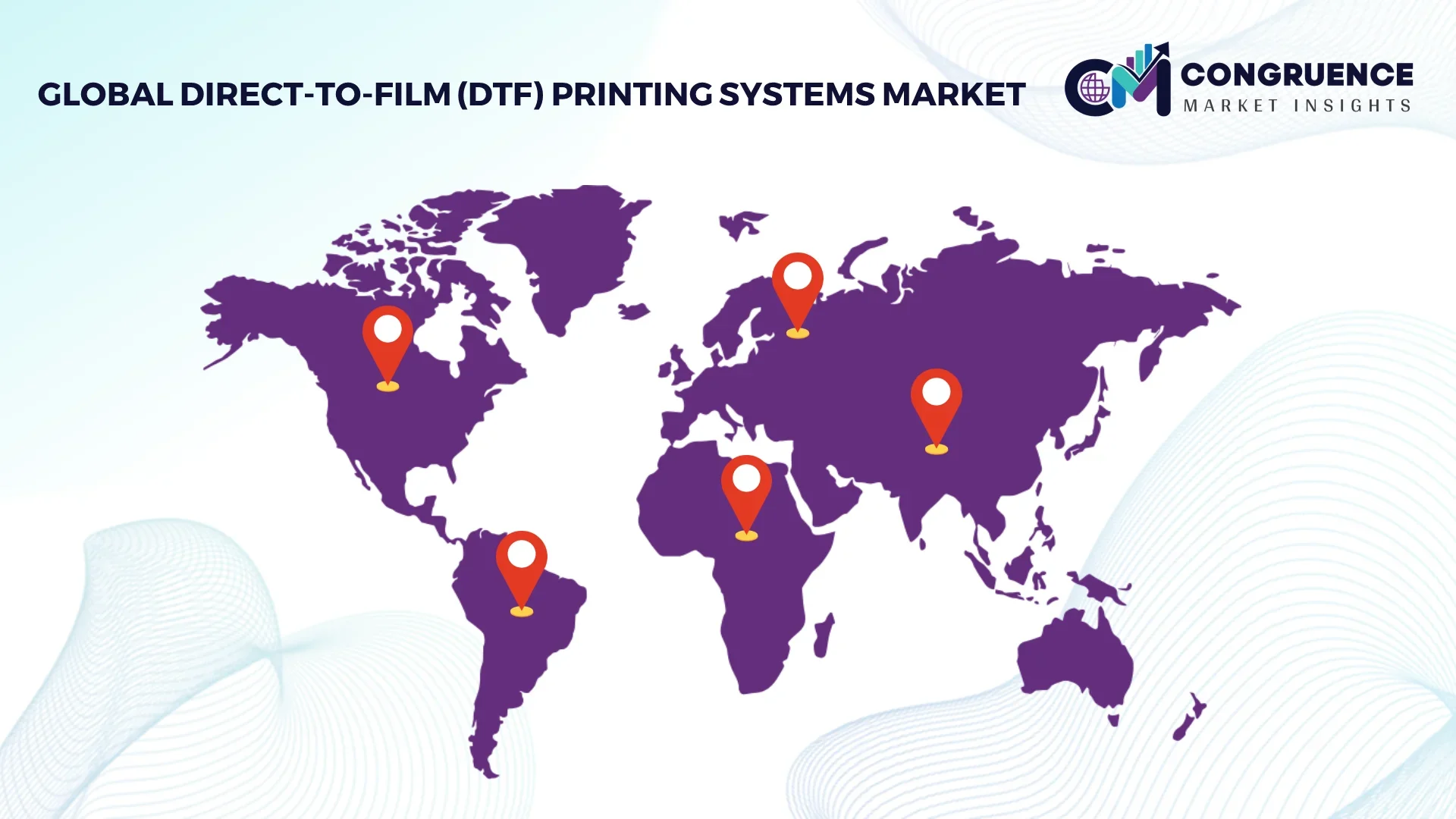
Regional performance in the Global Direct-to-Film (DTF) Printing Systems Market reflects structural differences in manufacturing intensity, digital adoption, regulatory priorities, and end-user behavior. In 2025, North America led in value-based adoption due to a dense base of commercial print service providers, high automation penetration, and strong demand from apparel, promotional products, and specialty textiles. Europe followed with approximately 26% share, shaped by sustainability regulations, eco-ink standards, and premium-quality textile production clusters in Germany, Italy, and the UK. Asia-Pacific represented roughly 24% of the market in 2025 but dominated in production volume, driven by export-oriented garment hubs, e-commerce expansion, and rapid SME adoption. South America contributed around 7%, led by Brazil and Argentina with growing digital textile modernization, while the Middle East & Africa held about 5%, supported by rising construction, hospitality branding, and industrial labeling applications. Across regions, automation, AI-enabled color management, and low-energy curing technologies are redefining competitive positioning and reshaping supply chains.
North America holds approximately 38% market share in 2025, underpinned by strong adoption among commercial print houses, sportswear brands, and promotional merchandise providers. The apparel, advertising, and industrial labeling sectors are primary demand drivers, with thousands of small and mid-sized printers integrating DTF into mixed production lines. Federal and state-level incentives for sustainable manufacturing—particularly low-VOC inks and energy-efficient curing—are accelerating upgrades to compliant systems. Technological momentum is visible in AI-based RIP software, automated powder applicators, and cloud-based production scheduling that reduces rework rates and downtime. Local equipment integrators are increasingly offering modular DTF lines that can scale from 300 to over 1,500 prints per day, helping SMEs compete with large contract printers. Regional consumer behavior favors rapid customization and same-week delivery, which has pushed enterprises in healthcare merchandising and financial services branding to adopt DTF for short-run, high-precision applications.
Europe accounts for roughly 26% of the market in 2025, with Germany, the UK, France, Italy, and Spain as leading national contributors. Strict EU sustainability frameworks—such as REACH compliance, circular-economy directives, and carbon-reporting requirements—are pushing printers toward water-based inks, recyclable films, and low-energy curing systems. Apparel fashion, technical textiles, and premium home décor segments are major demand pillars. European manufacturers are actively piloting AI-driven color calibration and waste-reduction software that minimizes ink overspray and material scrap. Several regional equipment suppliers are introducing compact automated DTF lines tailored for artisanal and high-design production studios. Consumer behavior in Europe increasingly favors traceable, eco-labeled textile products, creating demand for transparent, explainable digital printing workflows that document material origin and environmental impact.
Asia-Pacific is the fastest-growing region and the largest in production volume, with the regional market valued at approximately USD 82 Million in 2025. China, India, Japan, Vietnam, and Bangladesh are top-consuming countries, anchored by massive garment manufacturing ecosystems and rapidly expanding online retail platforms. Large-scale textile clusters are investing in automated DTF lines integrated with ERP systems, conveyorized curing, and robotic powder application to support export orders at scale. Innovation hubs in Shenzhen, Guangzhou, and Bangalore are accelerating software-driven color management, predictive maintenance, and defect detection. Local players are rolling out cost-optimized, high-speed printers capable of over 2,000 prints per day for mass customization. Regional consumer behavior is strongly influenced by e-commerce and mobile commerce, where fast turnaround personalized apparel is becoming a core differentiator for brands.
South America holds about 7% regional share, led by Brazil and Argentina, where apparel branding, sports merchandising, and media-related customization are expanding. Investments in energy-efficient production facilities and digital textile parks are gradually modernizing legacy printing infrastructure. Government trade policies aimed at reducing import dependence have encouraged local assembly of digital printers and consumables. Brazil’s growing fashion-tech sector is experimenting with hybrid DTF–DTG workflows to serve domestic brands and regional exporters. Consumer behavior is closely tied to media, entertainment, and language localization, increasing demand for short-run, culturally customized merchandise such as event apparel, football jerseys, and promotional textiles.
The Middle East & Africa region represents roughly 5% of the market, with key growth in the UAE, Saudi Arabia, and South Africa. Demand is rising from construction signage, industrial labeling, corporate uniforms, and hospitality branding. Large-scale urban development projects are boosting requirements for durable, high-quality textile graphics. Governments are promoting local manufacturing and free-trade zones that facilitate equipment imports and technology partnerships. Smart-factory initiatives in the UAE are integrating automated DTF workflows with cloud-based monitoring. Consumer behavior varies widely, but corporate buyers increasingly prioritize fast turnaround, consistent quality, and localized language printing for uniforms and promotional materials.
United States – 29% Market Share: Dominance driven by high automation penetration, dense network of print service providers, and strong demand from custom apparel and promotional merchandise.
China – 18% Market Share: Leadership rooted in massive garment manufacturing capacity, export-oriented production, and rapid adoption of automated digital textile technologies.
The competitive environment in the Direct-to-Film (DTF) Printing Systems Market is increasingly dynamic and moderately fragmented, with 20+ active competitors ranging from established printer manufacturers to specialized digital print innovators. Leading players maintain strong strategic positions through continuous product launches, partnerships, and technology-driven differentiation. Collectively, the top 5 companies account for an estimated ~42–48% combined share of global installations, underscoring both concentrated leadership and opportunities for emerging challengers. Strategic initiatives such as collaborative ink and film co-development, automation innovations, and integrated software solutions are shaping competition. For example, significant product introductions in 2024–2025 include advanced roll-to-roll DTF printers, AI-enhanced RIP software, and hybrid DTF hardware platforms designed to address diverse fabric types. Market leaders are also forming alliances to secure consumables compatibility, streamline supply chains, and expand regional footprints.
Innovation trends include the integration of automation for film feeding and curing, AI-driven color management, and predictive maintenance systems that reduce downtime and improve throughput. Partnerships between hardware manufacturers and consumable developers are strengthening ecosystem lock-ins and supporting customer retention. New entrants are focusing on niche segments, such as eco-friendly inks and specialty films, while established firms are leveraging broader digital print portfolios to cross-sell DTF solutions into existing customer bases.
Kornit Digital Ltd.
Brother International Corporation
Ricoh Company, Ltd.
ColDesi, Inc.
aeoon Technologies GmbH
Adelco Screen Process Ltd.
Axiom America, LLC
Mutoh
STS Inks
Prestige DTF
Procolored
The Direct-to-Film (DTF) Printing Systems Market is increasingly shaped by technological advancements that enhance productivity, quality, and operational efficiency. Automation and workflow integration are core trends; manufacturers are developing systems that automate film feeding, powder application, curing, and post-print processes, reducing labor costs and improving consistency. AI-driven RIP software is enabling smarter color profiling, layout optimization, and real-time print adjustments, supporting complex, multi-color designs with fewer errors and reduced waste. In high-volume environments, advanced printhead engineering is boosting print speeds without compromising resolution, making industrial DTF systems capable of output levels suited for commercial applications.
Emerging hybrid UV-DTF technology combines standard DTF with UV curing, delivering textured or glossy effects that appeal to premium fashion and accessory markets. Innovations in adhesive powders are producing softer prints with improved hand feel while maintaining durability. Sustainable materials are also a key focus; companies are introducing recyclable PET films and water-based pigment inks, aligning production with eco-conscious end-user demands and tightening environmental standards. Specialty films with metallic, glitter, or holographic effects are expanding creative possibilities and supporting differentiation in consumer-facing products.
Integration with cloud connectivity and IoT is enabling remote monitoring and predictive maintenance, reducing downtime and enhancing operational visibility. These technologies are critical for mid-size and enterprise printers aiming to scale operations efficiently. Compact, entry-level DTF printers equipped with smart software are also broadening access for SMEs and startups, expanding the overall market footprint.
• In January 2025, Roland DG Corporation launched the new TY-300 Direct-to-Film production transfer printer, now available globally following its debut in Japan in September 2024. The TY-300 delivers enhanced image quality, high productivity, and cost-performance for custom apparel and décor applications, supporting a wide range of fabrics and complex design transfers. Source: www.rolanddg.com
• In January 2026, Roland DG introduced significant technical enhancements to the TY-300 DTF printer, including doubled white ink capacity and workflow optimizations. These updates improve continuous production runs, reduce downtime, and enhance color rendering and opacity control—strengthening its efficiency and reliability for high-duty apparel printing environments. Source: www.prnewswire.com
• In January 2025, Epson announced its first wide-format Direct-to-Film printer, the SureColor G6070, designed for garment decorators seeking reliability, ease of use, and consistent print quality with minimal maintenance. The G6070 expands Epson’s product line into versatile DTF solutions for apparel customization. Source: www.news.epson.com
• In April 2025, Mimaki Engineering Co., Ltd. unveiled the UV-DTF Printer “UJV300DTF-75”, its first UV-curable DTF system, aimed at high-quality, hard and soft ink combinations with stable functions and reduced maintenance needs for custom goods production. Sales are scheduled around June 2025, with expected strong adoption in customizable product segments. Source: www.mimaki.com
The Direct-to-Film (DTF) Printing Systems Market Report offers a comprehensive overview of the industry’s breadth, covering equipment types, technology trends, application verticals, geographic regions, and end-user segments. It encompasses hardware innovations across manual/semi-automatic systems, fully automated production lines, hybrid DTF-DTG platforms, and roll-to-roll configurations designed for high-volume textile printing. The report also examines consumables such as films, inks, adhesive powders, and ancillary components like curing units and heat presses, providing insight into how material choices impact print quality, durability, and operational workflows.
In addition to type segmentation, the report details application areas including custom apparel, promotional products, industrial textiles, and home décor, analyzing distinct usage patterns and demand drivers in each vertical. Geographic coverage spans North America, Europe, Asia-Pacific, South America, and Middle East & Africa, comparing regional maturity, infrastructure trends, regulatory influences, and local consumer behaviors. It evaluates how sustainability initiatives, automation adoption, and digital transformation strategies vary across markets.
End-user analysis considers commercial print service providers, apparel manufacturers, SMEs, and in-house brand production units, highlighting differences in technology adoption, scale requirements, and workflow optimization practices. Technological insights include the impact of automation, AI-based software, hybrid printing solutions, and eco-friendly materials on competitive positioning. Emerging niche segments such as specialty films, IoT-enabled printers, and cloud-integrated production management systems are also explored, making the report a valuable resource for strategic decision-making, investment evaluation, and innovation road-mapping in the DTF printing ecosystem.
| Report Attribute / Metric | Details |
|---|---|
| Market Revenue (2025) | USD 293.0 Million |
| Market Revenue (2033) | USD 467.0 Million |
| CAGR (2026–2033) | 6.0% |
| Base Year | 2025 |
| Forecast Period | 2026–2033 |
| Historic Period | 2021–2025 |
| Segments Covered |
By Type
By Application
By End-User Insights
|
| Key Report Deliverables | Revenue Forecast, Market Trends, Growth Drivers & Restraints, Technology Insights, Segmentation Analysis, Regional Insights, Competitive Landscape, Regulatory & ESG Overview, Recent Developments |
| Regions Covered | North America; Europe; Asia-Pacific; South America; Middle East & Africa |
| Key Players Analyzed | Seiko Epson; Mimaki; Roland DG; Kornit Digital; Brother; Ricoh; ColDesi; aeoon Technologies; Adelco; Axiom America; Mutoh; STS Inks; Prestige DTF; Procolored |
| Customization & Pricing | Available on Request (10% Customization Free) |




