
Reports
The Global Content Authoring Tools Market was valued at USD 1,519.64 Million in 2024 and is anticipated to reach a value of USD 4,068.57 Million by 2032, expanding at a CAGR of 13.1% between 2025 and 2032. This growth is driven by the accelerating shift toward e-learning platforms and enterprise-level digital content creation across corporate and academic sectors.
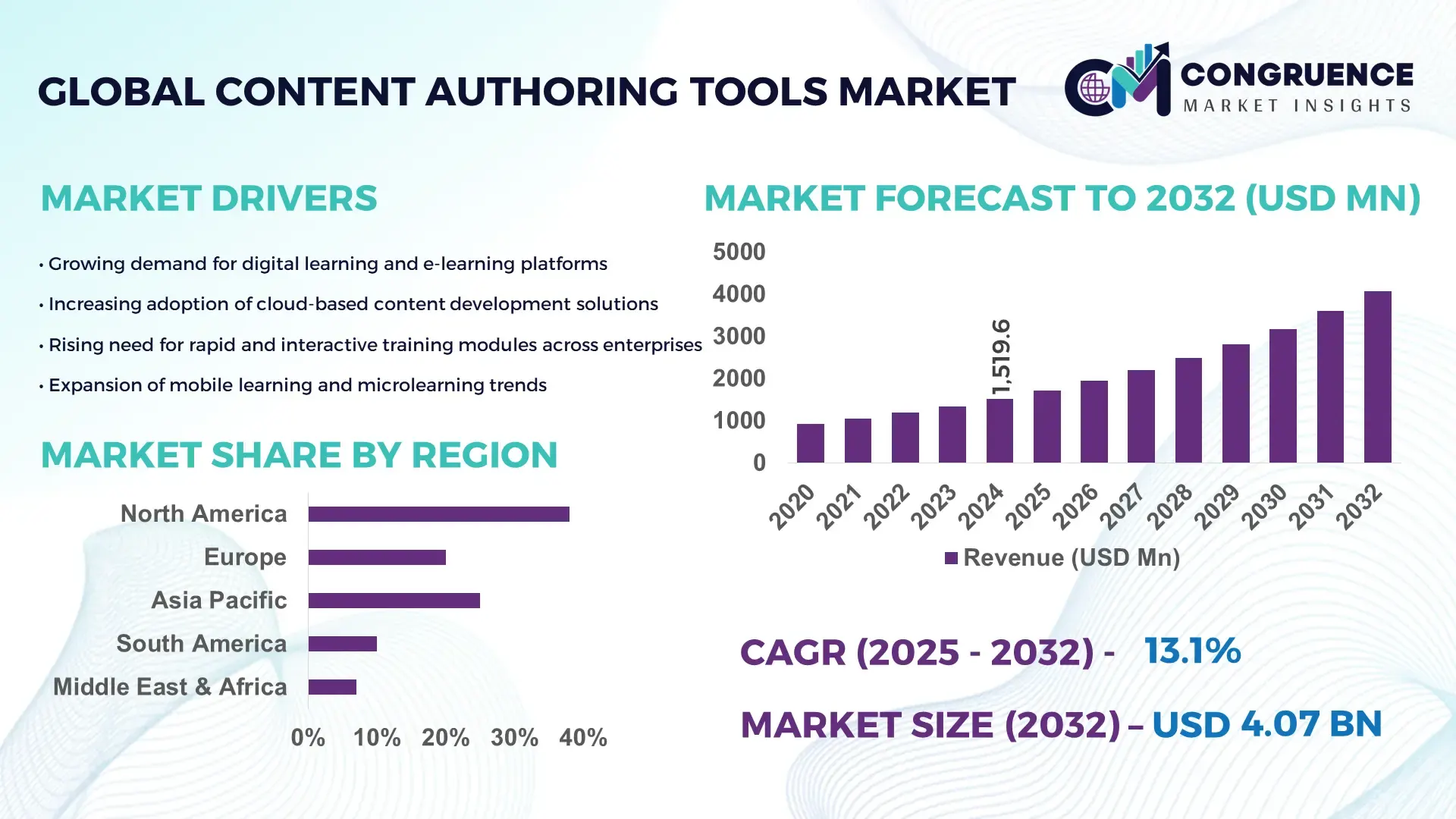
The United States leads the global Content Authoring Tools market, driven by large-scale investments in digital learning infrastructure, AI-driven personalization, and cloud-based authoring solutions. In 2024, over 68% of U.S. enterprises integrated content authoring platforms into learning management systems, while EdTech investments surpassed USD 22 billion. The country’s technology ecosystem also supports advanced interoperability standards, enhancing tool compatibility across multimedia and immersive content applications in higher education and corporate training environments.
Market Size & Growth: Valued at USD 1,519.64 Million in 2024, projected to reach USD 4,068.57 Million by 2032, growing at a CAGR of 13.1%, fueled by the expanding digital learning and corporate training demand.
Top Growth Drivers: 61% rise in e-learning platform adoption, 47% efficiency gain in digital content production, and 54% increase in enterprise upskilling initiatives.
Short-Term Forecast: By 2028, organizations are expected to achieve a 38% reduction in content creation time due to automation and collaborative cloud workflows.
Emerging Technologies: Integration of AI-powered content generation, immersive VR/AR training modules, and natural language-enabled authoring assistants are reshaping tool functionality.
Regional Leaders: North America projected at USD 1.5 Billion, Europe at USD 1.1 Billion, and Asia-Pacific at USD 900 Million by 2032, with Asia-Pacific leading in EdTech adoption rates.
Consumer/End-User Trends: High adoption among corporate L&D departments, universities, and online course providers focusing on interactive and mobile-optimized content formats.
Pilot or Case Example: In 2024, Adobe implemented an AI-based authoring pilot for enterprise users, achieving a 42% improvement in cross-platform content delivery speed.
Competitive Landscape: Adobe dominates with approximately 26% share, followed by Articulate Global, iSpring Solutions, dominKnow, and Lectora.
Regulatory & ESG Impact: Increasing compliance with accessibility standards such as WCAG 2.1 and sustainable digital content strategies are influencing procurement decisions.
Investment & Funding Patterns: Over USD 2.4 billion invested in EdTech authoring solutions since 2023, with growing venture capital focus on SaaS-based collaborative platforms.
Innovation & Future Outlook: AI-enabled adaptive learning paths, real-time analytics, and low-code authoring environments will define future market evolution, enhancing learner engagement and instructional design efficiency.
The Content Authoring Tools market is increasingly shaped by demand from sectors such as education technology, corporate training, and digital publishing. Key innovations include AI-assisted content design, microlearning module development, and multilingual content frameworks. Regulatory trends emphasizing accessibility and data privacy, coupled with digital transformation initiatives in emerging economies, are fostering consistent growth. Regional consumption is dominated by North America and Europe, while Asia-Pacific shows rapid expansion due to government-backed digital literacy programs. The future outlook indicates strong alignment between cloud collaboration tools, AI integration, and scalable training infrastructure across global industries.
The strategic relevance of the Content Authoring Tools Market lies in its pivotal role in driving the digital transformation of education, corporate learning, and training ecosystems worldwide. As enterprises increasingly adopt cloud-based and AI-integrated authoring platforms, the market is witnessing a measurable rise in operational efficiency and instructional design quality. Advanced AI-driven authoring delivers a 45% improvement in content creation speed compared to traditional manual tools, significantly enhancing time-to-market for learning modules. North America dominates in volume, while Europe leads in adoption with nearly 63% of enterprises integrating AI-assisted tools into their learning management systems.
By 2027, machine learning-based adaptive content systems are expected to improve learner engagement and performance metrics by 38%, while automation could reduce content maintenance costs by 30%. Firms are committing to measurable ESG improvements such as achieving a 25% reduction in digital energy consumption from cloud-hosted content by 2030. In 2024, Microsoft achieved a 41% improvement in content accessibility through its AI-empowered training material optimization initiative. These quantifiable outcomes highlight the synergy between technology, compliance, and sustainability. Moving forward, the Content Authoring Tools Market will remain a cornerstone of organizational agility, enabling scalable content ecosystems that reinforce resilience, regulatory alignment, and sustainable digital innovation across sectors.
The surge in enterprise digital training initiatives is a primary driver for the Content Authoring Tools Market. With over 72% of global corporations implementing e-learning modules to enhance workforce skills, demand for scalable authoring platforms has risen significantly. AI-enabled authoring systems streamline content updates and personalize training, leading to a 50% increase in learner retention rates. Furthermore, the integration of content tools into existing HR and learning management systems improves efficiency in onboarding and compliance training. The expanding hybrid work model further necessitates on-demand learning, positioning content authoring platforms as an essential component of modern organizational learning strategies.
Despite rapid growth, the Content Authoring Tools Market faces challenges related to high initial implementation costs and limited interoperability among diverse platforms. Integrating advanced authoring tools with legacy learning management systems requires significant technical adaptation, often increasing deployment timelines by up to 35%. Smaller organizations find these costs restrictive, particularly when scaling across multiple departments or regions. Additionally, the lack of standardized content formats complicates cross-platform compatibility, reducing efficiency and limiting content reusability. These operational hurdles create entry barriers and demand greater focus on open standards, plug-in integrations, and cloud-based modular systems to ensure long-term scalability and return on investment.
The integration of AI, AR, and VR technologies presents major growth opportunities for the Content Authoring Tools Market. AI-based tools are enabling automated content tagging, voice integration, and adaptive learning features that enhance user engagement. Immersive technologies such as AR and VR have expanded training applications in healthcare, manufacturing, and defense, improving knowledge retention by up to 60%. Furthermore, the increasing adoption of cloud-based SaaS platforms provides flexibility for remote content collaboration. As educational institutions and enterprises prioritize experiential learning and simulation-based training, the market is positioned for substantial expansion driven by continuous innovation in content interactivity and personalization.
Data security and compliance challenges remain critical concerns for the Content Authoring Tools Market. With growing data exchange across cloud-based authoring environments, protecting intellectual property and learner information has become increasingly complex. Inconsistent data protection laws across regions add to operational risks, as firms must comply with frameworks such as GDPR and CCPA. In 2024, nearly 29% of organizations reported delays in content rollout due to compliance audits or cybersecurity vulnerabilities. Moreover, unauthorized data access and limited encryption protocols hinder user trust. Strengthening multi-layered security, adopting end-to-end encryption, and ensuring audit-ready data governance are vital to sustaining global market confidence and growth momentum.
• Expansion of AI-Driven Authoring Automation: The integration of artificial intelligence is transforming how content is designed, edited, and deployed. Over 68% of leading e-learning and corporate training platforms now use AI algorithms to automate content creation, translation, and tagging. These solutions reduce manual editing time by approximately 45%, allowing rapid course deployment and higher learning engagement. Adaptive AI systems also enable real-time personalization, which has increased learner satisfaction scores by 37% across enterprise deployments.
• Growing Demand for Cloud-Based Collaborative Authoring Platforms: The shift toward remote and hybrid learning has accelerated the adoption of cloud-based authoring tools. By 2024, nearly 72% of organizations adopted cloud collaboration systems to enable simultaneous content creation and review across teams. This trend has resulted in a 42% improvement in project turnaround time and a 33% reduction in content duplication errors. Cloud environments also support secure data storage and automated version control, enabling consistent quality management across large-scale digital education networks.
• Rise of Immersive and Interactive Learning Experiences: Immersive technologies such as augmented and virtual reality are gaining traction in content authoring workflows. Approximately 48% of institutions are incorporating AR/VR-based authoring for simulation-driven training programs, particularly in healthcare, defense, and manufacturing. Interactive modules improve knowledge retention by up to 60% and reduce training costs by 35% compared to traditional video-based methods. The demand for immersive authoring templates and 3D scenario builders continues to grow globally.
• Emphasis on Accessibility, Localization, and Compliance Integration: Accessibility and localization have emerged as core priorities in content authoring. Around 64% of enterprises have implemented authoring solutions supporting WCAG 2.1 and ADA compliance standards. Multilingual content generation has expanded to cover over 100 languages, reducing translation expenses by 40%. Moreover, automated compliance audits integrated within authoring platforms have improved review efficiency by 28%, ensuring adherence to global learning and digital inclusion frameworks.
The Content Authoring Tools Market is segmented into types, applications, and end-user categories, each contributing distinctly to the industry’s evolution. By type, cloud-based platforms dominate due to their scalability, integration capabilities, and support for real-time collaboration across teams, accounting for a significant portion of total deployments. In terms of applications, e-learning and corporate training segments lead, driven by the surge in digital transformation initiatives and the expansion of online education ecosystems. End-user analysis highlights educational institutions and large enterprises as the principal adopters, utilizing authoring tools to enhance curriculum development, compliance training, and content localization. Collectively, these segments illustrate a market that is increasingly data-driven, automation-oriented, and aligned with global digital upskilling trends.
Cloud-based Content Authoring Tools currently account for approximately 46% of total adoption, primarily due to their flexibility, cross-platform integration, and reduced IT infrastructure costs. The demand for SaaS-based authoring environments continues to expand as organizations prioritize remote collaboration and seamless learning management system integration. On-premise tools, representing around 28% of the market, remain relevant for sectors requiring enhanced data security and regulatory compliance. Hybrid authoring solutions, combining on-premise control with cloud scalability, hold 18% share and are steadily gaining traction among large enterprises. The fastest-growing type—AI-enabled authoring systems—shows a projected CAGR of 14.5%, driven by automation in content creation, adaptive assessments, and multilingual support features. Other specialized types, including VR/AR-integrated authoring software, collectively account for 8%, catering to industries focusing on immersive learning and simulations.
E-learning and corporate training applications lead the Content Authoring Tools Market, accounting for approximately 49% of global usage, as organizations increasingly shift toward digital knowledge management and workforce upskilling. Academic course development follows with 26% share, supporting universities and online education providers adopting cloud-based content frameworks. Meanwhile, product documentation and compliance training collectively contribute around 19%, driven by stringent operational and regulatory requirements. The fastest-growing application—interactive and simulation-based learning—shows a projected CAGR of 15.2%, powered by AR/VR integration and gamified content creation that boosts learner engagement by 52%. Content marketing and multimedia design occupy the remaining 6%, primarily within creative and communications sectors utilizing responsive authoring tools for cross-platform storytelling.
Educational institutions dominate the Content Authoring Tools Market, representing nearly 41% of total adoption as universities and training centers expand digital course delivery and remote learning infrastructure. Large enterprises follow closely with 35%, leveraging AI-integrated authoring tools to enhance employee onboarding, compliance management, and skill development. SMEs contribute around 16%, driven by cost-effective cloud solutions that reduce dependency on external content developers. The fastest-growing end-user category—government and public sector organizations—exhibits a projected CAGR of 14.8%, propelled by investments in digital literacy and e-governance training initiatives. Other end-users, including non-profit and healthcare institutions, collectively account for 8%, using authoring tools for community education and patient training programs.
North America accounted for the largest market share at 38% in 2024; however, Asia-Pacific is expected to register the fastest growth, expanding at a CAGR of 14.5% between 2025 and 2032.
Europe followed with 27% of the global market, while South America and the Middle East & Africa collectively represented 15%. North America’s leadership stems from strong enterprise digital adoption and robust EdTech infrastructure, with more than 65% of corporate learning platforms using AI-assisted authoring tools. In contrast, Asia-Pacific’s rapid growth is attributed to large-scale investments in digital education and mobile-first learning technologies, particularly in China and India, where e-learning enrollment increased by 48% in 2024. Europe maintains consistent momentum due to stringent regulatory compliance standards and widespread adoption in corporate training and public institutions.
North America holds approximately 38% of the global Content Authoring Tools Market, supported by mature digital infrastructure and high enterprise adoption across education, healthcare, and financial services. The region benefits from government-backed digital training initiatives promoting workforce reskilling and e-learning modernization. The U.S. and Canada together account for over 70% of regional consumption, with over 60% of Fortune 500 companies integrating AI-based authoring platforms for compliance and corporate learning. Key players like Articulate Global are expanding adaptive content capabilities to enhance accessibility standards. The region also shows strong consumer behavior toward self-paced learning, with 57% of users preferring microlearning modules on cloud platforms.
Europe represents around 27% of the Content Authoring Tools Market, led by Germany, the UK, and France. Regulatory alignment with digital accessibility standards such as EN 301 549 has accelerated demand for compliant and sustainable authoring platforms. European enterprises are investing heavily in multilingual content systems, with 59% of companies using AI for translation and localization tasks. Local players are developing low-code authoring tools designed to meet GDPR and ESG reporting requirements. The region’s consumer behavior reflects strong institutional adoption, with public universities and government agencies increasingly leveraging authoring systems for digital course delivery and employee upskilling.
Asia-Pacific holds the fastest-growing position, accounting for nearly 21% of global market volume in 2024, driven by rapid expansion in China, India, Japan, and South Korea. Educational digitization initiatives and government-supported e-learning programs are fostering large-scale adoption. Over 62% of organizations in the region utilize mobile-compatible authoring platforms, and cloud infrastructure investment surged by 36% in 2024. Local players in India and Japan are introducing AI-powered tools that support multilingual and gamified content, aligning with regional preferences for interactive learning. Consumer behavior is characterized by high mobile engagement and increased use of low-bandwidth adaptive authoring solutions for remote and rural education accessibility.
South America accounts for roughly 8% of the global Content Authoring Tools Market, led by Brazil and Argentina. The region’s focus on educational digitalization and language localization has fueled steady adoption, particularly among schools and training institutions. Government reforms supporting online education have expanded digital literacy programs that rely on interactive authoring tools. Over 40% of regional enterprises now incorporate bilingual content authoring capabilities to serve multilingual audiences. Local software providers in Brazil are investing in cloud-based authoring to improve content accessibility and compliance. Consumer behavior indicates a growing preference for blended learning models, with 52% of users engaging in hybrid classroom-digital training formats.
The Middle East & Africa region holds an estimated 6% of the global Content Authoring Tools Market, driven by educational modernization programs in the UAE, Saudi Arabia, and South Africa. Investment in cloud-based and AI-enabled platforms increased by 31% in 2024, reflecting the region’s digital transformation priorities. Governments are promoting localized content development to enhance workforce training efficiency. Over 48% of institutions in the Gulf region now use cloud authoring tools for vocational and professional learning. Regional players are emphasizing Arabic-language support and compliance with data privacy laws. Consumer trends reveal strong demand from public-sector education programs and enterprise-driven skill development initiatives.
United States (31%) – Dominates due to advanced digital learning infrastructure, high enterprise adoption rates, and continuous AI integration in content design and delivery.
China (19%) – Leads in mobile-based and cloud-deployed content authoring platforms, driven by national e-learning policies and extensive government investment in digital education infrastructure.
The global Content Authoring Tools market remains moderately consolidated, with the top five companies accounting for approximately 52% of total market share as of 2024. Around 40 to 45 active vendors compete globally, spanning enterprise-level solution providers and emerging cloud-based authoring platforms. Competition is intensifying as enterprises prioritize scalable and AI-integrated authoring tools to streamline corporate training, e-learning, and digital content creation processes.
Between 2023 and 2024, over 60 product upgrades and 25 mergers or partnerships were recorded, with companies focusing on integrating generative AI and multimodal editing capabilities. The introduction of multilingual authoring features and adaptive content design frameworks has become a central differentiator. Notably, cloud deployment models now contribute to more than 68% of platform adoption worldwide, indicating a shift toward Software-as-a-Service (SaaS) ecosystems.
Innovation-driven competition has also led to a 35% increase in investment in user experience (UX) optimization and accessibility compliance. Vendors are leveraging AI-powered analytics and automation tools to enable data-driven authoring, reducing production time by nearly 40%. North American and European firms dominate the premium segment, while Asia-Pacific vendors are gaining ground through cost-effective and mobile-first authoring solutions, underscoring the global competitiveness and regional diversification of this market.
Adobe Inc.
Articulate Global, LLC
TechSmith Corporation
Elucidat Ltd.
iSpring Solutions, Inc.
Lectora (by eLearning Brothers)
dominKnow Inc.
Easygenerator
Knowbly Learning Systems
Gomo Learning
TalentCards
Xyleme, Inc.
BrainCert Inc.
Composica Enterprise
Evolve Authoring
Technological advancements are rapidly redefining the landscape of the Content Authoring Tools market, with AI, automation, and cloud-based architectures emerging as dominant enablers of digital content production. In 2024, nearly 72% of new authoring solutions integrated AI-powered writing and adaptive learning capabilities, significantly improving personalization and efficiency. Machine learning algorithms are being leveraged to automate repetitive authoring tasks such as quiz generation, translation, and layout optimization, reducing development time by approximately 45%.
Cloud-based deployment remains a cornerstone of market growth, with 68% of enterprise users now adopting SaaS-based authoring environments for remote access and real-time collaboration. Multi-user editing and cloud storage synchronization have boosted content development productivity by up to 35%, especially among global teams in education, healthcare, and finance. Additionally, hybrid deployment models combining local data storage with cloud scalability are gaining traction among government and regulated industries prioritizing data security.
Immersive technologies such as Virtual Reality (VR) and Augmented Reality (AR) are transforming learning experiences, with about 30% of high-end authoring platforms integrating 3D simulations and interactive storytelling modules. Furthermore, integration with Learning Management Systems (LMS) and Learning Experience Platforms (LXP) has risen by 40% year-over-year, enabling seamless content analytics and learner tracking. Emerging trends like voice-enabled authoring, multilingual natural language processing, and no-code authoring interfaces are expanding accessibility and inclusivity. These innovations are pushing the industry toward intelligent, connected, and adaptive content ecosystems—empowering organizations to enhance scalability, learner engagement, and operational agility in the digital knowledge economy.
In March 2023, Adobe Inc. launched Adobe Express for Enterprise, integrating its generative AI engine Firefly and enterprise creative workflows to enable any team member to produce branded multimedia content at scale.
In September 2023, Adobe announced Adobe GenStudio for Enterprises, a unified content-supply-chain solution combining Creative Cloud, Workfront, Experience Manager and generative AI models to streamline ideation, creation, and activation of digital assets.
In May 2023, iSpring Solutions released a feature within its authoring suite allowing users to build custom illustrated characters aligned with brand identity and learner diversity, enhancing personalization for e-learning content. (eLearning Industry)
In December 2024, Articulate Global, LLC launched its AI Assistant functionality fully integrated into its authoring workflow, enabling course creators to produce content up to nine times faster through guided generation of lesson outlines, media and quizzes. (Articulate)
This report provides a comprehensive analysis of the Content Authoring Tools market across multiple dimensions. It covers segmentation by solution type—such as cloud-based authoring platforms, on-premise enterprise tools, hybrid models, and AI-enabled authoring systems—and evaluates the competitive positioning of each. Geographic coverage spans North America, Europe, Asia-Pacific, South America and Middle East & Africa with regional analysis of adoption rates, infrastructure readiness, and content consumption patterns. The application segment includes e-learning and corporate training, academic course development, compliance and certification content, and content marketing and multimedia production. Technology focus areas include generative AI, immersive and simulation-based authoring (AR/VR), multilingual localization workflows, analytics-driven content optimization, and cloud collaboration tools. Industry focus spans education, healthcare, manufacturing, finance, public sector and media & entertainment, highlighting how each vertical deploys authoring tools for distinct objectives. The report also addresses emerging niches such as micro-learning modules, mobile-first content, low-code/no-code authoring, and adaptive learning experiences. For decision-makers, this scope ensures visibility into tool functionality, deployment modes, regional adoption trends, technology maturity and vertical-specific use-cases, enabling strategic investment, vendor evaluation and content strategy alignment.
| Report Attribute/Metric | Report Details |
|---|---|
Market Revenue in 2024 | USD 1519.64 Million |
Market Revenue in 2032 | USD 4068.57 Million |
CAGR (2025 - 2032) | 13.1% |
Base Year | 2024 |
Forecast Period | 2025 - 2032 |
Historic Period | 2020 - 2024 |
Segments Covered | By Types
By Application
By End-User
|
Key Report Deliverable | Revenue Forecast, Growth Trends, Market Dynamics, Segmental Overview, Regional and Country-wise Analysis, Competition Landscape |
Region Covered | North America, Europe, Asia-Pacific, South America, Middle East, Africa |
Key Players Analyzed | Adobe Inc. , Articulate Global, LLC , TechSmith Corporation , Elucidat Ltd., iSpring Solutions, Inc., Lectora (by eLearning Brothers), dominKnow Inc., Easygenerator, Knowbly Learning Systems, Gomo Learning, TalentCards, Xyleme, Inc., BrainCert Inc., Composica Enterprise, Evolve Authoring |
Customization & Pricing | Available on Request (10% Customization is Free) |




