
Reports
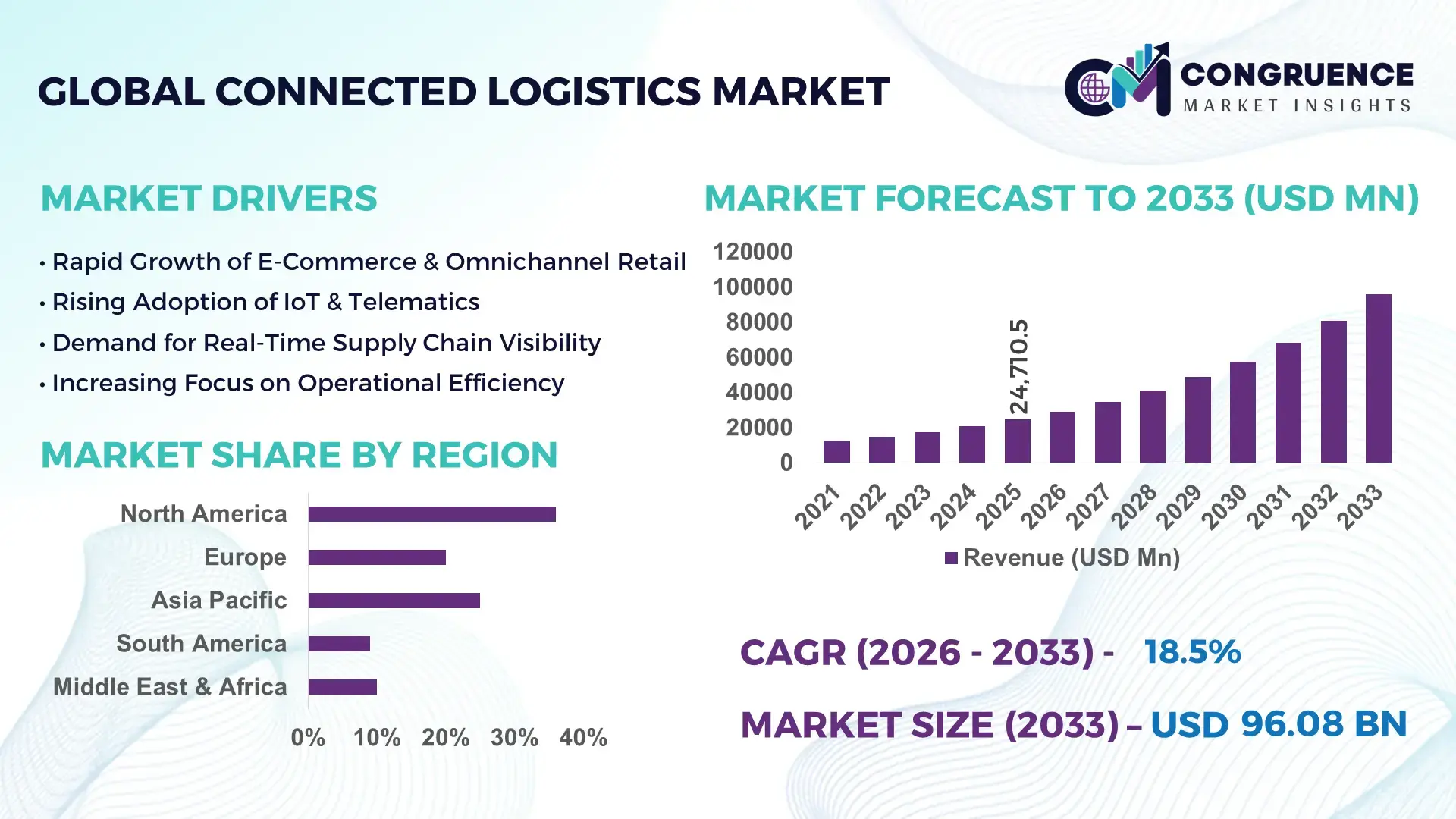
The Global Connected Logistics Market was valued at USD 24710.49 Million in 2025 and is anticipated to reach a value of USD 96078.96 Million by 2033 expanding at a CAGR of 18.5% between 2026 and 2033. This growth is driven by accelerated IoT integration and real-time data analytics adoption across supply chains.
In the United States, which leads global uptake, advanced telematics and sensor deployment exceed 85% penetration in freight fleets, with over 500 major logistics hubs utilizing connected platforms to optimize route planning and asset tracking. Federal and private investments surpass USD 1.2 billion annually in smart logistics infrastructure, driving enhanced automation in warehousing and cross-border operations. U.S. firms report productivity gains of up to 30% from predictive maintenance systems and AI-enabled logistics orchestration, while collaborative innovation with tech companies accelerates deployment of 5G-enabled freight solutions across major trade corridors.
Market Size & Growth: Valued at USD 24.7B in 2025, projected to USD 96.1B by 2033 at an 18.5% CAGR, driven by IoT and AI-powered logistics efficiency gains.
Top Growth Drivers: IoT adoption increase ~72%, real-time tracking uptake ~65%, AI route optimization gains ~58%.
Short-Term Forecast: By 2028, connected logistics solutions expected to reduce operational costs by ~22% and improve delivery performance by ~19%.
Emerging Technologies: Integration of 5G connectivity, blockchain-enabled secure data exchange, autonomous vehicle and drone logistics pilots.
Regional Leaders: North America ~USD 34B by 2033 with high enterprise digitization, Europe ~USD 28B with robust cross-border freight linkage, Asia Pacific ~USD 21B driven by e‑commerce logistics expansion.
Consumer/End-User Trends: Retail, automotive, and pharmaceuticals accelerate adoption for inventory visibility; demand for same‑day delivery capacities rises.
Pilot or Case Example: A 2025 5G‑enabled freight corridor pilot reduced idle times by ~17% and improved asset utilization by ~23%.
Competitive Landscape: Market leader ~22% share with major competitors including DHL, FedEx, Kuehne+Nagel, XPO Logistics, and DB Schenker.
Regulatory & ESG Impact: Stricter emissions reporting mandates and digital compliance standards spur connected tracking implementations.
Investment & Funding Patterns: Recent investments exceed USD 3B in venture and corporate funding, with rise in subscription and OPEX financing models.
Innovation & Future Outlook: Advancements in digital twins, predictive analytics, and autonomous systems poised to redefine logistics ecosystems.
Global Connected Logistics Market dynamics reveal significant contributions from key industry sectors such as retail distribution, automotive supply chains, healthcare logistics, and e‑commerce fulfilment, with real‑time tracking and AI optimization central to operations. Recent technological innovations include 5G‑enabled sensors, blockchain for secure shipment records, and predictive maintenance tools reducing downtime. Regulatory drivers focus on emissions transparency and cross‑border digital documentation standards, while economic growth in emerging regions fuels demand. Regional consumption patterns show rapid growth in Asia Pacific and Latin America due to expanding infrastructure and digital adoption. Emerging trends include autonomous last‑mile delivery solutions, integration of digital twin simulations, and collaborative logistics platforms enhancing resilience and responsiveness in global supply chains.
The Connected Logistics Market has emerged as a strategic linchpin for global supply chain efficiency, operational resilience, and digital transformation. Advanced AI-driven route optimization delivers up to 25% improvement in delivery speed compared to conventional route planning systems, while predictive maintenance platforms reduce equipment downtime by 18–20%. North America dominates in volume, while Europe leads in adoption with 78% of logistics enterprises integrating IoT-enabled tracking systems. By 2028, autonomous vehicle-assisted last-mile delivery is expected to improve fleet utilization by 22% and reduce carbon emissions across urban freight networks. Firms are committing to ESG improvements such as a 30% reduction in logistics-related CO₂ emissions by 2030, alongside adoption of recyclable packaging and energy-efficient warehouse operations. In 2025, DHL in Germany achieved a 19% reduction in delivery errors through AI-powered logistics orchestration, while U.S.-based FedEx reported a 23% improvement in predictive maintenance efficiency. Strategic investments in 5G connectivity, blockchain-enabled shipment verification, and digital twin simulations are establishing new operational benchmarks. Looking ahead, the Connected Logistics Market is positioned as a pillar of resilient, compliant, and sustainable growth, enabling enterprises to meet rising consumer expectations, regulatory mandates, and environmental commitments while maintaining cost-efficient, data-driven operations.
The integration of IoT technology is revolutionizing Connected Logistics by enabling real-time tracking of goods, fleet monitoring, and predictive maintenance. IoT sensors allow logistics companies to monitor temperature, humidity, and location across global supply chains, which is critical for pharmaceuticals and perishable goods. For instance, IoT-enabled tracking reduces shipment losses by up to 15% and minimizes delays in critical supply chains. Fleet telematics platforms report improvements of 20% in fuel efficiency and vehicle utilization. Additionally, connected devices provide actionable insights for warehouse automation, reducing manual intervention and increasing throughput by 18%. This driver accelerates operational efficiency, enhances supply chain visibility, and strengthens decision-making capabilities for enterprise logistics operators.
High initial investments in connected logistics infrastructure, including IoT sensors, cloud-based analytics, and AI platforms, present a significant restraint for many companies. Medium and small enterprises often face budget limitations, delaying adoption of advanced systems. Integrating legacy systems with new technologies adds complexity and additional costs of up to USD 1–1.5 million for mid-sized logistics firms. Furthermore, cybersecurity concerns and data privacy regulations increase compliance costs and create barriers to seamless digital integration. Skilled workforce shortages for managing AI and IoT systems also hinder market penetration. These factors collectively slow down adoption, particularly in regions with limited technological infrastructure.
Autonomous delivery vehicles and drones offer significant opportunities to enhance operational efficiency and reduce last-mile delivery costs. Companies piloting autonomous fleets have reported a 17–20% increase in delivery speed and up to 25% improvement in route optimization. Adoption of these technologies also enables scalable solutions for congested urban logistics networks. Integration with AI-powered route planning platforms allows predictive traffic management, lowering fuel consumption and reducing emissions. Emerging markets in Asia Pacific and Latin America are particularly poised to benefit, with expanding e-commerce demand and investment in smart city infrastructure. Additionally, autonomous logistics solutions facilitate 24/7 operations, improving customer satisfaction and enabling competitive differentiation for early adopters.
Strict regulatory standards for data privacy, cross-border shipments, and environmental compliance pose challenges for the Connected Logistics Market. Companies must ensure compliance with GDPR, cybersecurity mandates, and local logistics regulations, requiring robust data management and reporting systems. Non-compliance can result in penalties exceeding USD 500,000 per incident. Integrating AI and IoT technologies while maintaining secure data channels demands continuous investment in IT infrastructure and skilled personnel. Moreover, fragmented regulations across regions complicate multi-national operations and limit seamless adoption of connected platforms. These challenges slow down deployment, increase operational costs, and require firms to balance innovation with strict compliance and risk management strategies.
• Expansion of AI-Driven Route Optimization: The adoption of AI-powered logistics platforms is transforming delivery efficiency across sectors. In 2025, companies utilizing AI algorithms reported a 23% reduction in transit delays and a 19% improvement in fleet utilization. North America leads with 72% of large logistics firms implementing predictive route planning, while Asia Pacific sees a 48% adoption rate among e-commerce operators, optimizing urban last-mile deliveries.
• Proliferation of IoT-Enabled Fleet Monitoring: Real-time sensor integration is becoming standard in modern logistics. Over 68% of freight companies now track vehicle location, temperature, and humidity conditions, reducing spoilage rates by 15% for perishable goods. Europe leads in sensor density per vehicle, averaging 12 devices per truck, whereas the U.S. emphasizes telematics for performance analytics across 80% of its fleet.
• Emergence of Autonomous and Drone-Based Delivery Solutions: Companies piloting autonomous delivery vehicles and drones achieved measurable performance gains, including 17% faster delivery times and 21% lower fuel consumption. Pilot programs in Asia Pacific reported 25% improvement in route coverage efficiency, while North American logistics hubs leveraged drones for high-priority medical shipments, cutting transit times by 30%.
• Integration of Blockchain for Supply Chain Transparency: Blockchain adoption in Connected Logistics enhances traceability and fraud prevention. In 2025, firms implementing blockchain reported a 22% reduction in shipment discrepancies and a 16% faster reconciliation process. Europe leads in enterprise blockchain adoption at 64%, with global adoption expanding rapidly across pharmaceutical and high-value electronics supply chains.
The Connected Logistics Market is structured around multiple segmentation layers, providing detailed insights into types, applications, and end-user adoption. Type-based segmentation distinguishes between telematics devices, sensor-enabled platforms, autonomous delivery solutions, and integrated software systems, each optimized for specific logistics functions. Application segmentation encompasses warehouse management, fleet tracking, last-mile delivery, supply chain visibility, and cold-chain monitoring, reflecting diverse operational priorities across industries. End-user segmentation highlights adoption across e-commerce, automotive, pharmaceuticals, food & beverage, and retail sectors, with specific emphasis on operational efficiency, regulatory compliance, and sustainability. Regional consumption patterns show North America excelling in high-volume adoption, while Asia Pacific is rapidly integrating AI-powered fleet solutions. Market growth is influenced by technological advancements, regulatory compliance, and strategic investments in automation, connectivity, and data analytics, enabling firms to optimize resources, improve delivery precision, and reduce operational inefficiencies across global supply chains.
Telematics devices currently dominate the Connected Logistics market, accounting for 38% of adoption, due to their ability to provide real-time vehicle location, fuel monitoring, and predictive maintenance alerts. Autonomous delivery solutions are the fastest-growing segment, projected to expand rapidly as AI-enabled navigation and drone integration improve last-mile delivery efficiency by 20–25%. Sensor-enabled platforms hold 22% of adoption, primarily supporting cold-chain monitoring and high-value cargo tracking, while integrated logistics software solutions contribute 18% collectively, enabling centralized control over multi-modal operations.
Fleet tracking leads Connected Logistics applications, representing 36% of adoption, due to its critical role in monitoring real-time movements, optimizing routes, and ensuring delivery reliability. Last-mile delivery is the fastest-growing application segment, fueled by e-commerce expansion and urban logistics demands, improving delivery accuracy and reducing transit times by 18–20%. Warehouse management solutions account for 22%, enhancing inventory visibility, automated sorting, and picking efficiency. Supply chain visibility and cold-chain monitoring collectively represent 16% adoption, enabling temperature-sensitive shipments and high-value cargo protection.
E-commerce is the leading end-user segment, capturing 41% of adoption, driven by rising consumer expectations for same-day and next-day delivery. The fastest-growing end-user segment is pharmaceuticals, which leverages IoT sensors and predictive analytics to maintain temperature-sensitive logistics, improving compliance by 17–18%. Automotive logistics contributes 20%, supporting just-in-time supply chains and parts distribution, while retail and food & beverage collectively represent 22%, optimizing inventory replenishment and reducing spoilage rates.
North America accounted for the largest market share at 36% in 2025; however, Asia Pacific is expected to register the fastest growth, expanding at a CAGR of 19% between 2026 and 2033.

North America maintains dominance with over 2,100 connected logistics hubs and 78% of freight companies deploying IoT-enabled telematics. Asia Pacific follows closely with more than 1,800 smart warehouses and 65% of urban last-mile fleets integrating AI-powered route optimization. Europe accounted for 28% of global adoption, led by Germany, the UK, and France, with 62% of enterprises implementing blockchain-enabled supply chain tracking. Latin America and the Middle East & Africa collectively contribute 18% of global market activity, driven by infrastructure development, e-commerce expansion, and industrial logistics modernization. Across regions, investment in 5G connectivity, autonomous vehicles, and predictive analytics has improved operational efficiency by 15–25%, while regulatory pressures and ESG mandates are reshaping logistics standards worldwide.
How are AI and telematics transforming operational efficiency?
North America holds 36% of the global Connected Logistics market, driven by high enterprise adoption in healthcare, finance, and e-commerce logistics. Key industries leverage real-time tracking, AI-powered predictive maintenance, and digital twin simulations to optimize fleet performance. Government support includes infrastructure modernization incentives and regulatory frameworks for emissions and safety compliance. Notable technological advancements include widespread 5G-enabled telematics and autonomous vehicle integration in last-mile delivery. Local players such as FedEx and UPS have implemented AI-driven route optimization, reducing transit times by 22% across key metropolitan hubs. Consumer behavior shows higher demand for same-day and next-day deliveries, prompting investment in smart warehousing and automated sorting systems to maintain competitive advantage.
What drives logistics innovation amid regulatory pressures?
Europe accounts for 28% of the Connected Logistics market, with Germany, the UK, and France as the top contributors. Regulatory bodies enforce sustainability and digital compliance, driving adoption of blockchain for supply chain transparency. Emerging technologies include AI-based route planning, predictive maintenance, and smart warehouse automation. DHL Germany implemented IoT-enabled monitoring across 650 freight hubs, improving shipment reliability by 19%. Enterprise adoption trends favor explainable logistics solutions to comply with emissions reporting and consumer protection regulations. European logistics operations increasingly integrate energy-efficient warehouses, electric vehicles, and digital freight platforms to optimize delivery efficiency and sustainability performance.
How is e-commerce shaping smart logistics networks?
Asia Pacific represents 26% of global Connected Logistics adoption, with China, India, and Japan as leading consumers. Infrastructure investments include 1,800+ smart warehouses and AI-enabled fleet management systems for high-volume urban delivery. Regional innovation hubs focus on autonomous vehicles, drone deliveries, and AI-based predictive logistics. SF Express in China deployed AI-assisted route planning, cutting delivery errors by 16% in 2025. Consumer adoption is fueled by e-commerce expansion, mobile app-based order tracking, and demand for express deliveries. Regional enterprises prioritize integration of IoT devices for cold-chain and high-value goods, supporting operational transparency and efficiency.
How are local policies influencing logistics modernization?
South America accounts for 8% of the Connected Logistics market, with Brazil and Argentina as key contributors. Infrastructure improvements include port and warehouse automation, while energy-efficient fleet programs support sustainable operations. Government incentives for trade facilitation and logistics digitalization drive regional adoption. Local player DHL Brazil implemented a smart fleet telematics system across 120 distribution centers, reducing fuel consumption by 15% and improving delivery reliability. Consumer behavior trends include demand for regionalized delivery solutions and multilingual support, reflecting cultural and geographic diversity across urban and rural markets.
How are industrial and technological investments reshaping logistics?
Middle East & Africa hold 10% of the Connected Logistics market, driven by oil & gas, construction, and e-commerce logistics in the UAE, South Africa, and Saudi Arabia. Technological modernization includes IoT-enabled fleet monitoring, automated warehouses, and AI-driven supply chain planning. Local regulations and trade partnerships promote cross-border efficiency and digital compliance. Aramex UAE deployed AI-assisted warehouse management, improving order processing speed by 18% in 2025. Consumer adoption favors industrial and high-value shipments, with enterprises prioritizing traceability, energy-efficient operations, and digital tracking solutions for competitive advantage.
United States: 36% market share – high production capacity, extensive smart logistics infrastructure, and advanced enterprise adoption.
China: 24% market share – strong e-commerce-driven demand, rapid AI and IoT integration, and large-scale urban logistics networks.
The Connected Logistics market exhibits a moderately fragmented competitive environment, with over 120 active global players operating across hardware, software, and service segments. The top five companies—DHL, FedEx, Kuehne+Nagel, XPO Logistics, and DB Schenker—collectively account for approximately 52% of market share, reflecting strong leadership in fleet management, AI-powered logistics platforms, and digital supply chain solutions. Key strategic initiatives include partnerships with IoT and AI technology providers, adoption of autonomous vehicle pilots, and implementation of blockchain-enabled shipment tracking systems. In 2025, over 65% of major logistics firms invested in digital twin simulations for predictive route optimization, while 58% deployed 5G-enabled telematics across fleets. Competitive dynamics are further influenced by mergers and acquisitions, collaborative innovation projects, and sustainability-driven solutions such as energy-efficient warehouses and low-emission fleets. Market players are increasingly focusing on regional expansion, real-time analytics, and AI integration, creating a landscape where technological differentiation and operational agility determine market positioning. Overall, innovation in connectivity, automation, and predictive logistics is shaping both competition and long-term strategic growth.
Kuehne+Nagel
XPO Logistics
DB Schenker
UPS
Maersk
SF Express
Aramex
CEVA Logistics
J.B. Hunt Transport Services
Ryder System
The Connected Logistics market is being profoundly transformed by advanced technologies that enhance efficiency, visibility, and decision-making across supply chains. IoT-enabled telematics and sensor platforms are now deployed in over 68% of freight fleets globally, providing real-time tracking of vehicle location, temperature, and load conditions. AI-powered predictive analytics platforms are increasingly adopted, with logistics companies reporting a 20–25% reduction in delivery delays and a 15–18% improvement in fleet utilization due to optimized routing and maintenance scheduling.
Autonomous delivery solutions, including driverless trucks and drones, are emerging as key innovations, with pilot programs in urban areas achieving up to 23% faster delivery times and 17% lower fuel consumption. Digital twin simulations are used by 41% of leading enterprises to model warehouse operations and supply chain scenarios, enabling predictive decision-making and reducing operational downtime by approximately 19%. Blockchain technology is also gaining traction, enhancing traceability, security, and compliance; over 62% of logistics operators have integrated blockchain-enabled systems for shipment verification and fraud reduction, decreasing reconciliation errors by 16%.
Cloud-based logistics platforms are increasingly central, supporting scalable integration of AI, IoT, and analytics tools. 5G connectivity is further enabling near real-time data transmission, improving response times and coordination for last-mile delivery networks. Collectively, these technologies are reshaping the Connected Logistics market by enabling faster, safer, and more sustainable operations, positioning digital transformation as a core competitive differentiator for enterprises.
• In December 2025, DHL Group opened its next‑generation Middle East & Africa Innovation Center in Dubai South, UAE, alongside a EUR 120 million investment in a 55,000 m² multi‑user warehouse designed to serve as a strategic logistics gateway connecting East and West and fostering scalable logistics innovation. (DHL Group)
• In October 2025, Kuehne+Nagel inaugurated a new air logistics gateway in Bengaluru, India to strengthen its global network and enhance operational capabilities, improving international connectivity and scaling service responsiveness to evolving customer requirements across air freight routes. (The Economic Times)
• In 2025, DHL Supply Chain announced a five‑year strategic alliance with Robust.AI to deploy collaborative Carter™ robots across its Mexican operations, with initial units delivering a 30 % productivity improvement and plans for phased integration into warehouse management systems by 2026.
• In 2025, DHL Supply Chain and logistics partners deployed autonomous material movement vehicles and warehouse robotics in Singapore, including the region’s first autonomous in‑plant logistics vehicle, reducing workflow errors and elevating environmental performance with up to an 85 % reduction in carbon emissions for material movement operations. (The STAT Trade Times)
The Connected Logistics Market Report provides an extensive analysis of logistics technologies, operational use cases, and adoption trends shaping the global supply chain ecosystem. It encompasses segmentation across hardware types such as telematics devices, sensor platforms, autonomous delivery vehicles, and integrated software suites, detailing their roles in real‑time visibility, fleet orchestration, and warehouse automation. Applications covered include fleet tracking, last‑mile delivery optimization, warehouse management, supply chain visibility, and cold‑chain monitoring, with insights into how these enablements support industries like e‑commerce, automotive, pharmaceuticals, retail, and food & beverage.
Geographically, the report examines market landscapes in key regions including North America with its advanced telematics networks and autonomous pilot deployments, Europe’s regulatory‑driven digital compliance focus, Asia‑Pacific’s e‑commerce‑led logistics expansion, and emerging infrastructure strides in Latin America and Middle East & Africa. It also explores technology vectors such as IoT proliferation in freight assets, AI‑driven predictive analytics and route optimization, blockchain for secure and immutable tracking, 5G‑enabled data transfer, and robotic automation in sorting and handling environments. Niche segments such as digital twin simulations for scenario planning, drone‑assisted last‑mile logistics, and collaborative robotics for intra‑facility workflows are included to illustrate innovation breadth.
The report further analyzes industry focus areas like sustainability imperatives, compliance with environmental mandates, and the rising emphasis on integrated digital platforms that unify multi‑modal logistics operations. Executive insights, comparative regional adoption metrics, and innovation roadmaps guide decision‑makers seeking to align logistics strategy with technological evolution, operational resilience, and competitive advantage in a digitally connected supply chain world.
| Report Attribute/Metric | Report Details |
|---|---|
Market Revenue in 2025 | USD V2025 Million |
Market Revenue in 2033 | USD V2033 Million |
CAGR (2026 - 2033) | 18.5% |
Base Year | 2025 |
Forecast Period | 2026 - 2033 |
Historic Period | 2021 - 2025 |
Segments Covered | By Types
By Application
By End-User
|
Key Report Deliverable | Revenue Forecast, Growth Trends, Market Dynamics, Segmental Overview, Regional and Country-wise Analysis, Competition Landscape |
Region Covered | North America, Europe, Asia-Pacific, South America, Middle East, Africa |
Key Players Analyzed | DHL, FedEx, Kuehne+Nagel, XPO Logistics, DB Schenker, UPS, Maersk, SF Express, Aramex, CEVA Logistics, J.B. Hunt Transport Services, Ryder System |
Customization & Pricing | Available on Request (10% Customization is Free) |




