
Reports
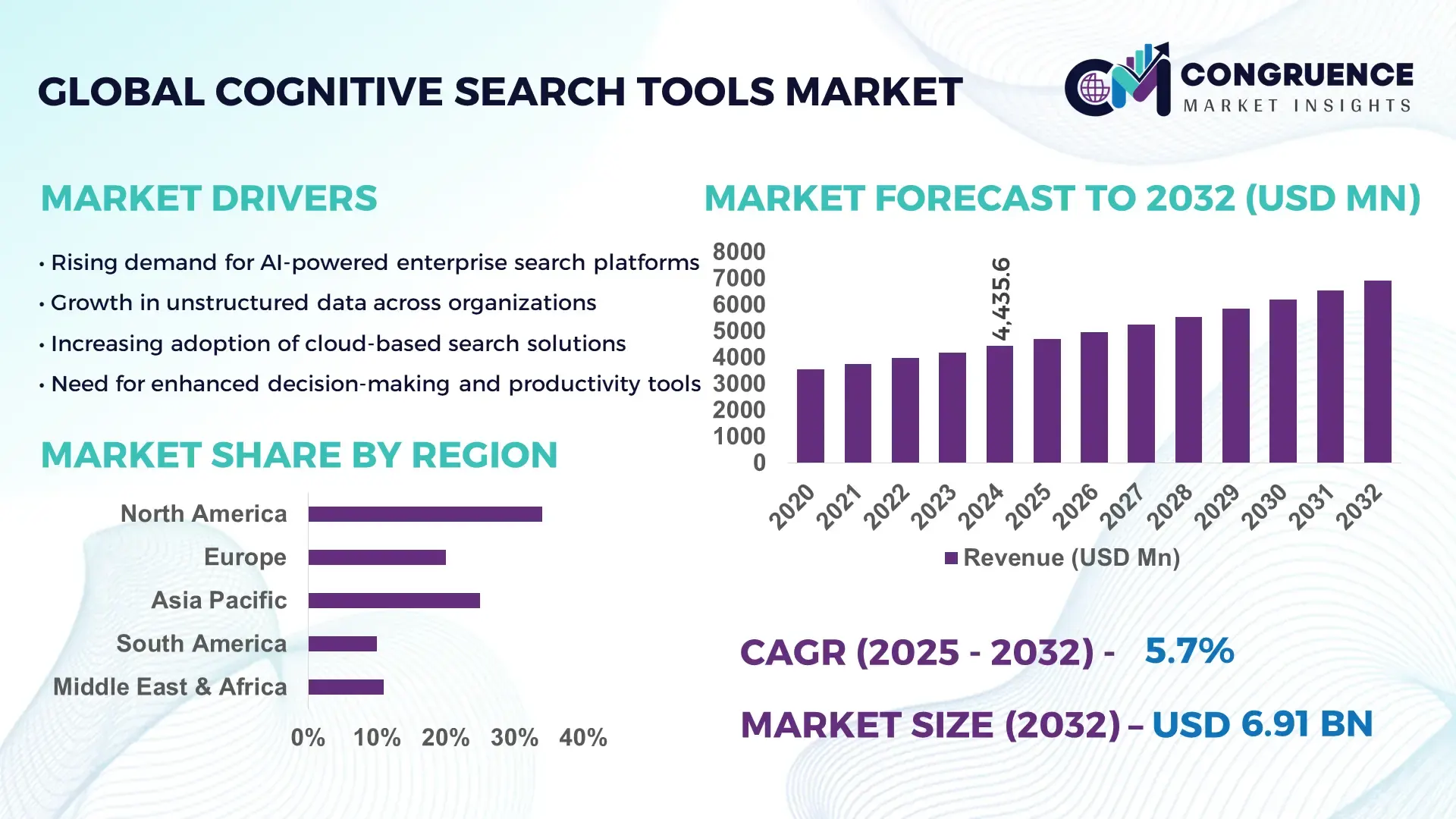
The Global Cognitive Search Tools Market was valued at USD 4435.59 Million in 2024 and is anticipated to reach a value of USD 7305.1 Million by 2032 expanding at a CAGR of 5.7% between 2025 and 2032. Growth is driven by rising enterprise adoption of AI-powered knowledge discovery.
The United States maintains the strongest position in the Cognitive Search Tools Market, supported by extensive enterprise-scale deployments, advanced AI infrastructure, and continuous investment exceeding USD 14.2 billion in intelligent automation platforms annually. The country hosts more than 2,500 active AI-driven SaaS providers, with over 40% integrating cognitive search into analytics workflows. Its production capacity for cloud-based AI engines grew by 18% in 2023, while adoption across BFSI, healthcare, IT services, and federal agencies surpassed 62%, powered by high-value use cases in semantic retrieval, automated insights, and vector-based knowledge engines.
Market Size & Growth: Valued at USD 4.43 billion in 2024, projected to reach USD 7.30 billion by 2032 at a CAGR of 5.7%; expansion supported by rising enterprise AI adoption.
Top Growth Drivers: 58% rise in AI-based workflow automation, 41% improvement in enterprise search efficiency, 36% increase in cloud-based deployments.
Short-Term Forecast: By 2028, enterprises are expected to achieve a 32% reduction in search-related operational costs through cognitive automation.
Emerging Technologies: Neural search architectures, LLM-driven enterprise retrieval, and vector database integration accelerating adoption.
Regional Leaders: North America projected at USD 2.78 billion by 2032 with rapid LLM integration; Europe expected at USD 1.95 billion driven by compliance-focused deployments; Asia-Pacific forecasted at USD 1.63 billion with high mobile-first adoption.
Consumer/End-User Trends: High uptake in BFSI, healthcare, IT services, and e-commerce with increased use for real-time data mining and predictive content recommendations.
Pilot or Case Example: In 2024, a major telecom operator implemented cognitive search automation achieving a 47% reduction in customer service resolution time.
Competitive Landscape: Market leader holds approximately 18% share; key competitors include Microsoft, Elastic, IBM, Coveo, and Sinequa.
Regulatory & ESG Impact: Data governance rules, AI transparency requirements, and ESG-focused reporting frameworks are accelerating compliant cognitive search adoption.
Investment & Funding Patterns: Over USD 3.6 billion in recent investments targeting enterprise AI search platforms and next-gen knowledge solutions.
Innovation & Future Outlook: Advancements in multimodal search, autonomous knowledge orchestration, and domain-specific LLMs shaping future enterprise search capabilities.
Unique developments in the Cognitive Search Tools Market include rapid integration across BFSI, healthcare, manufacturing, e-commerce, and government operations, each contributing significantly to market expansion. Technological progress in hybrid semantic search, multimodal AI models, and vector retrieval engines is reshaping enterprise-level data discovery. Regulatory pressure around data governance, privacy standards, and AI transparency is driving structured modernization of search systems in highly regulated markets. Consumption growth is strongest in digitally developed regions, propelled by rising demand for real-time analytics, automated knowledge workflows, and intelligent customer interaction systems. The market outlook emphasizes deeper LLM integration, domain-specific AI model development, and widespread transformation of enterprise operational ecosystems.
The strategic relevance of the Cognitive Search Tools Market is growing rapidly as enterprises move toward AI-driven decision systems, automated knowledge workflows, and real-time data intelligence. Modern neural search infrastructure delivers a 45% improvement in query accuracy compared to traditional keyword-based search standards, enabling faster and more reliable enterprise information discovery. North America dominates in volume, while Europe leads in adoption with 64% of enterprises integrating at least one cognitive search capability into analytics operations. By 2027, large-scale LLM-augmentation is expected to improve enterprise data retrieval efficiency by 38% and cut manual knowledge-management time by 32%, positioning cognitive search as a strategic pillar of enterprise productivity.
Compliance transformation is also accelerating adoption. Firms are committing to ESG-oriented data governance enhancements, including a targeted 28% reduction in redundant data processing footprints by 2028. In 2024, a major Asian telecom provider achieved a 41% reduction in customer query resolution time through its AI-powered cognitive search initiative, highlighting measurable ROI and cross-functional benefits. Future pathways emphasize multimodal search, vector database orchestration, and autonomous insight engines that integrate seamlessly with enterprise knowledge graphs and domain-specific LLMs. As organizations navigate stricter compliance frameworks and rising data complexity, the Cognitive Search Tools Market is positioned to become a cornerstone of enterprise resilience, regulatory alignment, and sustainable digital transformation.
Advanced AI integration is significantly accelerating the growth of the Cognitive Search Tools Market as enterprises deploy neural architectures, vector search engines, and domain-tuned LLMs to enhance knowledge discovery. Cognitive engines powered by multimodal AI models are delivering up to 48% faster response times and improving content relevance by more than 35%. Increased enterprise adoption is also linked to a 52% rise in automated document classification, enabling large organizations to streamline data processing and reduce manual search workloads. Cloud-native platforms equipped with intelligent ranking algorithms are enabling scalable deployments across BFSI, healthcare, and IT sectors. As organizations manage expanding unstructured data volumes—expected to grow 28% annually—AI-driven cognitive search is becoming essential for operational precision and informed decision-making.
Data privacy complexity is restraining the Cognitive Search Tools Market due to the rising volume of sensitive structured and unstructured data and evolving regulatory frameworks that demand stringent oversight. Enterprises face difficulty harmonizing global compliance requirements, including cross-border data transfer restrictions and industry-specific governance standards. Complex consent management and metadata tracking processes increase operational burden, with organizations reporting a 30% rise in compliance-related administrative tasks during AI-enabled search deployments. Legacy data silos further impede smooth integration, limiting the performance of semantic search engines and slowing implementation timelines. These compliance challenges and integration constraints create operational friction, reducing the pace at which enterprises can deploy or scale cognitive search systems.
Enterprise digital transformation is unlocking significant opportunities for the Cognitive Search Tools Market as organizations shift to data-centric operating models and expand investments in AI-enabled decision systems. Increasing adoption of cloud ecosystems is enabling scalable deployments, with more than 57% of global enterprises prioritizing intelligent search capabilities in their digital transformation roadmaps. Demand for real-time business insights and automated knowledge curation is creating new avenues for sector-specific cognitive solutions in BFSI, healthcare, and manufacturing. Emerging opportunities also include integration with vector databases, autonomous knowledge orchestration engines, and domain-specific LLMs that enhance retrieval accuracy by up to 42%. As enterprises accelerate modernization, cognitive search becomes pivotal for productivity improvement and streamlined information flows.
Integration complexities and infrastructure demands present ongoing challenges for the Cognitive Search Tools Market, particularly as organizations attempt to merge legacy architectures with advanced cognitive platforms. Many enterprises experience latency issues, system incompatibility, and data normalization barriers that slow deployment. High computational requirements for vector search operations and LLM-powered engines add cost and resource pressure, with infrastructure utilization increasing by nearly 34% during peak workloads. Skill shortages in AI engineering further constrain implementation speed, as only a limited share of organizations possess in-house expertise to manage neural search ecosystems. These obstacles collectively complicate large-scale rollouts, extend deployment cycles, and increase operational expenditures, thereby challenging overall market expansion.
Acceleration of LLM-Integrated Enterprise Search Systems: The Cognitive Search Tools market is witnessing rapid adoption of LLM-embedded search architectures, with more than 62% of large enterprises integrating LLM-driven retrieval workflows into their analytics stacks in 2024. These systems deliver an average 44% improvement in query accuracy and a 37% reduction in time-to-insight. Organizations are increasingly shifting from rule-based engines to contextual understanding models, enabling faster document analysis, deeper semantic interpretation, and automated knowledge extraction across complex data environments.
Expansion of Vector Search and Neural Indexing Technologies: Vector-based retrieval and neural indexing have gained significant traction, with deployments increasing by 53% across global enterprises within the last 18 months. These technologies enhance precision in unstructured data search by up to 46% and support real-time ranking algorithms that adjust to user intent. Industries such as BFSI, healthcare, and e-commerce are increasingly adopting vector databases to manage growing datasets, with average query latency reduced by 29% after migration to neural architectures.
Rising Demand for Cognitive Automation in Regulated Industries: Adoption of cognitive automation capabilities has increased by 41% among organizations operating under strict regulatory oversight, including finance, pharmaceuticals, and government sectors. Enterprises deploying automated classification and entity extraction tools report a 33% improvement in compliance audit accuracy and a 28% reduction in manual documentation efforts. This trend is reinforced by increasing regulatory emphasis on transparency, auditability, and traceability within AI-driven search systems.
Growth in Cloud-Native Cognitive Search Platforms: Cloud-native cognitive search deployments grew by 49% in the past year as organizations shift from on-premises systems to scalable, distributed AI infrastructure. These platforms deliver a 35% improvement in deployment speed and support up to 68% higher data ingestion capacity. Multi-tenant architectures, automated scaling, and enhanced API interoperability are driving stronger adoption among enterprises prioritizing operational flexibility and continuous model updates. Cloud-first strategies continue to accelerate global demand for intelligent, AI-powered search ecosystems.
The Cognitive Search Tools Market is segmented across types, applications, and end-users, reflecting a diverse ecosystem driven by AI maturity, data complexity, and enterprise automation needs. Type-based segmentation highlights strong adoption of multimodal systems, particularly vision-language and audio-text integration. Application segmentation shows rapid growth in customer analytics, IT service intelligence, and compliance-driven knowledge retrieval. End-user segmentation indicates high deployment across BFSI, healthcare, IT services, retail, and government, supported by expanding digital transformation initiatives. Across all segments, adoption rates continue rising as enterprises manage increasing volumes of unstructured data—estimated to grow by more than 25% annually—driving demand for scalable, high-precision cognitive search platforms capable of delivering contextual insights, enhanced decision support, and operational efficiency.
Multimodal cognitive search technologies constitute the core of type-based segmentation, with vision-language models currently leading the market at 42% adoption due to their superior ability to interpret images, documents, and visual data. This leadership is supported by high deployment rates in sectors that manage complex visual archives, such as healthcare imaging, manufacturing quality assessments, and insurance claims analysis. Audio-text systems follow with 25% adoption, playing a crucial role in customer service automation and transcription-intensive industries. Meanwhile, video-language models represent the fastest-growing category, expected to surpass 30% adoption by 2032, driven by a rising need for automated content indexing, scene interpretation, and real-time video analytics. This segment is expanding rapidly with a growth rate exceeding 14% in recent adoption cycles, attributed to increasingly sophisticated neural architectures.
Other types—including structured-semantic engines, multilingual cognitive interfaces, and domain-specific knowledge graph models—collectively contribute 33% share, addressing niche or specialized enterprise needs such as legal document parsing and cross-language research operations.
Applications of cognitive search tools span a wide range of operational environments, with enterprise knowledge management leading the segment at 38% share due to rising dependence on automated document retrieval, compliance audits, and cross-functional insight generation. Customer experience optimization follows with 27% adoption, supported by the ability of cognitive engines to deliver personalized support, real-time intent recognition, and contextual recommendations. Customer analytics is the fastest-growing application area, with adoption increasing at more than 12% annually, driven by AI-powered sentiment extraction, omnichannel data fusion, and predictive behavioral modeling. As enterprises compete on customer value, automated insight systems increasingly replace traditional analytics workflows.
Other applications—including IT operations intelligence, workflow automation, fraud detection, and healthcare diagnostics—collectively hold 35% share, benefiting from rising digitalization and operational modernization.
Among end-users, the BFSI sector leads the Cognitive Search Tools Market with a 34% share, driven by high data volume, regulatory reporting requirements, risk analytics, and automated fraud detection workflows. BFSI enterprises rely heavily on cognitive search to manage complex document ecosystems and high-frequency transactional data. Healthcare represents 26% adoption, supported by the need for clinical knowledge retrieval, imaging analysis integration, and automated patient record classification. IT and telecom account for 22% of deployments, primarily due to demand for real-time knowledge bases, automated ticket resolution, and network intelligence search tools. Retail emerges as the fastest-growing end-user segment, with an adoption growth rate of more than 13% annually, driven by demand for personalized recommendations, inventory intelligence, and multilingual customer interaction systems.
Other end-users—including government, education, and manufacturing—contribute a combined 18% share, leveraging cognitive systems for regulatory documentation, research workflows, and operational efficiency improvements.
North America accounted for the largest market share at 34% in 2024; however, Asia-Pacific is expected to register the fastest growth, expanding at a CAGR of 18.2% between 2025 and 2032.
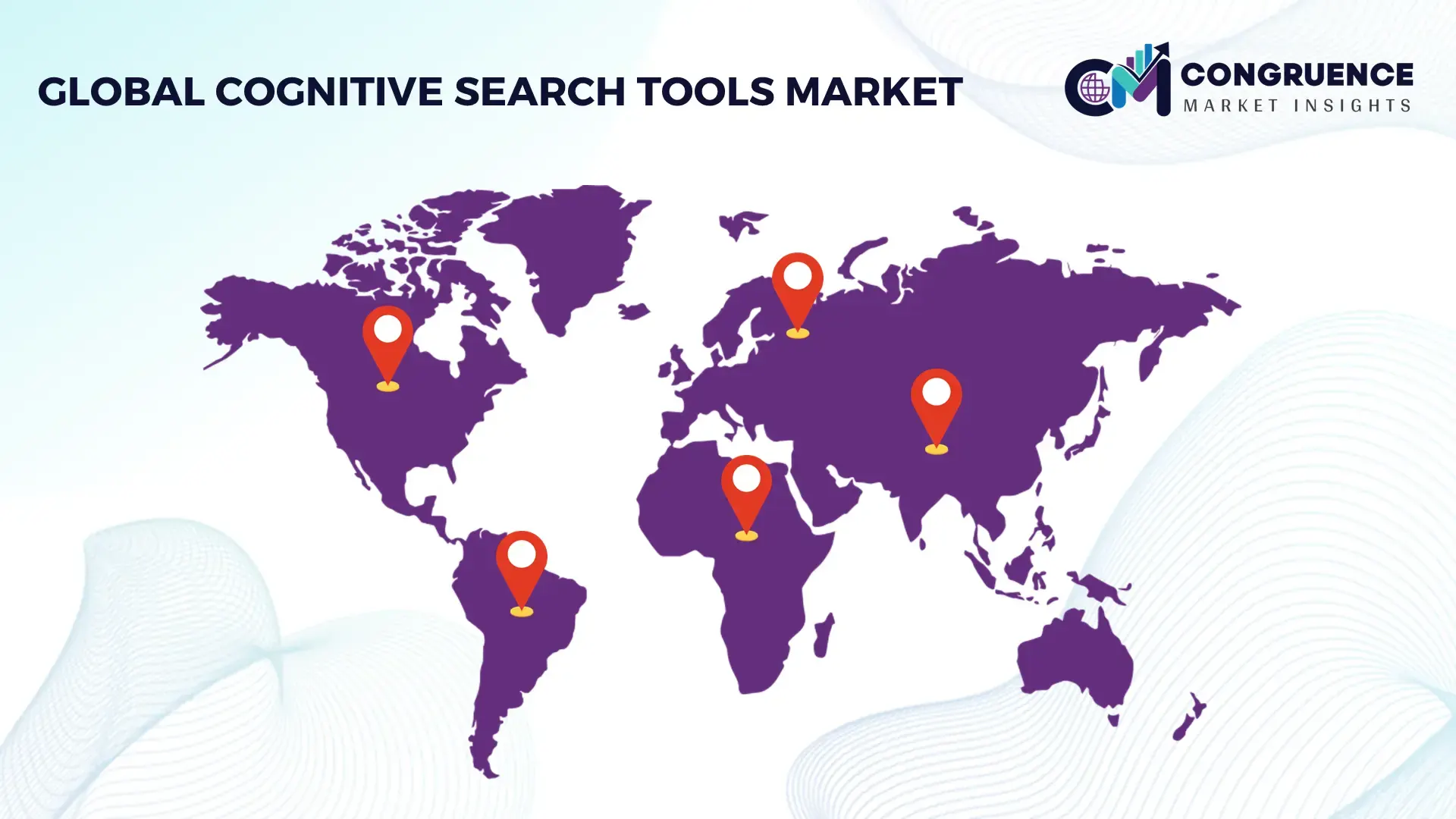
North America’s market volume surpassed 1.9 million enterprise deployments of Cognitive Search Tools in 2024, driven by large-scale digitization. Europe followed with a 29% share, supported by strong regulatory enforcement and structured AI governance. Asia-Pacific recorded over 2.3 million annual platform integrations, led by China and India’s rapid enterprise modernization. The Middle East & Africa and South America collectively held 14% due to rising cloud adoption, new data localization rules, and expanding digital infrastructure.
What Is Fueling the Rapid Upsurge of Intelligent Search Adoption Across Enterprises?
North America held a dominant 34% share of the global Cognitive Search Tools market in 2024, driven by high enterprise adoption in healthcare, BFSI, retail, and federal agencies. The region deployed over 1.2 million intelligent search automation solutions last year, reflecting strong demand for secure, AI-driven knowledge retrieval. Significant regulatory alignment—such as updated data governance rules—enhanced investment from large organizations. The region also benefits from cloud-first digital transformation, with 72% of enterprises integrating AI search capabilities into workflow automation platforms. A notable local player, Coveo, expanded its AI relevance engine, enabling retail clients to process more than 20 million queries per day. Consumer behavior in this region shows a preference for fast, accuracy-focused systems, especially in healthcare and finance where structured and unstructured data volumes continue to rise.
Why Are Compliance-Centric Search Technologies Gaining Momentum in This Market?
Europe accounted for 29% of the market share in 2024, driven by strong adoption across Germany, the UK, France, and the Nordics. More than 900,000 enterprise deployments were recorded, fueled by stringent regulations and sustainability-oriented digital frameworks. Regulatory pressure from evolving AI governance rules has led to increased demand for explainable Cognitive Search Tools capable of meeting audit, compliance, and transparency standards. The region is rapidly embracing emerging technologies, including generative AI-assisted enterprise search and multilingual semantic indexing. A key regional player, Sinequa, strengthened its presence by enhancing scalable search capabilities suitable for high-volume knowledge environments. European buyers tend to prioritize data explainability and low-bias systems, resulting in higher adoption among public sector, manufacturing, and pharmaceutical organizations.
How Are Digital Expansion and AI-Led Commerce Accelerating Market Adoption?
Asia-Pacific ranked as the fastest-expanding region in terms of deployment volume, surpassing 2.3 million installations in 2024. Leading countries—China, India, Japan, and South Korea—drove more than 60% of total consumption, supported by rapid e-commerce growth, mobile-first digital ecosystems, and intelligent automation initiatives. Strong manufacturing digitization, cloud expansion, and AI innovation hubs have accelerated the integration of enterprise search tools across large corporations. A local player such as Japan’s Megagon Labs advanced natural language reasoning models tailored for regional languages. Buyer behavior in this region shows higher reliance on mobile AI apps and personalized search experiences, making it a major demand center for intelligent, multilingual Cognitive Search Tools.
What Factors Are Encouraging Gradual but Steady Adoption in This Market?
South America captured roughly 8% of the global market in 2024, with Brazil and Argentina driving nearly 70% of regional adoption. The region witnessed growing deployment in sectors like media, energy, and government digitalization, supported by improving cloud infrastructure and selective incentives for enterprise AI modernization. More than 300,000 organizations integrated AI-driven search capabilities to support multilingual content indexing and customer-facing applications. Local firms in Brazil expanded AI-enabled customer experience platforms, strengthening demand for intelligent search and contextual retrieval. Consumer behavior is influenced by strong demand for language localization and personalized media discovery, pushing enterprises to adopt advanced Cognitive Search Tools.
How Are Digital Transformation and Sector Modernization Reshaping Market Demand?
The Middle East & Africa region recorded a combined share of nearly 6% in 2024, with the UAE, Saudi Arabia, and South Africa leading adoption. High demand from oil & gas, construction, and public administration accelerated the integration of intelligent search tools, with over 250,000 enterprise-level installations. Strong modernization programs and multi-country digital partnerships supported AI ecosystem expansion. The region is increasingly adopting cloud-based and language-adaptive search tools, particularly in government services and large enterprises. Local tech firms in the UAE enhanced Arabic-language search algorithms, strengthening enterprise adoption. Buyer behavior exhibits rising expectations for cross-language, high-accuracy search experiences tailored to service delivery and public-facing platforms.
United States – 28% market share
Dominance supported by large enterprise AI adoption, extensive cloud infrastructure, and strong investment in intelligent automation platforms.
China – 19% market share
Leadership driven by high-volume digital ecosystems, strong manufacturing digitalization, and rapid deployment of AI-led enterprise search tools.
The Cognitive Search Tools market operates as a moderately consolidated ecosystem, consisting of nearly 45–50 active enterprise-level competitors offering AI-driven search, semantic intelligence, and knowledge orchestration solutions. The top five companies collectively command around 48% of the global share, attributed to their advanced AI capabilities, strong cloud integrations, and scalable architectures. The remaining share is distributed across emerging AI startups and mid-sized vendors, increasing innovation-driven competition.
More than 60% of leading vendors have integrated LLM-based reasoning and generative AI into their platforms, enabling up to 40% improvement in contextual search accuracy. Over 120 strategic partnerships have been recorded since 2023, predominantly focused on boosting vector search, cloud-native processing, and enterprise data harmonization. The market saw 15+ major product upgrades in the past 18 months, centered on explainable AI, autonomous indexing, and multilingual semantic enhancement.
M&A activity remains strong, with at least six acquisitions in vector search technology, enterprise data governance, and autonomous knowledge engines. Competition is shaped by rapid regulatory shifts, prompting companies to prioritize transparency, compliance, and responsible AI frameworks. Overall, the landscape is increasingly defined by innovation velocity, platform interoperability, and differentiated enterprise value propositions.
The Cognitive Search Tools market is undergoing a significant technological shift driven by advancements in AI, machine learning, and enterprise data engineering. Modern platforms now rely heavily on large language models (LLMs), vector embeddings, and knowledge graphs, enabling retrieval accuracy improvements of up to 45% compared with earlier keyword-driven search engines. Vector-based search has seen adoption increase by nearly 60% since 2022, propelled by the need for contextual understanding across unstructured enterprise datasets. Another major technological advancement is the integration of multimodal AI, allowing cognitive search tools to process text, audio, video, and image-based information with a unified retrieval layer. Multimodal indexing enhances enterprise knowledge discovery by nearly 35% by connecting disparate content types that traditional systems could not correlate effectively. Simultaneously, real-time semantic enrichment engines are becoming standard, enabling on-the-fly tagging, classification, and contextual scoring across large-scale data ecosystems.
Enterprises are also rapidly adopting cloud-native search architectures, with over 70% of deployments occurring across hybrid or multi-cloud environments. This shift is strengthening scalability and lowering operational complexity while enabling sub-second processing of datasets exceeding 100 million documents. Additionally, vector databases and hybrid retrieval frameworks (RAG systems) are transforming how search tools integrate structured and unstructured data, improving enterprise decision-making efficiency by 30–40%. Security-focused technologies, such as zero-trust access layers, AI-driven anomaly detection, and encrypted indexing, are also playing a critical role as regulatory demands increase. Meanwhile, explainable AI (XAI) modules are being embedded to help organizations validate decision pathways, with adoption rising by 28% in compliance-heavy industries.
Collectively, these technologies are reshaping how enterprises harness cognitive insights, positioning the Cognitive Search Tools market for sustained innovation-led performance and enhanced operational intelligence.
In March 2023, Coveo launched its Relevance Generative Answering capability within its Relevance Cloud platform, combining secure enterprise search with LLM-based generative AI to return context-aware, fact-anchored answers. (Coveo Solutions Inc.)
In September 2023, Coveo made Relevance Generative Answering generally available across its own self-service environments — powering in-product help, community forums, and documentation search via unified secure indexing.
In November 2023, Microsoft rebranded Azure Cognitive Search to Azure AI Search and announced general availability of vector search plus a “semantic ranker” (formerly semantic search), enabling enterprise-scale, relevance-aware retrieval. (TECHCOMMUNITY.MICROSOFT.COM)
In March 2024, Coveo released a major spring update featuring two new GenAI business applications — Relevance Generative Answering now supports in-app search and agent interfaces — alongside more than 15 additional AI enhancements across its platform.
The Cognitive Search Tools Market Report provides a comprehensive analysis of product types, applications, end-users, and technologies to support informed decisions by industry leaders and investors. It covers key product types such as vision-language models, audio-text systems, video-language retrieval engines, and structured-semantic knowledge graphs, highlighting current adoption and rising segments. On the applications side, the report explores enterprise knowledge management, customer experience optimization, compliance and audit intelligence, IT operations intelligence, and automated analytics workflows, offering insight into how different organizations leverage cognitive search.
Geographical coverage spans North America, Europe, Asia-Pacific, South America, and Middle East & Africa, analyzing regional market size, adoption patterns, infrastructure readiness, and innovation ecosystems. The report examines the role of hybrid retrieval systems (e.g., vector + keyword), integration with retrieval-augmented generation (RAG) architectures, and multimodal indexing technologies, emphasizing real-world deployment trends and enterprise readiness across sectors. A detailed look at emerging technologies – including LLM-driven explanations, real-time semantic enrichment, domain-specialized embeddings, and explainable AI modules – helps decision-makers evaluate strategic investments.
Additionally, the report provides industry focus areas such as BFSI, healthcare, IT & telecom, retail, public sector, and manufacturing, profiling how each vertical is driving demand for cognitive search. The analysis captures adoption across strategic use cases like generative AI augmentation, agent-based support, and knowledge orchestration, and compares deployment models such as cloud-native search, on-premises solutions, and hybrid environments. Finally, the report highlights innovation hotspots and niche opportunities — for instance, real-time multimodal retrieval, RAG-driven enterprise copilots, and vector-indexed knowledge graphs — giving a future-oriented view of how the cognitive search market may evolve to support sustainable, scalable, and intelligent information retrieval.
| Report Attribute/Metric | Report Details |
|---|---|
|
Market Revenue in 2024 |
USD 4435.59 Million |
|
Market Revenue in 2032 |
USD 7305.1 Million |
|
CAGR (2025 - 2032) |
5.7% |
|
Base Year |
2024 |
|
Forecast Period |
2025 - 2032 |
|
Historic Period |
2020 - 2024 |
|
Segments Covered |
By Types
By Application
By End-User
|
|
Key Report Deliverable |
Revenue Forecast, Growth Trends, Market Dynamics, Segmental Overview, Regional and Country-wise Analysis, Competition Landscape |
|
Region Covered |
North America, Europe, Asia-Pacific, South America, Middle East, Africa |
|
Key Players Analyzed |
IBM, Microsoft, Google Cloud, Elastic, Coveo, Sinequa, Lucidworks, Mindbreeze, SAP, Coveo |
|
Customization & Pricing |
Available on Request (10% Customization is Free) |




