
Reports
The Global Cloud Engineering Market was valued at USD 8893.6 Million in 2025 and is anticipated to reach a value of USD 23979.99 Million by 2033 expanding at a CAGR of 13.2% between 2026 and 2033. This growth is primarily driven by the increasing adoption of cloud-based solutions across enterprises seeking operational efficiency and scalability.
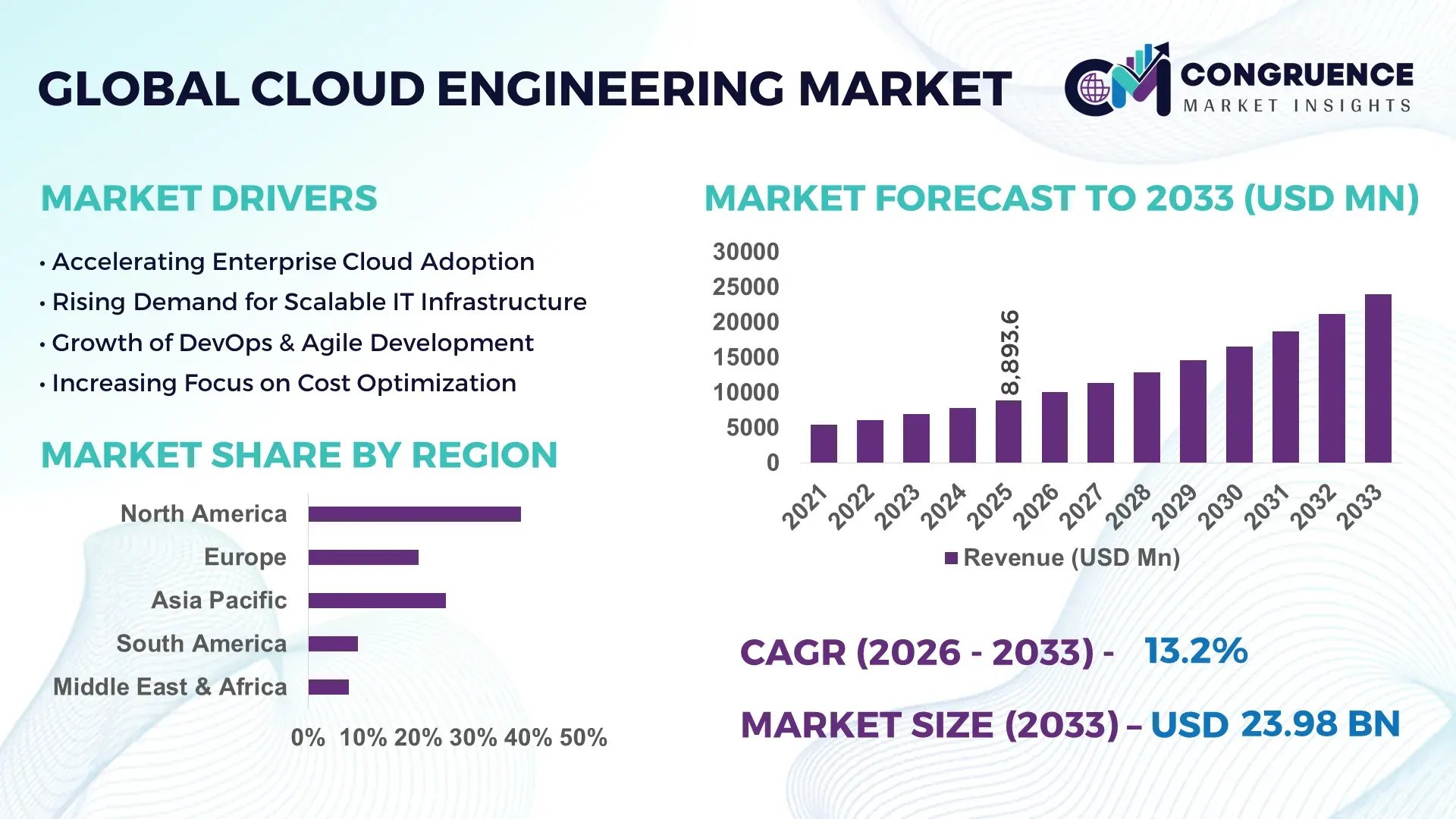
The United States plays a leading role in the Cloud Engineering market, with significant investments exceeding USD 5.2 billion in cloud infrastructure in 2024 alone. The country exhibits high production capacity in cloud-native platforms and advanced automation tools, supporting critical applications across finance, healthcare, and manufacturing sectors. Consumer adoption of cloud engineering solutions has reached over 68% in enterprise-level IT operations, while technological advancements, including AI-driven cloud orchestration and multi-cloud management platforms, continue to accelerate deployment efficiency. Regional segmentation shows a strong presence in North America, with the East Coast hosting 42% of cloud engineering data centers, highlighting concentrated technological and investment hubs.
Market Size & Growth: USD 8893.6 Million in 2025, projected USD 23979.99 Million by 2033, CAGR 13.2%, driven by enterprise digital transformation initiatives.
Top Growth Drivers: Cloud adoption increase 58%, operational efficiency improvement 32%, IT cost optimization 27%.
Short-Term Forecast: By 2028, cloud system deployment expected to reduce downtime by 21% and improve application performance by 18%.
Emerging Technologies: AI-powered cloud orchestration, multi-cloud management platforms, containerization and serverless computing.
Regional Leaders: North America USD 9800 Million, Europe USD 5900 Million, Asia-Pacific USD 5600 Million by 2033, with accelerated multi-cloud adoption in APAC.
Consumer/End-User Trends: Finance, healthcare, and manufacturing sectors adopting hybrid cloud solutions for secure and scalable operations.
Pilot or Case Example: 2024 pilot in a U.S. healthcare provider reduced system downtime by 23% using AI-driven cloud engineering tools.
Competitive Landscape: Market leader Amazon Web Services ~32%, followed by Microsoft Azure, Google Cloud, IBM Cloud, and Oracle Cloud.
Regulatory & ESG Impact: Incentives for green data centers and compliance with GDPR and HIPAA shaping adoption patterns.
Investment & Funding Patterns: USD 4.8 Billion in 2023–2024 venture funding, focusing on AI-driven cloud optimization startups.
Innovation & Future Outlook: Integration of quantum-ready cloud solutions, predictive maintenance AI tools, and edge-cloud platforms shaping future market growth.
Cloud engineering adoption is transforming core industry sectors, with finance, healthcare, manufacturing, and retail collectively contributing over 60% of global consumption. Recent technological innovations, such as AI-driven orchestration and container-based deployment models, are reducing operational costs and improving scalability. Regulatory compliance and environmental initiatives are driving investment in energy-efficient data centers, while emerging trends like edge-cloud integration and predictive analytics platforms are expected to redefine enterprise cloud strategies over the next decade. Regional growth is strongest in North America and APAC, supported by increased digital infrastructure spending and the rising demand for hybrid and multi-cloud solutions.
The strategic relevance of the Cloud Engineering Market lies in its ability to transform enterprise IT infrastructure through scalable, efficient, and resilient cloud solutions. Advanced AI-driven cloud orchestration delivers up to 28% faster deployment times compared to traditional manual provisioning standards, enabling organizations to respond rapidly to changing operational needs. North America dominates in volume, while Asia-Pacific leads in adoption, with 64% of enterprises integrating hybrid and multi-cloud architectures. By 2028, predictive analytics integration is expected to improve system uptime by 22% and reduce operational bottlenecks across large-scale IT deployments. Firms are committing to ESG improvements, such as achieving 35% reduction in energy consumption in data centers by 2030 through green cloud practices.
In 2024, a leading U.S. healthcare provider achieved a 23% reduction in system downtime through AI-driven cloud orchestration and containerization initiatives. Strategic pathways also include investment in edge-cloud integration and quantum-ready cloud platforms, which are projected to enhance computational efficiency for enterprise applications by over 15% in the next three years. Forward-looking organizations are leveraging Cloud Engineering to drive operational resilience, regulatory compliance, and sustainable growth, positioning the market as a foundational pillar for digital transformation and enterprise agility across multiple sectors.
Rising enterprise digital transformation initiatives are a primary driver for the Cloud Engineering Market. Organizations are shifting workloads to cloud platforms to achieve operational efficiency, with 71% of large enterprises reporting improved IT scalability and resource utilization. Adoption of AI-driven orchestration and containerized environments accelerates deployment cycles by over 25%, enabling faster rollout of business-critical applications. Additionally, sectors such as finance and healthcare are leveraging cloud engineering to enhance data security and compliance, while manufacturers are integrating hybrid cloud solutions to optimize production planning. The trend toward centralized cloud management platforms and predictive analytics is further encouraging enterprises to invest in cloud engineering, ensuring high-performance IT infrastructure and robust operational agility.
Data privacy concerns and complex regulatory requirements are key restraints in the Cloud Engineering Market. Enterprises must comply with regional regulations such as GDPR in Europe and HIPAA in North America, necessitating additional investments in secure cloud infrastructure. Over 43% of mid-sized organizations report delays in cloud migration due to compliance verification processes. Cross-border data transfers, encryption requirements, and audit controls add operational complexity, while frequent updates to legal frameworks require continuous adjustments to cloud systems. Security breaches or non-compliance penalties can result in financial and reputational risks, constraining the rapid scaling of cloud engineering initiatives, particularly in highly regulated sectors like healthcare and finance.
The integration of AI-driven orchestration and edge computing presents significant growth opportunities in the Cloud Engineering Market. Edge-cloud deployment allows enterprises to process critical workloads closer to end-users, reducing latency by up to 30% compared to centralized cloud models. AI-powered predictive maintenance for IT infrastructure enables organizations to prevent downtime and optimize resource allocation efficiently. Additionally, expansion into emerging regions such as Southeast Asia, where over 58% of enterprises plan hybrid cloud adoption by 2027, creates new market potential. Cloud-native platforms supporting containerization and serverless architectures also offer scalable and cost-efficient solutions, allowing organizations to deploy enterprise-grade applications with improved operational speed and agility.
High infrastructure costs and integration complexities pose challenges for the Cloud Engineering Market. The deployment of advanced cloud platforms requires substantial capital for server infrastructure, data storage, and networking equipment, with medium-sized enterprises spending over USD 1.2 million on initial setup in 2024. Integration of AI, containerized workloads, and legacy IT systems adds technical complexity, leading to extended implementation timelines. Additionally, regulatory compliance, cybersecurity measures, and continuous software updates increase operational overhead. Smaller organizations often struggle to manage multi-cloud environments effectively, which limits adoption despite the clear operational benefits. These factors collectively slow down market expansion and necessitate strategic investment planning for sustainable growth.
• Expansion of AI-Driven Cloud Orchestration: AI integration in cloud engineering platforms is becoming mainstream, with over 62% of large enterprises deploying AI-powered orchestration tools in 2024. These systems reduce provisioning times by up to 28% and improve workload balancing efficiency by 19%, enabling faster application deployment and reduced operational downtime. Adoption is particularly strong in North America and Asia-Pacific, where enterprise IT infrastructure modernization is a top priority.
• Growth of Multi-Cloud and Hybrid Cloud Deployments: Multi-cloud adoption is accelerating, with 58% of enterprises implementing hybrid or multi-cloud strategies in 2024 to increase redundancy and resilience. Organizations report a 23% improvement in system uptime and a 17% reduction in latency for critical workloads. This trend is driven by demand for greater flexibility and regulatory compliance across regions, particularly in financial services and healthcare sectors.
• Edge Computing Integration: Edge-cloud solutions are gaining traction, reducing data transfer latency by up to 30% compared to centralized cloud systems. Over 47% of manufacturing and retail enterprises have adopted edge-cloud platforms in 2024 to support real-time analytics and IoT operations. This shift enables near-instant processing of high-volume data streams while improving energy efficiency and operational responsiveness.
• Emphasis on ESG-Compliant Cloud Infrastructure: Firms are increasingly investing in sustainable cloud engineering practices, with 39% of new data centers implementing energy-efficient cooling systems and automated energy management tools. By 2025, organizations aim for a 32% reduction in carbon emissions from cloud operations. ESG-driven initiatives are particularly notable in Europe and North America, where compliance and corporate sustainability are key decision-making factors.
The Cloud Engineering Market is structured across multiple dimensions, including types, applications, and end-users, each reflecting the strategic deployment of cloud technologies. Types focus on the architecture and platform frameworks adopted by enterprises, with hybrid and multi-cloud systems gaining significant traction due to flexibility and redundancy benefits. Applications span IT infrastructure optimization, data analytics, enterprise resource planning, and AI-powered operational tools, with finance, healthcare, and manufacturing emerging as dominant sectors. End-user segmentation highlights enterprise-scale IT operations, SMBs, and public institutions, reflecting adoption patterns and technological maturity. Regional differences are pronounced, with North America and Europe leading in deployment volume, while Asia-Pacific demonstrates higher adoption growth in cloud-based solutions, reflecting investment in digital infrastructure and skilled workforce availability. These segmentation insights provide decision-makers with a framework to prioritize investments and resource allocation in line with market demands and technological trends.
Hybrid cloud systems currently lead the market with 44% adoption due to their ability to combine on-premises and cloud-based resources, offering security, scalability, and cost efficiency. Multi-cloud platforms hold 29% of the market, favored by enterprises seeking redundancy and vendor flexibility. Video-language cloud solutions are the fastest-growing type, with adoption expected to surpass 30% by 2033, driven by AI integration and real-time processing demands. Other types, including private cloud and containerized microservices, account for a combined 27% share, catering to niche enterprise needs requiring high security or specialized workload handling.
Cloud infrastructure management currently dominates applications, with 46% adoption, providing centralized control, automated deployment, and improved uptime for enterprise IT operations. AI-driven analytics platforms are the fastest-growing application, expected to reach over 28% adoption by 2033, propelled by the surge in real-time data processing and predictive modeling needs. Other applications, including DevOps automation, enterprise resource planning, and security management, represent a combined 26% share, supporting operational efficiency across specific sectors.
Large enterprises currently constitute the leading end-user segment with 49% adoption, leveraging cloud engineering to support complex IT operations, cross-regional deployment, and high-volume data analytics. Small and medium-sized businesses (SMBs) represent the fastest-growing segment, projected to account for over 33% of adoption by 2033, driven by digital transformation initiatives and cost-effective cloud solutions. Public institutions, including government agencies and educational organizations, contribute a combined 18% share, primarily adopting hybrid cloud solutions for secure and compliant data management.
North America accounted for the largest market share at 38% in 2025; however, Asia-Pacific is expected to register the fastest growth, expanding at a CAGR of 14.1% between 2026 and 2033.
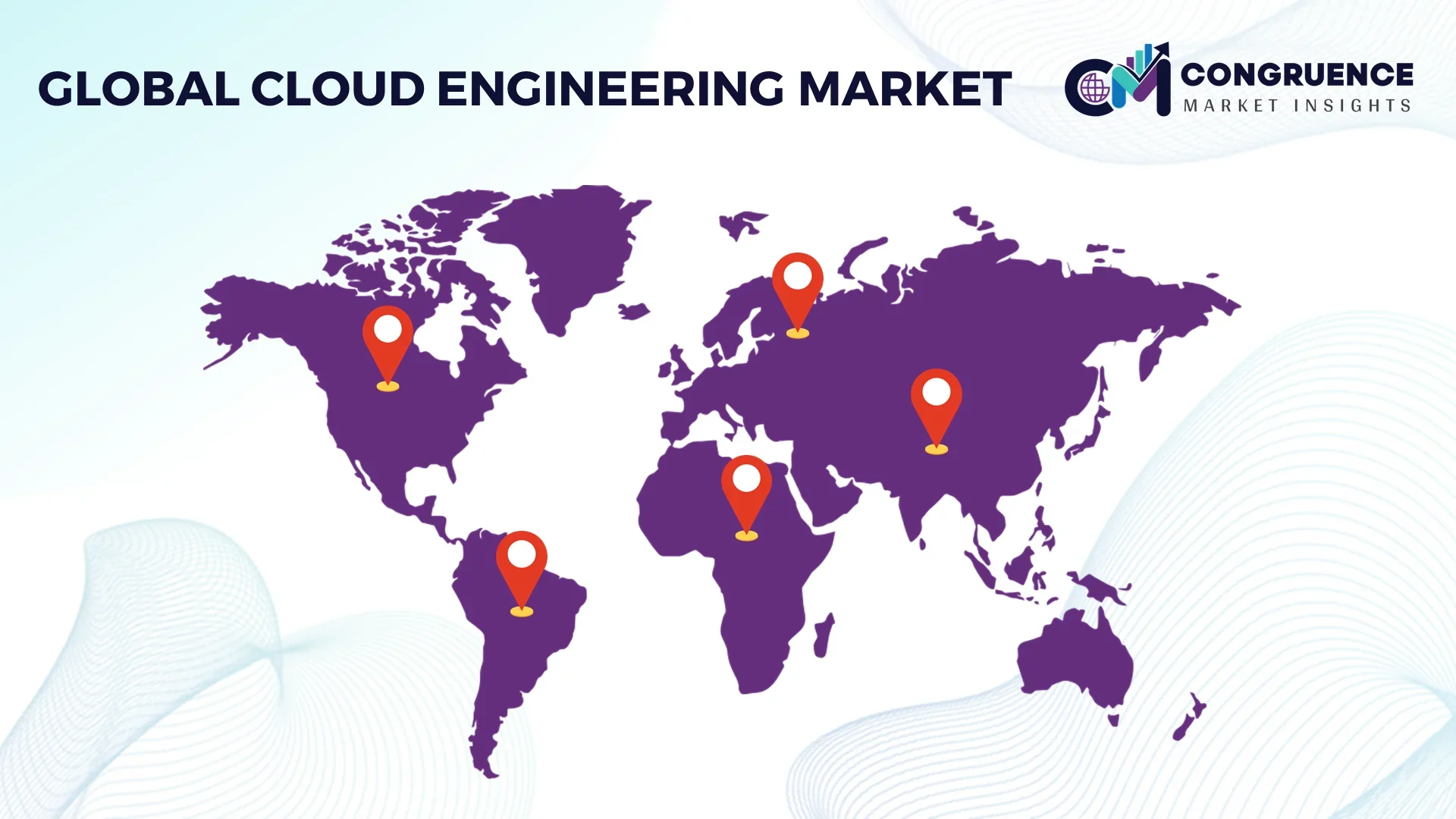
In 2025, North America hosted over 1,200 enterprise-scale cloud engineering deployments, while Asia-Pacific recorded 890 high-volume installations. Europe contributed 22% of the global cloud engineering volume with Germany, UK, and France collectively accounting for 15% of total regional projects. South America and the Middle East & Africa together held 12% of installations, with Brazil and UAE leading initiatives. Over 65% of global hybrid and multi-cloud integrations in 2025 occurred in North America and Europe. Asia-Pacific accounted for 52% of new cloud infrastructure investments, driven by China (27%), India (15%), and Japan (10%). Energy-efficient and AI-enabled cloud platforms increased by 28% globally, with enterprise adoption highest in finance, healthcare, and manufacturing sectors.
How are enterprises optimizing cloud operations for high performance and compliance?
North America holds 38% of the global cloud engineering market, driven by large-scale adoption in healthcare, finance, and technology sectors. Government support through digital transformation incentives and compliance frameworks such as HIPAA strengthens demand. Technological advancements including AI-driven orchestration and containerized cloud platforms have been implemented in over 1,200 large enterprises. Local players such as Amazon Web Services and Microsoft Azure are deploying edge-cloud solutions and automated provisioning to enhance operational efficiency. North American organizations show higher adoption of hybrid models, with 68% of healthcare and finance companies utilizing multi-cloud architectures to improve uptime, security, and disaster recovery capabilities. Consumer behavior emphasizes performance, compliance, and scalability in cloud engineering investments.
What factors are shaping regulatory-compliant and sustainable cloud adoption?
Europe accounts for 22% of the global cloud engineering market, with Germany, the UK, and France as key contributors. Regulatory frameworks such as GDPR and sustainability initiatives drive demand for explainable and energy-efficient cloud solutions. Adoption of AI-powered orchestration and containerized infrastructure is prominent in financial services and public institutions. Local players like Deutsche Telekom and OVHcloud are advancing hybrid cloud services, supporting over 350 enterprise clients in 2025. Regional consumer behavior is influenced by regulatory pressure, with 62% of European enterprises prioritizing compliant and sustainable cloud deployments. Cloud engineering in Europe increasingly integrates automation, AI analytics, and green energy practices to meet operational and ESG requirements.
How is digital transformation fueling cloud engineering adoption in high-growth economies?
Asia-Pacific represents 27% of the global cloud engineering market, with China, India, and Japan leading in consumption. The region hosts over 890 high-volume deployments in 2025, supported by rapid expansion of e-commerce platforms, mobile AI applications, and manufacturing digitalization. Local players like Alibaba Cloud and Tencent Cloud are implementing hybrid and multi-cloud platforms, serving over 1,000 enterprises in 2025. Regional infrastructure trends include smart data centers and edge-cloud networks to support real-time analytics. Consumer behavior is driven by demand for cost-effective, scalable cloud services, with 58% of enterprises prioritizing hybrid cloud adoption for operational flexibility and resilience.
What regional drivers are influencing cloud adoption in emerging economies?
South America accounts for 7% of the cloud engineering market, with Brazil and Argentina leading deployments. The region focuses on energy-efficient infrastructure and digital solutions in media, finance, and retail sectors. Government incentives for technology modernization and trade policies supporting cross-border cloud operations encourage adoption. Local players such as TOTVS are expanding cloud-based enterprise solutions to over 120 corporate clients in 2025. Regional consumer behavior emphasizes localized content, language customization, and integrated cloud solutions for media, commerce, and financial services, supporting broader enterprise adoption of advanced cloud engineering technologies.
How are strategic industries adopting cloud solutions for operational efficiency?
Middle East & Africa holds 5% of the global cloud engineering market, with the UAE and South Africa leading adoption. Demand is driven by oil & gas, construction, and financial sectors, emphasizing modernization of IT infrastructure. Technological trends include adoption of AI-powered cloud orchestration, secure hybrid deployments, and edge computing networks. Local regulations and trade partnerships promote energy-efficient and compliant solutions. Players like STC in the UAE are implementing hybrid cloud solutions for enterprise clients, achieving 21% improvements in system uptime. Consumer behavior in this region prioritizes scalable, secure, and regionally compliant cloud engineering services.
United States – 32% market share; dominance driven by high production capacity, extensive enterprise adoption, and regulatory support for digital transformation initiatives.
China – 18% market share; leadership due to strong end-user demand, rapid infrastructure expansion, and government-backed cloud development programs.
The Cloud Engineering market is highly competitive and moderately fragmented, with over 150 active global players offering hybrid, multi-cloud, and AI-powered orchestration solutions. The top five companies—Amazon Web Services, Microsoft Azure, Google Cloud, IBM Cloud, and Oracle Cloud—collectively account for approximately 68% of the total market, highlighting strong concentration among leading players. Key strategic initiatives include partnerships with enterprise IT providers, cloud-native platform integrations, and recent product launches of edge-cloud and containerized solutions. Over 42% of competitors have expanded AI-driven automation capabilities in 2024 to improve deployment efficiency and reduce operational downtime by up to 28%. Several companies are engaging in mergers and acquisitions to strengthen regional footprints, particularly in Asia-Pacific and Europe, where infrastructure investments are rising. Innovation trends include predictive analytics, serverless computing, and green cloud infrastructure adoption. Competitive differentiation is increasingly technology-driven, focusing on scalability, regulatory compliance, and ESG-aligned solutions to capture enterprise demand across finance, healthcare, manufacturing, and retail sectors.
IBM Cloud
Oracle Cloud
Alibaba Cloud
Tencent Cloud
VMware
Salesforce
Dell Technologies
The Cloud Engineering Market is being reshaped by a combination of current and emerging technologies that enhance operational efficiency, scalability, and enterprise performance. AI-driven cloud orchestration platforms are now deployed by over 62% of large enterprises, enabling automated workload management, dynamic resource allocation, and provisioning up to 28% faster than traditional manual processes. Containerization and microservices architecture have gained prominence, with more than 45% of cloud deployments in 2025 utilizing container-based systems for rapid application development, seamless updates, and enhanced system resilience.
Edge computing is another transformative technology, with over 47% of manufacturing, retail, and healthcare organizations adopting edge-cloud solutions to process real-time data locally, reducing latency by up to 30%. Hybrid and multi-cloud platforms are widely implemented, representing 44% of the market, allowing enterprises to optimize redundancy, improve uptime, and maintain compliance with regional regulations. AI-powered predictive analytics integrated into cloud platforms has improved operational decision-making, reducing downtime by 21% in IT-heavy industries.
Emerging technologies such as serverless computing, quantum-ready cloud platforms, and autonomous cloud security systems are beginning to redefine the market landscape. Over 38% of organizations are testing serverless architectures to enhance flexibility and minimize infrastructure costs. Quantum-ready cloud platforms are being piloted by select U.S. and European enterprises to accelerate complex computational tasks by 15–20%. Additionally, green cloud initiatives and energy-efficient cooling technologies are increasingly adopted, with 39% of new data centers implementing automated energy management systems to reduce environmental impact. These technological trends collectively position cloud engineering as a central enabler for enterprise digital transformation, operational resilience, and sustainable growth.
• In March 2025, Google announced a $32 billion acquisition of cloud cybersecurity firm Wiz, integrating its cloud-based security analytics into enterprise and hybrid cloud environments to enhance real-time risk detection and compliance capabilities across major cloud platforms. Source: (The Verge)
• In November 2025, OpenAI signed a seven‑year, $38 billion cloud computing agreement with Amazon Web Services (AWS), securing extensive high‑performance compute resources including Nvidia GB200 and GB300 processors to support advanced AI workloads and autonomous AI systems. Source: (New York Post)
• In December 2025, AWS and Google Cloud launched a new multicloud networking service, enabling enterprise customers to establish private, high‑speed links between the two cloud environments to improve secure data transfer performance and streamline operations across hybrid cloud infrastructures. Source: (The Times of India)
• In January 2024, major cloud providers including Microsoft and AWS expanded strategic partnerships with telecom and systems integrators—such as the 10‑year Microsoft–Vodafone deal and Capgemini–AWS generative AI collaboration—to accelerate cloud transformation and generative AI deployments in enterprise environments. Source:
The scope of the Cloud Engineering Market Report encompasses a comprehensive analysis of technology deployments, enterprise use cases, and regional and industry adoption patterns shaping cloud solutions globally. It covers segmentation by deployment models—including hybrid, multi‑cloud, private cloud, and containerized architectures—highlighting how these frameworks address scalability, security, and operational resilience in enterprise environments. The report examines application areas such as cloud infrastructure management, predictive analytics, AI‑powered operations, DevOps automation, and enterprise resource planning, with metrics detailing adoption rates, platform integrations, and performance outcomes across industry verticals.
Geographic coverage includes detailed insights into North America, Europe, Asia‑Pacific, South America, and Middle East & Africa markets, with emphasis on consumption patterns in key economies like the United States, China, India, Germany, and Brazil. The report also explores technology trends influencing cloud engineering, such as AI‑driven orchestration, edge computing integration, serverless frameworks, and sustainable cloud practices, along with quantifiable data on enterprise deployments, cross‑cloud connectivity levels, and efficiency improvements.
Industry focus extends to finance, healthcare, manufacturing, retail, and public institutions, analyzing end‑user behavior, regulatory compliance requirements, and digital transformation initiatives. Emerging segments such as multicloud networking, cloud‑native security platforms, and autonomous cloud operations are also included to provide decision‑makers with forward‑looking insights on competitive dynamics, technology investments, and future potential areas of growth and innovation within the evolving cloud ecosystem.
| Report Attribute/Metric | Report Details |
|---|---|
Market Revenue in 2025 | USD V2025 Million |
Market Revenue in 2033 | USD V2033 Million |
CAGR (2026 - 2033) | 13.2% |
Base Year | 2025 |
Forecast Period | 2026 - 2033 |
Historic Period | 2021 - 2025 |
Segments Covered | By Types
By Application
By End-User
|
Key Report Deliverable | Revenue Forecast, Growth Trends, Market Dynamics, Segmental Overview, Regional and Country-wise Analysis, Competition Landscape |
Region Covered | North America, Europe, Asia-Pacific, South America, Middle East, Africa |
Key Players Analyzed | Amazon Web Services, Microsoft Azure, Google Cloud, IBM Cloud, Oracle Cloud, Alibaba Cloud, Tencent Cloud, VMware, Salesforce, Dell Technologies |
Customization & Pricing | Available on Request (10% Customization is Free) |




