
Reports
The Global Bulk Molding Compounds (BMC) Market was valued at USD 8,141.9 Million in 2024 and is anticipated to reach USD 10,771.2 Million by 2032, expanding at a CAGR of 3.56% between 2025 and 2032, according to an analysis by Congruence Market Insights. This growth is primarily driven by rising demand for lightweight, durable, and heat-resistant composite materials across electrical, electronics, and automotive manufacturing.

The United States maintains a leading position in the BMC market due to its advanced composite production ecosystem, supported by an estimated annual output exceeding 450,000 tons of thermoset compounds, high-capacity molding facilities, and sustained investments in automotive lightweighting and electrical component manufacturing. With more than 1,200 active composite processing units and strong integration into aerospace and EV component supply chains, the country continues to expand its BMC utilization across connectors, housings, circuit components, and structural parts. The U.S. also benefits from accelerated R&D investments exceeding USD 1.3 billion annually in composite material innovation, including high-flow BMC formulations and low-emission thermoset technologies.
Market Size & Growth: Market valued at USD 8,141.9 Million in 2024, projected to reach USD 10,771.2 Million by 2032 with a CAGR of 3.56%; growth supported by rising demand for lightweight electrical and automotive components.
Top Growth Drivers: 38% higher adoption in electrical insulation systems; 27% improvement in component durability; 22% efficiency gains in high-volume manufacturing.
Short-Term Forecast: By 2028, processing efficiency in BMC molding lines is expected to rise by 18% due to upgraded automation and material-flow optimization.
Emerging Technologies: High-flow BMC formulations, low-styrene emission compounds, and AI-enabled process monitoring systems are shaping next-phase industry adoption.
Regional Leaders: North America projected to reach USD 3.5 Billion by 2032; Europe projected at USD 2.8 Billion with strong electrical component usage; Asia Pacific projected at USD 4.2 Billion driven by automotive electrification.
Consumer/End-User Trends: Surge in electrical component manufacturers adopting BMC for flame-retardant housings, alongside rising preference for corrosion-resistant parts in transportation equipment.
Pilot or Case Example: In 2024, a European electrical OEM achieved a 26% reduction in defect rates using automated BMC compression-molding inspection.
Competitive Landscape: Market leader holds roughly 14% share; key competitors include firms specializing in thermoset resin systems, precision molding, and engineered composite formulations.
Regulatory & ESG Impact: Adoption driven by stricter flame-retardancy rules and sustainability initiatives encouraging up to 20% reduction in hazardous emissions by 2030.
Investment & Funding Patterns: Over USD 450 Million invested recently in modernizing composite molding facilities and developing high-performance BMC grades.
Innovation & Future Outlook: Advancements in bio-based BMC, automated molding robotics, and EV-grade components are set to accelerate market transformation in coming years.
The Bulk Molding Compounds (BMC) Market is increasingly shaped by high-performance applications in automotive electrification, industrial electrical systems, and precision engineering. Adoption is further influenced by advancements in glass-fiber dispersion, hybrid thermoset formulations, and low-emission processing technologies. Regulatory requirements for heat resistance and flame retardancy, especially in North America and Europe, continue to steer material development, while Asia Pacific consumption accelerates due to expanding EV and electronics manufacturing.
The strategic relevance of the Bulk Molding Compounds (BMC) Market lies in its ability to support high-performance manufacturing ecosystems where durability, heat resistance, and dimensional stability are critical. As industries transition toward electrification and lightweighting, BMC is increasingly adopted for connectors, housings, structural enclosures, and safety-critical components. Technological upgrades are improving material consistency, enabling faster cycle times and higher-precision molding. For example, AI-enabled molding analytics deliver 19% improvement in dimensional accuracy compared to conventional compression-molding standards.
Regionally, Asia Pacific dominates in volume, supported by large-scale automotive and electronics output, while North America leads in adoption, with more than 63% of enterprises integrating engineered BMC components into electrical assemblies. Short-term forecasts indicate significant operational efficiency gains as well; by 2027, AI-driven quality monitoring is expected to cut production defects by 22%, particularly in electrical insulation and EV component manufacturing.
Compliance trends also play a major role, with firms increasingly committing to achieve 30% reductions in styrene emissions by 2030, aligning with sustainability frameworks and circularity goals. Micro-level advancements demonstrate measurable success—for example, in 2024, Japan achieved a 17% improvement in molding cycle efficiency through adoption of hybrid automated compression systems.
Looking forward, the Bulk Molding Compounds (BMC) Market is positioned as a critical pillar of industrial resilience, offering improved safety, compliance readiness, and sustainability-driven performance outcomes for global manufacturing sectors.
The Bulk Molding Compounds (BMC) Market is shaped by increasing requirements for lightweight, corrosion-resistant, and heat-stable materials across transportation, electrical, and industrial sectors. Demand is bolstered by expanding EV production, the adoption of miniaturized electrical components, and growing investments in composite manufacturing automation. Innovations in fiber-dispersion technology and hybrid thermoset systems are enhancing material performance, while regional consumption patterns reflect rising industrialization in Asia Pacific and regulatory pressure in Europe and North America.
The rising need for advanced electrical components with high mechanical strength and superior thermal stability is a major driver of the Bulk Bolding Compounds (BMC) Market. BMC materials support enhanced dielectric integrity, dimensional accuracy, and heat resistance up to 180°C, making them indispensable for switches, circuit breakers, and motor components. With more than 40 million new electrical safety devices installed annually across industrial facilities, the shift toward durable, flame-retardant materials is accelerating. In addition, advancements in fiber alignment and resin reinforcement techniques are enabling manufacturers to meet stringent performance standards, reducing failure rates and improving equipment lifecycle efficiency.
Volatile raw-material costs, particularly those associated with polyester resins and glass fibers, create significant uncertainty for manufacturers operating in the Bulk Molding Compounds (BMC) Market. These fluctuations affect cost structures and limit the scalability of production. Furthermore, BMC processing requires specialized compression- or injection-molding equipment, which demands regular calibration and skilled operators. Global reports show that over 32% of composite manufacturers face periodic production delays linked to equipment maintenance and material curing inconsistencies. These limitations hinder throughput, extend lead times, and complicate integration into high-speed manufacturing environments.
The accelerating transition toward electric mobility presents a major growth opportunity for the Bulk Molding Compounds (BMC) Market. BMC is increasingly used in battery housings, electronic control systems, under-hood components, and structural brackets due to its insulation capability and thermal stability. With global EV production projected to increase by over 30 million units by 2030, demand for lightweight, heat-resistant composite materials is rising. Enhanced processing technologies, such as automated closed-mold systems, are opening new opportunities for mass manufacturing of precision BMC parts supporting reliability, safety, and energy efficiency improvements in EV platforms.
The Bulk Molding Compounds (BMC) Market faces challenges stemming from complex material-handling requirements, stringent safety regulations, and the need for standardized molding processes. Compliance with flame-retardant, emission, and dielectric specifications necessitates advanced testing equipment and quality-control systems. Regulatory adjustments in Europe and North America require manufacturers to maintain emission reductions of up to 25% during thermoset processing, adding operational burdens. Additionally, the curing behavior of BMC varies with formulation, complicating process optimization and increasing the likelihood of defects when production conditions are not tightly controlled.
Surge in Electrified Component Manufacturing: Growing integration of BMC into EV components, including 48V architectures and e-motor insulation, has led to a 34% rise in demand for high-thermal-resistance compounds. Manufacturers report 18% improvements in part durability and 22% reductions in thermal degradation due to upgraded resin-fiber matrices supporting next-gen mobility systems.
Automation-Driven Efficiency Gains: Advanced robotic compression-molding systems have boosted throughput by up to 28%, particularly in North American and Japanese facilities. Plants adopting inline AI inspection report 21% lower defect rates, improving operational reliability and enabling large-scale production of high-precision electrical components.
Bio-Enhanced and Low-Emission BMC Formulations: With sustainability targets intensifying, bio-resin–infused BMC variants have achieved 15% reductions in lifecycle emissions and 12% improvements in molding consistency. Low-styrene emission formulations now account for over 40% of new product development, driven by tightening environmental regulations.
Expansion in High-Load Industrial Applications: Industrial machinery manufacturers are adopting high-strength BMC for pumps, valves, and enclosure systems, resulting in 17% higher load-bearing performance and 30% longer operational lifecycles. Demand is notably rising in heavy engineering sectors where durability and heat resistance are essential for long-term operational stability.
The Bulk Molding Compounds (BMC) market is segmented by resin chemistry, reinforcement type, product form, processing method, application, and end-user industry. Key type distinctions include unsaturated polyester BMC, vinyl ester BMC, epoxy BMC, and specialty phenolic formulations; reinforcement segmentation commonly separates glass-fiber-reinforced grades from hybrid and specialty fiber variants. Application segmentation covers automotive & transportation, electrical & electronics, construction, consumer appliances, and industrial machinery. End-user segmentation ranges from OEMs and tier-1 suppliers to contract manufacturers and repair/retrofit services. Regional segmentation—Asia Pacific, North America, Europe, Latin America, and MEA—reflects differing adoption patterns, with high-volume manufacturing concentrated in Asia Pacific and technology-intensive applications concentrated in North America and Europe. This structure enables targeted strategic planning for product development, capacity allocation, and channel prioritization, with measurable implications for production footprint and inventory management across geographies.
Bulk Molding Compounds are produced in multiple resin families and reinforcement configurations to meet varied performance and processing needs. Unsaturated polyester BMC is the leading type, accounting for approximately 46% of the market due to its balance of cost, moldability, and flame-retardant formulation capability; it remains the default for high-volume electrical housings and consumer enclosures. The fastest-growing type is epoxy-based BMC, driven by demand for higher thermal stability and superior mechanical properties in EV and aerospace applications; epoxy BMCs are expanding at an estimated 5.8% CAGR as formulators optimize cure kinetics and fiber wet-out for structural parts. Vinyl ester BMCs and phenolic BMCs serve niche roles—vinyl ester for improved chemical resistance and phenolic for extreme flame-retardant and smoke-suppression requirements—together representing a combined 27% share of the market. Specialty hybrid products (bio-enhanced resins, high-flow grades, and glass-/carbon hybrids) fill the remaining 27%, targeting performance differentiation and tailored processing windows.
Applications for BMC span electrical & electronics, automotive & transportation, industrial machinery, construction components, and consumer appliances. Electrical & electronics is the leading application area, representing roughly 38% of use, due to BMC’s inherent dielectric performance, flame retardancy, and molding precision for connectors, switchgear, and motor housings. The fastest-growing application is automotive EV components, supported by vehicle electrification trends and thermal management requirements; this application segment is expanding at an estimated 6.1% CAGR, driven by demand for battery housings, high-voltage insulators, and under-hood, heat-resistant parts. Other applications—industrial pump housings, construction panels, and consumer appliance enclosures—constitute a combined 34% of demand and remain important for diversification. In 2024, more than 38% of OEMs reported piloting BMC-based components in either electrical or drivetrain subsystems as part of product redesign programs.
End-users of BMC include automotive OEMs and tier-1 suppliers, electrical equipment manufacturers, industrial machinery builders, construction system producers, and consumer appliance brands. Automotive OEMs and suppliers are the leading end-user segment, accounting for approximately 33% of BMC consumption as manufacturers adopt composite solutions for weight reduction and integration of electrical insulation. The fastest-growing end-user segment is electric vehicle manufacturers and associated tier-1 suppliers, growing at an estimated 6.5% CAGR, propelled by requirements for high-temperature, high-dielectric components in battery and power-electronics systems. Other end-users—electrical OEMs, industrial equipment builders, and construction fabricators—collectively represent about 34% of usage, with adoption rates varying by region and regulatory pressure. In terms of adoption trends, over 60% of design engineers surveyed in 2024 preferred BMC for flame-retardant enclosure applications, and more than 42% of large manufacturers reported active integration pilots for BMC replacements of metal or thermoplastic parts.
North America accounted for the largest market share at 36% in 2024 however, Asia-Pacific is expected to register the fastest growth, expanding at a CAGR of 5.2% between 2025 and 2032.
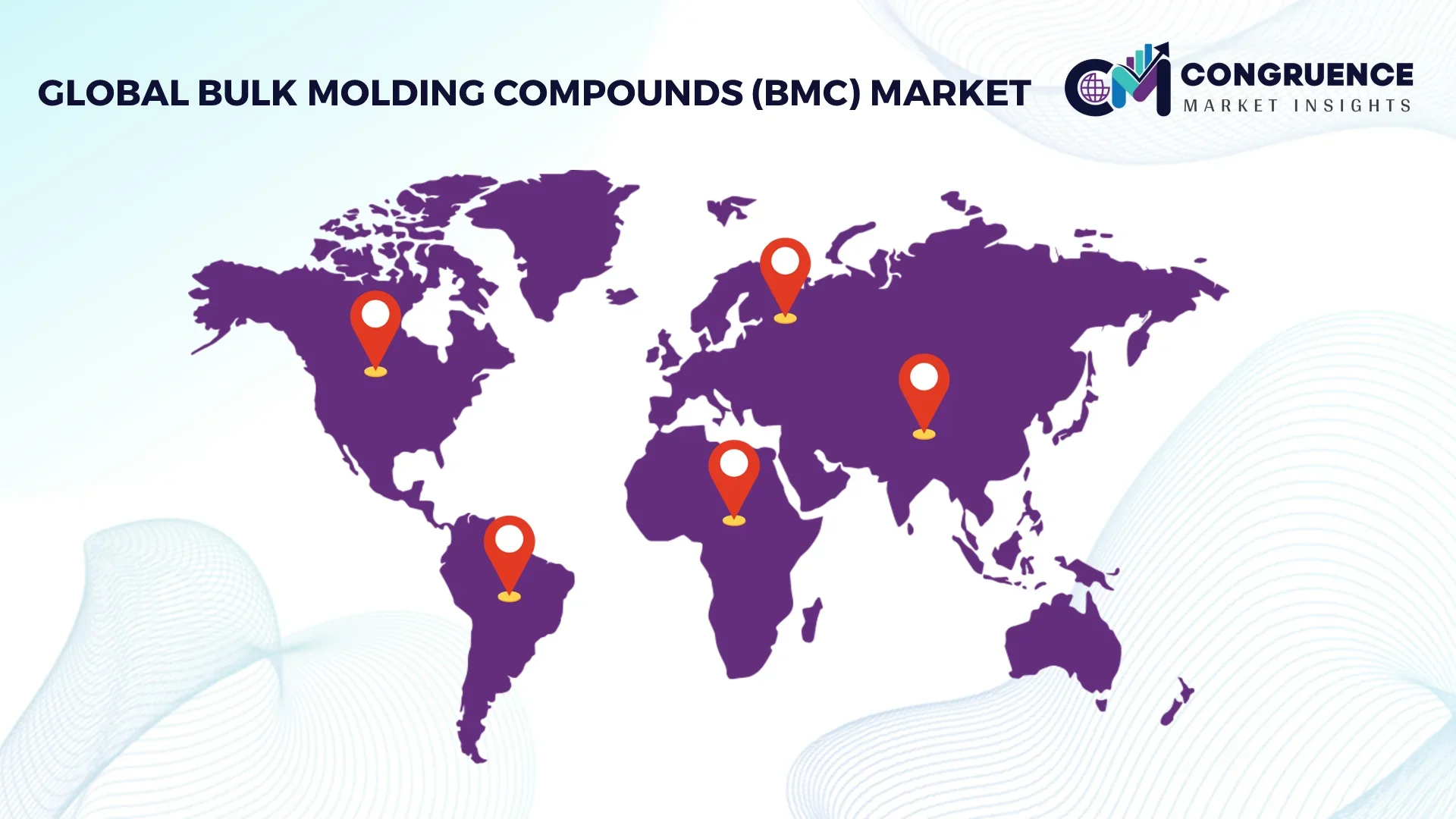
North America continues to lead due to advanced manufacturing infrastructure, high demand in automotive electrification and electrical-equipment sectors, and regulatory frameworks favoring thermoset composites for safety and performance. Asia-Pacific’s rising growth trajectory stems from rapidly expanding automotive and electronics manufacturing bases, increased industrialization in China, India, Japan, and Southeast Asian countries, and rising demand for lightweight, heat-resistant materials in EV production and consumer appliances. Global supply-chain shifts and investment in new composite‐processing capacity in these regions are reshaping competitive dynamics.
North America commands approximately 36% of the global BMC consumption volume, reflecting strong demand from electrical/electronics and automotive sectors. Key industries driving demand include EV powertrain components, high-voltage electrical housings, industrial equipment, and heavy machinery enclosures. Recent regulatory updates emphasizing fire safety and material flame-retardancy have increased demand for certified thermoset BMCs in electrical equipment and building products. Technological advancements such as automated compression-molding lines, inline quality inspection, and digital process monitoring are enhancing throughput, reducing defect rates, and improving consistency. For instance, a major U.S.-based composite manufacturer rolled out a new high-flow BMC line in 2024, enabling production of over 120,000 EV-ready electrical connectors annually with consistent dielectric performance. Regional consumer behavior shows higher enterprise adoption in industrial automation, heavy equipment manufacturing, and utility infrastructure, reflecting demand for durable, compliance-ready parts.
Europe accounts for around 24% of global BMC usage, with leading markets including Germany, France, and the United Kingdom. Stringent environmental and flame-retardancy regulations across the EU have prompted manufacturers to adopt low-styrene, low-emission BMC formulations for electrical housings, building materials, and appliance enclosures. Companies in Germany are investing in bio-resin BMC variants and smoke-suppression phenolic grades to meet regulatory standards. Emerging technologies such as high-precision compression molding, recyclable glass-fiber reinforced BMC, and digitally monitored curing processes are increasingly adopted. A European composite producer recently launched a “green BMC” line tailored to HVAC and appliance housings, with adoption rising among manufacturers seeking compliance and environmental credentials. Regional behavior indicates elevated demand for traceable, eco-certified components, particularly in construction and consumer appliances, where buyers demand compliance with EU sustainability norms.
Asia-Pacific represents approximately 28% of the global BMC market in volume, making it a key consumption region. Top consuming countries include China, India, Japan, and South Korea. The region’s rapid industrial growth, expansion of EV production, and surge in electronics manufacturing drive demand for BMC in battery housings, electrical enclosures, and automotive components. Manufacturing trends show investment in new composite molding plants and expansion of glass-fiber reinforced BMC production capacity to meet surge in demand. Technology trends include hybrid thermoset composites, locally optimized high-flow BMC grades, and automated molding systems to support high-volume output. For example, a major Japanese composites supplier expanded its production lines in 2025 to supply more than 80,000 EV-related BMC parts monthly to domestic automakers. Regional consumer behavior leans toward mass adoption in consumer appliance manufacturing, e-commerce electronics enclosures, and affordable EV components, reflecting high demand from rapidly growing middle-class markets and urbanization.
In South America, key markets such as Brazil and Argentina account for about 6% of global BMC demand. The region’s demand is driven by infrastructure development, energy sector projects—especially in electrical grid equipment—and growing demand for durable plastic housings in consumer appliances. Governments in several countries are offering import incentives and reduced tariffs for composite materials to reduce dependence on metal imports. Local composite fabricators have begun supplying BMC-based molded switchgear housings and electrical enclosures for expanding power distribution networks. Regional behavior shows modest but growing adoption, especially in urban construction and energy infrastructure projects where durability and flame retardancy are valued over cost. The relative youth of composite industry infrastructure means growth is gradual but steady, with niche demand in industrial and energy sectors.
The Middle East & Africa region accounts for roughly 6% of global BMC consumption, with major demand hubs in UAE, Saudi Arabia, South Africa, and Gulf countries. Demand is fueled by oil & gas infrastructure upgrade projects, electrical network expansion, and construction of utility and industrial facilities. Technological modernization trends include adoption of corrosion-resistant, high-temperature BMC grades suitable for harsh environments, and composite-based enclosures for equipment exposed to heat and humidity. Local players are supplying molded housings for pump systems, control panels, and cable-management components tailored to energy and industrial sectors. Regional behavior reflects preference for long-lasting, low-maintenance composite parts over traditional metal and wood alternatives, especially in industrial and infrastructure projects.
United States — 21% Market Share: Dominance due to high production capacity, advanced manufacturing infrastructure, and widespread adoption of composite solutions in electrical and automotive industries.
China — 18% Market Share: Strong demand driven by rapid industrialization, expanding EV production, and large-scale electronics and appliance manufacturing industries.
The competitive environment in the Bulk Molding Compounds (BMC) market remains moderately consolidated: as of 2024, there are dozens of active global and regional producers operating across resin chemistry, reinforcement, and application specialization — with the top five companies together controlling around 65% of the global BMC market. This concentration allows major players to set quality and pricing benchmarks, especially in high-performance and electrical-grade BMC segments.
Major companies maintain strong market positioning by leveraging strategic initiatives such as capacity expansion, product-line diversification, and advanced formulation development. For example, some firms are investing in flame-retardant, low-emission, and recyclable BMC grades to comply with stricter regulatory and environmental standards — while others are scaling up production capacity to meet rising demand in automotive, EV, electrical, and industrial sectors.
Beyond the top tier, mid-sized and regional operators compete by focusing on cost-competitive standard BMC grades for price-sensitive markets, as well as by offering customer-specific formulations tailored to local industry needs. This dual-tier competitive structure — global heavyweights and agile regional players — fosters innovation, flexibility, and a broad product offering across applications.
In recent years, innovation trends have reshaped competition: companies are prioritizing high-flow BMC for rapid-molding applications, bio-resin and recyclable BMC to meet sustainability demands, and specialized BMC formulations for EV battery housings, insulation, and structural components. Many firms are also adopting digital process controls, automated molding technologies, and in-house R&D to reduce defects and accelerate product-to-market cycles. The increasing cost and complexity to meet new regulatory and performance standards have raised the entry barrier, reinforcing the dominance of established players. Overall, the BMC market’s competitive landscape is defined by a mix of consolidation among leading firms and active fragmentation at the regional level — balancing scale with specialization.
Core Molding Technologies, Inc.
Continental Structural Plastics (CSP)
AOC Aliancys
Lorenz Composites
The BMC market is undergoing a significant technological transformation as manufacturers adopt and develop advanced compound formulations, processing technologies, and sustainability-oriented materials. A key trend is the shift toward high-flow and low-viscosity BMC formulations, which improve mold fill efficiency and reduce cycle times — critical for high-volume automotive and electrical applications. These formulations enable consistent fiber dispersion and better surface finish, supporting tighter tolerances required for EV components and compact electrical housings.
Another technology trajectory is bio-based and recyclable resin systems, driven by regulatory and ESG demands. Many manufacturers now offer BMC grades with partially bio-derived resins or recyclable filler content — reducing environmental footprint while maintaining mechanical and thermal performance. Alongside this, flame-retardant and low-emission BMC grades are increasingly deployed to meet stricter fire-safety and emission norms, especially for electrical enclosures, consumer appliances, and building components.
Advancements in automated molding and process digitalization are also reshaping production. Inline quality inspection, digital temperature and flow controls, and robotics-assisted compression molding are helping reduce defects, improve reproducibility, and support just-in-time manufacturing for OEMs and tier-1 suppliers. This automation supports demand from sectors requiring high consistency and compliance, such as automotive EV modules, industrial machinery, and electrical switchgear.
Moreover, hybrid BMC systems — combining glass- or carbon-fiber reinforcements with specialized fillers or additives — are being customized for high-performance structural, thermal, and dielectric applications. These tailored compounds support uses in EV battery housings, high-voltage electrical components, and structural parts in industrial machinery or renewable-energy infrastructure. As such, technology evolution in BMC centers on performance optimization, sustainability, and integration with modern high-volume manufacturing processes, reinforcing the material’s strategic relevance in contemporary composite supply chains.
In October 2024, IDI Composites opened a new 120,000 sq ft global headquarters and next-generation manufacturing & technology center in Noblesville, Indiana — housing expanded SMC and BMC production and doubling BMC/SMC capacity to support higher-volume EV and electrical part programs. Source: www.idicomposites.com
Effective 30 September 2024, Reichhold do Brasil was merged into Polynt Composites Brazil Ltda, reorganizing regional operations and consolidating resin and compound production lines; the group also published updated LCA and organizational structure documents as part of its 2024 restructuring activity. Source: www.polynt.com
In 2024, Toray promoted its thermoset and chopped-fiber BMC product suite and showcased industrial success stories (including CAMX 2024 participation), highlighting BMC product lines and case examples for complex molded parts and tooling applications to automotive and industrial customers. Source: www.toraytac.com
This BMC Market Report covers a broad and comprehensive scope across product types, applications, end-user industries, geographic regions, and technology trends. On the product side, it examines multiple resin chemistries (unsaturated polyester, vinyl-ester, epoxy, and specialty thermosets), reinforcement strategies (glass-fiber, hybrid fiber, mineral-filled, and specialty additives), and compound grades (general-purpose, electrical-grade, flame-retardant, high-strength, low-shrinkage, recyclable, and bio-resin variants). Processing method segmentation — including compression molding, injection molding, and transfer molding — is addressed to reflect real-world manufacturing workflows and capacity planning needs.
Application-wise, the report analyzes demand across key sectors: automotive (internal components, structural parts, EV battery housings), electrical & electronics (housing, insulation, switchgear, high-voltage components), industrial machinery, construction & infrastructure, consumer appliances, and renewable-energy equipment. End-user segmentation differentiates OEMs, tier-1 suppliers, contract manufacturers, and retrofit/aftermarket service providers, offering insights into procurement patterns, supply-chain dependencies, and component sourcing strategies.
Geographically, the coverage spans major global regions — North America, Europe, Asia-Pacific, Latin America, Middle East & Africa — and highlights regional consumption patterns, capacity distribution, regulatory environment, and growth drivers. The report also addresses emerging markets in Asia-Pacific and Latin America, where industrialization, EV adoption, and infrastructure expansion are pushing demand.
Technological and industry-focus areas include the emergence of high-flow BMC for rapid-molding, bio-based and recyclable resin systems for sustainability compliance, flame-retardant and low-emission compounds for electrical safety and regulatory alignment, and hybrid fiber-reinforced BMC for high-performance structural and thermal applications. The report also examines automation and digitalization trends in molding operations, supply-chain resilience, and demand shifts driven by EV, renewables, and construction sectors — giving decision-makers a comprehensive overview to guide strategic planning, capacity investment, and product innovation prioritization.
| Report Attribute / Metric | Details |
|---|---|
| Market Revenue (2024) | USD 8,141.9 Million |
| Market Revenue (2032) | USD 10,771.2 Million |
| CAGR (2025–2032) | 3.56% |
| Base Year | 2024 |
| Forecast Period | 2025–2032 |
| Historic Period | 2020–2024 |
| Segments Covered |
By Type
By Application
By End-User Insights
|
| Key Report Deliverables | Revenue Forecast, Market Trends, Growth Drivers & Restraints, Technology Insights, Segmentation Analysis, Regional Insights, Competitive Landscape, End-User Behavior Analysis, Regulatory & ESG Overview, Recent Developments |
| Regions Covered | North America, Europe, Asia-Pacific, South America, Middle East & Africa |
| Key Players Analyzed | IDI Composites International, Polynt-Reichhold Group, Toray Industries, Inc., Core Molding Technologies, Inc., Continental Structural Plastics (CSP), AOC Aliancys, Lorenz Composites |
| Customization & Pricing | Available on Request (10% Customization Free) |




