
Reports
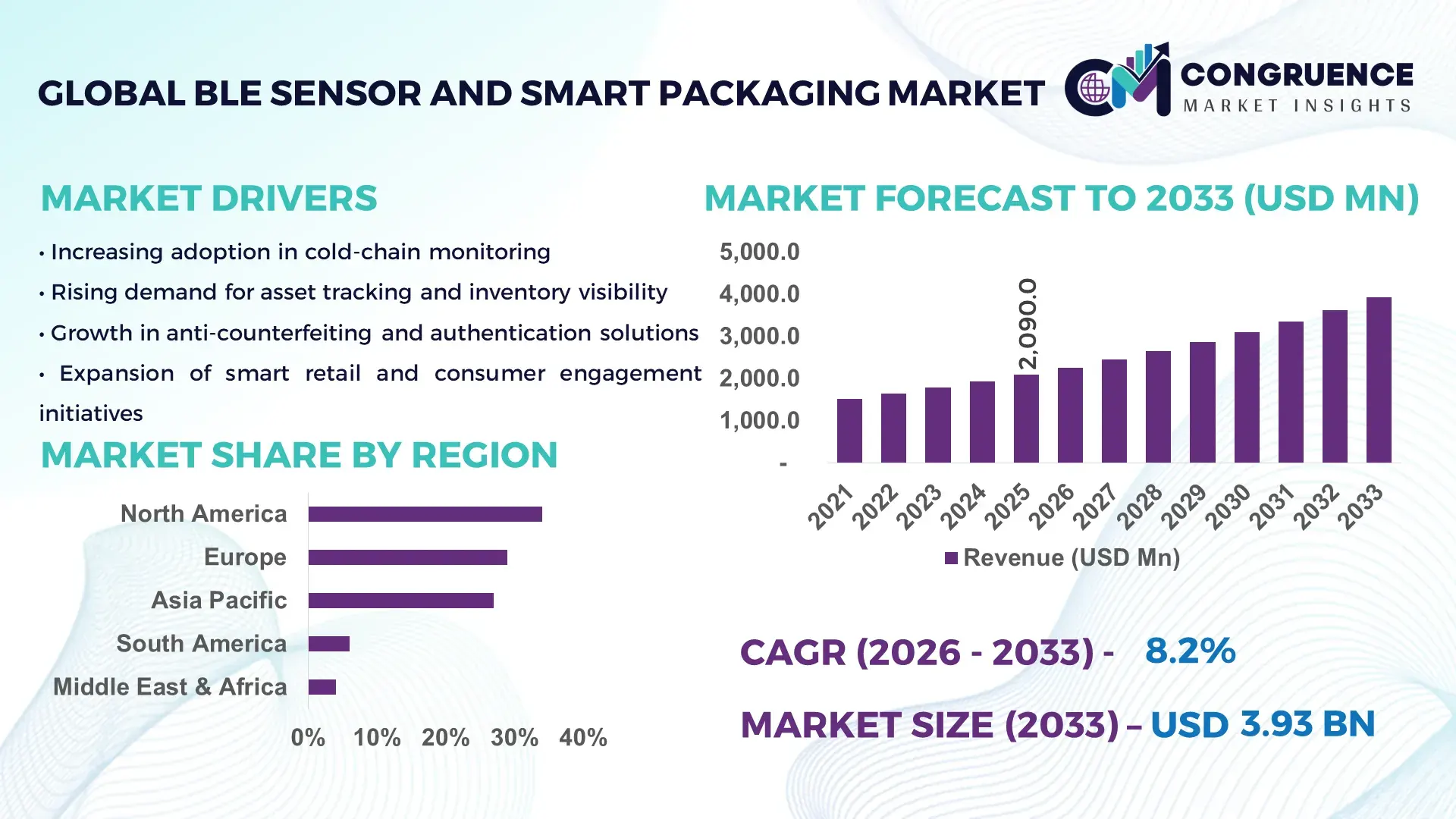
The Global BLE Sensor and Smart Packaging Market was valued at USD 2,090.0 Million in 2025 and is anticipated to reach USD 3,926.1 Million by 2033, expanding at a CAGR of 8.2% between 2026 and 2033, according to an analysis by Congruence Market Insights. This growth is largely driven by rising demand for real-time visibility in supply chains, especially across food, pharmaceuticals, and logistics.
The United States anchors the global ecosystem for BLE sensor–enabled smart packaging through large-scale manufacturing of micro-sensors, batteries, and printed electronics. More than 120 domestic facilities are actively producing IoT-ready packaging components, supported by annual private investment exceeding USD 1.8 billion in connected packaging R&D. The country hosts over 60 pilot testbeds across cold-chain logistics, retail shrink reduction, and pharmaceutical traceability. Adoption is concentrated in healthcare and grocery retail, where more than 35% of national cold-chain shipments now integrate temperature-sensing smart labels. Advanced roll-to-roll printing of flexible circuits, ultra-low-power BLE chips consuming under 10 mW, and recycled substrate innovation have accelerated industrial scalability, while public–private collaborations have expanded deployment across airports, ports, and distribution centers.
Market Size & Growth: USD 2.09 billion in 2025 to USD 3.93 billion by 2033; driven by real-time traceability, spoilage reduction, and regulatory digitization.
Top Growth Drivers: Cold-chain compliance adoption +42%, inventory accuracy improvement +28%, food-waste reduction initiatives +25%.
Short-Term Forecast: By 2028, automated recall analytics to cut manual audit time by 35% across large retailers.
Emerging Technologies: Printable BLE tags, battery-free energy harvesting, AI-enabled anomaly detection at the edge.
Regional Leaders (2033): North America ~USD 1.35 billion (pharma leadership); Europe ~USD 1.10 billion (sustainability-led adoption); Asia-Pacific ~USD 1.20 billion (manufacturing scale).
End-User Trends: Rapid uptake in pharma, fresh food, and e-commerce fulfillment with continuous temperature monitoring.
Pilot Example: In 2024, a global retailer reduced cold-chain spoilage by 18% using BLE-enabled pallet tags.
Competitive Landscape: Leader ~30% share (Avery Dennison); followed by Thinfilm, Toppan, Packeta, and Timestrip.
Regulatory & ESG Impact: Alignment with GS1 digital links and mandatory pharma serialization plus recyclable packaging mandates.
Investment Patterns: Over USD 1.2 billion in recent venture and corporate investments toward printable electronics and analytics platforms.
Future Outlook: Convergence of BLE, digital twins, and circular packaging to create self-reporting supply chains.
Food & beverage and pharmaceuticals together account for the bulk of deployments, supported by rising recalls and temperature-sensitivity requirements. Flexible printed sensors, paper-based substrates, and ultra-low-power chips are reshaping product design. Europe’s packaging-waste rules and U.S. Drug Supply Chain Security Act digitization are accelerating adoption, while Asia-Pacific leads consumption growth via export logistics and electronics manufacturing. Edge analytics, battery-free tags, and standardized digital product passports are defining the next phase of scale.
The BLE Sensor and Smart Packaging Market is becoming a core infrastructure layer for digitized supply chains, enabling continuous visibility from factory to consumer. Strategically, it shifts packaging from a passive container to an active data asset that improves safety, efficiency, and compliance. Companies are integrating BLE-enabled tags with warehouse management systems, digital twins, and AI analytics to reduce losses and optimize inventory flows.
Compared with legacy barcode-only systems, BLE-enabled smart labels deliver ~40% faster inventory reconciliation and 25% lower labor costs in high-turnover facilities. While Asia-Pacific dominates in production volume due to electronics manufacturing scale, Europe leads in adoption with roughly 38% of large food and pharma enterprises actively deploying smart packaging pilots, driven by sustainability and traceability mandates.
In the near term, by 2028, AI-assisted cold-chain monitoring is expected to reduce temperature excursions by 30–35%, cutting spoilage and recalls. Digital product passports linked to BLE identifiers will further standardize cross-border data exchange.
From an ESG perspective, firms are committing to 20–30% reductions in plastic use by 2030 through paper-based smart labels and recyclable sensor substrates, while expanding circular take-back programs for reusable containers.
A concrete micro-scenario illustrates impact: in 2024, a multinational pharma distributor in Germany reduced batch quarantine time by 22% using BLE temperature tags integrated with automated release workflows.
Looking ahead, the BLE Sensor and Smart Packaging Market is positioned as a pillar of resilient, compliant, and sustainable commerce—linking physical goods with trusted digital data, minimizing waste, and enabling safer, smarter global supply chains.
The BLE Sensor and Smart Packaging Market is shaped by converging trends in IoT connectivity, regulatory digitization, and sustainability. Rising complexity of global supply chains has increased demand for real-time tracking of temperature, humidity, shock, and location at the item or pallet level. Retailers and pharmaceutical companies are moving from periodic audits to continuous monitoring, creating steady pull for low-cost, scalable BLE tags. At the same time, advances in printable electronics, flexible batteries, and energy harvesting are lowering unit costs and expanding use cases beyond high-value goods. Environmental regulations are pushing brands toward recyclable substrates and reusable containers, influencing sensor design and materials. Interoperability standards such as GS1 digital links and EPCIS are improving data sharing across stakeholders, while analytics platforms are turning sensor streams into actionable insights. Competition is intensifying among packaging converters, label manufacturers, and IoT hardware suppliers, accelerating innovation but also pressuring margins.
Pharmaceutical products are highly sensitive to temperature and handling conditions, making them one of the most critical application areas for BLE-enabled smart packaging. Global vaccine and biologics distribution has expanded rapidly, with many products requiring strict cold-chain ranges between 2–8°C or even −20°C to −80°C. As a result, manufacturers and logistics providers are embedding BLE temperature sensors into pallets, cartons, and even primary packaging to create continuous audit trails. Major distributors are equipping thousands of shipments per month with smart labels that transmit data to cloud dashboards in real time, reducing manual checks and enabling proactive interventions. Serialization rules in the U.S. and EU have already digitized product identities; adding sensor data is the next logical step to enhance patient safety. Hospitals are also adopting smart packaging to reduce drug wastage, especially for high-value biologics. This healthcare-driven demand is encouraging suppliers to develop more accurate, lower-cost, and longer-life sensors tailored specifically for pharmaceutical workflows.
A major restraint is the reliance on small batteries that add cost, weight, and environmental complexity to smart packaging. Many BLE tags currently have operational lifespans of only 6–18 months, which limits reuse and makes large-scale deployment less economical for low-value goods. Disposing of battery-embedded labels also conflicts with recycling systems designed for paper or plastic packaging, creating compliance challenges under tightening waste regulations in Europe and parts of North America. Collection and separation of electronic components remain inconsistent, increasing landfill risks. In addition, temperature extremes during transport can degrade battery performance, reducing data reliability for sensitive shipments. These technical and environmental constraints force companies to balance functionality against sustainability goals, slowing adoption in sectors that prioritize fully recyclable packaging solutions.
The rapid expansion of e-commerce creates a powerful opportunity for BLE sensor-enabled smart packaging, particularly in last-mile delivery. Online grocery and meal-kit services increasingly ship perishable items directly to consumers, where temperature control and delivery transparency are critical. BLE tags can provide end-to-end visibility, alerting carriers and customers if packages experience unsafe conditions during transit. Warehouses are also adopting smart packaging to improve picking accuracy and reduce mis-shipments in high-volume fulfillment centers. Integration with route optimization software allows real-time rerouting when delays occur, minimizing product losses. As same-day and next-day delivery become standard, demand for compact, low-cost sensors that can be embedded at scale will rise. This creates room for innovation in printable, battery-free, or ultra-low-power BLE solutions tailored for fast-moving consumer goods.
A key challenge is integrating sensor data into existing enterprise systems such as ERP, warehouse management, and transportation platforms. Many organizations operate fragmented IT environments, making it difficult to harmonize data from multiple sensor vendors. Custom integration projects can be expensive and time-consuming, discouraging smaller companies from adopting smart packaging solutions. Data standardization is still evolving, and inconsistent formats reduce the value of real-time insights across supply-chain partners. Cybersecurity concerns also add complexity, as companies must protect sensitive shipment data transmitted over wireless networks. Additionally, training staff to interpret and act on sensor analytics requires investment in skills and change management, which can slow implementation timelines.
Ultra-low-power printable tags scaling to mass deployment: Manufacturers are rolling out paper-thin BLE labels consuming <10 mW, enabling single-use deployments across retail pallets. More than 25% of new smart labels in 2024–2025 used roll-to-roll printed circuits, cutting material waste by 30% and reducing per-tag assembly time to under 2 seconds.
Battery-free energy harvesting for circular packaging: Solar and RF-harvesting BLE tags are gaining traction, with pilots showing 60–70% longer operational life compared to coin-cell designs. Reusable containers equipped with these tags are being rotated up to 12 cycles per year in closed-loop logistics.
AI-driven cold-chain analytics at the edge: Smart gateways now process data locally, reducing cloud uploads by 40% while flagging anomalies in under 5 seconds. Early adopters report 15–20% fewer spoilage incidents through predictive alerts rather than reactive reporting.
Integration with digital product passports: By 2027, roughly 30% of regulated food and pharma shipments in Europe are expected to link BLE identifiers to digital passports, enabling automatic recall targeting and traceability from farm to shelf.
The BLE Sensor and Smart Packaging Market is segmented primarily by type, application, and end-user, reflecting the diverse technological architectures and use cases driving adoption. By type, the market spans disposable BLE labels, reusable tags, integrated smart containers, and hybrid printed-electronics solutions, each serving different lifecycle and cost requirements. Applications range from cold-chain monitoring and asset tracking to anti-counterfeiting, inventory automation, and consumer engagement, with increasing convergence between physical packaging and digital data platforms. End-user demand is concentrated in highly regulated and perishable industries where real-time visibility delivers measurable operational value. Large-scale logistics networks are standardizing on interoperable tags, while brand owners are prioritizing recyclable formats to align with sustainability mandates. Meanwhile, the rise of e-commerce and personalized supply chains is accelerating customization of sensor form factors, placement, and data workflows across verticals.
Disposable BLE smart labels represent the largest type, accounting for roughly 48% of current deployments, because they are low-cost, thin, and compatible with existing labeling lines used in food and pharmaceutical packaging. Their dominance is reinforced by compatibility with paper substrates and high-volume roll-to-roll printing, which enables millions of units to be produced daily without major line modifications.
By contrast, reusable BLE tags (for pallets, crates, and returnable containers) hold about 27% of adoption today, while integrated smart containers capture around 15% as they are mainly used for high-value or temperature-critical shipments. The remaining niche formats—such as hybrid printed sensors, battery-free harvesters, and multi-sensor modules—collectively represent about 10% of the market but are growing in technical sophistication.
The fastest-growing type is battery-free energy-harvesting BLE tags, expanding at approximately 14% annually as logistics providers seek fully recyclable, maintenance-free solutions for circular packaging and reusable container systems. Their growth is fueled by advances in RF harvesting, ultra-low-power chip design, and wider acceptance of closed-loop asset pools.
Integrated smart containers are gaining traction in pharmaceuticals and biologics because they combine insulation, active cooling, and embedded telemetry in a single system, reducing handling complexity and data gaps. Hybrid printed sensors—combining temperature, humidity, and shock detection—are emerging as a cost-effective middle ground between basic labels and full containers.
• In 2025, the U.S. National Institute of Standards and Technology (NIST) demonstrated field trials of battery-free BLE harvesters on returnable food crates across a 1,200-km logistics route, proving stable data transmission without onboard batteries.
Cold-chain monitoring is the leading application, representing about 45% of current usage because temperature excursions directly affect food safety, drug efficacy, and regulatory compliance. Asset tracking follows with roughly 28%, driven by the need to reduce shrinkage, misplacement, and manual audits in warehouses and distribution hubs.
The fastest-growing application is automated recall and traceability systems, rising at around 13% annually, supported by stricter food and pharma regulations that require rapid, data-backed product identification across complex supply networks.
Anti-counterfeiting and authentication account for approximately 12%, particularly in pharmaceuticals and premium consumer goods, while consumer engagement applications—such as interactive smart labels linked to digital experiences—make up about 10%. The remaining 5% is spread across niche uses including environmental monitoring, smart shelf management, and rental equipment telemetry.
In 2025, over 40% of global food retailers reported piloting sensor-enabled smart packaging for real-time freshness monitoring, and nearly 58% of logistics firms indicated higher trust in suppliers that provide continuous temperature data rather than manual logs.
• In 2024, the European Food Safety Authority supported a multi-country pilot in which BLE temperature labels reduced spoilage-related recalls in fresh produce distribution centers by more than 20% across 12 participating facilities.
The pharmaceutical sector leads end-user adoption with about 38% share, as continuous monitoring is critical for biologics, vaccines, and temperature-sensitive medicines that can lose efficacy outside narrow ranges. Large drug distributors increasingly treat sensor data as a core quality-control requirement rather than an optional add-on.
The fastest-growing end-user is e-commerce grocery and meal-kit delivery, expanding at roughly 15% annually, fueled by direct-to-consumer cold shipments, same-day delivery expectations, and rising consumer demand for transparency about product freshness.
Food and beverage manufacturers account for around 27%, using BLE sensors to manage cold storage, reduce waste, and optimize inventory rotation. General logistics and third-party carriers represent approximately 18%, deploying reusable tags on pallets, containers, and trailers to improve asset utilization. The remaining 17% is split among healthcare providers, retail chains, and specialty chemicals firms.
In 2025, 42% of large hospitals reported testing smart packaging systems for temperature-sensitive medical supplies, and 35% of global retailers stated that real-time packaging data had become a formal procurement requirement for their suppliers.
• In 2024, a U.S. Department of Health–backed pilot showed that BLE-enabled vaccine packaging cut emergency wastage by 23% across state-run clinics by preventing unnoticed temperature excursions during transport.
North America accounted for the largest market share at 34% in 2025; however, Asia-Pacific is expected to register the fastest growth, expanding at a CAGR of 11.4% between 2026 and 2033.
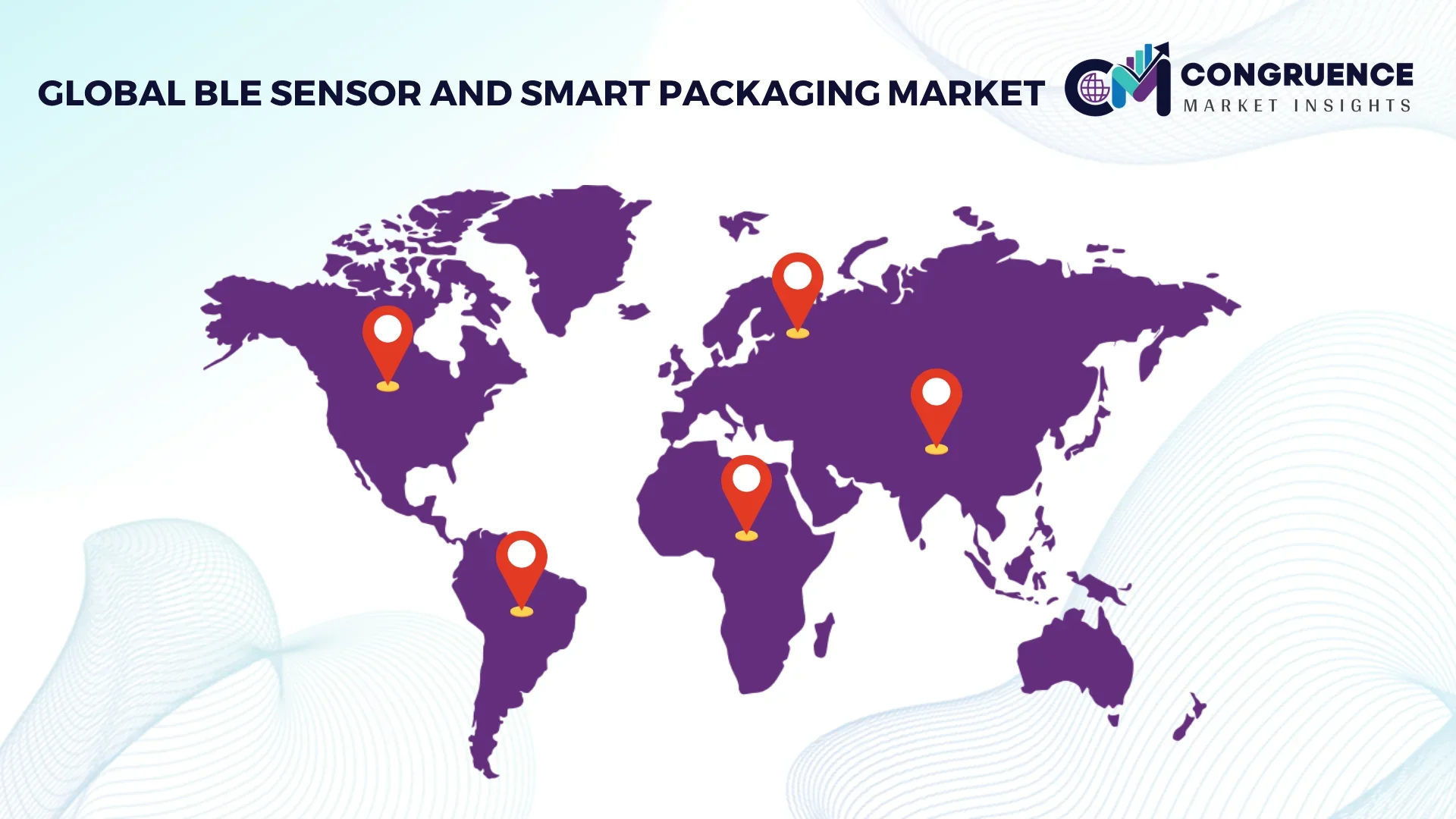
Regional performance reflects differences in industrial digitization, regulatory enforcement, logistics maturity, and technology adoption intensity. Europe followed North America closely with 29% share, supported by sustainability-driven smart packaging mandates and traceability compliance across food and pharmaceuticals. Asia-Pacific captured 27% of global adoption, driven by manufacturing scale, export-oriented logistics, and fast-growing e-commerce ecosystems. South America and the Middle East & Africa collectively accounted for the remaining 10%, reflecting early-stage adoption concentrated in food exports, healthcare distribution, and infrastructure-linked logistics modernization. Across regions, deployment density varies significantly, ranging from high-frequency sensor use in regulated cold chains to selective pallet-level tagging in cost-sensitive markets.
North America represents 34% of the global BLE Sensor and Smart Packaging Market, making it the leading regional contributor. Demand is primarily driven by pharmaceuticals, fresh food retail, healthcare logistics, and third-party logistics providers managing temperature-sensitive goods. Regulatory frameworks such as serialized drug traceability mandates and food safety modernization rules have increased enterprise-level deployment of real-time monitoring labels and reusable BLE tags. Technological advancement is marked by widespread integration of BLE data into warehouse management and analytics platforms, with over 45% of large distribution centers using automated sensor data ingestion. Local players such as Avery Dennison are expanding smart label portfolios with recyclable substrates and ultra-low-power chips. Consumer behavior reflects higher enterprise adoption in healthcare and life sciences, where compliance-driven monitoring outweighs cost sensitivity.
Europe holds approximately 29% of the global market, supported by strong adoption across Germany, the United Kingdom, and France. Regulatory pressure related to packaging waste reduction, recyclability, and product traceability has accelerated the use of BLE-enabled smart labels, particularly in food exports and pharmaceuticals. More than 50% of large European food processors are actively testing sensor-enabled packaging to meet cross-border compliance requirements. The region shows high uptake of battery-free and paper-based BLE tags aligned with circular economy goals. Companies such as Toppan Europe are collaborating with packaging converters to deploy printable electronics at scale. Consumer behavior is influenced by regulatory compliance, with procurement teams favoring explainable, auditable smart packaging systems.
Asia-Pacific accounts for 27% of global adoption, ranking third in share but first in growth momentum. China, Japan, and India dominate regional consumption due to export-driven manufacturing, pharmaceutical production, and large-scale cold-chain expansion. The region produces more than 60% of global BLE hardware components, enabling cost-efficient sensor integration. Smart packaging is increasingly embedded at the pallet and carton level for cross-border shipments. Technology hubs in Shenzhen, Tokyo, and Bengaluru are advancing printable sensors and miniaturized BLE modules. Regional consumer behavior shows strong growth driven by e-commerce and mobile-first logistics platforms, with last-mile visibility becoming a competitive differentiator.
South America represents 6% of the global market, with Brazil and Argentina as the primary contributors. Adoption is concentrated in food exports, meat processing, and pharmaceutical distribution where cold-chain integrity is critical. Infrastructure modernization and port digitization initiatives have supported selective deployment of reusable BLE tags for container tracking. Government trade policies aimed at improving export quality standards have indirectly encouraged smart packaging trials. Local packaging firms are piloting sensor-enabled labels for export certification workflows. Consumer behavior shows demand tied closely to export compliance rather than domestic retail engagement.
The Middle East & Africa region accounts for 4% of global market share, reflecting early-stage but strategically important adoption. Demand is driven by pharmaceuticals, food imports, and oil & gas logistics requiring environmental monitoring. Countries such as the UAE and South Africa are investing in smart ports, free zones, and cold-chain infrastructure. Technological modernization includes integration of BLE sensors with smart customs and warehouse platforms. Regional regulations increasingly emphasize product safety and traceability for imported goods. Consumer behavior varies widely, with enterprise-led adoption dominating over retail-driven use cases.
United States – 26% Market Share: High production capacity, advanced cold-chain infrastructure, and strong regulatory enforcement drive widespread enterprise adoption.
Germany – 12% Market Share: Strong manufacturing base, sustainability-led packaging policies, and high compliance requirements support consistent deployment across industries.
The competitive environment in the BLE Sensor and Smart Packaging Market is moderately consolidated, with a diverse set of 30+ active competitors spanning sensor manufacturers, packaging converters, IoT solution providers, and integrated systems developers. The top 5 companies collectively hold around 38% of total market activity, illustrating a landscape where mid-tier players and specialists also wield influence. Strategic positioning ranges from global conglomerates expanding smart label portfolios to agile tech firms driving next-generation BLE sensor innovation. Major players are engaging in partnerships, co-development agreements, and targeted product launches to expand capabilities and market reach.
Partnerships and technology alliances are prominent—identifiable in recent collaborations focused on BLE-enabled smart labels designed for cold-chain, healthcare, and logistics applications. Product innovation trends include ultra-low power BLE tag designs, multi-sensor integration (e.g., temperature, humidity, motion), and scalable form factors adaptable to smartphone and BLE gateway ecosystems. Competitive differentiation often arises from digital ecosystem integration, such as cloud connectivity, advanced analytics, and compatibility with existing supply-chain IT infrastructure.
There is also a notable trend toward sustainable smart packaging, where companies integrate recyclable materials and paper-based substrates without compromising performance. Players are investing in printed electronics, battery-free BLE tags, and enhanced security features such as encryption. These strategic initiatives reflect an emphasis on interoperability, scalability, and environmental credentials, with companies leveraging mergers, expanded portfolios, and joint marketing programs to strengthen competitive positions. The landscape remains dynamic, with continued entry from niche IoT and semiconductor innovators pushing boundaries in sensor performance, production efficiency, and packaging intelligence.
CCL Industries Inc.
Invengo Information Technology Co. Ltd.
SATO Holdings Corporation
All4Labels Global Packaging Group
Linxens
Alien Technology
Checkpoint Systems, Inc.
Giesecke+Devrient (G+D)
R.R. Donnelley and Sons Company
Honeywell International Inc.
Wiliot
Thin Film Electronics ASA
Smurfit Kappa Group
Technology in the BLE Sensor and Smart Packaging Market is evolving rapidly, driven by innovations in low-power communication, printable electronics, sensor miniaturization, and digital integration. Bluetooth Low Energy (BLE) systems remain at the core of smart labels and packaging solutions, enabling real-time broadcasting of identifiers, condition data (such as temperature and humidity), and interaction with gateways and smartphones without substantial energy drain. Modern BLE System-on-Chip (SoC) designs operate at ultra-low power thresholds—often under 10 mW—making them suitable for disposable smart labels and reusable tags alike. Battery-free and energy-harvesting technologies are progressing, aiming to eliminate traditional power sources and improve recyclability in line with sustainability objectives.
Sensor integration is broadening beyond temperature to include multi-modal sensing (shock, motion, humidity, gas detection), enhancing the ability to monitor environmental conditions throughout supply chains. Integrated sensors combined with BLE allow packaging to communicate detailed condition profiles that alert logistics managers to deviations in transit. These systems increasingly interface with analytics platforms, delivering end-to-end visibility from manufacturer to consumer in both B2B and B2C contexts.
Advances in printed electronics and flexible substrates enable high-volume, low-cost production of smart labels. Paper-based and biodegradable materials are being adapted to embed BLE functionality without compromising recyclability, aligning with circular economy principles. Interoperability protocols, digital product passports, and cloud connectivity are also shaping technological roadmaps, ensuring that sensor data flows seamlessly into enterprise systems and stakeholder dashboards. Edge computing integration is enhancing responsiveness, allowing localized processing of sensor data and reducing IoT network load.
Furthermore, development platforms and reference designs are facilitating rapid prototyping and deployment of smart sensor systems, bringing together BLE, advanced sensing, and low-power computing in compact, versatile form factors suited for diverse industries from pharmaceuticals to fresh food logistics. As digital transformation accelerates, the interplay between sensor hardware, BLE communication, and intelligent software will drive differentiated value and competitive advantage in packaging ecosystems.
• In May 2025, Identiv and InPlay co-developed a next-generation BLE smart label portfolio designed for high-value logistics, cold-chain, pharmaceutical, and food applications. The portfolio, powered by InPlay’s ultra-low-power IN100 NanoBeacon™ SoC, is configured to offer enhanced sensor integration, extended read range, encryption, and scalable form factors for real-time tracking and condition monitoring, with commercial availability expected in late 2025. Source: www.prnewswire.com
• In August 2025, Identiv partnered with IFCO to integrate BLE-enabled smart labels into IFCO’s global reusable packaging pool of over 400 million reusable packaging containers to enable real-time traceability and temperature monitoring, enhancing supply chain visibility and reducing food waste in fresh grocery logistics. Source: www.prnewswire.com
• In September 2025, Avery Dennison expanded its strategic partnership with Wiliot to scale next-generation ambient IoT BLE sensors and integrate them into its Intelligent Labels portfolio and atma.io connected product cloud, aiming to accelerate global adoption of continuous, low-cost condition monitoring across supply chains. Source: www.averydennison.com
• In January 2025, Giesecke+Devrient (G+D) launched the ultra-thin G+D Smart Label, a compact IoT smart label solution with GPS-level tracking, motion and temperature sensors, tamper detection, and cloud connectivity, designed for parcel tracking, fleet management, and logistics visibility, adaptable to diverse industry needs. Source: www.gi-de.com
The BLE Sensor and Smart Packaging Market Report delivers a comprehensive evaluation of the technologies, segments, adoption patterns, and competitive structures that shape this rapidly evolving industry. It encompasses detailed segmentation by type (e.g., disposable smart labels, reusable BLE tags, integrated smart containers, hybrid printed sensors), applications (cold-chain monitoring, asset tracking, anti-counterfeiting, consumer engagement, regulatory compliance), and end-user industries (pharmaceuticals, food and beverage, logistics and carriers, e-commerce fulfillment). The report also examines geographic regions, evaluating adoption density, infrastructure readiness, regulatory influences, and enterprise priorities across North America, Europe, Asia-Pacific, South America, and Middle East & Africa.
Technology insights cover both current and emerging innovations, including BLE communications, sensor integration, energy-harvesting methods, flexible substrates, and digital ecosystems that allow sensor data to feed enterprise systems and analytics platforms. Detailed profiles of competitive players highlight strategic initiatives such as partnerships, product launches, sustainability integration, and technology roadmaps. The report explores consumer behavior variations, illustrating how supply-chain digitization and regulatory enforcement influences deployment.
Broader industry focus areas include sustainability imperatives, such as recyclable materials and integration of circular economy principles; digital traceability mandates affecting pharmaceuticals and food exports; and e-commerce logistics requirements for real-time condition monitoring. The scope further incorporates niche segments such as interactive packaging for marketing engagement and smart labels with multi-sensor arrays for enhanced environmental tracking. Tailored for decision-makers, the report synthesizes qualitative and quantitative insights to support strategic planning, investment decisions, product development, and competitive benchmarking in the global BLE sensor and smart packaging landscape.
| Report Attribute / Metric | Details |
|---|---|
| Market Revenue (2025) | USD 2,090.0 Million |
| Market Revenue (2033) | USD 3,926.1 Million |
| CAGR (2026–2033) | 8.2% |
| Base Year | 2025 |
| Forecast Period | 2026–2033 |
| Historic Period | 2021–2025 |
| Segments Covered |
By Type
By Application
By End-User Insights
|
| Key Report Deliverables | Revenue Forecast, Market Trends, Growth Drivers & Restraints, Technology Insights, Segmentation Analysis, Regional Insights, Competitive Landscape, Regulatory & ESG Overview, Recent Developments |
| Regions Covered | North America; Europe; Asia-Pacific; South America; Middle East & Africa |
| Key Players Analyzed | Identiv, Inc., Avery Dennison Corporation, Zebra Technologies Corporation, CCL Industries Inc., Invengo Information Technology Co. Ltd., SATO Holdings Corporation, All4Labels Global Packaging Group, Linxens, Alien Technology, Checkpoint Systems, Inc., Giesecke+Devrient (G+D), R.R. Donnelley and Sons Company, Honeywell International Inc., Wiliot, Thin Film Electronics ASA, Smurfit Kappa Group |
| Customization & Pricing | Available on Request (10% Customization Free) |




