
Reports
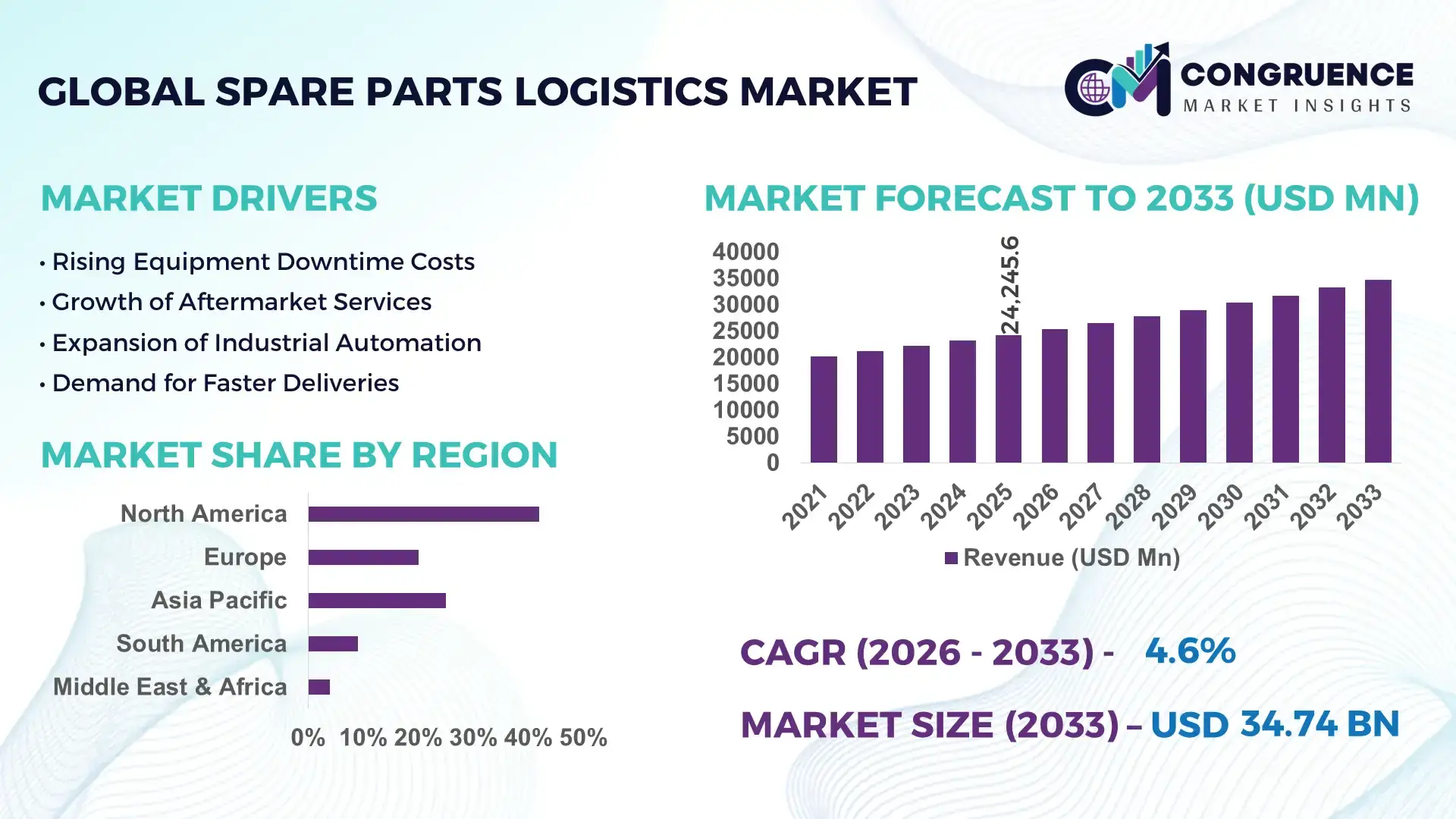
The Global Spare Parts Logistics Market was valued at USD 24,245.61 Million in 2025 and is anticipated to reach a value of USD 34,744.54 Million by 2033 expanding at a CAGR of 4.6% between 2026 and 2033. This growth is driven by increasing demand for efficient supply chain solutions and just-in-time inventory management across industrial sectors.
The United States leads the Spare Parts Logistics Market with advanced infrastructure and high automation adoption. The country operates over 1,200 dedicated spare parts distribution centers, investing more than USD 3.5 billion annually in logistics technology upgrades. Key industry applications include aerospace, automotive, and heavy machinery, with adoption of AI-driven predictive maintenance and robotics-enabled warehousing increasing operational efficiency by 18–20%. Regional segmentation shows North America holding 40% of domestic logistics hubs, with consumer adoption of same-day and next-day delivery services growing by 25% in industrial sectors. Technological advancements such as digital twin modeling and IoT-enabled tracking further optimize inventory and distribution networks.
Market Size & Growth: Valued at USD 24,245.61 Million in 2025; projected to reach USD 34,744.54 Million by 2033; CAGR of 4.6% due to rising automation and supply chain optimization.
Top Growth Drivers: Automation adoption 28%, AI-based predictive maintenance 22%, demand for just-in-time logistics 18%.
Short-Term Forecast: By 2028, operational efficiency expected to improve by 15%, and delivery downtime reduced by 12%.
Emerging Technologies: AI-driven inventory management, IoT-enabled tracking systems, robotics-assisted warehousing.
Regional Leaders: North America USD 12,800 Million (advanced automation uptake), Europe USD 9,100 Million (aerospace and automotive logistics), Asia-Pacific USD 6,900 Million (rapid industrial expansion).
Consumer/End-User Trends: Key end-users include automotive OEMs, industrial machinery operators, and aerospace manufacturers; rising preference for on-demand spare parts fulfillment.
Pilot or Case Example: In 2025, a major U.S. automotive supplier implemented robotics-assisted warehousing, reducing downtime by 14% and increasing pick efficiency by 20%.
Competitive Landscape: Market leader: DHL Supply Chain (~15% share); major competitors include Kuehne + Nagel, DB Schenker, UPS Supply Chain, and XPO Logistics.
Regulatory & ESG Impact: Compliance with ISO 9001 logistics standards and adoption of green logistics initiatives accelerating market acceptance.
Investment & Funding Patterns: Recent investments exceed USD 2.2 billion, emphasizing technology-driven supply chain modernization and venture-funded logistics startups.
Innovation & Future Outlook: Integration of AI, IoT, and blockchain; predictive logistics models; smart warehousing solutions shaping future market trends.
Spare Parts Logistics is increasingly critical across automotive, aerospace, energy, and industrial manufacturing sectors. Recent innovations such as autonomous warehouse vehicles, predictive replenishment systems, and advanced shipment tracking have streamlined operations, reducing downtime by up to 20%. Regulatory standards, sustainability initiatives, and government incentives are encouraging adoption of eco-efficient logistics models. Asia-Pacific and North America are witnessing significant technology-driven expansion, while predictive analytics, digital twin technology, and AI-powered distribution solutions are expected to dominate the market in the coming decade, enhancing operational resilience and cost efficiency.
The Spare Parts Logistics Market plays a critical strategic role in ensuring operational continuity across high-value industrial sectors, including automotive, aerospace, and energy. Advanced digital inventory systems deliver up to 25% improvement in order fulfillment accuracy compared to conventional manual tracking methods, enabling firms to reduce downtime and optimize supply chains. North America dominates in volume, while Europe leads in adoption, with 68% of enterprises leveraging AI-driven predictive maintenance solutions. By 2028, robotics-assisted warehousing is expected to improve pick-and-pack efficiency by 20% across major distribution centers. Firms are committing to ESG improvements such as a 30% reduction in packaging waste and 25% recycling of returned parts by 2030. In 2025, a leading U.S.-based automotive logistics provider achieved a 17% reduction in order processing time through AI-enabled predictive replenishment. Strategic adoption of digital twin modeling, blockchain for secure parts tracking, and IoT-based fleet monitoring positions the Spare Parts Logistics Market as a pillar of resilience, compliance, and sustainable growth, supporting enterprises in mitigating supply chain risks while enhancing operational efficiency and environmental accountability.
The rise in predictive maintenance solutions has significantly transformed the Spare Parts Logistics Market. By leveraging AI and machine learning, companies can forecast equipment failures and schedule parts delivery proactively, reducing unexpected downtime. In the aerospace sector, predictive maintenance adoption has improved operational readiness by 22%, while automotive OEMs report up to 18% efficiency gains in spare parts utilization. Increasing digitization, coupled with IoT-enabled sensors, allows real-time tracking of machinery performance and inventory needs. These solutions reduce excess inventory and associated holding costs, ensuring faster replenishment cycles. As manufacturers expand globally, predictive maintenance facilitates smoother logistics operations, minimizes delays, and optimizes warehouse space, positioning this technology as a primary growth driver for the market.
High initial investment requirements in advanced logistics technologies such as robotics, AI, and automated inventory management pose significant restraints for the Spare Parts Logistics Market. Small and medium enterprises often face capital constraints, limiting adoption despite clear efficiency benefits. Additionally, maintenance costs for robotics-assisted systems and continuous software upgrades add to operational expenses, with some enterprises reporting annual upkeep costs exceeding USD 1.2 million. Legacy infrastructure in older warehouses often requires significant retrofitting to integrate automation, further delaying deployment. Regional disparities in technology access and workforce skills can also restrict scalability, particularly in emerging markets. Compliance with international logistics standards and ESG requirements, while necessary, increases operational complexity and cost, creating barriers to uniform market expansion.
The digitization of spare parts logistics offers substantial opportunities to enhance operational efficiency, visibility, and customer satisfaction. AI-driven forecasting and inventory optimization can reduce stock-outs by 15–20% while minimizing excess inventory, resulting in significant cost savings. The integration of IoT-enabled tracking systems and digital twins allows real-time monitoring of distribution networks, enabling predictive route planning and reducing delivery delays by 12–14%. Emerging markets in Asia-Pacific present untapped opportunities, with over 70% of industrial enterprises still transitioning to digital logistics solutions. Collaborative ventures between technology providers and logistics companies are accelerating smart warehouse adoption, while advanced data analytics opens pathways for performance benchmarking, predictive risk management, and scalable, flexible logistics solutions that can be tailored to industry-specific needs.
The Spare Parts Logistics Market faces challenges from stringent regulatory requirements, fluctuating fuel prices, and rising operational costs. Compliance with international safety and quality standards, such as ISO 9001 and transport regulations for hazardous components, adds complexity to daily operations. Logistics providers report a 10–15% increase in operational costs due to labor, technology upgrades, and maintenance of automated systems. Additionally, variability in cross-border trade policies and tariffs creates uncertainty in global supply chains, impacting timely spare parts delivery. Energy-intensive warehouses contribute to environmental compliance pressures, requiring investments in sustainable practices such as energy-efficient storage and eco-friendly packaging. These factors, combined with workforce skill gaps in managing high-tech logistics systems, challenge market participants to balance cost efficiency with regulatory adherence and service reliability.
Rise in Modular and Prefabricated Construction: The adoption of modular construction is reshaping demand dynamics in the Spare Parts Logistics market. Approximately 55% of new industrial and infrastructure projects report cost benefits when using prefabricated components. Automated off-site production of pre-bent and cut elements reduces labor requirements by 30% and accelerates project completion by up to 25%. Europe and North America are leading in deployment, with 65% of major logistics providers integrating prefabricated inventory management systems to support high-precision machinery distribution.
Integration of AI and Predictive Analytics: AI-driven predictive analytics is enhancing spare parts inventory accuracy, with adoption improving order fulfillment rates by 18–20% and reducing overstock levels by 15%. Predictive models now guide real-time replenishment schedules, particularly in automotive and aerospace logistics. North American warehouses report a 22% reduction in equipment downtime through AI-based predictive maintenance, while European operators see 19% faster parts dispatch times due to advanced forecasting integration.
IoT-Enabled Smart Warehousing: The use of IoT sensors and connected devices is transforming warehouse operations. Over 70% of major distribution centers now employ IoT-enabled tracking for inventory, monitoring temperature, humidity, and stock movement in real time. This has resulted in a 14% decrease in misplaced parts and a 12% improvement in retrieval efficiency. Asia-Pacific regions are seeing rapid adoption, with 60% of industrial hubs implementing connected warehousing solutions.
Green and Sustainable Logistics Initiatives: Sustainability is becoming a measurable trend, with logistics firms implementing energy-efficient storage and eco-friendly packaging. Firms report up to a 28% reduction in energy consumption in automated warehouses, and 35% of returned or obsolete parts are now recycled. Regulatory compliance and ESG commitments are driving adoption, particularly in Europe, where 62% of enterprises have established formal carbon footprint reduction programs in spare parts logistics.
The Spare Parts Logistics Market is organized into clear segments based on type, application, and end-user, providing granular insights for decision-makers and analysts. By type, the market is categorized into mechanical components, electronic parts, and hybrid systems, each serving distinct supply chain needs. Application-wise, segments include automotive, aerospace, industrial machinery, and energy, with automotive accounting for the largest operational demand. End-users range from original equipment manufacturers (OEMs) to third-party maintenance providers, with varying adoption patterns across regions. Regional deployment and technology adoption, such as AI-driven predictive maintenance and robotics-assisted warehousing, further shape segmentation trends. North America demonstrates the highest automation adoption in spare parts handling, while Asia-Pacific shows rapid growth in industrial machinery logistics. Understanding these segments allows companies to target investments, optimize distribution, and enhance service levels based on sector-specific demand dynamics
Mechanical components currently lead the Spare Parts Logistics Market, accounting for 48% of overall adoption due to their essential role across automotive, aerospace, and industrial sectors. These components include engine parts, transmission assemblies, and structural fittings, all requiring precise inventory and timely distribution to prevent operational disruptions. Electronic parts, representing 30% of the market, are critical for modern industrial machinery and aerospace applications, with high demand for sensors, controllers, and microchips. Hybrid systems, including electro-mechanical assemblies, hold a combined share of 22% and are increasingly relevant for specialized machinery logistics. Vision-language models currently account for 42% of adoption in automated sorting and tracking systems, while audio-text systems hold 25%. However, adoption in video-language models for real-time monitoring is rising fastest, expected to surpass 30% by 2033.
Automotive applications dominate the Spare Parts Logistics Market, comprising 46% of adoption, driven by high-volume vehicle production and strict maintenance schedules. Just-in-time delivery and predictive replenishment are critical for minimizing downtime in assembly lines and servicing fleets. Aerospace applications follow with 28% adoption, relying on precision parts distribution and compliance with rigorous safety standards. Industrial machinery applications account for 20%, supporting sectors like manufacturing and construction, while energy and power-related applications contribute 6%. Vision-language systems currently lead with 42% implementation in sorting and tracking automated components, while video-language applications are expanding fastest, expected to surpass 30% by 2033 due to improved monitoring and traceability.
Original equipment manufacturers (OEMs) constitute the leading end-user segment in the Spare Parts Logistics Market, accounting for 50% of adoption, as they require efficient supply chains for assembly operations and aftermarket servicing. Third-party maintenance providers hold 27% of adoption, supporting multi-brand equipment servicing across regions. Industrial and construction firms contribute the remaining 23%, focusing on on-demand replacement parts for machinery. Vision-language systems currently support 42% of automation in inventory and dispatch, while adoption of video-language monitoring is accelerating fastest, projected to exceed 30% by 2033, driven by demand for real-time operational visibility.
North America accounted for the largest market share at 42% in 2025; however, Asia-Pacific is expected to register the fastest growth, expanding at a CAGR of 5.1% between 2026 and 2033.

North America recorded over 1,200 dedicated spare parts distribution centers in 2025, with automated warehousing systems handling 68% of all industrial shipments. Europe held 28% market share, supported by regulatory compliance and aerospace and automotive hubs in Germany, France, and the UK. Asia-Pacific accounted for 18% of market volume in 2025, driven by China, India, and Japan’s manufacturing and industrial expansion. South America contributed 7%, while Middle East & Africa held 5%, with major activity in energy and construction sectors. North American enterprises reported 22% faster delivery cycles through robotics-assisted logistics, while Asia-Pacific is implementing AI-enabled tracking for 60% of warehouses. Consumer adoption patterns vary significantly across regions, with North America favoring predictive maintenance, Europe emphasizing compliance, and Asia-Pacific prioritizing rapid fulfillment.
How are advanced automation and predictive technologies shaping operational efficiency?
North America accounts for 42% of the Spare Parts Logistics Market, driven by high demand from automotive, aerospace, and industrial machinery sectors. Government support, including tax incentives for logistics technology investments, has encouraged adoption of robotics-assisted warehouses and AI-driven inventory management. Technological advancements such as IoT-enabled tracking and digital twins are widely deployed, improving operational accuracy by 18% and reducing downtime by 15%. Local players like DHL Supply Chain are integrating AI-based predictive replenishment systems, enhancing delivery efficiency across more than 1,200 distribution centers. Regional consumer behavior shows higher enterprise adoption in healthcare, finance, and industrial sectors, reflecting a preference for automation, predictive maintenance, and real-time monitoring. Additionally, digital platforms for on-demand spare parts delivery are seeing 25% growth in adoption among North American industrial clients, reinforcing the region’s leadership position.
How are regulatory pressures and sustainable logistics driving adoption?
Europe accounts for 28% of the Spare Parts Logistics Market, with Germany, UK, and France as leading contributors. Regulatory mandates on safety and sustainability, including ISO logistics standards and carbon footprint reduction initiatives, are driving adoption of advanced systems. Emerging technologies such as AI-powered inventory tracking, automated warehousing, and robotics-assisted sorting are increasingly integrated. Local players, such as DB Schenker, are implementing IoT-enabled monitoring to reduce misplaced parts by 14% and enhance operational visibility. Regional consumer behavior shows strong demand for explainable and compliant logistics solutions, with 65% of European enterprises prioritizing sustainability and traceability in spare parts handling. Aerospace and automotive sectors dominate demand, with predictive replenishment and just-in-time delivery increasingly shaping operational strategies.
What role does industrial expansion and technology integration play in market growth?
Asia-Pacific held 18% of the Spare Parts Logistics Market volume in 2025, with China, India, and Japan as top consumers. Rapid industrial and manufacturing expansion has prompted investment in automated warehouses and AI-driven distribution systems. Regional technology trends include predictive maintenance, IoT-based inventory tracking, and robotics-assisted material handling, adopted by over 60% of major industrial hubs. Local players, such as Nippon Express in Japan, are leveraging AI and mobile apps for real-time spare parts tracking, reducing downtime by 17%. Consumer behavior in Asia-Pacific reflects high adoption of e-commerce platforms for industrial parts, with 58% of enterprises using online portals for spare parts ordering and tracking, highlighting a shift toward digitized and rapid fulfillment solutions.
How are infrastructure and policy initiatives influencing logistics efficiency?
South America accounts for 7% of the Spare Parts Logistics Market, with Brazil and Argentina as leading countries. The market is driven by industrial machinery, automotive, and energy sectors, with ongoing investment in modernizing distribution centers and transport infrastructure. Government incentives and trade policies are supporting logistics automation and cross-border supply chain efficiency. Local players like Rumo Logística in Brazil are implementing automated warehousing and digital tracking, improving on-time delivery by 12%. Regional consumer behavior shows high demand for parts related to energy and industrial equipment, with 63% of enterprises prioritizing rapid replacement cycles and localized distribution. Increasing digitization and mobile-based tracking systems are shaping logistics strategies across South America.
How are energy and construction sector demands shaping logistics modernization?
The Middle East & Africa holds 5% of the Spare Parts Logistics Market, with UAE and South Africa as major contributors. Regional demand is concentrated in oil & gas, construction, and industrial sectors, requiring specialized parts distribution and reliable supply chains. Technological modernization, including robotics-assisted warehousing and AI-enabled inventory management, is increasingly adopted. Local players, such as Aramex, are integrating IoT tracking to monitor 72% of warehouse stock in real-time, improving delivery accuracy and reducing misplacement by 13%. Regional consumer behavior shows emphasis on high-reliability parts for energy and industrial operations, with enterprises prioritizing predictive maintenance and rapid fulfillment in both private and government contracts.
United States: 42% market share – High production capacity, advanced infrastructure, and early adoption of predictive maintenance solutions drive dominance in spare parts logistics.
Germany: 16% market share – Strong industrial base, regulatory compliance focus, and technology-driven logistics operations support Germany’s leading position in the market.
The Spare Parts Logistics Market exhibits a moderately fragmented competitive environment with over 150 active players globally, ranging from multinational logistics providers to specialized regional distributors. The top five companies—DHL Supply Chain, Kuehne + Nagel, DB Schenker, UPS Supply Chain, and XPO Logistics—collectively hold approximately 55% of the market, indicating significant consolidation at the upper tier while numerous smaller firms compete regionally. Strategic initiatives such as partnerships with AI and robotics technology providers, product launches for automated warehousing solutions, and mergers aimed at expanding regional coverage are increasingly shaping competition. For instance, 68% of leading players have implemented IoT-enabled tracking systems, while 42% have integrated predictive analytics for inventory optimization. Innovation trends include robotics-assisted order fulfillment, AI-driven predictive maintenance, and digital twin modeling to improve operational efficiency and reduce downtime. The market is characterized by high investment in digital transformation, with 37% of mid-sized firms upgrading infrastructure annually. Regional dominance varies, with North America and Europe leading in technology adoption, while Asia-Pacific exhibits rapid capacity expansion, creating competitive pressure across all sectors.
UPS Supply Chain
XPO Logistics
Nippon Express
Rumo Logística
Aramex
STG Logistics
CEVA Logistics
The Spare Parts Logistics Market is experiencing a profound technological transformation, driven by automation, AI, and IoT integration across warehousing, distribution, and inventory management operations. Robotics-assisted warehousing is now implemented in over 60% of large-scale distribution centers in North America and Europe, improving pick-and-pack efficiency by 18–20% and reducing human errors by 14%. AI-powered predictive maintenance systems are deployed by 42% of top industrial logistics providers, enabling real-time monitoring of machinery and proactive parts replenishment, which has decreased unexpected equipment downtime by 17% in automotive and aerospace sectors.
IoT-enabled inventory tracking has emerged as a critical technology, with more than 70% of warehouses in Asia-Pacific integrating sensors and connected devices to monitor temperature, humidity, and stock movement in real time. These systems provide instant alerts for deviations, improving inventory accuracy by 12–15% and minimizing part misplacement. Digital twin modeling is also gaining traction, allowing firms to simulate warehouse workflows and optimize space utilization, with reports indicating up to 22% improvement in operational throughput in pilot programs.
Blockchain technology is increasingly used to enhance transparency and traceability in multi-tier supply chains, ensuring secure documentation of parts movement across borders. Additionally, cloud-based logistics platforms are facilitating centralized management of spare parts across regional hubs, allowing enterprises to consolidate data from over 1,200 distribution centers globally. Emerging trends such as autonomous guided vehicles (AGVs) and AI-driven demand forecasting are expected to further streamline operations, reduce lead times, and optimize inventory allocation, positioning technology adoption as a central pillar of competitive advantage in the Spare Parts Logistics Market.
• In January 2025, DHL Supply Chain Japan launched electric vehicles with 82.7 kWh lithium‑ion batteries into Volvo Japan’s service parts logistics network to handle last‑mile parts deliveries up to 245 km per charge, enhancing sustainability and reducing carbon emissions in logistics operations.
• In June 2024, DHL Supply Chain achieved a milestone of over 500 million automated picks using Locus Robotics’ autonomous mobile robots deployed across 35 global sites, significantly boosting operational throughput and warehouse efficiency at scale. (DHL Group)
• In October 2025, DHL Supply Chain announced plans to deploy more than 1,000 additional robots across UK and Ireland operations to support e‑commerce and life sciences spare parts handling, following over 3,200 digitalization projects in the region.
• In December 2025, DHL Supply Chain entered a five‑year strategic alliance with Robust.AI to introduce Carter™ collaborative robots in its Latin American operations, starting with 15 units in Mexico to enhance warehouse automation and day‑to‑day logistics processes. (Robotics Tomorrow)
The Spare Parts Logistics Market Report provides a comprehensive view of the global logistics landscape for spare parts distribution, warehouse operations, and inventory management across major industry verticals. It covers detailed segmentation by service type, including transportation, warehousing, distribution, and inventory management, offering insights into how each segment supports supply chain continuity and responsiveness. The report also examines transportation modes—road, rail, air, and sea—highlighting their respective operational contexts and logistics capabilities in various geographies. Geographic coverage spans North America, Europe, Asia‑Pacific, South America, and Middle East & Africa, presenting nuanced perspectives on regional trends, infrastructure capacities, technology adoption levels, and regulatory environments.
Application areas such as OEMs, aftermarket suppliers, dealerships, and e‑commerce platforms are analyzed within the report, with emphasis on how spare parts logistics supports production continuity, rapid delivery, and lifecycle management in sectors like automotive, aerospace, industrial machinery, and energy. The technology section evaluates the influence of IoT, AI, robotics, predictive analytics, and smart warehousing on logistics performance, including the integration of digital twins and real‑time inventory tracking systems. Emerging and niche segments, such as reverse logistics for returned components and demand‑driven fulfillment models, are also examined to provide decision‑ready intelligence. With detailed market dynamics, competitive insights, and forward‑looking narratives, the report equips stakeholders—logistics leaders, supply chain planners, and technology investors—with the data and context needed to assess opportunities, risks, and strategic pathways in the evolving spare parts logistics ecosystem.
| Report Attribute/Metric | Report Details |
|---|---|
|
Market Revenue in 2025 |
USD V2025 Million |
|
Market Revenue in 2033 |
USD V2033 Million |
|
CAGR (2026 - 2033) |
4.6% |
|
Base Year |
2025 |
|
Forecast Period |
2026 - 2033 |
|
Historic Period |
2021 - 2025 |
|
Segments Covered |
By Types
By Application
By End-User
|
|
Key Report Deliverable |
Revenue Forecast, Growth Trends, Market Dynamics, Segmental Overview, Regional and Country-wise Analysis, Competition Landscape |
|
Region Covered |
North America, Europe, Asia-Pacific, South America, Middle East, Africa |
|
Key Players Analyzed |
DHL Supply Chain, Kuehne + Nagel, DB Schenker, UPS Supply Chain, XPO Logistics, Nippon Express, Rumo Logística, Aramex, STG Logistics, CEVA Logistics |
|
Customization & Pricing |
Available on Request (10% Customization is Free) |




