
Reports
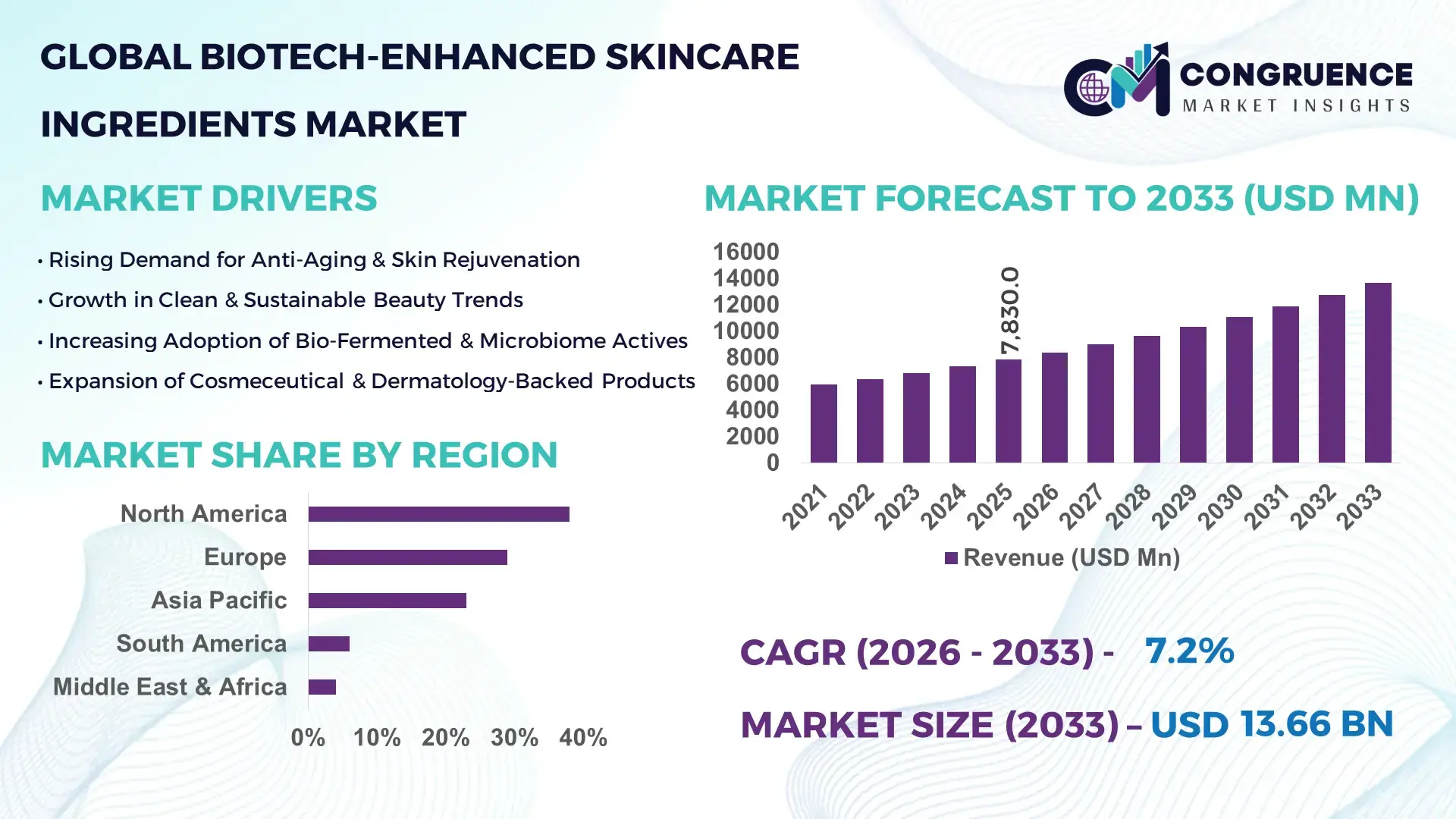
The Global Biotech-Enhanced Skincare Ingredients Market was valued at USD 7,830.0 Million in 2025 and is anticipated to reach a value of USD 13,655.9 Million by 2033 expanding at a CAGR of 7.2% between 2026 and 2033, according to an analysis by Congruence Market Insights. Growth is primarily driven by rising consumer preference for bio-derived, clinically validated, and sustainable active ingredients across premium and mass skincare formulations.
The United States represents the dominant country in the marketplace, supported by advanced biotechnology infrastructure and strong cosmetic innovation ecosystems. The U.S. biotechnology sector invests over USD 50 billion annually in R&D, with a significant portion directed toward synthetic biology, peptide engineering, and microbial fermentation platforms used in cosmetic actives. More than 65% of premium skincare brands in the country incorporate biotech-derived ingredients such as bio-fermented hyaluronic acid, recombinant collagen, and lab-engineered peptides. Over 40 large-scale fermentation facilities support domestic production capacity, while clinical-grade testing infrastructure enables rapid commercialization. In addition, over 70% of dermatology-backed skincare launches in 2025 featured at least one biotech-engineered active, reflecting high consumer adoption and advanced formulation capabilities.
Market Size & Growth: USD 7,830.0 Million in 2025, projected to reach USD 13,655.9 Million by 2033 at 7.2% CAGR, driven by 68% consumer preference for clinically proven bio-based actives.
Top Growth Drivers: 72% clean-label adoption rate; 60% increase in peptide-based formulations; 48% improvement in ingredient stability through fermentation technologies.
Short-Term Forecast: By 2028, precision fermentation is expected to reduce active ingredient production costs by 22% while improving purity levels by 30%.
Emerging Technologies: AI-assisted bio-discovery platforms, CRISPR-enabled microbial strain engineering, and cell-free biosynthesis systems.
Regional Leaders: North America projected at USD 4,950.0 Million by 2033 with high dermatology-led adoption; Europe at USD 3,780.0 Million driven by 75% sustainable sourcing mandates; Asia-Pacific at USD 3,520.0 Million supported by 58% K-beauty biotech integration.
Consumer/End-User Trends: 64% of Gen Z consumers prefer bio-engineered actives; dermatology clinics report 35% higher recommendation rates for peptide-infused products.
Pilot Example: In 2024, a U.S.-based biotech lab achieved 28% higher collagen synthesis efficiency using AI-optimized fermentation strains.
Competitive Landscape: Market leader holds approximately 18% share, followed by 4–5 multinational ingredient innovators specializing in bio-fermentation and peptide technologies.
Regulatory & ESG Impact: 52% of manufacturers comply with carbon-neutral ingredient production targets; biodegradable ingredient usage increased by 37%.
Investment & Funding Patterns: Over USD 2.4 billion invested globally in synthetic biology and cosmetic biotech startups between 2023–2025.
Innovation & Future Outlook: Integration of synthetic biology and AI-driven molecular design is expected to accelerate ingredient discovery cycles by 40% over the next five years.
Biotech-enhanced ingredients account for nearly 38% of premium skincare formulations, with peptides contributing 32% of segment demand and bio-fermented hyaluronic acid representing 26%. Sustainable production technologies have reduced water usage by 35% in advanced facilities. Regulatory emphasis on biodegradable and cruelty-free formulations is accelerating adoption across Europe and North America, while Asia-Pacific drives high-volume consumption through innovation-led product launches and microbiome-focused skincare advancements.
The Biotech-Enhanced Skincare Ingredients Market holds strategic relevance as global cosmetic manufacturers transition from plant-extracted and petrochemical-derived actives toward precision-engineered bio-based molecules. Synthetic biology platforms enable controlled molecular design, ensuring higher stability, purity, and bioavailability. For example, precision fermentation delivers 30% higher molecular consistency compared to traditional botanical extraction methods, significantly improving formulation performance and shelf life.
Strategically, companies are integrating AI-powered molecular screening to shorten development cycles by nearly 40%, enabling faster commercialization of recombinant peptides, growth factors, and bio-fermented antioxidants. North America dominates in volume production supported by large-scale fermentation infrastructure, while Asia-Pacific leads in adoption with over 62% of premium skincare brands integrating biotech actives into new product launches. By 2028, AI-driven strain optimization is expected to reduce batch failure rates by 25%, enhancing manufacturing efficiency.
From an ESG perspective, firms are committing to measurable sustainability benchmarks, including 45% reduction in carbon emissions and 50% water recycling targets by 2030 within fermentation facilities. In 2025, a leading U.S. biotech cosmetic manufacturer achieved a 33% improvement in yield efficiency through CRISPR-enhanced microbial strains, reducing waste output by 20%.
Looking ahead, the Biotech-Enhanced Skincare Ingredients Market is positioned as a pillar of resilience, regulatory compliance, and sustainable growth, combining advanced bioengineering, digital R&D platforms, and circular manufacturing models to future-proof global skincare supply chains.
The Biotech-Enhanced Skincare Ingredients Market is shaped by evolving consumer demand for high-efficacy, clinically validated, and environmentally sustainable cosmetic actives. Increased investment in synthetic biology, microbial fermentation, and recombinant protein production is transforming traditional ingredient sourcing models. Over 58% of new premium skincare launches incorporate biotech-derived peptides or bio-fermented compounds. Regulatory tightening around traceability and clean-label claims is influencing procurement strategies, while dermatology-driven product endorsements are strengthening clinical positioning. Additionally, partnerships between biotech startups and multinational cosmetic manufacturers are accelerating commercialization timelines. Rapid advancements in AI-assisted ingredient discovery and microbiome research further contribute to dynamic product innovation cycles within the Biotech-Enhanced Skincare Ingredients Market.
Growing consumer preference for evidence-based skincare has significantly increased demand for bioengineered peptides, recombinant collagen, and fermentation-derived antioxidants. Surveys indicate that 68% of consumers prioritize scientifically validated claims, while 72% prefer sustainable ingredient sourcing. Biotech production methods reduce contamination risks by 40% compared to conventional extraction processes. Furthermore, dermatology clinics report 35% higher recommendation rates for products containing lab-engineered actives. Large cosmetic brands have expanded biotech ingredient integration by 50% over the past three years, strengthening performance differentiation and supporting scalable, traceable manufacturing systems.
Establishing advanced fermentation and bioreactor facilities requires capital investments exceeding USD 100 million per facility. Development timelines for novel bioengineered actives can extend beyond 5–7 years due to safety validation and regulatory testing requirements. Specialized talent shortages in synthetic biology and microbial engineering impact 42% of biotech cosmetic firms. Additionally, stringent regulatory compliance for genetically modified strains increases documentation and audit costs by nearly 25%. These financial and operational barriers limit entry for smaller manufacturers and slow commercialization cycles.
Microbiome-based formulations are gaining traction, with 55% of premium skincare brands launching probiotic or postbiotic products. Personalized skincare platforms leveraging genomic and AI-driven skin diagnostics have grown by 47% in user adoption. Biotech-enabled ingredients allow targeted modulation of skin microbiota, improving efficacy outcomes by 28% in clinical settings. Expansion into emerging markets with rising disposable income and increasing dermatological awareness provides scalable opportunities. Additionally, sustainable bio-factories using renewable feedstocks can reduce environmental impact by 35%, aligning with evolving regulatory frameworks.
Regulatory approvals for recombinant and gene-edited ingredients require multi-phase toxicology and stability testing, extending approval timelines by up to 24 months. Approximately 38% of consumers express concerns about genetically modified components in cosmetics, influencing labeling strategies. Compliance with regional cosmetic safety standards across North America, Europe, and Asia adds operational complexity. Supply chain traceability demands digital tracking systems, increasing compliance costs by 18%. Managing transparency, consumer education, and evolving safety frameworks remains a critical challenge for manufacturers.
Expansion of Precision Fermentation Platforms: Over 62% of new biotech cosmetic ingredient facilities commissioned between 2023–2025 utilize precision fermentation technology. These systems improve yield efficiency by 30% and reduce raw material waste by 25%. Automated bioreactors with AI monitoring have decreased contamination incidents by 18%, enhancing production reliability.
Surge in Peptide and Recombinant Protein Innovation: Peptide-based ingredients now account for nearly 32% of biotech skincare actives in premium formulations. Clinical data indicates a 27% improvement in collagen stimulation compared to traditional botanical extracts. More than 45% of anti-aging product launches in 2025 incorporated synthetic or recombinant peptides.
AI-Driven Ingredient Discovery Acceleration: AI-integrated molecular modeling platforms have reduced discovery timelines by 40% and improved compound success rates by 22%. Approximately 50% of leading biotech ingredient developers have integrated machine learning into R&D pipelines, optimizing strain selection and bioactivity screening.
Growth in Sustainable Bio-Manufacturing Infrastructure: Advanced facilities report 35% lower water consumption and 28% reduction in carbon emissions through renewable energy integration. Nearly 52% of global manufacturers have committed to biodegradable ingredient portfolios, aligning with evolving ESG mandates and strengthening long-term supply resilience.
The Biotech-Enhanced Skincare Ingredients Market is strategically segmented by type, application, and end-user, reflecting differentiated demand patterns across formulation science and commercialization channels. By type, peptides, bio-fermented actives, recombinant proteins, stem-cell-derived extracts, and microbiome-based ingredients dominate product innovation pipelines. Peptides and fermentation-derived hyaluronic acid collectively account for over 55% of premium anti-aging formulations, reflecting their clinical validation and high bioavailability. By application, anti-aging and skin rejuvenation products represent the largest demand cluster, followed by hydration, brightening, acne management, and sensitive-skin solutions. Clinical dermatology and cosmeceutical positioning continue to influence ingredient selection, with over 60% of new product launches incorporating at least one biotech-derived active. From an end-user perspective, multinational cosmetic manufacturers, dermatology-backed brands, and contract manufacturers drive the majority of demand. Independent clean-beauty brands and medical aesthetics providers are increasingly integrating recombinant and microbiome-based ingredients, supported by growing consumer preference for clinically substantiated and sustainable skincare solutions.
Peptides currently represent the leading product type, accounting for approximately 34% of total adoption due to their clinically proven collagen-boosting and anti-wrinkle properties. Bio-fermented ingredients, including hyaluronic acid and antioxidants, hold nearly 28%, benefiting from scalable microbial production and high purity levels. Recombinant proteins contribute around 16%, while microbiome-based ingredients and plant stem-cell cultures together account for roughly 22% of the remaining segment share.
Peptides dominate due to strong dermatological endorsement and measurable efficacy improvements of 25–30% in elasticity enhancement compared to conventional botanical extracts. However, microbiome-based ingredients are the fastest-growing type, expanding at an estimated CAGR of 9.1%, driven by 55% of premium brands introducing probiotic or postbiotic lines. Increasing consumer awareness of skin barrier health and personalized skincare diagnostics is accelerating this growth trajectory.
Recombinant collagen and growth factors are gaining traction in high-end cosmeceutical products, while plant stem-cell extracts maintain niche positioning in clean-label segments.
In 2025, the U.S. Food and Drug Administration approved multiple recombinant protein-based cosmetic ingredients for topical safety clearance, accelerating their integration into over 200 newly launched dermatology-backed products.
Anti-aging and skin rejuvenation applications lead the market, accounting for approximately 42% of total ingredient utilization, driven by strong clinical demand for wrinkle reduction and collagen stimulation. Hydration-focused applications represent 24%, supported by bio-fermented hyaluronic acid adoption. Brightening and pigmentation control hold around 18%, while acne management and sensitive-skin treatments collectively contribute 16%.
Although anti-aging dominates in volume, microbiome-focused acne and barrier-repair applications are expanding fastest, projected to grow at a CAGR of 8.7% through 2033. Clinical trials indicate up to 28% improvement in inflammatory lesion reduction using postbiotic formulations, accelerating dermatology-driven demand.
In 2025, more than 44% of premium skincare brands globally reported reformulating core anti-aging lines with biotech-derived peptides. Additionally, 61% of Gen Z consumers indicated preference for clinically validated hydration and barrier-repair products over traditional herbal formulations.
In 2025, the European Medicines Agency recognized standardized safety frameworks for bioengineered cosmetic actives, enabling structured clinical documentation for over 150 dermatology-linked skincare applications.
Multinational cosmetic and personal care manufacturers represent the leading end-user segment, accounting for approximately 48% of total demand due to large-scale formulation pipelines and global distribution networks. Dermatology-backed and cosmeceutical brands follow with 27%, leveraging clinical validation and prescription-adjacent positioning. Contract development and manufacturing organizations (CDMOs) contribute 15%, while independent clean-beauty brands and medical aesthetic clinics collectively account for 10%.
While multinational corporations lead in production scale, dermatology-backed brands are the fastest-growing end-user category, expanding at an estimated CAGR of 8.9%, fueled by rising consumer trust in clinically endorsed products. Over 52% of dermatologists in North America report recommending peptide-based formulations as part of preventive skincare regimens.
In 2025, approximately 46% of premium skincare enterprises globally piloted AI-assisted formulation systems integrating biotech ingredients. Additionally, 63% of urban consumers in Asia-Pacific showed higher purchase intent for products labeled as bioengineered or fermentation-derived.
In 2025, the National Institutes of Health reported collaborative research initiatives with cosmetic biotech firms to evaluate skin microbiome modulation in over 1,000 clinical participants, advancing dermatology-grade biotech ingredient validation.
North America accounted for the largest market share at 38% in 2025; however, Asia-Pacific is expected to register the fastest growth, expanding at a CAGR of 8.4% between 2026 and 2033.
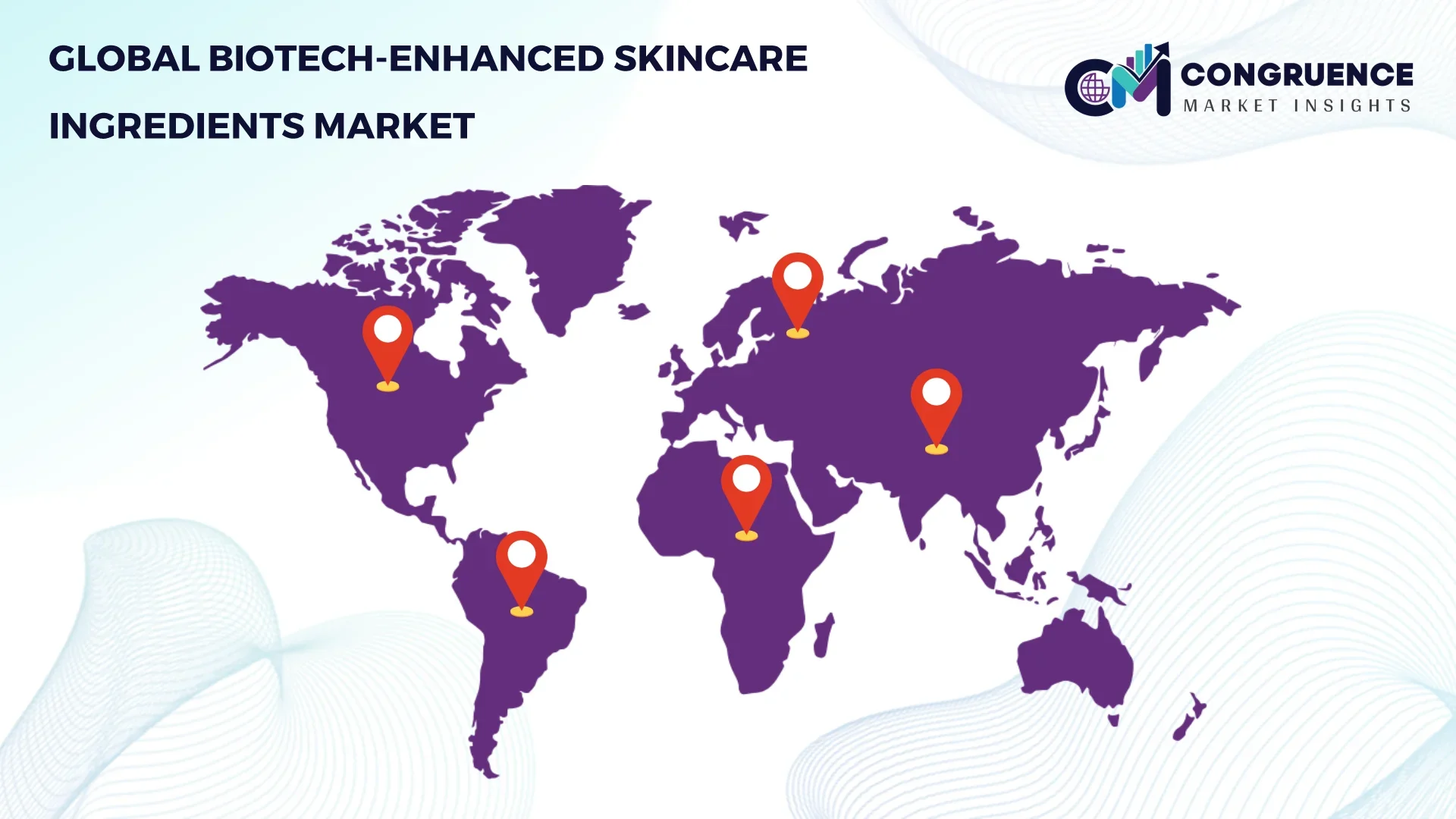
Europe followed with a 29% share, while Asia-Pacific held 23%, South America 6%, and Middle East & Africa 4%. More than 62% of premium skincare formulations in North America incorporated biotech-derived actives in 2025, compared to 55% in Europe and 48% in Asia-Pacific. Asia-Pacific recorded over 1,200 biotech-integrated product launches in 2025 alone, reflecting strong innovation momentum. Europe leads in sustainability compliance, with 75% of manufacturers aligning with biodegradable ingredient mandates. Meanwhile, over 40% of global fermentation-based cosmetic ingredient facilities are concentrated in North America, while Asia-Pacific hosts nearly 35% of emerging synthetic biology startups focused on cosmetic actives. Regional consumption patterns show higher dermatology-driven adoption in developed markets and digitally influenced, e-commerce-led purchasing in emerging economies.
North America represents approximately 38% of the global Biotech-Enhanced Skincare Ingredients Market share, driven by high R&D expenditure and established fermentation infrastructure. The United States accounts for over 80% of the regional demand, supported by more than 40 industrial-scale bioprocessing facilities dedicated to cosmetic and personal care ingredients. Key industries driving demand include dermatology-backed skincare brands, premium anti-aging manufacturers, and contract formulation laboratories. Regulatory oversight by the U.S. Food and Drug Administration ensures structured safety validation, accelerating acceptance of recombinant peptides and bio-fermented hyaluronic acid. Over 65% of premium skincare brands in the region promote clinically validated biotech actives. Digital transformation trends, including AI-assisted molecular modeling, have shortened ingredient development cycles by nearly 35%.
Europe holds approximately 29% of the global Biotech-Enhanced Skincare Ingredients Market share, led by Germany, France, and the United Kingdom. Germany accounts for nearly 32% of regional consumption due to its strong cosmetic manufacturing base, while France leads in premium skincare innovation. Over 70% of European manufacturers comply with strict biodegradable and clean-label mandates. The European Chemicals Agency and regional sustainability frameworks have accelerated the shift toward fermentation-derived and recombinant ingredients. Nearly 60% of new skincare launches in 2025 emphasized microbiome-friendly or biotech-enhanced formulations. Adoption of green chemistry platforms and low-carbon fermentation systems reduced production emissions by 28% across leading facilities.
Asia-Pacific accounts for 23% of global market volume and ranks as the fastest-growing regional cluster. China, Japan, and South Korea collectively represent over 70% of regional demand, with China alone contributing nearly 45% of Asia-Pacific consumption. The region recorded more than 1,200 biotech-integrated skincare product launches in 2025. Manufacturing expansion includes over 150 mid-scale fermentation units supporting cosmetic ingredient production. South Korea leads in peptide and growth-factor innovation, while Japan emphasizes recombinant collagen technologies. Regional innovation hubs in Seoul, Shanghai, and Tokyo focus on AI-integrated bio-discovery platforms.
South America accounts for approximately 6% of the global Biotech-Enhanced Skincare Ingredients Market, with Brazil contributing nearly 55% of regional demand and Argentina around 18%. Brazil hosts over 300 registered cosmetic manufacturers, supporting domestic ingredient utilization. Government-backed industrial development programs have encouraged biotech integration within cosmetic supply chains. Regional infrastructure investments in bio-based production facilities increased by 15% between 2023 and 2025. Trade agreements facilitating ingredient imports from North America and Europe have enhanced access to advanced peptides and fermentation-derived actives.
The Middle East & Africa region represents 4% of global market share, led by the United Arab Emirates and South Africa. The UAE accounts for nearly 38% of regional demand, supported by premium retail expansion and dermatology clinics. South Africa contributes approximately 27% through growing personal care manufacturing capabilities. Technological modernization includes the adoption of automated formulation labs and digitally tracked ingredient sourcing systems. Over 45% of high-end cosmetic retailers in the UAE stock biotech-enhanced skincare products. Regulatory harmonization efforts within Gulf Cooperation Council countries have streamlined product approvals.
United States – 34% Market Share: Leads due to advanced fermentation infrastructure, over 50 billion USD annual biotech R&D investment, and strong dermatology-backed product demand.
Germany – 11% Market Share: It is driven by a robust cosmetic manufacturing base, strict sustainability compliance frameworks, and high adoption of green biotechnology platforms.
The Biotech-Enhanced Skincare Ingredients Market demonstrates a moderately fragmented competitive structure, with over 120 active global and regional ingredient manufacturers operating across peptides, recombinant proteins, fermentation-derived actives, and microbiome-based formulations. The top five companies collectively account for approximately 46% of global market share, reflecting a competitive yet innovation-driven landscape. Market leaders maintain strong positioning through vertically integrated fermentation infrastructure, proprietary strain libraries, and patent portfolios exceeding 500 active biotech-related filings globally.
Strategic initiatives between 2024 and 2025 included more than 35 cross-industry partnerships between synthetic biology startups and multinational cosmetic manufacturers to accelerate ingredient commercialization. Over 60% of leading players increased capital allocation toward AI-assisted molecular discovery platforms, shortening development timelines by up to 40%. Additionally, nearly 28% of competitive expansion strategies involved mergers or minority equity investments in microbiome-focused startups.
Product innovation intensity remains high, with more than 1,500 new biotech-derived ingredient variants launched globally in 2025 alone. Competitive differentiation is increasingly based on sustainability metrics, including carbon reduction targets of 30–50% per production cycle and water recycling rates exceeding 45%. As regulatory scrutiny intensifies, firms with validated clinical documentation and traceability systems gain strategic advantage, reinforcing barriers to entry and sustaining technology-led competition.
Givaudan Active Beauty
Ashland Inc.
Clariant AG
Solabia Group
DSM-Firmenich
Amyris, Inc.
Lonza Group AG
Bioeffect hf.
Codexis, Inc.
Symrise AG
Lubrizol Corporation
Seppic S.A.
Technological advancement in the Biotech-Enhanced Skincare Ingredients Market is centered around precision fermentation, recombinant protein synthesis, CRISPR-enabled strain engineering, and AI-assisted molecular modeling. Precision fermentation platforms now achieve up to 30% higher yield efficiency compared to conventional microbial extraction systems, while reducing contamination risk by nearly 20%. More than 65% of newly commissioned cosmetic ingredient facilities integrate automated bioreactors equipped with real-time digital monitoring sensors.
CRISPR-based microbial optimization enables targeted genetic edits that enhance peptide stability and bioactivity, improving formulation compatibility by approximately 25%. AI-driven bioinformatics tools screen over 10,000 molecular variants per simulation cycle, accelerating candidate selection and reducing early-stage R&D time by up to 40%. Additionally, cell-free biosynthesis systems are gaining traction, enabling protein expression without live cells and increasing purity levels beyond 95%.
Microbiome analytics technologies are transforming personalized skincare development. Over 50% of premium dermatology brands now utilize skin microbiome sequencing platforms to design probiotic or postbiotic formulations. Advanced encapsulation technologies, including liposomal and nano-carrier systems, improve active ingredient penetration efficiency by nearly 35%.
Sustainable bio-manufacturing technologies are also critical, with renewable feedstock utilization increasing by 28% between 2023 and 2025. Digital traceability platforms using blockchain-based ingredient tracking are implemented by approximately 32% of multinational cosmetic manufacturers, strengthening supply chain transparency and regulatory compliance.
• In October 2025, BASF spotlights biotech‑powered actives at In‑Cosmetics Asia 2025, unveiling Aloversil™ (a botanical peptide-based active supporting scalp and hair health) and Mimiskin® Garde (a next-generation skin protective ingredient forming a breathable film) as part of its expanded holistic biotech-enabled solutions portfolio for personal care. This showcase emphasizes climate-adaptive protection and longevity in formulations. Source: www.basf.com
• In September 2025, Croda International launched Zenakine™ as a neurocosmetic active ingredient, designed to help skin respond to stress and support wellbeing. Zenakine™ was developed with translational dermatology research and targets stress ageing mechanisms while aligning with COSMOS and RSPO sustainability standards—significant in Croda’s science-led, sustainable active portfolio expansion. Source: www.croda.com
• In April 2025, Evonik showcased its expanded biosolutions at in‑cosmetics® global 2025, highlighting a suite of eco-efficient biotech-derived ingredients such as Vecollage® Fortify GP (vegan skin-identical collagen peptide with dual anti-aging action), TEGOSOFT® BC MB (biodegradable emollient), and RHEANCE® D50 (vegan biosurfactant suitable for certified natural cosmetics)—demonstrating Evonik’s commitment to sustainable high-performance biotech innovation. Source: www.evonik.com
• In April 2025, dsm‑firmenich formed a strategic partnership with Inscripta to drive biotech innovation in well‑aging skincare, focusing on developing novel bio-active ingredients. The collaboration combines Inscripta’s GenoScaler™ strain engineering platform with dsm-firmenich’s biotech expertise to accelerate development of next-generation sustainable skincare actives with superior performance and supply scalability. Source: www.dsm-firmenich.com
The Biotech-Enhanced Skincare Ingredients Market Report provides comprehensive coverage of product types including peptides, recombinant proteins, fermentation-derived hyaluronic acid, microbiome-based actives, and plant stem-cell extracts. The scope encompasses clinical dermatology applications, anti-aging, hydration, pigmentation management, acne treatment, and sensitive-skin solutions across mass, premium, and cosmeceutical categories.
Geographically, the report evaluates five primary regions—North America, Europe, Asia-Pacific, South America, and Middle East & Africa—covering more than 25 key countries. Regional analysis includes production capacity metrics, ingredient integration rates in product launches, regulatory compliance frameworks, and sustainability benchmarks such as carbon reduction targets exceeding 30% in advanced manufacturing facilities.
Technological coverage spans precision fermentation systems, CRISPR-enabled strain development, AI-assisted molecular modeling, nano-encapsulation delivery systems, and blockchain-based ingredient traceability platforms. The report further examines end-user segments including multinational cosmetic manufacturers, dermatology-backed brands, contract manufacturers, medical aesthetic clinics, and emerging clean-beauty enterprises.
In addition to mainstream categories, the scope includes emerging niches such as microbiome-focused skincare, lab-grown collagen substitutes, postbiotic complexes, and cell-free biosynthesis platforms. The report also evaluates competitive intensity, patent activity trends exceeding 500 biotech-related cosmetic filings globally, partnership ecosystems, and sustainability commitments shaping long-term strategic positioning within the Biotech-Enhanced Skincare Ingredients Market.
| Report Attribute / Metric | Details |
|---|---|
| Market Revenue (2025) | USD 7,830.0 Million |
| Market Revenue (2033) | USD 13,655.9 Million |
| CAGR (2026–2033) | 7.2% |
| Base Year | 2025 |
| Forecast Period | 2026–2033 |
| Historic Period | 2021–2025 |
| Segments Covered |
By Type
By Application
By End-User Insights
|
| Key Report Deliverables | Revenue Forecast; Market Trends; Growth Drivers & Restraints; Technology Insights; Segmentation Analysis; Regional Insights; Competitive Landscape; Regulatory & ESG Overview; Recent Developments |
| Regions Covered | North America; Europe; Asia-Pacific; South America; Middle East & Africa |
| Key Players Analyzed | BASF SE; Evonik Industries AG; Croda International Plc; Givaudan Active Beauty; Ashland Inc.; Clariant AG; Solabia Group; DSM-Firmenich; Amyris, Inc.; Lonza Group AG; Bioeffect hf.; Codexis, Inc.; Symrise AG; Lubrizol Corporation; Seppic S.A. |
| Customization & Pricing | Available on Request (10% Customization Free) |




