
Reports
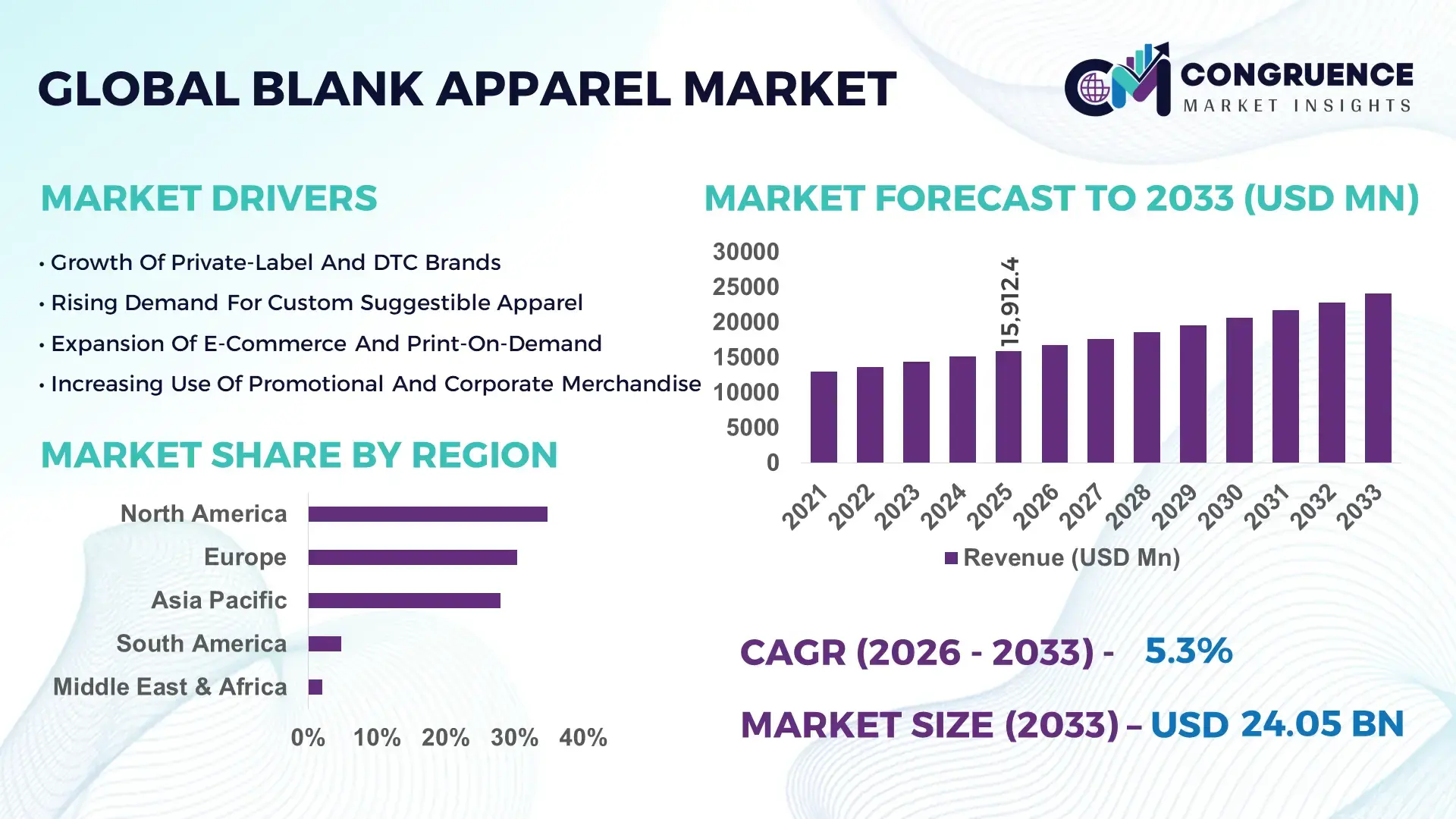
The Global Blank Apparel Market was valued at USD 15,912.4 Million in 2025 and is anticipated to reach a value of USD 24,052.6 Million by 2033 expanding at a CAGR of 5.3% between 2026 and 2033, according to an analysis by Congruence Market Insights. Market growth is supported by rising demand from print-on-demand businesses, private labeling, promotional merchandising, and the global expansion of casual and athleisure wear.
The United States dominates the Blank Apparel market through high-volume domestic consumption, advanced textile manufacturing infrastructure, and strong integration with e-commerce-driven customization platforms. In 2025, the country produced over 1.4 billion blank garments annually, supported by investments exceeding USD 1.1 billion in automated knitting, dyeing, and finishing facilities. Apparel printing, promotional merchandise, and sportswear collectively accounted for over 62% of blank apparel utilization. More than 48% of small and mid-sized apparel brands in the U.S. rely on blank garments as base products, while direct-to-consumer customization platforms reported blank apparel adoption across nearly 57% of product catalogs.
Market Size & Growth: Valued at USD 15,912.4 million in 2025 and projected to reach USD 24,052.6 million by 2033, driven by private labeling and customization demand.
Top Growth Drivers: Print-on-demand adoption (44%), athleisure demand (38%), promotional merchandise usage (33%).
Short-Term Forecast: By 2028, automated textile production is expected to reduce unit manufacturing costs by 18%.
Emerging Technologies: Automated knitting systems, sustainable fabric processing, AI-based demand forecasting.
Regional Leaders: North America projected at USD 8.2 billion by 2033 with customization demand; Asia-Pacific at USD 9.1 billion driven by manufacturing scale; Europe at USD 4.6 billion led by sustainable textiles.
Consumer/End-User Trends: SMEs and online brands represent over 53% of blank apparel procurement.
Pilot or Case Example: In 2024, an automated garment facility improved production throughput by 27%.
Competitive Landscape: Gildan leads with approximately 19% share, followed by Hanesbrands, Fruit of the Loom, Bella+Canvas, and Next Level Apparel.
Regulatory & ESG Impact: Sustainability mandates and labor compliance standards influencing sourcing decisions.
Investment & Funding Patterns: Over USD 2.3 billion invested globally between 2022–2025 in textile automation and sustainable fabrics.
Innovation & Future Outlook: Growth in eco-friendly blanks and rapid-turnaround manufacturing shaping future demand.
Blank apparel demand is concentrated in promotional clothing (36%), private-label fashion (34%), and athletic wear (30%). Advancements in fabric blends, waterless dyeing, and supply chain digitization are reshaping competitiveness. Regional consumption growth is reinforced by e-commerce expansion, sustainability regulations, and faster fashion cycles.
The Blank Apparel Market holds strategic importance as a foundational layer of the global apparel value chain, enabling scalability, customization, and rapid brand deployment. Blank garments serve as core inputs for print-on-demand, corporate merchandise, sportswear branding, and emerging direct-to-consumer labels. Advanced circular knitting technology delivers 22% higher fabric consistency compared to traditional cut-and-sew processes, improving print quality and reducing defect rates.
Asia-Pacific dominates in production volume, while North America leads in adoption with nearly 61% of independent apparel brands sourcing blank garments for customization. By 2027, AI-driven demand forecasting is expected to reduce excess inventory levels by 25% across blank apparel distributors. From an ESG perspective, manufacturers are committing to sustainability metrics such as 40% reduction in water usage and 30% recycled fiber integration by 2030. In 2024, a vertically integrated textile producer achieved a 19% reduction in fabric waste through automated cutting and real-time quality monitoring.
Strategic pathways emphasize nearshoring, flexible manufacturing, and eco-certified materials to support faster turnaround and compliance. Integration with digital printing platforms, inventory-as-a-service models, and blockchain-based traceability will further enhance transparency. These developments position the Blank Apparel Market as a resilient, compliance-driven, and sustainable growth enabler for global fashion and merchandise ecosystems.
The Blank Apparel market dynamics are shaped by customization demand, fast fashion cycles, and evolving sourcing strategies. Growth is influenced by expansion of online retail, brand localization, and demand for versatile base garments. Manufacturing automation, fabric innovation, and supply chain digitization improve efficiency and responsiveness. Regulatory focus on labor practices and sustainability adds compliance complexity, while price competition intensifies among large-scale producers. Market participants increasingly prioritize scalability, consistent quality, and rapid replenishment to meet fluctuating demand.
Print-on-demand and private labeling models significantly boost blank apparel demand. In 2025, over 46% of new apparel brands launched with blank garment sourcing. These models reduce upfront inventory costs by 35% and enable rapid design iteration. Blank apparel supports faster product launches, lower risk, and higher margin potential, particularly for SMEs and online retailers.
Cotton and synthetic fiber price fluctuations impact production planning, with input cost variability reaching 21% year-over-year. Compliance with labor and environmental standards increases operational costs, especially for smaller manufacturers. These factors pressure margins and limit expansion in price-sensitive segments.
Demand for sustainable blanks is rising, with eco-friendly garments accounting for 28% of new product introductions in 2025. Organic cotton, recycled polyester, and low-impact dyes create differentiation opportunities. Brands adopting sustainable blanks report 17% higher customer retention rates.
Global logistics disruptions and port congestion increased average lead times by 14% in recent years. Brands face challenges balancing speed and cost efficiency. Nearshoring strategies help mitigate risks but require significant capital investment and operational restructuring.
Expansion of Sustainable Blank Collections: Eco-friendly blanks grew by 32%, supported by recycled fibers and water-efficient dyeing.
Automation in Textile Manufacturing: Automated knitting and cutting improved output efficiency by 29% across large facilities.
Growth of Direct-to-Consumer Brands: Over 41% of DTC apparel brands rely exclusively on blank garments for customization.
Digital Supply Chain Integration: Real-time inventory systems reduced stockouts by 24% among major distributors.
The Blank Apparel market is segmented by type, application, and end-user. Product types vary by garment category and fabric composition. Applications include promotional merchandise, fashion branding, sportswear, and workwear. End-user adoption differs between enterprises, SMEs, and individual creators, influenced by scale, customization needs, and sustainability priorities.
T-shirts lead with 48% adoption due to universal usage and print compatibility. Hoodies and sweatshirts account for 27%, while blank activewear is the fastest-growing type, expanding at over 7% CAGR driven by athleisure demand. Other types, including caps, polos, and outerwear, collectively contribute 25%.
In 2025, a national apparel innovation program reported adoption of advanced blank activewear fabrics across over 8 million garments.
Promotional merchandise dominates with a 39% share, followed by private-label fashion at 34%. Athletic and lifestyle branding is the fastest-growing application, expanding at over 6% CAGR. Other applications, including corporate uniforms and event apparel, account for 27%. In 2025, over 42% of SMEs used blank apparel for branded merchandise.
In 2025, blank apparel supported large-scale branding initiatives across more than 120,000 corporate campaigns.
SMEs lead adoption with 46%, driven by flexibility and low entry barriers. Online creators and influencers are the fastest-growing end-user group, expanding at over 8% CAGR. Large enterprises and institutions collectively account for 54%. In 2025, 38% of e-commerce sellers relied on blank garments for product launches.
In 2025, small apparel brands using blank garments improved time-to-market by 21% through streamlined sourcing.
North America accounted for the largest market share at 34.8% in 2025 however, Asia-Pacific is expected to register the fastest growth, expanding at a CAGR of 6.7% between 2026 and 2033.
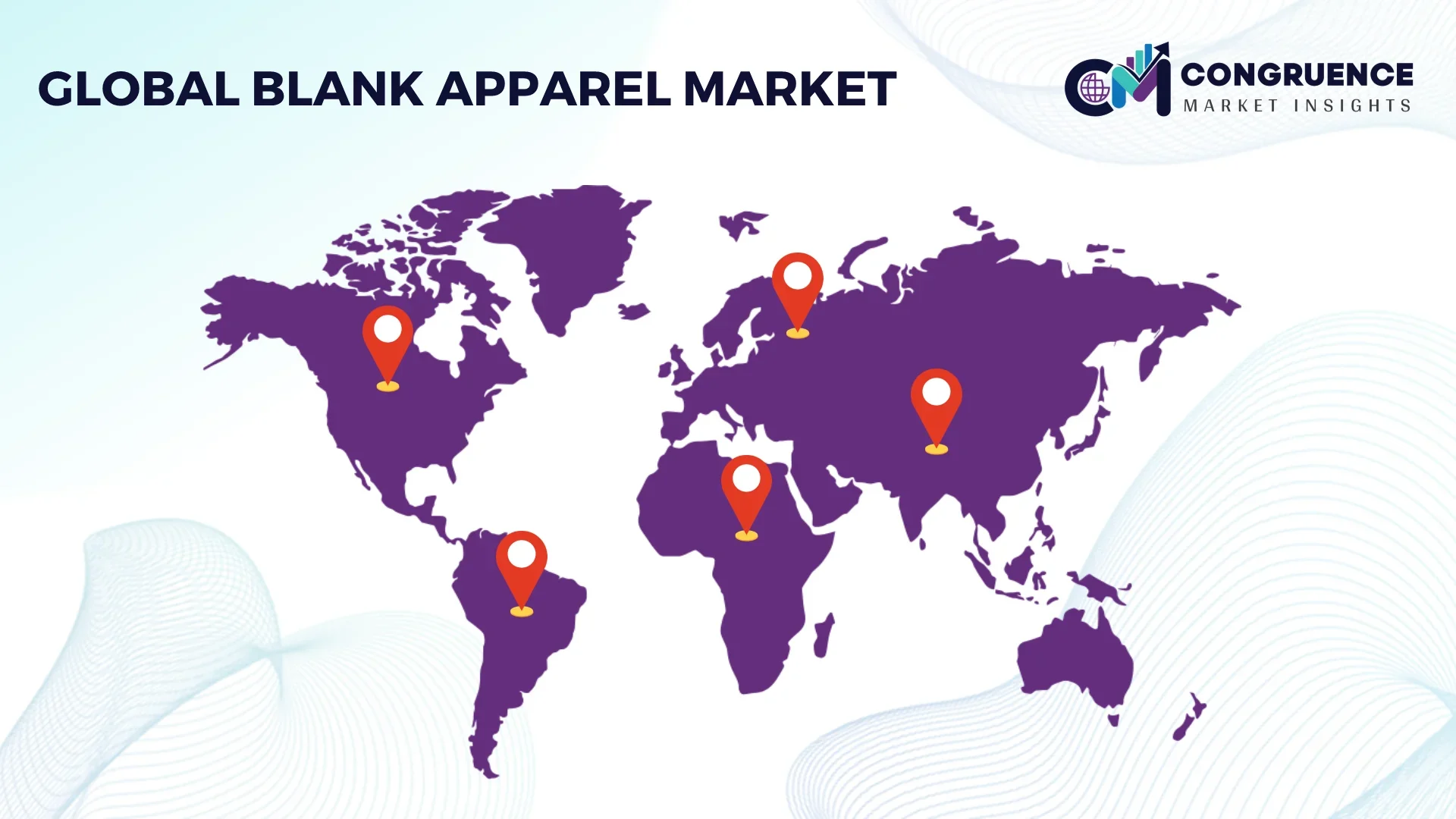
North America consumed over 5.6 billion units of blank apparel in 2025, driven by strong demand from promotional merchandise, print-on-demand platforms, and private-label fashion brands. Europe followed with a 27.9% share, supported by premium blank garment demand and sustainability-led sourcing across Germany, the UK, and France. Asia-Pacific accounted for 30.4% of global production volume in 2025, with China, India, and Bangladesh collectively manufacturing more than 9.2 billion blank garments annually. South America and Middle East & Africa together represented 6.9%, where adoption is rising in corporate uniforms, sports merchandising, and event-based apparel, supported by localized printing and distribution networks.
How is customization-led commerce reshaping large-scale blank garment consumption?
The region contributed approximately 34.8% of global Blank Apparel demand in 2025, with the United States accounting for the majority of consumption volume. Key industries driving demand include promotional products, corporate branding, sports merchandise, hospitality uniforms, and e-commerce-based apparel startups. Regulatory emphasis on labor compliance and textile labeling standards has encouraged sourcing from certified domestic and nearshore suppliers. Digital transformation is evident through automated screen printing, AI-based inventory forecasting, and integrated fulfillment platforms. A leading domestic manufacturer expanded automated cutting and dyeing operations, improving order turnaround times by nearly 22%. Consumer behavior shows strong preference for rapid customization, bulk ordering flexibility, and consistent fabric quality, particularly among SMEs and enterprise buyers.
Why are sustainability mandates influencing sourcing and material choices?
Europe represented around 27.9% of the Blank Apparel market in 2025, led by Germany, the UK, France, Italy, and Spain. Regulatory frameworks focused on sustainable textiles, circular economy practices, and supply chain transparency are shaping procurement decisions. Sustainability initiatives promote organic cotton, recycled polyester, and low-impact dyeing, accelerating adoption of eco-certified blank garments. Emerging technologies include digital fabric tracking and water-efficient finishing processes. A regional apparel supplier introduced carbon-labeled blank garments, enabling buyers to assess environmental impact at the SKU level. Consumer behavior reflects higher demand for ethically produced, traceable blanks, particularly from fashion brands and institutional buyers responding to regulatory pressure.
What makes manufacturing scale and digital retail central to regional leadership?
Asia-Pacific ranked first globally by production volume in 2025, with China, India, Bangladesh, and Vietnam dominating manufacturing output. The region produced over 60% of global blank apparel units, supported by integrated textile parks, low-cost labor, and advanced spinning and knitting infrastructure. Manufacturing automation increased output efficiency by approximately 26% across large facilities. Innovation hubs focus on sustainable fibers and smart textile processing. A major regional producer invested in high-speed knitting lines, adding capacity of over 400 million garments annually. Consumer behavior is driven by e-commerce expansion and social media-based apparel brands, with over 58% of regional blank apparel orders placed through digital channels.
How are regional branding and sports culture driving steady adoption?
South America accounted for nearly 4.8% of global Blank Apparel demand in 2025, led by Brazil and Argentina. Demand is supported by sports merchandising, corporate uniforms, and event-based promotional apparel. Infrastructure investments in textile finishing and regional distribution centers improved delivery times by 18%. Government incentives for domestic manufacturing and favorable trade agreements support regional sourcing. A local apparel group expanded blank sportswear production for football clubs and community leagues. Consumer behavior is closely linked to media, sports culture, and localized branding, driving demand for region-specific fits and color palettes.
Why are uniforms and hospitality segments shaping selective demand growth?
The region represented approximately 2.1% of global Blank Apparel consumption in 2025, with growth concentrated in the UAE, Saudi Arabia, and South Africa. Demand is driven by corporate uniforms, hospitality apparel, construction workwear, and event merchandise. Infrastructure development and large-scale hospitality projects increase bulk procurement. Technological modernization includes adoption of automated embroidery and digital printing for uniforms. A regional distributor partnered with logistics providers to improve fulfillment efficiency across GCC markets. Consumer behavior emphasizes durability, climate-appropriate fabrics, and bulk customization for institutional buyers.
United States Blank Apparel Market – 28.4%: High consumption from promotional merchandise, print-on-demand platforms, and enterprise branding demand.
China Blank Apparel Market – 24.6%: Massive production capacity, vertically integrated textile supply chains, and global export orientation.
The Blank Apparel market is moderately consolidated with over 120 active global and regional manufacturers and distributors. The top five companies collectively account for approximately 46% of total market presence, reflecting scale-driven advantages in sourcing, pricing, and distribution. Competitive positioning is influenced by fabric quality consistency, color availability, sustainability credentials, and fulfillment speed. Strategic initiatives include expansion of nearshore manufacturing, partnerships with print-on-demand platforms, and investments in sustainable textiles. Product innovation focuses on improved fabric blends, reduced shrinkage rates, and enhanced print compatibility. Smaller players compete by targeting niche segments such as eco-friendly blanks, premium heavyweight garments, and rapid-turnaround regional supply. Inventory depth, SKU breadth, and digital ordering platforms remain critical differentiators in enterprise procurement.
Fruit of the Loom
Next Level Apparel
American Apparel
Jerzees
Russell Athletic
Alstyle Apparel
Port Authority
AS Colour
Tultex
Technology adoption in the Blank Apparel market is centered on automation, sustainability, and supply chain digitization. Automated circular knitting machines improve fabric uniformity by up to 24% and reduce material waste during production. Digital dyeing and waterless finishing technologies cut water usage by nearly 30% per garment batch. AI-based demand forecasting tools help distributors optimize inventory levels, reducing excess stock by approximately 21%. RFID tagging and blockchain-enabled traceability systems enhance transparency across sourcing and logistics. Advanced fabric engineering enables development of lightweight, breathable, and print-optimized blanks suitable for multiple decoration techniques. Nearshore manufacturing supported by digital production planning reduces lead times by 15–20%. Sustainability-focused innovations, including recycled fibers and biodegradable packaging, are increasingly integrated into product lines. These technologies collectively support scalability, compliance, and operational efficiency for manufacturers and buyers.
In May 2025, Gildan Activewear expanded its sustainable blank apparel portfolio with increased use of recycled polyester blends, reducing fabric-related water consumption by approximately 25% across select product lines. Source: www.gildan.com
In October 2024, Hanesbrands enhanced automation at its North American manufacturing facilities, increasing blank garment output capacity by over 200 million units annually. Source: www.hanesbrands.com
In March 2025, Bella+Canvas introduced new heavyweight blank styles manufactured using energy-efficient knitting processes, improving fabric durability metrics by 18%. Source: www.bellacanvas.com
In August 2024, Fruit of the Loom upgraded digital inventory management systems across distribution centers, reducing order fulfillment times by 16%. Source: www.fruitoftheloom.com
The Blank Apparel Market Report provides a comprehensive evaluation of the global market landscape covering garment types, applications, end-users, and regional demand patterns. The scope includes blank T-shirts, hoodies, sweatshirts, polos, activewear, caps, and outerwear manufactured using cotton, blended, and synthetic fabrics. Applications analyzed span promotional merchandise, private-label fashion, sports branding, corporate uniforms, and event apparel. The report covers geographic regions including North America, Europe, Asia-Pacific, South America, and Middle East & Africa, with country-level insights for key manufacturing and consumption hubs. Technology coverage includes textile automation, sustainable fabric processing, digital inventory systems, and advanced finishing techniques. Emerging niches such as eco-certified blanks, nearshore manufacturing models, and rapid customization platforms are included. The scope supports strategic decision-making for manufacturers, distributors, investors, and brand owners by outlining production trends, sourcing strategies, competitive positioning, and operational innovation across the Blank Apparel value chain.
| Report Attribute/Metric | Report Details |
|---|---|
|
Market Revenue in 2025 |
USD 15,912.4 Million |
|
Market Revenue in 2033 |
USD 24,052.6 Million |
|
CAGR (2026 - 2033) |
5.3% |
|
Base Year |
2025 |
|
Forecast Period |
2026 - 2033 |
|
Historic Period |
2021 - 2025 |
|
Segments Covered |
By Type
By Application
By End-User
|
|
Key Report Deliverable |
Revenue Forecast, Growth Trends, Market Dynamics, Segmental Overview, Regional and Country-wise Analysis, Competition Landscape |
|
Region Covered |
North America, Europe, Asia-Pacific, South America, Middle East, Africa |
|
Key Players Analyzed |
Gildan Activewear, Hanesbrands, Bella+Canvas, Fruit of the Loom, Next Level Apparel, American Apparel, Jerzees, Russell Athletic, Alstyle Apparel, Port Authority, AS Colour, Tultex |
|
Customization & Pricing |
Available on Request (10% Customization is Free) |




