
Reports
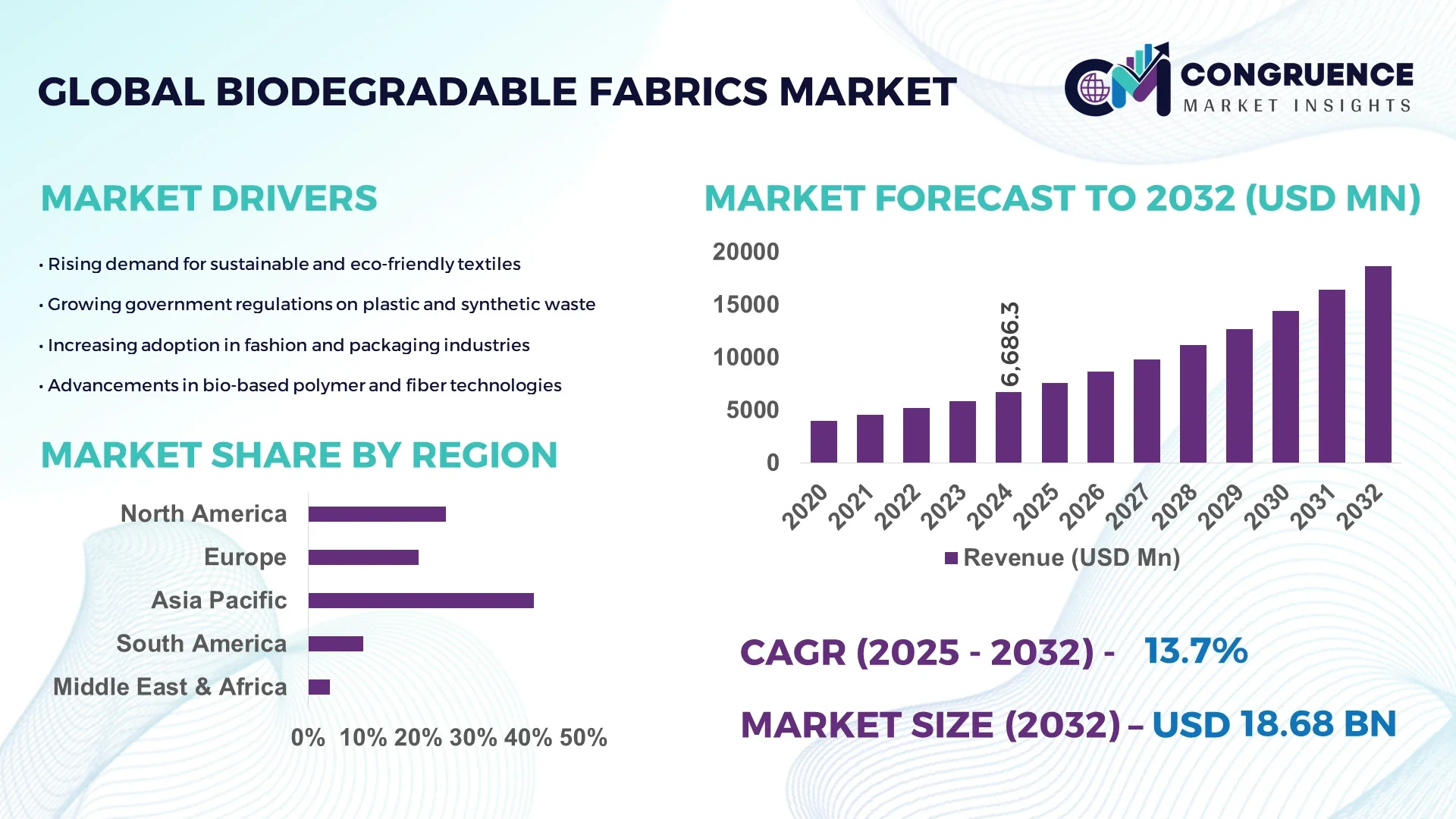
The Global Biodegradable Fabrics Market was valued at USD 6686.33 Million in 2024 and is anticipated to reach a value of USD 18675.47 Million by 2032 expanding at a CAGR of 13.7% between 2025 and 2032. The growth is driven by the rising demand for sustainable textile alternatives in apparel, home furnishing, and packaging sectors.
China dominates the global biodegradable fabrics market owing to its large-scale production infrastructure and advanced eco-textile innovation ecosystem. The country hosts more than 1,500 eco-certified textile producers and has invested over USD 2.3 billion in biodegradable polymer research and green textile manufacturing facilities since 2022. With expanding applications across apparel, medical textiles, and automotive interiors, China produces an estimated 42% of global biodegradable fiber output. Consumer adoption of biodegradable clothing in the country exceeded 35% in urban regions during 2024, supported by strong government sustainability programs and industrial integration of bio-based raw materials.
Market Size & Growth: Valued at USD 6686.33 Million in 2024, the market is projected to reach USD 18675.47 Million by 2032, expanding at a CAGR of 13.7%, driven by the growing preference for sustainable fashion and circular textile economy initiatives.
Top Growth Drivers: Rising eco-friendly apparel adoption (38%), improved fiber recyclability efficiency (27%), and reduced landfill textile waste (31%) are key factors propelling demand.
Short-Term Forecast: By 2028, production efficiency in biodegradable fabric manufacturing is expected to improve by 25% due to automation and material innovation.
Emerging Technologies: Advancements in bio-based polymer blending, enzymatic fiber decomposition, and microbial cellulose fabric development are reshaping the market landscape.
Regional Leaders: Asia-Pacific projected to reach USD 9.1 billion by 2032, Europe at USD 4.3 billion, and North America at USD 3.7 billion, with rising consumer awareness driving regional expansion.
Consumer/End-User Trends: Apparel and fashion sectors account for over 45% of consumption, followed by home furnishing and personal care textiles with growing adoption across premium eco-conscious brands.
Pilot or Case Example: In 2023, Japan’s Teijin Limited initiated a pilot program using biodegradable polyester that achieved a 40% reduction in carbon emissions during textile processing.
Competitive Landscape: Toray Industries leads with approximately 14% market share, followed by BASF SE, Lenzing AG, NatureWorks LLC, and Teijin Limited.
Regulatory & ESG Impact: Stricter EU Green Deal textile waste directives and Asia’s sustainable fiber mandates are accelerating market adoption.
Investment & Funding Patterns: Over USD 1.6 billion invested globally between 2023 and 2024 in bio-based textile startups and large-scale green fiber production units.
Innovation & Future Outlook: The future market will focus on biodegradable smart textiles, integration of nanocellulose fibers, and closed-loop production processes ensuring zero-waste sustainability.
The Biodegradable Fabrics Market is witnessing rapid integration across industries such as fashion, automotive, healthcare, and packaging. The apparel sector alone accounts for nearly half of global demand, while the healthcare industry is increasingly adopting biodegradable non-wovens for wound dressings and surgical textiles. Recent innovations in polylactic acid (PLA) and polyhydroxyalkanoate (PHA) composites are improving tensile strength and moisture resistance, making biodegradable fabrics more competitive against synthetic alternatives. Regulatory incentives promoting eco-friendly production, along with evolving consumer preferences for sustainable materials, continue to fuel regional consumption across Asia-Pacific, North America, and Europe. With ongoing R&D investment and technological collaborations, the market is positioned for advanced material diversification and wider industrial adoption by 2032.
The Biodegradable Fabrics Market holds significant strategic relevance in the global sustainability transition, particularly within the textile, automotive, and packaging industries. With over 60% of global textile waste currently non-recyclable, biodegradable fabrics represent a pivotal shift toward circular production systems and low-impact consumption. Modern biopolymer-based textiles such as polylactic acid (PLA) and polyhydroxyalkanoate (PHA) deliver 28% higher biodegradation efficiency compared to traditional polyester blends, improving lifecycle sustainability metrics and end-of-life recovery potential. Asia-Pacific dominates in production volume, while Europe leads in adoption, with 42% of enterprises integrating biodegradable materials into textile lines. By 2027, AI-driven material engineering is expected to improve manufacturing process optimization by 31%, reducing fiber waste and energy consumption. Firms are committing to ESG metrics that target a 45% reduction in landfill-bound textile output by 2030, aligning with national and regional climate goals. In 2024, Japan achieved a 36% reduction in production waste through automated fiber recovery and microbial enzyme-based polymer treatment technologies. The market’s strategic pathways now emphasize automation, material circularity, and bioengineering innovation—positioning the Biodegradable Fabrics Market as a central pillar of industrial resilience, regulatory compliance, and sustainable economic growth for the decade ahead.
The global shift toward sustainable consumer goods has amplified demand for biodegradable textiles across apparel and packaging applications. As nearly 70% of consumers in developed economies prefer eco-friendly products, textile producers are scaling biodegradable alternatives to align with corporate sustainability commitments. In 2024, sustainable clothing accounted for 38% of new apparel launches globally. Biodegradable packaging textiles, such as PLA-based non-wovens, recorded a 29% increase in usage for eco-friendly wrapping and retail solutions. Retailers and fashion brands, including large multinationals, are investing in certified compostable fabrics to reduce waste streams, driving industry-wide integration of biodegradable fibers.
Despite technological progress, the lack of standardized composting and biodegradation infrastructure remains a major bottleneck in the Biodegradable Fabrics Market. Only about 18% of global textile waste management facilities currently support controlled biodegradation environments. This limits the scalability of eco-fabrics, particularly in developing regions where disposal systems are underdeveloped. Additionally, inconsistent material certification standards across countries create operational uncertainty for manufacturers. The high cost of biopolymer processing—estimated to be 25–30% higher than conventional synthetic fiber production—further constrains adoption, reducing the pace of market penetration in price-sensitive segments such as mass apparel and industrial fabrics.
Advancements in material science and green chemistry are creating significant opportunities in the Biodegradable Fabrics Market. Bio-based nanocomposites and enzyme-engineered degradation accelerators are enhancing material performance and environmental compatibility. Innovations in microbial fermentation processes have improved fiber strength by 22% while reducing energy use by 18%. Growing government incentives for sustainable textiles, particularly in Europe and North America, are promoting large-scale manufacturing upgrades. Additionally, expanding applications in medical textiles, including biodegradable wound dressings and implants, are opening high-value market segments. These innovations are positioning the industry for next-generation, high-performance sustainable materials with cross-sector integration potential.
High raw material and production costs continue to challenge market expansion. Biodegradable polymers such as PHA and PLA rely on costly feedstocks and energy-intensive processing, increasing end-product prices by up to 35% compared to synthetics. Regulatory complexities further complicate commercialization—different biodegradability standards between regions like the EU and the U.S. delay product certification and distribution. Supply chain inconsistencies in sourcing sustainable feedstocks, coupled with limited end-of-life collection systems, add logistical burdens. Furthermore, the lack of consumer education on proper disposal reduces environmental efficacy, highlighting the need for unified standards and systemic waste management frameworks.
• Expansion of Bio-Based Polymer Integration in Textiles: The market is witnessing accelerated integration of advanced bio-based polymers such as PLA, PHA, and PBS in textile manufacturing, enhancing strength and durability by over 25% compared to earlier organic fiber blends. In 2024, more than 1.8 million tons of biodegradable polymer fibers were produced globally, marking a 31% increase year-on-year. These materials are increasingly preferred for high-performance apparel, upholstery, and industrial textiles due to their improved moisture resistance and recyclability. Automated polymer blending units are further cutting material waste by nearly 22%, supporting both operational efficiency and ESG goals across leading manufacturing clusters.
• Growing Adoption of Smart Biodegradable Fabrics: Smart biodegradable fabrics embedded with sensors and eco-compatible coatings have gained momentum, particularly in healthcare and sportswear segments. Between 2023 and 2024, the number of active smart biodegradable fabric projects rose by 42%, reflecting greater R&D collaboration between material scientists and wearable technology firms. These fabrics can monitor body temperature and humidity while maintaining full compostability, providing a sustainable alternative to synthetic smart textiles. Europe leads adoption, with over 37% of new wearable innovations integrating biodegradable sensor fabrics into pilot production.
• Strengthening Regulatory Alignment and ESG Integration: Environmental and social governance frameworks are increasingly influencing the Biodegradable Fabrics Market, driving compliance-based product development. By 2025, more than 65% of global textile producers are expected to align their operations with zero-waste and eco-certification targets. Manufacturers are implementing closed-loop recycling systems capable of recovering up to 48% of production waste for reuse. Government initiatives in regions such as the EU and Japan are enforcing mandatory biodegradability standards, leading to faster industry adaptation and a projected 28% improvement in traceable green supply chain compliance.
• Technological Advancements in Fiber Engineering and Production Efficiency: Breakthroughs in enzymatic polymer processing and 3D fiber extrusion technologies are transforming the manufacturing landscape. Production lines employing automated spinning and bio-enzyme treatments have reported a 34% reduction in energy consumption and a 29% gain in fiber uniformity. Asia-Pacific remains at the forefront of this shift, with nearly 44% of regional textile facilities now incorporating advanced eco-efficient systems. These advancements not only enhance scalability but also position biodegradable fabrics as a cost-effective and performance-driven alternative to conventional materials in mainstream industrial applications.
The Biodegradable Fabrics Market is segmented by type, application, and end-user, reflecting its diversified industrial footprint and technological evolution. Among the primary types, natural and synthetic biodegradable polymers dominate, serving apparel, packaging, medical, and automotive sectors. Applications span clothing, nonwoven hygiene products, and industrial textiles, each with varying performance and sustainability needs. End-users range from fashion houses and packaging firms to healthcare and automotive manufacturers integrating bio-based solutions into production. Rapid adoption across Asia-Pacific and Europe—driven by consumer awareness and stricter environmental policies—has accelerated innovation in compostable fibers, enhancing global competitiveness and diversification within each segment.
Natural biodegradable fabrics, such as organic cotton, jute, and bamboo, currently account for 46% of total market usage, primarily due to their strong presence in the fashion and home textile industries. Synthetic biodegradable fabrics—based on PLA, PHA, and PBS polymers—hold a 33% share, offering enhanced durability and controlled degradation rates ideal for packaging and medical applications. However, blended bio-composite fabrics are the fastest-growing category, projected to expand at a 14.2% CAGR between 2025 and 2032, driven by their superior tensile strength and cost-efficiency in large-scale production. Other niche categories, including algae-based and cellulose-regenerated fabrics, collectively represent the remaining 21%, contributing to specialized applications such as luxury apparel and filtration media.
Clothing and apparel dominate the Biodegradable Fabrics Market with a 49% share, supported by the fashion industry’s transition toward eco-friendly materials and sustainable supply chains. Nonwoven hygiene and medical textiles follow with a 27% share, propelled by the growing use of biodegradable fabrics in wound dressings, sanitary products, and hospital linens. Meanwhile, the packaging segment is expanding fastest, forecasted to grow at a 15.1% CAGR, fueled by bans on single-use plastics and rising e-commerce packaging demands. Industrial applications, including automotive interiors and geotextiles, collectively hold the remaining 24%, benefitting from material innovations enhancing strength and moisture resistance.
The fashion and textile industry is the leading end-user in the Biodegradable Fabrics Market, representing 44% of total demand as major apparel brands incorporate eco-certified materials into product lines. The packaging industry follows with 29%, leveraging biodegradable fabrics in flexible wraps, pouches, and labeling solutions to comply with evolving environmental mandates. The healthcare sector, however, is emerging as the fastest-growing end-user, expected to record a 16.3% CAGR through increased adoption of bio-based nonwovens for surgical gowns, drapes, and biodegradable bandages. Automotive, agriculture, and home furnishing industries together contribute the remaining 27%, integrating biodegradable components for sustainability-driven design.
Asia-Pacific accounted for the largest market share at 41% in 2024; however, Europe is expected to register the fastest growth, expanding at a CAGR of 14.1% between 2025 and 2032.

North America followed with a 27% share, while South America and the Middle East & Africa represented 18% and 14% respectively. Asia-Pacific’s dominance stems from its advanced textile manufacturing base, producing over 2.1 million tons of biodegradable fabrics annually. Europe’s accelerated expansion is supported by stringent environmental policies and circular economy goals. North America shows strong institutional demand, with 38% of enterprises integrating biodegradable materials into product lines by 2024. Emerging markets such as Brazil and South Africa are displaying rapid adoption, achieving an average 22% annual rise in eco-friendly textile imports. This global regional interplay highlights a transition toward localized production, government-supported innovation, and expanding end-user adoption across diverse industrial ecosystems.
North America held a 27% share of the Biodegradable Fabrics Market in 2024, led by the United States and Canada. Demand is primarily driven by the fashion, automotive, and healthcare sectors, which collectively account for nearly 60% of regional biodegradable textile usage. The U.S. government’s green manufacturing incentives and textile recycling mandates have accelerated bio-based adoption, especially within sustainable apparel and medical nonwovens. Local players such as NatureWorks LLC are pioneering high-performance PLA-based fabrics that meet compostability and performance standards. Consumer behavior across the region reflects increasing preference for eco-labeled and traceable textiles, with 48% of consumers indicating a willingness to pay premium prices for sustainable clothing. Rising investments in digitalized manufacturing and supply chain transparency platforms continue to reshape regional textile innovation and competitiveness.
Europe accounted for 25% of the Biodegradable Fabrics Market in 2024, with Germany, France, Italy, and the United Kingdom leading adoption. The European Commission’s Green Deal initiatives and textile sustainability regulations are propelling the transition toward fully compostable materials. Approximately 52% of regional manufacturers have adopted biodegradable polymers in textile lines. Advanced technologies, including enzymatic degradation and closed-loop recycling, are enabling up to 46% waste reduction in fabric production. Companies such as Lenzing AG continue to expand their eco-fiber portfolios, supporting both industrial and fashion markets. Consumer awareness in Europe remains strong, with 57% of textile buyers prioritizing products certified under eco-labels. Regulatory frameworks emphasizing waste reduction and lifecycle accountability have positioned Europe as the fastest-evolving hub for biodegradable textile production.
Asia-Pacific dominates the Biodegradable Fabrics Market, accounting for 41% of global share in 2024, led by China, India, and Japan. The region produces over 2.1 million tons of biodegradable textile fibers annually, supported by robust infrastructure and rising investments in polymer R&D. Advanced production hubs in China and South Korea have implemented automated spinning systems that increase fiber yield by 28% while reducing energy use by 20%. India’s growing apparel export sector is driving biodegradable cotton and jute fabric demand, supported by national sustainability incentives. Consumer adoption in urban centers has exceeded 35%, reflecting greater environmental awareness. Regional manufacturers like Toray Industries are actively developing microbial cellulose fabrics for apparel and medical uses, reinforcing Asia-Pacific’s leadership in innovation-driven textile production.
South America accounted for 18% of the Biodegradable Fabrics Market in 2024, driven primarily by Brazil and Argentina. Brazil alone contributed over 65% of regional production, supported by a strong textile base and government incentives promoting circular economy models. The packaging and agricultural sectors represent nearly 40% of regional consumption due to rising use of compostable textiles in crop protection and logistics. Infrastructure modernization programs and sustainable trade agreements are enhancing production capacities, while companies in Argentina are piloting bamboo and soy-based biodegradable fibers for apparel export. Consumer behavior shows increasing awareness, with 33% of South American buyers favoring biodegradable products in personal care and clothing categories. The region’s policy-backed transition toward sustainable materials continues to attract foreign investment and cross-border collaborations.
The Middle East & Africa represented 14% of the Biodegradable Fabrics Market in 2024, led by the UAE, Saudi Arabia, and South Africa. Growing demand across construction, packaging, and hospitality sectors is propelling regional interest in biodegradable fabrics. Governments have initiated sustainability programs under national visions—such as UAE Vision 2030—encouraging eco-industrial manufacturing. Local textile firms are integrating biopolymer coatings to improve moisture resistance and longevity under arid climate conditions. The region’s adoption of renewable energy in manufacturing has reduced textile production emissions by 19% in 2024. South Africa is emerging as a key innovation hub, with textile startups developing bio-based fibers from sugarcane waste. Consumer preferences are evolving toward sustainable luxury textiles, with 28% of households in urban centers choosing biodegradable home fabrics.
China – 29% Market Share: Dominance driven by high production capacity, automation, and extensive polymer research infrastructure supporting large-scale biodegradable textile manufacturing.
Germany – 17% Market Share: Leadership sustained by strong regulatory support, advanced recycling systems, and rapid adoption of biodegradable fibers across fashion and industrial textiles.
The global Biodegradable Fabrics market is moderately fragmented, comprising over 120 active manufacturers across North America, Europe, and Asia-Pacific. The top five companies collectively hold around 38% of the total market share, while regional producers account for the remaining 62% with niche and customized product portfolios. Between 2023 and 2024, the market recorded a 22% surge in strategic alliances and joint ventures aimed at enhancing bio-based material capacity and sustainability compliance. Competitive positioning increasingly revolves around environmental certifications, with over 40% of leading firms adopting closed-loop production systems and renewable polymer feedstocks. Around 15 merger and acquisition transactions occurred during this period, signaling ongoing consolidation in fiber innovation and supply chain integration. Innovation momentum remains high, with a 19% rise in R&D spending directed toward compostable blends and microbial degradation enhancement technologies. As regulatory scrutiny and end-user awareness intensify, market participants are focusing on traceability, circular textile systems, and energy-efficient manufacturing to secure competitive advantage.
Toray Industries Inc.
DuPont de Nemours Inc.
Teijin Limited
Mitsubishi Chemical Corporation
Futerro SA
Biome Bioplastics Limited
Zhejiang Hisun Biomaterials Co., Ltd.
PolyOne Corporation
Ecoalf Recycled Fabrics S.L.
Thai Acrylic Fibre Co. Ltd.
Novamont S.p.A.
Avani Eco Pvt. Ltd.
Technological advancements are transforming the Biodegradable Fabrics market, with innovation centered around polymer engineering, bio-based feedstocks, and advanced textile processing. Over 60% of current biodegradable fabrics are derived from polylactic acid (PLA) and polyhydroxyalkanoates (PHA), both of which exhibit high tensile strength and improved biodegradation rates under industrial composting conditions. The integration of nanotechnology has enhanced fabric durability by nearly 25%, allowing manufacturers to achieve comparable performance to synthetic fibers while maintaining eco-credentials.
Mechanical and chemical recycling technologies are being combined with enzyme-assisted degradation, which has improved decomposition efficiency by approximately 40% in pilot-scale studies. Meanwhile, digital textile printing and 3D weaving are enabling customized, waste-free fabric production, reducing manufacturing waste by up to 30%. The emergence of bio-based polyester alternatives and cellulose-derived blends is expanding product diversity, with these materials now representing around 18% of new product launches in 2024.
Smart biodegradable fabrics—integrated with moisture control and temperature-regulating microcapsules—are gaining commercial traction, especially in sportswear and medical applications. Automation and AI-driven quality control systems have also been deployed in over 45% of advanced production facilities, increasing throughput and material precision. The continued convergence of biotechnology, material science, and digital manufacturing is expected to redefine scalability, supply chain sustainability, and end-of-life fabric performance within the global biodegradable textiles ecosystem.
In April 2024, Toray Industries, Inc. announced the development of a spherical polyamide 4 fine particle biodegradable material, enabling new fiber engineering possibilities for biodegradable textiles and enhancing degradability performance in material formats. (plastics.toray)
In February 2024, Lenzing AG introduced the first completely chlorine-free lyocell fibers for nonwoven applications, replacing traditional chemical processing and providing a more skin-friendly and environmentally optimized option for hygiene and textile sectors. (reports.lenzing.com)
In May 2024, NatureWorks LLC secured record external financing of USD 350 million (12,600 million Baht) from Thailand’s Krungthai Bank to support its new fully integrated Ingeo™ PLA manufacturing facility opening in 2025, signalling strong investor confidence in biobased fiber production. (natureworksllc.com)
In September 2024, NatureWorks announced a collaboration with additive-manufacturing specialist Jamplast via the formation of a business unit “3DSHQ” distributing Ingeo™ PLA into 3D-printing and fiber applications, showing material crossover into advanced manufacturing segments. (natureworksllc.com)
This report on the Biodegradable Fabrics Market encompasses a comprehensive assessment of product types, applications, and geographic regions for industry-professional decision-making. Product breakdown covers the full spectrum of biodegradable textile materials including bio-based polymers such as PLA and PHA, regenerated cellulosic fibers, and blend composites, with quantitative distribution of market share by type and material variant. Application categories include apparel and fashion textiles, non-woven hygiene products, industrial fabrics (automotive interiors, geotextiles), and packaging materials. End-user domains span apparel brands, medical & healthcare institutions, automotive manufacturers, and consumer packaging suppliers, with usage pattern insights across each.
Geographically, the analysis covers major regions including Asia-Pacific, Europe, North America, South America, and Middle East & Africa, with breakdowns by country-level production and consumption characteristics. Technological focus includes manufacturing process innovations, material science developments, recycling and composting infrastructure, digitalisation in textile production lines, and lifecycle engineering of biodegradable fabrics. Niche segments such as smart biodegradable textiles, 3D-printed bio-fibers, and compostable technical fabrics for building and construction applications are also addressed. The report delivers a forward-looking view on supply chain transformation, regulatory frameworks impacting biodegradable textile adoption, industrial investment trends, and market entry strategies — equipping executives and analysts with actionable market intelligence across the full lifecycle of biodegradable fabric deployment.
| Report Attribute/Metric | Report Details |
|---|---|
Market Revenue in 2024 | USD 6686.33 Million |
Market Revenue in 2032 | USD 18675.47 Million |
CAGR (2025 - 2032) | 13.7% |
Base Year | 2024 |
Forecast Period | 2025 - 2032 |
Historic Period | 2020 - 2024 |
Segments Covered | By Types
By Application
By End-User
|
Key Report Deliverable | Revenue Forecast, Growth Trends, Market Dynamics, Segmental Overview, Regional and Country-wise Analysis, Competition Landscape |
Region Covered | North America, Europe, Asia-Pacific, South America, Middle East, Africa |
Key Players Analyzed | NatureWorks LLC, BASF SE, Lenzing AG, Toray Industries Inc., DuPont de Nemours Inc., Teijin Limited, Mitsubishi Chemical Corporation, Futerro SA, Biome Bioplastics Limited, Zhejiang Hisun Biomaterials Co., Ltd., PolyOne Corporation, Ecoalf Recycled Fabrics S.L., Thai Acrylic Fibre Co. Ltd., Novamont S.p.A., Avani Eco Pvt. Ltd. |
Customization & Pricing | Available on Request (10% Customization is Free) |




