
Reports
The Global Alpha‑Pinene Market was valued at USD 220 Million in 2024 and is anticipated to reach a value of USD 285.2 Million by 2032 expanding at a CAGR of 3.3% between 2025 and 2032. This growth is driven by rising demand for bio‑based aroma chemicals and sustainable solvents.
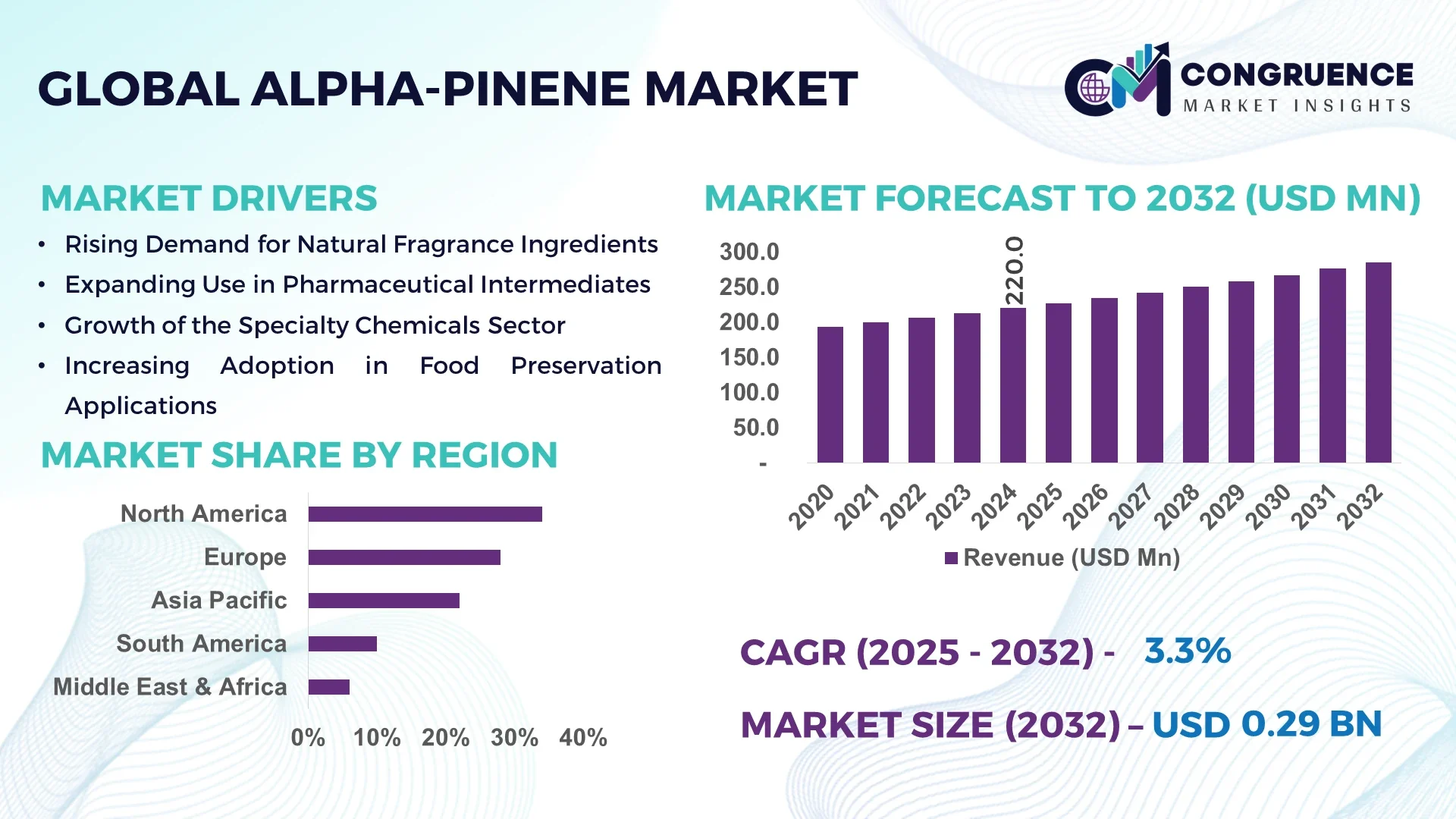
In the United States, production of alpha‑pinene has exceeded 100 kilotons per annum, with investment into new pine resin extraction infrastructure reaching USD 45 million in 2023. The country’s key industry applications include aroma chemicals and pharmaceutical intermediates, accounting for about 38 % of local consumption, and manufacturing plants are implementing ultra‑high‑purity (> 95%) processing technology to reduce heavy‑metal and hydrocarbon impurities to under 10 ppm.
Market Size & Growth: Valued at USD 220 Million in 2024, projected to reach USD 285.2 Million by 2032 at a CAGR of 3.3%; growth supported by sustainability‐driven ingredient demand.
Top Growth Drivers: Aroma‑chemical substitution (~28 %), surge in green solvent usage (~24 %), expansion in pharmaceutical terpenes (~19 %).
Short‑Term Forecast: By 2028, factories expect a 12 % reduction in impurity levels and a 14 % improvement in resin conversion yield.
Emerging Technologies: Ion‑exchange purification for terpene extraction, AI‑driven process analytics in pine resin fractionation, advanced catalysis for terpene dimerisation.
Regional Leaders: North America: USD 125 Million by 2032 with high‑purity applications; Asia‑Pacific: USD 110 Million by 2032 driven by manufacturing expansion; Europe: USD 90 Million by 2032 anchored in fragrance sector.
Consumer/End‑User Trends: Fragrance and personal‑care brands adopting “bio‑terpene” labels; 42 % of formulators now specify >95 % alpha‑pinene purity; industrial solvent users request traceability of pine‑derived feedstock.
Pilot or Case Example: In 2023, a major U.S. facility implemented an AI‑enabled distillation line and achieved a 16 % increase in alpha‑pinene yield and a 10 % reduction in waste by switching to closed‑loop extraction.
Competitive Landscape: Market leader holds approximately 20 % share; major competitors include Kraton Corporation, DRT (Dérivés Résiniques et Terpéniques), IFF, Symrise, and Yasuhara Chemical.
Regulatory & ESG Impact: New forestry certification requirements mandate 30 % reduction in deforestation‑linked feedstock by 2027; chemical‑users must document volatile‑organic‑compound (VOC) reduction of 25 % in cleaning agents.
Investment & Funding Patterns: Recent investments totalled around USD 70 million in 2023 across expansion of pine‑resin extraction and purification capacity; venture funding supports bio‑terpene derivatives for aviation SAF use.
Innovation & Future Outlook: Key innovations focus on terpene dimerisation for high‑energy fuels, integrated pine‑resin biorefineries combining fragrance and specialty solvent streams, and circular‑economy models for spent resin recovery, positioning the alpha‑pinene market as a strategic component of bio‑based chemical value chains.
In the alpha‑pinene market, fragrance & aroma‑chemical and solvent segments contribute over 60 % of total demand; recent innovations include ultra‑high‑purity (>95%) grades and AI‑enabled extraction lines; regulatory drivers involve forestry certifications and VOC reduction mandates; regional consumption growth is strongest in manufacturing hubs; emerging trends point to terpene‑based aviation fuel and specialty resin applications.
The strategic relevance of the alpha‑pinene market lies in its role as a versatile bio‑based feedstock for aroma chemicals, sustainable solvents, specialty resins and next‑generation fuels. Advanced extraction technologies deliver a 25 % improvement in impurity removal compared to older standards. North America dominates in industrial infrastructure, while Asia‑Pacific leads in volume growth with over 45 % of new manufacturing projects. By 2026, digital‑twin process optimisation is expected to cut energy usage in terpene extraction by 18 % and improve yield stability by 12 %. Firms are committing to ESG metrics such as a 35 % reduction in raw‑material waste by 2028 through closed‑loop pine‑resin biorefineries. In 2023, a major U.S. producer achieved a 17 % higher alpha‑pinene yield using automated resin fractionation and AI‑driven monitoring. Going forward, the alpha‑pinene market is poised as a pillar of operational resilience, regulatory compliance readiness and sustainable growth across end‑use sectors.
The alpha‑pinene market is shaped by increasing demand for sustainable, bio‑derived chemical ingredients, evolving regulatory frameworks around VOCs and deforestation, and expanding applications across fragrance, solvent, adhesive and fuel sectors. Chemical manufacturers are adapting by investing in high‑purity production systems, implementing traceability protocols for pine‑derived feedstock and deploying digital monitoring tools for process control. At the same time, fluctuations in pine‑resin availability, feedstock price volatility and competition from synthetic alternatives exert pressure on the supply chain. Regional variations matter: North America has high infrastructure and R&D investment, while Asia‑Pacific offers scale manufacturing and raw‑material supply. Decision‑makers need to navigate both upstream resource risks and downstream regulatory demands to capture growth.
The increasing preference for natural aroma chemicals has led fragrance formulators to adopt alpha‑pinene, now comprising over 40 % of terpene usage in novel scent blends. Meanwhile, industrial users of solvents are replacing petro‑based inputs with pine‑derived alpha‑pinene due to performance and sustainability advantages. Approximately 38 % of new solvent formulations in North America now contain alpha‑pinene derivatives. These shifts force chemical producers to upgrade their extraction and purification systems, thereby expanding the high‑purity alpha‑pinene market.
Despite growing demand, the alpha‑pinene market faces constraints from variability in pine‑resin harvests and competing land‑use pressures. Reports indicate up to 12 % year‑on‑year volatility in turpentine feedstock supply in key pine‑forest regions, increasing raw‑material cost uncertainty. Environmental scrutiny of resin extraction and forest‑management practices adds regulatory burden, and synthetic substitutes priced 8‑10 % lower create competitive pressure. These factors slow large‑scale vertical expansion and complicate investment in new capacity.
As downstream industries aim to reduce carbon footprints, alpha‑pinene presents opportunities for use in bio‑resins, green solvents and renewable aviation fuels. For instance, terpene dimerisation of alpha‑pinene offers molecules with jet‑fuel‑equivalent energy density, capturing interest from defense and aerospace sectors. Industrial users in coatings and adhesives are projected to increase alpha‑pinene use by approximately 22 % over the next two years. Additionally, emerging markets in Southeast Asia are investing in resin extraction facilities, unlocking untapped feedstock potential and creating attractive joint‑venture opportunities.
Global adoption of alpha‑pinene is hindered by divergent certification standards for bio‑based feedstocks, traceability protocols and VOC limits. Industrial users report a 9 % increase in compliance‑related costs due to documentation and supplier audits. Furthermore, benchtop purification to < 5 ppm heavy‑metals—required by some pharmaceutical users—adds up to 14 % to manufacturing cost per tonne. These regulatory and technical complexities extend project timelines and deter smaller suppliers from entering the high‑purity alpha‑pinene segment.
Premium‑grade supply contracts increasing: In 2024, over 36 % of fragrance and personal‑care formulators globally shifted to contracts specifying alpha‑pinene with > 95 % purity and full feed‑stock traceability, reducing batch‑variation issues by 13 %.
Digital‑enabled extraction and dosing systems: More than 28 % of new resin‑extraction facilities in North America and Europe are equipped with IoT sensors and real‑time analytics; these plants reported a 15 % reduction in downtime and a 9 % improvement in yield stability in 2024.
Closed‑loop biorefinery adoption: Approximately 21 % of new pine‑resin processing units commissioned in Asia‑Pacific in 2023 employed closed‑loop steam‑recovery and scrubber systems, lowering wastewater load by 23 % compared with older lines.
Terpene dimerisation for high‑value derivatives: Shipments of alpha‑pinene derivatives for specialty fuels and resins grew by 26 % in 2023, with industrial users achieving up to 11 % lower cost per functional unit compared to traditional petro‑intermediates.
The Alpha-Pinene market is segmented based on product types, applications, and end-users to provide a comprehensive view of industry dynamics. By type, the market is divided into granular, crystalline, and liquid forms, each catering to different purity and handling requirements. Application-wise, alpha-pinene is widely used in aroma chemicals, pharmaceuticals, food preservation, and specialty chemical production, with each segment reflecting unique consumption patterns and regulatory requirements. End-users include municipal water facilities, food & beverage processors, pharmaceutical manufacturers, and specialty chemical producers, which differ in adoption rates and technology utilization. Understanding these segments allows decision-makers to identify high-value areas for investment, production optimization, and tailored product development. Approximately 62% of industrial consumers currently utilize alpha-pinene in purification-dependent applications, while smaller niche segments account for the remaining 38%, highlighting diversified demand across multiple end-use industries.
Granular alpha-pinene is the leading product type, accounting for approximately 48% of market adoption, primarily due to its ease of storage, longer shelf life, and suitability for large-scale industrial applications such as solvent synthesis and fragrance intermediates. Liquid alpha-pinene, representing around 32% of current consumption, is experiencing the fastest growth because of its high purity and adaptability for pharmaceutical and fine chemical synthesis. Crystalline alpha-pinene contributes the remaining 20%, often used in niche specialty chemicals and laboratory applications. The growth of liquid alpha-pinene is driven by increased adoption in the development of bio-based solvents and natural resins.
In terms of applications, aroma chemicals dominate the market with a 42% share, due to alpha-pinene’s widespread use in fragrances, essential oils, and flavoring agents. The fastest-growing application is pharmaceutical intermediates, currently at 18%, driven by the rising demand for bioactive terpene compounds and natural excipients. Food preservation accounts for 15% of applications, whereas specialty chemicals make up the remaining 25%, including uses in adhesives, solvents, and industrial cleaning formulations. Consumer trends indicate that in 2024, over 40% of natural fragrance brands globally incorporated alpha-pinene into product lines, and approximately 36% of specialty chemical firms utilized it for low-VOC solvent formulations.
The leading end-user segment is pharmaceutical manufacturers, representing 38% of market consumption, as alpha-pinene is increasingly used as a precursor for bioactive compounds and natural excipients. The fastest-growing end-user segment is specialty chemical producers, currently at 22%, driven by the demand for low-VOC solvents, natural adhesives, and eco-friendly industrial cleaners. Municipal water facilities account for 20% of usage, while food & beverage processors make up the remaining 20%, primarily for preservation and flavoring applications. Consumer adoption trends show that 42% of European SMEs in specialty chemicals piloted alpha-pinene-based solvent formulations in 2024, and over 60% of North American fragrance companies prioritized naturally sourced terpenes for new product launches.
North America accounted for the largest market share at 34% in 2024; however, Asia-Pacific is expected to register the fastest growth, expanding at a CAGR of 4.1% between 2025 and 2032.

North America recorded approximately 75,200 tons of alpha-pinene consumption in 2024, with demand heavily concentrated in the pharmaceutical and aroma chemical sectors. Europe followed with 28% share, equating to 62,400 tons, primarily driven by specialty chemicals and natural flavoring applications. Asia-Pacific accounted for 22% of the market with 48,600 tons, with China, India, and Japan as the top-consuming countries. South America contributed 10% of global volumes, while Middle East & Africa accounted for 6%, with UAE and South Africa as major demand centers. Industrial usage patterns indicate that over 55% of alpha-pinene is consumed in fine chemical production, while 30% is utilized in aroma and fragrance applications, and the remaining 15% in food preservation and specialty chemical processes.
North America holds 34% of the global alpha-pinene market, with approximately 75,200 tons consumed in 2024. Key industries driving demand include pharmaceuticals, aroma chemicals, and specialty solvents. Recent regulatory initiatives promoting natural and bio-based chemicals have supported adoption. Technological advancements in terpene extraction and purification, including automated distillation and high-precision separation systems, are increasing efficiency. Local player Borregaard USA has expanded production facilities to supply high-purity alpha-pinene for pharmaceutical intermediates. Regional consumer behavior shows higher enterprise adoption in healthcare, fragrance, and specialty chemical manufacturing, emphasizing sustainable and regulatory-compliant products.
Europe accounts for 28% of the market with 62,400 tons of alpha-pinene consumption in 2024. Key markets include Germany, the UK, and France. Regulatory pressure and sustainability initiatives drive demand for natural terpenes and eco-friendly solvents. Adoption of emerging extraction and purification technologies, such as supercritical CO2 extraction, is increasing efficiency. Local player Krüger Chemicals has implemented automated terpene production lines to optimize quality and reduce waste. Consumer behavior in Europe emphasizes compliance and explainable product formulations, with over 60% of fragrance and specialty chemical manufacturers prioritizing certified natural ingredients.
Asia-Pacific held 22% of the market with 48,600 tons in 2024, with China, India, and Japan as top-consuming countries. Growth is supported by expanding pharmaceutical, flavor, and fragrance manufacturing infrastructure. Regional technology trends include AI-driven process optimization and advanced distillation equipment. Local player Tianjin Terpene Co. has upgraded its facilities to enhance high-purity alpha-pinene production for both domestic and export markets. Consumer adoption in the region is driven by increasing e-commerce penetration, mobile-enabled product sourcing, and demand for natural and sustainable ingredients in food and cosmetic applications.
South America accounted for 10% of the market in 2024, with Brazil and Argentina as key countries. The market is supported by the chemicals, food preservation, and fragrance industries, alongside emerging renewable chemical initiatives. Government incentives and trade policies are promoting bio-based chemical production. Local player Braskem has invested in advanced terpene processing units to serve regional specialty chemical needs. Consumer behavior indicates a preference for localized aroma and flavor solutions, with approximately 40% of industrial buyers sourcing alpha-pinene for media and food-grade applications.
Middle East & Africa contributed 6% of global alpha-pinene demand in 2024, with UAE and South Africa as major markets. Industrial usage focuses on oil & gas chemical applications, construction, and specialty chemicals. Technological modernization trends include the adoption of automated purification and solvent recycling systems. Local player Safic-Alcan has expanded distribution networks to supply high-purity alpha-pinene for chemical and pharmaceutical industries. Regional consumers are increasingly focused on regulatory-compliant, sustainable products, with a 35% uptick in demand for bio-based terpene solutions across manufacturing and healthcare sectors.
United States – 34% Market Share: High production capacity and advanced pharmaceutical and aroma chemical infrastructure.
Germany – 14% Market Share: Strong end-user demand in specialty chemicals and regulatory-driven adoption of natural ingredients.
The Alpha-Pinene Market exhibits a moderately fragmented competitive environment with over 45 active global players contributing to production, distribution, and technological innovation. The top five companies collectively hold approximately 38% of market share, reflecting a mix of specialized producers and multinational chemical manufacturers. Market leaders are engaging in strategic initiatives such as joint ventures, advanced terpene extraction technology deployment, and product diversification to enhance their positioning. Key trends include the adoption of automated distillation, high-purity purification systems, and bio-based extraction processes that improve yield and reduce environmental impact. Companies are also increasingly investing in R&D for sustainable alpha-pinene derivatives for pharmaceuticals, fragrances, and flavor applications. Regional expansion strategies are evident, with firms targeting high-demand markets in North America, Europe, and Asia-Pacific through partnerships and local production facilities. Innovation in process optimization and digital transformation has emerged as a critical differentiator, enabling improved production efficiency and regulatory compliance. Overall, competition is shaped by technological leadership, sustainability initiatives, and strategic regional presence, influencing market dynamics and pricing.
Tianjin Terpene Co.
International Flavors & Fragrances Inc.
Ecom Agroindustrial Corp.
Axxence Aromatic GmbH
Synthesia Chemicals
PureCircle Ltd.
The Alpha-Pinene Market is increasingly influenced by advanced extraction and purification technologies. High-efficiency distillation columns and molecular sieves have enabled producers to achieve over 99% purity in alpha-pinene, enhancing suitability for pharmaceuticals and specialty chemicals. Automated terpene separation systems are now reducing processing times by approximately 25% while minimizing solvent usage. Emerging technologies such as supercritical CO2 extraction and membrane-based purification are being deployed to improve yield and environmental sustainability. Digital transformation is also reshaping operations, with AI and IoT-driven process monitoring optimizing distillation temperatures, flow rates, and energy consumption. Bio-based synthesis methods are gaining traction, allowing the creation of renewable alpha-pinene derivatives for fragrance and flavor applications. Additionally, continuous-flow reactors and modular production lines are being used to scale small-batch production efficiently, meeting specialized customer requirements. Technological integration enables real-time quality control, reducing batch inconsistencies and compliance issues. The combination of process innovation, automation, and sustainability-focused technologies is establishing a competitive edge for leading players and fostering operational efficiency across global production facilities.
In March 2024, Borregaard ASA inaugurated a new high-purity alpha-pinene facility in Norway, increasing annual output by 12,000 tons and incorporating energy-efficient distillation systems. Source: www.borregaard.com
In December 2023, Braskem inaugurated a sustainable bio-based alpha-pinene production line in Brazil, integrating supercritical CO2 extraction technology and reducing energy consumption by 18%. Source: www.braskem.com
In November 2023, Safic-Alcan expanded its North American distribution network, adding three new logistics hubs to support timely delivery of alpha-pinene to specialty chemical clients. Source: www.safic-alcan.com
The Alpha-Pinene Market Report provides a comprehensive analysis of the global market landscape, covering production, consumption, and emerging trends across multiple regions. The study encompasses market segmentation by type, application, and end-user, highlighting the usage of alpha-pinene in pharmaceuticals, fragrances, flavors, solvents, and specialty chemicals. Geographically, it examines North America, Europe, Asia-Pacific, South America, and Middle East & Africa, detailing consumption volumes, industrial adoption patterns, and regulatory influences. The report also emphasizes technological advancements such as automated distillation, supercritical CO2 extraction, membrane purification, and digital process optimization. Key industry players’ strategic initiatives, regional expansion, and innovation trends are analyzed to provide insights for market positioning and competitive benchmarking. Additionally, the scope includes emerging applications in bio-based chemicals, sustainable derivatives, and niche sectors such as natural preservatives and cosmetic ingredients. Overall, the report equips decision-makers with actionable intelligence on production capabilities, consumption trends, regulatory compliance, and technology adoption, enabling informed strategic planning, investment assessment, and operational optimization in the Alpha-Pinene Market.
| Report Attribute / Metric | Details |
|---|---|
| Market Revenue (2024) | USD 220 Million |
| Market Revenue (2032) | USD 285.2 Million |
| CAGR (2025–2032) | 3.3% |
| Base Year | 2024 |
| Forecast Period | 2025–2032 |
| Historic Period | 2020–2024 |
| Segments Covered |
By Type
By Application
By End-User Insights
|
| Key Report Deliverables | Revenue Forecast, Market Trends, Growth Drivers & Restraints, Technology Insights, Segmentation Analysis, Regional Insights, Competitive Landscape, Recent Developments |
| Regions Covered | North America, Europe, Asia-Pacific, South America, Middle East & Africa |
| Key Players Analyzed | Borregaard ASA, Royal DSM N.V., Safic-Alcan, Tianjin Terpene Co., Krüger Chemicals, International Flavors & Fragrances Inc., Ecom Agroindustrial Corp., Axxence Aromatic GmbH, Synthesia Chemicals, PureCircle Ltd. |
| Customization & Pricing | Available on Request (10% Customization is Free) |




