
Reports
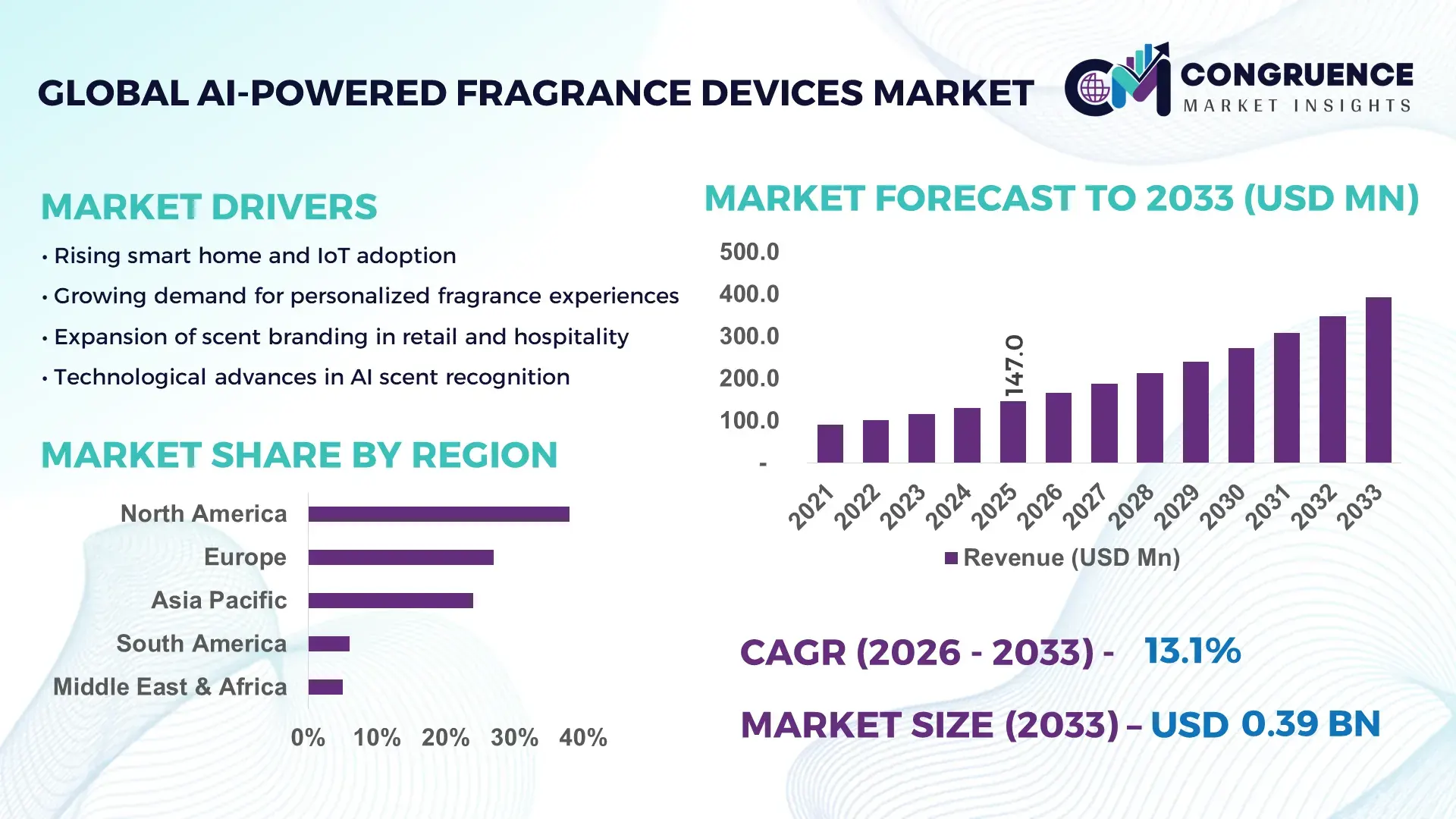
The Global AI-Powered Fragrance Devices Market was valued at USD 147.0 Million in 2025 and is anticipated to reach a value of USD 393.6 Million by 2033 expanding at a CAGR of 13.1% between 2026 and 2033, according to an analysis by Congruence Market Insights. This growth is driven by rising demand for hyper-personalized scent experiences enabled by machine learning algorithms that adapt fragrance profiles in real time based on user behavior and environmental data.
The United States represents the dominant country in the AI-Powered Fragrance Devices Market, supported by strong production capabilities, sustained private investment, and advanced AI integration across consumer and commercial applications. The U.S. hosts over 35% of global smart home fragrance device manufacturing facilities, with more than USD 420 million invested in AI-enabled consumer IoT scent technologies between 2021 and 2024. AI-powered fragrance devices are increasingly deployed across hospitality, luxury retail, healthcare wellness centers, and automotive interiors. Over 62% of premium hotels in major U.S. metropolitan areas use AI-driven scent systems to enhance brand experience, while consumer adoption of connected fragrance devices reached 28% penetration among smart home users in 2025. Continuous advancements in edge AI chips, sensor fusion, and cloud-connected scent analytics platforms further strengthen the country’s technological depth.
Market Size & Growth: Valued at USD 147.0 Million in 2025, projected to reach USD 393.6 Million by 2033, growing at a CAGR of 13.1% driven by demand for personalized ambient intelligence solutions.
Top Growth Drivers: Smart home integration adoption (42%), personalized wellness solutions usage (37%), AI-driven retail experience deployment (31%).
Short-Term Forecast: By 2028, AI-enabled scent optimization is expected to improve fragrance efficiency and reduce refill wastage by 22%.
Emerging Technologies: Edge AI scent profiling, biometric-linked fragrance algorithms, and IoT-connected adaptive diffusion systems.
Regional Leaders: North America (USD 142.0 Million by 2033, smart home penetration focus), Europe (USD 118.5 Million by 2033, hospitality adoption), Asia Pacific (USD 96.4 Million by 2033, premium residential demand).
Consumer/End-User Trends: High adoption among luxury households, wellness centers, boutique hotels, and premium automotive interiors.
Pilot or Case Example: In 2024, a U.S. retail chain deployed AI scent devices across 120 stores, improving in-store dwell time by 18%.
Competitive Landscape: Market leader holds ~24% share, followed by ScentRealm, Moodo, OVR Technology, AmbiScent, and Scentee.
Regulatory & ESG Impact: Energy-efficient device mandates and VOC emission standards influencing product design.
Investment & Funding Patterns: Over USD 680 Million invested globally in AI scent technology startups since 2022, led by venture funding.
Innovation & Future Outlook: Integration of emotion-sensing AI and generative fragrance modeling shaping next-generation devices.
The AI-Powered Fragrance Devices Market serves hospitality (34%), residential smart homes (29%), retail branding (21%), and healthcare wellness applications (16%). Innovations in generative scent algorithms, recyclable cartridges, and low-VOC diffusion systems are reshaping product design. Regulatory focus on indoor air quality, coupled with rising premium lifestyle spending in North America and Asia Pacific, is accelerating adoption. Future trends emphasize emotion-responsive scents and cross-platform smart home integration.
The AI-Powered Fragrance Devices Market holds growing strategic relevance as enterprises and consumers increasingly leverage sensory intelligence to enhance experience, wellness, and brand differentiation. AI-driven scent personalization platforms enable real-time adjustment of fragrance intensity, composition, and diffusion timing, aligning with behavioral analytics and environmental inputs. Compared with traditional programmable scent diffusers, machine-learning-based adaptive scent engines deliver nearly 35% improvement in scent accuracy and user satisfaction, positioning AI fragrance systems as a premium experiential technology.
From a regional perspective, North America dominates in volume deployment, driven by smart home penetration and hospitality use cases, while Europe leads in enterprise adoption with nearly 41% of luxury retail chains utilizing AI-based scent marketing systems. In the near term, by 2028, emotion-recognition AI integrated into fragrance devices is expected to improve consumer engagement metrics such as dwell time and repeat visits by 20–25%. ESG considerations are also shaping strategy, with firms committing to 30% recyclable fragrance cartridge usage and 18% reduction in VOC emissions by 2030.
A micro-scenario illustrates this trajectory: in 2024, a U.S.-based hospitality group implemented AI-powered scent personalization across 60 properties, achieving a 17% improvement in guest satisfaction scores and a measurable reduction in fragrance consumption through predictive diffusion controls. Looking ahead, the AI-Powered Fragrance Devices Market is positioned as a pillar of experiential resilience, regulatory compliance, and sustainable growth, blending artificial intelligence with multisensory innovation to redefine ambient environments.
The AI-Powered Fragrance Devices Market is shaped by the convergence of artificial intelligence, IoT connectivity, and consumer demand for personalized environments. Market dynamics are influenced by rapid advancements in sensor technologies, cloud-based analytics, and edge AI processing, enabling real-time scent customization. Commercial sectors such as hospitality, retail, and healthcare increasingly deploy AI fragrance systems to enhance ambiance, emotional response, and brand identity. At the same time, residential adoption is rising as smart home ecosystems integrate fragrance control alongside lighting and climate systems. Regulatory attention on indoor air quality and volatile organic compound limits also impacts product design, encouraging innovation in low-emission diffusion mechanisms and sustainable consumables.
Growing consumer preference for individualized experiences is a major driver of the AI-Powered Fragrance Devices Market. Studies indicate that over 68% of premium consumers value personalized ambient environments, leading to increased adoption of AI-enabled scent systems capable of learning user preferences. In hospitality and retail, personalized scenting has been shown to increase customer engagement metrics such as dwell time by 15–20%. AI algorithms analyze user behavior, time of day, and environmental conditions to dynamically adjust fragrance profiles, offering a level of customization unattainable with conventional devices. This shift toward experiential differentiation is accelerating deployments across luxury residences, wellness centers, and branded commercial spaces.
Despite strong demand, high upfront costs and technical integration challenges restrain market expansion. AI-powered fragrance devices incorporate sensors, processors, and connectivity modules that increase hardware costs by 30–45% compared to traditional scent diffusers. Additionally, integration with existing building management or smart home systems requires specialized software compatibility and skilled installation. Smaller enterprises and cost-sensitive consumers often delay adoption due to these barriers. Maintenance requirements, including firmware updates and cartridge calibration, further add to operational complexity, limiting penetration in price-sensitive regions.
The expansion of wellness-oriented healthcare environments presents significant opportunities for the AI-Powered Fragrance Devices Market. Hospitals, clinics, and wellness centers increasingly adopt therapeutic scenting to reduce stress and improve patient experience. Research indicates that calming fragrances can lower perceived anxiety levels by up to 25%, creating demand for AI-driven systems capable of precise scent modulation. AI fragrance devices enable controlled diffusion aligned with patient flow and treatment schedules, opening new use cases in mental health, rehabilitation, and elder care facilities. This sector remains underpenetrated, offering long-term growth potential.
Regulatory compliance poses ongoing challenges for the AI-Powered Fragrance Devices Market. Governments and industry bodies impose strict guidelines on indoor air quality, chemical composition, and electronic safety. Compliance testing and certification can extend product development cycles by 6–12 months. Lack of global standardization further complicates cross-border commercialization, requiring region-specific product modifications. These factors increase time-to-market and compliance costs, particularly for emerging manufacturers, constraining scalability and global expansion.
Expansion of AI-Driven Personalization Engines: AI-powered fragrance devices increasingly utilize machine-learning models trained on user behavior datasets exceeding 1 million interaction points, enabling scent personalization accuracy improvements of 32%. Devices now adjust fragrance intensity and composition based on occupancy, mood inputs, and environmental sensors, driving higher user engagement in both residential and commercial settings.
Integration with Smart Home and IoT Ecosystems: Over 58% of new AI fragrance devices launched in 2024 featured native compatibility with smart home platforms, enabling synchronized control with lighting and HVAC systems. This integration has reduced energy consumption related to scent diffusion by 18%, supporting efficiency-focused deployments in premium residences and hotels.
Growth of Commercial Scent Branding Applications: Retail and hospitality operators increasingly deploy AI scent branding, with 47% of luxury retail outlets adopting adaptive fragrance systems. These deployments have delivered measurable outcomes, including 16% increases in customer dwell time and improved brand recall metrics through consistent multisensory experiences.
Shift Toward Sustainable and Low-Emission Designs: Manufacturers are prioritizing sustainability, with 40% of new devices using recyclable cartridges and low-VOC formulations. AI-controlled diffusion algorithms have reduced fragrance waste by 20%, aligning with regulatory requirements and corporate ESG goals while maintaining scent performance.
The AI-Powered Fragrance Devices Market is segmented based on type, application, and end-user, reflecting diverse deployment environments and technology configurations. By type, the market spans standalone smart diffusers, connected IoT-enabled fragrance systems, and fully adaptive AI-driven scent platforms that integrate sensors and machine learning. Applications range from residential smart homes to commercial spaces such as hospitality, retail branding, healthcare wellness, and automotive interiors. End-user segmentation highlights adoption differences between households, enterprises, and institutional users, driven by personalization needs, scale of deployment, and regulatory considerations. Segmentation insights indicate that advanced AI-enabled systems are gaining stronger traction in commercial and enterprise environments, while residential adoption remains volume-driven but increasingly feature-focused. Decision-makers use segmentation analysis to align product development with specific performance requirements such as scent accuracy, energy efficiency, and integration with broader digital ecosystems.
The market by type includes smart fragrance diffusers, IoT-connected fragrance devices, and advanced AI-powered adaptive fragrance systems. AI-powered adaptive fragrance systems represent the leading type, accounting for approximately 46% of overall adoption, due to their ability to analyze user behavior, environmental conditions, and biometric inputs to dynamically adjust scent profiles. These systems are favored in hospitality and retail environments where consistent experiential quality is critical. IoT-connected fragrance devices follow with around 29% adoption, offering remote control, scheduling, and integration with smart home platforms. Traditional smart diffusers with limited AI functionality contribute the remaining 25%, maintaining relevance in cost-sensitive residential use cases.
The fastest-growing type is fully adaptive AI-powered fragrance systems, expanding at an estimated 14.2% CAGR, driven by improvements in edge AI processing, sensor miniaturization, and emotion-recognition algorithms. Growth is further supported by enterprise demand for data-driven ambient optimization. Other niche types, including modular cartridge-based systems and portable AI scent devices, collectively account for a small but stable share, primarily serving wellness and automotive applications.
By application, hospitality and commercial spaces represent the leading segment, accounting for nearly 38% of total deployments, as hotels, resorts, and luxury retail outlets increasingly use AI-powered scenting to enhance brand identity and customer experience. Residential smart homes follow with approximately 31% adoption, driven by rising smart home penetration and consumer interest in personalized living environments. Healthcare and wellness applications account for about 18%, leveraging controlled scent diffusion to support stress reduction and patient comfort, while automotive interiors and other niche applications collectively contribute 13%.
The fastest-growing application segment is healthcare and wellness, projected to expand at a 15.0% CAGR, supported by growing awareness of sensory therapy and integration of AI systems in patient-centric environments. Commercial retail scent branding continues to gain traction as retailers seek differentiation through multisensory engagement.
In 2025, more than 41% of global hospitality operators reported using AI-enabled ambient technologies, including fragrance systems, to improve guest experience. Additionally, 27% of smart home users indicated regular use of automated scent devices linked to daily routines.
End-user segmentation highlights hospitality and commercial enterprises as the leading end-user group, representing approximately 44% of total market adoption, due to large-scale deployments and high willingness to invest in experiential technologies. Residential consumers account for around 34%, driven by premium households and smart home adopters seeking personalized environments. Healthcare institutions contribute about 14%, while automotive manufacturers, offices, and other institutional users collectively represent 8%.
The fastest-growing end-user segment is healthcare and wellness providers, expanding at an estimated 15.4% CAGR, fueled by increased adoption of non-invasive patient experience technologies and AI-driven environmental controls. Residential adoption is also accelerating, particularly among tech-savvy consumers in urban markets.
In 2025, approximately 36% of enterprises reported piloting AI-driven ambient experience systems for customer engagement, while over 52% of Gen Z consumers expressed higher preference for brands incorporating AI-powered sensory technologies in physical spaces.
North America accounted for the largest market share at 38% in 2025, however, Asia-Pacific is expected to register the fastest growth, expanding at a CAGR of 14.6% between 2026 and 2033.
Europe followed North America with a 27% share, driven by strong adoption in hospitality, luxury retail, and wellness infrastructure, while Asia-Pacific represented 24%, supported by rapid urbanization and smart consumer electronics penetration. South America and the Middle East & Africa contributed 6% and 5%, respectively, reflecting emerging adoption and expanding commercial scenting use cases. Region-wise dynamics vary significantly, with mature markets emphasizing advanced AI integration and compliance, while emerging regions focus on volume expansion, localized manufacturing, and affordability. Increasing cross-border trade, declining sensor costs, and cloud-based AI platforms are further reshaping regional demand patterns across both developed and developing economies.
This region held approximately 38% market share in 2025, supported by strong demand from hospitality, smart residential developments, healthcare facilities, and luxury retail environments. Hotels, corporate offices, and wellness centers are major demand drivers, leveraging AI-powered fragrance devices to enhance customer experience and brand identity. Regulatory emphasis on indoor air quality and VOC emission limits has encouraged adoption of low-emission, sensor-driven fragrance systems. Rapid digital transformation, high smart home penetration exceeding 45% of households, and widespread IoT infrastructure accelerate deployment. Local players are actively investing in AI scent personalization platforms, integrating biometric feedback and cloud-based analytics. Consumer behavior shows higher enterprise-led adoption, particularly in healthcare and corporate real estate, where experiential differentiation and employee well-being are strategic priorities.
Europe accounted for nearly 27% of the global market share, with Germany, the UK, and France leading regional demand. Adoption is strongly influenced by sustainability initiatives and regulatory frameworks governing indoor environmental quality and chemical usage. Hospitality, retail branding, and public infrastructure projects drive demand, while emerging technologies such as explainable AI and eco-friendly diffusion systems gain traction. Regional manufacturers emphasize recyclable cartridges and energy-efficient designs, aligning with circular economy goals. Local technology firms are deploying AI fragrance systems across museums, airports, and luxury retail chains. Consumer behavior reflects higher sensitivity to regulatory compliance, leading enterprises to favor transparent, controllable AI-driven scent technologies over conventional solutions.
Asia-Pacific represented 24% of global market volume, ranking second in growth momentum. China, Japan, and India are the largest consuming countries, supported by expanding urban populations, rising disposable incomes, and strong electronics manufacturing ecosystems. The region benefits from large-scale production capabilities, reducing unit costs and enabling wider market penetration. Innovation hubs in Japan and South Korea are advancing compact AI scent modules and mobile-connected fragrance devices. Regional players are integrating AI fragrance devices into smart appliances and e-commerce-driven lifestyle products. Consumer behavior is heavily influenced by mobile platforms and online retail, with over 50% of purchases initiated through digital channels, accelerating adoption across residential and commercial segments.
South America held approximately 6% of the global market share, with Brazil and Argentina as key contributors. Demand is primarily driven by hospitality, entertainment venues, and premium retail environments seeking differentiation through sensory branding. Infrastructure upgrades in urban centers and increased foreign investment in tourism support adoption. Government initiatives promoting technology imports and reduced tariffs on smart devices have improved accessibility. Regional players focus on localized scent profiles tailored to cultural preferences. Consumer behavior shows demand closely tied to media exposure and localized branding strategies, with fragrance personalization increasingly used in shopping malls and event spaces.
The Middle East & Africa accounted for 5% of global market share, led by the UAE and South Africa. Demand is concentrated in luxury hotels, commercial complexes, and high-end residential projects, particularly in urban hubs. Smart city initiatives and large-scale construction projects create opportunities for integrated AI fragrance systems. Governments support digital modernization through public–private partnerships and technology-friendly trade policies. Local distributors collaborate with international vendors to deploy AI scent solutions in malls and airports. Consumer behavior emphasizes premium experiences, with higher adoption in hospitality and commercial venues compared to residential use.
United States – 26% Market Share: Strong production capacity, advanced AI infrastructure, and high enterprise adoption across hospitality and healthcare.
Germany – 14% Market Share: Robust industrial base, regulatory-driven demand for sustainable technologies, and widespread use in premium commercial environments.
The competitive environment in the AI-Powered Fragrance Devices Market is characterized by a moderately fragmented but rapidly evolving landscape, with over 30 active competitors globally ranging from startups to established scent technology firms. The top players collectively hold an estimated 60–65% combined share, leaving 35–40% distributed among numerous niche innovators. Market leaders emphasize differentiation through deep AI integration, sensor enhancement, and cloud-managed scent orchestration platforms. Strategic initiatives include mergers, partnerships, and innovative product launches designed to enhance system performance and broaden application scenarios. For example, in December 2024, an established scent tech provider acquired a hardware diffusion specialist to create an end-to-end AI scent ecosystem, demonstrating consolidation and vertical integration trends within the market. Another notable partnership in March 2025 focused on co-developing AI-enabled scent synthesis platforms, expanding both companies’ portfolios and technical IP.
Innovation trends influencing competition include adaptive machine-learning scent profiling, biometric-linked scent modulation, and integration with wellness and sensory analytics platforms. Companies are increasingly prioritizing mobile app control, interoperability with smart home ecosystems, and AI-driven personalization engines that adjust fragrance profiles based on user feedback and environmental inputs. The ongoing introduction of enterprise-grade design tools and developer platforms reflects an emphasis on ecosystem expansion and third-party integration, positioning the sector for sustained competitive dynamics that reward both technological sophistication and broad deployment capabilities.
Olfactory Labs
Airscent
Scentsory
Fermata
Moodo
Pura
Olo
Prolitec Inc.
Cyrano (Aromyx Inc.)
NINU Smart Perfume
eNose
The AI-Powered Fragrance Devices Market is being shaped by a suite of current and emerging technologies that enhance scent personalization, delivery precision, and system intelligence. Central to this evolution are machine-learning algorithms capable of analyzing user interaction patterns, environmental conditions, and occupancy signals to tailor scent profiles in real time. These adaptive AI engines are increasingly paired with edge computing capabilities, allowing devices to process data locally and respond with micro-adjustments to fragrance intensity with minimal latency. Bluetooth, Wi-Fi, and IoT protocols facilitate interoperability with broader smart home and enterprise ecosystems, enabling synchronized control alongside lighting, HVAC, and occupancy sensing systems.
Another technology trend is biometric integration, where AI modules interpret physiological data—such as heart rate or stress indicators—to trigger contextually appropriate scent modulation, enhancing wellness and therapeutic applications. Cloud platforms and API frameworks are also emerging, enabling developers to build customized applications atop core scent-delivery technologies, which broadens market reach and encourages third-party innovation. Sensor fusion technologies combine environmental monitors, motion detectors, and air quality analyzers to optimize fragrance dispersion based on user presence and air dynamics.
Advances in digital olfaction research and electronic nose (e-nose) systems are enabling high-resolution scent detection and classification, improving feedback loops and device accuracy. These systems leverage miniaturized chemical sensors and classification models trained on extensive scent databases to distinguish subtle olfactory cues, enabling richer personalization. Additional innovation includes modular scent cartridges, allowing multi-note blends and rapid swap-outs, and eco-friendly, low-VOC diffusion mechanisms that meet regulatory and sustainability criteria while maintaining performance across residential and commercial deployments. Together, these technologies are driving an increasingly adaptive, responsive, and user-centric market.
• In March 2025, Osmo launched “Generation,” the world’s first AI-Powered Fragrance House, introducing three exclusive AI-formulated fragrance ingredients — Glossine, Fractaline, and Quasarine — and an AI-driven formulation platform that turns text and images into precise fragrance formulas, accelerating innovation and sustainability in scent creation. Source: www.osmo.ai
• In January 2025, Perfumeo joined the Google for Startups Accelerator, securing strategic support and approximately USD 350,000 in technology, mentorship, and tools. This collaboration enables deeper integration of its smart scent diffusers and AI fragrance personalization algorithms with the Google Home ecosystem, enhancing mobile control and mood-based scent experiences. Source: www.prlog.org
• In March 2025, iRomaScents showcased its enhanced AI-Powered fragrance dispenser at CosmoProf North America, featuring an interactive touchscreen capable of holding up to 135 fragrances per station. The upgraded technology delivers immersive scent discovery and retail engagement for global beauty brands. Source: www.einnews.com
• In January 2025, Aromajoin partnered with Nostalgia Scents to co-develop an AI-driven scent synthesis platform that expands both companies’ capabilities in digital and adaptive fragrance experiences, positioning them for broader commercial applications.
The AI-Powered Fragrance Devices Market Report encompasses an extensive review of technology, application landscapes, geographic penetration, and industry usage patterns shaping the future of scent personalization and smart fragrance delivery. It covers a broad range of device types, from standalone smart diffusers and IoT-connected fragrance systems to advanced adaptive AI platforms integrating sensors, machine learning, and cloud analytics. The report details segmentation by application areas, including residential smart homes, commercial hospitality and retail scent branding, wellness and therapeutic environments, and innovative automotive interior fragrance systems engineered for occupant comfort.
Geographically, the report analyzes regional adoption patterns across North America, Europe, Asia-Pacific, South America, and the Middle East & Africa, addressing infrastructure readiness, consumer behavior nuances, regulatory environments, and industry investment trends influencing device deployment and integration. It also explores technology trends—such as edge AI processing, biometric integration, multi-note scent cartridges, and ecosystem interoperability—that enable richer personalization experiences and operational efficiencies.
Industry focus extends to end-user categories, highlighting enterprise and healthcare adoption, developer ecosystems leveraging cloud-based platforms, and consumer usage behaviors that prioritize customization, sustainability, and digital control. Emerging and niche segments, such as therapeutic scent systems and augmented reality fragrance applications, are also examined, providing insights into innovation trajectories and potential market expansions. This comprehensive scope supports strategic decision-making for manufacturers, investors, and technology partners seeking to navigate and capitalize on evolving opportunities within the AI-Powered Fragrance Devices market.
| Report Attribute / Metric | Details |
|---|---|
| Market Revenue (2025) | USD 147.0 Million |
| Market Revenue (2033) | USD 393.6 Million |
| CAGR (2026–2033) | 13.1% |
| Base Year | 2025 |
| Forecast Period | 2026–2033 |
| Historic Period | 2021–2025 |
| Segments Covered |
By Type
By Application
By End-User Insights
|
| Key Report Deliverables | Revenue Forecast, Market Trends, Growth Drivers & Restraints, Technology Insights, Segmentation Analysis, Regional Insights, Competitive Landscape, Regulatory & ESG Overview, Recent Developments |
| Regions Covered | North America; Europe; Asia-Pacific; South America; Middle East & Africa |
| Key Players Analyzed | Aromyx, Scentys, The Olfactory Company, Olfactory Labs, Airscent, Scentsory, Fermata, Moodo, Pura, Olo, Prolitec Inc., Cyrano (Aromyx Inc.), NINU Smart Perfume, eNose |
| Customization & Pricing | Available on Request (10% Customization Free) |




