
Reports
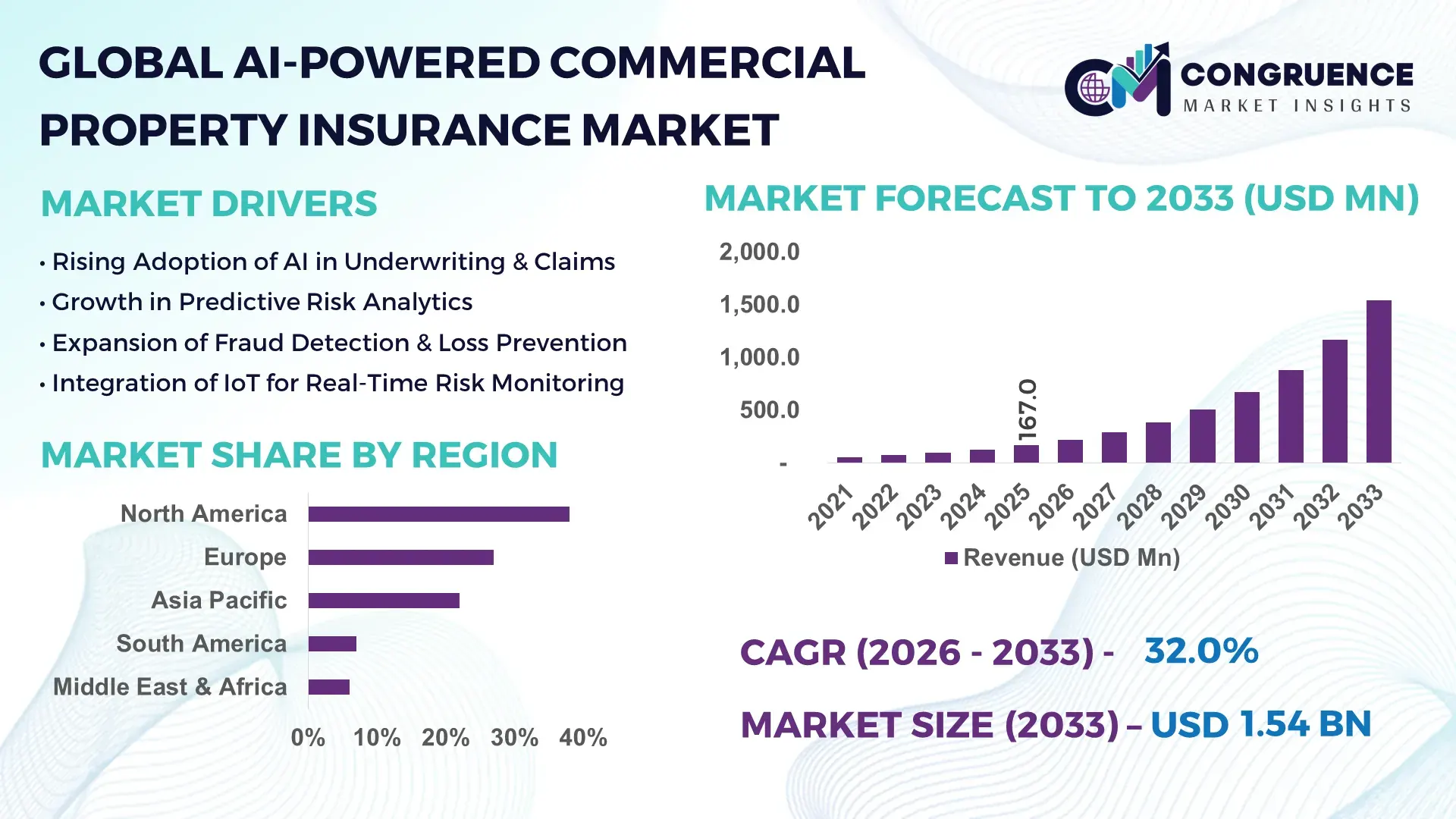
The Global AI-Powered Commercial Property Insurance Market was valued at USD 167.0 Million in 2025 and is anticipated to reach a value of USD 1,539.2 Million by 2033 expanding at a CAGR of 32% between 2026 and 2033, according to an analysis by Congruence Market Insights. The growth is primarily driven by accelerated AI adoption in underwriting, automated claims processing, and predictive risk analytics across large-scale commercial assets.
The United States dominates the AI-Powered Commercial Property Insurance Market with substantial technological deployment and capital investment. Over 65% of large commercial insurers in the U.S. have integrated AI-driven underwriting platforms, while more than 70% of commercial property claims above USD 1 million now involve automated risk modeling tools. The country accounts for over 45% of global insurtech funding, exceeding USD 8 billion annually in recent investments. AI-powered catastrophe modeling platforms process more than 10 terabytes of climate and geospatial data per major underwriting cycle. Additionally, over 60% of Fortune 500 property owners utilize AI-based risk monitoring systems linked to insurers, enhancing loss prevention and asset-level analytics capabilities.
Market Size & Growth: Valued at USD 167.0 Million in 2025, projected to reach USD 1,539.2 Million by 2033 at 32% CAGR, driven by automation of underwriting and climate risk modeling.
Top Growth Drivers: 68% AI adoption in underwriting workflows, 40% reduction in claims processing time, 35% improvement in fraud detection accuracy.
Short-Term Forecast: By 2028, AI-based claims automation is expected to reduce operational costs by 28% across commercial insurers.
Emerging Technologies: Generative AI risk summarization, IoT-based property sensors, AI-powered satellite imagery analytics.
Regional Leaders: North America projected at USD 620 Million by 2033 with high catastrophe modeling usage; Europe at USD 410 Million driven by ESG-linked underwriting; Asia-Pacific at USD 330 Million with 45% surge in digital policy issuance.
Consumer/End-User Trends: Large enterprises represent over 58% of AI-enabled commercial property policies, with real estate and manufacturing leading adoption.
Pilot or Case Example: In 2024, a U.S. insurer reduced loss-adjustment expenses by 31% using AI-based damage assessment tools.
Competitive Landscape: Guidewire Software holds approximately 22% solution share, followed by Duck Creek Technologies, CCC Intelligent Solutions, Shift Technology, and IBM.
Regulatory & ESG Impact: 52% of insurers align AI underwriting models with climate disclosure standards and ESG-linked reporting mandates.
Investment & Funding Patterns: Over USD 5.5 Billion invested globally in AI-driven insurtech platforms in recent funding cycles, with 30% directed to property analytics tools.
Innovation & Future Outlook: Integration of digital twins, parametric insurance automation, and AI-driven catastrophe simulations is reshaping risk engineering models.
Commercial real estate (42%), manufacturing facilities (27%), and logistics infrastructure (18%) account for the largest adoption shares in AI-Powered Commercial Property Insurance Market applications. Advanced satellite imagery and IoT-enabled monitoring solutions improved loss prediction accuracy by 36% in 2024 deployments. Climate-risk regulations across Europe and North America are increasing AI-driven scenario modeling usage by 48%. Asia-Pacific demonstrates rapid digital underwriting expansion, with over 44% of new commercial policies issued via AI-assisted platforms.
The AI-Powered Commercial Property Insurance Market holds strategic relevance as insurers confront rising catastrophe frequency, asset complexity, and regulatory compliance requirements. AI-driven predictive risk analytics delivers 35% faster underwriting decisions compared to traditional actuarial assessment models. Computer vision–based claims systems deliver 42% improvement compared to manual on-site inspections in property damage validation.
North America dominates in volume of AI-powered commercial policies, while Europe leads in ESG-integrated adoption with over 58% of insurers embedding climate-risk analytics into underwriting workflows. By 2028, generative AI-based risk modeling is expected to reduce underwriting cycle times by 30%, improving combined ratios across commercial property portfolios.
Firms are committing to ESG metrics such as 25% reduction in paper-based policy processing and 40% increase in climate-risk disclosure transparency by 2030. In 2024, a U.S.-based insurer achieved 33% claims cycle reduction through AI-driven drone and satellite imagery analytics deployment after major weather events.
Looking forward, integration of IoT sensors, digital twins, and AI-powered catastrophe modeling platforms will strengthen predictive capabilities. The AI-Powered Commercial Property Insurance Market is positioned as a pillar of operational resilience, regulatory compliance, and sustainable portfolio growth in an increasingly risk-sensitive global insurance landscape.
The AI-Powered Commercial Property Insurance Market is evolving rapidly due to increasing climate-related losses, digitization of commercial assets, and expanding enterprise risk management requirements. Commercial insurers are integrating AI algorithms to analyze historical claims, satellite imagery, IoT sensor data, and geospatial datasets exceeding petabyte-scale annually. Over 62% of tier-one insurers have shifted from rule-based underwriting to machine learning–driven risk scoring systems. The rise in extreme weather events—exceeding 20 billion-dollar disasters annually in recent years—has intensified demand for predictive analytics. Additionally, regulatory frameworks now require more transparent risk disclosures, accelerating AI-driven scenario modeling adoption. Competitive differentiation increasingly depends on automation speed, risk accuracy improvements exceeding 30%, and enhanced fraud detection rates above 35%, reshaping operational benchmarks across global insurance markets.
The surge in climate-related property losses has significantly increased underwriting complexity. Insurers now process over 50 variables per property risk assessment compared to fewer than 15 a decade ago. AI-powered catastrophe modeling enhances prediction accuracy by up to 38%, while geospatial analytics tools process satellite imagery covering over 90% of insured commercial zones in developed markets. Automated underwriting reduces evaluation time from 5 days to under 24 hours for large portfolios. Over 60% of reinsurers require AI-supported exposure modeling before issuing risk coverage, directly driving demand for AI-integrated commercial property insurance platforms. These measurable performance gains and compliance pressures are accelerating AI integration across underwriting operations.
Despite strong adoption trends, integration challenges remain significant. Nearly 45% of commercial insurers operate on legacy core systems over 15 years old, limiting seamless AI deployment. Data fragmentation across underwriting, claims, and reinsurance systems creates inconsistencies in 30% of datasets analyzed. Strict data protection regulations across more than 60 jurisdictions impose compliance complexity, increasing implementation timelines by 20–25%. Additionally, AI model bias concerns have led regulators to mandate algorithm audits, adding operational oversight costs. These technological and regulatory barriers constrain rapid scaling of AI-powered commercial property insurance systems globally.
The global smart building base now exceeds 115 million connected commercial devices, generating real-time operational data. IoT-enabled sensors reduce fire and water damage losses by approximately 25% through early detection alerts. Insurers integrating IoT-linked AI analytics report 29% improvement in risk selection precision. Over 48% of new Grade-A commercial buildings incorporate sensor-based environmental monitoring, creating vast predictive datasets. Parametric insurance models tied to automated weather triggers are expanding, offering payout settlements within 72 hours. These developments present substantial opportunities for AI-driven dynamic pricing, proactive risk mitigation, and differentiated policy structuring in commercial property insurance markets.
Catastrophe severity has increased by more than 30% over the past decade, creating model volatility. AI systems trained on historical datasets struggle with unprecedented climate patterns, reducing forecast reliability margins by 12–18% in extreme scenarios. Reinsurance costs have risen by nearly 25% in high-risk zones, pressuring underwriting profitability. Data standardization gaps across emerging markets affect over 35% of global commercial properties, limiting predictive consistency. Furthermore, talent shortages in actuarial data science roles—estimated at a 20% supply gap—constrain model development and validation capacity, posing structural challenges to AI system scalability.
AI-Driven Catastrophe Modeling Accuracy Improvement: Advanced machine learning catastrophe models improved loss prediction accuracy by 38% in 2024 deployments. Over 72% of large insurers now use satellite-based AI analytics for post-disaster damage assessment, reducing on-site inspection costs by 34%. Real-time weather data integration increased event response speed by 41%, significantly enhancing portfolio resilience.
Expansion of IoT-Based Risk Monitoring: More than 48% of new commercial buildings incorporate IoT-enabled fire, flood, and structural monitoring sensors. Insurers leveraging sensor-linked AI systems reported 26% decline in large-loss frequency and 29% improvement in underwriting precision. Smart facility adoption in North America and Europe exceeded 60% in premium commercial real estate portfolios.
Automation in Claims Settlement Cycles: AI-powered computer vision tools reduced claims assessment time by 42%, while automated document processing cut administrative handling by 37%. Digital-first insurers process 65% of commercial property claims without manual intervention, improving customer retention by 18%.
Rise in Modular and Prefabricated Construction: The adoption of modular construction is reshaping demand dynamics in the AI-Powered Commercial Property Insurance Market. Research suggests that 55% of the new projects witnessed cost benefits while using modular and prefabricated practices in their projects. Pre-bent and cut elements are prefabricated off-site using automated machines, reducing labor needs and speeding project timelines. Demand for high-precision machines is rising, especially in Europe and North America, where construction efficiency is critical.
The AI-Powered Commercial Property Insurance Market is segmented by type, application, and end-user, reflecting the expanding integration of artificial intelligence across underwriting, claims, and risk engineering functions. By type, the market encompasses AI-based underwriting platforms, claims automation systems, predictive risk analytics engines, computer vision–enabled inspection tools, and IoT-integrated monitoring solutions. Predictive analytics and underwriting systems together account for more than 55% of deployments due to their role in pricing accuracy and catastrophe exposure modeling.
By application, underwriting and risk assessment dominate with over 45% adoption share, followed by claims management and fraud detection. AI-driven loss prevention and real-time property monitoring solutions are gaining traction in high-risk geographies exposed to climate events.
From an end-user perspective, large commercial insurers represent over 60% of adoption due to capital capacity and digital transformation budgets, while mid-sized insurers and reinsurers are increasingly implementing modular AI tools to improve operational efficiency and portfolio resilience.
The AI-Powered Commercial Property Insurance Market by type includes AI underwriting platforms, predictive risk analytics systems, AI-based claims management tools, computer vision damage assessment solutions, and IoT-integrated risk monitoring platforms.
AI underwriting platforms currently account for approximately 34% of total adoption, as they streamline risk scoring across large commercial property portfolios and reduce manual evaluation time by nearly 40%. Predictive risk analytics systems hold about 28% share, driven by climate modeling and catastrophe simulation integration. However, computer vision–based damage assessment tools are the fastest-growing type, expanding at an estimated CAGR of 36%, fueled by drone inspections and satellite imagery automation that improve damage validation accuracy by 38%.
IoT-integrated monitoring systems and fraud detection engines together contribute a combined 20% share, serving niche but expanding roles in proactive risk mitigation and anomaly detection.
Underwriting and risk assessment represent the leading application, accounting for nearly 46% of AI deployment within commercial property insurance. Machine learning–based exposure modeling improves pricing precision by 32% compared to traditional actuarial methods. Claims management systems hold around 29% share, as AI-driven automation reduces claims cycle times by up to 42%. However, fraud detection applications are growing fastest, with an estimated CAGR of 35%, supported by increasing digital claims submissions and anomaly detection algorithms that improve fraud identification rates by 37%.
Other applications—including loss prevention, policy administration automation, and customer service chatbots—collectively account for approximately 25% of adoption, contributing to operational efficiency gains exceeding 25%.
In 2025, more than 41% of global insurers reported piloting AI-based property risk scoring platforms. Additionally, 58% of large enterprises expressed preference for insurers offering AI-driven risk monitoring dashboards.
Large multinational insurance carriers dominate the AI-Powered Commercial Property Insurance Market, representing approximately 62% of total adoption due to higher digital budgets and reinsurance-linked compliance requirements. Regional insurers account for 23%, while reinsurers and specialty insurers collectively contribute about 15%.
While large insurers lead in deployment scale, mid-sized insurers represent the fastest-growing end-user group, expanding at an estimated CAGR of 34% as cloud-based AI platforms lower implementation barriers. Adoption among specialty insurers focusing on high-risk assets has increased by over 28% year-over-year due to climate volatility exposure.
In 2025, more than 39% of mid-tier insurers globally initiated AI modernization programs targeting commercial property lines. Furthermore, 64% of commercial real estate asset managers reported preferring insurers that integrate AI-based predictive risk analytics into policy structures.
North America accounted for the largest market share at 38% in 2025 however, Asia-Pacific is expected to register the fastest growth, expanding at a CAGR of 34% between 2026 and 2033.

North America processed over 65% of AI-enabled commercial property underwriting submissions digitally in 2025, supported by advanced catastrophe modeling infrastructure and insurtech investment exceeding USD 8 billion annually. Europe held approximately 27% share, driven by regulatory mandates requiring climate-risk disclosure across more than 70% of listed property portfolios. Asia-Pacific represented nearly 22% of global adoption, with more than 45% of new commercial property policies in developed Asian markets incorporating AI-assisted underwriting tools. South America and the Middle East & Africa collectively accounted for 13%, reflecting increasing digital transformation initiatives in commercial real estate, energy, and logistics sectors. Regional differentiation is influenced by catastrophe exposure frequency, regulatory compliance frameworks, smart building penetration exceeding 48% in developed markets, and enterprise-level digital transformation spending surpassing 6% of insurer operating budgets in leading economies.
North America commands approximately 38% of the global AI-Powered Commercial Property Insurance Market share, supported by deep technology integration and large-scale commercial asset coverage. The United States and Canada lead adoption, with over 68% of tier-one insurers deploying AI-driven underwriting engines. Key industries driving demand include commercial real estate, manufacturing, logistics, and energy infrastructure, collectively representing more than 60% of insured commercial property values. Regulatory initiatives emphasizing climate-risk transparency and resilience planning have accelerated AI integration across underwriting workflows. Technological advancements such as satellite-based geospatial analytics, IoT-linked risk monitoring, and drone-enabled inspections have reduced claims processing time by up to 42%. Guidewire Software and other regional solution providers have expanded AI-powered policy administration modules to enhance automation across enterprise insurers. Regional consumer behavior reflects higher enterprise-level AI adoption in finance, healthcare, and logistics sectors, where over 55% of asset managers prefer insurers offering predictive risk dashboards.
Europe accounts for approximately 27% of the AI-Powered Commercial Property Insurance Market share in 2025. Germany, the United Kingdom, and France represent the largest contributors, together covering over 65% of the region’s AI-driven underwriting activity. Regulatory bodies enforcing ESG disclosure requirements and climate risk assessments have pushed more than 58% of insurers to integrate explainable AI frameworks within underwriting systems. Emerging technologies such as digital twins and climate scenario modeling platforms are increasingly deployed across industrial and commercial property portfolios. European insurers report 33% improvement in catastrophe exposure modeling accuracy following AI integration. Local market players such as Allianz have implemented AI-based risk scoring tools for commercial properties to enhance underwriting transparency and operational efficiency. Consumer behavior trends indicate that regulatory pressure strongly influences procurement decisions, with 61% of enterprises prioritizing insurers demonstrating compliance-ready AI models.
Asia-Pacific holds nearly 22% of global market share and ranks as the fastest-growing region in AI-powered commercial property insurance adoption. China, Japan, and India are the top consuming countries, collectively accounting for more than 70% of regional digital underwriting activity. Rapid infrastructure development and manufacturing expansion have increased insured commercial floor space by over 25% in key urban centers since 2020. Innovation hubs in Singapore, Tokyo, and Shenzhen are promoting AI-integrated insurtech platforms, with more than 44% of new commercial policies in advanced Asian markets issued via AI-assisted digital channels. Ping An has deployed AI-based property risk evaluation systems capable of processing thousands of data variables per underwriting cycle. Regional consumer behavior reflects strong digital preference, as over 52% of commercial policyholders favor mobile-enabled AI platforms for risk assessment and claims tracking.
South America represents approximately 7% of the global AI-Powered Commercial Property Insurance Market. Brazil and Argentina lead adoption, with Brazil accounting for nearly 60% of the regional market share. Infrastructure expansion in logistics corridors and renewable energy installations has increased demand for predictive catastrophe modeling tools. Government-led digital finance initiatives have encouraged insurers to modernize underwriting platforms, with more than 35% of regional insurers investing in AI-backed risk scoring systems. Porto Seguro in Brazil has piloted AI-based claims automation to reduce manual processing time by over 25%. Consumer behavior variations indicate growing enterprise demand tied to infrastructure, agribusiness, and energy sectors, where AI-driven climate modeling improves portfolio stability.
The Middle East & Africa region accounts for roughly 6% of the global AI-Powered Commercial Property Insurance Market. Demand is driven by oil & gas, large-scale construction projects, and smart city developments across the UAE and Saudi Arabia. South Africa also demonstrates increasing digital insurance modernization, with over 30% of commercial insurers implementing AI-assisted underwriting modules. Technological modernization initiatives linked to smart infrastructure projects have increased IoT-enabled building integration by 40% in Gulf countries. Regulatory reforms encouraging financial technology innovation have strengthened AI platform deployment. Local insurers such as GIG Gulf have expanded digital underwriting frameworks for commercial portfolios. Consumer behavior reflects demand for technology-enabled claims transparency, particularly in construction and energy-related property insurance segments.
United States – 34% Market Share: Leads due to advanced catastrophe modeling infrastructure, high insurtech investment exceeding USD 8 billion annually, and widespread enterprise AI adoption across commercial real estate and industrial sectors.
Germany – 9% Market Share: It is driven by strong industrial asset coverage, ESG compliance mandates, and widespread adoption of explainable AI underwriting systems across regulated commercial insurers.
The AI-Powered Commercial Property Insurance Market is moderately fragmented, with over 120 active technology vendors and insurance platform providers globally competing across underwriting automation, claims analytics, geospatial risk modeling, and IoT-integrated monitoring solutions. The top five companies collectively account for approximately 48% of the total solution deployment share, indicating a semi-consolidated structure where established enterprise software vendors compete alongside agile insurtech firms.
Large core insurance technology providers dominate enterprise-level deployments, particularly among tier-one insurers that represent over 60% of AI platform contracts. Meanwhile, niche AI analytics startups specialize in catastrophe modeling, computer vision damage assessment, and fraud detection algorithms, contributing to more than 30% of innovation-driven partnerships formed between 2023 and 2025. Strategic initiatives include API-based ecosystem integrations, cloud-native underwriting modules, and AI governance frameworks to meet regulatory transparency mandates.
Between 2024 and 2025, over 25 strategic collaborations were announced between insurers and AI platform vendors to expand automated risk assessment capabilities. More than 40% of product launches during this period focused on explainable AI and climate-risk modeling enhancements. Competitive differentiation increasingly depends on data processing scale—leading platforms now analyze over 10 terabytes of geospatial and property data per underwriting cycle—and integration compatibility with legacy policy administration systems used by more than 45% of global insurers.
Shift Technology
IBM
Microsoft
Google Cloud
Amazon Web Services
SAS Institute
Cognizant
Capgemini
DXC Technology
Ping An Technology
Allianz
Zurich Insurance Group
The AI-Powered Commercial Property Insurance Market is shaped by advanced machine learning algorithms, geospatial intelligence systems, computer vision analytics, and IoT-enabled real-time monitoring platforms. More than 68% of tier-one insurers deploy machine learning–based underwriting engines capable of processing over 50 structured and unstructured risk variables per commercial asset.
Computer vision technologies leveraging drone imagery and satellite feeds now assess over 70% of catastrophe-affected commercial properties in developed markets, reducing inspection time by up to 42%. Natural language processing (NLP) tools automate claims documentation review, cutting administrative workloads by approximately 35%.
IoT-based smart building integration is expanding rapidly, with over 48% of new commercial real estate developments embedding sensor networks for fire, water leakage, and structural health monitoring. These connected systems feed AI platforms with real-time data, improving loss prediction accuracy by nearly 30%.
Cloud-native underwriting platforms now enable scalable data processing exceeding 10 terabytes per major risk assessment cycle. Explainable AI (XAI) frameworks are increasingly implemented, as 52% of insurers align model outputs with regulatory transparency requirements. Digital twin simulations are also emerging, allowing insurers to create virtual replicas of insured commercial properties, enhancing predictive catastrophe modeling precision by over 25%. Collectively, these technologies are redefining underwriting accuracy, operational efficiency, and portfolio resilience across global commercial property insurance ecosystems.
• In October 2025, Zurich North America integrated AI-enhanced high-resolution aerial imagery and AI-powered roof scoring from Nearmap directly into its U.S. Middle Market commercial property underwriting workflows. The system provides updated property details such as condition scores and deferred maintenance indicators, enabling underwriters to assess risk more efficiently and tailor coverage faster. Source: www.zurichna.com
• In September 2025, Guidewire Software was recognized as a Leader in the 2025 Gartner Magic Quadrant for SaaS P&C Core Platforms, emphasizing embedded AI and predictive analytics capabilities that help insurers accelerate underwriting support, streamline claims decisioning, and improve risk selection across property and casualty lines. Source: www.guidewire.com
• In December 2025, Guidewire announced that Heritage Insurance Company deployed Guidewire PolicyCenter and BillingCenter on Guidewire Cloud to modernize underwriting, policy administration, and billing operations. The implementation streamlined workflows and improved agility for underwriting and commercial property handling across 13 U.S. states. Source: www.guidewire.com
• In November 2025, at Guidewire’s InsurPitch London, AI-driven risk engineering solution developer Nettle won top honors with its platform that automates commercial property risk assessments, addressing talent shortages and enabling scalable insights for underwriting teams. Source: www.guidewire.com
The AI-Powered Commercial Property Insurance Market Report provides a comprehensive evaluation of artificial intelligence integration across underwriting, claims management, fraud detection, and predictive risk modeling for commercial property portfolios. The report covers segmentation by technology type—including machine learning platforms, computer vision inspection tools, IoT-enabled monitoring systems, predictive analytics engines, and cloud-native insurance management software.
Geographically, the scope spans North America, Europe, Asia-Pacific, South America, and the Middle East & Africa, collectively representing 100% of global commercial property insurance AI adoption patterns. The study evaluates over 15 key countries accounting for more than 85% of insured commercial real estate assets worldwide.
Applications analyzed include underwriting automation, catastrophe modeling, claims digitization, fraud analytics, parametric insurance frameworks, and ESG-compliant risk disclosure tools. The report also examines enterprise insurer adoption levels exceeding 60% among large carriers, alongside growing mid-sized insurer participation.
Industry focus areas encompass commercial real estate, manufacturing facilities, logistics infrastructure, retail complexes, healthcare campuses, and energy installations. The report further assesses emerging niches such as digital twin simulations, AI governance frameworks, and smart building integration platforms embedded in over 48% of new commercial developments.
By analyzing technology deployment intensity, digital transformation budgets averaging 6% of insurer operating expenditures in leading markets, and evolving regulatory mandates, the report provides decision-makers with actionable insights into competitive positioning, operational modernization, and long-term resilience strategies within the AI-Powered Commercial Property Insurance Market.
| Report Attribute / Metric | Details |
|---|---|
| Market Revenue (2025) | USD 167.0 Million |
| Market Revenue (2033) | USD 1,539.2 Million |
| CAGR (2026–2033) | 32.0% |
| Base Year | 2025 |
| Forecast Period | 2026–2033 |
| Historic Period | 2021–2025 |
| Segments Covered |
By Type
By Application
By End-User Insights
|
| Key Report Deliverables | Revenue Forecast; Market Trends; Growth Drivers & Restraints; Technology Insights; Segmentation Analysis; Regional Insights; Competitive Landscape; Regulatory & ESG Overview; Recent Developments |
| Regions Covered | North America; Europe; Asia-Pacific; South America; Middle East & Africa |
| Key Players Analyzed | Guidewire Software; Duck Creek Technologies; CCC Intelligent Solutions; Shift Technology; IBM; Microsoft; Google Cloud; Amazon Web Services; SAS Institute; Cognizant; Capgemini; DXC Technology; Ping An Technology; Allianz; Zurich Insurance Group |
| Customization & Pricing | Available on Request (10% Customization Free) |




