
Reports
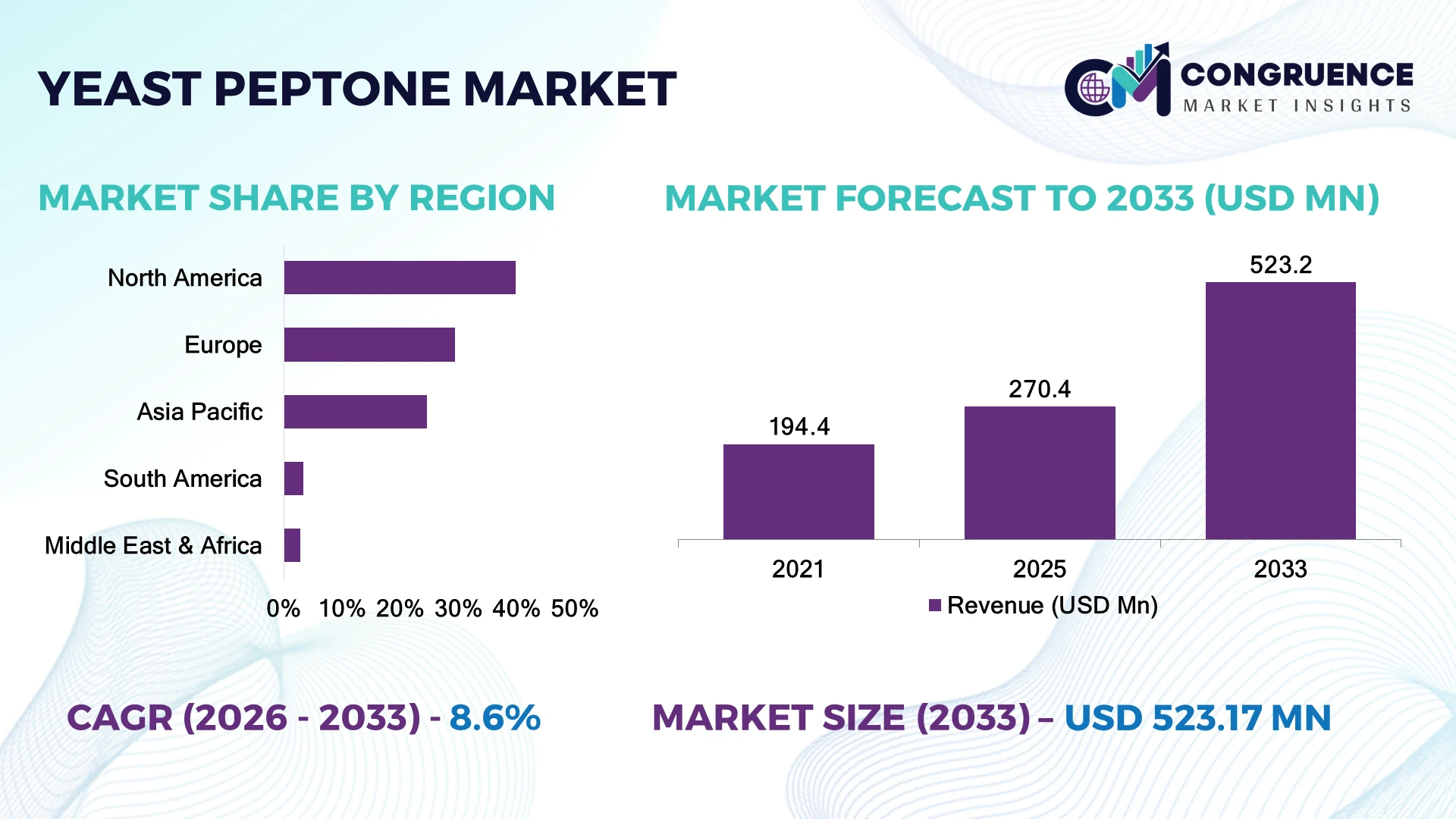
The Global Yeast Peptone Market was valued at USD 270.4 Million in 2025 and is anticipated to reach a value of USD 523.2 Million by 2033 expanding at a CAGR of 8.6% between 2026 and 2033. Rising biopharmaceutical fermentation, microbial culture media production, and precision bioprocessing requirements are accelerating demand for high-purity yeast peptone across vaccines, biologics, and industrial biotechnology.
The United States leads the market with approximately 31% global demand, supported by advanced biopharmaceutical manufacturing, large-scale CDMO operations, and sustained investments in cell culture technologies. More than 68% of commercial biologics facilities utilize animal-free or optimized microbial media formulations containing yeast peptone, while China continues expanding fermentation capacity at over 11% annually amid supply-chain diversification following post-pandemic pharmaceutical localization initiatives. This production advantage keeps the U.S. ahead in high-value applications despite China's faster capacity expansion.
Strategic investment in high-purity fermentation ingredients and localized manufacturing capacity will determine long-term supplier competitiveness.
Market Size & Growth: USD 270.4 million (2025) to USD 523.2 million (2033), CAGR 8.6%, driven by biopharmaceutical fermentation expansion.
Top Growth Drivers: Biologics +34%, vaccine media +27%, industrial fermentation +22%.
Short-Term Forecast: By 2028, media preparation efficiency improves 18% through automated formulation systems.
Emerging Technologies: AI-assisted fermentation control, precision nutrient blending, and continuous bioprocessing accelerate adoption.
Regional Leaders: North America, Europe, and Asia-Pacific account for over 82% demand with expanding biotech manufacturing.
Consumer/End-User Trends: Nearly 65% of biopharmaceutical facilities prioritize high-purity animal-free media ingredients.
Pilot/Case Example: 2025 fermentation optimization projects improved microbial biomass yield by approximately 15%.
Competitive Landscape: Top suppliers collectively command nearly 49% market share through quality consistency and GMP capabilities.
Regulatory & ESG Impact: Low-waste fermentation processes reduce production waste by approximately 16%.
Investment & Funding: More than USD 900 million supports global biologics manufacturing expansion and fermentation infrastructure.
Innovation & Future Outlook: Next-generation recombinant media ingredients strengthen precision biomanufacturing and supply-chain resilience.
Yeast peptone demand is increasingly concentrated in biopharmaceutical manufacturing, microbial diagnostics, industrial enzymes, and cultured protein development. High-purity enzymatic processing and consistent amino acid profiles improve fermentation productivity by nearly 18%, while regional pharmaceutical manufacturing expansion and resilient raw material sourcing are reshaping procurement strategies, setting the foundation for broader strategic market evolution.
Yeast peptone has become a strategic component of modern biomanufacturing because fermentation efficiency, biologics quality, and microbial consistency increasingly determine competitive advantage across pharmaceuticals, industrial biotechnology, and specialty food ingredients. Supply-chain localization following geopolitical disruptions has encouraged manufacturers to expand regional fermentation capacity while strengthening quality assurance for critical culture media components.
Advanced enzymatic hydrolysis delivers approximately 20% higher batch consistency than conventional acid hydrolysis while reducing impurity variability during microbial cultivation. North America remains the leader in pharmaceutical-grade applications, whereas Asia-Pacific is expanding production capacity through integrated fermentation infrastructure and contract manufacturing. Over 60% of newly commissioned biologics facilities are incorporating automated media preparation and digital process monitoring to improve production reliability during the next two to three years.
Manufacturers are investing in dedicated high-purity production lines, strategic distribution partnerships, and process automation to support growing biologics and precision fermentation demand. For example, integrated fermentation facilities combining upstream nutrient preparation with downstream quality testing shorten production cycles and improve batch reproducibility. Organizations that secure premium raw materials, optimize process control, and expand regional manufacturing capabilities will strengthen long-term competitive positioning in the evolving yeast peptone market.
Growing biologics manufacturing and precision fermentation programs are accelerating demand for high-purity yeast peptone as a critical culture media ingredient. Nearly 68% of commercial biologics facilities now prioritize animal-free nutrient formulations, while optimized media can improve microbial biomass productivity by 15–20%. China continues expanding fermentation infrastructure to strengthen domestic biologics production, creating sustained procurement demand for pharmaceutical-grade peptones. The structural shift toward continuous bioprocessing increases requirements for batch-to-batch consistency, directly influencing supplier qualification standards. This drives manufacturers to invest in advanced enzymatic hydrolysis, dedicated GMP production lines, and strategic partnerships with contract development and manufacturing organizations, improving product traceability while securing long-term supply agreements across pharmaceutical and industrial biotechnology markets.
Dependence on food-grade yeast extract feedstock and stringent pharmaceutical quality requirements creates persistent operational constraints. Raw material costs have fluctuated by approximately 12–18% over recent procurement cycles, while quality deviations exceeding 3–5% in amino acid composition can trigger batch rejection during biologics production. Europe faces additional compliance costs associated with increasingly rigorous GMP documentation and validation requirements. These factors compress supplier margins and complicate production planning for smaller manufacturers. To reduce operational risk, companies are diversifying yeast sourcing across multiple countries, expanding localized inventory buffers, adopting long-term procurement contracts, and implementing real-time analytical quality control systems that stabilize production consistency while reducing dependence on individual suppliers.
Rapid expansion of precision fermentation, cultured proteins, and next-generation biopharmaceutical manufacturing creates significant opportunities for specialized yeast peptone formulations. More than 40% of newly commissioned fermentation facilities are integrating digitally controlled nutrient optimization platforms capable of improving media utilization by approximately 16%. Singapore and South Korea continue investing in advanced biomanufacturing ecosystems supporting high-value fermentation inputs. A non-obvious opportunity lies in customized peptone formulations designed for strain-specific microbial performance, reducing development timelines and media consumption simultaneously. Suppliers are strengthening competitive positioning through application-specific R&D, collaborative product development with biotechnology companies, and expansion of customized media portfolios that deliver measurable improvements in fermentation efficiency across emerging life science applications.
Maintaining pharmaceutical-grade consistency while expanding global production remains a significant execution challenge. Validation activities can extend production qualification by 20–30%, while more than 25% of biotechnology manufacturers require supplier-specific performance verification before commercial deployment. Cross-site process harmonization becomes increasingly complex as manufacturers establish production facilities across different regulatory jurisdictions. Inconsistent analytical methodologies and workforce shortages in specialized fermentation operations further complicate manufacturing scalability and technology transfer. Companies must strengthen automated quality monitoring, invest in advanced process analytical technologies, standardize global manufacturing protocols, and expand technical collaboration with biotechnology customers to maintain reproducibility, regulatory compliance, and competitive differentiation as production volumes increase.
Customized Media Formulations Application-specific yeast peptone formulations are expanding rapidly, with nearly 38% of biotechnology companies requesting strain-optimized nutrient profiles. Digital formulation platforms reduce media optimization time by approximately 20%, enabling faster biologics development. Suppliers increasingly collaborate with pharmaceutical manufacturers to deliver customized fermentation solutions that improve production efficiency while reducing process variability.
Continuous Bioprocess Integration Continuous fermentation systems now support approximately 35% of newly commissioned biologics facilities, improving nutrient utilization by nearly 18%. The shift toward uninterrupted production workflows reduces operational downtime and inventory requirements. Manufacturers are redesigning production processes and expanding automated media preparation capabilities to align with next-generation manufacturing facilities.
Regional Manufacturing Localization Supply-chain diversification has encouraged pharmaceutical ingredient localization, with regional sourcing increasing by approximately 24% across strategic biotechnology hubs. India and China continue expanding fermentation infrastructure to reduce import dependence. Companies are investing in localized production capacity and distribution networks to strengthen supply resilience while shortening customer delivery timelines.
Advanced Quality Analytics Real-time analytical monitoring and automated quality verification are being adopted across nearly 42% of high-purity fermentation ingredient facilities. Enhanced process analytics reduce batch variability by approximately 14% while improving regulatory readiness. Manufacturers are integrating predictive quality management systems and automated laboratory workflows to support consistent pharmaceutical-grade production and faster customer qualification.
Pharmaceutical-grade yeast peptone accounted for approximately 48% of the market in 2025, maintaining leadership because of stringent purity specifications, batch-to-batch consistency, and regulatory compliance required for vaccine, monoclonal antibody, and biologics manufacturing. Its scalability within GMP production environments and compatibility with advanced microbial fermentation platforms continue to strengthen supplier preference. Technical-grade yeast peptone remains important for industrial fermentation and enzyme production where cost optimization is prioritized, while food-grade products support nutritional fermentation and specialty food applications with stable demand.
High-purity recombinant and application-specific yeast peptone represents the fastest-growing segment, supported by precision fermentation, cultured protein development, and cell-based biotechnology. Customized formulations are expanding at nearly 15% annually within new biotechnology projects, while pharmaceutical-grade materials account for over 70% of new biologics media qualification programs. Manufacturers are investing in enzymatic hydrolysis technologies, application-specific formulations, and dedicated GMP production capacity to strengthen premium product portfolios and secure long-term supply agreements.
According to findings published by the International Society for Pharmaceutical Engineering (ISPE) during 2025, more than 65% of newly qualified biologics manufacturing facilities prioritized high-purity, traceable culture media ingredients to improve process reproducibility and regulatory compliance.
Biopharmaceutical manufacturing represented approximately 44% of global demand in 2025, driven by large-scale microbial fermentation for vaccines, recombinant proteins, and monoclonal antibodies. High media consistency, optimized nutrient composition, and regulatory compliance make yeast peptone indispensable in commercial biologics production. Microbial diagnostics and laboratory research continue to represent mature application areas with stable procurement, while industrial enzyme production maintains steady demand through large-volume fermentation operations.
Precision fermentation and alternative protein manufacturing are emerging as the fastest-growing applications as commercial facilities expand beyond traditional pharmaceutical production. More than 30% of newly commissioned precision fermentation facilities incorporate customized nutrient formulations to improve microbial productivity, while industrial biotechnology applications continue expanding through synthetic biology innovation. Manufacturers are strengthening technical service capabilities, developing application-specific formulations, and integrating digital fermentation optimization to improve process performance while supporting increasingly specialized production workflows.
Industry observations released by the Biotechnology Innovation Organization (BIO) during 2026 indicated that over 60% of commercial biologics developers increased investment in optimized culture media formulations to enhance fermentation efficiency and manufacturing consistency.
Biopharmaceutical companies accounted for approximately 46% of total demand in 2025, reflecting their extensive dependence on high-quality fermentation media for commercial biologics manufacturing. Large-scale production, stringent validation protocols, and continuous manufacturing expansion sustain procurement volumes across established pharmaceutical facilities. Contract development and manufacturing organizations (CDMOs) represent another significant customer base because of rising outsourcing activity, while academic research institutes and diagnostic laboratories maintain consistent purchasing for research and analytical applications.
Biotechnology companies are emerging as the fastest-growing end-user segment, supported by precision fermentation, synthetic biology, and cultured protein commercialization. Nearly 35% of expanding biotechnology production facilities are adopting customized media formulations to optimize strain-specific performance and reduce process variability. Suppliers are responding through collaborative formulation development, technical consulting, flexible supply contracts, and localized manufacturing support, enabling differentiated customer engagement while strengthening long-term commercial partnerships.
An enterprise assessment published by the BioProcess Systems Alliance (BPSA) during 2025 found that more than 62% of biologics manufacturers preferred strategic media ingredient suppliers capable of providing customized formulations alongside validated technical support.
North America accounted for the largest market share at 39.8% in 2025 however, Asia-Pacific is expected to register the fastest growth, expanding at a CAGR of 10.4% between 2026 and 2033.
Biopharmaceutical Manufacturing Strengthens Premium Ingredient Demand
North America leads the yeast peptone market through its mature biopharmaceutical manufacturing ecosystem, advanced fermentation infrastructure, and high concentration of GMP-certified production facilities. The region contributes nearly 40% of global pharmaceutical-grade yeast peptone consumption, supported by extensive biologics manufacturing and contract development activities. More than 70% of commercial biologics plants utilize high-purity microbial media formulations incorporating pharmaceutical-grade peptones. Investments in precision fermentation facilities and continuous bioprocessing are increasing demand for customized nutrient ingredients with validated quality standards. Suppliers are expanding application laboratories, strengthening regional distribution capabilities, and integrating digital quality monitoring to improve supply reliability and accelerate customer qualification across life science manufacturing.
United States Market Outlook: The United States dominates regional demand through its extensive biologics manufacturing capacity, large CDMO network, and established biotechnology innovation ecosystem. More than 65% of North American commercial biologics production is concentrated in the country, supported by continuous investments in fermentation infrastructure and pharmaceutical manufacturing modernization. Domestic manufacturers increasingly prioritize application-specific media development and automated quality verification to strengthen production consistency and secure long-term supply resilience.
Regulatory Compliance Drives Premium Product Adoption
Europe maintains a strong market position through advanced pharmaceutical manufacturing, strict regulatory oversight, and established industrial biotechnology capabilities. Germany, France, and Switzerland remain central to regional demand for pharmaceutical-grade fermentation ingredients. Nearly 34% of European procurement focuses on high-purity GMP-compliant yeast peptone formulations for biologics and vaccine manufacturing. Continuous investment in sustainable fermentation technologies and traceable raw material sourcing is encouraging suppliers to modernize production processes while improving quality assurance. Strategic collaboration between fermentation ingredient producers and biotechnology companies continues strengthening product innovation and operational efficiency across pharmaceutical manufacturing.
Germany Market Outlook: Germany serves as Europe's leading production and innovation hub due to its advanced pharmaceutical manufacturing infrastructure and biotechnology research capabilities. Large-scale biologics facilities, precision fermentation investments, and strong industrial automation enable efficient production of high-value microbial culture media. More than 40% of Germany's biotechnology manufacturing facilities continue expanding digital process monitoring, reinforcing demand for premium fermentation ingredients with consistent analytical performance.
Fermentation Capacity Expansion Accelerates Market Growth
Asia-Pacific is experiencing the fastest market expansion as pharmaceutical manufacturing, industrial biotechnology, and precision fermentation investments continue accelerating across major economies. China, India, South Korea, and Singapore are expanding domestic fermentation infrastructure to strengthen biologics production and reduce import dependence. More than 45% of newly established regional fermentation facilities incorporate automated nutrient preparation systems that improve production consistency and operational efficiency. Manufacturers are increasing localized production capacity while strengthening partnerships with biotechnology firms to support customized media development and regional supply-chain resilience.
China Market Outlook: China represents the region's largest manufacturing base through extensive fermentation capacity, expanding biologics production, and strong government support for biotechnology localization. Industrial fermentation output continues increasing across dedicated biotechnology clusters, while pharmaceutical manufacturers invest heavily in high-purity culture media ingredients. Modern production facilities increasingly integrate automated quality control systems to improve batch reproducibility and strengthen competitiveness in global life science supply chains.
Industrial Biotechnology Expands Regional Demand
South America is steadily strengthening its position through expanding pharmaceutical manufacturing, industrial fermentation, and food biotechnology investments. Brazil and Argentina continue developing domestic fermentation capabilities while increasing procurement of premium microbial nutrients for biologics and enzyme production. Approximately 28% of regional demand originates from industrial biotechnology applications, supported by modernization of manufacturing infrastructure. Although dependence on imported specialty ingredients remains a constraint, suppliers are improving distribution efficiency and localized inventory strategies to support stable customer supply and faster product availability.
Brazil Market Outlook: Brazil leads regional demand through its expanding pharmaceutical manufacturing sector, established industrial biotechnology base, and growing vaccine production capabilities. National investments in domestic bioprocessing infrastructure continue encouraging wider adoption of high-quality fermentation ingredients across commercial manufacturing. Pharmaceutical companies are strengthening local production partnerships and expanding fermentation capacity to improve supply security while reducing dependence on imported specialty raw materials.
Healthcare Manufacturing Investments Create New Demand
The Middle East & Africa market is gradually expanding as governments invest in pharmaceutical manufacturing, biotechnology research, and healthcare modernization. Saudi Arabia, the United Arab Emirates, and South Africa are strengthening domestic life science capabilities through new industrial investments and technology partnerships. Nearly 30% of recently announced biotechnology projects across Gulf countries include fermentation or biologics manufacturing components requiring specialized culture media ingredients. Suppliers are establishing regional technical support networks and expanding distribution partnerships to improve market access and customer responsiveness.
Saudi Arabia Market Outlook: Saudi Arabia has emerged as the region's most strategic market through pharmaceutical localization initiatives, biotechnology investment programs, and expanding life science manufacturing infrastructure. National industrial diversification policies continue supporting domestic biologics production and advanced fermentation capabilities. Investments in modern pharmaceutical facilities and technology transfer programs are increasing demand for pharmaceutical-grade fermentation ingredients while strengthening long-term manufacturing competitiveness.
The market is shaped by competition between global fermentation specialists including Kerry Group, Lesaffre (Biospringer), Thermo Fisher Scientific, Merck KGaA, and Titan Biotech, while regional biotechnology ingredient manufacturers compete through cost-efficient production and localized supply. The top five players collectively control approximately 51% of global demand. Competition centers on product purity, batch consistency, technical support, and supply reliability rather than price alone, with pharmaceutical-grade products commanding 20–30% higher pricing than standard industrial grades. Leading suppliers improve customer retention through customized formulations, GMP-certified manufacturing, strategic distribution partnerships, and vertical integration across fermentation and downstream processing. Technology-focused companies compete through enzymatic hydrolysis innovation, whereas cost-focused suppliers emphasize manufacturing scale and regional availability. Qualification timelines exceeding 12 months create a significant entry barrier for new participants. Winning requires validated production consistency, application-specific formulation expertise, resilient raw material sourcing, and long-term partnerships with biologics manufacturers.
Kerry Group
Lesaffre (Biospringer)
Thermo Fisher Scientific
Merck KGaA
Titan Biotech Limited
HiMedia Laboratories
Neogen Corporation
CONDALAB
Sisco Research Laboratories (SRL)
Liofilchem S.r.l.
Hardy Diagnostics
BD (Becton, Dickinson and Company)
Advanced enzymatic hydrolysis has become the preferred production technology for pharmaceutical-grade yeast peptone because it preserves amino acid integrity and improves nutrient consistency. Compared with conventional acid hydrolysis, enzymatic processing delivers approximately 18% higher batch uniformity while reducing undesirable degradation compounds by nearly 15%. More than 60% of newly commissioned premium production lines now incorporate automated hydrolysis control and in-line analytical monitoring, strengthening reproducibility required for biologics manufacturing and precision fermentation.
Digital fermentation analytics, process analytical technology (PAT), and AI-assisted quality prediction are transforming production efficiency. Automated quality monitoring reduces batch release time by approximately 20% while predictive process control lowers manufacturing deviations by nearly 17%. Suppliers integrating digital manufacturing platforms gain stronger customer qualification performance than conventional manufacturers relying on laboratory-only testing. Biotechnology companies and contract manufacturing organizations benefit most because faster qualification shortens commercial production timelines and improves operational flexibility.
Between 2026 and 2028, customized strain-specific nutrient formulations, continuous fermentation, and digital twin process optimization will reshape competitive positioning. Application-specific peptones are expected to become standard across advanced biologics manufacturing as companies invest in automated formulation systems, integrated quality analytics, and collaborative product development. Organizations adopting intelligent production technologies today will secure higher-value pharmaceutical contracts and stronger long-term differentiation.
October 2024 Lesaffre, through Biospringer, acquired the yeast extract business of dsm-firmenich, expanding its fermentation-derived ingredient portfolio supporting microbial culture media and biotechnology applications. The transaction broadened specialty nitrogen-source capabilities and strengthened global supply resilience. Source: Biospringer
January 2025 Thermo Fisher Scientific published new bioprocess research demonstrating how Gibco peptones improved cell culture productivity and process consistency using advanced analytical characterization, helping manufacturers optimize media formulation and biologics production performance.
September 2025 Nu-Tek BioSciences launched its Variability Reduction Program, enabling biotechnology manufacturers to improve raw material consistency and optimize fermentation workflows using animal-free peptones, enhancing manufacturing reliability for commercial biologics.
May 2026 Biospringer by Lesaffre acquired selected intellectual property and technology from PTX Food, extending fermentation expertise beyond yeast into bacterial solutions to accelerate innovation and strengthen next-generation biotechnology ingredient development. Source: Biospringer News (Biospringer)
The report provides comprehensive analysis of pharmaceutical-grade, technical-grade, food-grade, and customized yeast peptone products across biopharmaceutical manufacturing, industrial fermentation, diagnostics, research laboratories, and precision biotechnology applications. It evaluates demand across pharmaceutical companies, biotechnology firms, contract development and manufacturing organizations, research institutes, and industrial biotechnology enterprises spanning North America, Europe, Asia-Pacific, South America, and the Middle East & Africa. More than 20 strategic market indicators, technology trends, and competitive benchmarks are incorporated to strengthen decision-making.
The study further examines enzymatic hydrolysis technologies, continuous fermentation, automated quality monitoring, and customized media formulation strategies shaping future industry development. Coverage includes regional manufacturing expansion, procurement dynamics, deployment patterns, product differentiation, and supplier positioning between 2026 and 2033, enabling stakeholders to identify investment priorities, expansion opportunities, partnership potential, competitive risks, and evolving customer requirements across high-value fermentation markets.
| Report Attribute/Metric | Report Details |
|---|---|
|
Market Revenue in 2025 |
USD 270.4 Million |
|
Market Revenue in 2033 |
USD 523.2 Million |
|
CAGR (2026 - 2033) |
8.6% |
|
Base Year |
2025 |
|
Forecast Period |
2026 - 2033 |
|
Historic Period |
2021 - 2025 |
|
Segments Covered |
By Type
By Application
By End-User
|
|
Key Report Deliverable |
Revenue Forecast, Growth Trends, Market Dynamics, Segmental Overview, Regional and Country-wise Analysis, Competition Landscape |
|
Region Covered |
North America, Europe, Asia-Pacific, South America, Middle East, Africa |
|
Key Players Analyzed |
Kerry Group, Lesaffre (Biospringer), Thermo Fisher Scientific, Merck KGaA, Titan Biotech Limited, HiMedia Laboratories, Neogen Corporation, CONDALAB, Sisco Research Laboratories (SRL), Liofilchem S.r.l., Hardy Diagnostics, BD (Becton, Dickinson and Company) |
|
Customization & Pricing |
Available on Request (10% Customization is Free) |




