
Reports
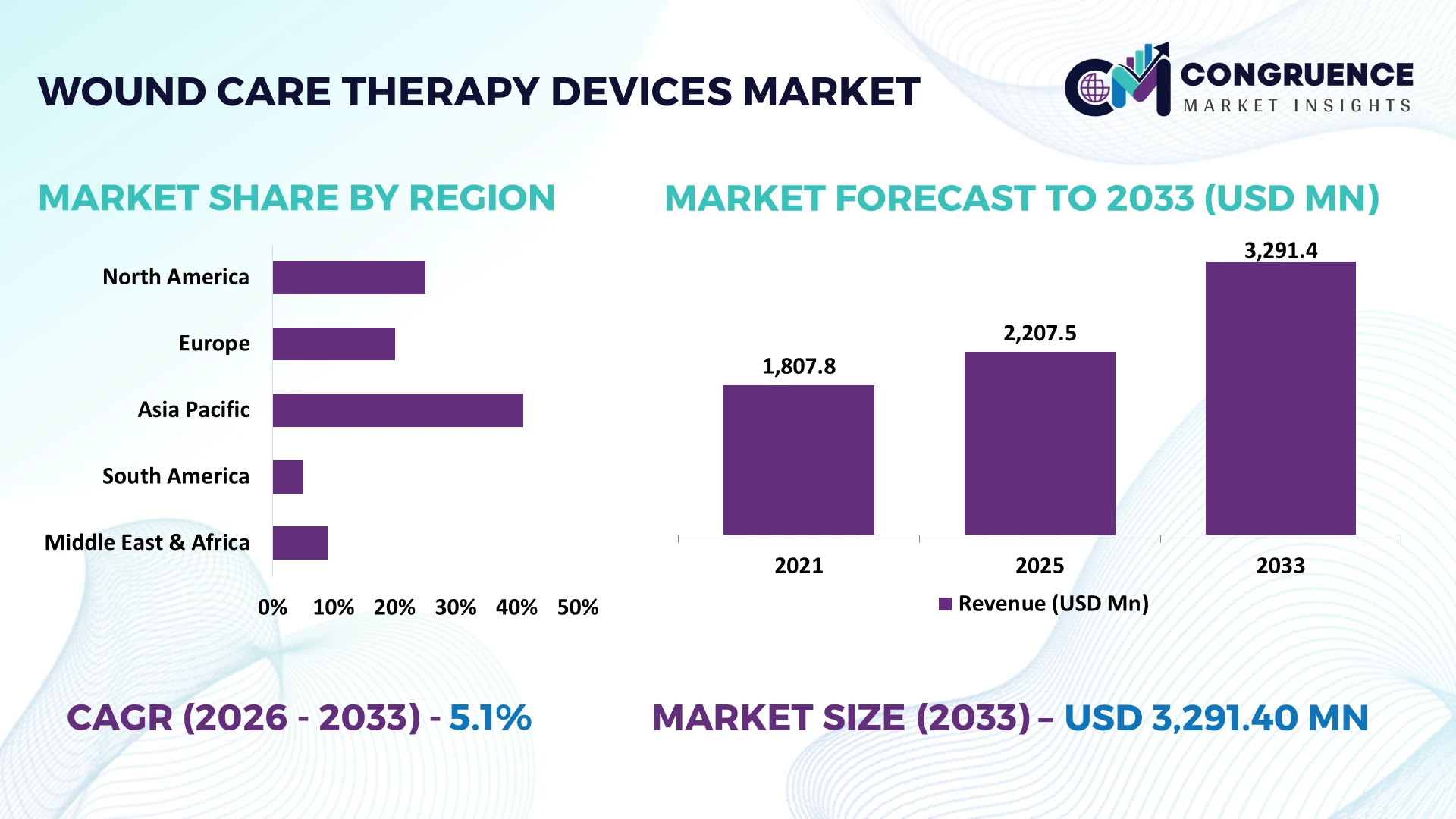
The Global Wound Care Therapy Devices Market was valued at USD 2207.5 Million in 2025 and is anticipated to reach a value of USD 3291.4 Million by 2033 expanding at a CAGR of 5.12% between 2026 and 2033. Growth is driven by wider adoption of negative pressure wound therapy (NPWT), portable wound management systems, and advanced dressings that accelerate exudate control and support treatment of complex surgical wounds, diabetic ulcers, and pressure injuries.
The United States holds a strategic position in the global wound care therapy devices landscape, supported by established hospital procurement networks, specialist wound centers, and reimbursement pathways for eligible treatments. North America accounted for 43.8% of the global negative pressure wound therapy market in 2025, reinforcing its importance as a commercial launchpad for portable therapy systems. India and China offer contrasting expansion opportunities through healthcare infrastructure development and broader access to advanced treatment. The US–China trade environment also makes manufacturing diversification, component availability, and regional distribution resilience important considerations for suppliers.
Strategic implication: Prioritize North American clinical differentiation while developing cost-efficient product portfolios and localized distribution partnerships for high-growth Asian markets.
Market Size & Growth: USD 2,207.5 million in 2025 to USD 3,291.4 million by 2033, at 5.12% CAGR, driven by portable NPWT adoption and complex-wound treatment.
Top Growth Drivers: Portable therapy adoption, 9.13% projected CAGR; home-care expansion, 10.64%; Asia-Pacific NPWT growth, 8.72%.
Short-Term Forecast: By 2028, manufacturers should target measurable reductions in dressing-change time and treatment costs through workflow automation; outcomes require product-specific validation.
Emerging Technologies: AI-assisted wound measurement, connected NPWT pumps, and antimicrobial biomaterials strengthen monitoring and treatment precision.
Regional Leaders: North America leads NPWT with 39.61% share; Asia-Pacific records 8.72% projected growth; Europe remains a major institutional procurement market.
Consumer/End-User Trends: Hospitals accounted for 53.81% of NPWT revenue in 2025, while home-care settings are expanding at 10.64% projected CAGR.
Pilot/Case Example: In 2025, ConvaTec received regulatory approval for ConvaNiox, a nitric oxide-generating multimodal dressing for hard-to-heal wounds.
Competitive Landscape: Solventum led the wound therapy devices market with over 18% share in 2024; Smith+Nephew, Mölnlycke, ConvaTec, and Cardinal Health are key competitors.
Regulatory & ESG Impact: EU MDR compliance and sustainability requirements increase the importance of clinical evidence, traceability, and material efficiency.
Investment & Funding: A reliable, consolidated global investment total is unavailable; strategic partnerships and portfolio expansion remain visible competitive priorities.
Innovation & Future Outlook: Single-use pumps, sensor-enabled dressings, and remote wound monitoring support a shift toward outpatient treatment and measurable clinical outcomes.
The wound care therapy devices market is increasingly shaped by demand for portable NPWT systems, advanced antimicrobial dressings, and digitally connected wound assessment tools across hospitals, specialty clinics, and home-care settings. Diabetic foot ulcers represented 33.72% of NPWT demand in 2025, highlighting the commercial importance of chronic-wound treatment pathways. Product innovation increasingly combines pressure regulation, infection management, and remote monitoring to improve continuity of care. Meanwhile, evolving medical-device compliance requirements and cross-border supply-chain pressures strengthen the case for validated products, reliable component sourcing, and region-specific commercialization strategies.
The wound care therapy devices market is becoming strategically important as hospitals shift complex wound management toward measurable clinical outcomes, outpatient treatment, and digitally supported care. Competitive advantage increasingly depends on demonstrating healing performance, controlling treatment costs, and securing reliable access to advanced pumps, dressings, and monitoring technologies. Manufacturers that integrate devices with clinical workflows strengthen their position in hospital procurement and home-care channels.
Negative pressure wound therapy (NPWT) illustrates this shift. Traditional hospital-based systems offer extensive therapy controls, while single-use portable devices support patient mobility and reduce dependence on bulky equipment. Actual efficiency gains depend on wound type, treatment protocol, and device design; companies need validated clinical and operational evidence rather than assuming uniform savings. At the same time, medical-device regulatory requirements and cross-border manufacturing pressures are encouraging suppliers to strengthen quality systems and diversify sourcing.
Over the next two to three years, commercial priorities will center on expanding portable-device adoption, improving clinician training, and integrating wound documentation with electronic health records. US providers will continue emphasizing clinical evidence and reimbursement alignment, while Indian healthcare networks present opportunities to scale cost-conscious treatment through specialist centers and home-care services. Companies are responding through targeted R&D, distribution partnerships, and localized commercialization. The strategic priority is to compete on verified treatment outcomes and total care-pathway efficiency, not device specifications alone.
Increasing diabetes prevalence, vascular complications, and surgical wound-management requirements are strengthening demand for advanced wound care therapy devices. In the United Kingdom’s SWHSI-2 randomized trial, 80.0% of 686 participants had diabetes, illustrating the clinical complexity of patients requiring specialized wound management. However, negative pressure wound therapy (NPWT) did not significantly accelerate healing compared with standard care in this specific patient group. This evidence is pushing manufacturers to refine patient selection, develop portable systems, and demonstrate measurable clinical value. Companies that align device innovation with wound-specific treatment protocols and clinician training can improve procurement credibility and reduce inappropriate technology deployment.
High equipment costs, recurring consumable requirements, and limited specialist infrastructure constrain advanced wound therapy adoption in price-sensitive healthcare systems. A randomized trial involving complex traumatic wounds reported mean treatment costs of USD 15.15 for a low-cost negative-pressure system versus USD 872.59 for a commercial comparator, demonstrating the potential economic impact of device design and procurement choices. These figures are specific to the trial and should not be generalized across treatment settings. In India, affordability and access to trained wound-care personnel influence purchasing decisions beyond technical performance. Manufacturers can address these constraints through locally manufactured components, tiered product portfolios, distributor partnerships, and transparent lifecycle-cost models.
Portable NPWT devices, sensor-enabled dressings, and remote wound assessment create opportunities to extend advanced treatment beyond inpatient facilities. The commercial opportunity lies in reducing unnecessary clinic visits while maintaining appropriate clinical oversight, particularly for patients requiring repeated wound assessments. India’s expanding private hospital networks and specialist diabetes-care services offer potential channels for lower-cost portable systems. In the United States, connected-device development also creates opportunities for differentiated monitoring and documentation services. Manufacturers should prioritize interoperability, user-friendly interfaces, and clinical validation alongside device performance. Partnerships with home-health providers and wound-care networks can establish recurring consumable demand while generating real-world evidence to support reimbursement discussions and institutional purchasing decisions.
Scaling connected wound therapy requires reliable integration with clinical records, consistent staff training, and safeguards for patient data. Under US medical-device cybersecurity requirements effective from March 29, 2023, manufacturers submitting covered cyber devices must provide specified cybersecurity information, including plans for vulnerability management and software-component documentation. These obligations add engineering, documentation, and lifecycle-support requirements for connected products. Hospitals also need standardized wound measurement, escalation protocols, and dependable connectivity to translate device data into clinical decisions. Companies must embed cybersecurity controls during product development, validate interoperability before deployment, and invest in clinician education. Competitive differentiation will increasingly depend on delivering reliable performance across diverse care environments, not merely launching technically advanced devices.
Negative Pressure Wound Therapy Leads Advanced Device Deployment
Negative pressure wound therapy (NPWT) is the leading technology segment, representing approximately 58% of the wound treatment system equipment market under a narrower equipment-based classification. Its position reflects controlled exudate removal, suitability for selected complex wounds, and established use in hospital protocols. Reusable systems support intensive treatment, while portable and single-use configurations extend deployment into outpatient care. Companies are refining pump portability, simplifying consumable replacement, and expanding clinician education to improve utilization across care settings.
Hyperbaric oxygen therapy (HBOT) remains relevant for selected wounds requiring specialized oxygen delivery, although capital-intensive chambers and indication-specific reimbursement limit widespread deployment. Electrical stimulation and ultrasound therapy devices provide complementary options for selected chronic wounds, while compression therapy devices remain important for venous leg ulcers. Advanced wound dressings support routine wound management through moisture regulation and exudate control. As a result, investment priorities differ: NPWT suppliers focus on product scalability, whereas specialized technology providers must demonstrate clinical value and justify infrastructure requirements.
Chronic Wounds Anchor Demand Across Treatment Pathways
Chronic wounds represent the leading application category, accounting for approximately 59.8% of the broader wound care market in 2025. This benchmark reflects the wider wound care category rather than an independently verified share for therapy devices alone. Prolonged treatment cycles, recurring dressing requirements, and repeated clinical assessment sustain demand for advanced wound management. Diabetic foot ulcers are particularly important because delayed healing can lead to infection, hospitalization, and amputation. Manufacturers are prioritizing wound-specific treatment protocols, compatible dressings, and product configurations that support continuity between hospital and outpatient care.
Pressure ulcers and venous leg ulcers require consistent assessment and targeted management, while surgical wounds generate demand around perioperative recovery. Traumatic wounds and burns require specialized treatment according to tissue damage, infection risk, and wound severity. These applications create different procurement priorities: hospitals emphasize clinical protocols and procedural consistency, while community-based providers prioritize manageable treatment routines. Companies are strengthening product portfolios around wound-specific needs instead of relying on one universal device platform, enabling more precise clinical positioning and resource allocation.
Hospitals Remain the Primary Institutional Buyers
Hospitals are the leading end-user group, accounting for approximately 45.5% of the chronic wound care market in 2025. This benchmark reflects the broader chronic wound care category rather than the therapy-device market exclusively. Hospitals concentrate complex cases, specialist expertise, and procurement of NPWT equipment, advanced dressings, and associated consumables. Standardized purchasing and clinical protocols support large-volume deployment, giving suppliers opportunities to negotiate institutional contracts and establish product consistency across departments. Wound care centers and specialty clinics complement hospital services through focused assessment and treatment, while ambulatory surgery centers generate demand linked to postoperative wound management.
Home healthcare represents a strategically important expansion channel as suitable patients transition from inpatient treatment to supervised recovery at home. Long-term care facilities also require dependable wound assessment and pressure-injury management for residents with limited mobility. These settings place greater emphasis on ease of application, caregiver training, supply continuity, and simplified equipment handling. Manufacturers are responding with portable systems, accessible pricing, distributor partnerships, and training programs tailored to non-hospital users. Competitive positioning increasingly depends on matching device complexity to the care environment while maintaining treatment quality and predictable consumable availability.
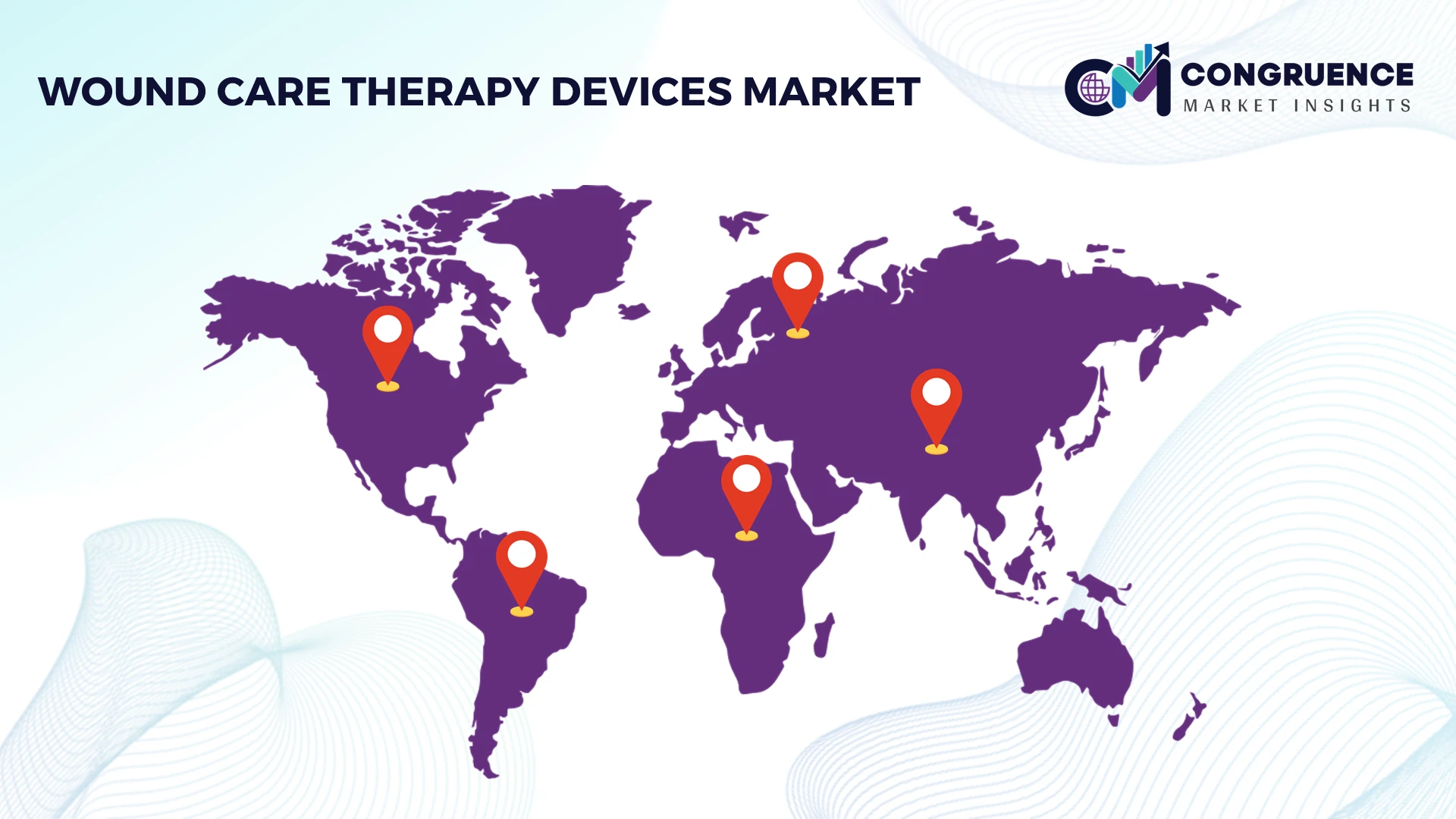
North America accounted for the largest market share at 42.6% in 2025 however, Asia-Pacific is expected to register the fastest growth, expanding at a CAGR of 6.03% between 2026 and 2033.
Clinical sophistication and established procurement sustain market leadership
North America accounted for approximately 42.6% of the global wound treatment system equipment market in 2025, reflecting established hospital infrastructure, specialist wound-care services, and established reimbursement pathways. The United States anchors regional demand through advanced surgical care, chronic-wound treatment programs, and strong manufacturer presence. Hospitals prioritize dependable negative pressure wound therapy (NPWT), standardized consumables, and clinically validated treatment protocols. Canada adds opportunities through community-based care and outpatient treatment, although procurement models differ. Manufacturers are strengthening institutional partnerships, expanding portable-device portfolios, and aligning product development with clinical evidence requirements. The key operational advantage is the ability to introduce differentiated products through established clinical networks, while reimbursement alignment and documented treatment outcomes remain decisive for sustained adoption.
United States Market Outlook: The United States represents the principal commercialization hub for advanced wound therapy devices, supported by major manufacturers, specialist clinicians, and established medical-device regulation. Approximately 85% of North American wound care device market activity is concentrated in the country under selected market estimates. Companies are prioritizing product validation, hospital contracting, and distribution capabilities that support consistent device availability. The strategic opportunity lies in extending suitable treatments beyond hospitals without compromising clinical oversight or reimbursement compliance.
Regulatory discipline and healthcare efficiency shape purchasing decisions
Europe represented approximately 27.4% of the global wound treatment system equipment market in 2025. Germany, the United Kingdom, and France contribute through established healthcare infrastructure, specialist treatment facilities, and demand for clinically supported wound-management technologies. The European Union's Medical Device Regulation (MDR) increases the importance of clinical evidence, quality management, traceability, and post-market surveillance. These requirements influence product launch timelines and favor manufacturers with established compliance systems. Aging populations and chronic-wound treatment needs sustain demand, while budget constraints encourage healthcare providers to assess lifecycle costs rather than purchase prices alone. Suppliers are strengthening regulatory documentation, consolidating product portfolios, and improving consumable efficiency to maintain institutional competitiveness.
Germany Market Outlook: Germany combines a substantial hospital network, specialist medical services, and a strong medical-technology manufacturing base. Its estimated share of approximately 29% of Europe's broader wound care devices market in 2025 highlights its commercial significance, although this figure varies by market definition. Manufacturers can use German clinical institutions and distribution networks to establish product credibility and support broader European commercialization. Regulatory readiness, dependable servicing, and evidence of treatment effectiveness remain important purchasing advantages.
Manufacturing scale and expanding clinical access reshape demand
Asia-Pacific accounted for approximately 23.0% of the global wound treatment system equipment market in 2025 and represents an important expansion market as healthcare infrastructure and access to advanced treatment improve. China, Japan, and India offer distinct commercial advantages: manufacturing capacity in China, established medical technology adoption in Japan, and growing hospital networks in India. Procurement remains sensitive to affordability, reimbursement coverage, and clinical training. Manufacturers are responding through localized distribution, competitively priced product configurations, and partnerships with hospital groups. The region's non-obvious advantage is its ability to support both product manufacturing and incremental clinical adoption, allowing suppliers to adapt device specifications and pricing to different healthcare systems.
China Market Outlook: China offers substantial manufacturing infrastructure, a large hospital network, and established medical-device production capabilities. Its estimated share of approximately 36% of Asia-Pacific's broader wound care devices market in 2025 illustrates its importance, although estimates vary by category. Domestic manufacturers can compete through localized production and cost control, while international suppliers benefit from differentiated technology and clinical partnerships. Companies must align regulatory approvals, product pricing, and distributor coverage with local purchasing requirements to establish sustainable market access.
Affordability and healthcare access determine deployment potential
South America represented approximately 4.0% of the global wound treatment system equipment market in 2025, with Brazil serving as a major demand center. Private hospital networks, specialist clinics, and surgical services support demand for advanced wound-management equipment, while public-sector procurement and affordability constraints influence adoption. Uneven access to specialist care and differences in healthcare infrastructure create substantial variation between urban treatment centers and less-served areas. Import dependence can also expose suppliers to currency fluctuations, logistics costs, and procurement delays. Companies are responding through local distributors, value-oriented product portfolios, and selective partnerships with private healthcare providers. Commercial success depends on matching clinical performance with realistic acquisition and servicing costs.
Brazil Market Outlook: Brazil offers the region's largest strategic base for wound care device commercialization, supported by major urban hospitals, private healthcare providers, and a broad medical-products distribution network. The country accounts for approximately 40% of South America's broader wound care devices market under selected 2025 estimates. Manufacturers can strengthen penetration by working with hospital procurement teams and specialist clinics while developing affordable configurations. Local distribution capabilities and dependable consumable supply are critical to reducing delays and improving access beyond major metropolitan centers.
Healthcare modernization creates targeted procurement opportunities
The Middle East and Africa accounted for approximately 3.0% of the global wound treatment system equipment market in 2025. Demand is concentrated in better-equipped healthcare systems, including Saudi Arabia, the United Arab Emirates, and South Africa. Hospital modernization, specialist treatment services, and investment in healthcare infrastructure support adoption of advanced wound-management technologies. However, purchasing capacity, specialist workforce availability, and access to maintenance services vary substantially between countries. Suppliers are adapting through public and private hospital partnerships, distributor development, and products designed for different budget levels. The strategic priority is to secure reliable installation, training, and consumable support rather than depend on equipment sales alone.
Saudi Arabia Market Outlook: Saudi Arabia offers a strategically significant market through healthcare infrastructure investment, hospital modernization, and efforts to expand specialized treatment capacity under Vision 2030. Its estimated share of approximately 29% of the Middle East and Africa's broader wound care devices market in 2025 highlights its importance within selected market definitions. Suppliers can pursue institutional tenders and partnerships with private hospital operators while emphasizing clinical training, product reliability, and after-sales service. Successful market entry requires alignment with local regulatory procedures and procurement requirements.
Smith & Nephew, Mölnlycke Health Care, ConvaTec, and 3M Health Care lead advanced wound care therapy devices, collectively commanding approximately 45–50% of global market share through negative pressure wound therapy (NPWT) platforms and advanced dressings. Competition bifurcates into two arenas: global device manufacturers competing on NPWT system integration and reimbursement access versus regional dressing suppliers competing on cost-per-application and tender pricing. Basis of competition is shifting from product efficacy toward connected therapy: smart NPWT systems with remote monitoring now capture 25–30% of premium segment adoption, while antimicrobial dressing innovation targets the 20%+ infection-rate reduction benchmark demanded by hospital procurement. Players compete through vertical integration—Smith & Nephew and ConvaTec control dressing-to-device portfolios—and through health-economic outcome contracts with payers. The competitive shift is toward outpatient and home-care NPWT, expanding beyond acute hospital settings. Entry barriers include FDA 510(k) clearance, clinical evidence generation, and payer contracting relationships. To win, competitors must deliver cost-effective connected therapy platforms with published healing-outcome data.
Smith & Nephew
Mölnlycke Health Care
ConvaTec Group
3M Health Care
Cardinal Health
B. Braun Melsungen
Coloplast
Paul Hartmann
Medline Industries
Lohmann & Rauscher
Integra LifeSciences
DeRoyal Industries
Winner Medical
Zhende Medical
Artificial intelligence (AI) and computer vision are transforming wound assessment by replacing subjective visual estimates with standardized digital measurements. A 2025 multicenter UK evaluation of AI-enhanced multispectral imaging reported 95.3% overall accuracy in burn-wound assessment, with results delivered in approximately five minutes. Traditional assessment relies more heavily on clinician judgment, increasing variability between observers. Digital platforms give providers more consistent documentation and support faster treatment decisions, benefiting manufacturers that integrate validated imaging with clinical workflows.
Connected wound-management platforms are extending this transformation into home healthcare. A 2025 study across 14 adopting home-health branches reported a 4.3% reduction in skilled nursing visits per treatment episode and a 2.5% decrease in visit duration. These measurable gains support workforce utilization and care coordination. Companies combining remote monitoring, secure data exchange, and clinical decision support can differentiate through operational performance rather than device specifications alone.
From 2026 to 2028, integration of AI, portable negative pressure wound therapy devices, and electronic health records will strengthen competition around measurable outcomes. Adoption remains uneven, and clinical validation, cybersecurity, and interoperability determine deployment readiness. Manufacturers should prioritize scalable software integration, evidence-backed performance, and clinician usability. Early investment positions suppliers to improve workflow efficiency, support decentralized treatment, and meet institutional demand for accountable, data-driven wound care.
November 2024: Smith & Nephew launched its next-generation PICO 7 single-use negative pressure wound therapy system with expanded indication coverage for closed surgical incisions, targeting a 30% reduction in surgical site complications across orthopedic and cardiac procedures. This expands NPWT adoption into prophylactic surgical applications beyond chronic wound management. Source: smith-nephew.com
September 2025: Mölnlycke Health Care announced a strategic partnership with a digital wound-imaging platform to integrate AI-assisted wound assessment into its dressing portfolio, enabling clinicians to track healing trajectories across 1,000+ European wound care centers. This positions connected dressings as clinical decision-support tools rather than passive products. Source: molnlycke.com
June 2025: ConvaTec received FDA clearance for its next-generation NPWT system featuring remote therapy monitoring and automated canister-change alerts, targeting a 25% reduction in unplanned home-care nursing visits for chronic wound patients. The approval accelerates the shift toward outpatient and home-based negative pressure therapy. Source: convatec.com
March 2025: 3M Health Care expanded its advanced wound dressing manufacturing capacity in Asia-Pacific, increasing regional production of antimicrobial silver dressings to support a 20% year-over-year demand increase from hospital procurement networks in India and Southeast Asia. This addresses regional supply-chain concentration risk. Source: 3m.com
This report evaluates the global wound care therapy devices market across product categories, clinical applications, end-user settings, regional demand, and competitive positioning for 2026–2033. Type coverage includes Negative Pressure Wound Therapy, Hyperbaric Oxygen Therapy, Electrical Stimulation Devices, Ultrasound Therapy Devices, Compression Therapy Devices, and Advanced Wound Dressings. Application analysis covers chronic wounds, diabetic foot ulcers, pressure ulcers, venous leg ulcers, surgical wounds, traumatic wounds, and burns. End-user assessment spans hospitals, wound care centers, specialty clinics, ambulatory surgery centers, home healthcare, and long-term care facilities.
Geographic coverage includes North America, Europe, Asia-Pacific, South America, and the Middle East & Africa, with country-level analysis of manufacturing capabilities, clinical infrastructure, regulatory conditions, and technology adoption. The report examines portable therapy systems, AI-assisted wound assessment, connected monitoring, and advanced dressing materials alongside established treatment technologies. With negative pressure wound therapy holding a substantial position in specialized equipment categories, the analysis distinguishes mature product markets from emerging deployment opportunities. These insights support investment prioritization, market-entry planning, portfolio development, competitive benchmarking, and expansion strategies aligned with evolving clinical requirements and healthcare procurement models.
| Report Attribute/Metric | Report Details |
|---|---|
Market Revenue in 2025 | USD 2207.5 Million |
Market Revenue in 2033 | USD 3291.4 Million |
CAGR (2026 - 2033) | 5.12% |
Base Year | 2025 |
Forecast Period | 2026 - 2033 |
Historic Period | 2021 - 2025 |
Segments Covered | By Type
By Application
By End-User
|
Key Report Deliverable | Revenue Forecast, Growth Trends, Market Dynamics, Segmental Overview, Regional and Country-wise Analysis, Competition Landscape |
Region Covered | North America, Europe, Asia-Pacific, South America, Middle East, Africa |
Key Players Analyzed | Smith & Nephew, Mölnlycke Health Care, ConvaTec Group, 3M Health Care, Cardinal Health, B. Braun Melsungen, Coloplast, Paul Hartmann, Medline Industries, Lohmann & Rauscher, Integra LifeSciences, DeRoyal Industries, Winner Medical, Zhende Medical |
Customization & Pricing | Available on Request (10% Customization is Free) |




