
Reports
The Global Wide Orifice Pipette Tip Market was valued at USD 765.6 Million in 2025 and is anticipated to reach a value of USD 1,148.5 Million by 2033 expanding at a CAGR of 5.2% between 2026 and 2033. Growth is anchored in the escalating use of automated liquid handling platforms that require geometrically consistent wide-bore tips to maintain throughput integrity across high-volume genomic and cell-culture workflows .
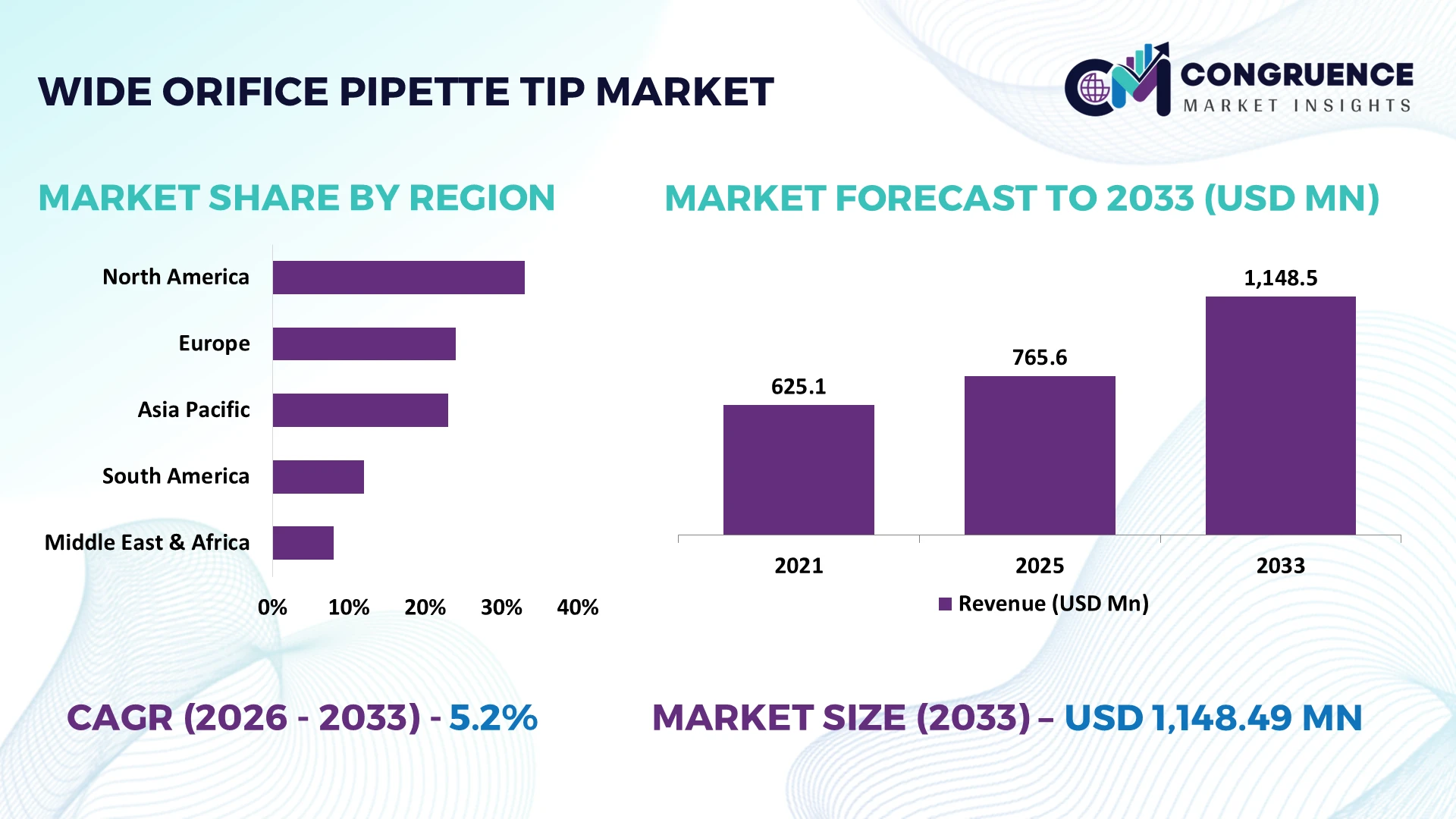
North America commands approximately 33.0% of global demand, concentrated in U.S. biotech hubs where Thermo Fisher’s Mebane, North Carolina facility now produces at least 40 million tips weekly to anchor domestic supply . This domestic capacity expansion contrasts with Asia-Pacific’s import-dependent positioning, where cost sensitivity drives 18–24% lower average selling prices for standard wide-orifice formats.
The strategic implication is clear: suppliers with validated automation-compatible geometries and localized U.S. sterilization capacity will capture premium pricing as tariff exposure reshapes sourcing decisions .
Market Size & Growth: Valued at USD 765.6 million in 2025 and projected to reach USD 1,148.5 million by 2033; high-throughput screening adoption contributes a 2.3% directional growth impact .
Top Growth Drivers: High-throughput screening demand (+2.3%), automation technology advancement (+1.5%), and robotic pipetting system adoption (+1.1%) collectively reshape procurement specifications .
Short-Term Forecast: By 2027, automated platform compatibility validation reduces tip changeover downtime by an estimated 15–20%, directly lowering per-sample handling costs in clinical diagnostics.
Emerging Technologies: PFAS-free low-retention additives embedded at the polymer matrix level eliminate fluorinated coatings while maintaining fluid release performance; bio-based polypropylene from used cooking oil feedstock achieves up to 54% lower CO₂ versus disposable rack formats .
Regional Leaders: North America (~33.0% share, USD ~253 million); Europe driven by PPWR packaging compliance pressure; Asia-Pacific expanding at the fastest adoption rate for automation-compatible formats .
Consumer/End-User Trends: Approximately 70–85% of U.S. filtered tip value derives from repeat replacement demand, locking in supplier relationships through validated automation platforms .
Pilot/Case Example: Thermo Fisher’s August 2025 Mebane facility launch adds 40 million tips weekly capacity, reducing U.S. import dependence by an estimated 12–15 percentage points for standard formats .
Competitive Landscape: Eppendorf, Thermo Fisher, Sartorius, Corning, and Mettler-Toledo Rainin anchor the field; no single player exceeds ~20% share, indicating consolidation headroom .
Regulatory & ESG Impact: EU PPWR enforcement since August 2025 mandates 35% recycled content in pipette tip rack packaging by 2030, forcing material redesign across 90% of product weight classified as packaging .
Investment & Funding: U.S. government financing supported Thermo Fisher’s North Carolina expansion; M&A and partnership activity accelerates as top players pursue scale advantages .
Innovation & Future Outlook: Next-generation surface modification shifts from post-treatment coatings to embedded additives, enabling sterilization compatibility and permanent low-retention performance without PFAS regulatory exposure .
The Wide Orifice Pipette Tip Market is witnessing concentrated demand from cell-culture and viscous-reagent workflows, where tip geometry directly determines sample viability and assay reproducibility. Product innovation has shifted toward embedded PFAS-free low-retention additives and bio-based polymer feedstocks, with one supplier achieving up to 54% CO₂ reduction through second-generation renewable content . A critical operational context: U.S. tariffs on Mexican and Canadian imports have introduced landed-cost volatility for plastic labware, prompting procurement teams to qualify dual-source suppliers and prioritize domestic sterilization capacity . This supply-chain restructuring now frames the strategic discussion on where capacity investment and partnership alignment will determine competitive positioning.
The wide orifice pipette tip is transitioning from a commodity consumable into a validated component of automated liquid handling ecosystems, where geometric inconsistency triggers downstream assay failure at scale. This shift elevates supplier qualification from price-driven purchasing to technical partnership, particularly as U.S. tariff exposure on Mexican plasticware imports compels procurement teams to re-evaluate landed costs against domestic sterilization capacity .
A measurable technology comparison illustrates the stakes: embedded PFAS-free low-retention additives deliver permanent surface functionality without secondary coating steps, eliminating a sterilization-incompatible process while maintaining volumetric accuracy across PCR and ELISA workflows . Regionally, North America’s 33.0% demand share is reinforced by Thermo Fisher’s Mebane facility producing 40 million tips weekly, while Asia-Pacific manufacturers compete primarily on cost for standard formats, leaving premium automation-compatible segments underserved . Over the next 24–36 months, suppliers that achieve dual-site sterilization validation and PPWR-compliant rack recyclability will secure multi-year enterprise contracts; those without will face exclusion from EU tenders .
Operationally, leading laboratories are consolidating tip SKUs from five or more suppliers to two validated platforms, trading unit price for supply continuity and change-control simplicity. Companies are responding by investing in regional sterilization rather than greenfield molding, prioritizing partnership over vertical integration to accelerate compliance documentation. The strategic conclusion is unambiguous: competitive advantage now resides in validated automation compatibility and regulatory-ready packaging, not in molding capacity alone.
High-throughput screening adoption contributes a 2.3% directional growth impact, with robotic pipetting platforms requiring tip dimensional consistency that manual workflows tolerate but automated systems reject . Thermo Fisher’s August 2025 Mebane, North Carolina facility, producing at least 40 million tips weekly, exemplifies the response: domestic capacity co-located with pharmaceutical customers reduces lead times and tariff exposure simultaneously . The operational insight is that automation compatibility is not a product feature but a validation barrier—suppliers lacking documented geometric tolerances across lot numbers are excluded from enterprise procurement regardless of unit pricing.
U.S. tariffs of 25% on Mexican and Canadian imports and 20% on Chinese goods directly increase landed costs for plastic labware, with Mexico serving as a primary supplier of pipette tips to U.S. laboratories . This structural constraint compresses distributor margins on standard wide-orifice formats and delays capital allocation decisions for laboratory expansion. Companies are responding through dual sourcing and pre-tariff inventory builds, but the strategic vulnerability remains: suppliers without U.S. or non-tariffed sterilization capacity cannot guarantee price stability across annual contracts.
Regulatory acceleration under EPA and REACH frameworks is phasing out fluorinated coatings, creating a replacement window for embedded low-retention additives that maintain performance through sterilization . Techmer PM and Premix’s 2025 launch of a non-PFAS additive embedded directly into the polymer matrix—compatible with gamma irradiation and high-throughput molding—demonstrates the commercial pathway . The non-obvious opportunity lies in defense against regulatory obsolescence: suppliers that qualify embedded alternatives now will retain EU and U.S. clinical accounts when coating-based tips face procurement exclusion.
EU PPWR enforcement since August 2025 classifies pipette tip racks, lids, and outer boxes—approximately 90% of product weight—as packaging subject to 35% recycled content by 2030, with laboratory consumables excluded from the medical-device exemptions granted to IVD products . This creates a material science execution barrier: recycled polypropylene must meet cleanroom compatibility and sterilization validation without introducing extractables. Suppliers that solve the recycled-content specification early will lock in EU hospital and reference laboratory contracts; those that delay face tender exclusion in the bloc representing the second-largest regional demand pool.
Filtered wide-orifice pipette tips command the dominant revenue position, with approximately 55–60% of segment value concentrated in this format due to contamination-sensitive molecular diagnostics and PCR workflows. The filter barrier prevents aerosol cross-contamination that invalidates amplification results, making it non-negotiable in clinical laboratories where assay failure carries regulatory and financial consequences. Non-filtered tips retain relevance in viscous cell-suspension transfers and general liquid handling where contamination risk is operationally managed, holding roughly 40–45% share.The fastest-growing adoption shift favors filtered formats compatible with automated liquid handlers, where tip-to-platform validation documentation reduces onboarding friction. Companies are responding by expanding filtered wide-orifice portfolios with pre-validated automation compatibility rather than generic catalog additions. Eppendorf and Sartorius have prioritized filter-integrated designs for genomic workflows, while Corning emphasizes cost-competitive non-filtered formats for academic volume buyers. Investment priorities are shifting toward filter membrane consistency and lot-traceability documentation.
Cell culture applications lead wide-orifice tip demand, with approximately 30–35% of application value concentrated here because standard-bore tips shear fragile cell suspensions and compromise viability. Drug discovery follows at roughly 20–25%, driven by viscous compound handling and automated screening workflows. Next-generation sequencing—including RNA, targeted, and whole-genome sequencing—represents the fastest-growing application cluster, where low-retention surfaces and contamination control directly determine library quality and sequencing yield .The operational shift accelerating NGS adoption is the integration of wide-orifice tips into automated library preparation platforms, where tip geometry consistency affects reagent recovery rates below 10 µL. Companies are adapting by co-developing tip specifications with liquid handler manufacturers rather than selling through generic distribution. PCR remains a mature but stable application, with demand tied to diagnostic testing volumes rather than research expansion. Investment is concentrating on application-specific validation data that reduces customer qualification time.
Diagnostics and healthcare represents the leading end-user segment, commanding approximately 50–52% of wide-orifice tip consumption in 2025, driven by high-volume clinical testing where contamination-free liquid handling is operationally mandatory . Pharmaceutical and biotechnology companies constitute the fastest-growing buyer group, expanding at nearly 9.9% as drug discovery pipelines prioritize cell-based assays and viscous biologic formulations that require wide-bore geometries . Academic and research institutes remain price-sensitive volume purchasers, while industrial applications—including food and environmental testing—represent a smaller but stable demand pool.Companies are targeting diagnostics accounts through sterilization documentation and dual-source supply guarantees, while pharmaceutical customers receive application-specific validation packages for automation platforms. The competitive positioning shift favors suppliers that bundle tip qualification with liquid handler integration support, converting transactional consumable sales into workflow dependencies. Academic pricing pressure persists, but volume consolidation through institutional purchasing contracts offers margin stability.
North America accounted for the largest market share at 33.0% in 2025 however, Asia-Pacific is expected to register the fastest growth, expanding at a CAGR of 8.2% between 2026 and 2033.
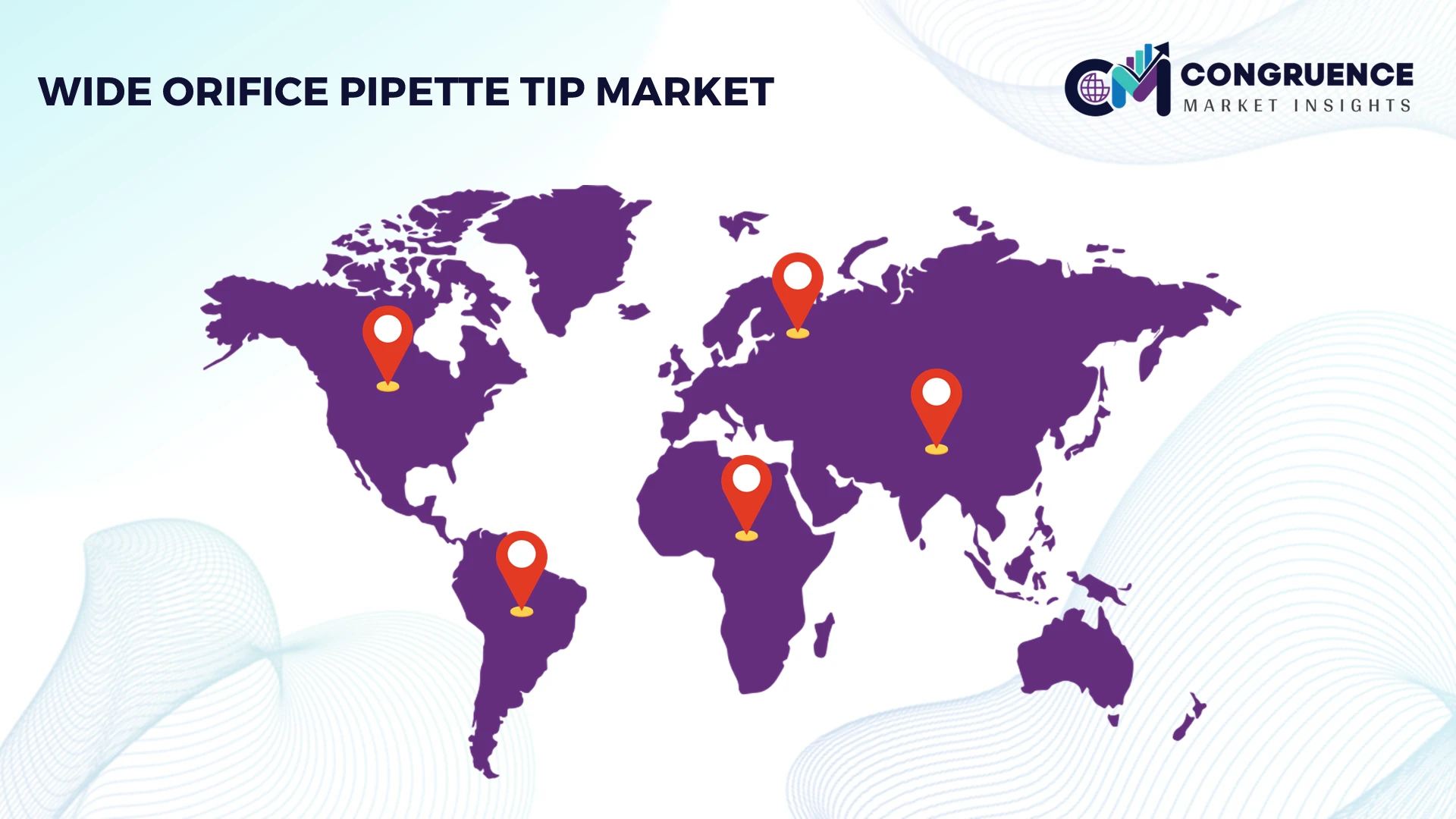
North America anchors global wide-orifice tip demand with a 33.0% share, concentrated in U.S. diagnostics and pharmaceutical hubs where automated liquid handling platforms require validated geometric consistency . Thermo Fisher’s August 2025 Mebane, North Carolina facility, backed by a $192.5 million federal contract, produces at least 40 million tips weekly with automated lines generating 96 tips every 12 seconds—a deployment explicitly structured to reduce import dependence for clinical testing . This domestic capacity shifts supplier qualification criteria: buyers now prioritize sterilization documentation and dual-source availability over unit pricing alone.
United States Market Outlook: The U.S. commands the region’s dominant deployment base, with North Carolina’s life sciences sector employing over 225,000 workers and generating $88.3 billion in annual economic activity, anchoring sustained tip consumption from diagnostics and research laboratories . Federal investment in domestic consumable manufacturing creates a pricing floor that disadvantages import-dependent competitors.
Europe holds a 24.0% share, with demand shaped by EU PPWR enforcement since August 2025 that classifies pipette tip racks and outer packaging—approximately 90% of product weight—as regulated packaging requiring 35% recycled content by 2030. Eppendorf’s Wismar production site, scheduled for initial high-tech plastic output by end-2025, positions capacity near Northern European diagnostic clusters while the company’s ept.i.p.s. bio-based line, manufactured from at least 90% renewable feedstock, targets compliance-driven procurement . Suppliers without recyclable rack formats face tender exclusion in Germany and France.
Germany Market Outlook: Germany’s laboratory consumables demand is reinforced by Eppendorf’s Oldenburg facility, which produced approximately four billion high-tech plastic products in 2021 before capacity constraints prompted the Wismar expansion . The country’s diagnostic and pharmaceutical infrastructure creates stable volume demand for filtered wide-orifice formats with documented extractables profiles.
Asia-Pacific captures 23.0% of global demand, with China serving as both a production base and an accelerating consumption market as domestic laboratories adopt automated liquid handling. The region’s competitive position rests on cost-competitive standard formats, though suppliers are investing in filter-integrated and automation-validated lines to escape price-driven competition. Japan and South Korea contribute precision manufacturing capacity for high-performance polymer tips, while Southeast Asia emerges as a volume growth pocket for clinical diagnostics expansion.
China Market Outlook: China’s wide-orifice tip demand is expanding faster than the global average, driven by biopharmaceutical contract research expansion and public hospital diagnostic volume growth. Domestic manufacturers are scaling production of standard formats while gradually qualifying filtered variants for clinical customers, reducing reliance on imported premium tips.
South America represents a 12.0% share, with demand concentrated in Brazil’s clinical diagnostics and public research networks. The region’s operational constraint is structural: limited domestic sterilization and molding capacity for laboratory plastics creates import dependency, exposing buyers to currency volatility and shipping delays. Distribution partnerships with global suppliers anchor supply for large hospital networks, while academic institutions face longer procurement cycles and pricing pressure.
Brazil Market Outlook: Brazil accounts for the majority of regional demand, with clinical diagnostic testing volumes and public health laboratory infrastructure driving wide-orifice tip consumption. Import-dependent supply chains create inventory buffer requirements of 60–90 days for institutional buyers, favoring distributors with established logistics networks and multi-origin sourcing arrangements.
Middle East & Africa holds an 8.0% share, with demand concentrated in Gulf Cooperation Council states where healthcare infrastructure investment and diagnostic laboratory expansion create institutional procurement opportunities. The region’s operational profile is distribution-led: global suppliers serve hospital networks and research centers through regional partners, with limited local manufacturing. Saudi Arabia and the UAE anchor volume demand through centralized healthcare procurement, while African markets present long-term growth potential constrained by cold-chain and logistics infrastructure gaps.
Saudi Arabia Market Outlook: Saudi Arabia’s healthcare transformation initiatives and diagnostic capacity expansion drive institutional demand for validated laboratory consumables, with procurement favoring suppliers capable of bundled liquid handling ecosystem offerings. The country’s centralized purchasing model creates high-volume contract opportunities but requires local partner presence and regulatory documentation.
The competitive field pits integrated instrument-and-consumable majors—Thermo Fisher, Eppendorf, Sartorius, Mettler-Toledo Rainin, and Hamilton—against cost-driven regional molders and OEM suppliers. The top five players command an estimated 55–60% combined share, with Thermo Fisher’s domestic capacity expansion reinforcing its scale advantage. Competition hinges on automation validation documentation rather than unit price: platform-locked buyers accept 15–20% price premiums for guaranteed geometric consistency, while commodity segments face margin compression from import-dependent distributors. Players are vertically integrating sterilization and packaging to control lead times, with Sartorius acquiring MATTEK in 2025 to embed consumables within advanced cell-model workflows. The decisive competitive shift is supply-chain sovereignty—U.S. federal contracts now favor domestic pipette tip production, raising entry barriers for offshore manufacturers. Winning requires validated automation compatibility, dual-site sterilization redundancy, and regulatory-ready packaging; suppliers lacking these will be excluded from enterprise diagnostics contracts regardless of pricing.
Thermo Fisher Scientific
Eppendorf SE
Sartorius AG
Mettler-Toledo Rainin
Hamilton Company
Corning Incorporated
Tecan Trading AG
Avantor
Axygen (Corning)
Sarstedt
Starlab Group
DLAB Scientific
Thomas Scientific
Embedded low-retention additives are displacing post-treatment fluorinated coatings, eliminating a sterilization-incompatible process while maintaining volumetric accuracy. This shift improves fluid recovery consistency by an estimated 8–12% across viscous reagent workflows, with adoption concentrated among clinical diagnostics suppliers preparing for PFAS regulatory pressure. Companies that qualify embedded formulations now avoid product redesign costs when coating-based tips face procurement exclusion.
Automation-compatible geometry validation has become the decisive integration technology, as robotic liquid handlers reject tip lots exceeding dimensional tolerances. Suppliers investing in lot-level traceability documentation reduce customer qualification time by 20–30%, converting consumable sales into workflow dependencies. The competitive beneficiaries are integrated platform providers—Thermo Fisher, Eppendorf, Mettler-Toledo—that control both tip specifications and the instruments validating them.
Between 2026 and 2028, the disruptive pressure point is bio-based polymer qualification at cleanroom grade. Eppendorf’s ept.i.p.s. line, manufactured from at least 90% renewable feedstock, signals the pathway, but extractables profiling remains a bottleneck. Suppliers that solve recycled-content and bio-feedstock specifications early will lock in EU hospital contracts; laggards face tender exclusion in regulated markets.
August 2025 — Thermo Fisher Scientific opened its 375,000-square-foot Mebane, North Carolina facility, capable of producing at least 40 million pipette tips weekly with automated lines generating 96 tips every 12 seconds, directly strengthening U.S. diagnostic supply-chain resilience under a $192.5 million federal contract. Source: newsroom.thermofisher.com
September 2025 — Eppendorf SE launched ept.i.p.s. bio-based pipette tips manufactured from at least 90% renewable feedstock, with Reload variants cutting plastic use by up to 54% versus disposable racks, positioning the company ahead of EU packaging compliance requirements. Source: lab-worldwide.com
March 2025 — Corning Incorporated received a $14.0 million award ceiling through the BioMaP-Consortium to expand domestic injection-molded pipette tip and centrifuge tube capacity over 27 months, directly addressing pandemic-surge supply gaps in U.S. biomanufacturing. Source: biomap-consortium.org
2025 — Sartorius AG acquired MATTEK to strengthen its position in advanced cell-model workflows, aligning premium consumable demand with integrated instrument-and-tip validation for biopharmaceutical customers. Source: mordorintelligence.com
This report delivers a complete analytical framework covering the global wide orifice pipette tip market across product types, applications, end-user segments, and five major regions from 2026 to 2033. Segmentation spans filtered and non-filtered formats, cell culture and NGS applications, diagnostics and pharmaceutical end-users, with regional breakdowns across North America, Europe, Asia-Pacific, South America, and Middle East & Africa.
Quantitative coverage includes segment share distribution—diagnostics commanding approximately 51.78% of end-user demand, North America holding 33.0% regional share—alongside adoption patterns for automation-compatible geometries and bio-based material qualifications. The report supports investment planning through competitive positioning analysis, capacity expansion tracking, and regulatory compliance mapping. Strategic insights address domestic manufacturing shifts, PFAS-free technology transitions, and packaging regulation impacts, enabling decision-makers to prioritize validated automation compatibility, dual-site sterilization redundancy, and regulatory-ready product formats through 2033.
| Report Attribute / Metric | Details |
|---|---|
| Market Revenue (2025) | USD 765.6 Million |
| Market Revenue (2033) | USD 1,148.5 Million |
| CAGR (2026–2033) | 5.2% |
| Base Year | 2025 |
| Forecast Period | 2026–2033 |
| Historic Period | 2021–2025 |
| Segments Covered |
By Type
By Application
By End-User
|
| Key Deliverables | Revenue Forecast; Market Trends; Growth Drivers & Restraints; Technology Insights; Segmentation Analysis; Regional Insights; Competitive Landscape; Regulatory & ESG Overview; Recent Developments |
| Regions Covered | North America; Europe; Asia-Pacific; South America; Middle East & Africa |
| Companies Profiled | Thermo Fisher Scientific; Eppendorf SE; Sartorius AG; Mettler-Toledo Rainin; Hamilton Company; Corning Incorporated; Tecan Trading AG; Avantor; Axygen (Corning); Sarstedt; Starlab Group; DLAB Scientific; Thomas Scientific |
| Customization & Pricing | Available on Request (10% Customization Free) |




