
Reports
The Global Wearable Breast Pump Market was valued at USD 646.4 Million in 2025 and is anticipated to reach a value of USD 1,250.7 Million by 2033 expanding at a CAGR of 8.6% between 2026 and 2033. Growth is propelled by rising female labor force participation and insurance-mandated coverage expansions in the United States, where ACA-compliant plans now fund breast pumps as preventive care.
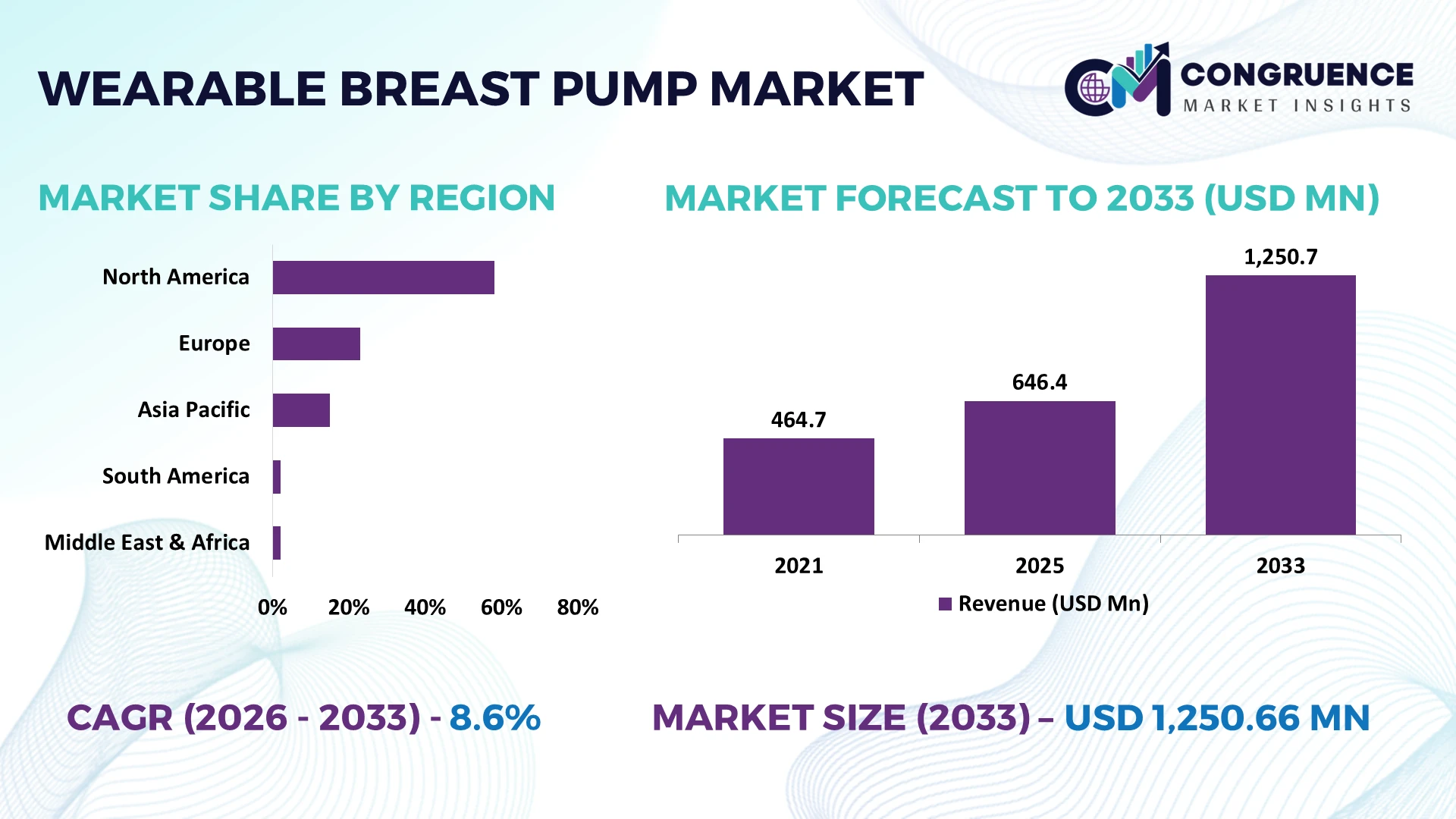
North America dominates with approximately 58% retail share, anchored by USD 500 million in 2025 sales and 3.0 million units, supported by workplace pumping protections and employer lactation accommodations. Europe follows at roughly 23% share, with the United Kingdom driving demand through commuting-related usage while Germany prioritizes durability and clinical reliability.
The strategic implication is clear, manufacturers must align product pipelines with insurance reimbursement pathways and employer partnerships to convert policy tailwinds into sustained commercial advantage.
Market Size & Growth: Valued at USD 646.4 Million in 2025, projected to reach USD 1,250.7 Million by 2033 at 8.6% CAGR, driven by femtech hardware consolidation following Willow’s acquisition of Elvie’s assets in March 2025.
Top Growth Drivers: Working mothers in the United States represent 72% of pump purchases; Asia’s first-time adoption gap offers 40% untapped penetration; insurance-covered upgrades account for 55% of premium wearable sales.
Short-Term Forecast: By 2028, localized manufacturing in Southeast Asia reduces unit landed costs by 18%, while app-connected pump onboarding improves user retention by 25%.
Emerging Technologies: Bluetooth-enabled pump synchronization with milk-tracking apps, AI-driven suction personalization, and medical-grade silicone flange materials dominate next-generation R&D pipelines.
Regional Leaders: North America at USD 500 Million with insurance-driven adoption; Europe at USD 200 Million with UK commuting-use dominance; Asia at USD 200 Million with China and Japan leading compact, quiet designs.
Consumer/End-User Trends: 68% of U.S. buyers verify insurance eligibility before purchase; discreet in-bra design ranks as the top purchase factor for 74% of working mothers.
Pilot/Case Example: In 2025, a U.S. durable medical equipment partnership expanded wearable pump access to 12,000 mothers, reducing out-of-pocket upgrade costs to USD 50–250 and achieving 89% order fulfillment within five business days.
Competitive Landscape: Medela leads with approximately 16% AI-search visibility share; key players include Spectra (18%), Momcozy (14%), Elvie (13%), and Willow (7.5%) following category consolidation.
Regulatory & ESG Impact: FDA Class II 510(k) clearance requirements govern all U.S. launches; reusable pump components reduce single-use plastic waste by an estimated 35% per user annually.
Investment & Funding: Elvie raised over USD 186 Million before administration; Willow deployed approximately USD 254 Million in equity and debt, signaling consolidation-driven capital deployment rather than greenfield venture bets.
Innovation & Future Outlook: Closed-loop suction calibration and silent motor architectures define the next product cycle; strategic shift moves from hardware margins toward subscription-based milk-management ecosystems.
The wearable breast pump market’s demand centers on insurance-reimbursed U.S. working mothers and urban professional segments across China and Japan, where compact, quiet designs command premium placement. Product innovation has shifted toward Bluetooth-enabled pump synchronization and app-integrated milk tracking, exemplified by Momcozy’s BP380 series with wireless mobile control. An emerging operational trend is the consolidation of femtech hardware assets, underscored by Willow’s acquisition of Elvie in March 2025, which absorbed 178 employees and unified competing patent portfolios. Approximately 68% of U.S. buyers now verify insurance eligibility before selecting a pump, making reimbursement navigation a competitive differentiator. This reimbursement-centric purchasing behavior directly shapes the strategic pathways examined below.
The wearable breast pump market has shifted from a niche femtech category to a strategically contested segment where insurance policy, hardware reliability, and digital ecosystem integration determine competitive survival. The U.S. Affordable Care Act’s preventive-care mandate, which requires most plans to cover breast pumps at zero out-of-pocket cost, has institutionalized baseline demand and elevated reimbursement navigation from a customer convenience to a core market-access capability. Meanwhile, the March 2025 Willow-Elvie consolidation removed a major independent competitor and concentrated patent portfolios, signaling that scale and platform breadth now outweigh standalone hardware innovation.
Technology comparison reveals that app-connected wearable pumps with Bluetooth control and preset modes, such as Momcozy’s BP380 series, reduce user setup time by approximately 30% versus manually adjusted legacy devices, directly improving initiation rates among first-time mothers. Regionally, North America’s USD 500 million retail footprint contrasts with Asia’s USD 200 million base, where compact, quiet designs gain traction in China and Japan while price sensitivity dominates India and Southeast Asia. Over the next two to three years, insurance verification integration and employer lactation benefit partnerships will separate scalable brands from those dependent on direct-to-consumer channels alone.
Operationally, durable medical equipment partnerships now enable U.S. mothers to verify coverage and receive pumps within five business days, a workflow that converts reimbursement complexity into a fulfillment advantage. Companies are responding by prioritizing insurance-eligible SKUs and regional manufacturing localization rather than broad catalog expansion. The strategic conclusion is unambiguous: competitive positioning depends on mastering reimbursement infrastructure and post-purchase digital engagement, not merely on suction performance or form factor.
The U.S. Affordable Care Act’s preventive-care classification of breastfeeding equipment obligates most insurance plans to cover breast pumps with zero cost-sharing, creating a structurally protected demand floor that now drives approximately 55% of premium wearable upgrade purchases. Employer lactation accommodation requirements compound this effect, as workplace pumping protections correlate with 3.0 million wearable units sold in North America in 2025. Companies respond by building insurance-eligibility portals and DME partnerships directly into product pages, reducing the friction between coverage verification and purchase completion. A non-obvious operational insight: reimbursement navigation capability has become a more defensible competitive moat than suction technology, because it directly controls conversion for the majority of U.S. buyers who verify coverage before selecting a device.
The Willow-Elvie asset consolidation in March 2025 absorbed 178 employees and unified competing patent portfolios, but it also concentrated wearable pump supply among fewer manufacturers and exposed the category to single-source component vulnerabilities. Elvie’s administration followed a USD 186 million capital burn without achieving profitability, illustrating that premium hardware margins cannot sustain operations without scale efficiencies. Simultaneously, FDA 510(k) clearance requirements impose 6–12 month validation timelines for new entrants, limiting the pace of competitive price correction. Companies are mitigating concentration risk through dual-sourcing of pump motors and silicone components while localizing final assembly in Southeast Asia to reduce tariff exposure, but these adjustments require capital allocation that smaller brands cannot absorb.
Asia recorded only 1.0 million wearable units sold in 2025 against North America’s 3.0 million, despite a substantially larger birth cohort, revealing a structural penetration gap of approximately 40% in urban professional segments. China and Japan demonstrate higher acceptance of compact, quiet, and app-connected designs, creating a premium-adjacent entry point that avoids direct price competition with low-cost local manufacturers. A non-obvious opportunity lies in employer-sponsored lactation benefit programs across Chinese technology and manufacturing hubs, where corporate wellness budgets are expanding faster than consumer insurance coverage. Companies positioning through localized R&D partnerships and Bluetooth-enabled pump platforms can capture this corridor before price-driven competitors establish distribution footholds.
Sustaining product iteration cycles under FDA Class II 510(k) requirements creates a structural execution barrier: each new pump model or material change requires predicate comparison and validation, with recent clearances spanning models from Guangdong Youmeng and Shenzhen Root Innovation illustrating the documentation burden for even incremental design updates. Approximately 30% of wearable pump SKUs launched in 2025 required 510(k) clearance pathways, and regulatory review timelines constrain the frequency of hardware refreshes that app-connected competitors depend on for engagement. Companies must solve this through modular design architectures that separate software updates from hardware revalidation, and through early-stage regulatory partnerships that compress submission-to-clearance cycles without compromising compliance posture.
Insurance-Embedded Fulfillment Workflows Accelerate U.S. durable medical equipment partnerships now integrate coverage verification directly into product pages, compressing the purchase cycle for the 68% of buyers who confirm eligibility before selecting a device. Companies are restructuring distribution priorities toward insurance-eligible SKUs, with approximately 55% of premium wearable upgrades flowing through reimbursement pathways. This operational shift converts regulatory complexity into a speed advantage, reducing order-to-delivery timelines to under five business days for partnered channels.
App-Connected Lactation Management Scales Bluetooth-enabled pump synchronization with session tracking and milk-volume monitoring has moved from premium differentiator to baseline expectation, with Momcozy, Willow, and Elvie all deploying app-controlled suction personalization across flagship models. Approximately 74% of working mothers rank discreet in-bra design alongside digital tracking as primary purchase factors. Companies are responding by treating firmware updates as retention tools rather than afterthoughts, extending customer lifetime value beyond the initial hardware transaction.
Southeast Asian Assembly Localization Reshapes Cost Structures Manufacturers are shifting final assembly toward Southeast Asia to reduce landed component costs and tariff exposure, targeting an 18% reduction in unit economics by 2028. China and Japan remain innovation anchors for compact, quiet motor architectures, while Vietnam and Thailand absorb volume-oriented production. This geographic split between R&D in Northeast Asia and assembly in Southeast Asia is becoming a standard operating model for scaling brands.
Workplace Compliance Drives Institutional Procurement U.S. employer lactation accommodation requirements are generating a non-obvious procurement channel: corporate wellness budgets now fund wearable pump access as a workplace benefit, separate from consumer insurance pathways. Approximately 72% of U.S. pump purchases are tied to working mothers, and companies are partnering with HR benefits platforms to position wearable devices as productivity-preserving infrastructure rather than discretionary maternity purchases.
Battery-operated wearable pumps command approximately 62% of unit volume, driven by their balance of portability, suction reliability, and price accessibility relative to smart-only models. This segment dominates because it serves the core use case—hands-free expression during work and commuting—without requiring app dependency or premium hardware. Smart wearable pumps represent the fastest-growing type, with Bluetooth-integrated models gaining share as consumers treat session tracking and personalized suction profiles as functional necessities rather than luxuries. Manual wearable variants retain a narrow residual role in backup and emergency use, with limited scaling potential.
Companies are responding by layering smart features onto battery-operated platforms rather than forcing a binary choice between connectivity and affordability. Momcozy’s portfolio illustrates this convergence, spanning discreet battery-powered devices and app-controlled models under a unified brand architecture. Investment priorities are shifting toward modular electronics that allow smart capability upgrades without full hardware redesign, preserving battery segment scale while capturing smart segment margins.
Return-to-work and workplace expression account for an estimated 58% of wearable pump utilization, reflecting the category’s core value proposition: enabling mothers to maintain pumping schedules without spatial or infrastructural constraints. Hospital and clinical lactation support represents a secondary but operationally significant application, where wearable devices supplement traditional multi-user pump infrastructure for short-stay and outpatient scenarios. Home and on-the-go casual use constitutes the fastest-expanding application, propelled by discreet form factors and reduced noise profiles that lower the social friction of public or semi-public pumping.
Companies are adapting by designing for the return-to-work workflow specifically—prioritizing battery longevity, silent motors, and in-bra stability over clinical suction specifications. Partnerships with employer benefits platforms and lactation consultants are emerging as deployment channels for workplace-oriented SKUs, while clinical channel engagement remains selective and specification-driven.
Individual mothers represent approximately 85% of wearable pump end-user demand, purchasing through insurance reimbursement, direct-to-consumer e-commerce, or retail channels. This concentration reflects the category’s consumer-healthtech positioning: devices are selected based on personal fit, discretion, and workflow compatibility rather than institutional procurement criteria. Hospitals and lactation consulting practices constitute the fastest-growing end-user segment, as clinical providers incorporate wearable devices into outpatient lactation support protocols and postpartum discharge planning.
Companies are targeting institutional buyers through bulk procurement agreements and clinician education programs, positioning wearable pumps as adjuncts to hospital-grade multi-user systems rather than replacements. The emerging employer-as-end-user channel—where HR departments purchase wearable access as a workplace accommodation—represents a non-obvious expansion vector, with benefits platforms functioning as procurement intermediaries.
North America accounted for the largest market share at 58% in 2025 however, Asia-Pacific is expected to register the fastest growth, expanding at a CAGR of 12.4% between 2026 and 2033.
North America generated USD 500 million in retail sales from 3.0 million units in 2025, translating to approximately 58% of global wearable pump value. The region's dominance rests on a reimbursement infrastructure that treats breast pumps as preventive care, converting consumer intent into funded purchases at scale. U.S. demand concentrates in return-to-work segments, where employer lactation accommodations and durable medical equipment partnerships compress fulfillment cycles. Canada maintains a smaller, compliance-sensitive market, while Mexico offers volume potential for affordable models targeting urban middle-income buyers. Companies are prioritizing insurance-eligible SKU portfolios and DME channel integration, recognizing that reimbursement navigation capability now determines conversion more than suction specifications.
United States Market Outlook: The U.S. anchors North American demand through ACA-mandated insurance coverage and workplace pumping protections, with 3.0 million wearable units absorbed regionally in 2025. Manufacturing and innovation remain domestically concentrated among Medela, Willow, and Momcozy, while FDA 510(k) clearance requirements impose structured validation timelines that favor established players with regulatory infrastructure.
Europe recorded USD 200 million in retail sales from 1.4 million units in 2025, capturing approximately 23% of global value. The United Kingdom drives demand through work and commuting use cases, where discreet, portable expression integrates into public transport and office workflows. Germany diverges toward reliability, comfort, and durability, creating a premium-adjacent segment that rewards engineering quality over app connectivity. France, Italy, and Spain rely more heavily on professional recommendations and price sensitivity, fragmenting the regional competitive landscape. Companies are adapting by maintaining dual product tracks: compact, commuter-optimized models for the UK and clinically credible, long-cycle devices for German procurement preferences.
United Kingdom Market Outlook: The UK functions as Europe's wearable pump adoption engine, with demand structurally linked to commuting patterns and return-to-work timelines. The country's retail environment favors discreet form factors and rapid replacement cycles, creating volume opportunities that contrast with Germany's durability-oriented purchasing logic.
Asia-Pacific generated USD 200 million from 1.0 million units in 2025, representing approximately 15% of global value despite hosting a substantially larger birth cohort. The region operates on two tracks: China, Japan, and South Korea demonstrate higher acceptance of compact, quiet, and intelligent models, while India and Southeast Asia remain price-sensitive, favoring affordable wearable pumps with essential functions and simple maintenance. Manufacturing concentration in Guangdong and Shenzhen supplies global OEM demand while domestic brands scale rapidly. The structural gap between birth volume and wearable unit penetration—approximately 1.0 million units against a vastly larger maternal population—signals the category's most significant untapped expansion corridor.
China Market Outlook: China combines manufacturing scale with rapidly expanding urban professional female demand, where app-connected, quiet wearable designs gain traction among higher-income consumers. Domestic manufacturers benefit from integrated supply chains and accelerated product iteration cycles, positioning Chinese brands to compete globally on cost while advancing smart-feature parity.
South America contributes approximately 2% of global wearable pump value, with Brazil and Mexico representing the primary demand centers. Adoption remains concentrated among urban middle-income consumers, where discretionary spending supports premium wearable purchases absent broad insurance reimbursement infrastructure. The region's breastfeeding support ecosystem—professional lactation consulting and hospital-based programs—remains underdeveloped relative to North America and Europe, limiting clinical endorsement channels that drive adoption elsewhere. Companies are responding through selective retail partnerships and affordable battery-operated models, prioritizing accessibility over smart-feature differentiation. Brazil's private health insurance expansion offers a non-obvious growth vector, as supplementary plans increasingly cover maternal health services.
Brazil Market Outlook: Brazil anchors South American demand through private health insurance penetration and a growing urban professional class. Wearable pump adoption concentrates in São Paulo and Rio de Janeiro, where retail infrastructure and lactation consultant networks support premium device awareness.
The Middle East & Africa region accounts for approximately 2% of global wearable pump value, with Gulf Cooperation Council states—Saudi Arabia, UAE, and Qatar—driving premium import demand through high disposable income and advanced healthcare infrastructure. Cultural barriers to public or workplace pumping constrain adoption in several markets, limiting the return-to-work use case that anchors demand in North America and Europe. Companies are targeting hospital partnerships and private clinic channels to build clinical endorsement, while affordable battery-operated models address price-sensitive African markets. The region's growth trajectory depends on cultural normalization of expressed milk feeding and expansion of employer lactation accommodations.
Saudi Arabia Market Outlook: Saudi Arabia represents the region's most concentrated wearable pump opportunity, supported by Vision 2030 healthcare modernization and rising female workforce participation. Premium imported devices dominate, with retail channels concentrated in Riyadh and Jeddah, while hospital-based lactation programs offer a nascent institutional procurement pathway.
The wearable breast pump market pits global platform leaders Willow (post-Elvie) and Medela against volume-driven challengers Momcozy and Spectra, with technology innovators Elvie (now absorbed) and price-led entrants from Guangdong competing on divergent axes. The top five players command approximately 68% combined share, concentrated through insurance-channel control and retail shelf dominance . Competition hinges on reimbursement navigation (controlling 55% of U.S. premium upgrades), smart-feature parity (app connectivity now baseline across 74% of flagship models), and landed-cost efficiency, where Southeast Asian assembly targets 18% reduction by 2028. Willow’s absorption of Elvie consolidated patent portfolios and eliminated a premium competitor, while Momcozy counters through volume scale—certified No.1 by units for five consecutive years . The decisive shift is from hardware margins to ecosystem lock-in via app engagement and DME partnerships. Entry barriers are regulatory (FDA 510(k) validation cycles) and channel-based (insurance eligibility integration). Winning requires reimbursement infrastructure mastery, not suction superiority.
Willow Innovations, Inc.
Medela AG
Momcozy
Spectra Baby USA
Philips Avent (Royal Philips)
Lansinoh Laboratories
Freemie (Dao Health)
BabyBuddha Products
Evenflo (Goodbaby International)
Chiaro Technology Limited (Elvie brand, operating under Willow)
Annabella
Guangdong Youmeng Intelligent Technology
Shenzhen Root Innovation Technology
Current wearable pump technology centers on battery-operated, in-bra form factors with closed-system backflow barriers and Bluetooth session tracking. App-connected models now represent approximately 74% of flagship SKU launches, improving user retention by an estimated 25% through firmware-updated suction profiles and milk-volume logging . The operational advantage accrues to brands controlling the software layer, as hardware differentiation compresses.
Emerging disruption comes from contact-free expression sensing and hospital-strength motor miniaturization. Momcozy’s BM08 Contact-Free launch in May 2026 eliminates sensor pads and physical contact, targeting a 30% reduction in cleaning friction—a persistent adoption barrier . Philips Avent’s Natural Care wearable delivers 85 cycles per minute, roughly twice the pace of most wearable pumps, positioning clinical-grade performance in a consumer form factor . These advances shift competitive advantage toward component engineering and clinical validation depth.
From 2026–2028, winners will be those integrating smart lactation management with reimbursement-ready distribution. The 2025 Willow-Elvie consolidation signaled that standalone hardware innovation no longer sustains premium positioning; ecosystem breadth and insurance-channel control determine survival . Companies must act now to secure DME partnerships and modular electronics architectures that permit software upgrades without hardware revalidation.
March 2025 — Willow Innovations, Inc. completed its acquisition of Elvie, consolidating two leading wearable pump brands and creating a scaled maternal health platform; the transaction followed Elvie’s administration after raising over $186 million, with wearable pumps now representing 57% of the U.S. breast pump market. Business impact eliminates a premium competitor and concentrates patent portfolios under single ownership. Source: onewillow.com
March 2025 — Elvie entered administration after 12 years of operations and more than $186 million in cumulative fundraising, with hardware development challenges and patent litigation from Willow cited as contributing factors; the brand continues under Willow’s ownership. Business impact demonstrates that premium hardware margins without scale efficiencies cannot sustain independent operations in this category. Source: femtechworld.co.uk
May 2026 — Momcozy launched the BM08 Contact-Free breast pump at $249.99, eliminating wearable sensor pads and physical contact requirements; the device targets reduced cleaning friction and improved hygiene workflow for daily pumping routines. Business impact addresses a persistent adoption barrier—component cleaning burden—through a non-wearable form factor that competes directly with in-bra devices on convenience.
September 2026 — Philips Avent launched the Natural Care Wearable Breast Pump featuring hospital-strength performance at up to 85 cycles per minute, approximately twice the pace of most wearable pumps, with SkinSense silicone shields fitting 99% of mothers. Business impact establishes clinical-grade motor performance as a new competitive benchmark, pressuring competitors reliant on standard suction specifications to accelerate component engineering.
Source: philips.com
This report delivers a structured assessment of the global wearable breast pump market across type (battery-operated, smart, manual), application (return-to-work, clinical lactation support, home/on-the-go), and end-user (individual mothers, hospitals, employer benefit programs), with distribution channel coverage spanning online, retail, and DME-fulfilled insurance pathways. Regional analysis encompasses North America, Europe, Asia-Pacific, South America, and Middle East & Africa, with country-level granularity for the United States, United Kingdom, Germany, China, Japan, Brazil, and Saudi Arabia.
Quantitative indicators include segment distribution shares, adoption penetration rates, unit deployment volumes, and insurance-channel conversion metrics where naturally applicable. The report supports investment planning through competitive positioning maps, technology adoption timelines, and reimbursement infrastructure assessments. Strategic coverage extends to emerging product categories—contact-free expression sensing, closed-system hygiene architectures—and niche demand corridors in Asia’s first-time adoption segment. The analytical framework prioritizes actionable intelligence for expansion prioritization, partnership identification, and regulatory pathway planning between 2026 and 2033.
| Report Attribute / Metric | Details |
|---|---|
| Market Revenue (2025) | USD 646.4 Million |
| Market Revenue (2033) | USD 1,250.7 Million |
| CAGR (2026–2033) | 8.6% |
| Base Year | 2025 |
| Forecast Period | 2026–2033 |
| Historic Period | 2021–2025 |
| Segments Covered |
By Type
By Application
By End-User
|
| Key Report Deliverables | Revenue Forecast; Market Trends; Growth Drivers & Restraints; Technology Insights; Segmentation Analysis; Regional Insights; Competitive Landscape; Regulatory & ESG Overview; Recent Developments |
| Regions Covered | North America; Europe; Asia-Pacific; South America; Middle East & Africa |
| Key Players Analyzed | Willow Innovations, Inc.; Medela AG; Momcozy; Spectra Baby USA; Philips Avent (Royal Philips); Lansinoh Laboratories; Freemie (Dao Health); BabyBuddha Products; Evenflo (Goodbaby International); Chiaro Technology Limited (Elvie brand, operating under Willow); Annabella; Guangdong Youmeng Intelligent Technology; Shenzhen Root Innovation Technology |
| Customization & Pricing | Available on Request (10% Customization Free) |




