
Reports
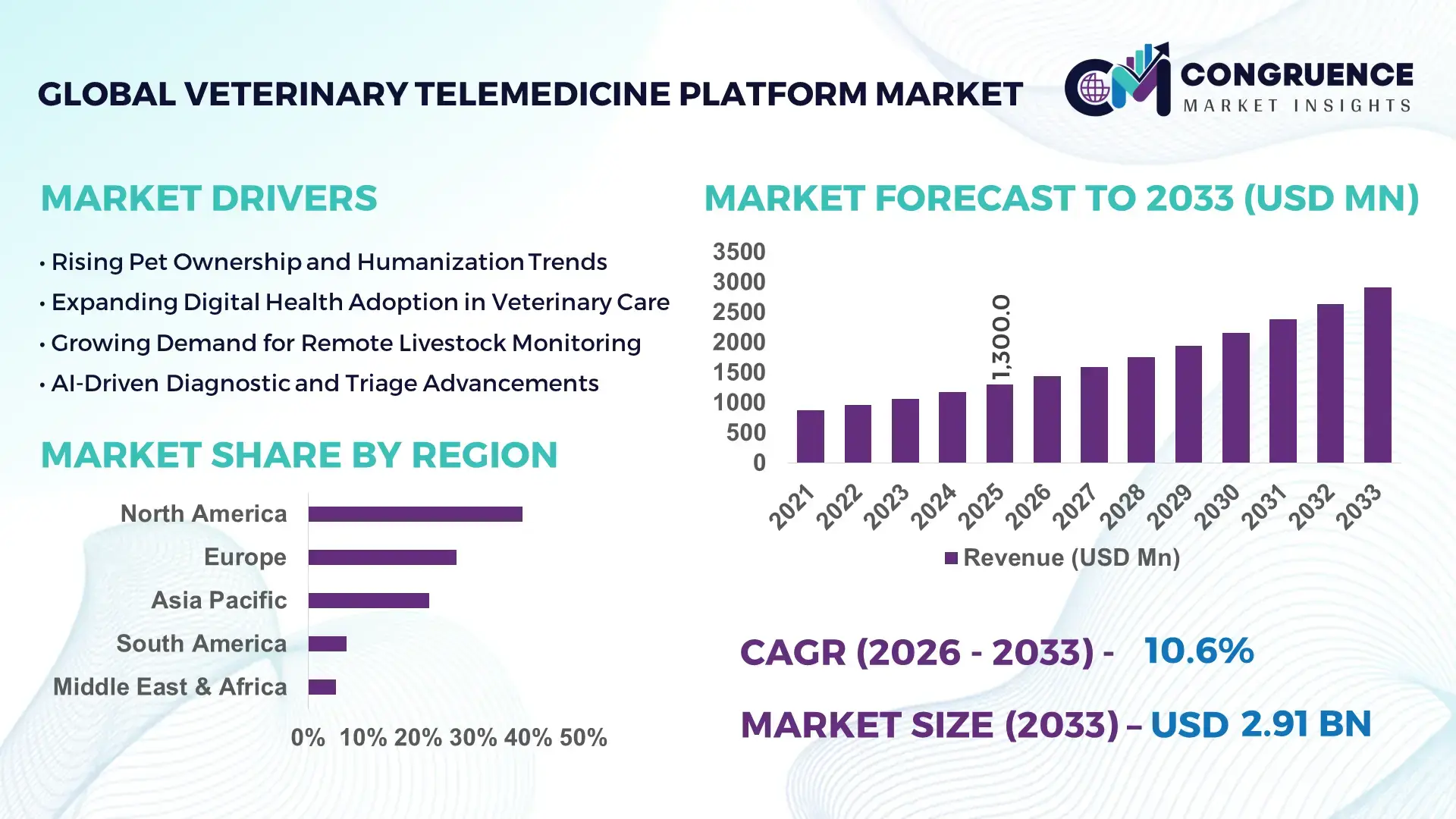
The Global Veterinary Telemedicine Platform Market was valued at USD 1,300 Million in 2025 and is anticipated to reach a value of USD 2,910.6 Million by 2033 expanding at a CAGR of 10.6% between 2026 and 2033, according to an analysis by Congruence Market Insights. The growth is primarily driven by increasing pet ownership, rising demand for remote animal healthcare services, and digital transformation across veterinary practices.
The United States dominates the Veterinary Telemedicine Platform Market, supported by over 32,000 veterinary clinics and hospitals operating nationwide and a companion animal population exceeding 165 million pets. More than 45% of large veterinary hospital chains have integrated digital consultation modules and AI-enabled triage systems into daily operations. Investment in pet health technology startups in the U.S. surpassed USD 500 million cumulatively over recent years, with teleconsultation platforms increasingly adopted by corporate veterinary networks. Companion animal applications account for nearly 70% of total platform utilization, while livestock telehealth deployment is expanding across large-scale dairy and poultry farms utilizing IoT-enabled monitoring systems.
Market Size & Growth: Valued at USD 1,300 Million in 2025, projected to reach USD 2,910.6 Million by 2033 at 10.6% CAGR, driven by rising remote consultations and digital veterinary infrastructure expansion.
Top Growth Drivers: 62% increase in teleconsultation adoption, 48% improvement in appointment efficiency, 35% reduction in follow-up visit burden.
Short-Term Forecast: By 2028, digital triage systems are expected to reduce non-emergency in-clinic visits by 28%.
Emerging Technologies: AI-based symptom checkers, cloud-integrated Electronic Veterinary Records (EVR), IoT-enabled livestock monitoring platforms.
Regional Leaders: North America projected at USD 1,050 Million by 2033 with high subscription adoption; Europe at USD 820 Million driven by regulatory-backed digital health; Asia-Pacific at USD 690 Million supported by rising pet insurance penetration.
Consumer/End-User Trends: Companion animal clinics contribute nearly 70% of usage, with 55% of millennial pet owners preferring hybrid consultation models.
Pilot or Case Example: In 2024, a U.S.-based veterinary chain implemented AI triage tools, achieving 31% faster case prioritization.
Competitive Landscape: Market leader holds approximately 18% share, followed by TeleVet, Airvet, Vetster, and Pawp.
Regulatory & ESG Impact: Telehealth guidelines across 40+ U.S. states now permit remote prescriptions under defined VCPR rules; paperless workflows reduce clinic documentation waste by 22%.
Investment & Funding Patterns: Over USD 400 Million invested globally in veterinary digital health platforms between 2022–2025, with venture-backed SaaS models leading funding rounds.
Innovation & Future Outlook: Integration of wearable pet diagnostics and predictive AI analytics is expected to enhance preventive care planning by over 30%.
Companion animal services contribute nearly 70% of Veterinary Telemedicine Platform Market demand, followed by livestock applications at approximately 30%. AI-powered symptom triage and wearable-enabled monitoring solutions are reshaping digital consultation workflows. Regulatory relaxation of remote prescription frameworks in North America and Europe supports expansion, while Asia-Pacific adoption is driven by rising pet insurance coverage and urbanization trends. Hybrid in-clinic and virtual care models are emerging as the standard delivery approach.
The Veterinary Telemedicine Platform Market holds strategic relevance as veterinary networks transition toward digitally enabled, data-driven healthcare ecosystems. AI-enabled diagnostic triage delivers 35% faster case prioritization compared to traditional phone-based scheduling systems, significantly improving clinic throughput. Cloud-based Electronic Veterinary Records integration enhances data accessibility by nearly 40% compared to on-premise legacy systems, strengthening multi-location veterinary chains’ operational resilience.
North America dominates in volume due to its dense veterinary clinic infrastructure, while Europe leads in structured digital adoption, with over 52% of urban veterinary facilities utilizing regulated teleconsultation frameworks. Asia-Pacific demonstrates rapid enterprise-level onboarding, particularly in metropolitan centers where digital veterinary consultations account for nearly 38% of non-emergency pet care interactions.
By 2028, predictive AI-powered remote monitoring tools are expected to reduce emergency clinic visits by 25%, improving preventive care adherence rates. Firms are committing to ESG-linked digitalization targets, including 30% paperless documentation transitions by 2027 and 20% reductions in clinic energy consumption through cloud migration initiatives.
In 2024, a leading U.S. veterinary network achieved a 29% reduction in missed appointments after deploying automated reminder and tele-triage systems. As regulatory clarity improves and wearable pet diagnostics mature, the Veterinary Telemedicine Platform Market is positioned as a pillar of operational resilience, regulatory compliance, and sustainable healthcare delivery across companion and livestock segments.
The Veterinary Telemedicine Platform Market is shaped by rapid digital transformation across animal healthcare ecosystems, increasing integration of SaaS-based consultation platforms, and regulatory adjustments enabling remote veterinary services. Growing companion animal populations and expanding livestock farm digitization are intensifying demand for real-time monitoring and virtual consultation systems. Veterinary chains are consolidating operations, leading to centralized cloud-based practice management platforms that streamline multi-location service delivery. Increased penetration of pet insurance—covering nearly 25% of insured pets in developed markets—has strengthened reimbursement models for virtual consultations. Meanwhile, data security frameworks and compliance-driven digital recordkeeping requirements are influencing vendor innovation strategies. The market reflects a shift from standalone teleconsultation tools to fully integrated, AI-enabled, interoperable veterinary health management ecosystems.
Pet humanization has significantly increased healthcare spending per animal, with average annual companion animal expenditure exceeding USD 1,200 in developed markets. Nearly 68% of U.S. households own pets, creating consistent demand for accessible veterinary services. Digital-first pet owners—particularly millennials—demonstrate 55% preference for online consultation options before scheduling physical visits. Veterinary telemedicine platforms reduce consultation wait times by approximately 30% while improving follow-up compliance rates by nearly 25%. Additionally, corporate veterinary chains operating multi-location networks report up to 40% operational efficiency gains through centralized digital scheduling and AI-supported triage systems. These behavioral and operational shifts directly reinforce sustained adoption of remote veterinary healthcare platforms.
Despite growing acceptance, veterinary telemedicine regulations vary significantly across jurisdictions. In the United States, remote prescriptions are restricted in states lacking clearly defined Veterinary-Client-Patient Relationship (VCPR) frameworks, limiting full-service digital care coverage. Approximately 30% of smaller independent clinics report uncertainty regarding cross-state compliance obligations. In parts of Asia and Latin America, limited formal telehealth regulations delay enterprise-scale implementation. Data privacy mandates require encryption standards and secure cloud hosting, increasing compliance costs by nearly 18% for small-scale providers. These fragmented regulatory landscapes slow cross-border platform deployment and create operational complexities for global SaaS vendors.
Large-scale livestock farms are adopting IoT-based animal health tracking systems at increasing rates, with over 35% of commercial dairy operations in developed markets utilizing digital monitoring collars and sensors. Integration of telemedicine platforms with herd management software enables early disease detection, reducing livestock mortality by nearly 20%. Remote reproductive health consultations and vaccination planning tools enhance farm productivity metrics by up to 15%. Emerging economies with expanding protein consumption trends are digitizing veterinary outreach programs, creating scalable SaaS deployment opportunities. This convergence of agri-tech and veterinary telehealth platforms represents a substantial untapped growth corridor beyond companion animal services.
Veterinary telemedicine platforms handle sensitive medical records, payment data, and diagnostic imaging files, increasing exposure to cybersecurity risks. Healthcare-related cyber incidents have risen by more than 25% globally over recent years, prompting stricter encryption and authentication protocols. Integration with legacy clinic management systems often requires customized APIs, raising implementation timelines by 20–30%. Smaller clinics face IT skill shortages, with nearly 42% relying on third-party vendors for system maintenance. Interoperability limitations between wearable pet devices and clinic databases also hinder seamless data exchange, constraining real-time analytics deployment. Addressing these infrastructure challenges is critical for sustained digital ecosystem expansion.
AI-Powered Remote Triage Adoption Surpasses 50% in Urban Clinics: More than 52% of large urban veterinary hospitals have integrated AI-based symptom checkers, reducing manual intake time by 34%. Automated prioritization tools improve case classification accuracy by nearly 28%, while decreasing non-critical physical appointments by 22%.
Wearable Pet Health Monitoring Devices Expand by 40% Annually: Approximately 38% of insured companion animals in developed regions now use at least one health-tracking device. Continuous monitoring has reduced emergency visits by 18% and improved chronic condition management adherence by 26%.
Hybrid Consultation Models Drive 45% Operational Efficiency Gains: Veterinary networks adopting blended in-clinic and virtual models report 30% shorter appointment cycles and 24% higher follow-up compliance rates. Over 60% of millennial pet owners prefer hybrid care pathways for non-emergency consultations.
Cloud-Based Practice Management Integration Reaches 58% Penetration: More than 58% of multi-location veterinary chains operate fully cloud-hosted management systems, reducing administrative processing time by 33% and lowering paper-based documentation by 27%. Enhanced analytics dashboards improve decision-making speed by 21%, reinforcing enterprise-level digital transformation.
The Veterinary Telemedicine Platform Market is segmented by type, application, and end-user, reflecting the industry’s transition from standalone video consultation tools to integrated digital health ecosystems. Type-based segmentation includes standalone teleconsultation software, integrated practice management platforms, AI-enabled diagnostic and triage platforms, and remote monitoring & wearable-integrated systems. Applications are divided into companion animal care, livestock & farm animal management, emergency & specialty consultations, and preventive & chronic disease management. End-users include veterinary hospitals & clinics, livestock farms, corporate veterinary chains, and pet owners/individual consumers. Companion animal–focused deployments account for nearly 70% of platform utilization, while livestock use cases represent approximately 30%, primarily driven by large-scale commercial farms. Increasing hybrid care models and cloud-based interoperability are reshaping demand across all segments, with decision-makers prioritizing scalability, compliance readiness, and real-time analytics integration.
The Veterinary Telemedicine Platform Market by type comprises standalone teleconsultation software, integrated practice management platforms, AI-enabled diagnostic & triage systems, and remote monitoring & wearable-integrated platforms. Standalone teleconsultation software currently accounts for approximately 38% of total deployments, as smaller and mid-sized clinics prioritize cost-effective video consultation modules for non-emergency care. Integrated practice management platforms hold nearly 27% adoption, particularly among multi-location veterinary chains seeking centralized scheduling, billing, and medical record synchronization. However, AI-enabled diagnostic & triage systems are the fastest-growing type, expanding at an estimated CAGR of 14.2%, driven by rising demand for automated symptom assessment, predictive alerts, and workflow optimization. Remote monitoring and wearable-integrated platforms collectively represent about 20% share, gaining traction among chronic disease management and livestock monitoring programs. AI-based systems reduce case intake time by 30% and improve triage accuracy by nearly 28%, supporting rapid enterprise-level deployment. Wearable integration enables continuous monitoring of vital signs, improving preventive care adherence rates by over 25%.
In 2024, the American Veterinary Medical Association reported that more than 50% of surveyed veterinary practices were evaluating or piloting AI-assisted triage and digital workflow tools to enhance operational efficiency and patient monitoring capabilities.
Application segmentation includes companion animal consultations, livestock & farm animal management, emergency & specialty consultations, and preventive & chronic disease management. Companion animal consultations dominate with approximately 58% share, reflecting high pet ownership levels and increasing preference for virtual first-contact assessments. Livestock & farm animal management holds around 24%, driven by herd health monitoring, reproductive tracking, and disease surveillance across commercial dairy and poultry farms. Preventive & chronic disease management is the fastest-growing application, expanding at an estimated CAGR of 13.5%, supported by wearable-enabled health tracking and subscription-based wellness plans. Emergency & specialty consultations account for the remaining 18%, particularly in dermatology, behavioral medicine, and post-surgical follow-ups. In 2025, nearly 44% of urban pet owners reported using teleconsultation services for non-emergency conditions before scheduling in-clinic visits. Additionally, more than 36% of corporate veterinary networks globally indicated piloting digital chronic care management tools to reduce readmission rates and improve adherence to treatment plans.
In 2024, the U.S. Department of Agriculture highlighted expanded digital livestock health monitoring initiatives across multiple states, integrating remote veterinary advisory systems to support disease surveillance and herd productivity improvements.
End-user segmentation includes veterinary hospitals & clinics, livestock farms, corporate veterinary chains, and individual pet owners. Veterinary hospitals & clinics represent the leading segment with approximately 46% share, as independent and group practices deploy teleconsultation platforms to optimize appointment scheduling and follow-up management. Corporate veterinary chains hold around 28%, benefiting from scalable SaaS integration and centralized data analytics across multi-site operations. Livestock farms constitute roughly 18%, primarily commercial dairy and poultry producers implementing remote herd monitoring solutions. Individual pet owners directly subscribing to virtual veterinary platforms account for the remaining 8%, reflecting growing consumer-driven demand. Corporate veterinary chains are the fastest-growing end-user group, expanding at an estimated CAGR of 15.1%, fueled by consolidation trends and investments in enterprise-level digital transformation. In 2025, nearly 48% of multi-location veterinary enterprises reported adopting hybrid consultation models to improve operational throughput. Furthermore, over 52% of digitally engaged pet owners indicated preference for online follow-ups for chronic or minor health conditions.
In 2024, the American Veterinary Medical Association noted a significant increase in telehealth utilization among companion animal practices, with thousands of clinics integrating structured virtual care protocols to enhance service accessibility and workflow efficiency.
North America accounted for the largest market share at 39% in 2025 however, Asia-Pacific is expected to register the fastest growth, expanding at a CAGR of 13.8% between 2026 and 2033.

North America’s leadership is supported by more than 32,000 veterinary clinics and hospitals and a companion animal population exceeding 165 million, driving high digital consultation penetration rates of nearly 45% among corporate veterinary networks. Europe holds approximately 27% share, backed by structured telehealth regulations and over 300,000 registered veterinarians across EU member states. Asia-Pacific represents nearly 22% of global demand, with rising urban pet adoption rates exceeding 12% annually in major metropolitan areas. South America accounts for about 7%, driven by large-scale livestock operations in Brazil and Argentina, while Middle East & Africa contribute close to 5%, supported by increasing veterinary infrastructure investments in the UAE and South Africa. Digital platform integration across multi-location chains exceeds 50% in developed markets, reflecting accelerating enterprise-level adoption worldwide.
North America holds approximately 39% share of the global Veterinary Telemedicine Platform Market, reflecting advanced digital infrastructure and high pet healthcare expenditure levels exceeding USD 1,200 per companion animal annually. Key industries driving demand include companion animal clinics, corporate veterinary hospital chains, livestock enterprises, and pet insurance providers. Regulatory modernization in over 40 U.S. states permits structured telehealth consultations under defined Veterinary-Client-Patient Relationship (VCPR) frameworks, strengthening remote prescription compliance. Cloud-based Electronic Veterinary Records penetration exceeds 58% among multi-location networks, while AI-enabled triage systems reduce intake processing time by nearly 30%. Companies such as TeleVet are expanding integrated video consultation and workflow automation modules to streamline appointment scheduling and payment integration. Regional consumer behavior reflects strong hybrid adoption patterns, with over 55% of millennial pet owners preferring virtual-first consultation models before in-clinic visits.
Europe represents nearly 27% of the global Veterinary Telemedicine Platform Market, led by Germany, the United Kingdom, and France, which collectively account for over 60% of regional demand. The presence of more than 300,000 registered veterinarians across the region supports structured digital adoption. Regulatory oversight from veterinary councils and EU-aligned data protection frameworks has accelerated demand for secure, encrypted teleconsultation platforms. Emerging technologies such as AI-assisted diagnostics and multilingual teleconsultation interfaces are gaining traction, with approximately 42% of urban veterinary clinics integrating digital scheduling and remote advisory tools. Local players like Vetster are expanding services across European urban centers, offering subscription-based virtual consultation packages. Consumer behavior reflects strong compliance-driven adoption, with clinics prioritizing explainable AI tools and transparent digital documentation workflows to align with stringent regulatory standards.
Asia-Pacific accounts for approximately 22% of the Veterinary Telemedicine Platform Market and ranks as the fastest-expanding region by deployment volume. China, India, and Japan are the top consuming countries, collectively representing more than 65% of regional demand. Urban pet ownership growth in Tier-1 cities exceeds 15% annually, while livestock digitization programs are expanding across dairy and poultry sectors. Mobile-based teleconsultation applications dominate usage, with nearly 60% of digital veterinary interactions occurring via smartphones. Regional innovation hubs are integrating AI-powered symptom checkers and wearable pet diagnostics into cloud-based platforms. Companies such as Petriage are collaborating with regional distributors to expand digital triage capabilities. Consumer behavior demonstrates strong mobile-first preferences, with over 48% of younger pet owners opting for app-based veterinary follow-ups rather than in-person revisits.
South America contributes around 7% to the global Veterinary Telemedicine Platform Market, with Brazil and Argentina representing nearly 70% of regional demand. The region’s strong livestock sector—particularly beef and poultry exports—supports adoption of remote herd monitoring and disease surveillance tools. Over 35% of large-scale commercial farms are evaluating digital health tracking systems to reduce mortality rates and improve productivity metrics.Government-backed agricultural modernization initiatives and trade expansion policies are encouraging smart farm technology integration. Regional platforms are introducing Spanish- and Portuguese-language teleconsultation modules to improve accessibility. Consumer behavior indicates rising urban pet adoption, with approximately 30% of metropolitan pet owners utilizing online consultation tools for non-emergency care.
Middle East & Africa hold nearly 5% of the Veterinary Telemedicine Platform Market, with the UAE and South Africa serving as primary growth centers. Veterinary infrastructure modernization programs are underway in urban hubs, where digital appointment scheduling adoption exceeds 35% among private clinics. Livestock management remains a key driver, particularly in dairy and poultry sectors. Technological partnerships with international SaaS providers are facilitating cloud migration and AI-assisted diagnostics integration. Regulatory updates supporting digital recordkeeping and remote consultations are emerging in select Gulf countries. Local veterinary groups are piloting hybrid telehealth models to improve rural access. Consumer behavior reflects increasing demand for premium companion animal care in metropolitan areas, while rural adoption remains linked to livestock advisory services.
United States – 36% Market Share: High concentration of veterinary clinics, strong pet insurance penetration, and advanced telehealth regulatory frameworks support sustained digital adoption.
Germany – 11% Market Share: Structured regulatory oversight, strong companion animal healthcare expenditure, and early integration of AI-enabled practice management systems drive national market leadership.
The Veterinary Telemedicine Platform Market is moderately fragmented, with more than 45 active technology providers operating across standalone teleconsultation software, AI-enabled diagnostic systems, and integrated practice management platforms. The top five companies collectively account for approximately 52% of total market presence, reflecting growing consolidation among leading SaaS-based veterinary technology vendors. Competitive positioning is driven by platform scalability, regulatory compliance capabilities, AI-powered triage integration, and interoperability with Electronic Veterinary Records (EVR).
Over 60% of leading vendors have adopted subscription-based SaaS pricing models, enabling predictable recurring revenue streams and multi-location enterprise onboarding. Strategic initiatives between 2023 and 2025 included over 20 reported partnerships between veterinary chains and telehealth solution providers, along with at least 12 notable product launches introducing AI symptom checkers and wearable device integrations. Mergers and acquisitions activity has intensified, particularly among U.S.-based digital veterinary platforms seeking cross-border expansion into Europe and Asia-Pacific markets.
Innovation competition centers on predictive analytics, cloud-native infrastructure, and API-based integrations with pet insurance providers. More than 48% of corporate veterinary groups now prioritize AI-assisted triage capabilities when selecting vendors. The market is transitioning from simple video-based consultation tools to comprehensive digital ecosystems, increasing barriers to entry and encouraging technology specialization among mid-sized providers.
Pawp
Petriage
WhiskerDocs
FirstVet
Anipanion
GuardianVets
VetCT
BabelBark
PetDesk
Digitail
VitusVet
Vet-AI
Technological innovation is central to the Veterinary Telemedicine Platform Market, with AI, cloud computing, IoT-enabled wearables, and cybersecurity frameworks shaping competitive differentiation. AI-powered symptom triage systems now process over 1 million digital consultations annually across major platforms, improving case prioritization accuracy by approximately 28% compared to manual intake processes. Natural language processing modules enable automated clinical note generation, reducing documentation time by nearly 35%.
Cloud-native Electronic Veterinary Record (EVR) integration exceeds 58% penetration among multi-location veterinary networks, supporting centralized data management and multi-device accessibility. API-based interoperability with pet insurance providers enables automated claims validation, reducing reimbursement processing times by up to 22%.
Wearable pet diagnostics represent a growing technological frontier, with more than 38% of insured companion animals in developed markets using at least one health-monitoring device. These devices track heart rate, activity levels, and temperature, enabling early disease detection and reducing emergency visits by roughly 18%. In livestock applications, IoT ear tags and smart collars improve herd health tracking and reduce mortality rates by nearly 20%.
Cybersecurity investment has increased significantly, with over 70% of enterprise vendors implementing end-to-end encryption and multi-factor authentication. Predictive analytics dashboards now provide real-time population health monitoring, enabling veterinary groups to identify chronic disease trends and improve preventive care adherence by more than 25%.
• In August 2025, Vetster was named “Pet App of the Year” at the 2025 Pet Innovation Awards for excellence and innovation in veterinary care delivery, reflecting its leadership in accessible virtual vet consultations and expanded subscription services like Vetster Plus. Source: www.globenewswire.com
• In December 2025, Vetster announced a new initiative to bring virtual veterinary support to PetSmart associates, enhancing care access for employees through on-platform telehealth services with licensed veterinarians. Source: www.vetster.com
• In October 2025, Airvet partnered with Healthy Paws to integrate 24/7 veterinary telehealth into pet insurance offerings, giving policyholders direct access to Airvet’s licensed vet network alongside insurance coverage. Source: www.prnewswire.com
• In 2025, Airvet expanded its virtual services presence in the United Kingdom and India, increasing clinical support and preventive care touchpoints for pet parents in those markets, while reporting strong utilization trends and fast response times under two minutes on average. Source: www.airvet.com
The Veterinary Telemedicine Platform Market Report provides a comprehensive assessment of digital veterinary healthcare infrastructure across companion animal and livestock segments. The scope covers platform types including standalone teleconsultation systems, AI-enabled triage tools, integrated practice management solutions, and remote monitoring technologies connected to wearable devices and IoT-enabled livestock systems. The report evaluates application areas such as non-emergency consultations, chronic disease management, emergency triage, herd health advisory services, and preventive wellness programs.
Geographically, the study spans North America, Europe, Asia-Pacific, South America, and the Middle East & Africa, analyzing variations in regulatory frameworks, digital maturity, and veterinary infrastructure density. The report examines more than 45 active vendors, assessing competitive positioning, technological innovation levels, API integration capabilities, and enterprise adoption rates exceeding 50% in developed markets.
It also reviews adoption trends among veterinary hospitals, corporate chains, livestock farms, and individual pet owners, highlighting hybrid consultation models preferred by over 55% of digitally engaged pet owners. Additional focus areas include cybersecurity standards, ESG-driven digital documentation reduction initiatives, and interoperability with insurance and pharmacy systems. Emerging niches such as AI-based predictive diagnostics, wearable health analytics, and multilingual teleconsultation platforms are incorporated to provide forward-looking strategic insights for decision-makers evaluating long-term digital veterinary investment opportunities.
| Report Attribute / Metric | Details |
|---|---|
| Market Revenue (2025) | USD 1,300.0 Million |
| Market Revenue (2033) | USD 2,910.6 Million |
| CAGR (2026–2033) | 10.6% |
| Base Year | 2025 |
| Forecast Period | 2026–2033 |
| Historic Period | 2021–2025 |
| Segments Covered |
By Type
By Application
By End-User Insights
|
| Key Report Deliverables | Revenue Forecast; Market Trends; Growth Drivers & Restraints; Technology Insights; Segmentation Analysis; Regional Insights; Competitive Landscape; Regulatory & ESG Overview; Recent Developments |
| Regions Covered | North America; Europe; Asia-Pacific; South America; Middle East & Africa |
| Key Players Analyzed | TeleVet; Airvet; Vetster; Pawp; Petriage; WhiskerDocs; FirstVet; Anipanion; GuardianVets; VetCT; BabelBark; PetDesk; Digitail; VitusVet; Vet-AI |
| Customization & Pricing | Available on Request (10% Customization Free) |




