
Reports
The Global Veterinary Defibrillators Market was valued at USD 78 Million in 2025 and is anticipated to reach a value of USD 134.15 Million by 2033 expanding at a CAGR of 7% between 2026 and 2033. Market growth is driven by expanding emergency veterinary hospitals, increasing companion animal critical care requirements, adoption of biphasic defibrillation technology, and standardized veterinary cardiopulmonary resuscitation protocols.
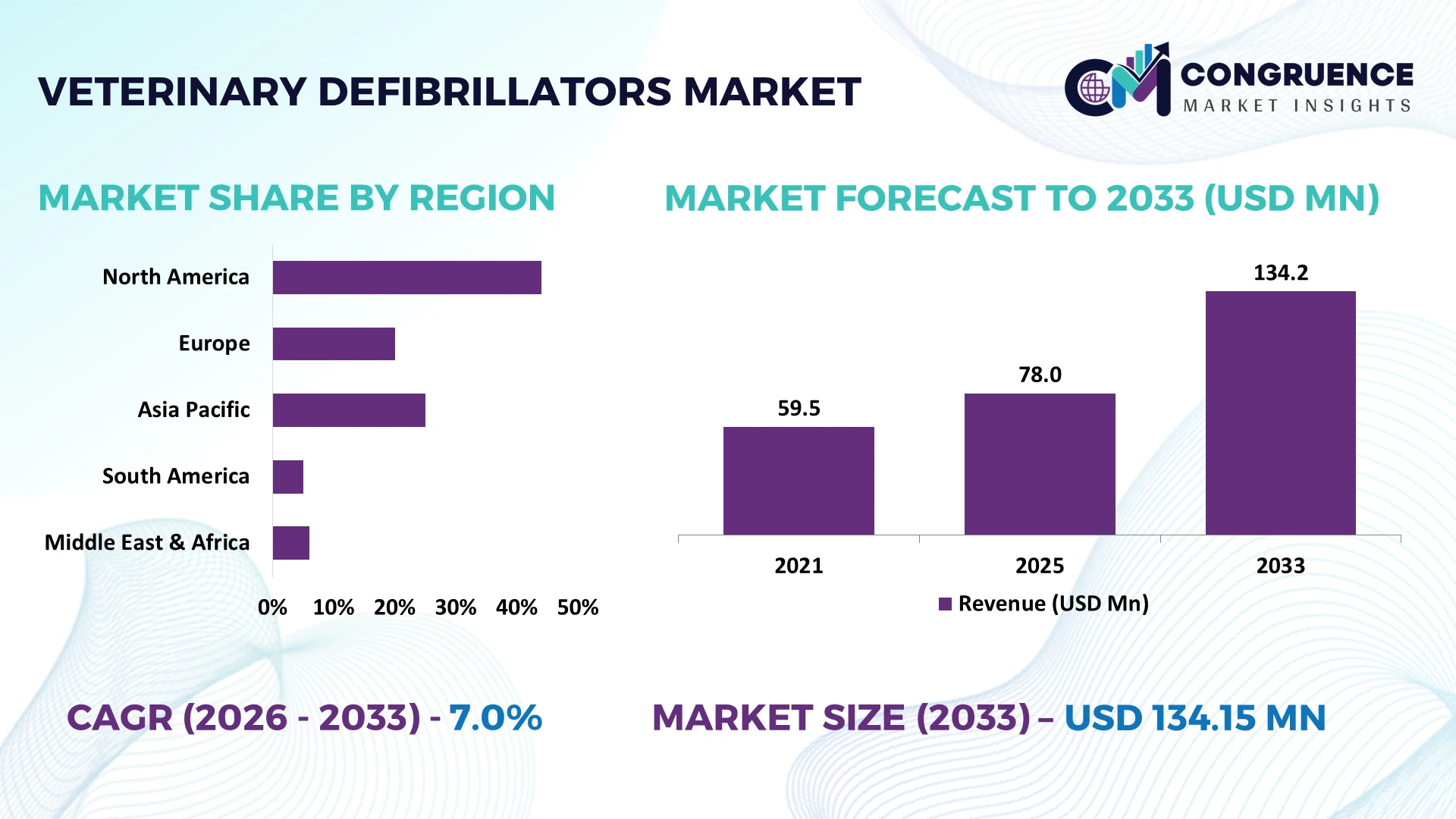
The United States represents a major center for veterinary defibrillator adoption, supported by specialized animal hospitals, emergency care infrastructure, and advanced veterinary medical equipment suppliers. North America accounted for approximately 41.1% of global market demand in 2024, while 94 million American households owned pets in 2025. The updated RECOVER guidelines recommend biphasic defibrillation at an initial 2 J/kg for shockable cardiac arrest. Compared with India's developing veterinary emergency infrastructure, the United States maintains stronger specialist hospital coverage and established critical care training systems.
Medical equipment manufacturers prioritizing veterinary-specific energy controls, portable device integration, and specialist hospital distribution can strengthen competitive positioning in animal emergency care.
Market Size & Growth: Valued at USD 78 Million in 2025, projected to USD 134.15 Million by 2033 at 7% CAGR, driven by rising pet cardiac emergencies and emergency care infrastructure expansion.
Top Growth Drivers: Companion animal population growth (1 billion pets globally), veterinary emergency service expansion (55% emergency centers share), and pet insurance adoption increases.
Short-Term Forecast: By 2027, portable AED adoption in mobile veterinary practices reduces emergency response time by 40–60%, extending defibrillation access beyond traditional clinics.
Emerging Technologies: AI-integrated rhythm analysis algorithms, compact biphasic waveform delivery, and multiparameter monitoring integration with ECG/SpO2 capabilities.
Regional Leaders: North America at 41.1% market share and USD 27.1 million US value, Asia-Pacific expanding at 8.8% CAGR, and Europe maintaining regulated adoption stability.
Consumer/End-User Trends: External defibrillators command 65% device share; automated mode captures 60% operational preference due to user-friendly guided functionality.
Pilot/Case Example: HEARTS project (2024–2026) develops equine-specific defibrillator addressing large animal cardiac emergency gap, with veterinary teaching hospitals leading high-end adoption.
Competitive Landscape: Mindray, Avante Animal Health, Zoll Medical, Philips Healthcare, and Digicare Biomedical lead; top five players hold concentrated market presence.
Regulatory & ESG Impact: USDA Veterinary Medicine Loan Repayment Program expands rural service access; EU Animal Health Law standardizes emergency equipment requirements across member states.
Investment & Funding: Malaysia allocated USD 500,000 for endangered species veterinary equipment; manufacturers invest in compact, portable devices combining ease of use with clinical sophistication.
Innovation & Future Outlook: Implantable defibrillators grow at 8.5% CAGR; AI rhythm algorithms and wireless multiparameter monitoring reshape emergency veterinary workflows.
The Veterinary Defibrillators Market encompasses manual and automated electrical defibrillation systems used in animal cardiac emergencies, specialist hospitals, and veterinary surgical facilities. Demand concentrates on companion animal intensive care, anesthesia-related emergencies, and treatment of shockable cardiac arrhythmias. Biphasic technology is gaining importance through improved energy control and compatibility with veterinary resuscitation protocols. RECOVER guidelines recommend an initial external biphasic shock of 2 J/kg, compared with 4 J/kg for monophasic systems. Expanding specialist hospital networks and standardized veterinary CPR training are influencing equipment procurement, creating opportunities for manufacturers offering clinically suitable devices and technical support.
The Veterinary Defibrillators Market is becoming strategically important as animal healthcare providers modernize emergency response infrastructure and incorporate standardized resuscitation equipment into critical care operations. The 2024 RECOVER guidelines strengthened clinical preference for biphasic defibrillation, encouraging veterinary hospitals to reassess equipment specifications, emergency workflows, and staff training requirements. Manufacturers are responding through compact device engineering, integrated ECG monitoring, and technical support programs that improve equipment readiness across specialist facilities and surgical departments.
Biphasic defibrillators offer measurable advantages over conventional monophasic systems, delivering an initial external shock of 2 J/kg compared with 4 J/kg, representing a 50% reduction in recommended energy. The United States benefits from established veterinary emergency networks, while India is expanding animal healthcare infrastructure and specialized treatment availability. These differences influence equipment procurement, training investment, and regional distribution strategies.
Between 2026 and 2028, veterinary equipment development will emphasize automated rhythm recognition, adjustable energy delivery, and portable critical care integration. RECOVER's training ecosystem has reached more than 113,000 online participants, demonstrating growing clinical standardization. Manufacturers combining veterinary-specific functionality, dependable maintenance services, and professional training partnerships will strengthen hospital relationships and establish sustainable competitive advantages.
The growing emphasis on evidence-based veterinary resuscitation is strengthening demand for clinically appropriate defibrillation equipment. Published veterinary cardiac arrest research reports survival to hospital discharge of approximately 5–7% in dogs and 1–19% in cats, highlighting the importance of coordinated emergency intervention. The RECOVER initiative has certified more than 38,000 veterinary resuscitation professionals, expanding institutional awareness of standardized cardiac life support. American veterinary hospitals are integrating rhythm assessment, emergency medication protocols, and electrical defibrillation into critical care operations. Equipment manufacturers are responding through veterinary-compatible paddles, adjustable energy settings, and integrated monitoring devices. Suppliers supporting practical resuscitation training alongside equipment installation gain stronger institutional relationships and improved opportunities for replacement equipment contracts.
High equipment acquisition costs and limited specialist infrastructure constrain veterinary defibrillator deployment, particularly in smaller clinical facilities. Defibrillation is appropriate for ventricular fibrillation and pulseless ventricular tachycardia, rather than the full spectrum of cardiac arrest presentations, reducing utilization relative to multipurpose monitoring equipment. Recommended internal defibrillation energy ranges from 0.2–0.4 J/kg for biphasic systems, compared with 0.5–1 J/kg for monophasic devices, requiring suitable low-energy adjustment capabilities. India's veterinary service infrastructure remains concentrated around established institutions, limiting access to specialized cardiac emergency equipment in smaller facilities. Manufacturers are addressing procurement barriers through multifunction monitoring systems, distributor partnerships, and equipment servicing arrangements. Facilities prioritizing versatile emergency platforms achieve better equipment utilization than those purchasing narrowly configured standalone devices.
Portable defibrillation technology creates opportunities for manufacturers serving expanding veterinary referral networks and advanced companion animal treatment facilities. The RECOVER protocol recommends uninterrupted chest compression cycles lasting 2 minutes, supporting demand for devices that facilitate rapid rhythm assessment and coordinated emergency response. For persistent shockable rhythms, the recommended biphasic energy increases from 2 J/kg to 4 J/kg, representing a 100% escalation after an unsuccessful initial shock. These requirements create opportunities for configurable veterinary interfaces, preset treatment protocols, and integrated ECG monitoring. China's established medical electronics manufacturing ecosystem supports development of compact multiparameter emergency equipment. Manufacturers investing in modular devices, veterinary-specific software, and specialist distribution partnerships can address equipment portability requirements while differentiating products through integrated clinical functionality.
Achieving reliable defibrillation across different animal sizes presents significant engineering and clinical implementation challenges. The 2024 RECOVER guidelines recommend initial external biphasic defibrillation at approximately 2 J/kg, while internal defibrillation requires substantially lower energy, beginning at 0.2 J/kg. Consequently, device interfaces must support precise weight-based settings and different electrode configurations without increasing treatment preparation complexity. Clinical execution also requires uninterrupted post-shock compressions for 2 minutes, demanding coordination between defibrillator operation and resuscitation personnel. Veterinary hospitals in the United States increasingly emphasize standardized emergency preparedness, creating pressure for consistent staff competency and equipment maintenance. Manufacturers must strengthen software safeguards, species-appropriate accessories, simulation training, and technical service programs. Long-term competitiveness depends on dependable device performance and seamless integration into veterinary emergency procedures.
Portable AEDs Extend Emergency Reach: Automated external defibrillators captured USD 44.4 million in 2024, with battery-powered units holding 67% share due to field and mobile practice versatility . Compact AEDs with guided algorithms now enable smaller clinics, mobile veterinary units, and rescue operations to deliver cardiac intervention outside traditional hospital settings. This operational shift reduces emergency response latency and expands addressable demand beyond large referral centers.
Emergency Centers Drive Protocol Standardization: Emergency centers command 55% of end-user share, with veterinary hospitals growing at 7.8% as they adopt standardized crash cart protocols requiring operational defibrillator readiness . AAHA accreditation standards now mandate documented emergency equipment checks, creating recurring compliance-driven replacement cycles. Manufacturers are responding with multiparameter monitoring-defibrillation integration that consolidates workflow and reduces equipment footprints.
Asia-Pacific Infrastructure Investment Accelerates: India's veterinary infrastructure guidelines mandate defibrillator inclusion in casualty/emergency sections, while the Malaysian government allocated USD 500,000 for endangered species veterinary equipment . Government-backed modernization programs are institutionalizing defibrillator procurement across public veterinary facilities. Manufacturers are scaling distribution partnerships and localized manufacturing to capture public-sector tenders in these expanding markets.
Species-Specific Device Development Gains Momentum: Large animals represent the fastest-growing segment at 9.0%, reflecting increased focus on livestock cardiac health and equine emergency care . The HEARTS project targets equine-specific defibrillation, addressing a critical gap where large animal physiology requires higher energy outputs and species-adapted electrode systems. Companies are investing in bipolar waveform customization and electrode redesign to serve livestock and equine veterinary practices.
Automated External Defibrillators represent the leading product category in the Veterinary Defibrillators Market, accounting for approximately 48.3% of market share in 2025. Their dominance reflects automated rhythm assessment, simplified operator interaction, and compatibility with emergency treatment environments where specialist cardiologists are not continuously available. Semi-Automatic Defibrillators account for approximately 32.8%, combining automated rhythm interpretation with clinician-controlled shock delivery. Manual Defibrillators retain relevance in advanced veterinary hospitals requiring precise energy selection and direct operator control. Manufacturers are strengthening automated device portfolios through compact construction, integrated monitoring, and simplified clinical interfaces.
Biphasic Defibrillators dominate the technology category, supported by lower recommended shock energy and compatibility with contemporary resuscitation procedures. Monophasic Defibrillators represent legacy technology, while Portable Defibrillators are gaining importance through flexible deployment across smaller veterinary facilities and emergency treatment locations. Equipment manufacturers are prioritizing veterinary-compatible electrode configurations, adjustable energy delivery, and dependable battery operation. Investment increasingly favors devices combining clinical versatility with straightforward maintenance, supporting differentiated procurement decisions and stronger institutional relationships.
Cardiac Arrest represents the leading application within the Veterinary Defibrillators Market, reflecting the concentration of defibrillation equipment in emergency response and advanced veterinary critical care. Veterinary defibrillation specifically addresses shockable cardiac arrest rhythms, requiring immediate rhythm identification before electrical treatment. Ventricular Fibrillation is a principal indication, while pulseless Ventricular Tachycardia requires equivalent emergency defibrillation pathways. The 2024 RECOVER guidelines recommend initial biphasic energy of 2 J/kg, increasing to 4 J/kg following an unsuccessful shock. Equipment manufacturers are improving energy controls and ECG visibility to support coordinated emergency procedures.
Emergency Resuscitation represents an expanding operational application as veterinary facilities strengthen standardized treatment protocols and emergency equipment readiness. Perioperative Cardiac Care supports defibrillator placement in advanced surgical environments where unexpected rhythm disturbances require immediate intervention. Manufacturers are adapting through integrated monitoring capabilities, rechargeable equipment, and clinical training partnerships. Demand increasingly concentrates on devices supporting reliable rhythm interpretation, rapid shock preparation, and compatibility with veterinary resuscitation workflows. Suppliers offering comprehensive emergency equipment support gain advantages in hospital procurement and clinical service agreements.
Veterinary Hospitals represent the leading end-user segment in the Veterinary Defibrillators Market, accounting for approximately 54.6% of market share in 2025. Their dominance reflects established intensive care infrastructure, surgical facilities, and continuous requirements for emergency response equipment. Veterinary Clinics remain important buyers of compact defibrillation systems, particularly where multifunction monitoring improves equipment utilization. Animal Specialty Hospitals emphasize advanced cardiac care, specialist treatment capabilities, and integration with intensive monitoring equipment. Manufacturers are responding through differentiated equipment configurations, installation services, and institutional procurement partnerships.
Emergency Veterinary Centers represent a significant expansion opportunity as around-the-clock treatment facilities strengthen cardiac arrest preparedness and critical care capabilities. Veterinary Teaching Hospitals require devices supporting clinical treatment and structured practical instruction, while Animal Research Institutes emphasize controlled equipment performance and specialized operational requirements. Equipment suppliers are developing portable configurations, adaptable monitoring accessories, and technical training packages to address these institutional differences. Competitive positioning increasingly depends on comprehensive service support, clinical compatibility, and equipment availability. Manufacturers offering dependable maintenance programs alongside practical veterinary training gain stronger opportunities in specialist procurement channels.
North America accounted for the largest market share at approximately 41.1% in 2025 however, Asia-Pacific is expected to register the fastest growth between 2026 and 2033, supported by expanding veterinary healthcare infrastructure, medical equipment manufacturing, and specialist animal emergency services.

Advanced Animal Emergency Infrastructure and Critical Care Modernization
North America dominates the Veterinary Defibrillators Market through established emergency animal hospitals, specialist cardiac care facilities, and extensive veterinary equipment distribution networks. The United States concentrates demand within companion animal referral hospitals and intensive care departments, while Canada contributes through advanced veterinary teaching institutions and regional specialist services. The implementation of updated veterinary resuscitation protocols is influencing procurement of biphasic defibrillators, integrated ECG monitoring, and appropriately sized electrode accessories. With approximately 94 million American households owning pets in 2025, the companion animal population supports an extensive veterinary healthcare ecosystem. Equipment manufacturers are strengthening relationships with hospital networks, emergency medicine educators, and veterinary equipment distributors. Demand increasingly favors defibrillators offering precise energy adjustment, dependable maintenance support, and compatibility with existing critical care equipment.
United States Market Outlook: The United States represents the principal veterinary defibrillator commercialization center, supported by established specialist training and advanced animal hospital infrastructure. The American College of Veterinary Emergency and Critical Care maintains structured specialist certification pathways, strengthening clinical expertise in emergency intervention. The 2024 RECOVER guidelines recommend initial external biphasic defibrillation at 2 J/kg for appropriate shockable rhythms. Manufacturers supplying veterinary-compatible electrodes, configurable shock settings, and clinician training resources benefit from these institutional requirements.
Standardized Emergency Care and Veterinary Network Consolidation
Europe represents an established market for veterinary defibrillation equipment, supported by regulated veterinary practice networks, advanced companion animal healthcare, and specialist treatment facilities. The United Kingdom, Germany, France, and the Netherlands contribute through emergency hospitals, veterinary education institutions, and medical equipment distribution networks. Increasing consolidation of veterinary practices is reshaping equipment procurement toward standardized devices, centralized servicing contracts, and coordinated clinical protocols. The United Kingdom recorded approximately 6,522 registered veterinary premises in 2024, including 3,586 facilities participating in the RCVS Practice Standards Scheme. Equipment manufacturers are expanding regional technical support, training partnerships, and integrated emergency monitoring portfolios. Mindray Animal Medical's European training center in the Netherlands strengthens professional education and customer engagement. Regional competition increasingly emphasizes equipment standardization, operator training, and dependable service arrangements across multisite veterinary organizations.
United Kingdom Market Outlook: The United Kingdom provides a substantial institutional market for veterinary emergency equipment through established referral hospitals and consolidated veterinary groups. CVS Group operated 425 UK veterinary practice sites as of June 2025, demonstrating the scale of centralized procurement opportunities. Veterinary suppliers offering compatible equipment across multiple facilities can simplify staff training, maintenance scheduling, and consumables purchasing. Specialist referral hospitals strengthen demand for integrated cardiac monitoring and clinically appropriate defibrillation systems.
Medical Electronics Manufacturing and Veterinary Infrastructure Expansion
Asia-Pacific is strengthening its position in the Veterinary Defibrillators Market through medical electronics manufacturing, expanding companion animal healthcare, and increasing veterinary hospital modernization. China provides established capabilities in patient monitoring technology, medical device electronics, and equipment assembly, while Japan and South Korea contribute advanced medical engineering and specialized veterinary services. India is expanding veterinary education and treatment infrastructure, creating additional opportunities for medical equipment distribution. Chinese manufacturers benefit from existing production capabilities in monitoring systems, compact electronic components, and integrated critical care equipment. Mindray Animal Medical operates from Shenzhen and offers a broad veterinary patient monitoring and life support portfolio. Manufacturers are strengthening device localization, technical service networks, and distributor partnerships to address differing clinical infrastructure requirements. Competitive advantage depends on affordability, reliable electronics integration, and practical veterinary equipment support.
China Market Outlook: China represents a strategically important veterinary medical equipment manufacturing center through Shenzhen's established medical electronics ecosystem. Mindray Animal Medical develops veterinary monitoring, anesthesia, and life support technologies, drawing on expertise in integrated clinical equipment. The company's European training center opened in June 2025 with nearly 200 guests, demonstrating international technical engagement. Domestic component sourcing, electronics manufacturing infrastructure, and export distribution capabilities support opportunities for advanced veterinary emergency equipment and integrated monitoring systems.
Companion Animal Healthcare Expansion and Equipment Accessibility
South America's Veterinary Defibrillators Market is influenced by expanding companion animal healthcare, specialist veterinary hospitals, and increasing demand for emergency treatment equipment. Brazil represents the principal regional center through its extensive veterinary workforce, established animal healthcare institutions, and medical equipment distribution infrastructure. Argentina, Chile, and Colombia contribute demand from urban veterinary clinics and specialist animal care facilities. Brazil recorded approximately 77,287 veterinary establishments in March 2025, demonstrating the scale of its institutional healthcare network. However, emergency equipment availability remains uneven between metropolitan hospitals and smaller veterinary practices. Imported medical electronics, equipment servicing requirements, and exchange rate exposure influence purchasing decisions. Manufacturers are strengthening relationships with Brazilian distributors, expanding portable monitoring equipment portfolios, and developing maintenance partnerships. Suppliers offering affordable multifunction devices and dependable replacement accessories gain advantages in cost-sensitive institutional procurement.
Brazil Market Outlook: Brazil represents a major opportunity for veterinary emergency equipment suppliers through its established animal healthcare workforce and expanding specialist treatment capabilities. More than 215,000 veterinary professionals were active across the country in September 2025, according to the national veterinary regulatory system. São Paulo concentrates substantial specialist healthcare activity and equipment distribution capacity. Manufacturers can strengthen market access through Portuguese-language equipment interfaces, local technician training, and partnerships with established veterinary hospital networks.
Veterinary Healthcare Investment and Emergency Equipment Modernization
The Middle East and Africa Veterinary Defibrillators Market is shaped by specialist animal healthcare investment, livestock treatment infrastructure, and expanding companion animal services. The United Arab Emirates and Saudi Arabia emphasize veterinary facility development and advanced animal treatment capabilities, while South Africa provides established veterinary education, clinical services, and regulatory infrastructure. In June 2026, Dubai-based Al Khayyat Investments announced a USD 100 million commitment to establish VetHealth, expanding animal healthcare distribution and service capabilities across the region. Such investments strengthen the broader commercial infrastructure supporting veterinary medical equipment procurement. However, uneven specialist coverage and equipment servicing capabilities influence adoption outside major metropolitan centers. Manufacturers are developing distributor partnerships, localized technical support, and portable critical care portfolios. Reliable equipment maintenance and access to trained operators remain essential for successful institutional deployment.
United Arab Emirates Market Outlook: The United Arab Emirates is strengthening its animal healthcare ecosystem through private investment, specialist veterinary facilities, and regional distribution capabilities. Dubai's position as a commercial and logistics center supports medical equipment imports, technical servicing, and onward distribution. The VetHealth initiative encompasses 5 animal healthcare categories, including diagnostics and pharmaceutical services. Veterinary defibrillator manufacturers can leverage established healthcare distribution relationships to serve specialist hospitals, companion animal emergency providers, and institutional veterinary facilities requiring integrated monitoring equipment.
Mindray Medical International, Avante Animal Health, Digicare Biomedical, Shenzhen Comen Medical Instruments, and Shinova Medical constitute the top five veterinary defibrillator players, collectively commanding approximately 45–50% of global market share . Competition bifurcates sharply: these global leaders leverage integrated monitoring-defibrillation platforms and broad distribution networks, while regional entrants such as Kalstein (France) and ARI Medical (China) compete on cost-per-device and localized service models . The basis of competition is shifting from energy delivery accuracy toward workflow integration and portability, with battery-powered units capturing 67% share and automated operation preferred by 60% of practitioners . Market structure remains moderately consolidated, with the top five exerting significant influence on technology trends, quality standards, and pricing . The current competitive shift centers on portable AED deployment beyond traditional hospitals into mobile veterinary units and emergency response vehicles, expanding addressable demand .
Mindray Medical International
Avante Animal Health
Digicare Biomedical Technology
Shenzhen Comen Medical Instruments
Shinova Medical
ARI Medical Technology
Kalstein France
Meditech Equipment
New Gen Medical Systems
Promed Technology
Wuhan Union Medical Technology
Hefei Eur Vet Technology
Infinium Medical
Zoll Medical Corporation
Biphasic waveform technology is transforming veterinary cardiac emergency equipment through controlled energy delivery, impedance compensation, and integrated ECG monitoring. Current veterinary resuscitation protocols recommend an initial external biphasic shock of 2 J/kg, compared with 4 J/kg for conventional monophasic systems, representing a 50% reduction in delivered energy. Mindray's veterinary defibrillation platform incorporates impedance compensation, patient contact indicators, and automated equipment checks. Veterinary hospitals benefit from more consistent equipment preparation, clinically appropriate energy selection, and simplified emergency response.
Emerging defibrillation technologies emphasize rapid charging, automated rhythm interpretation, and multiparameter monitoring integration. Mindray's uMED 20 Vet completes its power-on, charging, and ECG recovery sequence in under 7.5 seconds. Its battery supports at least 300 shocks at 200 J, strengthening operational readiness during extended emergency coverage. Manufacturers integrating pacing, defibrillation, and patient monitoring gain competitive advantages through reduced equipment complexity and consolidated maintenance requirements.
Disruptive developments include intelligent waveform adjustment, connected equipment diagnostics, and software-guided resuscitation workflows. Between 2026 and 2028, product development will prioritize veterinary-specific operating interfaces, automated readiness verification, and adaptable electrode configurations. Established medical electronics manufacturers benefit from controller expertise and manufacturing scale, while specialized veterinary suppliers differentiate through clinical customization and technical support.
2025: Mindray Medical International expanded its veterinary monitoring-defibrillation portfolio integration, extending its BeneVision platform compatibility to veterinary emergency centers across 190+ countries. The company's veterinary-critical care segment contributes to its global installed base exceeding 100,000 units across human and animal monitoring systems. Business impact: consolidates multiparameter monitoring-defibrillation workflows for veterinary emergency adoption.
2024: Avante Animal Health maintained its position as a dedicated veterinary equipment distributor, supplying defibrillator and emergency care devices to companion animal practices across North America. The company's veterinary-exclusive distribution model serves as a channel advantage over human-medical OEMs entering animal health. Business impact: sustains specialized veterinary emergency equipment access for small and mid-sized clinics.
2025: Digicare Biomedical Technology continued supply of veterinary-specific defibrillator and monitoring systems, with its LifeWindow platform integrating ECG, SpO2, and defibrillation capabilities for companion animal emergency care. Business impact: advances integrated monitoring-defibrillation consolidation in veterinary critical care workflows. Source: digicare.com
2026: Veterinary emergency care infrastructure investment accelerated across Asia-Pacific, with India's veterinary infrastructure guidelines mandating defibrillator inclusion in casualty and emergency sections of public facilities. Business impact: institutionalizes defibrillator procurement in government veterinary modernization programs. Source: gov.in
The Veterinary Defibrillators Market Report evaluates emergency cardiac equipment, treatment applications, institutional purchasing patterns, and technological developments between 2026 and 2033. Type segmentation covers Manual Defibrillators, Automated External Defibrillators, Semi-Automatic Defibrillators, Biphasic Defibrillators, Monophasic Defibrillators, and Portable Defibrillators. Application analysis examines Cardiac Arrest, Ventricular Fibrillation, Ventricular Tachycardia, Emergency Resuscitation, and Perioperative Cardiac Care. End-user coverage includes Veterinary Hospitals, Veterinary Clinics, Emergency Veterinary Centers, Animal Specialty Hospitals, Veterinary Teaching Hospitals, and Animal Research Institutes.
Regional assessment encompasses North America, Europe, Asia-Pacific, South America, and the Middle East & Africa. The report evaluates biphasic waveform engineering, ECG integration, adjustable energy delivery, portable equipment, and automated readiness diagnostics. Clinical operating benchmarks include initial shock settings of 2 J/kg and rapid equipment preparation capabilities. Strategic analysis supports procurement planning, product development, distribution partnerships, competitive positioning, and veterinary emergency infrastructure investment.
| Report Attribute/Metric | Report Details |
|---|---|
Market Revenue in 2025 | USD 78 Million |
Market Revenue in 2033 | USD 134.15 Million |
CAGR (2026 - 2033) | 7% |
Base Year | 2025 |
Forecast Period | 2026 - 2033 |
Historic Period | 2021 - 2025 |
Segments Covered | By Type
By Application
By End-User
|
Key Report Deliverable | Revenue Forecast, Growth Trends, Market Dynamics, Segmental Overview, Regional and Country-wise Analysis, Competition Landscape |
Region Covered | North America, Europe, Asia-Pacific, South America, Middle East, Africa |
Key Players Analyzed | Mindray Medical International, Avante Animal Health, Digicare Biomedical Technology, Shenzhen Comen Medical Instruments, Shinova Medical, ARI Medical Technology, Kalstein France, Meditech Equipment, New Gen Medical Systems, Promed Technology, Wuhan Union Medical Technology, Hefei Eur Vet Technology, Infinium Medical, Zoll Medical Corporation |
Customization & Pricing | Available on Request (10% Customization is Free) |




