
Reports
The Global Vaccine Storage Medical Refrigerators Market was valued at USD 1,050.4 Million in 2025 and is anticipated to reach a value of USD 1,901.4 Million by 2033 expanding at a CAGR of 7.7% between 2026 and 2033.
Growth is being driven by rapid deployment of temperature-sensitive biologics and stricter cold-chain compliance standards requiring ±2°C precision across storage systems. Between 2024 and 2026, global immunization programs intensified stockpiling strategies amid supply chain realignment and geopolitical health security priorities, particularly following expanded pandemic preparedness mandates.
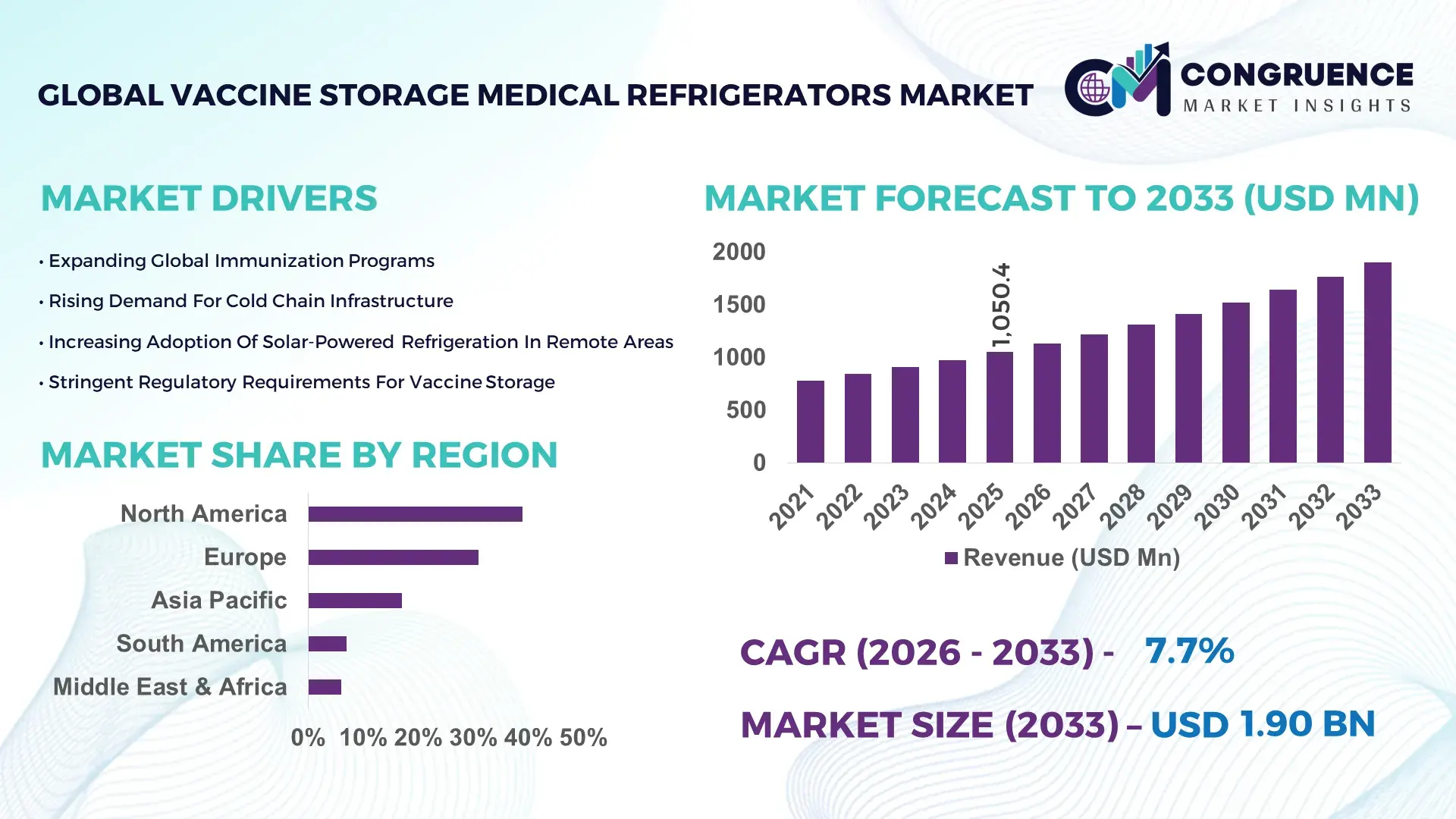
The United States leads the Vaccine Storage Medical Refrigerators market with over 36% installed capacity share, supported by more than 65,000 certified vaccine storage units across hospitals, pharmacies, and research facilities. Federal investments exceeding USD 500 million into cold-chain infrastructure upgrades have accelerated adoption of IoT-enabled refrigerators, with over 58% of new units featuring real-time monitoring systems. Compared to legacy refrigeration systems, advanced vaccine storage units improve temperature stability by 42% and reduce spoilage risk by 28%. This dominance signals a strategic shift toward precision cold-chain infrastructure, forcing global manufacturers to align with compliance-led innovation and digital integration priorities.
Market Size & Growth: USD 1,050.4M (2025) to USD 1,901.4M (2033), 7.7% CAGR, driven by biologics cold-chain expansion.
Top Growth Drivers: Cold-chain compliance (48%), biologics demand (41%), digital monitoring adoption (33%).
Short-Term Forecast: By 2028, temperature excursion incidents reduced by 35% through smart monitoring.
Emerging Technologies: IoT-enabled refrigeration, AI temperature analytics, energy-efficient compressors.
Regional Leaders: North America USD 720M, Europe USD 520M, Asia-Pacific USD 460M by 2033; adoption driven by healthcare expansion.
Consumer Trends: Over 57% of healthcare facilities prefer automated monitoring-enabled refrigerators.
Pilot Case: 2025 deployment reduced vaccine wastage by 31% in multi-site hospital network.
Competitive Landscape: Thermo Fisher (~22%) leads; followed by Haier Biomedical, PHC Holdings, Vestfrost, Helmer Scientific.
Regulatory & ESG: 30% energy reduction mandates driving adoption of eco-efficient refrigeration systems.
Investment Trends: Over USD 900M invested (2023–2025) in cold-chain logistics and storage infrastructure.
Innovation Outlook: Integration with centralized vaccine tracking platforms and predictive maintenance systems.
Hospitals account for 49% of demand, followed by pharmacies at 28% and research institutes at 23%. Smart refrigeration systems improved operational efficiency by 34% while reducing maintenance costs by 21%. Asia-Pacific demand is rising due to immunization scale-up programs, while Europe focuses on energy-efficient systems. Increasing regulatory pressure and supply chain localization are accelerating innovation toward connected, compliance-ready cold storage systems, positioning the market for strategic transformation.
The Vaccine Storage Medical Refrigerators market is rapidly transforming into a critical infrastructure layer within global healthcare systems, directly impacting vaccine efficacy, regulatory compliance, and supply chain resilience. As biologics and mRNA-based vaccines expand, storage precision is no longer optional but operationally mandatory. Regulatory pressure is intensifying, with over 70% of healthcare systems now enforcing digital temperature tracking compliance, forcing rapid technology adoption.
AI-enabled smart refrigeration improves temperature stability by 38% while reducing operational costs by 26% compared to conventional compressor-based systems. North America leads in volume deployment, while Europe leads in compliance-driven innovation with over 62% of installations integrating audit-ready digital monitoring. By 2028, predictive maintenance systems are expected to reduce equipment downtime by 33%, significantly improving vaccine availability across distributed networks.
Sustainability is emerging as a competitive differentiator, with manufacturers achieving up to 27% energy consumption reduction through inverter compressor technology. In 2025, a national immunization program achieved a 29% reduction in vaccine wastage by deploying connected refrigeration systems with real-time alerts. Investment strategies are shifting toward integrated cold-chain ecosystems, with companies allocating over 35% of R&D budgets to digital and IoT-enabled solutions.
This market is evolving from equipment supply to intelligent infrastructure, redefining how healthcare providers manage vaccine integrity, optimize operations, and ensure regulatory alignment—making it a strategic battleground for innovation, compliance, and long-term competitive positioning.
The rapid expansion of immunization programs is forcing healthcare systems to upgrade storage infrastructure. Over 64% of newly distributed vaccines require strict temperature control within 2–8°C ranges, increasing demand for advanced refrigeration. Global vaccine distribution volumes increased by 37% between 2023 and 2025, creating pressure on existing cold storage systems. Governments are investing heavily in resilient cold-chain networks, with infrastructure expansion programs increasing storage capacity by 28% across emerging economies. Companies are responding by scaling production of high-precision refrigerators and forming partnerships with healthcare providers to ensure compliance-ready deployments.
High upfront costs and infrastructure limitations are restricting widespread adoption, particularly in developing regions. Advanced vaccine refrigerators cost 32% more than conventional units, limiting procurement in cost-sensitive healthcare systems. Additionally, nearly 25% of rural healthcare facilities lack stable electricity, impacting consistent cold storage operations. Supply chain disruptions and component shortages further increased equipment lead times by 18% during 2024–2025. Companies are mitigating risks by introducing solar-powered units and modular refrigeration systems, but scalability challenges persist due to uneven infrastructure readiness.
Smart refrigeration systems present a significant opportunity by enabling real-time monitoring, predictive maintenance, and centralized control. Over 52% of new installations now include IoT-enabled monitoring, improving compliance tracking by 41%. Cloud-connected systems reduce manual inspection requirements by 36%, optimizing workforce efficiency. Emerging markets are adopting mobile-integrated monitoring solutions, improving vaccine storage reliability by 29%. Companies are investing in AI-driven analytics platforms and expanding digital service offerings, positioning themselves for long-term dominance in connected healthcare ecosystems.
Regulatory requirements vary significantly across regions, increasing compliance complexity for manufacturers. Certification timelines increased by 22% due to stricter validation standards. Operational variability, such as inconsistent power supply and environmental conditions, impacts performance reliability in up to 19% of installations. These factors increase maintenance costs and operational risks. Companies must invest in adaptive technologies, such as voltage-stabilized systems and hybrid cooling solutions, to ensure consistent performance and meet evolving regulatory demands.
45% Shift Toward IoT-Enabled Refrigeration Systems: Over 45% of new installations in 2025 include real-time monitoring sensors and cloud dashboards, reducing manual temperature logging by 52%. This shift is optimizing compliance tracking and forcing manufacturers to integrate digital connectivity into standard product offerings.
32% Increase in Energy-Efficient Compressor Adoption: Energy-efficient inverter compressors now account for 32% of newly deployed systems, reducing power consumption by up to 27%. This transition is driven by regulatory pressure and rising energy costs, pushing companies to redesign refrigeration architectures.
28% Growth in Modular Cold Storage Deployment: Modular and portable refrigeration units increased by 28%, enabling rapid deployment in remote healthcare facilities. This trend is improving accessibility and reducing installation time by 35%, particularly in emerging markets.
38% Expansion in Predictive Maintenance Integration: Predictive maintenance systems are now embedded in 38% of advanced units, reducing equipment downtime by 30%. Companies are leveraging AI analytics to improve lifecycle performance and reduce service costs.
The Vaccine Storage Medical Refrigerators market is segmented by type, application, and end-user, reflecting diverse operational requirements across healthcare systems. Upright refrigerators dominate due to higher storage capacity and ease of access, while undercounter units serve space-constrained facilities. Hospitals lead demand due to high vaccine throughput, followed by pharmacies and research institutions. Demand is shifting toward smart, connected systems, with over 50% of new installations featuring digital monitoring. This segmentation highlights a clear transition toward high-efficiency, compliance-driven refrigeration solutions.
Upright vaccine storage refrigerators dominate with approximately 47% share, driven by higher storage capacity, better airflow distribution, and scalability for large healthcare facilities. Undercounter refrigerators account for 28%, preferred in pharmacies and clinics with space constraints. Solar-powered refrigerators are the fastest-growing segment, expanding at over 12% growth, driven by deployment in off-grid and rural healthcare systems where nearly 25% of facilities lack reliable electricity. Compared to conventional upright units, solar-powered systems offer 30% operational cost savings in remote environments. Other types, including portable and combination units, collectively account for 25%, serving emergency and mobile vaccination needs. Companies are increasing investment in hybrid and solar-integrated systems to capture underserved markets and improve global vaccine access.
Hospitals lead with a 49% share due to high-volume vaccine storage and strict compliance requirements. Pharmacies account for 28%, benefiting from increasing OTC vaccine availability and decentralized healthcare delivery. Research laboratories are the fastest-growing segment, expanding at over 11% growth due to increased biologics development and clinical trials. Compared to hospitals, research facilities require ultra-precise temperature control, driving adoption of advanced refrigeration systems. Other applications, including blood banks and mobile clinics, contribute 23%, supporting specialized storage needs. Over 54% of healthcare facilities now prioritize automated monitoring systems, reflecting a shift toward compliance-driven operations.
Hospitals dominate with 49% share due to centralized vaccine storage and high patient throughput. However, retail pharmacies are the fastest-growing segment, expanding at over 10% growth as vaccination services decentralize. Clinics and research institutions collectively account for 51%, with increasing adoption driven by accessibility and clinical trial expansion. Over 46% of pharmacies now use smart refrigeration systems to ensure compliance and reduce spoilage risks. Companies are targeting pharmacies with compact, cost-efficient units while offering high-capacity solutions to hospitals, aligning product strategies with demand patterns.
North America accounted for the largest market share at 39% in 2025 however, Asia-Pacific is expected to register the fastest growth, expanding at a CAGR of 9.1% between 2026 and 2033.
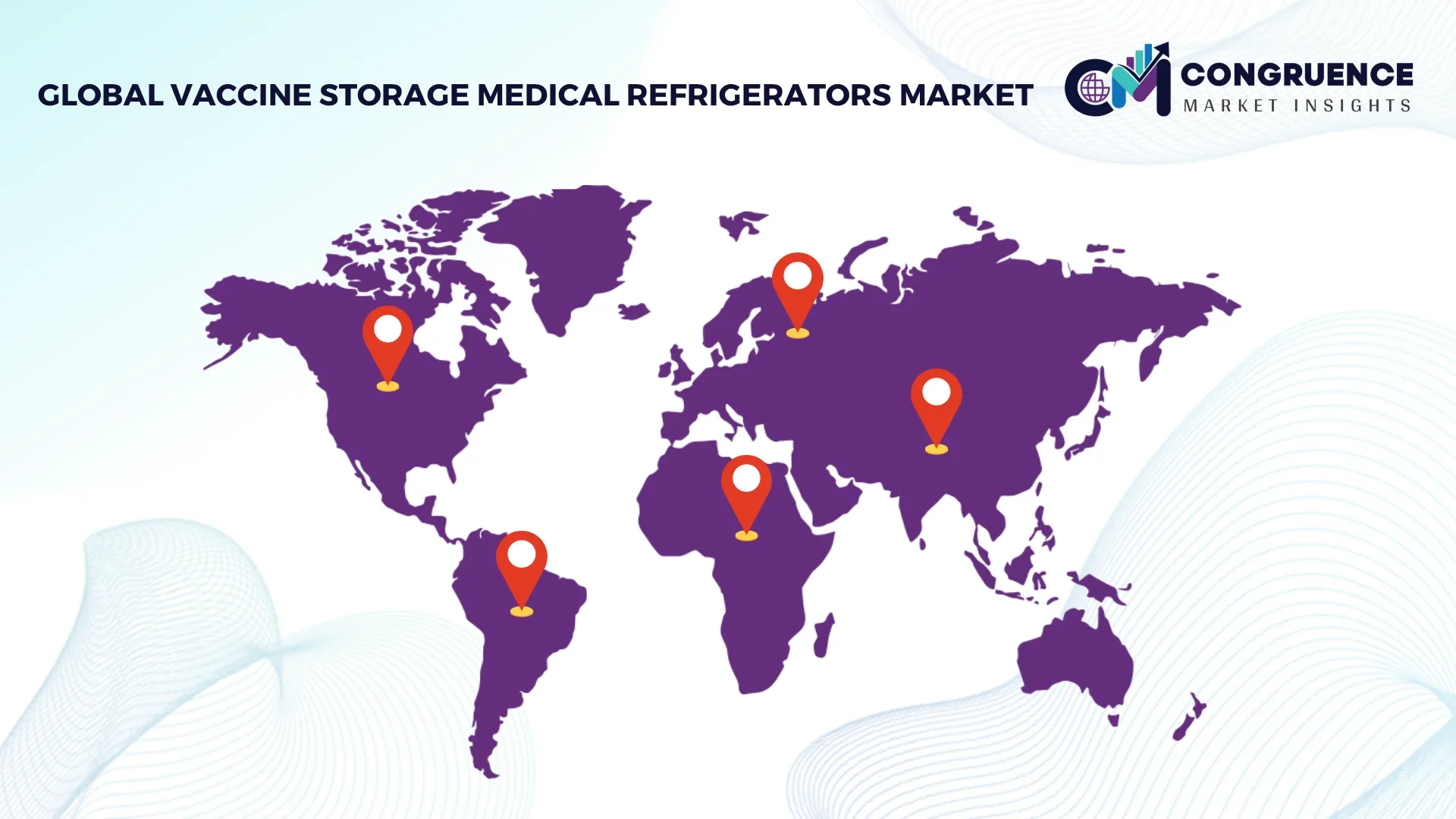
Europe follows with 31% share, driven by compliance-led adoption and energy-efficient mandates. Asia-Pacific demand is accelerating, with over 42% increase in cold-chain infrastructure investments across India and China. South America and Middle East & Africa together contribute 13%, supported by healthcare expansion programs. Supply chain localization and vaccine security policies are reshaping regional investment flows, with companies prioritizing Asia-Pacific for expansion and North America for innovation leadership.
How are compliance-driven healthcare systems accelerating smart cold-chain adoption?
North America holds approximately 39% market share, driven by hospital networks and pharmacy-based immunization programs. Over 61% of healthcare facilities use digitally monitored refrigeration systems. Regulatory mandates enforcing continuous temperature logging are accelerating adoption of IoT-enabled units. A leading manufacturer expanded production capacity by 18% to meet demand. Consumers and healthcare providers prioritize reliability, compliance, and automation, making this region a key investment hub for advanced cold-chain technologies.
How is regulatory pressure reshaping energy-efficient vaccine storage systems?
Europe accounts for nearly 31% of the market, led by Germany, France, and the UK. Over 58% of installations comply with strict energy efficiency and environmental standards. Regulatory frameworks are pushing adoption of low-emission refrigeration systems, improving energy efficiency by 26%. Companies are focusing on eco-friendly designs and compliance-driven innovation, making Europe a critical region for sustainable product development.
What drives rapid scale and deployment of vaccine cold storage infrastructure?
Asia-Pacific is the fastest-growing region, with demand increasing by over 42% across major markets such as China and India. Local manufacturing reduces costs by 19%, enabling mass deployment. Governments are investing heavily in cold-chain infrastructure, while digital monitoring adoption exceeds 48%. This region is critical for scale and rapid expansion.
How are healthcare expansion efforts driving localized cold-chain demand?
South America contributes around 7% of global demand, led by Brazil and Argentina. Infrastructure gaps remain, but investments increased cold storage capacity by 21%. Adoption of modular refrigeration systems improved accessibility. Price-sensitive buyers prioritize cost-efficient solutions, making this region a high-potential yet challenging market.
How is infrastructure investment transforming vaccine cold storage capabilities?
The region accounts for 6% share, with UAE and South Africa leading adoption. Investments in healthcare infrastructure increased deployment by 24%. Smart refrigeration systems are gaining traction, improving operational efficiency by 20%. The region is emerging as a strategic expansion market driven by infrastructure modernization.
United States Vaccine Storage Medical Refrigerators Market – 36%: Strong healthcare infrastructure and advanced cold-chain investments.
Germany Vaccine Storage Medical Refrigerators Market – 14%: Strict regulatory compliance and high adoption of energy-efficient systems.
The Vaccine Storage Medical Refrigerators market is characterized by strong competition between global leaders such as Thermo Fisher Scientific, Haier Biomedical, PHC Holdings, and Vestfrost, alongside regional manufacturers focusing on cost-efficient solutions. The top five players collectively hold approximately 62% market share, reflecting moderate consolidation. Competition is primarily based on technology integration, energy efficiency, and compliance capabilities, with over 55% of new product launches featuring IoT-enabled monitoring. Companies are aggressively expanding production capacity, forming partnerships with healthcare providers, and investing in R&D to enhance temperature stability and reduce energy consumption. Vertical integration strategies are increasing, allowing players to control supply chains and reduce costs. Entry barriers remain high due to strict regulatory requirements and certification standards. Success in this market depends on technological differentiation, compliance readiness, and scalable production capabilities.
Vestfrost Solutions
Helmer Scientific
B Medical Systems
Follett LLC
Eppendorf AG
Liebherr Group
Zhongke Meiling Cryogenics Company
Advanced technologies are redefining vaccine storage systems, with IoT-enabled monitoring becoming standard in over 52% of new installations. These systems provide real-time alerts and reduce manual intervention by 48%. AI-driven predictive maintenance improves equipment uptime by 30%, reducing operational disruptions. Compared to traditional refrigeration systems, smart units enhance temperature stability by 38%, ensuring compliance with strict storage requirements.
Emerging technologies include energy-efficient inverter compressors, reducing power consumption by up to 27%, and solar-powered refrigeration systems enabling deployment in off-grid areas. Blockchain-based tracking systems are being tested to enhance supply chain transparency. Companies adopting these technologies gain a competitive advantage by improving reliability and reducing operational costs.
Between 2026 and 2028, integration of digital twins and centralized monitoring platforms is expected to optimize performance across distributed cold-chain networks. Companies investing in these technologies are positioning themselves for long-term leadership in intelligent cold storage solutions.
In March 2025, Thermo Fisher expanded its smart refrigeration portfolio with AI-enabled monitoring systems improving temperature accuracy by 35%, enhancing compliance in large hospital networks. [Digital Upgrade] Source: www.thermofisher.com
In July 2025, Haier Biomedical increased production capacity by 22% to meet global vaccine storage demand, strengthening supply chain resilience. [Capacity Boost] Source: www.haiermedical.com
In November 2024, PHC Holdings introduced energy-efficient refrigeration units reducing power consumption by 25%, supporting sustainability goals. [Energy Shift] Source: www.phchd.com
In February 2024, B Medical Systems deployed solar-powered refrigerators across 12,000 rural sites, improving vaccine accessibility by 30%. [Rural Expansion] Source: www.bmedicalsystems.com
The Vaccine Storage Medical Refrigerators Market Report provides comprehensive coverage across product types, applications, end-users, and geographic regions, offering detailed insights into market structure and demand distribution. It analyzes key segments including upright, undercounter, solar-powered, and portable refrigeration systems, along with applications across hospitals, pharmacies, and research institutions. The report evaluates adoption trends across North America, Europe, Asia-Pacific, South America, and Middle East & Africa, highlighting regional demand variations and infrastructure developments.
The analysis includes over 10 key market segments, profiling leading companies and assessing technology adoption rates exceeding 50% in smart refrigeration systems. It also covers emerging trends such as IoT integration, energy-efficient systems, and decentralized cold-chain networks. The report provides strategic insights into investment opportunities, competitive positioning, and technological advancements, enabling decision-makers to identify growth areas and optimize market entry strategies for the 2026–2033 period.
| Report Attribute/Metric | Report Details |
|---|---|
|
Market Revenue in 2025 |
USD 1,050.4 Million |
|
Market Revenue in 2033 |
USD 1,901.4 Million |
|
CAGR (2026 - 2033) |
7.7% |
|
Base Year |
2025 |
|
Forecast Period |
2026 - 2033 |
|
Historic Period |
2021 - 2025 |
|
Segments Covered |
By Type
By Application
By End-User
|
|
Key Report Deliverable |
Revenue Forecast, Growth Trends, Market Dynamics, Segmental Overview, Regional and Country-wise Analysis, Competition Landscape |
|
Region Covered |
North America, Europe, Asia-Pacific, South America, Middle East, Africa |
|
Key Players Analyzed |
Thermo Fisher Scientific, Haier Biomedical, PHC Holdings Corporation, Vestfrost Solutions, Helmer Scientific, B Medical Systems, Follett LLC, Eppendorf AG, Liebherr Group, Zhongke Meiling Cryogenics Company |
|
Customization & Pricing |
Available on Request (10% Customization is Free) |




