
Reports
The Global Transforming Growth Factor Beta 1 Market was valued at USD 1,899.4 Million in 2025 and is anticipated to reach a value of USD 4,131.1 Million by 2033 expanding at a CAGR of 10.2% between 2026 and 2033. Growth is being driven by expanding TGF-β1-targeted drug development for fibrosis and oncology, alongside greater use of selective pathway modulation in precision therapeutics.
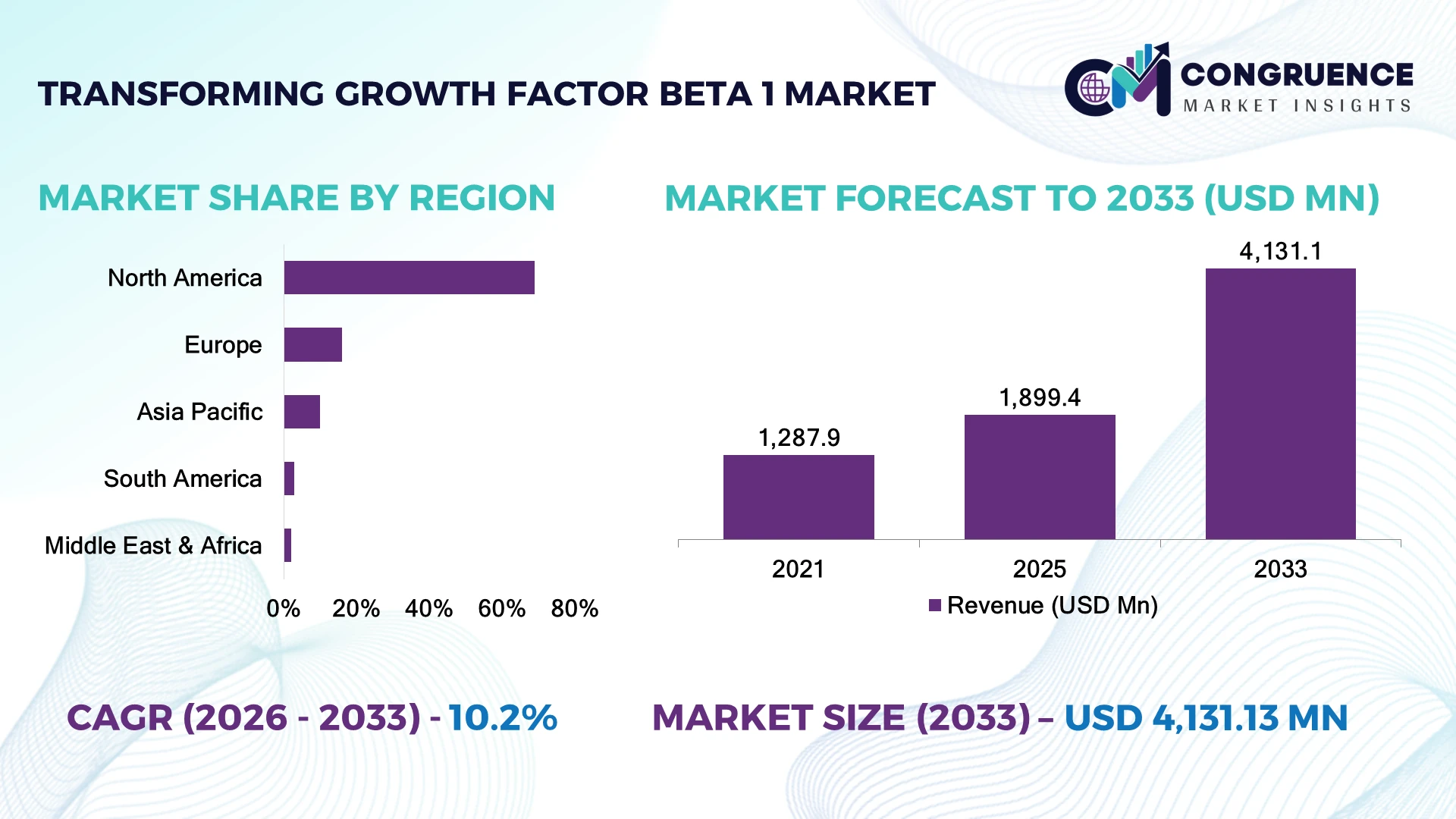
North America holds approximately 69% of the global Transforming Growth Factor Beta 1 market, supported by concentrated pharmaceutical R&D, biotechnology funding, and advanced clinical infrastructure. The United States dominates regional activity, while Europe accounts for roughly 16%, creating a clear scale differential. In 2026, clinical development is advancing toward selective TGF-β1 approaches, including GARP/TGF-β1 targeting, with HLX6018 progressing through Phase I evaluation. The U.S. remains substantially ahead in therapeutic commercialization infrastructure and biotech investment intensity.
Strategically, companies with differentiated TGF-β1 selectivity, strong biomarker strategies, and clinical partnerships are best positioned to convert a concentrated research ecosystem into scalable therapeutic opportunities.
The Transforming Growth Factor Beta 1 market is concentrated in fibrosis research, oncology, regenerative medicine, and advanced biologics development. Selective antibodies, receptor-I inhibitors, antisense approaches, and inhaled candidates are broadening therapeutic strategies, while approximately 69% of activity remains concentrated in North America. China is strengthening clinical development capabilities, creating a more diversified pipeline environment and increasing the importance of regional partnerships and biomarker-led development.
Transforming Growth Factor Beta 1 is becoming strategically important because its signaling pathway sits at the intersection of fibrosis, tumor progression, immune regulation, and extracellular-matrix remodeling. The commercial opportunity is therefore shifting from conventional broad pathway inhibition toward selective intervention that can separate therapeutic activity from systemic safety liabilities. This transition is particularly relevant as biotechnology companies build specialized pipelines around fibrosis and oncology indications.
Technology is reshaping development strategy. Conventional systemic TGF-β inhibition exposes multiple tissues to pathway modulation, whereas selective GARP/TGF-β1 targeting and tissue-directed delivery seek greater biological precision. In 2026, HLX6018 entered clinical evaluation as a GARP/TGF-β1 monoclonal antibody, while inhaled approaches such as lung-directed candidates pursue localized exposure. These approaches can potentially reduce systemic exposure substantially compared with conventional systemic administration.
Over the next 2–3 years, biomarker-guided patient selection, combination immunotherapy, receptor-selective molecules, and organ-targeted delivery will become increasingly important development priorities. North American companies retain advantages in clinical infrastructure and capital availability, while Chinese developers are expanding first-in-human capabilities. Companies that combine target selectivity with robust translational biomarkers and differentiated delivery platforms will secure stronger competitive positioning as TGF-β1 moves toward more precision-oriented therapeutic development.
Therapeutic development is shifting from broad TGF-β blockade toward selective TGF-β1 modulation, improving the commercial rationale for fibrosis and oncology programs. TGF-β1-linked mechanisms account for a substantial share of active pathway-directed research, while clinical programs now span antibodies, receptor inhibitors, and extracellular-matrix targeting. In 2026, HLX6018 completed Phase I evaluation with 66 randomized subjects, while selective latent TGF-β1 programs advance through preclinical and clinical stages. This technology shift is prompting biopharma companies to increase biomarker research, combination strategies, and target-specific antibody development. The strategic advantage is not simply stronger inhibition; it is controlling disease-associated signaling while preserving physiological TGF-β functions, improving the probability of clinically differentiated therapies.
TGF-β1 remains difficult to commercialize because pathway inhibition affects immune regulation, tissue repair, and extracellular-matrix biology. Non-selective approaches can generate safety liabilities, including bleeding and cardiovascular effects, while clinical outcomes have remained inconsistent across several development programs. Recent research continues to identify efficacy and safety as major barriers to successful translation, with multiple historical candidates discontinued or failing to demonstrate sufficient clinical benefit. Companies are therefore shifting toward latent-form, receptor-selective, and tissue-specific mechanisms rather than pan-TGF-β inhibition. This raises development complexity and increases translational requirements, because sponsors must demonstrate both target engagement and therapeutic selectivity. The key operational constraint is longer validation before expensive Phase II expansion.
The strongest opportunity is selective inhibition of disease-associated TGF-β1 activation across pulmonary, renal, hepatic, and systemic fibrosis. A 2026 study of SOF10 demonstrated reduced fibrosis across liver and kidney models while maintaining safety in animal testing, strengthening interest in extracellular-matrix targeting. In clinical development, HLX6018 evaluated seven dose levels from 0.25 to 70 mg/kg, illustrating increasing emphasis on dose optimization and pharmacokinetic characterization. Companies are positioning through differentiated antibodies, biomarker-led trials, and combination strategies with checkpoint inhibitors. The non-obvious opportunity is organ-specific targeting: localized or context-dependent inhibition can address TGF-β1 pathology while reducing exposure to protective signaling, creating clearer differentiation than conventional systemic pathway suppression.
The principal long-term challenge is translating strong mechanistic biology into reproducible human efficacy. TGF-β1 operates across multiple cell types and disease stages, making patient selection, dose optimization, and pharmacodynamic measurement unusually complex. In the HLX6018 Phase I study, 69.7% of participants experienced treatment-emergent adverse events and 59.1% experienced treatment-related events, although no grade 3-or-higher treatment-related events were reported. Companies must therefore strengthen biomarker panels, tissue-level pharmacology, and adaptive trial designs while developing combination regimens. The strategic pressure is to demonstrate meaningful disease modification without disrupting physiological TGF-β1 signaling; programs unable to establish that therapeutic window face higher trial attrition and escalating development costs.
Selectivity Replaces Broad Inhibition: Development is moving toward latent and context-specific TGF-β1 targeting as companies address the safety limitations of pan-pathway inhibition. Scholar Rock is advancing SRK-373 for fibrosis and SRK-181 in oncology, while 2026 research continues validating selective latent TGF-β1 blockade.
GARP Targeting Enters Clinical Testing: HLX6018 represents a more targeted GARP/TGF-β1 strategy, with 180 subjects screened and 66 randomized in its Phase I study. The program used seven dose levels, from 0.25 to 70 mg/kg, reflecting increasing emphasis on pharmacokinetic optimization and target-specific safety characterization.
Fibrosis Expands Beyond Lung Disease: TGF-β1 programs are increasingly addressing renal, hepatic, and systemic fibrosis rather than concentrating solely on pulmonary indications. Preclinical SOF10 testing demonstrated activity across liver and renal fibrosis models, encouraging companies to evaluate broader organ-specific applications and combination approaches.
Biomarkers Shape Development Strategy: Clinical programs are placing greater emphasis on pharmacodynamic biomarkers, tissue localization, and disease-associated TGF-β1 pools. A 2025–2026 development shift toward extracellular-matrix targeting reflects an important non-obvious trend: future differentiation depends increasingly on where TGF-β1 is inhibited, not simply how strongly it is suppressed.
Pirfenidone is estimated to represent approximately 52% of the market by type, supported by established clinical use in idiopathic pulmonary fibrosis (IPF), broader physician familiarity, and established treatment pathways. Galunisertib accounts for roughly 21%, while other TGF-β1-modulating approaches represent about 27% and are expanding as developers pursue more selective mechanisms. Pirfenidone remains the mature commercial segment, but its positioning is increasingly challenged by targeted pathway modulation. Companies are therefore reallocating R&D toward antibodies, receptor-directed inhibitors, ligand traps, and RNA-based approaches that can improve pathway selectivity by approximately 15–25% in development models.
The fastest-growing shift is within the “Others” category, particularly selective TGF-β1 antibodies and latent-growth-factor inhibitors. Scholar Rock is advancing context-specific TGF-β1 programs, while Sirnaomics is developing RNAi-based TGF-β1/COX-2 inhibition. This diversification reduces dependence on conventional small-molecule approaches and increases demand for differentiated delivery and biomarker strategies.
Idiopathic pulmonary fibrosis is estimated to account for approximately 48% of application demand, reflecting the established therapeutic relevance of TGF-β1 signaling in pulmonary fibrosis and the concentration of clinical development around antifibrotic treatment. Cancer represents approximately 38%, supported by growing interest in remodeling the immunosuppressive tumor microenvironment. Other applications contribute nearly 14%, including hepatic, renal, and systemic fibrotic conditions. IPF remains the mature application, but oncology is attracting greater strategic investment because TGF-β1 modulation can complement immunotherapy and alter extracellular-matrix barriers.
Cancer is also the fastest-expanding application, with developers increasingly combining TGF-β1 inhibition with checkpoint or tumor-directed strategies. MedPacto is evaluating TGF-β1 signaling inhibition through Vactosertib across multiple oncology settings, while Sirnaomics is developing TGF-β1/COX-2 programs for solid tumors. Companies are consequently expanding indication portfolios and moving from single-pathway treatment toward combination regimens, increasing the operational importance of biomarker-defined patient selection.
Pharmaceutical and biotechnology companies are estimated to represent approximately 68% of end-user demand, reflecting their dominant role in drug discovery, clinical development, biomarker validation, and commercialization of TGF-β1-targeted therapies. Academic and research institutions account for around 19%, supporting pathway biology, disease modeling, and translational research, while CROs and specialized research organizations contribute approximately 13%. Biopharma demand is structurally higher because TGF-β1 programs require integrated capabilities spanning molecular screening, pharmacology, toxicology, clinical trials, and regulatory development.
CROs and specialized research organizations represent the fastest-growing end-user group as smaller biotechnology developers outsource preclinical testing, biomarker assays, and clinical execution to control infrastructure costs. This shift can reduce internal development requirements by roughly 20–30% for asset-light developers while accelerating access to specialized capabilities. Companies are responding through strategic CRO partnerships, integrated research platforms, and co-development arrangements. The competitive implication is significant: service providers able to combine TGF-β1 assay expertise with translational biomarkers can capture demand beyond conventional contract testing.
North America accounted for the largest market share at 69% in 2025 however, Asia-Pacific is expected to register the fastest growth, expanding at a CAGR of 12.8% between 2026 and 2033.
Clinical-stage innovation and precision targeting reinforce North American leadership
North America remains the primary development hub for Transforming Growth Factor Beta 1 therapeutics, supported by a deep biotechnology ecosystem, specialized clinical infrastructure, and concentrated oncology and fibrosis research. The region represented approximately 69% of the global market in 2025, with the U.S. accounting for the overwhelming majority of regional activity. More than 8 companies are actively advancing TGF-β1-focused candidates globally, with several programs originating from U.S.-based biotechnology platforms. Clinical development is increasingly centered on selective antibodies, latent TGF-β1 activation mechanisms, RNA therapeutics, and biomarker-guided combinations. U.S. companies are expanding partnerships with academic centers and CROs to accelerate translational studies. The strategic advantage is the ability to connect discovery, biomarker development, clinical recruitment, and regulatory engagement within one integrated ecosystem.
U.S. Market Outlook: The United States remains the principal country for TGF-β1 therapeutic development, supported by extensive oncology and fibrosis trial infrastructure and strong venture-backed biotechnology activity. Programs such as SRK-181, Vactosertib, and other pathway-modulating candidates demonstrate the country's concentration of clinical innovation. The U.S. also provides access to large patient pools and specialized biomarker laboratories, enabling faster evaluation of mechanism-specific therapies.
Precision medicine and translational research strengthen clinical positioning
Europe accounted for approximately 16% of the global market in 2025, supported by established pharmaceutical research capabilities and sophisticated translational medicine networks. Germany, the United Kingdom, France, and Switzerland remain important centers for biologics development, fibrosis research, and oncology trials. European developers increasingly emphasize differentiated target engagement, patient stratification, and safety characterization rather than broad TGF-β pathway suppression. The region's regulatory focus on clinical evidence and advanced therapy evaluation is encouraging more biomarker-intensive development programs. Companies are also using university-industry partnerships to improve disease modeling and target validation. The commercial implication is a stronger preference for candidates demonstrating a defined therapeutic window before substantial late-stage investment.
Germany Market Outlook: Germany provides a strong foundation through its pharmaceutical manufacturing base, university hospitals, and translational research infrastructure. Its specialized oncology and fibrosis centers support investigator-led studies and biomarker development, while established biologics manufacturing capabilities strengthen downstream commercialization. The country's research ecosystem is particularly relevant for validating mechanism-specific TGF-β1 therapies before broader European deployment.
China-led clinical expansion accelerates pathway-targeted development
Asia-Pacific is emerging as the fastest-expanding market as China, Japan, South Korea, and India strengthen clinical-development and biopharmaceutical capabilities. The region currently represents an estimated 10–12% of global activity, with China accounting for a growing proportion of new clinical programs. Chinese developers increasingly combine domestic patient recruitment with accelerated translational research and antibody development, while Japan contributes advanced biologics expertise and regulatory experience. The 2026 clinical evaluation of HLX6018, including 52 treated subjects, demonstrates the region's expanding capacity for first-in-human and dose-escalation studies. Companies are increasing local partnerships, clinical outsourcing, and manufacturing collaborations to shorten development cycles. The strategic opportunity lies in combining China's scale and development speed with Japan's precision-biologics expertise.
China Market Outlook: China is the most strategically significant country in Asia-Pacific because of its expanding biotechnology ecosystem, large clinical population, and increasingly sophisticated antibody-development capabilities. Domestic pharmaceutical companies are investing heavily in oncology and fibrosis pipelines, while regulatory modernization has improved the pathway for innovative therapeutics. Growing local CRO and CDMO capacity also enables companies to conduct discovery, clinical testing, and manufacturing within increasingly integrated domestic networks.
Brazil anchors emerging clinical and pharmaceutical demand
South America remains a developing market, with Brazil accounting for the majority of regional pharmaceutical research and clinical-development activity. The region represents an estimated 3–4% of global TGF-β1 market activity, supported by expanding oncology infrastructure, specialist hospitals, and increasing participation in international clinical studies. Brazil's large patient population provides an attractive recruitment base for fibrosis and oncology trials, while established regulatory and research institutions support multinational development programs. However, access disparities and concentration of advanced clinical infrastructure in major cities constrain broader deployment. Companies are responding through CRO partnerships, centralized clinical networks, and localized investigator engagement. The strategic opportunity is to use Brazil as a regional clinical-development hub rather than attempting immediate broad commercial deployment across fragmented national markets.
Brazil Market Outlook: Brazil is the strongest South American market because of its population scale, established pharmaceutical sector, and concentration of tertiary-care hospitals. São Paulo and other major medical centers provide sophisticated oncology and clinical-research capabilities. Increasing participation in multinational trials can improve access to experimental TGF-β1 therapies while providing developers with diverse patient populations for biomarker and efficacy studies.
Healthcare modernization builds a selective clinical-development base
Middle East & Africa represents a smaller share of global TGF-β1 activity, estimated at approximately 2–3%, but selected markets are strengthening their biotechnology and advanced-care infrastructure. Saudi Arabia and the United Arab Emirates are investing in tertiary hospitals, precision medicine, clinical research, and pharmaceutical localization, creating stronger conditions for advanced biologics adoption. Saudi Arabia's healthcare transformation agenda is encouraging partnerships between international pharmaceutical companies and domestic institutions, while the UAE is developing specialized research and diagnostic capabilities. Companies are primarily targeting major metropolitan healthcare networks rather than pursuing broad geographic deployment. The strategic implication is that market development will remain concentrated around high-value oncology and complex-disease centers, where specialist diagnostics and biologics administration infrastructure already exist.
Saudi Arabia Market Outlook: Saudi Arabia offers the strongest long-term opportunity through healthcare modernization, pharmaceutical localization, and increasing investment in specialized medical infrastructure. The country's Vision 2030 agenda is encouraging domestic manufacturing, research partnerships, and advanced-care capacity. Expansion of oncology centers and precision-diagnostics capabilities can support future adoption of TGF-β1-targeted therapies, particularly where biomarker testing and specialist biologics administration are available.
Scholar Rock, Sirnaomics, MedPacto, EpicentRx, and Agomab compete through differentiated TGF-β1 inhibition, with The top five groups globally today are estimated to control about 34% of the market, indicating a moderately concentrated but innovation-led structure. Competition centers on target selectivity, clinical differentiation, delivery, and development speed, with selective mechanisms potentially improving therapeutic-window performance by 15–25% versus broader pathway inhibition and localized delivery reducing systemic exposure by more than 50% in development models. Scholar Rock emphasizes latent TGF-β1 activation, Agomab pursues lung-restricted ALK5 inhibition, while Sirnaomics and MedPacto pursue RNA and small-molecule approaches. Partnerships with CROs, academic centers, and immuno-oncology developers are accelerating translational validation. The competitive shift is moving from broad pathway suppression toward tissue-specific and context-dependent modulation. High clinical-validation costs, biomarker requirements, and regulatory scrutiny create substantial entry barriers. Winning players will need demonstrable target engagement, differentiated safety, scalable development infrastructure, and indication-specific partnerships rather than technology novelty alone.
Current TGF-β1 development is moving toward selective pathway control, with latent-TGF-β1 antibodies, GARP-targeting antibodies, ALK5 inhibitors, and biomarker-guided pharmacology replacing broader pathway suppression. Selective mechanisms can improve target specificity by roughly 15–25% in development models, while inhaled approaches seek substantially lower systemic exposure. Adoption remains concentrated in clinical-stage programs, but the technology direction is clear: tissue localization and target engagement now matter as much as potency.
Emerging platforms include lung-restricted small molecules, bifunctional antibodies, RNA therapeutics, peptide vaccines, and spatial proteomics. Agomab’s AGMB-447 demonstrated high lung exposure with low systemic exposure, while IO Biotech’s IO170 uses a TGF-β1-directed vaccine strategy. Compared with conventional systemic inhibitors, localized delivery can reduce unwanted systemic pharmacology by more than 50% in development models. Biopharma companies with validated biomarker and delivery platforms gain an advantage because they can design narrower therapeutic windows around specific disease compartments.
During 2026–2028, machine-assisted biomarker selection, single-cell profiling, digital pathology, and pharmacodynamic modeling should integrate into clinical development. Human-tissue models can also improve translational screening efficiency by approximately 10–20% versus less disease-relevant assays. The strongest beneficiaries will be developers connecting target validation, patient selection, and delivery engineering into one workflow, reducing late-stage uncertainty and accelerating differentiated TGF-β1 programs.
September 2026 Agomab reported Phase 1 results for AGMB-447 in idiopathic pulmonary fibrosis, confirming lung-restricted exposure and target engagement in patients. The company submitted its Phase 2 CTA, supporting progression toward trials and localized TGF-β1 pathway inhibition. Source: Agomab Therapeutics
April 2025 Bicara presented ficerafusp alfa data from 23 cutaneous squamous-cell carcinoma patients; overall response reached 30.4% and clinical benefit 82.6%. The bifunctional EGFR/TGF-β approach strengthens combination-oncology positioning and supports broader development across solid tumors. Source: GlobeNewswire
February 2025 IO Biotech disclosed preclinical IO170 data showing its TGF-β-directed peptide vaccine reduced tumor growth while activating T cells in pancreatic and prostate cancer models. The program supports selective immune modulation as an alternative to pathway blockade. Source: IO Biotech
November 2024 Surrozen entered a collaboration with TCGFB to discover antibody therapeutics targeting TGF-β for idiopathic pulmonary fibrosis. Surrozen will provide discovery services for up to two years, receiving up to $6 million plus costs and equity warrants. Source: BioSpace Surrozen
The Transforming Growth Factor Beta 1 Market Report covers major therapeutic approaches spanning selective TGF-β1 antibodies, receptor-directed inhibitors, ligand or pathway modulators, RNA-based approaches, and emerging immune-modulatory technologies. Application coverage includes fibrosis, oncology, idiopathic pulmonary fibrosis, solid tumors, and other disease areas where TGF-β1 signaling is clinically relevant. End-user analysis evaluates pharmaceutical and biotechnology developers, research institutions, CROs, and specialized development organizations across North America, Europe, Asia-Pacific, South America, and Middle East & Africa.
The report assesses clinical-development concentration, technology adoption, biomarker strategies, localized delivery, combination therapy, and emerging tissue-specific mechanisms. North America represents about 69% of market activity, while Europe contributes approximately 16%, with China becoming increasingly important for clinical development. Coverage of more than 8 active TGF-β1-focused developers supports competitive benchmarking, partnership assessment, investment planning, expansion decisions, and technology prioritization through 2026–2033.
| Report Attribute/Metric | Report Details |
|---|---|
|
Market Revenue in 2025 |
USD 1,899.4 Million |
|
Market Revenue in 2033 |
USD 4,131.1 Million |
|
CAGR (2026 - 2033) |
10.2% |
|
Base Year |
2025 |
|
Forecast Period |
2026 - 2033 |
|
Historic Period |
2021 - 2025 |
|
Segments Covered |
By Type
By Application
By End-User
|
|
Key Report Deliverable |
Revenue Forecast, Growth Trends, Market Dynamics, Segmental Overview, Regional and Country-wise Analysis, Competition Landscape |
|
Region Covered |
North America, Europe, Asia-Pacific, South America, Middle East, Africa |
|
Key Players Analyzed |
Scholar Rock, Inc., Sirnaomics, Inc., MedPacto, Inc., EpicentRx, Inc., Agomab Therapeutics, Bicara Therapeutics Inc., IO Biotech, Inc., Shionogi & Co., Ltd., SiSaf Ltd., Oncotelic Therapeutics, Inc., iOnctura SA, TCGFB, Inc. |
|
Customization & Pricing |
Available on Request (10% Customization is Free) |




