
Reports
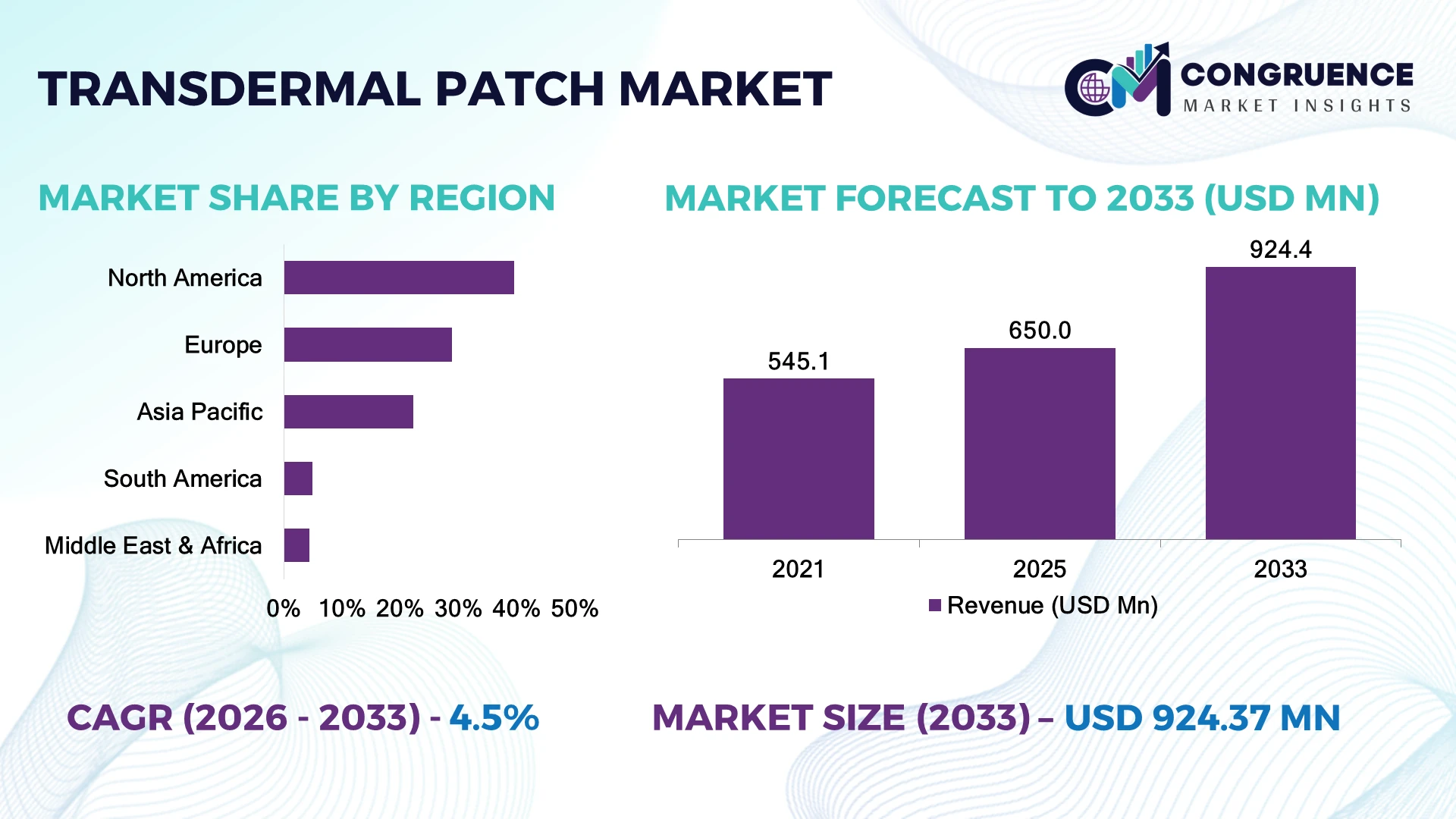
The Global Transdermal Patch Market was valued at USD 650.0 Million in 2025 and is anticipated to reach a value of USD 924.4 Million by 2033 expanding at a CAGR of 4.5% between 2026 and 2033. Growth is driven by controlled-release drug delivery, drug-in-adhesive formulations, microneedle technologies, and pharmaceutical investment in non-invasive dosage platforms.
The United States holds the dominant position with approximately 39.5% market share, supported by advanced pharmaceutical R&D, established transdermal manufacturing, and strong adoption of self-administered therapies. Japan maintains a technology-focused position, while China is expanding pharmaceutical manufacturing capacity and investment in advanced drug-delivery systems. The U.S. therefore maintains a substantially larger commercial base than Japan, reinforcing its leadership in transdermal patch adoption and innovation.
The strategic priority is to combine advanced formulation technologies with localized manufacturing and resilient specialty-material supply chains.
Market Size & Growth: USD 650.0 Million in 2025 to USD 924.4 Million by 2033 at a 4.5% CAGR, supported by controlled-release formulations.
Top Growth Drivers: Controlled drug delivery 35%; chronic therapy adoption 30%; non-invasive administration 25%.
Short-Term Forecast: By 2028, automated coating can reduce manufacturing waste by 8–10% and improve production consistency by 10%.
Emerging Technologies: Microneedles, advanced polymer matrices, and smart patches are improving permeability and dose control.
Regional Leaders: North America USD 360 Million, Europe USD 255 Million, and Asia Pacific USD 185 Million by 2033.
Consumer/End-User Trends: Around 40% of patients prioritize convenient self-administration across chronic-care therapies.
Pilot/Case Example: 2025 digital manufacturing initiatives targeted 10–15% reductions in material handling and production variability.
Competitive Landscape: North America holds approximately 39.5% share; key players include Teva, Novartis, Viatris, Teikoku Pharma, and Hisamitsu.
Regulatory & ESG Impact: Automated production can reduce manufacturing waste by 5–10% while strengthening pharmaceutical quality controls.
Investment & Funding: More than USD 1 billion is directed toward drug-delivery R&D, manufacturing expansion, partnerships, and formulation innovation.
Innovation & Future Outlook: Microneedles, smart patches, advanced adhesives, and precision-release systems are shifting competition toward differentiated delivery performance.
The Transdermal Patch Market is gaining traction in pain management, hormone therapy, smoking cessation, neurological treatment, and chronic-care applications. Advanced adhesives and microstructured delivery systems are expanding therapeutic flexibility, with approximately 40% of users emphasizing administration convenience. Pharmaceutical manufacturers are also localizing specialty-material sourcing as supply-chain restructuring and tighter quality requirements increase operational scrutiny, supporting more resilient production strategies.
The transdermal patch market is becoming strategically important as pharmaceutical companies prioritize controlled drug exposure, simplified administration, and differentiated delivery platforms. Approximately 47% of established transdermal formulations use drug-in-adhesive architectures, creating a substantial base for technology upgrades. The shift toward self-administered therapies is strengthening the strategic value of patches in chronic-care and outpatient treatment.
Technology modernization is improving production performance. Automated coating and inline inspection can reduce process variability by approximately 10% compared with less automated production, while advanced polymer matrices provide tighter drug-release control. The United States retains the strongest commercial infrastructure, Japan emphasizes precision delivery technologies, and China is expanding pharmaceutical manufacturing capabilities. Over the next 2–3 years, automated production is positioned to deliver 8–12% improvements in manufacturing efficiency.
A practical deployment model combines automated coating, machine-vision inspection, and digitally monitored batch release. Companies are increasing investment in microneedle R&D, specialty-material qualification, localized manufacturing, and technology partnerships. Reduced material waste also supports ESG objectives where automation improves process yield. Competitive advantage will increasingly depend on precision manufacturing, regulatory readiness, reliable material access, and scalable advanced delivery technologies.
Controlled-release drug delivery is strengthening transdermal patch adoption by providing sustained drug exposure while reducing dosing frequency. Drug-in-adhesive systems account for approximately 47% of established formulations, while advanced microneedle technologies represent around 12% of emerging transdermal delivery development. The United States remains a leading commercialization hub, supported by pharmaceutical R&D and advanced manufacturing infrastructure. Regulatory emphasis on dose uniformity is accelerating investment in precision coating and polymer technologies. Companies are responding through formulation partnerships, automated production, and microneedle R&D. The key operational advantage is improved batch consistency, with digital coating controls capable of improving manufacturing uniformity by approximately 10%.
Specialized adhesives, polymers, active pharmaceutical ingredients, and release liners create structural cost and supply exposure. Acrylate-based adhesives represent more than 80% of established adhesive applications, concentrating procurement around qualified suppliers. Reformulating a patch can increase validation and testing workloads by approximately 10–15% because changes can affect adhesion, permeability, stability, and drug release. Geopolitical tensions and logistics constraints have increased procurement pressure on pharmaceutical manufacturers. Companies are reducing exposure through dual sourcing, regional supplier qualification, longer-term procurement contracts, and localized inventories. The key strategic limitation is that low-cost substitution cannot proceed without demonstrating equivalent performance and maintaining regulatory compliance.
Microneedle technology is creating opportunities to expand transdermal delivery into compounds facing permeability limitations with conventional patches. Microneedle platforms represent approximately 12% of emerging transdermal delivery development, while specialty therapies are attracting increased formulation investment. China and India provide strong opportunities through expanding pharmaceutical production ecosystems and clinical infrastructure. Smart patches integrating sensing and controlled delivery are opening additional applications. Companies are increasing R&D partnerships around biodegradable microneedles, advanced polymers, and connected delivery systems. A distinctive opportunity is retrofitting established patch manufacturing platforms with microstructured delivery components, enabling technology upgrades without complete replacement of existing production infrastructure.
Scaling advanced transdermal platforms from laboratory production to commercial volumes creates substantial execution complexity. Microneedle integration, precision coating, adhesive uniformity, and drug-device compatibility can increase manufacturing complexity by approximately 15–20% compared with conventional passive patches. Connected systems add software validation and cybersecurity requirements, while automated production increases demand for specialized technical skills. The United States has the most mature commercial infrastructure, whereas emerging manufacturing hubs require continued investment in validation and quality-control systems. Companies must strengthen automated inspection, workforce training, digital manufacturing, and technology partnerships. Maintaining consistent product performance remains critical, as a process deviation of 5% can increase batch-release pressure and reduce production efficiency.
Automation Improves Manufacturing Precision: Pharmaceutical manufacturers are expanding automated coating, inline inspection, and digital batch monitoring, targeting 8–12% lower material waste and approximately 10% higher process consistency. U.S. and European producers are increasingly integrating machine-vision controls to reduce manual inspection workloads. This operational shift is improving throughput and reducing rework, while tighter quality expectations are pushing companies toward digitally validated production workflows.
Online Channels Reshape Replenishment: Digital pharmacy adoption is changing how transdermal patches reach long-term users, with online pharmacies projected to expand at an 8.1% annual rate through the forecast period. Hospital pharmacies still represented 39.6% of distribution in 2025, but online fulfillment is gaining relevance for recurring therapies. Manufacturers are responding with smaller shipping-ready packs, e-prescription integration, and partnerships with digital pharmacy platforms.
Matrix Designs Gain Formulation Flexibility: Matrix patches are becoming more prominent as manufacturers seek simpler formulation architectures and scalable production. The segment is projected to expand at an 8.1% annual rate, supported by formulation flexibility and manufacturing cost advantages, while multi-layer drug-in-adhesive patches retained 36.7% share in 2025. Companies are reallocating formulation R&D toward polymer systems that improve drug dispersion and release consistency.
Home-Based Therapy Gains Ground: Healthcare delivery is shifting toward self-administered treatment, with home-care settings accounting for approximately 52% of transdermal patch use in the latest patch-specific assessment. Hospitals remain important for supervised therapies, but home-based deployment is reducing routine facility visits and supporting chronic-care workflows. Companies are responding through easier application formats, clearer packaging, digital adherence support, and home-delivery partnerships.
Multi-layer drug-in-adhesive patches led the market with approximately 36.7% share in 2025, reflecting their ability to combine adhesive functionality with controlled and sustained drug release. Their layered architecture supports formulation flexibility, dose management, and integration across pain, hormonal, and chronic-care therapies. Single-layer drug-in-adhesive systems remain commercially important because of simpler construction and established manufacturing workflows, while reservoir patches retain relevance where membrane-controlled release is essential. Vapor patches remain a specialized category with narrower therapeutic applications.
Matrix patches represent the fastest-growing type, supported by formulation flexibility and manufacturing economics, with an estimated 8.1% annual growth trajectory. Their polymer-based structure allows manufacturers to optimize drug dispersion without adding complex reservoir components. This is shifting investment toward polymer engineering, adhesive optimization, and scalable coating systems. Companies are increasingly balancing the mature multi-layer drug-in-adhesive platform against matrix designs that offer greater manufacturing flexibility and cost control. The strategic implication is a gradual shift from purely established architectures toward formulations that improve production efficiency without compromising release performance.
Pain relief remained the leading application in 2025, accounting for approximately 22.9% of market share. Demand is concentrated around chronic pain management because patches provide sustained delivery while reducing dosing frequency. Nicotine cessation, hormone replacement therapy, neurological disorders, cardiovascular disorders, and other applications form important secondary demand pools. The established pain-relief segment benefits from mature products and broad clinical familiarity, whereas smoking-reduction applications are gaining momentum as healthcare systems increasingly emphasize structured cessation pathways.
The fastest-growing application shift is occurring in smoking reduction, supported by expanding use of transdermal nicotine delivery and consumer preference for controlled dosing. Cardiovascular applications also remain strategically relevant because transdermal systems support continuous administration for selected therapies. Companies are adapting product portfolios toward specialized therapeutic indications, patient-friendly wear profiles, and longer-duration formulations. Pain management therefore remains the volume anchor, while nicotine cessation and neurological applications are becoming more important for portfolio diversification.
Home care settings represent the dominant end-user group, accounting for approximately 52% of transdermal patch use in the latest patch-specific assessment. The segment benefits from self-administration, reduced facility visits, and suitability for long-term therapies. Hospitals and clinics remain important for prescription-grade products, supervised treatment, and acute-care applications. The contrast reflects a broader shift from institution-centered medication management toward decentralized treatment, particularly for chronic conditions requiring repeated administration.
Hospitals and clinics remain the principal institutional buying group, while home care is strengthening its position through easier application formats, caregiver support, and digital replenishment. In the broader transdermal delivery market, home-care settings accounted for approximately 57.9% in 2025, reinforcing the structural movement toward self-administered therapies. Companies are responding by improving packaging instructions, developing simplified application mechanisms, and building pharmacy and home-delivery partnerships. The strategic implication is a shift in product design toward usability outside clinical environments.
North America accounted for the largest market share at 39.5% in 2025 however, Asia Pacific is expected to register the fastest growth, expanding at a CAGR of 8.4% between 2026 and 2033.

North America represented 39.5% of the global transdermal patch market in 2025, supported by advanced pharmaceutical manufacturing, established reimbursement pathways, and high utilization of chronic-care therapies. The United States remains the principal commercial hub, with strong activity across pain management, hormone therapy, smoking cessation, and neurological treatment. In 2025, domestic manufacturing expansion included a USD 6 million facility upgrade by LGM Pharma, strengthening supply resilience for pharmaceutical and specialty drug-delivery products. FDA combination-product pathways continue to support commercialization of innovative patch technologies, while aging populations are increasing demand for administration formats requiring minimal dexterity. Companies are prioritizing domestic capacity, automated production, formulation development, and partnerships that reduce dependence on imported specialty materials.
United States Market Outlook: The United States remains the largest country market, supported by sophisticated pharmaceutical R&D, extensive hospital and retail pharmacy infrastructure, and strong commercialization capabilities. The country held the largest global country position in 2025, while regulatory clarity and established manufacturing ecosystems continue to support advanced patch development and product launches.
Europe accounted for approximately 28.9% of the global transdermal patch market in 2025, establishing a mature commercial base supported by pharmaceutical manufacturing, hospital pharmacy networks, and strong demand for hormone replacement and chronic-care therapies. The European Medicines Agency's clarification of drug-device integration requirements has improved regulatory predictability, while implementation of the Medical Device Regulation continues to increase compliance and documentation requirements. Recent estradiol supply shortages have highlighted the importance of regional manufacturing redundancy and qualified alternative suppliers. Companies are responding by strengthening localized procurement, expanding formulation capabilities, and increasing production resilience. Digital pharmacy adoption is also changing replenishment workflows, while sustainability priorities are encouraging more efficient packaging and material utilization across pharmaceutical manufacturing.
Germany Market Outlook: Germany is one of Europe's strategically important pharmaceutical manufacturing markets, supported by advanced chemical and pharmaceutical production infrastructure and a highly developed healthcare system. The country represented approximately 10% of Europe's transdermal patch market in 2025, providing manufacturers with strong access to hospital procurement networks, specialty pharmacies, formulation expertise, and established pharmaceutical distribution channels.
Asia Pacific is the fastest-growing major market, with the regional market expected to expand at an 22.2% CAGR through 2033. China, Japan, and India are driving the region's manufacturing and adoption momentum, while healthcare infrastructure expansion is increasing access to non-invasive drug-delivery technologies. The regional market was valued at approximately USD 1.47 billion in 2025, with hospital pharmacies representing the largest distribution channel and online pharmacies showing the fastest expansion. China is strengthening domestic pharmaceutical production, Japan is advancing precision transdermal technologies, and India is expanding cost-efficient formulation manufacturing. Companies are increasingly localizing production, partnering with domestic pharmaceutical firms, and developing products suited to large outpatient and home-care populations.
China Market Outlook: China is positioned as the leading Asia-Pacific country market and is projected to reach approximately USD 618.4 million by 2033. Its advantage stems from large-scale pharmaceutical manufacturing, expanding healthcare infrastructure, and increasing adoption of advanced drug-delivery technologies. Domestic production capabilities are enabling companies to shorten supply chains and improve cost competitiveness while supporting broader access to transdermal therapies.
South America remains a smaller but strategically relevant market, with approximately 5.0% of the global transdermal patch market in 2025 in regional market assessments. Brazil represents the principal commercial hub because of its large healthcare system, pharmaceutical manufacturing base, and extensive retail pharmacy network. Demand is concentrated in pain management, hormone therapy, and smoking cessation applications, while import dependence for specialized pharmaceutical materials continues to affect procurement economics. Companies are strengthening relationships with local distributors and prioritizing products that can move through established pharmacy channels without complex infrastructure requirements. Expansion of outpatient care and private healthcare coverage is supporting broader deployment, although price sensitivity remains an important purchasing consideration.
Brazil Market Outlook: Brazil is the most strategically significant South American market because of its population scale, established pharmaceutical industry, and broad pharmacy distribution infrastructure. Local manufacturers and multinational suppliers benefit from access to a large prescription and consumer healthcare base. The country's scale supports localized packaging, distributor partnerships, and portfolio expansion across pain-management and chronic-care patch applications.
Middle East & Africa represented approximately 4.4% of the global transdermal patch market in 2025, but modernization of healthcare infrastructure is creating selective opportunities. Saudi Arabia is the region's leading market and accounted for approximately 0.8% of global market activity, supported by hospital modernization, private healthcare expansion, and pharmaceutical procurement development. Hospital pharmacies remain the largest distribution channel, while online pharmacies are expanding rapidly as digital healthcare infrastructure improves. Saudi healthcare transformation initiatives are encouraging greater localization and technology adoption, while import dependence continues to make supply-chain reliability important. Companies are responding through distributor partnerships, localized inventory, digital pharmacy channels, and selective manufacturing investments focused on high-demand therapeutic categories.
Saudi Arabia Market Outlook: Saudi Arabia is the leading Middle Eastern transdermal patch market, with the country market valued at approximately USD 51.0 million in 2025. Hospital pharmacies represent the largest end-use channel, while online pharmacies are the fastest-growing channel. Healthcare modernization, private-sector investment, and centralized procurement are creating a stronger commercial environment for advanced transdermal therapies.
The market pits established pharmaceutical leaders such as Viatris, Teva Pharmaceutical Industries, Novartis, Hisamitsu Pharmaceutical, and Kindeva Drug Delivery against specialist innovators including Medherant and Nutriband. The top five players collectively command approximately 55% of market value, creating a moderately concentrated structure. Competition centers on formulation performance, manufacturing scale, regulatory execution, and supply reliability, with technology-led products targeting 10–15% improvements in delivery consistency and automated production reducing waste by 8–10%. Viatris is advancing lower-dose weekly contraceptive patches, while Nutriband and Kindeva combine abuse-deterrent technology with established manufacturing infrastructure. Medherant differentiates through high-payload adhesive technology, while regional manufacturers compete through cost and localized supply. The competitive shift is moving from conventional patch production toward differentiated delivery platforms, lifecycle extensions, and specialized therapeutic applications. High regulatory validation costs, clinical requirements, and proprietary adhesive technologies remain major entry barriers. Winning requires scalable manufacturing, differentiated drug-delivery technology, strong regulatory execution, and resilient pharmaceutical supply chains.
Viatris Inc.
Teva Pharmaceutical Industries Ltd.
Novartis AG
Hisamitsu Pharmaceutical Co., Inc.
Kindeva Drug Delivery
Bayer AG
Teikoku Seiyaku Co., Ltd.
Nutriband Inc.
Medherant Ltd.
AdhexPharma
Endo International plc
Starton Therapeutics, Inc.
Drug-in-adhesive systems remain the established technology base, while matrix architectures, solvent-free adhesives, microneedles, and advanced permeation enhancers are reshaping formulation development. Multi-layer drug-in-adhesive systems represented approximately 36.7% of type demand, reflecting strong commercial integration. Newer matrix and high-payload adhesive platforms can improve formulation flexibility by approximately 10–15% while reducing structural complexity.
Solvent-free adhesive processing is gaining attention as manufacturers target lower material handling and improved environmental performance. Medherant’s TEPI Patch platform supports drug payloads of up to 50 wt%, compared with conventional systems that frequently require tighter payload constraints. Automated coating and machine-vision inspection can improve production consistency by roughly 10% and reduce waste by 8–12%. Technology leaders therefore gain an advantage through higher throughput, better dose uniformity, and reduced rework.
From 2026–2028, microneedle arrays, smart patches, connected adherence systems, and precision-release polymers will move from specialized development toward broader commercial integration. Companies with established pharmaceutical manufacturing infrastructure benefit most because new technologies can be integrated into validated production workflows rather than built independently. The competitive priority is shifting toward scalable platforms that combine high drug loading, reliable adhesion, controlled permeation, and digitally monitored manufacturing.
February 2025 — Nutriband and Kindeva formalized an exclusive development partnership for Aversa Fentanyl, combining abuse-deterrent technology with an established fentanyl patch platform. The agreement uses shared development costs and milestone payments, strengthening commercialization economics.
May 2025 — AMW and AdhexPharma completed the 30-month transfer of transdermal delivery systems, including manufacturing equipment and intellectual property for buprenorphine and rivastigmine products. The transfer strengthened AdhexPharma’s commercial manufacturing position. Source: adhexpharma.com
May 2025 — Viatris reported Phase 3 results for its XULANE LO weekly contraceptive patch involving 1,272 participants across 81 investigative sites. The results supported planned U.S. regulatory submission and strengthened its lower-estrogen transdermal portfolio. Source: viatris.com
October 2025 — Medherant reported positive Phase 1 results for its testosterone TEPI Patch in post-menopausal women, demonstrating delivery that restored testosterone levels to the normal pre-menopausal range. A multiple-dose study was planned for Q4 2025. Source: medherant.co.uk
The Transdermal Patch Market Report covers the industry across product types, applications, end-users, distribution structures, and major geographic markets. Type analysis includes multi-layer drug-in-adhesive, single-layer drug-in-adhesive, reservoir, matrix, and vapor patches. Application coverage spans pain relief, nicotine cessation, hormone replacement therapy, neurological disorders, cardiovascular disorders, and other therapeutic uses, while end-user analysis evaluates home care, hospitals, and clinics.
The report assesses North America, Europe, Asia Pacific, South America, and Middle East & Africa, with country-level perspectives on manufacturing, adoption, pharmaceutical infrastructure, and technology deployment. It also evaluates advanced adhesives, microneedles, controlled-release systems, automated manufacturing, and emerging smart-patch technologies. These insights support investment planning, market-entry decisions, manufacturing localization, partnership development, competitive positioning, and portfolio prioritization through 2026–2033.
| Report Attribute / Metric | Details |
|---|---|
| Market Revenue (2025) | USD 650.0 Million |
| Market Revenue (2033) | USD 924.4 Million |
| CAGR (2026–2033) | 4.5% |
| Base Year | 2025 |
| Forecast Period | 2026–2033 |
| Historic Period | 2021–2025 |
| Segments Covered |
By Type
By Application
By End-User
|
| Key Deliverables | Revenue Forecast; Market Trends; Growth Drivers & Restraints; Technology Insights; Segmentation Analysis; Regional Insights; Competitive Landscape; Regulatory & ESG Overview; Recent Developments |
| Regions Covered | North America; Europe; Asia-Pacific; South America; Middle East & Africa |
| Companies Profiled | Viatris Inc.; Teva Pharmaceutical Industries Ltd.; Novartis AG; Hisamitsu Pharmaceutical Co., Inc.; Kindeva Drug Delivery; Bayer AG; Teikoku Seiyaku Co., Ltd.; Nutriband Inc.; Medherant Ltd.; AdhexPharma; Endo International plc; Starton Therapeutics, Inc. |
| Customization & Pricing | Available on Request (10% Customization Free) |




