Global Tissue Contact Probe Ablators Market Report Overview
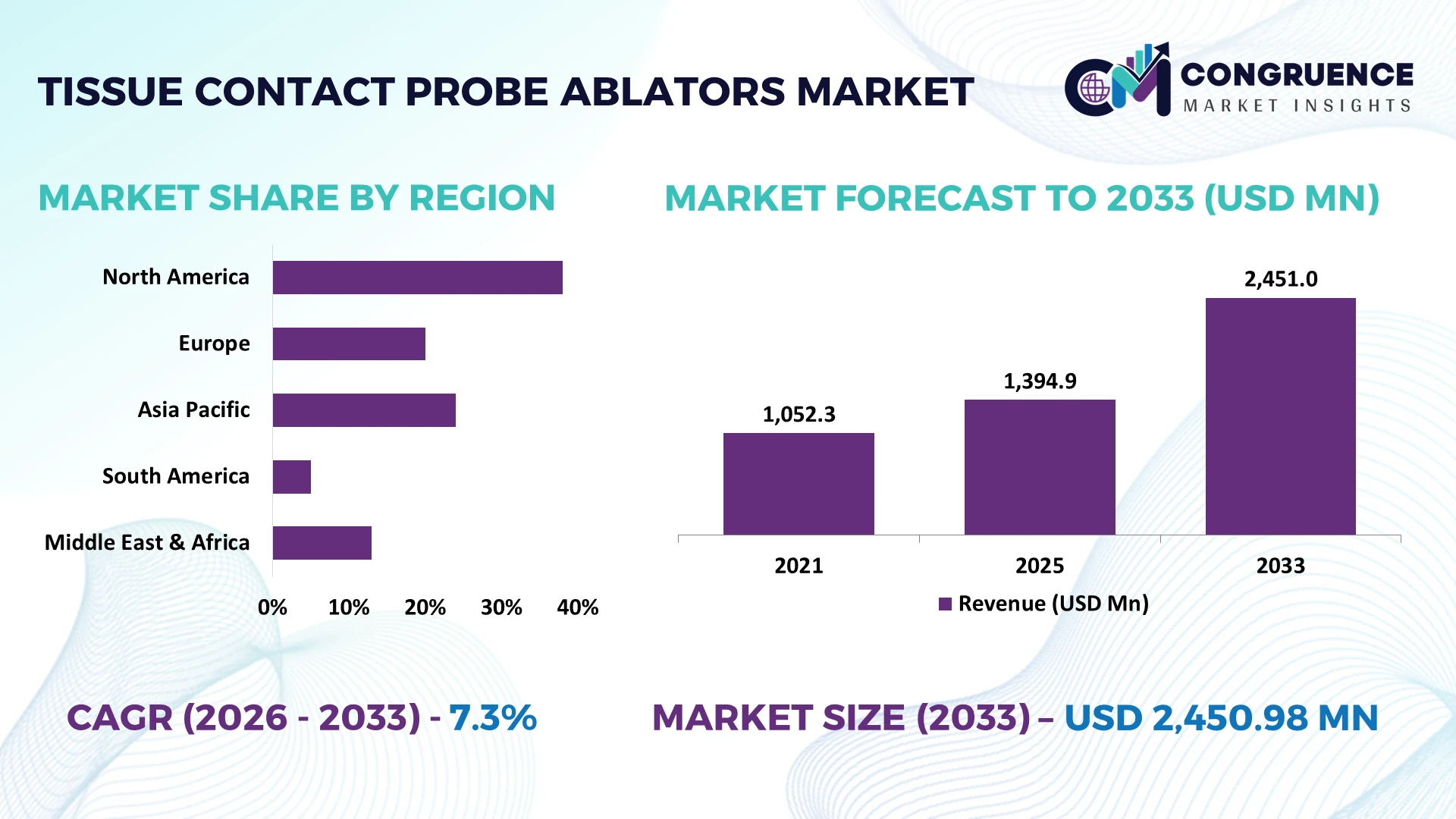
The Global Tissue Contact Probe Ablators Market was valued at USD 1394.9 Million in 2025 and is anticipated to reach a value of USD 2450.98 Million by 2033 expanding at a CAGR of 7.3% between 2026 and 2033. Growth is driven by increasing catheter ablation procedures for atrial fibrillation, adoption of contact force sensing technologies, expansion of electrophysiology laboratories, and advances in pulsed field ablation systems.
The United States leads the global tissue contact probe ablators market, with an estimated 42% share, supported by advanced electrophysiology infrastructure and substantial cardiovascular device investment. The country performs more than 100,000 atrial fibrillation ablation procedures annually, supporting demand for precision tissue contact monitoring. Abbott, Boston Scientific, and Johnson & Johnson MedTech are advancing catheter technologies and procedural integration. Compared with India, the United States benefits from broader specialist access and established reimbursement pathways. FDA clearance of next generation ablation technologies is accelerating clinical adoption and hospital procurement.
Strategically, manufacturers targeting 20% faster procedural workflows and 15% improved catheter positioning efficiency through contact sensing and advanced mapping integration can strengthen competitive differentiation.
Key Highlights of the Global Tissue Contact Probe Ablators Market
-
Market Size & Growth: USD 1,394.9 million in 2025, reaching USD 2,450.98 million by 2033 at 7.3% CAGR, supported by advanced cardiac ablation technology adoption.
-
Top Growth Drivers: Illustrative growth contributions include atrial fibrillation treatment demand at 40%, electrophysiology infrastructure expansion at 35%, and precision catheter adoption at 25%.
-
Short Term Forecast: By 2028, integrated mapping and contact sensing systems target 20% faster catheter positioning and 15% fewer repositioning events.
-
Emerging Technologies: Three innovations dominate development: pulsed field ablation, AI assisted electroanatomical mapping, and real time contact force sensing.
-
Regional Leaders: Illustrative 2033 allocations place North America at USD 1,078.43 million, Europe at USD 686.27 million, and Asia Pacific at USD 490.20 million, emphasizing advanced electrophysiology, precision ablation, and hospital infrastructure expansion.
-
Consumer and End User Trends: Hospitals represent an estimated 70% of device demand, supported by specialized electrophysiology laboratories and integrated cardiac mapping infrastructure.
-
Pilot and Case Example: The 2024 ADVENT clinical trial publication reported 73.3% treatment success with pulsed field ablation versus 71.3% with thermal ablation.
-
Competitive Landscape: Johnson & Johnson MedTech is a leading participant, alongside Abbott, Boston Scientific, Medtronic, and AtriCure, competing across advanced cardiac ablation platforms.
-
Regulatory & ESG Impact: The FDA authorized Boston Scientific's FARAPULSE system in 2024, introducing a nonthermal ablation option designed to reduce collateral tissue injury.
-
Investment & Funding: An illustrative USD 100 million industry investment scenario prioritizes electrophysiology research, catheter manufacturing capacity, and advanced mapping integration.
-
Innovation & Future Outlook: By 2033, next generation platforms will emphasize 3 capabilities: automated lesion assessment, precision energy delivery, and integrated procedural navigation.
The Tissue Contact Probe Ablators Market is increasingly influenced by complex arrhythmia treatment requirements, minimally invasive cardiac interventions, and demand for predictable lesion formation. Contact force sensing catheters improve electrode stability assessment, while pulsed field ablation introduces tissue selective energy delivery. Advanced electroanatomical mapping platforms strengthen procedural navigation and reduce reliance on conventional fluoroscopy. In the ADVENT trial, pulsed field ablation achieved 73.3% treatment success, supporting clinical interest in alternative energy modalities. FDA approvals and expanding electrophysiology training programs are influencing hospital purchasing decisions, establishing procedural precision, clinical evidence, and integrated technology platforms as priorities for strategic market development.
What Is the Strategic Relevance and Future Pathways of the Tissue Contact Probe Ablators Market?
Tissue contact probe ablators are becoming strategically important as cardiovascular device manufacturers compete to improve lesion durability, procedural safety, and electrophysiology laboratory productivity. Atrial fibrillation affects approximately 2% to 3% of adults globally, strengthening the clinical importance of catheter ablation technologies. The transition from conventional thermal energy delivery toward contact force sensing and pulsed field ablation is restructuring hospital procurement priorities. Manufacturers are investing in integrated electroanatomical mapping, catheter navigation, and precision energy delivery platforms to strengthen procedural differentiation.
Contact force sensing provides real time electrode pressure feedback, supporting more consistent lesion formation than conventional catheters without force measurement. In the ADVENT trial, pulsed field ablation achieved 73.3% treatment success compared with 71.3% for thermal ablation. The United States leads advanced electrophysiology deployment, while Germany maintains established cardiac intervention infrastructure and India expands specialized arrhythmia treatment capacity. Between 2026 and 2028, manufacturers are targeting 15% to 20% improvements in procedural workflow efficiency through integrated mapping and automated lesion assessment.
Boston Scientific's FARAPULSE deployment demonstrates how alternative energy platforms are influencing clinical purchasing decisions. Abbott, Medtronic, and Johnson & Johnson MedTech are strengthening technology portfolios, physician training, and hospital partnerships. Competitive advantage increasingly depends on validated clinical outcomes, integrated procedural ecosystems, and dependable catheter performance.
Tissue Contact Probe Ablators Market Dynamics
DRIVER:
Rising Atrial Fibrillation Treatment and Precision Ablation Adoption
Increasing atrial fibrillation prevalence and growing preference for minimally invasive rhythm management are strengthening demand for tissue contact probe ablators. Atrial fibrillation affects approximately 2% to 3% of adults, creating sustained requirements for electrophysiology interventions. The ADVENT clinical trial demonstrated 73.3% treatment success with pulsed field ablation compared with 71.3% using conventional thermal ablation. FDA authorization of advanced pulsed field ablation systems in 2024 accelerated technology availability in the United States. Contact force sensing improves electrode tissue interaction monitoring and supports consistent lesion delivery. Boston Scientific, Abbott, and Johnson & Johnson MedTech are expanding catheter portfolios, physician training, and mapping integration. Clinical differentiation increasingly depends on procedural reproducibility rather than energy delivery capability alone.
RESTRAINT:
High Procedural Costs and Specialized Infrastructure Requirements
Advanced tissue contact probe ablation systems require substantial investment in electroanatomical mapping, energy generators, disposable catheters, and specialized clinical personnel. In an illustrative hospital procurement scenario, equipment acquisition accounts for 35% of initial program expenditure, while disposable devices represent approximately 25% of recurring procedural costs. Hospitals targeting a 15% reduction in operating expenses face challenges when proprietary catheters require dedicated generators and mapping platforms. India's uneven electrophysiology infrastructure and limited specialist availability constrain deployment outside major metropolitan hospitals. Device manufacturers are responding through equipment leasing, bundled procurement agreements, and clinical training partnerships. Standardized consumable contracts and improved equipment utilization are becoming essential for maintaining procedural affordability and protecting hospital operating margins.
OPPORTUNITY:
Integrated Pulsed Field Ablation and Intelligent Mapping Platforms
Integration of pulsed field ablation with advanced contact sensing and electroanatomical mapping creates opportunities for differentiated cardiac intervention platforms. Automated lesion assessment targets 20% faster procedural decision making, while intelligent catheter navigation offers an estimated 15% reduction in unnecessary repositioning. Integrated workflow software can support approximately 25% fewer manual mapping adjustments under optimized deployment scenarios. The United States is advancing nonthermal ablation adoption following FDA authorization of multiple pulsed field technologies, creating opportunities for compatible catheter designs and integrated procedural systems. Manufacturers are investing in catheter research, mapping software, and clinical partnerships to strengthen platform adoption. A significant opportunity lies in combining energy delivery and procedural intelligence, allowing hospitals to improve laboratory utilization without proportionate increases in staffing.
CHALLENGE:
Clinical Validation and Complex Multiplatform Integration
Long term market competitiveness depends on demonstrating durable lesion formation, procedural safety, and consistent performance across different cardiac anatomies. In the ADVENT trial, pulsed field ablation achieved 73.3% treatment success compared with 71.3% for thermal ablation, illustrating the importance of comparative clinical evidence. An illustrative deployment scenario indicates that fragmented mapping integration can increase procedural setup time by 15%, while inadequate catheter navigation training can generate 20% more workflow interruptions. Hospitals in Germany and the United States must also manage evolving device cybersecurity requirements and postmarket clinical surveillance. Manufacturers are strengthening multicenter clinical studies, interoperability development, and physician certification programs. Sustainable differentiation requires validated outcomes, standardized procedural protocols, and reliable integration across electrophysiology platforms.
Tissue Contact Probe Ablators Market Latest Trends
-
Expansion of Image Guided Ablation Workflows: Hospitals are integrating ultrasound, computed tomography, and magnetic resonance imaging into tumor ablation procedures. Multimodal imaging targets 15% to 20% greater lesion localization efficiency and 10% fewer positioning adjustments in optimized workflows. Medtronic and Boston Scientific are strengthening imaging compatibility and procedural planning capabilities. This transition improves treatment precision, particularly for tumors adjacent to sensitive anatomical structures, while supporting consistent interventional radiology operations.
-
Increasing Preference for Outpatient Ablation: US healthcare providers are evaluating outpatient treatment pathways for appropriately selected tumor ablation patients. Ambulatory workflows target 20% to 30% shorter facility utilization periods and 15% lower procedural overhead compared with inpatient pathways. Device manufacturers are developing compact generators and simplified probe configurations, enabling selected procedures outside conventional operating theaters while maintaining imaging and anesthesia requirements.
-
Growing Emphasis on Disposable Probe Standardization: Hospitals are consolidating single use ablation probe purchasing to improve inventory control and procedural consistency. Standardized procurement programs target 10% to 15% lower inventory handling costs and 20% fewer product configuration errors. Manufacturers are expanding compatible probe portfolios and negotiating multiyear supply agreements. This approach reduces operational disruption while improving availability across interventional oncology departments.
-
Increasing Use of Thermal Monitoring: Real time temperature monitoring is gaining importance in protecting adjacent tissue during radiofrequency, microwave, and cryoablation procedures. Integrated monitoring targets 15% fewer thermal management adjustments and 20% faster identification of treatment boundary deviations. Manufacturers are refining probe sensors and generator feedback systems, strengthening procedural control and supporting standardized safety protocols across complex tumor anatomies.
Segmentation Analysis
By Type
Radiofrequency Ablation Probes Maintain Established Clinical Leadership
Radiofrequency Ablation Probes represent the leading segment, with an estimated 42% market share, supported by established clinical protocols, extensive physician familiarity, and broad compatibility with image guided procedures. Their controlled thermal energy delivery supports treatment of selected liver, kidney, bone, and soft tissue tumors. Microwave Ablation Probes account for an indicative 30% share and represent the fastest expanding segment, supported by higher temperature generation, larger ablation zones, and reduced sensitivity to tissue electrical impedance. Manufacturers are investing in antenna design, cooling mechanisms, and generator integration to improve lesion predictability and procedural throughput.
Cryoablation Probes represent approximately 20% of demand, offering visible ice ball formation during imaging and controlled treatment near sensitive anatomical structures. Laser Ablation Probes account for the remaining estimated 8%, serving applications requiring localized energy delivery and compact instrumentation. Hospitals increasingly evaluate probe selection according to tumor location, ablation zone geometry, and procedural complexity. Medtronic, Boston Scientific, and other interventional oncology manufacturers are strengthening product portfolios through advanced thermal control, imaging compatibility, and specialized probe configurations.
- The Society of Interventional Radiology's 2025 clinical education activities emphasized image guided thermal ablation and multidisciplinary treatment planning. Radiofrequency, microwave, and cryoablation technologies remain important procedural options, with selection determined by tumor characteristics, anatomical accessibility, and treatment objectives.
By Application
Liver Tumor Ablation Leads Interventional Oncology Demand
Liver Tumor Ablation represents the largest application, with an estimated 40% market share, supported by established thermal ablation protocols for hepatocellular carcinoma and selected metastatic liver lesions. Image guided radiofrequency and microwave procedures provide localized treatment options for patients unsuitable for surgical resection. Lung Tumor Ablation accounts for an indicative 25% share and represents the fastest expanding application, supported by increasing use of minimally invasive treatment for selected early stage tumors and metastatic lesions. Manufacturers are improving probe geometry, thermal control, and imaging compatibility to address respiratory motion and pulmonary tissue characteristics.
Kidney Tumor Ablation represents approximately 18% of demand, supported by nephron sparing treatment strategies for selected small renal masses. Bone Tumor Ablation contributes an estimated 10%, addressing painful metastatic lesions and selected benign tumors. Soft Tissue Tumor Ablation accounts for approximately 7%, requiring precise energy delivery around critical anatomical structures. Hospitals are strengthening multidisciplinary treatment pathways, while manufacturers are expanding specialized probes and procedural planning technologies. Competitive differentiation increasingly depends on anatomical precision, reproducible ablation margins, and compatibility with existing imaging infrastructure.
- The American Cancer Society estimated approximately 42,240 new liver and intrahepatic bile duct cancer cases in the United States during 2025. This disease burden reinforces the importance of localized treatment technologies within multidisciplinary oncology programs.
By End-User
Hospitals Dominate Advanced Tumor Ablation Deployment
Hospitals represent the leading end user segment, accounting for an estimated 65% of market demand, supported by established interventional radiology departments, oncology infrastructure, and access to advanced imaging equipment. Complex tumor ablation procedures require multidisciplinary coordination involving radiologists, oncologists, anesthesiologists, and surgical specialists. Specialty Cancer Centers account for approximately 20% of demand and represent the fastest expanding segment, supported by dedicated tumor treatment programs and specialized procedural expertise. Manufacturers are strengthening hospital partnerships through integrated generator platforms, clinical training, and procedure specific probe portfolios.
Ambulatory Surgical Centers represent an estimated 10% of demand, concentrating on selected lower complexity procedures with appropriate imaging and monitoring capabilities. Academic and Research Institutes contribute approximately 5%, supporting clinical trials, ablation technology evaluation, and treatment protocol development. Specialty Cancer Centers increasingly prioritize multimodal imaging compatibility, procedural standardization, and advanced thermal monitoring. Device manufacturers are responding through bundled equipment agreements, physician education, and specialized oncology partnerships. Competitive positioning depends on clinical evidence, equipment utilization, consumable availability, and reliable procedural support across treatment settings.
- The American College of Radiology's 2025 interventional radiology guidance emphasizes imaging expertise, patient selection, and procedural safety in minimally invasive tumor treatment. These requirements reinforce hospitals' infrastructure advantage while supporting specialized cancer center investment in dedicated ablation capabilities.
Region-Wise Market Insights
North America accounted for the largest market share at an estimated 44% in 2025 however, Asia Pacific is expected to register the fastest growth, expanding at a CAGR of an estimated 9.1% between 2026 and 2033.

North America Tissue Contact Probe Ablators Market
Advanced Interventional Oncology Infrastructure and Precision Ablation Adoption
North America accounts for an estimated 44% of the global tissue contact probe ablators market, supported by established interventional oncology infrastructure, advanced imaging capabilities, and strong medical device innovation. The United States dominates regional deployment through comprehensive cancer centers, specialized radiology departments, and established reimbursement pathways. Radiofrequency, microwave, and cryoablation technologies support minimally invasive treatment of liver, lung, kidney, and selected bone tumors. The FDA regulates ablation device commercialization through established medical device approval and clearance pathways, strengthening clinical evidence requirements. Manufacturers including Medtronic, Boston Scientific, and Johnson & Johnson MedTech are investing in precision energy delivery, procedural navigation, and clinical education. Integrated imaging workflows target an estimated 15% to 20% improvement in probe positioning efficiency. Hospital procurement increasingly prioritizes validated ablation performance, generator compatibility, and predictable consumable availability.
United States Market Outlook: The United States maintains a leading position through advanced cancer treatment infrastructure and extensive clinical research capabilities. The National Cancer Institute supports a network of more than 70 designated cancer centers, strengthening access to specialized interventional oncology services. Hospitals in California, Texas, and Massachusetts are important centers for clinical innovation and minimally invasive tumor treatment. FDA oversight, established reimbursement mechanisms, and physician training programs support commercialization of advanced microwave and cryoablation systems.
Europe Tissue Contact Probe Ablators Market
Image Guided Oncology Expansion and Clinical Technology Standardization
Europe represents an estimated 28% of the global tissue contact probe ablators market, supported by established cancer treatment networks, specialist radiology services, and increasing utilization of minimally invasive tumor therapies. Germany, France, Italy, and the United Kingdom maintain substantial interventional oncology infrastructure, supporting radiofrequency, microwave, and cryoablation procedures. European Union Medical Device Regulation requirements emphasize clinical evidence, postmarket surveillance, and device traceability, influencing manufacturer investment and procurement decisions. Hospitals are integrating advanced computed tomography and magnetic resonance imaging with ablation platforms to improve anatomical targeting. Digital procedural planning targets an estimated 15% reduction in positioning adjustments and 20% faster treatment preparation under optimized workflows. Manufacturers are expanding clinical training partnerships and strengthening regulatory documentation capabilities. Competitive differentiation increasingly depends on procedural reliability, regulatory compliance, and compatibility with existing hospital imaging systems.
Germany Market Outlook: Germany represents a strategically important European market through its extensive hospital network, specialized oncology centers, and advanced medical technology infrastructure. University hospitals in Heidelberg, Munich, and Berlin support image guided tumor treatment and interventional radiology research. The German healthcare system emphasizes clinical evidence and procedural quality when evaluating advanced medical devices. Manufacturers are strengthening partnerships with specialist hospitals and research institutions to support microwave ablation, cryoablation, and integrated imaging applications.
Asia-Pacific Tissue Contact Probe Ablators Market
Expanding Cancer Treatment Capacity and Localized Medical Device Manufacturing
Asia Pacific accounts for an estimated 20% of the global tissue contact probe ablators market, supported by expanding oncology infrastructure, increasing cancer treatment requirements, and growing availability of minimally invasive procedures. China, Japan, India, and South Korea represent important markets for thermal ablation technologies and advanced interventional radiology services. China benefits from substantial domestic medical device manufacturing capacity, while Japan maintains sophisticated hospital imaging infrastructure and established clinical treatment protocols. India's expanding tertiary care networks are strengthening access to image guided liver and kidney tumor ablation. Domestic manufacturing initiatives and localized distribution partnerships are influencing device availability and procurement economics. Manufacturers are targeting an estimated 15% to 20% reduction in procedural equipment acquisition costs through localized production and service networks. Competitive positioning increasingly depends on affordability, physician training, and reliable technical support.
China Market Outlook: China represents a major regional opportunity through its extensive hospital system, domestic medical device production, and growing interventional oncology capabilities. Beijing, Shanghai, and Guangzhou maintain established specialist cancer treatment infrastructure. China's National Medical Products Administration oversees medical device registration and commercialization, influencing domestic product development and international market entry. Local manufacturers are advancing microwave and radiofrequency ablation platforms, while hospital procurement increasingly emphasizes clinical performance, equipment availability, and cost efficiency.
South America Tissue Contact Probe Ablators Market
Specialized Oncology Expansion and Hospital Equipment Modernization
South America represents an estimated 5% of the global tissue contact probe ablators market, with demand concentrated in Brazil, Argentina, Chile, and Colombia. Increasing investment in specialist cancer treatment infrastructure is supporting adoption of radiofrequency, microwave, and cryoablation technologies. Brazil maintains the region's largest healthcare delivery system, combining public hospital networks with private oncology providers. Advanced ablation procedures remain concentrated in major metropolitan centers because of imaging equipment costs and specialist availability. Hospitals are evaluating minimally invasive tumor treatment pathways to reduce inpatient utilization and improve procedural efficiency. Optimized outpatient ablation programs target an estimated 20% reduction in facility utilization time for appropriately selected patients. Manufacturers are strengthening distributor partnerships, physician education, and equipment maintenance networks. Market development depends on reimbursement accessibility, imported device availability, and sustainable hospital procurement models.
Brazil Market Outlook: Brazil leads regional tissue contact probe ablator adoption through its established oncology hospitals and specialized interventional radiology services. São Paulo and Rio de Janeiro maintain major cancer treatment facilities, including institutions conducting image guided tumor ablation. ANVISA regulates medical device commercialization, requiring manufacturers to maintain appropriate registration and compliance procedures. Hospital purchasing decisions increasingly emphasize equipment durability, procedural versatility, and reliable access to disposable probes, encouraging partnerships between international manufacturers and local distributors.
Middle East & Africa Tissue Contact Probe Ablators Market
Specialized Cancer Infrastructure Investment and Advanced Treatment Deployment
The Middle East and Africa represent an estimated 3% of the global tissue contact probe ablators market, supported by investment in specialized oncology hospitals, advanced diagnostic imaging, and minimally invasive cancer treatment services. Saudi Arabia, the United Arab Emirates, and South Africa maintain important specialist healthcare infrastructure. Government healthcare modernization programs are supporting hospital equipment upgrades and advanced interventional radiology capabilities. Saudi Arabia's Vision 2030 healthcare transformation initiatives emphasize specialized treatment capacity and improved clinical service accessibility. Hospitals are evaluating integrated microwave and radiofrequency ablation platforms to strengthen localized tumor treatment capabilities. Advanced procedural workflows target an estimated 15% improvement in treatment preparation efficiency through coordinated imaging and intervention planning. Manufacturers are developing distributor networks, clinical training partnerships, and maintenance support programs to improve equipment availability and utilization.
Saudi Arabia Market Outlook: Saudi Arabia represents a strategically important market through sustained healthcare infrastructure investment and expansion of specialized cancer treatment services. Riyadh and Jeddah host major tertiary hospitals equipped with advanced diagnostic imaging and interventional radiology capabilities. The Saudi Food and Drug Authority regulates medical device authorization and market access. Healthcare transformation initiatives are encouraging adoption of minimally invasive oncology technologies, while manufacturers are strengthening local distribution, physician training, and technical service partnerships to support reliable deployment.
Market Competition Landscape
The tissue contact probe ablators market features competition between Medtronic, Boston Scientific, Johnson & Johnson MedTech, AngioDynamics, and Merit Medical Systems, alongside specialized thermal ablation manufacturers. An indicative competitive model places their combined share near 60%, reflecting established distribution networks and hospital procurement relationships. Medtronic emphasizes integrated microwave ablation systems, while Boston Scientific competes through cryoablation technologies and procedural innovation. AngioDynamics targets specialized oncology applications, whereas Merit Medical focuses on interventional product accessibility. Advanced thermal monitoring targets 15% fewer procedural adjustments, while integrated imaging workflows offer estimated 20% faster positioning. Manufacturers are expanding clinical partnerships, disposable probe portfolios, and physician education programs. Competition increasingly centers on treatment precision, procedural versatility, and equipment utilization rather than standalone device pricing. Regulatory clearance requirements, clinical validation expenses, and specialized distribution infrastructure restrict new entrants. Sustainable market leadership requires dependable clinical performance, integrated procedural support, competitive consumable economics, and scalable hospital relationships.
Companies Profiled in the Tissue Contact Probe Ablators Market Report
Technology Insights for the Tissue Contact Probe Ablators Market
Current tissue contact probe ablation technologies include radiofrequency electrodes, microwave antennas, cryogenic probes, and image guided navigation systems. Radiofrequency platforms provide controlled thermal delivery, while microwave systems create larger ablation zones with reduced sensitivity to tissue impedance. Integrated temperature monitoring targets 15% fewer energy adjustments, and automated generator feedback supports 20% faster parameter optimization under standardized operating conditions. Hospitals benefit from predictable lesion formation, reduced procedural variability, and improved equipment utilization across interventional oncology departments.
Emerging technologies combine artificial intelligence, three dimensional tumor segmentation, electromagnetic navigation, and real time ablation monitoring. Compared with conventional manual probe positioning, image guided navigation targets 20% greater placement efficiency and 15% fewer repositioning attempts. Cryoablation platforms provide visible ice ball monitoring, supporting precise treatment near sensitive structures. Adoption is concentrated in specialist oncology hospitals equipped with advanced computed tomography and magnetic resonance imaging. Manufacturers are integrating procedural planning software with energy delivery systems to strengthen clinical differentiation.
Disruptive innovation focuses on adaptive energy modulation, robotic probe guidance, and predictive ablation margin assessment. During 2026 to 2028, integrated platforms target 25% faster treatment planning and 20% fewer workflow interruptions. Established manufacturers benefit from installed generator networks, while specialist developers compete through precision instrumentation and software interoperability. Hospitals prioritizing validated performance and clinical integration gain sustainable operational advantages.
Recent Developments in the Global Tissue Contact Probe Ablators Market
-
December 2024 AngioDynamics secured FDA clearance for its NanoKnife system for prostate tissue ablation, following the PRESERVE study involving 121 patients across 17 clinical sites. The authorization expanded its minimally invasive treatment portfolio and strengthened commercial opportunities in urology. Source: angiodynamics.com.
-
October 2025 Medtronic and Techsomed announced collaboration integrating BioTraceIO360 imaging software with the Emprint microwave ablation platform. The combined solution connects 2 technologies for predictive margin assessment, improving procedural planning capabilities and strengthening precision oncology offerings for interventional radiologists. Source: interventionalnews.com.
-
June 2026 IceCure Medical reported a 70% increase in its active US commercial installation base for ProSense breast cancer cryoablation following FDA authorization. Expanding hospital adoption strengthened its commercial footprint and supported wider availability of minimally invasive tumor treatment. Source: sec.gov.
-
September 2025 Boston Scientific faced an FDA documented Class II recall involving ICEfx cryoablation systems and maintenance components. Manufacturing assembly defects prompted corrective action affecting specified units, reinforcing equipment quality controls, maintenance oversight, and hospital procurement risk management requirements. Source: fda.gov.
Scope of the Tissue Contact Probe Ablators Market Report
The Tissue Contact Probe Ablators Market Report evaluates technology adoption, clinical applications, competitive positioning, and medical device commercialization between 2026 and 2033. Segmentation covers radiofrequency, microwave, cryoablation, and laser ablation probes, alongside liver, lung, kidney, bone, and soft tissue tumor applications. End user assessment examines hospitals, specialty cancer centers, ambulatory surgical centers, and academic research institutes. Geographic analysis includes North America, Europe, Asia Pacific, South America, and the Middle East and Africa, with indicative regional shares of 44%, 28%, 20%, 5%, and 3%, respectively.
The report examines image guided navigation, automated energy modulation, thermal monitoring, robotic probe positioning, and predictive ablation assessment. Competitive evaluation covers established manufacturers and specialized developers, emphasizing clinical validation, regulatory approvals, hospital partnerships, and consumable economics. Strategic findings support capital allocation, geographic expansion, product development, and procurement planning across evolving interventional oncology treatment pathways.
Tissue Contact Probe Ablators Market Report Summary
| Report Attribute/Metric | Report Details |
|---|
Market Revenue in 2025 | USD 1394.9 Million |
Market Revenue in 2033 | USD 2450.98 Million |
CAGR (2026 - 2033) | 7.3% |
Base Year | 2025 |
Forecast Period | 2026 - 2033 |
Historic Period | 2021 - 2025 |
Segments Covered | By TypeRadiofrequency Ablation Probes Microwave Ablation Probes
By ApplicationSoft Tissue Tumor Ablation
By End-UserAmbulatory Surgical Centers Academic and Research Institutes
|
Key Report Deliverable | Revenue Forecast, Growth Trends, Market Dynamics, Segmental Overview, Regional and Country-wise Analysis, Competition Landscape |
Region Covered | North America, Europe, Asia-Pacific, South America, Middle East, Africa |
Key Players Analyzed | Medtronic plc, Boston Scientific Corporation, Johnson & Johnson, AngioDynamics, Inc., Merit Medical Systems, Inc., Olympus Corporation, Terumo Corporation, Stryker Corporation, CONMED Corporation, EDAP TMS S.A., IceCure Medical Ltd., STARmed Co., Ltd., Misonix, Inc., Hologic, Inc. |
Customization & Pricing | Available on Request (10% Customization is Free) |





