
Reports
The Global Thermoplastic Elastomers in Medical Devices Market was valued at USD 3520 Million in 2025 and is anticipated to reach a value of USD 5082.95 Million by 2033 expanding at a CAGR of 4.7% between 2026 and 2033. Growth is driven by phthalate-free medical tubing conversion, silicone replacement, multi-material overmolding, sterilization-compatible formulations, and expanding TPE use in catheters, drug-delivery systems, wearable devices, seals, and respiratory components.
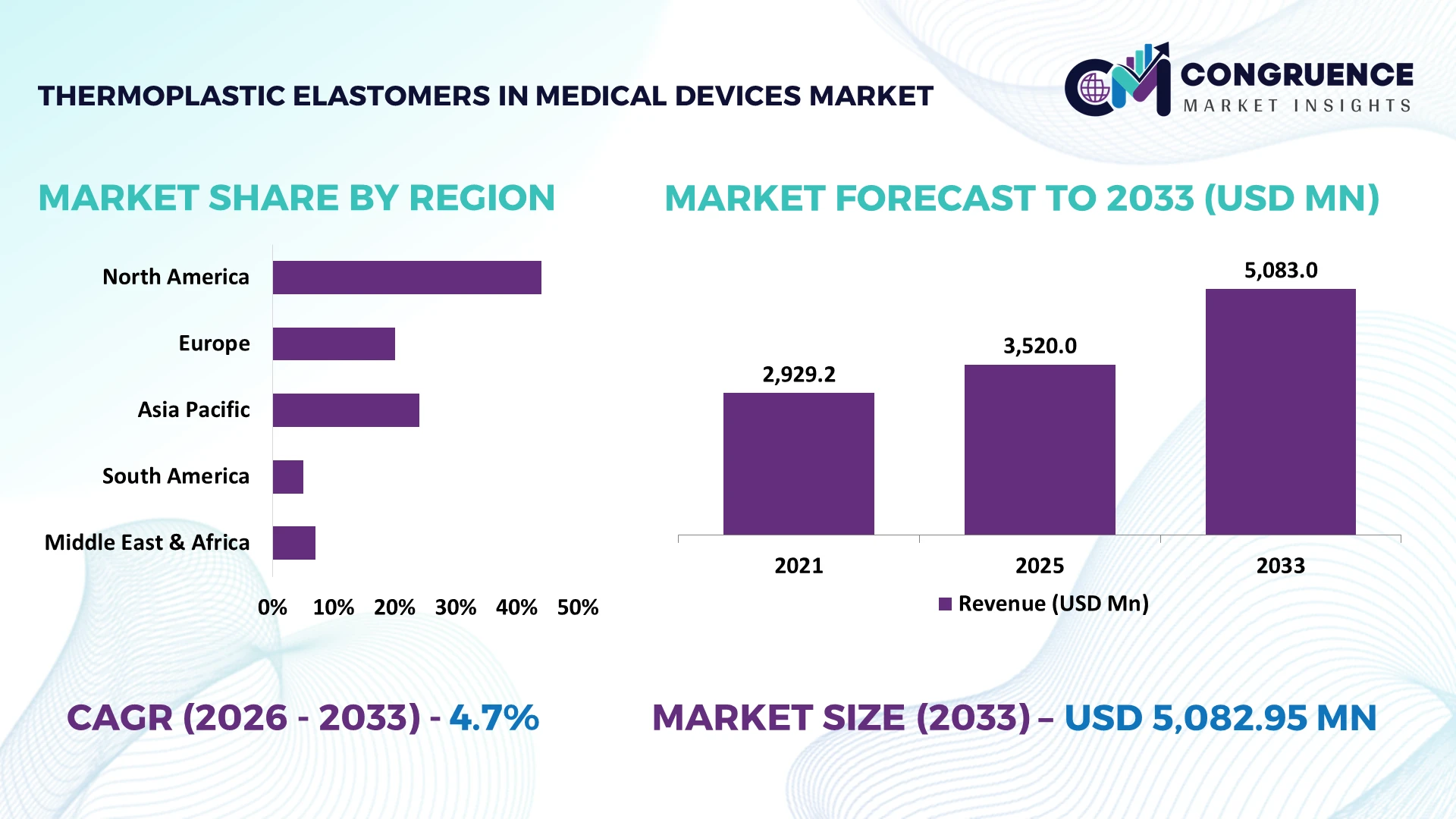
The United States anchors global demand through its dense medical-device manufacturing base and advanced polymer qualification ecosystem. North America represented approximately 36.3% of 2025 market demand, while Europe held about 28%. The wider U.S. medical-device industry accounts for roughly 46.4% of global device sales versus Europe’s 26.4%, strengthening TPE adoption in minimally invasive devices, infusion systems, diagnostics, and wearables. EU restrictions on DEHP-containing materials are simultaneously accelerating reformulation toward safer elastomer alternatives.
Strategically, suppliers combining biocompatibility documentation, sterilization resistance, low-extractable formulations, and localized technical support are best positioned to secure long-duration medical-device programs.
Market Size & Growth: USD 3.52 billion in 2025 is projected to reach USD 5.08 billion by 2033 at 4.7%, supported by silicone substitution, flexible tubing, and advanced overmolding.
Top Growth Drivers: Catheters and tubing represent about 31.3% of demand, TPE-S/SEBS holds approximately 43.2% material share, and extrusion accounts for nearly 38.2% of processing activity.
Short-Term Forecast: By 2028, integrated two-shot molding will increasingly reduce component assembly; proven medical-device conversions have already eliminated multi-component assembly operations and lowered component weight by 20%.
Emerging Technologies: Medical-grade SEBS, advanced TPU, low-extractable formulations, automated 2K molding, and gamma-stable compounds are reshaping high-performance catheter, wearable, sealing, and drug-delivery applications.
Regional Leaders: Applying current regional shares to the 2033 forecast indicates North America near USD 1.85 billion, Europe around USD 1.42 billion, and Asia-Pacific near USD 1.32 billion, with Asia-Pacific benefiting from manufacturing localization.
Consumer/End-User Trends: Wearable and skin-contact interfaces are among the fastest-expanding applications, while catheter and tubing systems maintain more than 30% of current market demand.
Pilot/Case Example: A medical-device material redesign replacing thermoset silicone with TPE reduced part weight by 20% and delivered annual manufacturing, freight, and scrap savings exceeding USD 175,000.
Competitive Landscape: BASF holds more than 13% share, while BASF, Lubrizol, Covestro, Dow, and Arkema collectively represent about 41% of the competitive market.
Regulatory & ESG Impact: Europe’s MDR requirements and tightening restrictions around DEHP are accelerating qualification of phthalate-free, recyclable, low-extractable TPE grades for regulated patient-contact applications.
Investment & Funding: Industry spending is increasingly directed toward regional compounding, medical-grade capacity, regulatory documentation, and OEM partnerships rather than commodity expansion, supporting shorter qualification cycles and resilient supply chains.
Innovation & Future Outlook: Next-generation medical TPE strategies center on recyclable formulations, silicone replacement, low-friction catheter materials, wearable interfaces, and automated overmolding, shifting competition toward application-engineered compounds rather than standard resin supply.
Thermoplastic elastomers in medical devices are gaining importance across catheters, tubing, infusion systems, seals, wearable interfaces, and drug-delivery components as manufacturers prioritize flexible, sterilization-resistant and phthalate-free materials. Catheters and tubing already represent roughly 31% of application demand. Regulatory pressure in Europe and localized medical-device manufacturing in Asia are also accelerating material redesign, creating a stronger strategic case for advanced medical-grade TPE platforms.
Thermoplastic elastomers are becoming strategically important because medical-device manufacturers increasingly need flexible materials that combine patient-contact performance with scalable automated processing. Regulatory restructuring is reinforcing this shift: European MDR rules require justification when specified CMR or endocrine-disrupting substances exceed 0.1% by weight, while DEHP authorization requirements are tightening toward 2030. This favors medical-grade SEBS, TPU and other phthalate-free elastomer platforms.
Compared with legacy thermoset silicone processing, TPEs support injection molding, two-shot molding and reprocessing without crosslinking. One commercial medical-device conversion reduced finished-part weight by 20% while eliminating a multi-component assembly operation. The United States offers greater commercialization scale, representing about 46% of global medical-device sales, whereas European manufacturers face stronger substance-substitution pressure and Asian producers emphasize localized, high-volume component manufacturing.
Through 2027–2029, qualification programs will increasingly target low-extractable compounds, sterilization compatibility, wearable interfaces and automated overmolding. Device manufacturers are already redesigning valve inserts and seals around two-material molding, reducing assembly steps while improving recyclability. Compounders are consequently prioritizing medical-grade capacity, application laboratories and OEM development partnerships. Competitive advantage will increasingly depend on combining regulatory documentation, formulation consistency and manufacturing efficiency rather than supplying commodity elastomers alone.
Regulatory pressure and medical-device redesign are pushing manufacturers toward phthalate-free TPE formulations for tubing, fluid-management components and patient-contact assemblies. European MDR requirements demand additional justification where designated hazardous substances exceed 0.1% by weight, while REACH authorization requirements place further pressure on DEHP-dependent applications toward 2030. The United States, representing approximately 46% of worldwide medical-device sales, provides a substantial commercialization base for compliant alternatives. At the manufacturing level, a documented silicone-to-TPE conversion lowered component weight by 20% while enabling two-shot processing. This combination of regulatory substitution and manufacturing efficiency is prompting compounders to expand medical-grade SEBS and TPU development, strengthen biocompatibility testing and collaborate earlier with catheter, diagnostic and drug-delivery OEMs.
Medical-device material substitution remains constrained by qualification complexity because changing an elastomer can affect biocompatibility, extractables, sterilization performance, bonding and validated manufacturing parameters simultaneously. European rules apply additional justification requirements when designated CMR or endocrine-disrupting substances exceed 0.1% by weight, turning formulation changes into documentation-intensive programs rather than simple resin replacements. The United States accounts for roughly 46% of global device sales, increasing the commercial consequences of qualification delays in a key launch market. Even where TPE conversion produces a 20% lighter component, manufacturers must validate tooling, dimensional stability and sterilization behavior before scaling. Suppliers are responding through formulation lock-in agreements, local technical laboratories, dual-source raw-material strategies and long-term OEM qualification partnerships that reduce change-control exposure and protect production continuity.
The strongest opportunity extends beyond replacing PVC or silicone: medical-grade TPEs enable manufacturers to redesign assemblies around automated two-shot molding, integrated seals and soft-touch interfaces. In a commercial device application, TPE adoption reduced component weight by 20% and removed a separate multi-component assembly process, demonstrating how material selection can eliminate downstream operations. With the United States representing about 46% of global medical-device sales and European regulations scrutinizing designated hazardous substances above 0.1% by weight, OEMs have both economic and compliance incentives to redesign components. Through 2027–2029, low-extractable SEBS, advanced TPU, wearable-grade compounds and sterilization-resistant formulations will gain strategic relevance. Compounders are expanding application engineering and co-development programs to capture specification positions before device architectures become commercially locked.
Long-term competitiveness depends on maintaining identical material performance across global production sites, sterilization methods and successive resin batches. A 20% reduction in component weight delivers little strategic value if hardness, compression set, extractables or bonding behavior drift after production transfer. European medical-device rules impose additional scrutiny on designated hazardous substances above 0.1% by weight, while the United States—about 46% of global device sales—raises the scale of any quality or supply interruption affecting validated programs. The operational challenge therefore shifts from initial formulation development to lifecycle consistency across molding, extrusion and sterilization environments. Suppliers must strengthen lot traceability, change-control systems, redundant compounding capacity and OEM-specific validation support. Companies that cannot maintain formulation continuity risk lengthy requalification cycles and exclusion from multi-year device platforms.
Medical-Grade Supply Networks Localize: U.S. medtech manufacturers operate roughly 16,000 manufacturing facilities, while about 70% of technologies sold domestically are produced in-country. Medical TPE suppliers are regionalizing compounding, inventory, and technical support, reducing exposure to long-distance qualification disruptions while accelerating OEM material-change response and shortening replenishment cycles.
Extrusion Control Becomes More Automated: Extrusion represents approximately 38% of medical-TPE processing activity, reflecting its importance in precision tubing and fluid-management products. Producers are installing automated dimensional inspection and closed-loop process controls to reduce scrap, improve lumen consistency, and support faster validation across high-volume catheter and tubing production lines.
Wearable Interfaces Demand Longer Performance: Sensor-based patches, bands, and continuous monitors are increasing requirements for skin-compatible elastomers. New wearable systems can operate continuously for about 10 days, increasing emphasis on softness, adhesion compatibility, moisture resistance, and dimensional stability. Compounders are responding with specialized low-extractable TPE formulations designed for extended patient contact and sensor integration.
Supplier Qualification Becomes Strategic: Europe has more than 38,000 medtech companies, with approximately 90% classified as SMEs, increasing reliance on suppliers offering stable formulations and technical documentation. Medical-grade resin changes can extend qualification programs significantly, so compounders are adopting formulation-lock policies, regional technical partnerships, and lifecycle support to protect OEM production continuity.
TPE-S is the leading material type, accounting for approximately 43% of medical-device TPE demand. Its dominance reflects scalable extrusion, soft-touch performance, low-density processing, and strong suitability for tubing, grips, seals, and flexible interfaces. Medical-grade SEBS formulations also provide an effective alternative where softness, clarity, and processing flexibility are critical. TPU represents approximately 28–32% within the supplied type structure and is emerging as the fastest-growing category because of its abrasion resistance, tensile strength, transparency, and compatibility with catheter shafts and wearable medical components.
TPE-E, TPE-V, and TPE-O collectively represent approximately 25–29% of demand. TPE-E remains strategically relevant for applications requiring dimensional stability and repeated thermal exposure, while TPE-V supports higher heat resistance and compression-set performance. TPE-O retains importance in economical, lightweight molded applications. Compounders are directing investment toward advanced medical-grade TPU and SEBS formulations while preserving specialized TPE-E and TPE-V portfolios for technically demanding applications.
Tubing represents the largest standalone application, accounting for an estimated 17–18% of demand, while catheters represent approximately 13–14%. Combined, these applications account for roughly 31% of medical-grade TPE consumption. Their dominance reflects stringent requirements for flexibility, kink resistance, biocompatibility, dimensional accuracy, and repeatable extrusion. Syringe components remain a mature application where sealing reliability, plunger performance, and consistent molding behavior are critical.
Wearable medical devices represent the fastest-growing application as continuous monitoring expands from hospitals into home and everyday settings. Drug-delivery devices are also gaining material intensity through integrated grips, seals, pump components, and soft-touch interfaces. Wearables currently represent a high-single-digit share but are gaining importance through longer skin-contact durations and integrated sensor architectures. Suppliers are responding with softer compounds, low-extractable formulations, enhanced adhesion characteristics, and overmolding-compatible grades, while tubing manufacturers continue investing in tighter extrusion tolerances and automated inspection systems.
Medical device manufacturers are the dominant direct buyer group, representing an estimated 55–60% of medical-grade TPE procurement within the supplied end-user structure. Their leadership reflects direct responsibility for material specification, biocompatibility validation, molding performance, sterilization compatibility, and supplier qualification. Hospitals influence material consumption indirectly through device purchasing, while pharmaceutical companies increasingly specify elastomers for injectors, pumps, pens, and other drug-delivery platforms. Diagnostic laboratories contribute steady demand for sample-handling, fluid-transfer, and diagnostic-device components.
Ambulatory care centers represent the fastest-expanding downstream adoption environment as procedures continue shifting away from hospital settings. The United States has more than 6,400 ambulatory surgical centers, while surgical procedures per Medicare beneficiary increased by approximately 3.5% in a recent annual period. This shift expands demand for disposable tubing, minimally invasive accessories, and single-use device components. Material suppliers are therefore strengthening OEM partnerships, application-development support, and custom formulation strategies rather than targeting care facilities directly.
North America accounted for the largest market share at approximately 36.3% in 2025 however, Asia-Pacific is expected to register the fastest growth, expanding at a CAGR of approximately 6.1% between 2026 and 2033.
Medical-Grade Manufacturing Concentration Strengthens Leadership
North America holds approximately 36% of global demand, supported by dense medical-device clusters in Minnesota, Massachusetts, California, and other U.S. manufacturing hubs. The United States accounts for roughly 46% of global medical-device sales and employs more than 285,000 people within dedicated device-industry clusters, creating a concentrated qualification base for medical-grade SEBS, TPU, and specialty overmolding compounds. Demand is strongest across catheter systems, diagnostics, wearable devices, respiratory products, and drug-delivery platforms. Suppliers increasingly colocate technical support, formulation laboratories, and inventory near OEM manufacturing centers to shorten material qualification cycles. U.S. device manufacturers are also emphasizing domestic sourcing and supply-chain resilience, strengthening the position of compounders able to provide consistent regional production, ISO-aligned documentation, and sterilization-compatible materials.
United States Market Outlook: The United States remains the region’s strategic center because it combines device engineering, regulatory expertise, advanced molding infrastructure, and large-scale commercialization. Approximately 70% of medical technologies sold domestically are manufactured within the country, supporting continuous demand for locally qualified elastomer compounds. California, Minnesota, Indiana, Arizona, and Utah maintain particularly strong device-manufacturing concentrations, encouraging suppliers to prioritize application-development laboratories, localized inventories, and direct OEM technical partnerships.
Regulatory Compliance Reshapes Material Selection
Europe accounts for approximately 28% of global medical-device TPE demand, with Germany, Italy, France, Switzerland, and the United Kingdom forming the core manufacturing and innovation base. The region contains more than 38,000 medical-technology companies, around 90% of which are SMEs, creating fragmented but technically demanding procurement patterns. EU Medical Device Regulation requirements and tighter scrutiny of designated hazardous substances are accelerating use of documented, phthalate-free elastomer formulations across tubing, seals, diagnostics, and patient-contact components. More than 15,700 medical-technology patent applications were filed in 2024, highlighting the region’s strong innovation intensity. Compounders are responding by expanding regulatory dossiers, extractables-and-leachables support, formulation-lock programs, and collaborative development with smaller OEMs that require application engineering without maintaining large internal materials teams.
Germany Market Outlook: Germany provides Europe’s strongest industrial foundation through its large concentration of medical-technology manufacturers, polymer processors, precision molders, and engineering suppliers. It has the highest absolute medical-technology employment in Europe and remains a leading location for regulated component production. German OEMs increasingly prioritize traceable material supply, validated sterilization performance, and high-precision injection molding, favoring TPE suppliers with local technical teams and stable long-term formulations.
Localized Manufacturing Accelerates Scale Advantage
Asia-Pacific represents approximately 26% of global demand and is becoming the most dynamic production platform for medical-grade thermoplastic elastomers. China, India, Japan, South Korea, and Southeast Asian manufacturing hubs are increasing local production of disposable devices, monitoring systems, catheter components, and diagnostic consumables. China’s medical and surgical equipment industry recorded imports equivalent to about 29.4% of domestic demand in 2025, while exports represented roughly 29% of production output, demonstrating substantial manufacturing scale alongside continued dependence on specialized imported materials. Suppliers are increasingly expanding regional compounding and OEM support to reduce lead times and improve qualification responsiveness. Local sourcing initiatives in China and India are also encouraging joint ventures and technical partnerships, shifting the region from primarily cost-driven assembly toward higher-value medical-material formulation and component engineering.
China Market Outlook: China combines high-volume device manufacturing with an increasingly sophisticated domestic supplier base. More than 119,000 enterprises operated across its medical and surgical equipment industry in 2025, while domestic suppliers controlled the majority of production value. Medical TPE companies are targeting Chinese catheter, infusion, diagnostic, and wearable manufacturers through localized compounding, shorter supply chains, and formulations tailored to high-throughput extrusion and injection-molding operations.
Import Dependence Drives Localization Pressure
South America accounts for approximately 4–5% of global medical-device TPE demand, with Brazil representing the region’s primary production and consumption center. Demand is concentrated in disposable healthcare products, diagnostic systems, tubing, surgical accessories, and drug-delivery components. Brazil’s medical-device consumption increased about 7% in 2025, while imports rose 10.9% and domestic manufacturing expanded only 2.6%, exposing a clear gap between healthcare demand and local production capability. This imbalance supports opportunities for regional polymer compounding and component localization but also creates exposure to currency volatility, logistics costs, and imported specialty-grade availability. Medical-material suppliers are responding through distributor partnerships, local inventory strategies, technical service agreements, and selective manufacturing localization rather than capital-intensive regional expansion across every application category.
Brazil Market Outlook: Brazil is the region’s principal strategic market because it combines domestic medical-device manufacturing, expanding healthcare infrastructure, and the largest procurement base in South America. The sector employed more than 152,000 workers in 2025 and added over 2,200 positions during the year. Import dependence remains substantial, encouraging device manufacturers to seek local suppliers capable of providing stable medical-grade compounds, documentation support, and shorter replenishment cycles.
Healthcare Localization Reshapes Material Demand
Middle East & Africa represents approximately 5–6% of global demand, with Saudi Arabia and the United Arab Emirates leading healthcare modernization and local manufacturing initiatives. Saudi Arabia is particularly important because government procurement accounts for roughly 66% of national medical-device demand, giving localization policies significant influence over supplier selection. Healthcare transformation programs are expanding hospitals, diagnostics, medical manufacturing, and advanced treatment infrastructure, strengthening demand for validated tubing, seals, drug-delivery components, and single-use devices. Saudi authorities have identified more than SAR 1.7 billion in medical-device localization opportunities and expect domestic medical-device manufacturing to support approximately 7,300 additional jobs by 2030. Material companies are responding through local distribution, technology-transfer arrangements, converter partnerships, and technical collaborations aimed at qualifying medical-grade polymers closer to end-market production.
Saudi Arabia Market Outlook: Saudi Arabia has emerged as the region’s strongest localization platform through Vision 2030, centralized procurement, healthcare infrastructure expansion, and targeted industrial incentives. Strategic healthcare partnerships announced in 2025 exceeded USD 33 billion, including substantial commitments to local medical technology and life-sciences manufacturing. TPE suppliers able to support technology transfer, regulatory qualification, and locally manufactured medical components are positioned to benefit from procurement localization and reduced import dependence.
BASF, Lubrizol, Covestro, Dow, and Arkema form the leading global competitive group, while Teknor Apex, KRAIBURG TPE, HEXPOL TPE, Kuraray, and RTP Company compete through specialized medical compounds, customization, and regional technical support. The top five suppliers collectively hold approximately 41% of the market, with BASF alone exceeding 13%. Competition increasingly centers on biocompatibility, sterilization stability, formulation continuity, and OEM qualification rather than commodity pricing. Medical-grade portfolios can command 10–20% performance-driven differentiation through lower extractables, tighter hardness tolerances, and processing consistency, while optimized overmolding can reduce assembly steps by up to 40%. Players are expanding application laboratories, locking formulations, partnering with device OEMs, and regionalizing compounding capacity. The competitive shift favors suppliers controlling qualification documentation and supply continuity. Entry barriers remain high because resin substitutions can trigger lengthy device revalidation. Winning requires regulatory-grade materials, consistent global production, fast customization, and embedded OEM development relationships in catheter, tubing, and wearable programs.
BASF SE
The Lubrizol Corporation
Covestro AG
Dow Inc.
Arkema
Teknor Apex
KRAIBURG TPE
HEXPOL TPE
Kuraray Co., Ltd.
RTP Company
Avient Corporation
Asahi Kasei Corporation
Mitsubishi Chemical Group
Celanese Corporation
Medical-grade SEBS, TPU, and advanced TPE compounds are becoming core technologies for catheter tubing, seals, wearable interfaces, and drug-delivery components. Precision extrusion and automated two-shot molding improve dimensional consistency by about 10–15% while reducing secondary assembly. Adoption is strongest in tubing and catheter applications, which together represent roughly 31% of demand, giving suppliers with validated sterilization-compatible grades a clear operational advantage.
Emerging technologies include low-extractable formulations, gamma- and e-beam-stable elastomers, antimicrobial surfaces, and digital process monitoring for molding and extrusion. Closed-loop controls can cut scrap by approximately 5–10%, while optimized overmolding reduces manual assembly steps by 20–40%. Compared with legacy thermoset silicone processing, modern TPE conversion can lower component weight by around 20% and enables recyclable processing without curing, improving throughput and design flexibility.
From 2026 to 2028, disruptive development will center on bio-based TPEs, smart wearable interfaces, micro-molded components, and AI-assisted quality control. Early deployment remains concentrated among large OEMs and specialized compounders, but adoption will broaden as qualification data expands. Companies combining material science, automation, and regulatory documentation will gain the strongest competitive position because faster validation, lower scrap, and multi-material integration directly improve manufacturing economics. This shift rewards suppliers that integrate formulation expertise with automated production systems.
November 2024 Teknor Apex launched Medalist MD-90000 medical-grade TPEs for biopharmaceutical tubing, targeting reduced spallation, enhanced clarity, and extended pump durability. The company marked its 100th year while expanding healthcare materials, supporting lower downtime in continuous fluid-processing systems. Source: teknorapex.com
March 2025 KRAIBURG TPE introduced THERMOLAST H HC/AD1/AP compounds for smart skin diagnostic devices, meeting ISO 10993-5 requirements and eliminating silicone, latex, PVC, and phthalates. The launch strengthens compliant material options for flexible connectors, seals, valves, and diagnostic-device interfaces. Source: kraiburg-tpe.com
June 2025 Lubrizol expanded its medical-grade TPU distribution partnership with IMCD from Europe into the United States and Canada. Lubrizol operates more than 100 manufacturing, sales, and technical facilities globally, strengthening inventory availability, customer access, and medical-device polymer commercialization across North America. Source: lubrizol.com
June 2025 KRAIBURG TPE expanded THERMOLAST H into medical tubing applications, emphasizing kink resistance, chemical compatibility, flexibility, and colorability. Its global operating footprint spans production locations in Germany, Malaysia, and the United States, improving regional supply responsiveness for medical tubing manufacturers. Source: kraiburg-tpe.com
The Thermoplastic Elastomers in Medical Devices Market report evaluates material demand across TPU, TPE-S, TPE-E, TPE-V, and TPE-O, covering catheters, tubing, syringe components, drug-delivery devices, and wearable medical devices. TPE-S represents approximately 43% of current material demand, while catheters and tubing together account for roughly 31%, highlighting concentration around flexible, patient-contact, and fluid-management applications.
The study assesses hospitals, medical-device manufacturers, pharmaceutical companies, diagnostic laboratories, and ambulatory care centers across North America, Europe, Asia-Pacific, South America, and Middle East & Africa. Coverage includes medical-grade extrusion, two-shot molding, low-extractable compounds, sterilization-resistant formulations, wearable interfaces, and silicone-replacement technologies. Competitive analysis examines more than 10 influential compounders and material suppliers, supporting investment planning, geographic expansion, supplier positioning, application prioritization, partnership strategy, and technology decisions through 2033.
| Report Attribute/Metric | Report Details |
|---|---|
Market Revenue in 2025 | USD 3520 Million |
Market Revenue in 2033 | USD 5082.95 Million |
CAGR (2026 - 2033) | 4.7% |
Base Year | 2025 |
Forecast Period | 2026 - 2033 |
Historic Period | 2021 - 2025 |
Segments Covered | By Type
By Application
By End-User
|
Key Report Deliverable | Revenue Forecast, Growth Trends, Market Dynamics, Segmental Overview, Regional and Country-wise Analysis, Competition Landscape |
Region Covered | North America, Europe, Asia-Pacific, South America, Middle East, Africa |
Key Players Analyzed | BASF SE, The Lubrizol Corporation, Covestro AG, Dow Inc., Arkema, Teknor Apex, KRAIBURG TPE, HEXPOL TPE, Kuraray Co., Ltd., RTP Company, Avient Corporation, Asahi Kasei Corporation, Mitsubishi Chemical Group, Celanese Corporation |
Customization & Pricing | Available on Request (10% Customization is Free) |




